The last day Mia Harper saw Khloe Bennett at school, the afternoon light made her look almost transparent.
It was the kind of pale winter light that slipped through classroom windows after last period, thin and cold, turning dust into glitter and making every face look tired.
The bell had already rung, and students were spilling into the hallway with the usual Friday noise: lockers slamming, sneakers squeaking, boys laughing too loudly, girls gathering in clusters near the doorway.
Mia was still at her desk, trying to stuff a history worksheet into her folder without bending it.
Across the aisle, Khloe reached for her textbook.
Then her phone buzzed.
It was such a small sound.
One vibration against the desk.
But Mia saw Khloe change completely.
Her hand froze halfway to the book. Her face went pale so fast it looked like someone had pulled color out of her skin. A tiny tremor moved through her fingers before she snatched the phone off the desk and turned the screen toward herself.
Mia saw only one name before Khloe hid it.
Marcus.
“Everything okay?” Mia asked.
Khloe shoved the phone into the pocket of her hoodie.
“Yeah,” she said too quickly. “Fine. Just my stepdad. He wants me home now.”
Her voice was clipped and flat.
Not annoyed.
Not normal teenage impatience.
Afraid.
Mia noticed things like that because she had known Khloe since seventh grade. Khloe had a different kind of quiet for every mood. There was bored quiet, sad quiet, angry quiet, and the sharp locked-up quiet she used when she wanted the world to stop asking questions.
This was worse than all of them.
Khloe rammed her textbook into her backpack so hard the corner bent.
“Khloe,” Mia said softly. “Are you sure?”
“I said I’m fine.”
Khloe turned away.
As she did, her sleeve slipped up.
Only an inch.
But an inch was enough.
Mia saw a yellowish-purple bruise on the inside of Khloe’s wrist.
Thumb-shaped.
Too clear to be accidental.
Khloe yanked the cuff down immediately.
Their eyes met for a heartbeat.
Pure, hunted exhaustion stared back at Mia.
Not embarrassment.
Not surprise.
A silent plea.
Then Khloe looked away and vanished into the hallway before Mia could say another word.
For the rest of the afternoon, the empty chair beside Mia’s desk felt like an accusation.
By Monday, Khloe was absent.
At first, everyone treated it like nothing.
Students missed school all the time. People got sick. People skipped. People disappeared for a day or two and came back with excuses no one believed and gossip no one needed.
Mia texted her after first period.
Hey, you okay?
Delivered.
No reply.
At lunch, she sent another.
You scared me Friday. Just text me one word, okay?
Delivered.
No reply.
By Tuesday, the messages changed.
Khloe, I’m serious. Are you sick? Do you need anything?
Still delivered.
No reply.
By Wednesday afternoon, Mia called.
Voicemail.
Khloe’s voice on the recording sounded bright and old, from a time before everything had gone dim.
“Hey, it’s Khloe. Leave a message.”
Mia hung up the first time because hearing that voice hurt.
Then she called again and left a message.
“Khloe, it’s me. I don’t know what’s going on, but I’m worried. Please call me back. You don’t have to explain. Just let me know you’re alive.”
On Thursday, the texts stopped delivering.
That was when the worry became something sharper.
Something with teeth.
Social media was dead too.
No new stories.
No likes.
No comments.
No activity on the private account Khloe used to post stray animals, thrift-store outfits, and moody pictures of clouds through bus windows.
Her last post was from three weeks earlier: a skinny gray cat sitting under the bleachers, one ear torn, yellow eyes glowing.
The caption read:
Found a little lost soul.
Mia stared at that picture so long her own reflection appeared over the screen.
Khloe had always found lost things.
Cats.
Birds.
Broken bracelets.
People.
Maybe that was why no one had noticed she was becoming one.
By Friday, Mia went to the school office.
Mrs. Ellison, the guidance counselor, smiled the way adults smile when they have already decided a teenager is being dramatic.
“Khloe is home sick,” she said.
“Sick with what?”
“I can’t share private medical information.”
“But she hasn’t answered anyone. Her phone is off.”
Mrs. Ellison folded her hands.
“Her stepfather came in yesterday to discuss it. He was very pleasant. He said Khloe has a serious contagious illness and needs isolation for her own good.”
The word pleasant made Mia’s stomach turn.
People always trusted pleasant men.
Men with pressed shirts, clean cars, polite voices, and firm handshakes. Men who knew how to say the right things to counselors and neighbors. Men who carried danger like a folded knife hidden in a suit pocket.
“Did anyone actually see her?” Mia asked.
Mrs. Ellison’s smile thinned.
“Mia, I understand you’re concerned about your friend, but families handle illness differently. Marcus assured us Khloe is being cared for.”
“Marcus assured you.”
“Yes.”
“Did Khloe?”
Mrs. Ellison looked uncomfortable.
“That’s enough, Mia.”
It was not enough.
It was not close.
That evening, Mia sat on her bedroom floor with her laptop open and Khloe’s old messages pulled up on her phone. Her parents thought she was doing homework. She was not.
She was searching.
Every conversation.
Every casual comment.
Every half-joke that might now mean something else.
Months earlier, during lunch, Khloe had mentioned Marcus while peeling the label off a juice bottle.
“He’s particular,” she had said.
Flat voice.
Fake smile.
Mia remembered laughing a little.
“Particular like what? Like color-coded pantry particular?”
Khloe had shrugged.
“Like rules. Doors. Time. Noise. He likes knowing where everyone is.”
“Creepy.”
“Yeah.”
Then Khloe had changed the subject.
But later that same lunch, when a group of boys at the next table started talking loudly about motorcycles, Khloe had smiled for real.
“My real dad’s brother is this huge biker,” she said. “Total opposite of Marcus. Leather, loud, scary-looking, all of it. Mom hates him.”
“What’s his name?”
“Walter, but nobody calls him that.”
“What do they call him?”
“Grizz.”
Mia had laughed.
“Of course they do.”
Khloe smiled into her sandwich.
“He told me once, ‘If you’re ever in real trouble, the kind no one listens to, call me. We come when we’re called.’”
“That’s kind of intense.”
Khloe had rolled her eyes, but there was warmth in it.
“Yeah. My personal superhero squad. Except with road rash and terrible tattoos.”
They had both laughed then.
Now, sitting on the floor, Mia did not laugh.
She searched through memory like a person digging through rubble.
The uncle’s nickname was Grizz.
His hangout was the Iron Hog.
A biker bar on the industrial edge of town.
Mia typed it into her laptop.
IRON HOG BAR INDUSTRIAL ROAD.
The result came up immediately.
A low black building between a welding shop and a boarded-up warehouse. Reviews ranged from “best wings in three counties” to “do not go here unless you know someone.” One photo showed a flickering neon pig sign over the door, half the letters dark.
Mia stared at the address.
Her heart began to pound.
She was sixteen.
She had never been inside a bar in her life.
Her idea of danger was walking home after debate club when the parking lot lights were out.
But she saw Khloe’s eyes again.
That one heartbeat before Khloe pulled down her sleeve.
Pure, hunted exhaustion.
Mia closed the laptop.
Then she opened it again.
She copied the address onto a piece of paper.
The next afternoon, she lied to her parents for the first time in her life.
She told them she was going to the library.
Then she took two buses and walked six blocks through an industrial district where every building looked abandoned until a machine clanged inside it.
The Iron Hog squatted between a welding shop and a warehouse with plywood over half its windows.
The parking lot was cracked, oil-stained, and crowded with motorcycles, pickup trucks, and one old van with faded flames painted along the side.
The neon pig sign flickered over the door.
HOG.
Then nothing.
Then HOG again.
Mia stood on the pavement for a long time.
A truck rumbled past, shaking the soles of her sneakers.
She nearly turned back three times.
No one at school believed her.
The counselor had dismissed her.
The police would need evidence, and Marcus would smile, talk softly, and explain everything away.
But blood and loyalty were different.
Khloe had said it herself.
We come when we’re called.
Mia had no right to make that call.
But Khloe could not.
So Mia pushed open the door.
Inside, the Iron Hog was dark, loud, and thick with the smell of stale beer, old wood, leather, smoke, and fried food. Pool balls cracked in the back. A jukebox played something rough and heavy. Men in leather vests leaned over tables, laughed into glasses, or watched a game on a television above the bar.
Then every head turned.
Noise dropped.
Not all at once.
In layers.
The jukebox kept playing, but the voices fell away.
Bearded, tattooed faces stared at Mia from every direction.
Some amused.
Some suspicious.
Some unreadable.
Her heart hammered so hard she thought everyone could hear it.
She wanted to apologize and run.
Instead, she walked straight to the bar.
The bartender was a woman with fiery red hair, inked arms, and eyes that took in everything before her mouth moved.
“Can I help you?” she asked.
Mia swallowed.
“I’m looking for Grizz.”
The bartender’s expression did not change.
“Who’s asking?”
“My name is Mia Harper. I’m a friend of his niece. Khloe Bennett.”
The woman’s eyes softened slightly.
Not much.
But enough.
“Khloe.”
“Yes.”
The bartender studied Mia for another second, then nodded toward a shadowed booth in the back corner.
“Back there. Don’t waste his time.”
Mia followed her gaze.
The man in the booth was enormous.
Wide shoulders.
Thick beard down to his chest.
Leather vest covered in patches.
Hands like dinner plates resting on the table.
Two other men sat with him, both large, both silent, both turning toward Mia as she approached.
The conversation stopped before she reached them.
Grizz looked up.
His eyes were pale gray, set in a weathered face.
Flint eyes.
That was the phrase that came to Mia’s mind.
“Are you Grizz?” she asked.
His voice rumbled low.
“Who wants to know?”
Mia forced herself not to step back.
“I’m Mia. Khloe’s friend.”
His posture did not change.
But his eyes sharpened.
“Haven’t heard that name in a while,” he said. “She okay?”
Mia’s throat tightened.
“No. I don’t think she is.”
One of the men beside him straightened.
Grizz stared at her for a long second.
Then he gestured to the seat across from him.
“Sit.”
Mia sat.
Her knees felt weak.
The bartender appeared and set a glass of water in front of her.
“Drink,” she said.
Mia took it with both hands.
Grizz leaned forward slightly.
“Tell me everything.”
So Mia did.
At first, her voice shook.
Then it steadied.
She told him about the last day at school.
The phone buzzing.
Marcus’s name.
Khloe going pale.
The trembling hand.
The bruise on the inside of her wrist.
The way she vanished into the hallway.
She told him about the empty chair, the dead texts, the voicemails, the social media silence, the stray cat post, and Mrs. Ellison saying Marcus had been pleasant.
She repeated the counselor’s words exactly.
Serious contagious illness.
Isolated for her own good.
Grizz stayed stone-faced.
Until she said Marcus.
Then his jaw tightened.
His fists curled slowly on the table, knuckles going white.
“Marcus Vale?” he asked.
Mia nodded.
“I think so.”
The man to Grizz’s left cursed under his breath.
Grizz closed his eyes for one second.
When he opened them, they were burning.
“I told my sister about him,” he said.
His voice was quiet now.
That was worse than shouting.
“I told Denise that man was wrong.”
“Khloe’s mom?”
Grizz nodded once.
“My sister. She married Marcus two years after Khloe’s dad died. Stopped answering my calls after that. Marcus said I was bad influence. Said the club scared the neighborhood. Said Khloe needed stability.”
His mouth twisted around the word.
“Stability.”
The bartender came back and stood beside the booth.
“Grizz.”
“I know, Red.”
“He has a history,” Red said, looking at Mia now. “The kind that leaves invisible scars.”
Grizz pushed himself to his feet.
The whole booth seemed smaller without him seated.
“Tank. Scrapper.”
The two men stood immediately.
“We’re going for a ride.”
Mia stood too.
“What are you going to do?”
Grizz looked down at her.
“A wellness check.”
His voice was calm.
Dangerously calm.
“Can I come?”
“No.”
“But—”
“No,” he repeated, not harshly. “You did the brave thing, kid. You came here. You told us. Now you stay with Red.”
“I can’t just sit here.”
“Yes, you can,” Red said. “And you will.”
Grizz placed one heavy hand gently on Mia’s shoulder.
It surprised her how careful he was.
“You listened to your gut when every adult told you not to,” he said. “That matters. But what comes next is grown-up trouble.”
“Will you bring her back?”
Something moved across his face then.
Pain.
Old and deep.
“If she wants to leave,” he said, “nothing in that house is keeping her there.”
He turned toward the door.
More men rose as he walked.
Not all of them.
Enough.
Without shouting, without dramatic speeches, the Iron Hog began moving like one body.
Jackets pulled on.
Keys lifted.
A phone call made near the jukebox.
Someone said, “I’ll call Deputy Reeves.”
Grizz nodded.
“Tell him possible unlawful confinement of a minor. We’re going to the address. Tell him to meet us there fast and calm.”
Mia blinked.
“You’re calling the police?”
Grizz looked back at her.
“Kid, we’re scary, not stupid.”
Then he walked out.
The door swung shut behind him.
A few seconds later, motorcycles started outside.
One.
Then another.
Then more.
The low synchronized rumble shook the floor beneath Mia’s sneakers.
Red set a Coke in front of her.
“Drink something with sugar.”
Mia wrapped both hands around the cold glass.
“Are they really the best?”
Red looked toward the door.
“They’re loud. Stubborn. Too proud. Half of them can’t apologize without sounding like they’re choking.”
Then her face softened.
“But if that girl needs help, they’ll get her.”
Waiting was torture.
Mia sat at the bar while Red worked and pretended not to watch her too closely.
The Iron Hog slowly returned to noise, but not the same noise as before. Conversations stayed lower. Men checked phones. Someone near the pool table kept looking toward the front window.
Mia imagined every possible outcome.
Khloe not being there.
Khloe being worse than she feared.
Marcus convincing everyone she was sick.
Police arriving and doing nothing.
Grizz losing his temper.
Khloe refusing to leave because fear had made the house feel bigger than the world.
Mia pressed her phone between her palms and whispered, “Please. Please.”
Across town, five motorcycles rolled through the suburbs with low, disciplined menace.
Grizz rode in front.
Tank and Scrapper behind him.
Two more brothers, Bishop and Lane, following wide enough to see the street clearly.
They did not speed.
They did not rev at stop signs.
They did not make a show.
That was not the point.
The point was presence.
Controlled.
Visible.
Impossible to ignore.
Grizz felt an old furnace burning in his chest.
He knew men like Marcus Vale.
Men who built cages out of politeness and control.
Men who smiled at teachers, shook hands with neighbors, and convinced mothers that isolation was love. Men who never seemed dangerous until the door closed.
He had seen it before.
His sister Denise had not listened when he warned her.
Or maybe she had listened and been too tired, too lonely, too charmed to hear the truth clearly.
That was another wound Grizz carried.
The yellow house sat on a neat suburban street with trimmed hedges, porch lights, and a basketball hoop in the driveway.
Cheerful.
Ordinary.
The kind of house people drove past without imagining anyone inside might be counting footsteps in the hallway.
The bikes lined the curb.
Engines cut one by one.
The silence after the rumble felt heavier than the noise.
Grizz removed his helmet and looked at the front window.
A curtain shifted.
Good.
Marcus knew they were there.
Grizz walked up the path.
Boots deliberate.
Tank and Scrapper followed but stopped two steps behind him.
Not crowding the porch.
Not yet.
Grizz knocked three times.
Solid.
Patient.
The porch light flicked on.
The peephole darkened.
A chain rattled.
The door opened two inches.
Marcus Vale stood behind it.
He was handsome in a corporate way. Clean-shaven, white shirt, expensive watch, hair carefully combed. His smile appeared before his eyes did, all teeth and no warmth.
“Can I help you?”
“I’m here for Khloe,” Grizz said. “Her uncle.”
Marcus glanced past him at the motorcycles.
For half a second, fear flickered.
Then annoyance replaced it.
“Khloe is very sick. Contagious. She can’t have visitors.”
“That’s fine,” Grizz said. “I’ll wait until I see her.”
Marcus’s smile tightened.
“That won’t be possible.”
“Make it possible.”
The chain remained hooked.
“Walter,” Marcus said, using the name like an insult. “This is inappropriate. You can’t show up at my home with your biker friends and demand access to my stepdaughter.”
“My niece.”
“Stepdaughter,” Marcus corrected.
Grizz’s eyes did not move.
“My niece.”
From somewhere inside the house came a muffled sound.
Not words.
A sob.
Small.
Cut off quickly.
Every man on the porch heard it.
Marcus’s face changed.
Just for a second.
The mask slipped.
Grizz looked past him into the narrow opening.
“Khloe,” he called, his voice suddenly deep enough to travel through walls. “It’s Uncle Grizz. If you can hear me, make noise.”
Marcus shoved at the door.
“Get off my property or I’m calling the police.”
Grizz did not move.
“Go ahead,” he growled. “They’re already on their way.”
Marcus froze.
Sirens were not yet audible, but that did not matter.
The sentence did its work.
Inside the house, something hit the floor.
Then a girl’s voice, weak and breaking.
“Uncle Walter?”
Grizz’s face shifted.
Not softer.
More human.
“I’m here, baby.”
The chain rattled from inside.
Marcus turned sharply.
“Khloe, go back to your room.”
“No,” she cried.
The door jerked.
Not from Grizz.
From inside.
The chain strained, then slipped because it had not been fully secured.
The door opened wider.
Khloe stood in the hallway in sweatpants and an oversized sweatshirt, one hand wrapped around the doorknob like it was the only solid thing in the world.
She looked thinner.
Gaunt.
Her hair hung unwashed around her face.
Dark circles bruised the skin beneath her eyes. Bad makeup had been smeared over one cheekbone, not enough to hide what lay beneath.
For one second, nobody moved.
Then Khloe saw Grizz fully.
The terror broke.
Relief crashed over her face so violently it looked painful.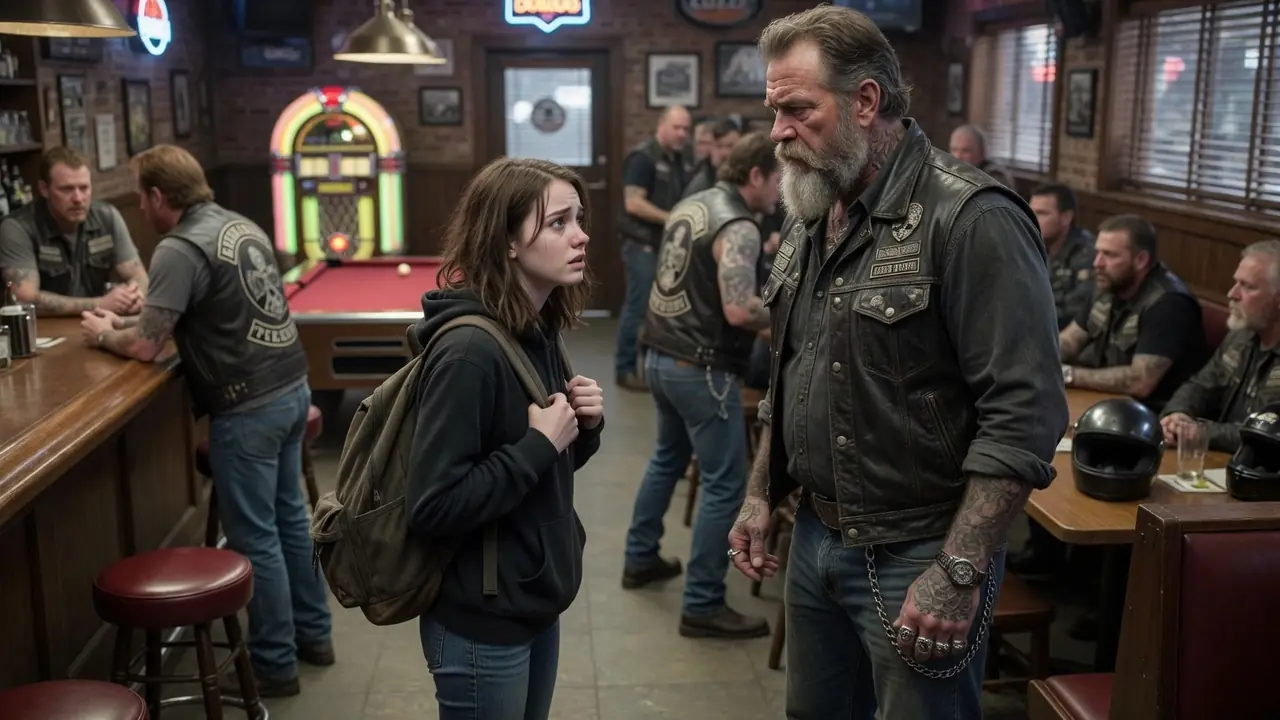
“Uncle Walter.”
Marcus grabbed her arm.
The movement was fast.
Too fast.
Khloe flinched before his hand closed.
Tank stepped forward.
Grizz’s voice cut through the porch like iron.
“Take your hand off her.”
Marcus turned toward him.
“She is sick. She is confused. She needs—”
Khloe pulled back.
“No,” she said.
It was barely more than a whisper.
But it was hers.
Marcus looked down at her.
His voice dropped into something poisonous.
“Go. Back. To. Your. Room.”
Khloe shook her head.
“I want to leave.”
Marcus laughed once.
“You don’t know what you want.”
“She just said it,” Grizz replied.
Sirens sounded then.
Distant but coming closer.
Marcus heard them and changed again.
The anger vanished.
The pleasant man returned so quickly it made the skin crawl.
He raised both hands.
“This is a misunderstanding. Khloe has been emotionally unstable. I’ve been caring for her. She’s been ill. I can explain everything.”
Khloe backed toward Grizz.
He did not grab her.
He opened his arms.
She crossed the threshold herself and collapsed against him.
Only then did he wrap the blanket of his leather vest around her trembling body.
“Easy,” he murmured. “I’ve got you. You’re not going back in there.”
Khloe clung to him like a child, though she was seventeen and had spent too many weeks being forced to feel older than that.
Two police cruisers pulled up.
Deputy Aaron Reeves stepped out first, hand near his belt but not drawn. He was in his early forties, broad-faced, calm-eyed, and tired in the way decent officers often were.
He looked from Marcus to Khloe to Grizz.
“Walter.”
“Reeves.”
Marcus spoke quickly.
“Officer, thank God. These men came onto my property and threatened me. My stepdaughter is very ill and confused, and they’re trying to take her.”
Khloe shook harder.
Deputy Reeves looked at her.
“Khloe, are you in immediate danger?”
Marcus answered first.
“She’s sick—”
Reeves held up one hand.
“I asked Khloe.”
For a moment, Khloe could not speak.
Grizz lowered his voice.
“Baby, look at me. You don’t have to protect him anymore.”
That did it.
Khloe lifted her head.
“Yes,” she whispered.
Reeves stepped closer.
“Do you want to leave this house?”
“Yes.”
“Did someone prevent you from leaving?”
Marcus’s face tightened.
“She needed isolation.”
Khloe’s voice broke.
“He locked my phone in his office. He took my shoes. He told the school I was sick. He said no one would believe me because he already talked to them.”
Deputy Reeves’s expression changed.
Not dramatically.
But enough.
The second officer moved toward Marcus.
Marcus lifted his chin.
“This is absurd. She is a minor. I am her legal guardian.”
“Where’s her mother?” Reeves asked.
Marcus hesitated.
“Visiting her sister.”
Khloe shook her head.
“He sent her away. He told her I was staying with a friend. He told me Mom didn’t want to deal with me.”
Grizz’s arm tightened around her, careful but furious.
“Reeves,” he said, “she needs medical attention.”
“I know.”
The paramedics arrived eight minutes later.
By then, Khloe was sitting on the curb wrapped in Grizz’s jacket while Tank stood nearby like a wall and Scrapper spoke quietly with another officer.
Marcus was still talking.
Men like Marcus always talk.
They believe if they keep words moving, truth cannot settle.
But truth had already settled.
It was in Khloe’s shaking hands.
In the missing phone.
In the locked bedroom door.
In the school’s unanswered records.
In Marcus’s careful story collapsing under the weight of one girl finally being asked directly.
When the paramedic knelt before Khloe and asked if she could check her vitals, Khloe looked at Grizz first.
He nodded.
“Your choice.”
Khloe looked back at the paramedic.
“Okay.”
That word mattered.
Okay.
Consent.
Choice.
The two things Marcus had tried to erase first.
At the Iron Hog, Mia was still waiting when Red’s phone rang.
Red answered, listened, and her face softened.
Then she looked at Mia.
“They found her.”
Mia stood so fast the stool nearly tipped.
“Is she alive?”
“Yes.”
Mia covered her mouth with both hands.
Tears came immediately.
Red came around the bar and pulled her into a hug without asking.
“She’s alive,” Red said. “They’re taking her to the hospital.”
“Can I see her?”
“Not yet.”
Mia nodded, crying harder.
“That’s okay. That’s okay. She’s alive.”
Red held her until her knees stopped shaking.
Hours later, Mia’s parents arrived at the Iron Hog in a panic because the library had called to say she had never been there.
It was the worst trouble Mia had ever been in.
It was also the least sorry she had ever felt.
Her mother cried.
Her father shouted.
Red stood behind the bar and said, “Before you ground her until retirement, you should know your daughter may have saved a girl’s life today.”
That changed the conversation.
Not immediately.
Parents need time to move from fear into understanding.
But eventually, Mia told them everything.
The bruise.
The messages.
The counselor.
The biker bar.
Her father sat down halfway through.
Her mother held her hand and did not let go.
At the hospital that night, Khloe asked for three people.
Her mother.
Grizz.
Mia.
Denise arrived first.
She came running down the hall in a wrinkled sweater, hair half-falling out of a clip, face gray with terror. When she saw Khloe in the hospital bed, she made a sound Mia would remember for years.
Not a scream.
Not a sob.
The sound of a mother realizing she had been lied to while her child suffered behind a closed door.
“Baby,” Denise whispered.
Khloe began to cry.
For a moment, neither of them knew how to reach across all the lies Marcus had placed between them.
Then Denise climbed carefully onto the edge of the bed and wrapped her daughter in both arms.
“I’m sorry,” she cried. “I’m so sorry. I didn’t know. He told me you were with Aunt Linda. He told me you needed space. I should have called you directly. I should have known.”
Khloe cried into her mother’s shoulder.
Grizz stood near the window, arms crossed, looking away because even men like him sometimes give grief privacy.
Mia came the next afternoon.
Her stomach twisted the entire elevator ride.
What if Khloe was angry?
What if she felt betrayed that Mia had told strangers?
What if Mia had made everything worse?
When she reached the room, Grizz was outside the door.
He stood when he saw her.
“Mia.”
She stopped.
“Is she okay?”
“She’s asking for you.”
Mia’s eyes filled.
“Really?”
Grizz nodded.
Then he placed a hand gently on her shoulder, just as he had at the Iron Hog.
“You did good, kid.”
Mia swallowed.
“I was scared.”
“Good,” he said. “Brave people usually are.”
Khloe was sitting up in bed when Mia entered.
She looked small in the hospital gown, but her eyes were clearer than they had been in weeks.
Mia stood near the door, suddenly unsure of how to exist.
“Hi.”
Khloe looked at her for a long moment.
Then she said, “You went to the Iron Hog?”
Mia nodded.
“You hate loud places.”
“I know.”
“And bikers.”
“I don’t hate them. I just think they look like they could bench-press vending machines.”
Khloe’s mouth trembled.
Then she laughed.
It came out broken and soft, but it was laughter.
Mia started crying.
“I’m sorry,” she said quickly. “I didn’t know what else to do. No one believed me. Your phone was off. I kept thinking about your wrist, and the way you looked at me, and I just—”
“Thank you,” Khloe whispered.
Mia stopped.
Khloe’s eyes filled.
“You noticed.”
The words were simple.
They broke Mia’s heart.
She crossed the room and hugged her friend carefully, gently, terrified of hurting her.
Khloe held on with surprising strength.
“I thought everyone forgot me,” Khloe said into her shoulder.
“I didn’t.”
“I know.”
They stayed like that until a nurse came in and pretended not to cry while checking the IV.
The investigation did not end quickly.
Stories like that rarely do.
The school district opened a review after it became clear Mrs. Ellison had accepted Marcus’s explanation without speaking to Khloe directly.
Mrs. Ellison cried in a meeting and said she had never intended harm.
Mia believed her.
She also believed intention did not undo failure.
Marcus had been pleasant.
Khloe had been absent.
The school had chosen pleasant.
That choice now had consequences.
Deputy Reeves took statements.
From Mia.
From Grizz.
From Red.
From the valet-like neighbor who admitted she heard crying but thought it was “family business.”
From Marcus’s coworkers, who said he was calm, professional, respected.
Always respected.
Men like Marcus often are until the locked door opens.
Police found Khloe’s phone in Marcus’s office desk, along with a written schedule of when she was allowed to eat, shower, and sleep. There were messages he had typed but never sent from her phone, drafted to make it look like she was choosing isolation.
I’m sick. Don’t come over.
I need space.
Tell everyone I’m fine.
There were also messages from Mia.
Delivered at first.
Then nothing.
Please just let me know you’re alive.
That message became evidence.
Not because it proved Marcus guilty by itself.
Because it proved someone had been looking.
Someone had cared enough to keep asking.
Marcus was arrested two days after Khloe left the house.
He wore a gray sweater and looked offended when officers placed him in the back of a cruiser.
Reporters later described him as “a respected local financial consultant.”
Grizz threw the newspaper across the Iron Hog when he read that.
Red picked it up, smoothed it out, and wrote one word across Marcus’s photograph in black marker.
Former.
Then she taped it behind the bar.
Khloe did not go home immediately.
Home had to be rebuilt before it could be safe again.
Denise moved into a small apartment near her sister and started counseling with Khloe. Grizz helped carry furniture. Tank fixed the door locks. Scrapper installed new window sensors. Red brought casseroles in containers labeled with heating instructions because, as she said, “Trauma people still need dinner.”
Mia visited every Saturday.
At first, Khloe barely spoke.
They watched movies with subtitles on because loud sound made Khloe flinch. They colored in old coloring books even though they were seventeen and sixteen. They fed the stray cat under the apartment stairs and named him Captain Pickle because Mia said every survivor deserved a ridiculous name.
Slowly, Khloe came back.
Not the same as before.
People never come back exactly the same from fear.
But clearer in some ways.
Sharper.
More careful with her yes and no.
One afternoon, months later, Mia and Khloe sat outside a coffee shop after school. Khloe had returned part-time. The school counselor had been replaced. A new policy required direct contact with absent students, not just guardians.
Khloe wore short sleeves that day.
It was the first time Mia had seen her do that since the day in class.
The bruise on her wrist was gone.
But Mia remembered it so clearly she could still see it if she blinked.
Khloe caught her looking.
“It’s okay,” she said.
Mia’s cheeks flushed.
“Sorry.”
“No. I get it.”
Khloe turned her wrist in the sunlight.
“It’s weird. When it was there, I hated that you saw it. Now I’m glad.”
Mia’s throat tightened.
“Why?”
“Because it meant I wasn’t invisible.”
Neither of them spoke for a while.
Then Khloe said, “I thought about calling Grizz so many times.”
“Why didn’t you?”
“I don’t know. Marcus made the world feel small. Like there were only two rooms in it. His and mine.”
She looked down at her cup.
“And after a while, asking for help felt like something I had lost permission to do.”
Mia reached across the table.
Khloe took her hand.
“You called for me,” Khloe said.
“I didn’t know if I had the right.”
“You did.”
Mia looked at her friend.
“I’d do it again.”
“I know.”
The Iron Hog changed after that too.
Not on the outside.
The neon pig still flickered.
The windows stayed dark.
The parking lot stayed cracked and crowded with bikes.
But inside, next to the old jukebox, Red put up a small corkboard.
At the top, in block letters, it read:
WE COME WHEN WE’RE CALLED.
Below it were cards.
Numbers for local shelters.
Teen crisis lines.
Legal aid.
Food banks.
Domestic abuse resources.
A handwritten note from Mia that said:
If your gut says something is wrong, listen.
Khloe wrote one too.
Sometimes the person who saves you is the one who refuses to believe the easy lie.
Grizz stood in front of that board for a long time the night Red put it up.
Then he cleared his throat and said it was “too sentimental.”
Red said, “Shut up, Walter.”
He did.
A year after Khloe vanished from school, she and Mia walked into the Iron Hog together.
This time, Mia did not tremble at the door.
The heads still turned.
The noise still dipped.
Then someone shouted, “Hey, it’s the kid who came for Grizz!”
The room cheered.
Mia turned bright red.
Khloe laughed so hard she had to grab Mia’s sleeve.
Grizz was in the back booth, exactly where he had been the first time. When he saw Khloe, he stood.
She crossed the room and hugged him.
He closed his eyes for one second and held her gently, like something breakable and precious that had chosen to become strong again.
“You good, baby?” he asked.
“Getting there.”
“That counts.”
She pulled back.
Then she looked around the bar.
At Red.
Tank.
Scrapper.
All the rough faces that had once terrified Mia.
“Thank you,” Khloe said.
The room went quiet.
Grizz shook his head.
“You don’t thank family for showing up.”
Khloe smiled.
“Then I’ll thank Mia.”
Mia looked startled.
Khloe turned to her friend.
“You saw me.”
Mia’s eyes filled.
“You looked at me.”
“I didn’t know if anyone understood.”
“I did.”
“I know.”
Khloe reached for her hand.
“Thank you for walking into the scary bar.”
Mia laughed through tears.
“It was very scary.”
Red called from behind the bar.
“We are delightful.”
“Eventually,” Mia said.
The whole room laughed.
Later that night, after Red fed them burgers and fries they did not have to pay for, Mia stepped outside with Khloe.
The air was cool.
Motorcycles lined the curb, chrome catching streetlight.
The industrial street looked less frightening now.
Not safe exactly.
But known.
Khloe leaned against the wall beneath the flickering neon pig.
“You know what the worst part was?” she asked.
Mia looked at her.
“What?”
“Not the locked door. Not even Marcus.”
Her voice softened.
“It was thinking nobody would notice the empty chair.”
Mia swallowed.
“I noticed.”
“Yeah.”
Khloe looked up at the night sky.
“That’s why I’m still here.”
Mia did not know what to say.
So she simply stood beside her.
Sometimes friendship was not about finding the perfect words.
Sometimes it was standing close enough that silence did not feel like abandonment.
Inside, the Iron Hog roared with laughter.
Outside, two girls stood under a broken neon sign, breathing air that belonged to them.
The world had not become simple.
Marcus was awaiting trial.
Khloe still had nightmares.
Mia still felt guilt for not acting sooner, though everyone told her not to.
Denise was still learning how to forgive herself.
Grizz still blamed himself for not forcing his way back into his sister’s life years earlier.
Healing did not arrive all at once.
It came in pieces.
A phone call answered.
A bedroom door left open.
A school desk no longer empty.
A biker bar becoming a place where a frightened girl could ask for help.
Months later, when Mia was asked to speak at a school assembly about student safety, she almost refused.
She hated public speaking unless it was debate club, where rules made fear manageable.
But Khloe sat in the front row.
Grizz stood at the back of the auditorium beside Red, both looking wildly out of place among teachers and folding chairs.
So Mia walked to the microphone.
She looked out at the students.
Then at Mrs. Ellison, who had come back only to listen and apologize privately afterward.
Then at Khloe.
“My friend disappeared,” Mia said. “And adults told me she was fine.”
The auditorium went still.
“I wanted to believe them because believing adults is easier than believing fear. But I had seen something. A bruise. A look. A pattern. And the truth is, I almost ignored it because I thought maybe I was being dramatic.”
She took a breath.
“I wasn’t.”
Khloe nodded once.
Mia continued.
“If someone disappears and the explanation feels wrong, ask again. If someone looks scared and says they’re fine, remember that fine can be a locked door. If every adult tells you not to worry, but your gut still says worry, listen to it.”
Her voice shook.
She let it.
“Caring about someone is not being nosy. It is not being dramatic. Sometimes it is the difference between an empty chair and someone coming home.”
At the back of the auditorium, Grizz lowered his head.
Red wiped her eyes and pretended she had dust in them.
Khloe smiled through tears.
And Mia, who had once stood trembling outside the Iron Hog, stood beneath the school lights and finally understood something.
Bravery was not the absence of fear.
Bravery was walking toward the door anyway.
Even when the door was blacked-out glass.
Even when every face turned.
Even when your voice shook.
Even when you were only sixteen and everyone told you to leave it alone.
The last day Mia saw Khloe before she vanished, the empty chair had felt like an accusation.
One year later, that chair was full again.
Khloe sat beside her in class, hair clean, sleeves pushed up, notebook open, pencil tapping lightly against the desk.
When her phone buzzed, she checked it without fear.
It was a picture from Grizz.
Captain Pickle the stray cat sitting on the seat of his motorcycle like he owned it.
The caption read:
Found a little lost soul. He’s family now.
Khloe laughed.
A real laugh.
Mia looked over.
“Good text?”
Khloe smiled and turned the phone so Mia could see.
“Yeah,” she said. “Good text.”
The bell rang.
The hallway erupted into noise.
Students stood, talked, complained, and rushed toward the door.
Khloe packed her books slowly.
No panic.
No shaking.
No hunted look.
At the doorway, she paused and glanced back at the classroom.
At the desk.
At the place where absence had once screamed louder than any alarm.
Then she looked at Mia.
“Come on,” she said. “Grizz is picking us up. He says Red made chili.”
Mia grinned.
“Do I have to ride on a motorcycle?”
“No. He borrowed the truck because apparently my mom said motorcycles are not appropriate school transportation.”
“That sounds fair.”
“Grizz said the truck is less cool.”
“It is.”
They walked into the hallway together.
Outside, near the curb, Grizz waited beside an old black pickup with the Iron Hog logo on the back window. He looked enormous and terrifying, as always, until Khloe came down the steps.
Then his whole face changed.
Softened.
Opened.
Like family should.
Mia watched Khloe run ahead and hug him.
The sight still made her chest ache.
In a good way.
A living way.
Grizz looked over Khloe’s shoulder at Mia.
“You coming, brave girl?”
Mia rolled her eyes, but she was smiling.
“Don’t call me that.”
“Too late,” he said. “Name stuck.”
Khloe laughed.
Mia climbed into the truck with her friend beside her and Grizz behind the wheel.
As they pulled away from the school, Mia looked back once at the building.
She thought about how close everyone had come to believing the easy lie.
She thought about empty chairs and locked doors and pleasant men with rehearsed smiles.
Then she looked at Khloe, who was alive beside her, arguing with Grizz about whether Captain Pickle needed a tiny leather vest.
Mia smiled.
Sometimes saving someone did not begin with certainty.
Sometimes it began with a bad feeling.
A bruise glimpsed for one second.
A phone call that changed a girl’s face.
A friend who refused to let silence become an answer.
And sometimes, when no one else listened, it began with walking into a biker bar on the edge of town and asking for Grizz.