Evelyn Parker knew something was wrong when Chloe called at nine forty-three on a Saturday night.
The anniversary dinner had supposedly begun at seven, yet nobody had sent Evelyn the restaurant address until nearly three hours later. Chloe spoke quickly, claiming the reservation had changed at the last minute and insisting Evelyn come immediately. Evelyn had already removed her navy dress and changed into pajamas, but the urgency in her daughter-in-law’s voice made her worry that Logan might be sick.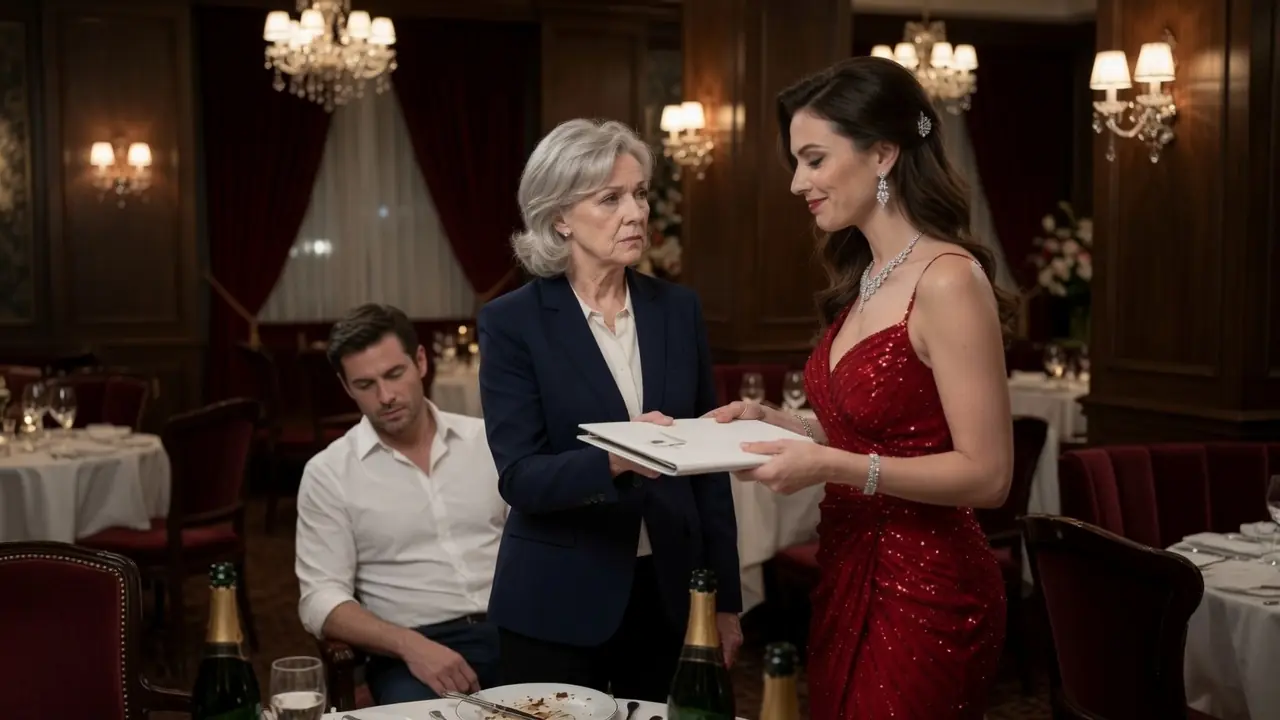
She dressed again, called a taxi, and carried the silver gift box she had prepared for them. Inside was the crystal clock she and her late husband had received on their own tenth anniversary. Evelyn had polished it carefully and placed a handwritten note beneath the base, hoping Logan and Chloe might keep it as a reminder that marriage required patience.
The restaurant occupied the top floor of a downtown Chicago hotel. Its windows overlooked the river, its waiters wore white jackets, and the smallest dinner plate cost more than Evelyn once spent feeding her family for a week. When she stepped from the elevator, she expected to hear laughter and find someone waiting to welcome her.
Instead, she found a table covered with empty dishes.
Twelve people sat among champagne bottles, half-finished desserts, and abandoned napkins. Chloe wore a sparkling green dress and a diamond necklace Evelyn had helped Logan purchase the previous Christmas. Logan sat beside her, staring at the table while the waiter stood nearby holding a leather bill folder.
Nobody had saved Evelyn a chair.
She stopped several feet from the table, still holding the gift.
“Why did you call me only after everyone finished eating?” she asked.
Chloe leaned back and slid the bill folder across the table.
“Because family ATMs don’t need dinner,” she said with a mocking smile. “They only need to pay.”
Several guests looked away. One woman lifted her water glass as though she had suddenly become fascinated by the ice. Logan remained seated, his hands clasped beneath the table.
Evelyn stared at the bill.
The total was $2,243.50.
There were four bottles of champagne, two seafood towers, steaks, imported desserts, and a private-room charge. Evelyn had not ordered a single item, yet her credit-card information had already been written on the payment line beneath the total.
“You spent more than two thousand dollars and expected me to cover it?” she asked.
Chloe’s smile disappeared.
“You always pay for family celebrations.”
“I was not part of this celebration.”
“You were invited.”
“After dessert.”
Chloe sighed loudly enough for the table to hear.
“Please don’t create a scene, Evelyn. You have money, and Logan is your only son. What exactly are you saving it for?”
Evelyn turned toward him.
Logan was thirty-eight, broad-shouldered, and still capable of looking like the frightened little boy who once climbed into her bed during thunderstorms. He worked as an account manager for a construction supplier and earned a respectable salary. Yet every time his family wanted something beyond that salary, he called his mother.
“You’re really letting her humiliate me like this?” Evelyn asked.
Logan finally looked up.
“Mom, it’s our anniversary,” he said quietly. “Can we discuss this later?”
Chloe laughed.
“He knows that without your money, no one here would have invited you.”
The words landed more deeply than Evelyn expected. For years, she had suspected that Chloe valued her bank account more than her presence. Hearing it stated openly should have made the truth easier to accept.
Instead, it made every memory hurt at once.
Evelyn remembered paying the down payment on Logan and Chloe’s house after they claimed rent was preventing them from building a future. She remembered covering their mortgage for nine months when Logan changed jobs. She remembered buying their first car, then helping replace it when Chloe decided the vehicle looked too ordinary beside the cars at her private fitness club.
Every rescue had come with a reason.
The baby needed a safe neighborhood.
The house needed a new roof.
Logan needed professional clothing.
Chloe needed time to recover from leaving a job she hated.
Evelyn had never asked for repayment. She believed helping her son was an extension of motherhood, not a loan. Yet somewhere along the way, gratitude had disappeared and expectation had taken its place.
The waiter remained beside the table, visibly uncomfortable.
Evelyn opened the bill folder again. Her emergency credit card number had been written from memory, including the security code. That card was meant for medical problems, urgent repairs, or anything involving her grandson, Owen.
It was not meant for champagne.
“Who gave the restaurant my card information?” Evelyn asked.
Chloe crossed her arms.
“You gave us the emergency card.”
“I gave it to Logan.”
“He is my husband.”
“That does not make my permission transferable.”
Logan leaned forward.
“Mom, please. We already told everyone dinner was covered.”
Evelyn looked around the table.
Among the guests were Chloe’s sister, two coworkers, three couples Evelyn barely recognized, and Chloe’s parents, Martin and Carol Brooks. Martin had ordered the most expensive steak, while Carol still wore the silk shawl Evelyn had given her the previous year.
Not one person had asked why Evelyn arrived after the meal.
Not one person had offered her a chair.
Evelyn placed the crystal gift on the empty service table behind her. Then she removed the emergency card from the bill folder and slipped it into her purse.
“I won’t be paying this.”
Chloe’s face became rigid.
“You cannot be serious.”
“I am completely serious.”
“The restaurant has already processed the deposit.”
“Then you may pay the remaining balance.”
Chloe looked toward Logan.
He stood and lowered his voice.
“Mom, people are watching.”
“They were watching when your wife called me an ATM.”
“That was a joke.”
“Did you laugh?”
Logan’s silence answered her.
Chloe pushed her chair back.
“This is unbelievable. After everything we do for you, you are going to embarrass your own son on his anniversary.”
Evelyn felt a strange calm settle over her.
“What exactly do you do for me?”
“We include you in the family.”
“You called me after you finished eating.”
“You come to our house whenever you want.”
“To babysit.”
“You attend holidays.”
“I cook them.”
“You see Owen.”
“Because I collect him from school three days a week.”
Chloe opened her mouth but found no immediate answer.
The waiter quietly explained that the table could divide the bill among the guests. Several people began reaching for wallets while avoiding Chloe’s eyes. Martin Brooks complained that he had been told the dinner was a gift.
“It was supposed to be,” Chloe said, glaring at Evelyn.
Evelyn lifted the silver box from the service table.
“This was the gift.”
She placed it in Logan’s hands.
For a moment, he looked close to apologizing. His eyes moved from the gift to his mother’s face, and Evelyn waited for the boy she had raised to remember himself.
Then Chloe spoke.
“Let her go. She’ll calm down and pay tomorrow.”
Logan did not stop Evelyn when she walked away.
The elevator doors closed before her tears began.
At home, Evelyn removed her shoes but did not change clothes. She sat at the small desk in her apartment and opened the blue financial folder she had avoided examining honestly for years. Inside were bank statements, transfer confirmations, credit-card reports, and handwritten notes explaining every time Logan had asked for help.
The numbers formed a history of dependence.
Evelyn paid $1,800 toward their mortgage each month. She covered the insurance on both vehicles, Owen’s school tuition, the family phone plan, and Chloe’s health-club membership, which had originally been described as physical therapy. She also transferred one thousand dollars monthly into a household account Logan called their safety cushion.
The emergency card had accumulated nearly sixteen thousand dollars in charges during the previous year.
Only four hundred dollars involved an actual emergency.
The rest included restaurants, clothing stores, hotel reservations, concert tickets, beauty treatments, and a weekend spa package Chloe had described as necessary for stress. Evelyn found three withdrawals she did not recognize and a payment to a travel agency for a Caribbean cruise.
She called the card company before midnight.
The representative canceled the card and blocked all authorized users. Evelyn changed every password, ended the automatic mortgage transfer, removed Logan from her phone account, and stopped the monthly household deposit. She also scheduled a meeting with her accountant, Marcus Bell, for Monday morning.
When the final confirmation appeared on the screen, Evelyn expected guilt.
Instead, she felt relief.
Her late husband, Thomas, had warned her about rescuing Logan too quickly. Thomas loved their son deeply, but he believed discomfort taught lessons that money often delayed. After Thomas died five years earlier, Evelyn became terrified that saying no might drive Logan away.
So she said yes until “yes” became the price of contact.
At eight the next morning, Logan called.
Evelyn allowed the phone to ring.
At eight twelve, Chloe called.
At eight twenty, the building intercom buzzed.
Evelyn checked the hallway camera and saw Logan standing outside her apartment. He wore the same dark shirt from dinner, though the collar was open and his face looked tired. She did not immediately unlock the door.
“What do you need?” she asked through the intercom.
“Mom, let me in.”
“Why?”
“Because we need to talk.”
“You had an opportunity to talk last night.”
“Chloe was upset.”
“She seemed very comfortable.”
Logan pressed the buzzer again.
“The emergency card stopped working.”
“Yes.”
“Our mortgage transfer is scheduled for tomorrow.”
“I canceled it.”
His expression changed.
“You canceled the mortgage?”
“I canceled my payment toward your mortgage.”
“Mom, unlock the door.”
Evelyn remained behind it.
“Our car insurance renews this week,” Logan continued. “The family phone account is also showing cancellation notices.”
“You have jobs. Arrange your own services.”
“Chloe is between positions.”
“Chloe has been between positions for three years.”
Logan lowered his voice.
“This is not like you.”
“No. This is the first thing I have done in years that is like me.”
He stepped closer to the camera.
“Why did you let one bad joke destroy everything?”
Evelyn placed her hand against the door.
“Why did you let your wife call me the family ATM while you waited for me to pay your bill?”
Logan looked down.
“I should have said something.”
“You should have.”
“I’m sorry.”
“You are sorry the cards were canceled.”
“That’s not fair.”
“What happened after I left?”
He hesitated.
“The restaurant divided the bill.”
“Did you manage to pay?”
“Yes, but Chloe’s parents are angry.”
“They ate dinner. Why are they angry about paying for it?”
Logan rubbed his face.
“Can you please unlock the door?”
“No.”
The word surprised both of them.
Evelyn had never refused him entry. Logan had possessed a key to every home she lived in since he left college. After Thomas died, he began arriving without warning, often to collect documents, borrow a car, or ask for money.
The previous night, Evelyn changed the digital lock code.
“Mom, I’m your son.”
“That is a relationship, Logan. It is not unlimited authorization.”
“You’d really let your own son lose everything?”
Evelyn closed her eyes briefly.
“You did not ask whether I had eaten. You did not save me a chair. You watched your wife humiliate me in front of strangers because you believed I would still pay afterward.”
“I made a mistake.”
“You made a choice.”
He stood silently in the hallway.
Evelyn continued.
“I will always love you, but I will not finance your life anymore. You will pay your mortgage, insurance, food, phone, vacations, and celebrations. The emergency card is permanently closed.”
“What about Owen’s school?”
“I will pay the school directly through the end of the year. After that, you and Chloe will make a plan.”
Logan’s face hardened.
“So you’re punishing your grandson too?”
“No. I am refusing to let you hide behind him.”
He stepped away from the door.
“Chloe said you would become vindictive.”
Evelyn felt the accusation strike, but she did not retreat.
“Then ask Chloe how many restaurant bills she has paid for me.”
Logan left without saying goodbye.
On Monday, Marcus Bell arrived at Evelyn’s apartment carrying three years of financial summaries. He had managed her investments since Thomas’s death and had repeatedly questioned the size of the transfers to Logan. Evelyn always defended them as temporary support.
The totals destroyed that description.
Over five years, she had given Logan and Chloe $287,640.
That amount did not include Owen’s school tuition, medical expenses, or gifts purchased directly. It included the house down payment, mortgage contributions, cars, monthly transfers, travel costs, and emergency-card charges. Marcus estimated that without Evelyn’s help, Logan’s family had been living nearly fifty percent beyond their actual income.
“They did not have an emergency,” Marcus said. “They built a lifestyle around you.”
Evelyn stared at the total.
“I kept thinking one more payment would stabilize them.”
“Your payments were the stability.”
Marcus recommended closing every shared account and moving key assets into a protected trust. He also advised Evelyn to document the unauthorized credit-card use. Chloe’s use of the emergency card had exceeded the permission originally given to Logan.
Evelyn did not pursue criminal charges.
She wanted boundaries, not revenge.
Marcus prepared a written notice stating that all financial support had ended and that any future assistance would require independent review. Evelyn mailed copies to Logan and Chloe, although she knew they had already understood the message when the cards stopped working.
Chloe responded on social media.
Without naming Evelyn directly, she wrote about elderly parents who used money to control adult children and punished grandchildren when family members established boundaries. Friends left sympathetic comments, calling the unnamed mother manipulative, cruel, and emotionally abusive.
Evelyn’s name did not appear, but enough details made the target obvious.
For one hour, Evelyn considered defending herself publicly.
Then she closed the application.
Three days later, Carol Brooks called and demanded that Evelyn restore the mortgage transfer. She argued that financial stress could damage Logan’s marriage and affect Owen. When Evelyn refused, Carol accused her of being jealous because Chloe had become the most important woman in Logan’s life.
“I never competed with Chloe,” Evelyn said.
“You resent that he chose his wife.”
“No. I resent that he stopped choosing basic decency.”
Carol warned that Evelyn might lose access to Owen.
The threat hurt more than losing the money.
Evelyn had collected Owen from school since kindergarten. They made pancakes on Fridays, built model airplanes, and read adventure books together. Chloe understood that the fastest way to weaken Evelyn was through the child she loved.
For two weeks, Evelyn was not allowed to see him.
She cried each evening but did not restart the payments.
On the third Friday, Logan appeared at the apartment again. This time, he did not press the intercom repeatedly. He stood quietly until Evelyn answered.
“Why are you here?” she asked.
“To apologize.”
“For what?”
He looked directly into the camera.
“For inviting you only to pay. For letting Chloe insult you. For knowing it was wrong and staying silent because I thought you would forgive me no matter what.”
Evelyn unlocked the outer building door but kept her apartment door closed until he reached the hallway. When she opened it, Logan stood several feet back instead of trying to enter. He looked thinner and less polished than before.
She invited him inside.
Logan sat at the kitchen table while Evelyn made coffee. He told her the mortgage payment had forced him to examine their accounts. He discovered two maxed-out credit cards, the cruise deposit, and a personal loan Chloe had taken without telling him.
Their anniversary dinner had not been a celebration of their marriage.
Chloe had organized it to impress a potential employer and several wealthy acquaintances. She believed Evelyn would pay because Evelyn always paid.
“I knew she used your card,” Logan admitted. “I didn’t know how much.”
“You could have asked.”
“I did not want the answer.”
He looked toward the floor.
“It was easier to believe you enjoyed helping us.”
“I enjoyed helping you when you needed help. I did not enjoy being used.”
Logan nodded.
“I understand that now.”
“Understanding is not the same as changing.”
“I know.”
He explained that they were selling one vehicle, canceling the club membership, withdrawing Owen from private school after the academic year, and considering selling the house. Chloe resisted every decision and insisted Evelyn would eventually give in.
Logan no longer believed that.
“Is that why you came?” Evelyn asked. “To convince me you are struggling enough?”
“No.”
He removed a small envelope from his pocket.
Inside was a check for six hundred dollars.
“It is not much,” he said. “It is my first repayment.”
Evelyn did not reach for it immediately.
“I never asked you to repay every dollar.”
“I know. But I need to stop pretending none of it mattered.”
She accepted the check.
Not because she needed the money, but because responsibility had finally entered the room.
Logan also brought the crystal clock. Chloe had wanted to return or sell it after the dinner. Logan found Evelyn’s note beneath the base and read the message written by Thomas years earlier.
Marriage survives when love and respect remain in the room together.
“I left you alone in that room,” Logan said.
“Yes.”
“I’m sorry, Mom.”
This time, Evelyn believed he was sorry for more than the canceled cards.
Their relationship did not repair itself that afternoon.
Logan attended financial counseling, moved his salary into an account Chloe could not access without transparency, and began paying every household bill himself. Chloe refused counseling initially, accusing both Logan and Evelyn of humiliating her.
Three months later, the house was listed for sale.
They moved into a smaller townhouse with a manageable payment. Chloe sold several handbags and returned to full-time work as an event coordinator. The marriage remained uncertain, but Logan stopped asking his mother to save it.
Owen began visiting Evelyn again after Logan refused to let financial conflict become a weapon against his son.
One evening, Owen asked why his parents no longer had the large house.
“Because adults sometimes buy more than they can afford,” Evelyn said.
“Did you take their money away?”
“No. I stopped giving them mine.”
The boy considered the answer.
“Is Dad mad?”
“He was.”
“Are you?”
“Sometimes.”
“Do you still love him?”
“Always.”
Owen smiled.
“Then maybe it will be okay.”
A year after the restaurant dinner, Logan invited Evelyn to lunch at a small neighborhood café. When she arrived, he was already seated, but this time an empty chair waited beside him. A menu lay at her place, and the waiter brought water before anyone ordered.
Chloe arrived several minutes later.
She looked uncomfortable but did not perform an exaggerated apology. She sat across from Evelyn and placed her hands on the table.
“I called you the family ATM because I believed your money made you easier to control,” she said. “I treated your generosity like weakness.”
Evelyn waited.
Chloe continued.
“When you stopped paying, I blamed you because accepting the truth meant admitting how much of my life depended on taking from someone I did not respect.”
“That is the first honest thing you have said to me in a long time,” Evelyn replied.
“I don’t expect you to forgive me today.”
“Good.”
The answer surprised Chloe, but Logan almost smiled.
They ate lunch quietly.
When the bill arrived, Logan picked it up.
“I’ve got this,” he said.
Evelyn watched him place his own card inside the folder.
The meal cost forty-eight dollars.
It meant more to her than the hundreds of thousands she had given him.
Evelyn never restored the emergency card, mortgage transfer, or monthly allowance. She maintained a separate education account for Owen that his parents could not access, and she kept her apartment door code private. Logan called before visiting and accepted “not today” without treating it as rejection.
Love remained.
The free rides ended.
On Evelyn’s sixty-eighth birthday, Logan hosted dinner in his smaller townhouse. The food was simple, the cake leaned slightly to one side, and Owen had decorated the room with paper stars. Evelyn had a chair at the center of the table before anyone else arrived.
Nobody asked her to pay.
As they raised their glasses, Logan looked at his mother.
“You taught me something I should have learned years ago,” he said. “Being your son never gave me the right to spend your sacrifice.”
Evelyn felt Thomas’s absence, but she also felt the strength his memory had left behind.
For years, she had believed that refusing her son would make her a bad mother. She finally understood that endless rescue had not protected Logan. It had delayed the moment when he had to become accountable for his own life.
Closing the cards had been difficult.
Closing the door had been harder.
But neither action had ended their family.
They had simply forced her son to knock, wait, and remember that the woman on the other side was not an account, a safety net, or a machine built to produce money.
She was his mother.
And at last, he treated her like one.