Patricia Hayes arrived at the family mansion carrying a pecan pie in one hand and a small velvet box in the other. Cold November rain swept across the circular driveway, turning the stone steps glossy beneath the porch lights. The mansion had once belonged to Patricia and her late husband, Richard, before they transferred it into the Hayes Family Trust for their children and grandchildren to enjoy. She had not expected to feel like a stranger approaching a home whose every room still carried a memory of the life she had built.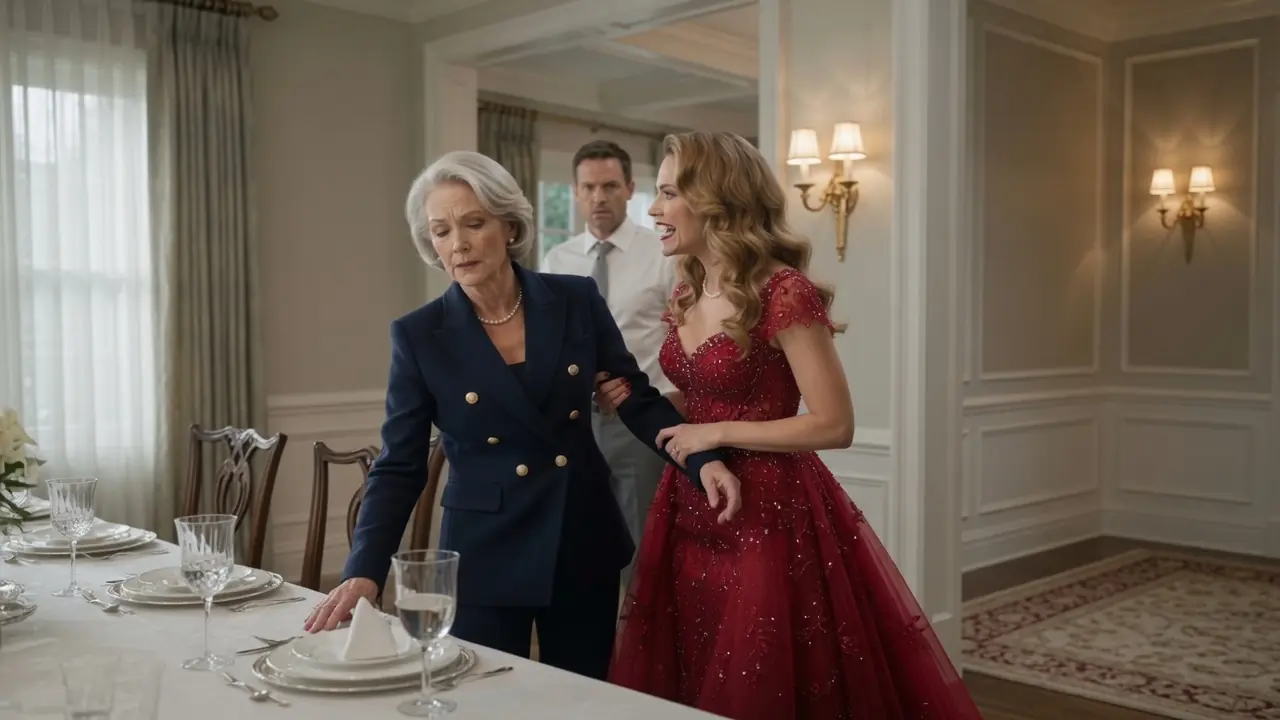
Through the tall windows, Patricia could see nearly thirty relatives gathered around the long dining table. Candles glowed between silver serving dishes, children chased one another near the staircase, and expensive wine filled glasses that had belonged to Patricia’s mother. Her son Daniel stood near the fireplace in a white shirt and gray tie, laughing at something his wife Brittany had said. For one hopeful moment, Patricia believed the evening might repair the distance that had grown between them.
Brittany opened the front door but did not smile. She wore a fitted burgundy dress, her blonde hair styled in polished waves, and her expression tightened when she saw the pie. Patricia had spent the entire morning making it from Richard’s handwritten recipe, the same dessert Daniel had requested every Thanksgiving since childhood. Brittany looked at it as though Patricia had brought something embarrassing.
“You should have called before coming,” Brittany said.
“Daniel invited me three weeks ago.”
“He invites people without checking the seating plan.”
Patricia looked past her toward the crowded dining room. “I am not a guest from his office, Brittany. I am his mother.”
“That does not mean you can appear whenever you want.”
Before Patricia could respond, Daniel approached the door. He glanced at the relatives watching from the dining room, then at Brittany’s tense face. Patricia expected him to step forward, kiss her cheek, and take the pie from her hands as he had done when he was younger. Instead, he sighed as though her arrival had created another problem he needed to manage.
“Mom, this isn’t a good time,” he said.
“It is Thanksgiving.”
“We’re hosting clients as well as family.”
“I know most of those clients. Their companies did business with your father before you learned to tie your shoes.”
Brittany’s fingers closed around Patricia’s arm. “Lower your voice.”
Patricia pulled away. “Do not grab me.”
Several conversations stopped. Daniel’s younger sister, Melissa, looked up from the far end of the table, but her husband touched her wrist and quietly discouraged her from getting involved. Daniel glanced toward the guests and then spoke in a low, cold voice that Patricia would hear many times afterward.
“You’re not needed here—go quietly before you ruin Thanksgiving.”
The words struck harder than the rain outside. Patricia stared at the man she had raised, searching his face for regret, embarrassment, or even hesitation. Daniel offered none of them. He looked down at his phone as Brittany took the pie from Patricia and placed it carelessly on the hall table.
Patricia’s voice trembled despite her effort to control it. “I built this home so no one in our family would ever feel unwanted.”
Brittany gave a sharp laugh. “You helped build it years ago. Daniel runs everything now.”
“The company, the house, the trust,” Daniel added quietly. “You need to accept that things have changed.”
Patricia looked at the faces around the dining room. Some relatives lowered their eyes, while others pretended to adjust napkins or refill drinks. Not one person came to the door. These were people whose tuition, medical bills, mortgages, and failed business ventures had been rescued by the family trust Patricia and Richard created.
Brittany pushed Patricia’s coat toward her. “We will send you a plate.”
“You are throwing me out into the rain.”
“You drove here,” Brittany replied. “You have somewhere to sit.”
Daniel remained silent.
Patricia picked up the velvet box she had brought for her eldest granddaughter. Inside was Richard’s small gold locket, intended as a reminder that the girl belonged to a family built on endurance rather than money. Patricia slipped the box back into her purse. Then she walked through the doorway without begging anyone to stop her.
The rain had become heavier. It soaked Patricia’s silver hair before she reached her black sedan, and her hands shook as she struggled to unlock the door. She sat behind the wheel but did not start the engine. Through the wet windshield, she could see the dining room windows glowing while her family returned to their meal.
For nearly five minutes, Patricia allowed herself to cry. She remembered carrying Daniel through the same front door after he broke his arm at nine years old. She remembered staying awake beside him when he had pneumonia, selling her mother’s jewelry to keep Richard’s first company alive, and signing personal guarantees that could have cost them everything. Daniel had grown up surrounded by sacrifices he eventually mistook for entitlement.
Her phone vibrated. It was a message from Brittany.
Please don’t make a scene about this. Daniel is under enough pressure.
Patricia read it twice. The cruelty was not impulsive; they had discussed it beforehand. Daniel had known his mother would be removed from Thanksgiving, and his primary concern was avoiding embarrassment.
Patricia opened her contacts and found the number of Jonathan Price, the attorney who had served Richard for more than thirty years. Jonathan answered on the second ring. He sounded surprised to hear from her on a holiday, but the concern in his voice deepened when he heard the rain striking the roof of her car.
“Patricia, where are you?”
“Outside the mansion.”
“Why aren’t you inside?”
“My son told me I was not needed.”
Jonathan was silent for several seconds. “Tell me exactly what happened.”
Patricia described Brittany pulling her away from the table, Daniel refusing to defend her, and the relatives who remained silent. She did not exaggerate. She did not need to.
“Jonathan,” she said when she finished, “activate the protection clause.”
His breath caught. “Are you certain?”
“Richard created it for a reason.”
“Full activation will freeze every privilege connected to the Hayes Family Trust. Daniel’s executive access, Brittany’s cards, the mansion account, the private aircraft, and every discretionary family payment will stop.”
“They believe everything belongs to them.”
“It will also trigger a review of Daniel’s company authority.”
Patricia watched Daniel lift a wineglass through the rain-streaked window. “Then let the review begin.”
Jonathan asked for the verbal authorization phrase Richard had chosen years earlier. It was a sentence only Patricia, Jonathan, and the trust administrator knew. Patricia spoke it clearly.
Protect the work before protecting the heirs.
Jonathan’s tone changed from personal concern to professional focus. “I will contact the bank, trustees, company counsel, and property manager immediately. The emergency restrictions should begin within forty-five minutes.”
“Do not warn Daniel.”
“I won’t.”
Patricia ended the call and finally started the engine. She drove away while the mansion remained bright behind her, filled with people celebrating on money they believed would never stop flowing. She checked into a quiet hotel across town under her maiden name and placed her phone face down on the bedside table. For the first time in years, she chose not to solve her family’s problems before they felt the consequences.
At the mansion, Thanksgiving continued for another twenty-three minutes before the first card was declined. Brittany had arranged for a private chef, musicians, and a luxury dessert service, all charged to a household account linked to the family trust. When the caterer attempted to process the final payment, the authorization failed. Daniel tried his executive card, then a second account.
Both were rejected.
His phone began filling with automated messages. Corporate signing authority suspended. Trust disbursements frozen pending emergency review. Property privileges temporarily revoked. Family-office transportation and household services discontinued.
Daniel immediately called the trust administrator. The call went to a recorded message stating that the accounts were under protective restriction. He called Jonathan next, but the attorney did not answer. Then he called Patricia.
Her phone remained silent on the hotel table.
Brittany tried to use her card to settle the caterer’s bill. It failed before the waiter could remove it from the machine. She whispered angrily to Daniel, demanding that he fix whatever technical problem had interrupted her evening.
“This is not technical,” Daniel said. “My mother activated something.”
“What could she activate? You run the company.”
“I run daily operations. She still controls the trust.”
Brittany’s face lost its color. “You told me the trust was ceremonial.”
“I thought it was.”
The musicians stopped playing when their payment guarantee was withdrawn. The private chef informed Brittany that he required immediate settlement, and the security company called to announce that household coverage would end at midnight unless a personal account replaced the trust contract. Guests began leaving as rumors spread across the dining room.
Melissa approached Daniel near the staircase. “What did Mom do?”
“She froze everything.”
“What did you do to her?”
Daniel looked toward the front door. Rainwater still glistened on the floor where Patricia had stood. “I told her to leave.”
Melissa stared at him. “On Thanksgiving?”
“Brittany thought—”
“I did not ask what Brittany thought.”
The mansion’s property manager called at eleven fifteen. Under the emergency clause, Daniel and Brittany’s residential permission had been suspended because the home belonged to the Hayes Family Trust, not to them personally. They would not be removed that night, but they were required to attend a trustee review the following morning.
Brittany began calling Patricia repeatedly. Her first messages sounded annoyed.
This has gone far enough. Call Daniel.
Then they became angry.
You cannot punish the whole family because your feelings were hurt.
By two in the morning, they sounded frightened.
Patricia, please answer. The bank says our personal accounts are being reviewed too.
Patricia listened to none of them. She turned off the lamp and slept more deeply than she had in months.
At seven the next morning, she woke to fifty-seven missed calls from Brittany, twenty-one from Daniel, and another dozen from relatives who had ignored her at the door. Several messages claimed the children were terrified, although Patricia knew the children had been taken to Melissa’s house before midnight. Others accused her of destroying Thanksgiving.
Not one message began with an apology.
Patricia dressed in a navy suit and pearl earrings. Richard had once told her she looked strongest in dark blue, and that morning she needed to remember the woman he had known. Jonathan’s driver collected her at eight and took her to Hayes Consolidated headquarters.
The company occupied twenty floors of a glass tower overlooking the river. Patricia and Richard had begun the business with one delivery truck and a rented warehouse, eventually expanding into construction logistics, commercial real estate, and regional transportation. Daniel had become chief operating officer five years earlier, but Patricia remained majority voting shareholder and chairwoman of the family trust.
She had stepped away from daily leadership after Richard’s death because Daniel insisted he was ready. In the three years since, he had replaced experienced managers with friends, approved Brittany’s luxury “branding initiatives,” and drawn increasingly large sums from the family accounts. Patricia noticed the changes but continued protecting him from the board.
That protection ended at the Thanksgiving door.
Jonathan met her in the executive conference room with trust administrator Helen Brooks, company counsel, and chief financial officer Marcus Lee. Several thick folders rested on the table. Their expressions revealed that the overnight review had uncovered more than a family argument.
“We need to discuss Daniel’s financial activity,” Marcus said.
Patricia sat at the head of the table. “How bad?”
“Potentially catastrophic.”
Daniel had used company guarantees to support three private investments connected to Brittany’s brother. One was a luxury resort project losing nearly four million dollars each quarter. Another involved a consulting company that had collected millions without providing documented services.
The largest problem was a loan secured against a distribution center owned by the family trust. Daniel did not have authority to pledge the property, but he had submitted documents claiming approval from Patricia. Her electronic signature appeared on two pages.
“I never signed these,” Patricia said.
Jonathan nodded. “We suspected that.”
“Did Daniel forge my name?”
“The authorization originated from his office. We need him to explain.”
At nine, Daniel entered the conference room with Brittany beside him. They both looked exhausted. Brittany wore yesterday’s makeup beneath a hastily buttoned coat, while Daniel’s tie hung loosely around his collar.
Jonathan blocked Brittany at the door. “This meeting is restricted to officers, trustees, and legal representatives.”
“I am Daniel’s wife.”
“You hold no legal position here.”
“She comes with me,” Daniel said.
Patricia looked at him. “Yesterday, you told your mother she was not needed. Today, your wife is not needed.”
Brittany’s jaw tightened. “You froze our home because I asked you to leave one dinner.”
“You dragged me away from my own family table.”
“You were making people uncomfortable.”
“I had not spoken to anyone.”
“You always make everything about Richard and how hard you worked.”
Patricia’s voice remained calm. “That work paid for the dress you wore while throwing me into the rain.”
Daniel stepped between them. “Enough. Restore the accounts, and we can discuss this privately.”
“We are discussing the company now,” Patricia said.
Jonathan placed copies of the unauthorized loan documents before Daniel. His face changed when he saw Patricia’s signature.
“Explain these,” she said.
Daniel stared at the pages. “The loan was temporary.”
“That was not my question.”
“The resort needed another capital injection.”
“Did I authorize you to pledge the distribution center?”
“You would have refused.”
“So you used my signature.”
Brittany interrupted. “The property will belong to Daniel someday.”
Patricia turned toward her. “You both seem confused by the word someday.”
“The company is his legacy,” Brittany said.
“It is the livelihood of eight thousand employees. It is not your emergency wallet.”
Daniel pushed the documents aside. “I planned to repay everything before the annual audit.”
“With what money?”
“The resort sale.”
Marcus opened another report. “The resort has no buyers and owes nearly thirty-six million dollars.”
Daniel looked at Brittany. She avoided his eyes.
Patricia finally understood the full purpose of the Thanksgiving humiliation. Brittany wanted the family, clients, and executives to see Patricia publicly diminished because they were preparing to push her out of the trust. If people believed she was elderly, emotional, and no longer respected by her own children, challenging her authority would become easier.
“Were you planning to remove me as trustee?” Patricia asked.
Daniel did not answer.
Jonathan placed one final document on the table. It was a draft petition claiming Patricia had become incapable of managing complex financial affairs after Richard’s death. Brittany had prepared a list of supposed examples: forgotten appointments, emotional decisions, and resistance to “necessary modernization.”
Patricia read each accusation slowly. Several events had never happened. Others were ordinary disagreements twisted into evidence of confusion.
“You planned to declare me incompetent,” she said.
Brittany folded her arms. “We were protecting the family.”
“You were stealing control.”
“You are seventy years old.”
“I am sixty-eight, and I remembered every account you tried to hide.”
Daniel lowered himself into a chair. “Mom, I never intended to file it.”
“But you allowed it to be written.”
“I was under pressure.”
“So was I when your father died. I did not steal from my children.”
The trustees entered at ten. After reviewing the forged authorization, undisclosed loans, and misuse of family property, they voted unanimously to remove Daniel from all executive and trust-related roles pending investigation. His company shares were restricted, his authority over the mansion was revoked, and the private investments were referred to financial regulators.
Brittany began shouting before the decision was fully read. She accused Patricia of choosing money over family and destroying Daniel’s future. The trustees listened without reacting.
Patricia waited until Brittany finished. “Family does not mean I finance anyone who humiliates me. Love is not permission to steal.”
Security escorted Brittany from the building. Daniel remained seated, staring at the table where his authority had disappeared in less than two hours. Patricia saw fear in his face, but she also saw the boy she had once carried through storms.
It would have been easier to comfort him.
She did not.
“You can remain in the mansion for thirty days while you arrange housing,” Patricia said. “The children’s needs will be protected separately. Your personal debts are yours.”
“Brittany will leave me.”
“She may.”
“You knew that.”
“I know she married the life you borrowed from me.”
Daniel’s eyes filled with tears. “Are you saying none of it was ever mine?”
“I gave you responsibility. You treated it as ownership.”
The investigation lasted four months. Daniel eventually admitted that Brittany had encouraged the false loan documents, but he accepted responsibility for signing them. He avoided criminal charges by cooperating fully, selling his personal assets, and surrendering his remaining company privileges.
Brittany filed for divorce six weeks after learning Daniel no longer had access to the trust. She demanded the mansion, company shares, and luxury vehicles, only to discover that all three belonged to the trust. She left with clothing, jewelry purchased from her personal account, and almost nothing else.
The relatives who had watched Patricia leave began sending apologies. Some were sincere, while others were clearly motivated by fear that their own trust benefits might disappear. Patricia read every letter but restored no privileges automatically.
Melissa visited one Sunday carrying Richard’s pecan pie recipe. She admitted that she should have followed Patricia outside.
“I was afraid Daniel would turn everyone against me,” she said.
“He already turned everyone against me.”
“I know.”
Patricia handed her a mixing bowl. “Then next time, choose what is right before you know whether it is safe.”
Daniel moved into a modest apartment and accepted work with a transportation company in another state. For the first time in his adult life, he received no family salary, company vehicle, or assistant. He called Patricia every Sunday, even when she did not answer.
Months passed before she agreed to meet him. They sat in a quiet café, where he placed his phone face down before speaking.
“I thought defending you would make me look weak in front of Brittany,” he said.
“And throwing me out made you feel strong?”
“For a few minutes.”
“What did it cost?”
He looked toward the window. “Everything I thought I owned.”
Patricia shook her head. “It cost you the person you were supposed to be.”
Daniel accepted the words without protest. He told her he had started counseling and was trying to understand why he had confused his wife’s approval with success. Patricia did not promise forgiveness, but she stayed until the coffee grew cold.
The following Thanksgiving, Patricia hosted dinner in a smaller house she had purchased near the river. There were no corporate clients, photographers, or extravagant decorations. Guests were invited because they had stood beside her during the investigation, not because they carried the Hayes name.
Melissa brought the pecan pie. Jonathan brought wine, and Marcus came with his wife and children. Daniel arrived alone with a bouquet of simple white flowers.
Patricia allowed him inside.
Before the meal, Daniel stood near the table and cleared his throat. “Last Thanksgiving, I told my mother she was not needed. I was wrong. This family exists because she and my father built it, but more importantly, because she kept loving us long after we stopped deserving protection.”
No one spoke.
“I cannot undo what I did,” he continued. “I can only stop expecting her to carry the consequences for me.”
Patricia looked around the table. No one lowered their eyes this time.
She placed a hand on the empty chair beside her. “Sit down, Daniel.”
His face softened, but he did not mistake the invitation for complete forgiveness. He sat quietly and helped pass the food. When Patricia’s glass needed filling, he noticed before anyone else.
Later that evening, rain began tapping against the windows. Patricia stood alone for a moment, remembering the previous Thanksgiving—the cold car, the glowing mansion, and the call that changed everything.
Activating the protection clause had frozen bank cards, company accounts, property access, and family privileges. But the clause had protected something more valuable than money. It had protected Patricia from spending the rest of her life financing people who believed love required her silence.
Her family had called fifty-seven times because their cards stopped working.
It took much longer for them to understand they should have called because they had broken her heart.
Patricia had built an empire beside her husband, but she no longer measured her strength by the properties, accounts, or voting shares under her control. Her real victory was the moment she stopped confusing sacrifice with surrender.
Daniel had told her she was not needed.
By the following morning, everyone had learned that Patricia had been holding up the house, the company, and the family all along.