“You’re nearly bankrupt, and you’re wasting time washing a dead pile of junk.”
Dale Miller stood inside his younger brother’s machine shed wearing polished shoes, pressed trousers, and a clean jacket that had never touched engine grease. Across from him, forty-six-year-old Ethan Miller gripped a high-pressure washer while black water poured from the corroded tractor sitting on wooden blocks. The machine had no visible paint, its tires had collapsed into the rims, and decades of pigeon waste still clung to its frame.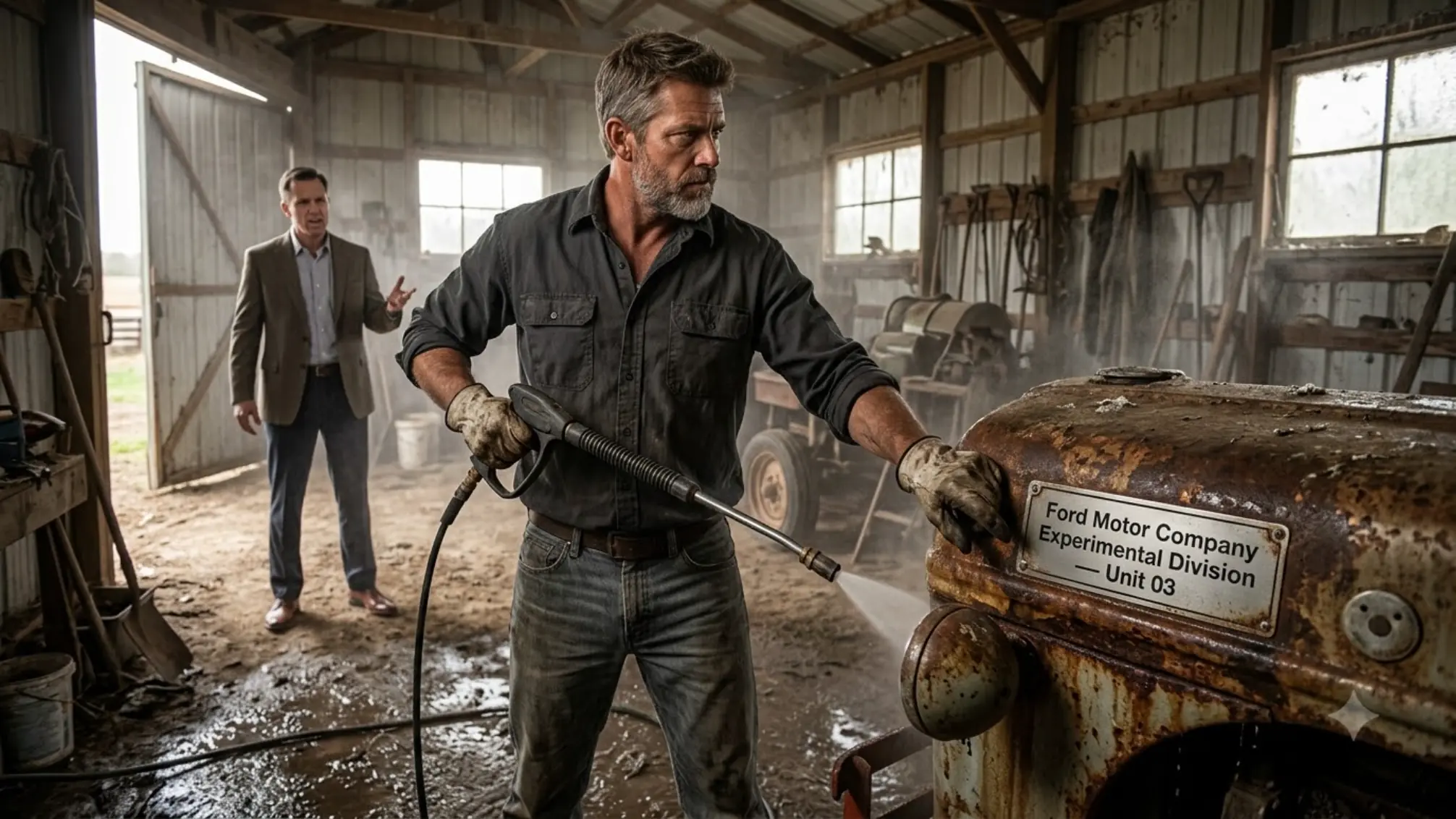
Ethan shut off the washer and let the sudden silence settle between them. His dark work shirt was soaked, his faded jeans were streaked with rust, and water dripped from his rough beard onto the concrete. “Then get out of my barn before I throw you out with it,” he said. Dale stepped closer and pointed toward the tractor as though it represented every bad decision Ethan had ever made.
“That rust won’t pay one damn bill.”
Ethan turned back to the left side of the engine block, where the water had exposed a small metal plate hidden behind a bracket. He brushed the remaining grime away with his thumb until stamped letters emerged beneath the oxidation. Then he looked over his shoulder and held Dale’s stare.
“Read this,” Ethan said. “Then tell me why Ford marked your ‘junk’ as Experimental Unit 03.”
Dale did not answer.
Three days earlier, Ethan had known nothing about experimental tractors, rare prototypes, or museum collections. He had been sitting alone at his kitchen table before sunrise, surrounded by overdue fuel invoices, equipment payments, and letters from the bank. The corn price had fallen below what he needed, the operating line was nearly exhausted, and the word restructuring appeared in every conversation with his lender.
The farm covered 320 acres outside Grinnell, Iowa, though ownership had become mostly theoretical. The bank held the mortgage, the cooperative held liens on two machines, and the seed company expected payment before spring. Ethan still worked the soil his father and grandfather had worked, but each year required more borrowed money simply to begin. He often wondered whether he was preserving a family farm or delaying its funeral.
At 6:14 that morning, Walt Dawson called.
Walt was eighty-nine and had farmed the neighboring 160 acres longer than Ethan had been alive. His voice remained slow and careful even while explaining that his daughter was moving him into Shady Oaks Retirement Home the following week. A demolition crew would soon tear down the rear barn, and an old tractor buried inside needed to be removed before the roof came down with it.
“I don’t want it going to the scrapyard,” Walt said. “Would you take it?”
Ethan looked at the bills spread across his table. He did not need another project, another broken machine, or another object occupying space inside a shed already crowded with repairs he could not afford. Yet Walt had helped Ethan’s father during bad harvests, loaned equipment without keeping score, and sat beside Ethan after his marriage ended.
“I’ll come after lunch,” Ethan said.
The rear barn leaned toward the east field as though the next strong wind might finish what time had started. Half the roof had collapsed, pigeons occupied the rafters, and decomposed hay covered the floor in dense layers. Walt stood near the doorway with an aluminum walker while Ethan climbed over broken beams toward a dark metal shape in the far corner.
The tractor looked less like a machine than something the barn had swallowed. A timber lay across its hood, rotten feed sacks covered the steering wheel, and packed hay reached halfway up the wheels. Ethan spent four hours clearing debris with a shovel, pry bar, and winch. By the time the tractor moved, his hands were bleeding through his gloves.
Sunlight revealed how badly the machine had deteriorated.
Rust had eaten through both fenders. The manifold had crumbled, the seat had disappeared, and every visible gasket had turned to dust. Its flat tires had fused to the rims, while the engine appeared to be one solid mass of corrosion. Walt watched from the doorway with an expression that carried apology and affection in equal measure.
“My father bought it at an estate sale near Cedar Rapids,” Walt said. “Paid forty dollars because the engine was seized even then.”
“What year?”
“Early fifties, maybe. He used parts from it for a while, then parked it here.”
Ethan secured the tractor to his flatbed and drove home slowly. People saw him crossing town with the ruined machine and began talking before he reached his driveway. By evening, Dale called to ask why a man struggling to save his farm was hauling home someone else’s garbage.
Ethan’s former wife sent a message soon afterward.
She had heard about the tractor through her sister, who heard it at the grocery store. Lisa reminded Ethan that their son needed braces and accused him of choosing another hopeless machine over real responsibilities. He did not explain that Walt had given him the tractor or that he had spent nothing except fuel and labor.
He placed the phone facedown and walked outside.
The tractor sat on the flatbed beneath the evening sky, black and shapeless against the fading fields. Ethan could not explain why he kept staring at it. Perhaps Walt’s request had made the machine feel like an inheritance from a man who did not want the final evidence of his working life crushed into scrap.
Or perhaps Ethan recognized something familiar in it.
The tractor had been useful once. Now people saw only damage, debt, and wasted space. Ethan understood what it meant to have others examine the worst condition of your life and mistake it for your permanent value.
He began cleaning it the following Saturday.
The pressure washer stripped away filth in slow layers. Black water became brown, then gray, carrying old grease and pigeon waste across the floor toward the drain. As the metal emerged, Ethan noticed that the frame joints were not uniform like the welds on ordinary production tractors.
Every bead was slightly different.
Someone had welded those joints by hand, shaping the machine one section at a time. The rear linkage was also unusual, resembling an early three-point hitch but with shorter hydraulic arms and hand-forged pins. Ethan had repaired tractors since childhood, yet the geometry matched nothing in his manuals.
Then the plate appeared.
Ford Motor Company
Experimental Division
Unit 03
Ethan read it until the letters stopped feeling real.
Dale tried to dismiss the plate as something a previous owner had attached, but Ethan saw uncertainty enter his brother’s face. Production tractors carried standardized serial tags, not experimental division plates fixed with old flathead screws. The surrounding metal showed no evidence of later drilling or replacement.
Dale eventually left without apologizing.
Ethan remained inside the shed until midnight, searching agricultural archives on an old laptop. He read about Henry Ford, engineer Harry Ferguson, and the revolutionary lightweight tractor they developed through a handshake agreement in the late 1930s. Their production Ford-Ferguson 9N transformed small farming by combining an affordable tractor with Ferguson’s hydraulic three-point hitch.
Before full production, five prototypes were reportedly assembled by hand.
Unit 01 survived in a museum. Historical records listed Units 02, 04, and 05 as dismantled during the war, their metal recycled after engineers extracted what they needed. Unit 03 had been transferred into private ownership in 1941 and disappeared from the record.
Most historians assumed it had also been destroyed.
Ethan returned to the shed with a flashlight and examined every visible component. The transmission housing carried a casting number absent from normal Ford catalogs. Hand-stamped marks appeared on the axle housings, and the brake drums differed slightly from later production specifications.
The tractor seemed to contain decisions made before a final design existed.
He found an archived Ford memo mentioning five experimental machines assembled at the Rouge River Plant in late 1938. A footnote confirmed that Unit 03 had entered private hands, though no owner was listed. Ethan looked through the window toward Walt’s old farm and imagined the tractor moving quietly from an engineer’s workshop to an Iowa estate sale.
Then it vanished beneath hay for nearly eight decades.
Ethan called the Henry Ford Museum the next morning.
After several transfers, he reached Dr. Catherine Marsh, senior curator of agricultural technology. She listened politely until he mentioned the plate, hand welds, and unusual hitch geometry. Ethan sent photographs while they remained on the phone.
She called back forty minutes later.
“Mr. Miller, we would like to examine the tractor in person.”
Dr. Marsh arrived two days later with Dr. James Aldridge, a retired mechanical engineer who had spent thirty years studying Ford’s prewar manufacturing methods. Aldridge walked around the machine without speaking, then lay on the floor and inspected its underside with a magnifying lens and flashlight.
When he stood, dust covered his blazer.
“This was not assembled on a production line,” he said. “These are developmental welds.”
Dr. Marsh photographed the identification plate, hydraulic linkage, axle marks, and brake components. Her professional calm gradually gave way to visible astonishment. She explained that the tractor appeared to be the only missing prototype from the group that preceded one of the most influential agricultural machines in history.
“This may be the most significant tractor discovery in generations,” she said.
Ethan’s first thought was not the farm or the bank.
It was Walt.
He drove to Shady Oaks that afternoon carrying printed photographs. Walt sat near the window of his new room with his walker folded beside the bed. When Ethan told him what the experts believed, the old man listened silently.
“So Daddy’s forty-dollar tractor mattered after all,” Walt said.
“It matters because your father saved it.”
Walt looked down at his hands. “I nearly let the demolition crew crush that barn with it inside.”
“But you didn’t.”
“No,” Walt said. “I called somebody who gives a damn.”
Authentication required months rather than one emotional visit.
Metallurgists tested the cast iron without damaging it. Historians compared the weld patterns and components with Unit 01 in Dearborn. Archived photographs revealed details matching the tractor in Ethan’s shed, including an experimental hydraulic bracket abandoned before production.
Every test supported the same conclusion.
The machine was genuine.
Ethan agreed to preserve it under strict guidance. The work could not become a glossy restoration that erased the evidence of how the prototype had been built. Original metal, tool marks, welds, and hand-machined surfaces had to remain visible.
He treated the tractor less like machinery and more like an archaeological site.
The engine consumed three weeks.
Penetrating oil soaked the cylinders while Ethan worked the pistons free millimeter by millimeter. He cleaned the crankshaft bearings with small brushes, rebuilt the carburetor according to faded experimental drawings, and rewired the ignition with cloth-covered wire matching the original material.
Nothing was rushed.
The three-point hitch required the greatest patience. Its hand-forged pins were structurally sound but fragile after decades of corrosion. Ethan cleaned them without removing the original lathe marks, then rebuilt the hydraulic system while preserving the unusual developmental geometry.
When the arms finally rose under pressure, Dr. Aldridge stood beside him in silence.
The engine started seven months after the tractor left Walt’s barn.
Ethan primed the fuel system, adjusted the timing, and pulled the hand crank. The first attempt produced nothing, while the second released a rough cough through the damaged exhaust. On the third pull, the engine caught.
The tractor shook on its blocks.
Its idle was uneven at first, then slowly settled into a low mechanical rhythm no one had heard for approximately seventy years. Oil seeped around old gaskets, and the manifold glowed faintly as heat returned to the iron.
Ethan stood with both hands hanging at his sides.
Then he sat on the concrete and cried.
He did not cry because collectors were already discussing millions. He cried because something abandoned before his parents were born had found its voice again. The machine had endured collapse, water, rodents, neglect, and decades of people believing it held nothing useful.
It still worked because someone had built it carefully.
The local newspaper published the first story. Larger publications followed, then historical programs, museum organizations, and collectors. Auction houses called Ethan daily, while strangers drove past the farm hoping to see the tractor through the shed doors.
Dale called again.
“I saw the article,” he said. “They’re saying it could be worth millions.”
“They don’t know yet.”
“I’m sorry about calling it junk.”
Ethan looked at the bare metal frame beneath the shop lights.
“You saw what everyone saw.”
“You looked closer.”
Ethan did not remind Dale of the bills, insults, or suggestion that his habits had driven Lisa away. The discovery did not make every criticism unfair, and money would not transform Ethan’s failures into virtues. Yet the tractor proved that judgment made from distance could miss the entire story.
He chose a major collector auction in Florida.
The official estimate ranged from two to five million dollars, though experts admitted no comparable sale existed. Unit 03 was not merely a rare tractor; it represented the experimentation that led to machinery used across farms throughout the world.
Walt’s health prevented him from traveling.
Ethan called him every evening during the drive south.
“Are you frightened?” Walt asked.
“Terrified.”
“Whatever happens, she won’t be buried in darkness anymore.”
The auction hall was filled with polished sports cars, wealthy collectors, cameras, and machines restored until their paint appeared flawless. Unit 03 sat on a raised platform without new paint, its scars and bare metal preserved as part of its history.
Ethan stood near the back in a clean flannel shirt.
Bidding opened at five hundred thousand dollars.
The price crossed one million almost immediately. Two serious bidders emerged: a private collector on the telephone and a representative from a technology foundation. Their offers climbed in increments that exceeded what Ethan once earned in an entire year.
Two million became four.
Four became six.
At eight million, Ethan gripped the railing.
At ten, the crowd began reacting after every bid. The auctioneer’s voice moved faster, yet Ethan heard only the restored engine running inside his memory. He thought about Walt’s collapsing barn and his father buying Unit 03 for forty dollars.
The final bid reached eleven million four hundred thousand dollars.
The gavel fell.
Applause filled the hall as Ethan’s knees weakened beneath him. Reporters approached, but he walked outside before answering questions. Beneath the Florida night sky, he called Shady Oaks.
Walt answered after four rings.
“Eleven million four hundred thousand,” Ethan said.
Silence followed.
Then the quietest man in Harland County began crying.
“Well,” Walt finally whispered, “I guess Daddy got his money’s worth.”
Ethan divided the proceeds equally with Walt.
The old man objected, insisting the tractor had been a gift. Ethan brought the financial papers to Shady Oaks and placed them on the small table beside Walt’s bed. He explained that without Walt’s father, Unit 03 would likely have disappeared into wartime scrap.
Without Walt, it would have died beneath a demolished barn.
“You preserved it for eighty years,” Ethan said. “Half belongs to you.”
Walt studied him for a long time before signing.
Ethan used his share to eliminate every debt attached to the farm. He paid the mortgage, equipment notes, cooperative line, and overdue accounts. For the first time in two decades, no lender held the right to decide whether his fields remained his.
He also purchased forty acres beside the farm.
That land had once belonged to Ethan’s father but was lost at a bank auction when Ethan was twenty-six. He remembered standing beside his father outside the courthouse while an investment company purchased it. Neither man spoke during the drive home.
His father died four years later.
Now Ethan removed the corporate lease signs, repaired the drainage, and parked beneath the old oak where his father once ate lunch. He stayed there until sunset, one hand resting on the steering wheel.
The land had returned.
Walt used part of his share to support his daughter, improve the local retirement home, and establish a fund for farm families facing medical emergencies. He died two years later, but not before visiting Ethan’s new workshop.
The building stood on the north side of the farm.
A sign above the door read Miller Engine Works.
Inside were lifts, welding stations, tools, classrooms, and engines donated by mechanics across Iowa. Ethan offered free instruction to any young person willing to learn. Some students wanted careers in agriculture, while others simply wanted to understand how machines worked.
Dale visited during the first summer class.
He watched Ethan show a twelve-year-old girl how to adjust a carburetor. The girl listened with complete concentration, then corrected the fuel mixture by sound. Ethan stepped back and allowed her to make the final adjustment herself.
“She’s good,” Dale said.
“She looks before deciding.”
Dale glanced toward the framed photograph of Unit 03 hanging on the wall.
“So do you.”
The tractor’s buyer eventually placed it on permanent museum loan. Unit 03 went behind glass beside exhibits explaining the Ford-Ferguson partnership, the three-point hitch, and the agricultural transformation that followed.
A small plaque identified Walt Dawson and Ethan Miller.
It also mentioned the forty-dollar estate-sale purchase.
Years later, a reporter asked Ethan whether he knew the tractor was valuable when he pulled it from the barn. He stood inside Miller Engine Works while students rebuilt a small engine behind him.
“No,” he said. “I thought it was broken machinery an old man didn’t want destroyed.”
The reporter asked what made him keep working.
Ethan looked through the shop windows toward the debt-free fields, including the forty acres his family had once lost.
“Most valuable things don’t announce themselves,” he said. “They sit under dirt, damage, and other people’s conclusions.”
He turned toward the students.
“The hard part isn’t finding treasure. It’s becoming someone who doesn’t walk past what everyone else has already thrown away.”
Outside, corn moved beneath the Iowa wind.
Inside the shop, the twelve-year-old girl started the engine she had rebuilt. It coughed twice, then settled into a steady idle as Ethan listened with the quiet pride of a man who understood that restoration was never only about machinery.
Dale had said the rusted tractor would never pay a bill.
Instead, Unit 03 paid off a farm, returned lost family land, protected an old man’s dignity, and opened a workshop where forgotten skills found new hands.
The tractor had spent eighty years waiting beneath a collapsed barn.
Ethan had spent nearly as long believing his own worth depended on what the bank, his brother, and everyone else could see from a distance.
Both of them needed the same thing.
Someone willing to look closer.