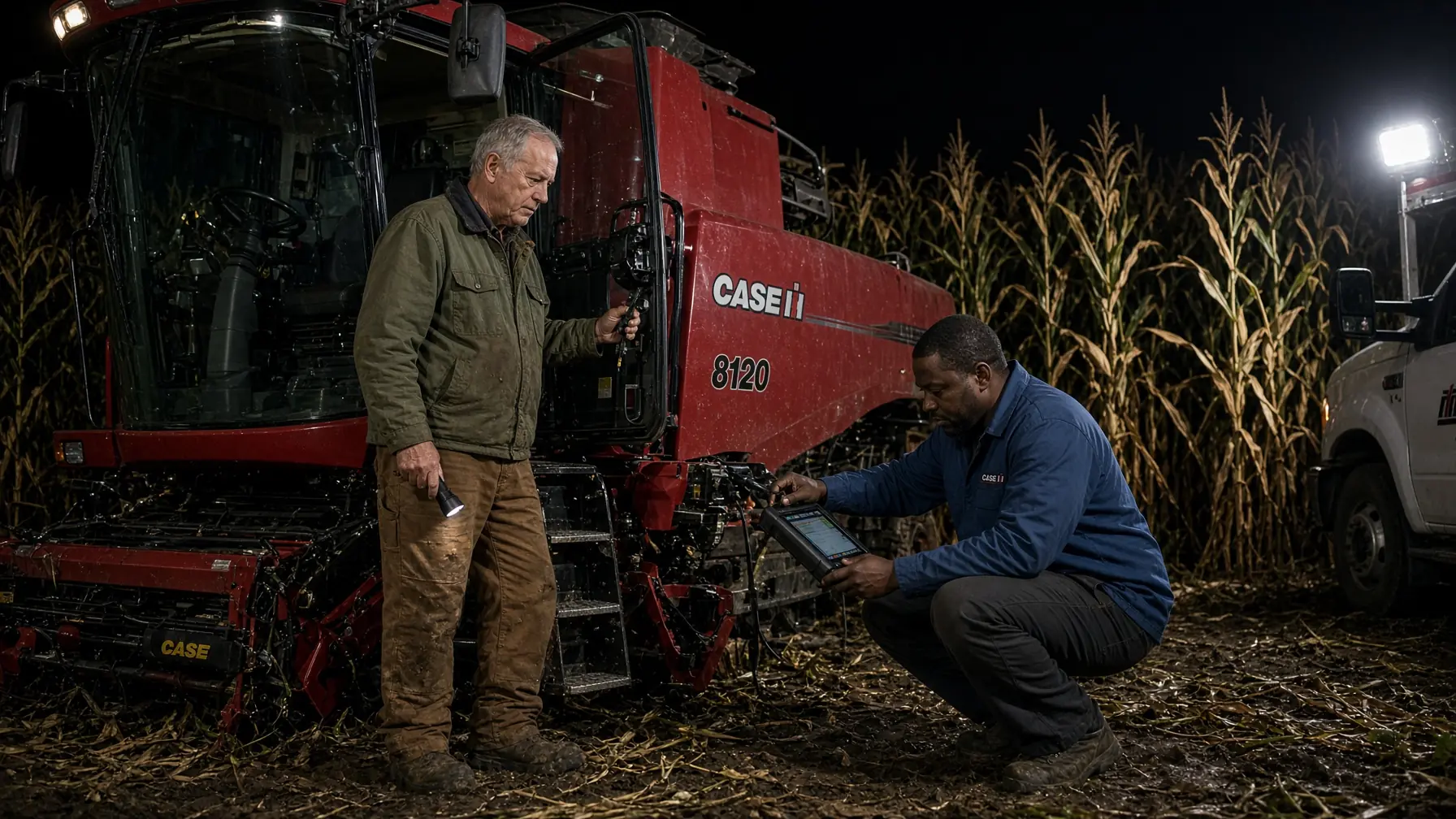
At 11:03 on a Tuesday night, the engine stopped so completely that Gene Whitfield could hear loose corn leaves moving beneath the machine. His last field stretched beyond the work lights, and a hard rain was forecast for Thursday. He tried the key twice, then sat with his hands on his knees, calculating how much damage a delay could do. Fourteen minutes later, he called the dealership expecting a recording—and heard a man ask where he was.
The silence did not sound like a broken machine at first.
It sounded like somebody had removed the world Gene had been living inside for four consecutive days. The steady engine note, the movement of material through the combine, the vibration beneath the seat—all of it vanished at once.
He looked at the cab display.
11:03.
There had been no gradual loss of power, no strange knocking, no warning that gave him time to finish the pass. One moment he was harvesting corn. The next, he was sitting inside a stopped Case IH 8120 in the second week of October 2019, with standing rows ahead of him and a weather forecast he could not negotiate with.
He tried the key.
The machine did not restart.
He waited, looked through the information available on the display, and tried again. There was still no running engine, no familiar sound to tell him the interruption had been temporary.
Gene put both hands on his knees.
He was sixty-three years old and had farmed the same ground in Champaign County, Illinois, for thirty-seven years. He had seen breakdowns before. He had seen crops lie flat after storms, seen machinery fail on the day it was needed most, and seen a promising season lose its margin through a series of ordinary expenses.
None of that experience made the silence less troubling.
The field was the last one of the season: a 312-acre piece of ground that had looked, earlier in the day, like the final manageable task between him and a completed harvest. Part of it was already behind him. Too much remained ahead.
Thursday’s rain would not care how close he was.
He reached for the weather information on his phone, though he had checked it so often that evening he could almost recite it. The forecast had not improved while the engine was stopping.
He studied the screen anyway.
Farmers sometimes checked a forecast not because they expected a different answer, but because looking at it gave them something to do with the waiting.
Gene had spent the day watching moisture readings and thinking about the elevator’s terms. Corn above twenty percent moisture would bring deductions substantial enough to matter in a season that already required careful arithmetic.
Rain could delay the harvest, alter the handling, and make an unfinished field more expensive in ways that did not arrive neatly on one invoice.
He could not put a precise loss against the next two days.
He knew it would not be small.
Outside the cab, the field remained visible within the work lights and disappeared beyond them. Corn stood motionless in some rows and stirred lightly in others, each stalk apparently indifferent to the machine that had stopped beside it.
Gene opened the door.
Cold air entered carrying the smell of corn dust, worked soil, and exhaust that was already fading. He listened for anything unusual.
There was nothing useful to hear.
He climbed down slowly, keeping a firm grip on the railing. Four long harvest days had stiffened his knees, and he was tired enough that an awkward step could become another problem.
At the bottom, he stood still for a moment before taking out his flashlight.
He walked around the combine once.
No fluid running down a panel. No obvious damage. No broken piece hanging where it should not be. Nothing outside the machine explained why the engine had stopped as cleanly as though somebody had turned it off.
He checked what he could safely check.
Then he stopped.
Years of working on his own equipment had taught him a distinction he did not always like: there were problems he could solve with attention and tools, and problems he could make worse by insisting they belonged in the first category.
This one had stopped him from inside the machine.
He looked toward the field edge, where his pickup waited near the access lane. Its shape was barely visible beyond the combine’s lights.
The walk gave him time to begin arranging possibilities.
A technician by morning.
A diagnosis before lunch.
A part somewhere close.
If all three happened, he might be moving again by afternoon.
If one failed, the narrow window before Thursday would become narrower still.
He called his wife first.
She answered before he had decided how to begin.
“You’re still out there?”
“I am.”
Something in his voice changed the question she asked next.
“What happened?”
“The combine quit.”
“Bad?”
“I don’t know yet.”
He told her the time, the way the engine had stopped, and what he had checked. She listened without interrupting because she knew the difference between a complaint he needed to finish and information she might need to act on.
“Are you all right?”
“Yes.”
“Where are you?”
“The last field.”
She knew which one.
For several seconds, neither spoke. They had been married long enough that some calculations passed between them without needing to be explained.
The forecast.
The corn.
The remaining work.
The fact that a late-night breakdown was never only a machine problem.