“Your father dumped his rust and dying farm on you—he gave me the future.”
Danny Holloway slapped one broad hand against the bright-red hood of his brand-new International Harvester tractor. Its fresh paint gleamed beneath the pale Iowa sun, and the enormous machine towered above the two aging green tractors parked beside Raymond Holloway’s weathered farmhouse. Danny stood proudly in polished boots and a pressed tan shirt, looking like a man who believed success had already chosen him.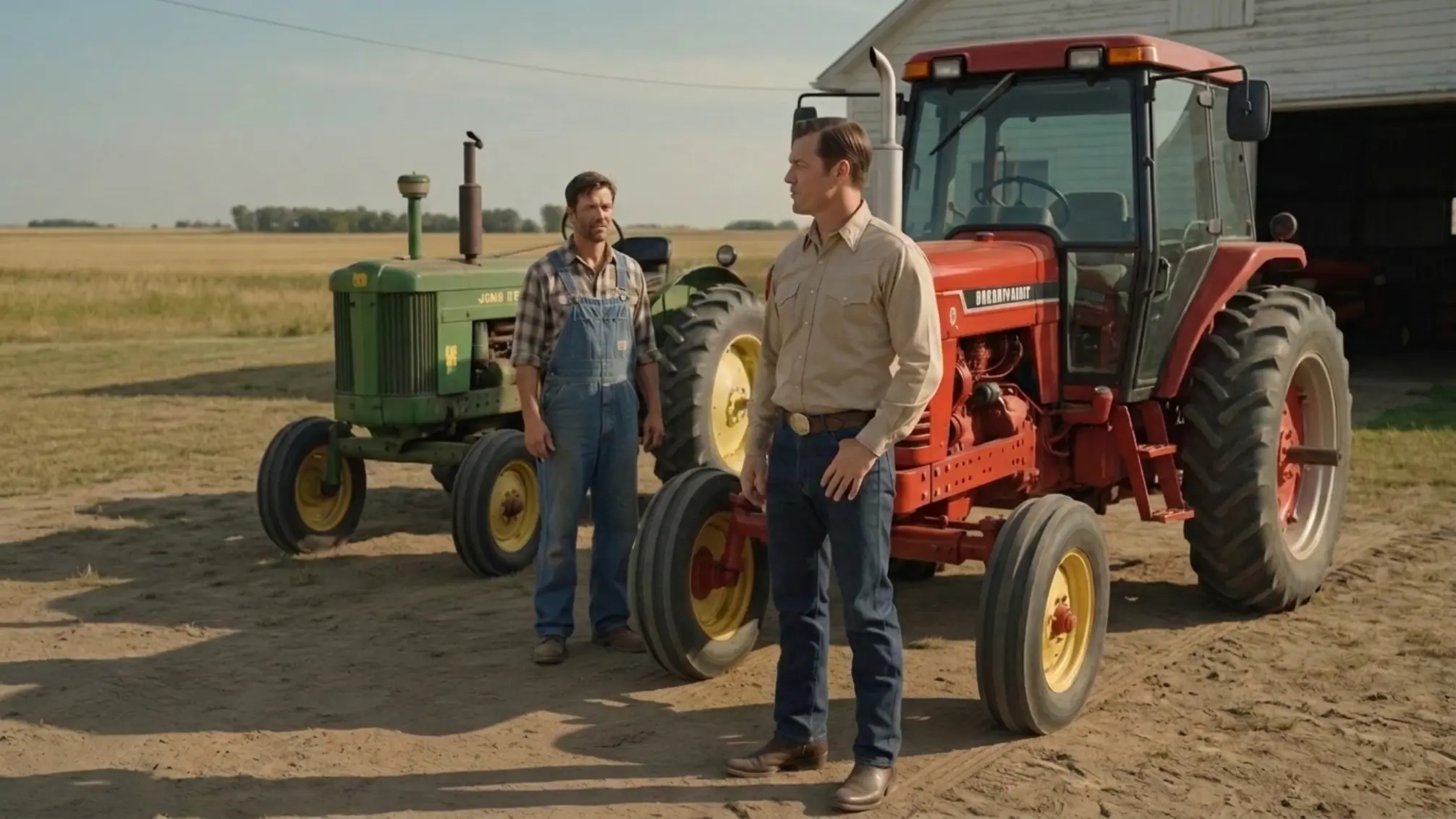
Raymond raised the deed he had just received from the attorney.
“He gave me land your bank will never touch.”
Danny stepped closer, his earlier grin sharpening into something meaner. “I’ll bury you before the first harvest ends.”
Raymond folded the deed and slipped it into his denim overalls. Then he climbed onto the cracked seat of the 1949 John Deere Model A and pulled the starter.
“Keep borrowing,” he said as the old two-cylinder engine began its slow, heavy rhythm. “When prices crash, I’ll buy your farm at auction.”
The words silenced both men.
It was February 1971, and nothing in the American agricultural market suggested prices were about to collapse. Farmers across northwestern Iowa were being encouraged to expand, modernize, borrow against rising land values, and replace old equipment with larger machines. Banks competed to finance tractors powerful enough to work hundreds of acres in a fraction of the time their fathers had needed.
Danny looked at Raymond as though he had heard a bitter man inventing a disaster to excuse his inferior inheritance.
“You really believe that antique will save you?”
“No,” Raymond answered. “Owning it will.”
Three days earlier, the cousins had sat inside an attorney’s office above Farmers and Merchants Bank while Curtis Holloway’s will was read. Curtis had died at sixty-eight after a short illness, leaving behind land, equipment, and two men who had worked beside him for most of their adult lives.
Raymond was Curtis’s forty-one-year-old son. He had lost his wife five years earlier and was raising his thirteen-year-old daughter alone in the farmhouse where he had grown up. He was quiet, cautious, and more comfortable repairing machinery than explaining himself.
Danny was Curtis’s thirty-nine-year-old nephew. Curtis had raised him after Danny’s father died during military service, and no one in the family treated him as anything less than a second son. He was ambitious, persuasive, and always searching for the next opportunity to make the operation larger.
The will divided their futures in a way neither expected.
Raymond inherited the original 320-acre farm completely paid off. He received the farmhouse, grain sheds, livestock buildings, and every machine Curtis owned: two aging John Deere tractors, an old planter, a worn grain drill, a baler that needed constant attention, two wagons, several plows, and a collection of implements ranging from dependable to nearly useless.
Danny received twenty-five thousand dollars toward the purchase of another 320 acres Curtis had leased from a local widow. The price was favorable, but Danny had to finance the remaining balance. Curtis also arranged for him to purchase a new tractor and modern implements through credit.
Danny inherited a path toward a powerful modern operation.
Raymond inherited an old farm with no debt.
At first, Raymond did not see the difference clearly.
After the reading, he sat across from Danny in a café near the courthouse. Snow pressed against the windows while both men stared into untouched coffee.
“He gave you the future,” Raymond said. “He gave me the past.”
Danny looked genuinely uncomfortable. “You received the home farm.”
“With equipment he should have sold ten years ago.”
“The land is clear.”
“So is an empty field.”
Danny leaned forward. “I didn’t write the will.”
“I know.”
“I would have divided it differently.”
Raymond looked at his cousin. For a moment, resentment almost made him say something their relationship would not survive. Then he remembered how Danny had stood beside him at his wife’s funeral, how he had repaired fences during the months Raymond could barely get through breakfast, and how he had treated Raymond’s daughter like his own niece.
“It’s done,” Raymond said. “We both make it work.”
That evening, Raymond sat at the kitchen table with his daughter, Emily. She had her mother’s dark eyes and the same habit of studying people silently until they said what they truly meant.
“Are we losing the farm?” she asked.
“No.”
“Uncle Danny said Grandpa left you the bad machines.”
“He said that where you could hear?”
“He talks loudly.”
Raymond looked toward the window. Outside, the Model A sat beneath a lean-to with frost covering its faded green hood.
“They’re old,” he admitted.
“Does old mean bad?”
“Sometimes.”
“Was Grandpa bad?”
Raymond looked back at her. “No.”
“Then maybe he had a reason.”
It was the sort of answer a child could offer because she had not yet learned to complicate obvious truths.
Raymond wished he believed it.
Within two months, he mortgaged part of the paid-off land and borrowed forty-five thousand dollars. He sold both old tractors at auction and used the money toward a newer John Deere 4020, an improved planter, better grain-handling equipment, and operating costs.
The 4020 transformed his work.
It started easily, pulled wider implements, handled more acres, and allowed Raymond to finish jobs before weather changed. Neighbors admired it, and for the first time since the will reading, Raymond felt he had corrected his father’s mistake.
Danny’s new International Harvester was even more impressive.
Its turbocharged diesel engine produced nearly three times the power of Curtis’s old tractors. It pulled equipment through heavy Iowa soil without slowing and allowed Danny to take custom work from neighboring farms. When he drove it through town, men stopped conversations to watch.
The cousins entered the most profitable years American agriculture had seen in a generation.
Corn prices climbed.
Soybean prices rose even faster.
Foreign demand expanded, land values increased, and agricultural experts predicted that global markets would permanently change the economics of farming. Banks told farmers that debt was not dangerous when the collateral beneath it appreciated every year.
Raymond’s farm produced record income.
Danny’s operation expanded.
By 1974, both men had more money moving through their accounts than Curtis had ever imagined. Danny leased additional acreage and discussed buying another tractor. Raymond upgraded his grain dryer and considered borrowing against the rising value of his land a second time.
Emily, now sixteen, watched the decisions with concern.
“Are we rich?” she asked one evening while helping him sort bills.
“No.”
“The banker says the farm is worth three times what Grandpa thought.”
“The banker does not own it.”
“He owns some now.”
Raymond stopped writing.
The mortgage balance sat in front of him.
Until that moment, he had spoken of the farm as though it remained exactly what Curtis had left him. But every improvement had transferred a little more control from his family to the bank.
“We’re doing fine,” Raymond said.
Emily looked unconvinced. “That wasn’t what I asked.”
He smiled despite himself. “You sound like your mother.”
“That means I’m right.”
For several years, high prices concealed every weakness.
When harvest income increased, monthly payments seemed small. Rising land values made debt appear safer, and modern equipment made old methods look foolish. Even Raymond began believing that caution belonged to an earlier era.
At a county fair in 1975, he found Danny standing beside a livestock pavilion with two beers.
“I owe you an apology,” Raymond said.
Danny handed him one bottle. “For what?”
“Dad’s will. I thought he favored you.”
Danny laughed. “You got the paid-off farm.”
“And immediately borrowed against it.”
“You modernized.”
“So did you.”
“We’re both making it.”
Raymond lifted his bottle. “That’s what matters.”
Their daughters and sons ran past them toward the carnival rides while music drifted across the fairgrounds. Neither cousin understood that they were standing near the peak of a cycle already beginning to turn.
The first decline appeared harmless.
Corn prices softened but remained profitable. Land continued appreciating. Banks continued lending. Farmers adjusted projections and assumed another strong export season would restore previous highs.
Then operating costs increased.
Fuel grew more expensive. Fertilizer prices climbed. Replacement parts for modern machinery cost far more than the simple components Curtis had kept stacked in his machine shed.
Raymond’s 4020 was dependable, but when its hydraulic system failed, the repair required a dealer mechanic and an invoice large enough to erase the profit from forty acres of corn.
He remembered repairing the old Model A with hand tools.
At the time, he had considered that work proof of its inferiority.
Now he understood there was value in a machine that revealed its problems openly.
Danny faced greater pressure.
His land and equipment payments did not care whether crops sold at three dollars or two. Each month, the bank expected its money. Custom farming helped, but neighbors experiencing the same squeeze began canceling work or delaying payment.
By 1979, both cousins stopped discussing expansion.
By 1980, they began discussing survival.
The Soviet grain embargo crushed a major export market. Elevators filled while prices declined. Interest rates rose rapidly, and variable agricultural loans adjusted upward.
Danny’s monthly obligations became impossible.
He sat inside the bank wearing the same tan shirt he had worn when mocking Raymond’s inheritance nine years earlier. The shirt no longer looked sharp. The collar was frayed, and worry had carved deep lines around his eyes.
“I need to restructure,” he told the loan officer.
The officer reviewed the papers. “Your land value has fallen.”
“The land still produces.”
“At current prices, it does not produce enough.”
“I have never missed until this year.”
“You have missed three payments.”
“I can sell equipment.”
“That may not be sufficient.”
Danny’s hands tightened beneath the desk. “Curtis did business with this bank for thirty years.”
“Curtis did not carry this debt.”
The words stayed with Danny long after he left.
Raymond received a similar warning, though his balance was smaller. The banker suggested selling acreage before prices fell farther.
Raymond refused.
“My father kept those 320 acres together through the Depression.”
“Your father was not paying today’s interest rates.”
“My father is the reason the original land was debt-free.”
“And you changed that.”
Raymond left without answering.
At home, Emily was preparing to leave for community college. She found him at the kitchen table with the bank statement and Curtis’s will laid side by side.
“You look like Grandpa died again,” she said.
“I sold what he left me.”
“You still have the farm.”
“The bank has a claim against it.”
“How much?”
He told her.
Emily sat down.
“Can we pay it?”
“Not with the operation structured this way.”
“Then change the operation.”
“I already changed it once.”
“Maybe that was the wrong direction.”
Raymond looked toward the empty lean-to where the old Model A had once stood.
He finally understood what Curtis had given him.
Not outdated machinery.
Time.
The paid-off land and inexpensive equipment had created room for bad years. Raymond had traded that room for speed because everyone around him insisted speed was the future.
He could not undo 1971.
But he could stop repeating it.
In the spring of 1981, Raymond attended a foreclosure auction three miles from his farm. The property belonged to a family who had expanded aggressively during the boom. Their land, machinery, and household goods were sold separately while the former owner stood near the barn pretending not to watch.
Rows of modern equipment attracted the largest crowd.
Raymond walked past them.
At the edge of the yard sat a 1951 John Deere Model A and a 1959 John Deere 630. Their paint was faded, tires cracked, and seats worn. Younger farmers laughed when the auctioneer attempted to create interest.
“Good tractors for a museum,” someone joked.
Raymond raised his bidding card.
He bought both for twelve hundred dollars.
The crowd stared.
One neighbor approached afterward. “You losing your mind?”
“Possibly.”
“You own a 4020.”
“Not for long.”
“That old iron cannot match it.”
“It doesn’t have to.”
Raymond sold the modern tractor for sixty-eight hundred dollars and put nearly every dollar toward principal. His payment fell. Fuel consumption dropped. When something broke, he repaired it himself using tools already hanging in the machine shed.
The work became slower.
He began earlier and finished later.
But every field completed with the old tractors cost less than working it with the newer machine.
Neighbors mocked him until more auction signs appeared.
Danny sold his International Harvester that same year. The tractor that had once represented the future brought less than half its original value. He replaced it with a used John Deere, but the sale did not reduce his debt enough.
One cold evening, Danny drove to Raymond’s farm.
The Model A was running beneath the machine-shed lights, its slow two-cylinder rhythm carrying across the yard. Raymond stood beside it adjusting the carburetor.
“You bought another one,” Danny said.
“Two.”
“I remember laughing when you inherited them.”
“I remember selling them.”
Danny ran a hand along the faded hood.
“You were right that day.”
“About what?”
Danny looked toward the dark fields. “Prices fell. The bank is going to take my land.”
Raymond stopped working.
“How long?”
“Maybe weeks.”
“Can the loan be purchased?”
“Not by anyone we know.”
“I can talk to my banker.”
“Your banker is trying to collect from you too.”
Raymond wiped his hands. “We find another way.”
“There isn’t one.”
“There is always something.”
Danny shook his head. “That is what I kept telling myself every time I borrowed more.”
The bitterness in his voice was not directed at Raymond.
It was aimed inward.
“I thought Uncle Curtis believed in me,” Danny continued. “That’s why he gave me the chance to buy modern land and machinery.”
“He did believe in you.”
“He put me under debt I couldn’t survive.”
“You signed the papers.”
Danny flinched.
Raymond regretted the harshness immediately, but the truth remained.
“Dad did not force either of us,” Raymond said more gently. “He left choices. I nearly lost my farm ignoring mine.”
“At least yours can still be saved.”
“You think that makes me feel better about yours?”
Danny looked at him.
For nearly ten years, comparison had shaped their relationship. Each measured his success against what the other inherited, borrowed, planted, and harvested.
Now neither man wanted victory.
They wanted the family to remain intact.
The foreclosure occurred in November 1982.
Danny watched strangers inspect the barns, measure the fields, and discuss the land as though his life had never happened there. The bank took possession, and the remaining equipment was sold.
Raymond stood beside him during the auction.
When Danny’s household goods were offered, Raymond purchased the dining table Curtis had built for him as a wedding present. He later returned it without mentioning the price.
Danny moved to Sioux Falls and accepted a job in the parts department of a John Deere dealership. The work was steady, but every farmer entering the store reminded him of the life he had lost.
Raymond continued fighting.
He cut household spending, repaired equipment through winter, and placed every spare dollar against principal. Emily postponed transferring to a larger university and attended school near home so she could help with records and seasonal work.
“You should not sacrifice your future for my farm,” Raymond told her.
“It is my farm too.”
“Not yet.”
“Grandpa thought ahead. Maybe I can too.”
By 1985, Raymond made the final loan payment.
He drove to the bank in the old Model A despite the cold. Its slow engine announced his arrival before he reached the parking lot.
The loan officer handed him the released mortgage papers.
“You kept it,” the man said.
Raymond looked at the stamped document. “Barely.”
“Many better operators didn’t.”
“They weren’t worse farmers.”
“No.”
“They owed more.”
The banker nodded.
Raymond carried the papers outside and sat on the tractor for several minutes. He thought of Curtis, the old machines sold for pennies, and the years he had spent believing modernization alone meant progress.
Then he drove home.
Emily waited beside the farmhouse.
“Is it ours again?” she asked.
Raymond handed her the release.
“It was always ours,” he said. “Now the bank agrees.”
She threw her arms around him.
The old tractor continued idling beside them, loud, inefficient, uncomfortable, and completely paid for.
Years passed.
Raymond expanded only when he could do so without risking the original 320 acres. During the lowest point of the farm crisis, he purchased adjoining land at prices no one had imagined during the boom. He paid large down payments, kept debt manageable, and refused equipment loans based on optimistic grain projections.
Danny rebuilt his life more slowly.
He became one of the dealership’s best parts specialists because he understood what farmers needed when equipment failed and money was scarce. He never returned to commercial farming, though he eventually bought a small acreage outside Sioux Falls and raised a few cattle.
The cousins remained close.
At family gatherings, Danny sometimes studied the old Model A parked in Raymond’s machine shed.
“I should have bought one of these first,” he said once.
“You would have hated it.”
“I hated monthly payments more.”
Raymond smiled. “We both learned late.”
“Not the same lesson.”
“No. But from the same teacher.”
Curtis Holloway’s will had not been equal.
It had not been cruel either.
He understood the two young men he had raised. Raymond’s cautious nature needed a stable foundation. Danny’s ambition needed boundaries. Curtis gave one protection and the other opportunity, trusting each to decide what to do afterward.
Both men made mistakes.
Only one had enough financial room to survive his.
Decades later, Raymond stood on the farmhouse porch with his grandson while the family’s modern equipment moved through the fields. The operation had expanded to nearly a thousand acres, but the original land remained debt-free.
Inside the machine shed, the old Model A still started.
Raymond’s grandson asked why they kept it when newer tractors could complete the same work in half the time.
Raymond rested one hand on the faded hood.
“Because this tractor taught our family the difference between owning progress and owing for it.”
The boy frowned. “Isn’t new equipment better?”
“Sometimes.”
“Then why not always buy the best?”
Raymond looked across the fields Curtis had farmed.
“The best machine is not the one that works fastest during a good year. It is the one that does not take your farm during a bad one.”
The grandson nodded, though Raymond knew true understanding might require time.
Some lessons could be explained.
Others had to survive long enough to become visible.
When Danny’s son later decided to begin farming a small acreage, the family helped him purchase an old paid-off tractor rather than finance a modern one. Raymond stood beside Danny while the younger man started the machine.
It coughed, shook, and finally settled into its rough rhythm.
Danny smiled.
“Sounds terrible.”
Raymond laughed. “Sounds owned.”
The cousins stood together listening.
Once, Danny had believed the shining red tractor represented the future and Raymond’s old green machines represented failure. Raymond had believed the same thing strongly enough to sell his inheritance and mortgage the land meant to protect him.
History corrected both men.
The modern equipment had not been evil, and the old equipment had not been magical. Debt had simply removed Danny’s ability to wait for better years, while ownership gave Raymond the time needed to endure the worst ones.
Curtis had understood that survival was not measured at the top of a market.
It was measured after the fall.
He left Raymond the past because the past had already survived things the future had not yet faced.
And when the dust finally settled across northwestern Iowa, the single father with the oldest tractors was still standing on land no bank could touch.