The man from the scrapyard did not bother opening the shed door all the way. He stood in the gap, looked at the three wagons, and asked whether Dale Rhodes could have them ready to move by Monday.
Dale wiped his hands on a rag.
“They’ll be ready.”
Eli heard the answer from behind the workbench, where he was sorting bolts into an old coffee can. His hand stopped above the rim, a bent washer caught between his fingers.
The scrapyard man pointed toward the wagon nearest the doorway.
“That tire holds air?”
“For a while.”
“Long enough to get it outside?”
“I’ll make sure it does.”
There was no discussion of what the wagons had carried, who had built their wooden sides, or how many harvests they had survived. The man saw steel running gears, rusty hardware, and a job that would go faster if everything was waiting near the lane.
Dale walked him outside.
Eli remained behind the bench, listening to their voices grow quieter. Beyond the shed, a truck door closed, an engine started, and tires crunched over the gravel.
Only then did he put the washer in the can.
Three wagons.
He had known his father was selling things. A spare cultivator had gone in spring. Then an attachment they rarely used, followed by a pile of metal Dale had spent a whole Saturday pulling out of the weeds behind the barn.
But the wagons were different.
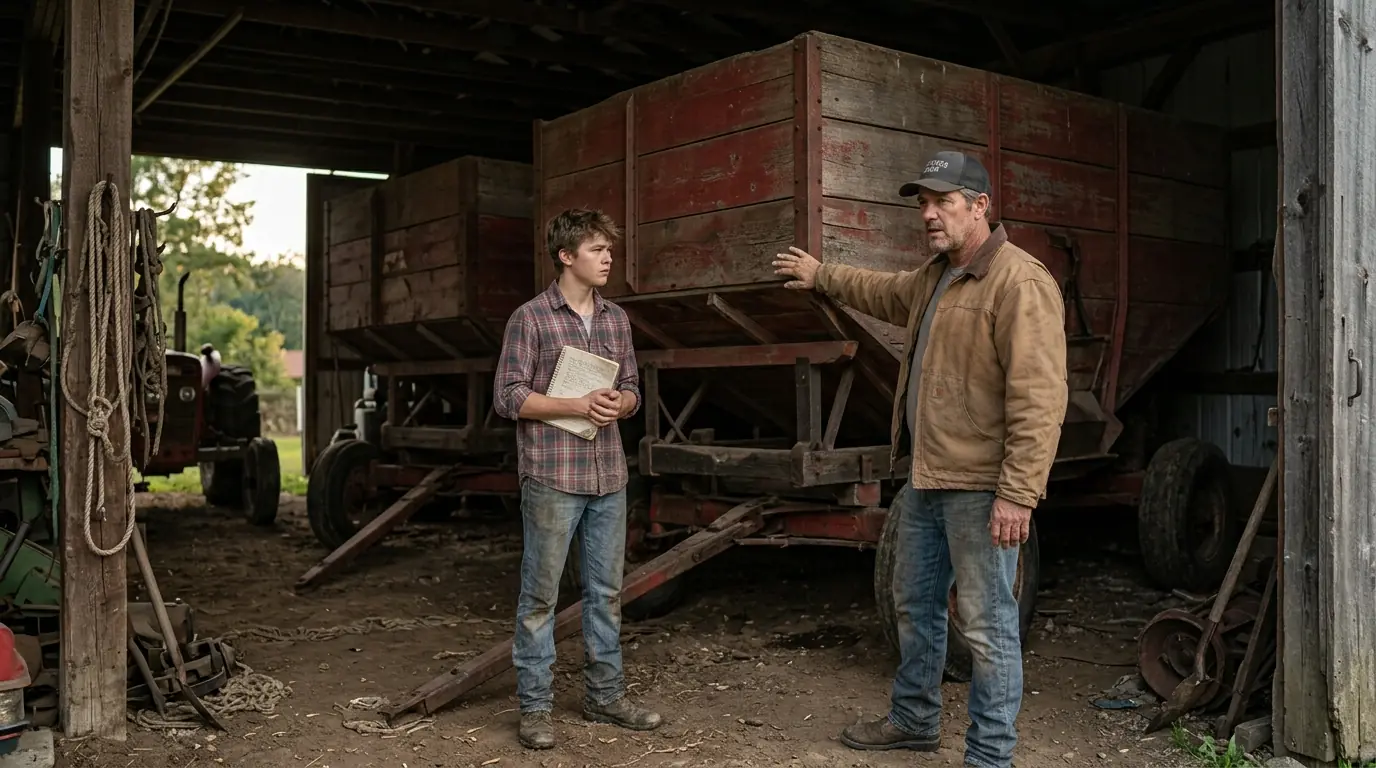
They stood along the back of the weathered machine shed beneath a strip of afternoon light. Their faded red sideboards looked brown in the shadows, and their hopper bottoms sloped toward discharge gates stiff with rust.
Eli had climbed into those boxes before he was tall enough to see over them.
Now a stranger had looked at all three and asked about a tire.
Dale came back inside, folded the rag, and set it beside the vise.
“You heard?”
Eli nodded.
His father waited, giving him a chance to say whatever was already forming on his face.
Instead, Eli asked, “Monday?”
“First thing.”
“That’s four days.”
“It’s enough.”
Dale picked up a wrench and returned to the piece of machinery he had been repairing for a neighbor. He had already worked most of the day outside, and the dust on his shirt had darkened where sweat had dried.
Eli looked toward the wagons again.
“Did you try selling them?”
His father’s hand stopped.
“They were listed.”
“I mean as wagons.”
“That’s how they were listed.”
“Maybe the pictures—”
“Eli.”
The boy swallowed the rest.
Dale turned back to the workbench. “If you want to help, find the socket I asked for.”
Eli searched the tray, found it, and placed it in his father’s open hand.
Neither spoke again until the light coming through the doorway had moved across the floor.
Outside, the summer evening settled over the farm in Juniata County, Pennsylvania. The hills beyond the fields softened in the heat, and the smell of cut grass drifted through the shed with the faint sweetness of the creek bottom.
The place still looked like a farm that could keep going.
That was part of what made the trouble difficult to explain.
The house stood where it always had. The barn roof remained above the same stone foundation. The fields were planted, the garden was growing, and the mailbox still leaned toward the road despite Dale straightening it every spring.
But things had begun to disappear.
At first, Eli had noticed empty spaces without asking about them. An implement gone from beneath the lean-to. A trailer no longer parked near the fence. A box of spare parts carried away by someone who handed his father folded cash.
Then he began noticing smaller changes.
Dale stopped buying bolts unless a repair required them. His mother checked the weather before deciding whether to run the dryer. Meals stretched into leftovers, and leftovers became lunch in reused containers.
Nobody announced that they were in trouble.
They simply adjusted.
Eli was seventeen, old enough to understand that adjustment had limits and young enough to believe there ought to be a way around them.
His father was forty-eight, with weathered features that made him look older when he was tired. Lately, he seemed tired before the day even began.
That night, Dale came to the supper table after everyone else had finished half their meal.
He washed his hands at the sink and stood there longer than necessary, letting the water run over a scrape across his knuckles.
“Neighbor picking that piece up tomorrow?” Eli’s mother asked.
“If I get the fitting loose.”
“Will he pay when he comes?”
Dale turned off the tap.
“He said he would.”
Eli looked down at his plate.
His mother nodded once, then passed Dale the potatoes.
There was no argument. No one said what the money was needed for. That silence told Eli more than a discussion would have.
After supper, he went back to the shed.
The air inside had cooled, but the timber still held the day’s heat. He opened the wider door and stood looking at the wagons, trying to see what the scrapyard man had seen.
There was rust.