Walter Hayes heard the tractor before he saw it.
The engine’s deep, measured rhythm rolled from behind the auction barn like a voice calling across twenty-nine years. It was not merely the sound of an old diesel working under load. It was the slight uneven pulse between the second and third cylinders, followed by a low metallic vibration that appeared only when the throttle rose above idle.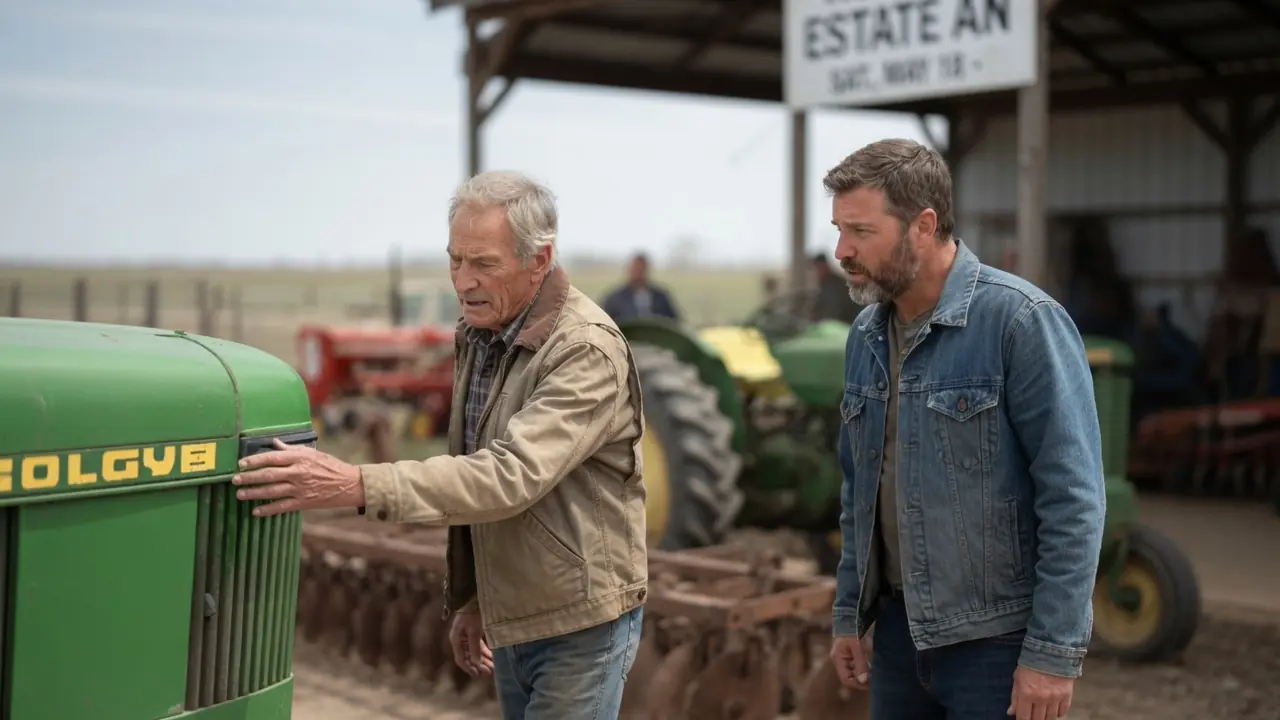
Walter stopped walking.
His son, Thomas, nearly collided with him.
“What is it?” Thomas asked.
Walter lifted one hand for silence.
Beyond the machinery shed, an auction employee drove a green tractor toward the display line. Its paint was brighter than any machine of that age should have been, and the yellow wheels appeared freshly restored. A wide front axle had replaced the narrow configuration Walter remembered, while newer lights and a different seat disguised much of its original appearance.
But the sound remained.
Walter’s chest tightened.
“That tractor,” he whispered.
Thomas followed his gaze. “What about it?”
Walter did not answer.
He crossed the muddy auction yard slowly, moving past wagons, plows, grain augers, and groups of farmers drinking coffee from paper cups. The sign above the open shed read Rush County Estate Auction, Saturday, May 18. Nearly two hundred people had gathered to bid on machinery from the estate of Harold Mercer, a retired farmer who had died the previous winter.
Walter had never met Harold.
He attended only because Thomas wanted to inspect a used planter listed in the catalog. At seventy-four, Walter rarely purchased equipment and had gradually transferred most farm decisions to his son. He expected to spend the morning offering unwanted advice, drinking weak coffee, and complaining privately about auction prices.
Then the tractor drove past him.
The employee parked it beside an old red Farmall and climbed down. A white auction number, 214, had been taped to the hood. According to the printed catalog, it was a 1968 John Deere 4020 diesel with unknown hours, recent paint, and no title history available.
Walter approached the left side.
His hand hovered above the hood but did not touch it.
Thomas stood behind him. “Dad?”
“I know this machine.”
“There were thousands of 4020s.”
“I know.”
Walter walked toward the rear axle.
In 1978, his father, Joseph Hayes, had cracked the left mounting bracket while pulling a heavy disk through frozen ground. Replacement parts were expensive, and Joseph believed nearly anything made of steel could be repaired by a patient man with a welding torch. He ground the fracture into a crescent shape, filled it in several passes, and left a distinctive raised scar beneath the axle housing.
Walter knelt.
The metal had been painted over, but the curved ridge remained.
He touched it with two fingers.
For an instant, he was thirty years old again, standing beside his father inside their drafty workshop while sparks struck the concrete floor. Joseph had warned him never to cool a heavy weld too quickly. Walter had complained that the repair looked ugly.
“Ugly steel can still carry weight,” Joseph replied.
The memory returned so clearly that Walter had to close his eyes.
Thomas crouched beside him. “What did you find?”
“My father made that weld.”
“You’re certain?”
“I watched him do it.”
Thomas examined the scar. “Someone else could have repaired one the same way.”
Walter stood and moved toward the steps.
The tractor had once carried a small dent below the instrument panel where Walter dropped a heavy wrench during a clutch repair. The panel now wore fresh paint, but when he leaned beneath the steering column, he found the shallow depression exactly where it should have been.
His breathing changed.
On October 12, 1995, Walter had parked his John Deere 4020 inside the machine shed after hauling the final wagon of soybeans. The next morning, the shed door stood open, a chain had been cut, and the tractor was gone.
Nothing else had been taken.
The sheriff’s office found tire tracks leading toward the county road, but rain erased them before investigators could identify the hauling vehicle. Walter provided the serial number, photographs, repair records, and every identifying mark he could remember. Notices were sent to dealerships and agricultural auctions across Iowa, Missouri, Nebraska, and Illinois.
No trace appeared.
The insurance company paid part of the tractor’s value, though not enough to replace what had been lost. Walter purchased a newer used tractor and continued farming because crops did not wait for grief. Yet the stolen 4020 remained different from any other financial loss.
Joseph had bought it in 1971.
Walter learned to plow with it, proposed to his late wife beside it, and brought Thomas home from the hospital in a pickup that followed the tractor during spring field work. After Joseph died, the 4020 became one of the few objects still carrying the marks of his hands.
For several years, Walter searched every machinery listing he could find.
Eventually, he stopped.
Now the tractor stood beneath an auction number at a stranger’s estate sale.
Walter climbed onto the platform and looked at the instrument panel. The hour meter had been replaced. Several switches were newer, and a metal plate beneath the dashboard appeared to have been covered by a welded patch.
That was not normal.
“Please step away from the equipment.”
Walter turned.
A broad-shouldered man in a denim jacket approached from the auction office. He appeared to be in his mid-forties, with a trimmed beard and the tired expression of someone managing too many details. His name badge read Daniel Rush, Auction Manager.
Walter climbed down.
“Who consigned this tractor?” he asked.
“It comes from the Mercer estate.”
“How long did Harold Mercer own it?”
Daniel glanced toward the catalog in Walter’s hand. “The estate paperwork doesn’t provide a purchase date.”
“I believe this tractor was stolen from my farm in 1995.”
Daniel looked at him without speaking.
Thomas stepped closer. “My father reported a John Deere 4020 stolen twenty-nine years ago.”
Daniel exhaled slowly. “Sir, every auction involving old equipment attracts someone who thinks a machine once belonged to him.”
“I do not think it.”
“You recognized a common model.”
“I recognized my father’s weld.”
Walter pointed toward the rear axle.
Daniel glanced at the scar but did not inspect it closely. “There are repaired tractors all over this property.”
“There is also a dent beneath the steering column and a hidden serial plate someone covered.”
That caught Daniel’s attention.
He looked toward the dashboard, then back at Walter. “Do not remove or damage anything.”
“I need to see the number.”
“You need documentation before interfering with an estate sale.”
“I filed a police report.”
“In 1995.”
“Yes.”
Daniel’s tone became firmer. “Then bring the report, photographs, serial number, and proof of ownership. Until then, this tractor belongs to the estate.”
Walter looked toward the registration booth. “The bidding begins in less than an hour.”
“That is correct.”
“You intend to sell a machine that may still be listed as stolen?”
“I intend to conduct an auction using the ownership documents provided to my company.”
“There are no ownership documents.”
“Farm tractors do not carry titles in the same way road vehicles do.”
“Then you have even more reason to verify it.”
Daniel folded his arms. Several nearby bidders had begun listening.
“You cannot stop someone’s auction with an old story because a machine looks familiar,” Daniel said. “We have employees, buyers, and a family depending on this sale.”
Walter felt humiliation rising through him.
Daniel was not shouting, but his words carried far enough for others to hear. A few men exchanged amused looks. To them, Walter was an elderly farmer confusing memory with evidence.
Thomas stepped between them slightly. “We can call the sheriff.”
“You are welcome to,” Daniel replied. “But until law enforcement gives me a lawful reason to remove the tractor, lot 214 remains scheduled.”
Walter looked at the bright green hood.
The paint was wrong.
The wheels were wrong.
But beneath those changes, the machine carried his father’s repair, the dent from his own wrench, and the engine note he had heard across thousands of hours. He had spent twenty-nine years wondering where the tractor went and whether it had been dismantled for parts.
He was not leaving.
“Thomas,” he said, “call your mother’s old filing cabinet.”
Thomas frowned. “The cabinet?”
“The farm insurance records are in the bottom drawer. Your wife has a key to the house.”
“You think the original report is still there?”
“I never threw it away.”
Thomas moved away to make the call.
Daniel watched him go. “Sir, I am asking you not to create a disturbance.”
“I’m standing beside a tractor.”
“You have already told several people it was stolen.”
“I told you.”
“Everyone nearby heard.”
Walter looked toward the growing crowd. “Then perhaps you should postpone the sale until the number is checked.”
Daniel’s jaw tightened. “Do you understand what happens if I stop an auction every time someone makes an unsupported claim?”
“Do you understand what happens if you knowingly sell stolen property?”
The tension between them sharpened.
Daniel pointed toward the registration building. “Wait there while you gather your paperwork. If you touch this tractor again, I will have security remove you.”
Walter stared at him.
“Remove me?”
“If necessary.”
For a moment, anger nearly overcame judgment.
Then Walter remembered Joseph’s voice.
Ugly steel could still carry weight, but only if the heat was controlled.
Walter stepped back.
“I will wait,” he said.
Daniel nodded once and walked away.
Thomas returned ten minutes later. His wife, Emily, had found the old insurance file, but the documents were too faded to read clearly by phone. She would photograph every page and send them as soon as possible.
“Did you call the sheriff?” Walter asked.
“The county dispatcher is sending Deputy Rachel Monroe.”
“Good.”
Thomas studied his father. “Are you absolutely certain?”
Walter looked at him.
Thomas raised both hands. “I believe you. I’m asking because once the deputy arrives, this becomes serious.”
“It was serious when they cut the chain in 1995.”
They waited beside a row of hay wagons.
The auctioneer began selling small equipment near the barn. His amplified voice moved rapidly through the crowd while assistants raised numbered cards and recorded bids. Walter barely heard any of it.
People continued approaching lot 214.
Some opened the hood, checked the tires, and climbed onto the seat. Walter felt an irrational urge to stop each one from touching the tractor. For decades, it had existed in his memory as something frozen on the night it vanished.
Now strangers leaned against it while discussing value.
An older bidder named Frank Dorsey recognized Walter and approached.
“I heard you’re claiming that 4020.”
“I am.”
“Harold Mercer ran it for at least twenty years.”
“How do you know?”
“I saw him using it.”
“Did he ever say where he bought it?”
Frank scratched his chin. “He said a dealer down in Missouri found it for him.”
“When?”
“Late nineties, maybe.”
Walter’s heart accelerated. “Was it green then?”
Frank looked toward the tractor. “No. It was yellow.”
Thomas stared at him. “Yellow?”
“Industrial paint. Ugly thing. Harold repainted it green about ten years ago.”
Walter walked quickly toward the machine despite Daniel’s warning.
Thomas followed.
Near the rear fender, beneath the fresh green paint, a chipped section exposed another layer. Walter scraped it gently with his thumbnail. Yellow appeared underneath.
Below the yellow was a thin line of original John Deere green.
Someone had repainted the tractor soon after stealing it.
Daniel saw them from across the yard and came toward them with two auction employees.
“I told you not to touch it.”
Walter stood. “It was painted yellow before Mercer bought it.”
Daniel looked toward Frank.
Frank nodded. “That’s true.”
“So what?” Daniel asked.
Walter pointed toward the exposed layers. “The tractor was green when stolen. Repainting a stolen machine is an easy way to change its appearance.”
“That remains speculation.”
A patrol vehicle entered the auction yard.
Deputy Rachel Monroe parked beside the office and stepped out. She was in her early forties, with dark hair pulled beneath her uniform hat. Daniel walked toward her before Walter could speak.
Rachel listened to both men separately.
Walter explained the theft, the repair scar, the dent, the covered serial plate, and the engine sound. Daniel explained that the estate had possessed the tractor for decades and no active ownership dispute had been disclosed. Rachel remained neutral.
“Do you have the original serial number?” she asked Walter.
“My daughter-in-law is sending the report.”
“Without that, we cannot compare anything.”
“The plate is beneath the dashboard.”
Daniel interrupted. “There is no visible plate.”
“Because someone covered it,” Walter said.
Rachel examined the metal patch beneath the steering column. It appeared to be a thin plate attached with two small welds, positioned exactly where the factory identification number should have been.
“Who approved this tractor for sale?” she asked Daniel.
“We use information supplied by the estate representative.”
“Who is the representative?”
“Harold Mercer’s nephew, Luke.”
“Is he here?”
Daniel looked toward the registration building. “He should be.”
Luke Mercer was found near the food trailer.
He was thirty-nine, thin, nervous, and clearly overwhelmed by the auction. When Rachel asked about the tractor, he shook his head immediately.
“I know nothing about it. Uncle Harold owned it before I was born.”
“You were born after 1995?” Thomas asked.
“1996.”
“Did your uncle keep purchase records?”
“Maybe in the farmhouse.”
Daniel looked frustrated. “Luke, you signed a declaration that the estate owned every item being sold.”
“It did own them.”
“Possession does not answer how they were acquired,” Rachel said.
Luke’s face went pale. “Are you saying my uncle stole it?”
“No one has established that.”
Walter studied the young man.
Luke appeared frightened rather than deceptive. If Harold Mercer purchased the tractor from a Missouri dealer, he might never have known its history. Walter had imagined confronting a thief for twenty-nine years, but the dead man connected to the tractor might have been another victim.
The photographs finally arrived on Thomas’s phone.
Emily had sent twelve images from the original sheriff’s report. One page listed the serial number.
T213R 129684R
Walter remembered the final six digits before Thomas read them aloud.
Rachel photographed the document and contacted dispatch. The county’s modern database did not immediately display records from 1995, but archived theft reports could be accessed through the state system.
“The record search may take time,” she said.
“The tractor could be sold before then,” Walter replied.
Rachel looked toward Daniel. “I recommend placing a temporary hold on lot 214.”
Daniel’s face hardened. “A recommendation?”
“I do not yet have enough evidence to seize the tractor. But selling it after being notified of a credible stolen-property claim would create legal risk.”
The auctioneer’s voice continued across the yard.
Daniel checked his watch. “The tractor section begins in twenty minutes.”
“Then remove this lot until the number is confirmed.”
He looked toward Luke.
The estate representative appeared near panic. “Hold it. I don’t want trouble.”
Daniel exhaled sharply.
“All right. Lot 214 is postponed.”
Walter felt no relief yet.
The number beneath the plate still had to match.
Rachel requested permission from Luke to expose the serial plate. Luke agreed. Daniel objected to using grinders or tools that might damage the tractor, so Thomas retrieved a small hammer and chisel from his truck.
Walter knelt beneath the dashboard.
His hands were not as steady as they had been twenty-nine years earlier. Thomas offered to do the work, but Walter shook his head. The plate covered something that belonged to both his past and his father.
He tapped the chisel against the first weld.
Metal cracked.
The auction continued nearby, but more people abandoned the bidding to watch. Within minutes, nearly fifty farmers formed a semicircle around the tractor.
Daniel stood with his arms crossed.
Luke stared at the ground.
Walter broke the second weld and lowered the thin cover.
A factory serial plate appeared beneath layers of dirt and paint.
Someone had scratched across several numbers, but the stamping remained deep enough to read after Rachel cleaned it with a cloth.
She called each character aloud.
“T. Two. One. Three. R.”
Walter closed his eyes.
Rachel continued.
“One. Two. Nine. Six. Eight. Four. R.”
Thomas released a breath.
The number matched.
Nobody spoke for several seconds.
Then Rachel’s radio crackled.
Dispatch confirmed that serial number T213R 129684R had been reported stolen by Walter Hayes on October 13, 1995. The case was inactive but never closed, and no recovery had ever been recorded.
Rachel placed one hand on the tractor.
“This machine is now evidence in a stolen-property investigation. It cannot be sold.”
The crowd erupted in murmurs.
Daniel’s face changed completely.
He looked at Walter, then toward the tractor. “Mr. Hayes, I owe you an apology.”
Walter stood slowly. “You owe the truth more attention than you gave it.”
Daniel accepted the rebuke.
Luke Mercer appeared close to tears. “What happens to the estate?”
Rachel answered carefully. “That depends on the ownership history, insurance settlement, and whether Mr. Hayes still has a legal claim after compensation.”
Walter had not considered that.
The insurance company had paid part of the tractor’s value in 1996. Legally, it might have acquired an interest in the recovered machine. Twenty-nine years of repairs and improvements by Harold Mercer also complicated ownership.
Finding the tractor did not mean simply driving it home.
The investigation took three weeks.
Harold Mercer’s farmhouse contained old records stored inside a metal cashbox. Among them was a handwritten receipt showing that he purchased the tractor in 1998 from Prairie Agricultural Exchange in northern Missouri. The business closed in 2003 after its owner, Calvin Rusk, was convicted of trafficking stolen construction equipment.
Additional records linked Rusk to a transportation company operating near Walter’s county in 1995.
The man who stole the tractor had likely sold it through Rusk’s operation after repainting it yellow and hiding the serial plate. Harold paid a fair market price and had no known reason to suspect theft. He repaired the tractor, used it for more than two decades, and left it with the rest of his estate.
Harold had been innocent.
So was Luke.
The insurance company still existed but had merged twice since the original claim. After reviewing the case, it asserted ownership based on the payment made to Walter. However, the company also acknowledged that storage, transport, and litigation would cost more than the tractor’s current market value.
It offered Walter a settlement.
He could repay the original insurance amount adjusted only for the policy’s recovery clause, and the company would release its claim. The figure was substantial but not impossible.
Thomas expected his father to agree immediately.
Walter did not.
He visited Luke Mercer at the farmhouse.
Luke was cleaning rooms before the property sale and appeared surprised when Walter knocked. The two men sat in Harold’s kitchen, surrounded by packed boxes and empty shelves.
“My uncle loved that tractor,” Luke said.
“So did my father.”
Luke nodded. “I found photographs.”
He opened an envelope.
The first picture showed Harold driving the yellow tractor through a cornfield. Another showed him repainting it green with two young boys standing nearby. The final photograph showed Harold and Luke beside the machine during the teenager’s first attempt at pulling a wagon.
Walter examined the pictures slowly.
The tractor had carried memories for both families.
“I thought finding it would feel different,” Walter said.
“How?”
“Like recovering something stolen.”
“Isn’t that what happened?”
Walter looked toward the empty yard. “The man who stole it is gone. My father is gone. Your uncle bought it honestly and spent twenty-six years taking care of it.”
Luke lowered his eyes. “The estate could not afford to repay the insurance company.”
“I know.”
“Then you’ll take it.”
“I have the right to.”
Luke nodded, though disappointment appeared across his face.
Walter returned the photographs. “But having the right does not always answer what a man should do.”
Two days later, everyone gathered at the county evidence lot.
Daniel Rush attended after asking permission. Rachel brought the release papers. Thomas stood beside Walter, while Luke remained several feet away with his hands inside his jacket pockets.
The insurance representative completed the final transfer.
Walter had paid the required amount.
The tractor legally belonged to him again.
Rachel handed him the keys.
Walter walked toward the machine and rested one hand against the hood. The green paint was newer, but beneath it remained the yellow disguise, the original factory finish, his father’s welded scar, and twenty-nine years of life he had never witnessed.
He climbed onto the seat.
The engine started after two turns.
That familiar rhythm filled the lot.
Walter drove one slow circle, testing the steering and brakes. When he returned, Luke was wiping his eyes.
Walter shut down the engine.
“Your uncle kept it running,” he said.
Luke nodded.
“He changed the seat.”
“He said the original nearly broke his back.”
Walter smiled. “My father said the same thing.”
He climbed down and held out the keys.
Luke stared at them.
“What are you doing?”
“You are taking it home.”
Thomas looked at his father in disbelief.
Luke stepped back. “I can’t accept that.”
“You are not receiving ownership.”
Walter pointed toward a trailer parked beside Thomas’s truck.
“The tractor will be restored at our farm. We are removing the yellow paint carefully, preserving your uncle’s repairs, and returning the body to its original appearance.”
Luke listened without understanding.
Walter continued. “After restoration, it will spend planting season at our farm and harvest season at yours.”
“Mine?”
“You still farm the south eighty?”
“Yes.”
“Then the tractor will work both properties.”
Luke looked toward Thomas.
Thomas smiled slowly as he understood.
Walter placed the keys inside Luke’s hand. “Your uncle did not steal my father’s tractor. He protected it without knowing where it belonged. That deserves recognition.”
Daniel Rush lowered his head.
“I judged you at the auction,” he said to Walter. “I thought you were confused.”
“You were protecting your sale.”
“I was protecting it before protecting the truth.”
Walter looked at him. “Then remember the difference next time.”
Daniel nodded.
The restoration took six months.
Thomas removed the newer paint while preserving markings beneath it. Walter rebuilt the fuel system, repaired the wiring, and replaced worn seals. Luke brought Harold’s service records, allowing them to identify every modification made after 1998.
They did not erase Harold’s history.
A small brass plaque was placed beneath the dashboard.
Joseph Hayes purchased this tractor in 1971. Walter Hayes farmed with it until its theft in 1995. Harold Mercer unknowingly purchased it in 1998 and cared for it for twenty-six years. Recovered in 2024, it now serves both families.
The crescent-shaped weld remained untouched.
On the first spring morning after restoration, Walter drove the tractor into the same field where his father had once taught him to plow. Thomas followed with the planter while Walter handled a light disk that required far less power than the 4020 could provide.
He did not care.
The engine sounded exactly as he remembered.
Near the field entrance, Luke stood beside his pickup with a photograph of Harold in his jacket pocket. Daniel Rush had also come, carrying no auction catalog and making no announcement.
Walter completed one pass before stopping.
Thomas climbed onto the step.
“How does it feel?”
Walter looked across the fresh earth.
“I spent twenty-nine years thinking the thief took everything connected to this machine.”
“He took the tractor.”
“He took time.”
Walter touched the steering wheel. “But he did not take what Dad taught me. He did not take the memories. And somehow, the tractor created another family’s memories while it was gone.”
Thomas rested one hand on the fender.
“You could have kept it entirely.”
“I did keep it.”
Thomas looked confused.
Walter pointed toward the welded scar.
“I kept the part that mattered before we ever found the machine.”
That autumn, the 4020 worked Luke’s field.
Walter drove over to watch the first day. Luke climbed down and offered him the seat, but Walter shook his head.
“Your turn.”
Luke drove the tractor beneath the October sky while dust rose behind the wagon. The machine no longer belonged completely to one family’s story. It carried the hands of Joseph Hayes, Walter’s lost years, Harold Mercer’s honest care, and Luke’s future.
The theft remained a crime.
Forgiveness did not change that.
But recovery became larger than possession.
Walter had reported his John Deere stolen in 1995 and found it at a stranger’s auction twenty-nine years later. He arrived believing he had recovered a piece of his father.
Instead, he discovered that the machine had been carrying two families through the years, waiting for someone to uncover its number without erasing either one.
The thief had tried to hide its identity beneath yellow paint and welded steel.
He failed.
A serial number endured.
A father’s repair endured.
And when the tractor finally drove home, it did not return to the past.
It carried the past forward.