The phone rang at 11:42 on a cold December night while Harold Whitaker was kneeling on the stairs with a strip of sandpaper in his hand.
He had been fixing the third step from the bottom, the one that had groaned every time his wife, Eleanor, walked down for her morning tea.
She had teased him about it for six months. “One day, Harold, that step is going to complain louder than I do.”
He had promised to fix it before Christmas.
He was late.
His hands were covered in sawdust when the phone rang. At first, he almost let it go. No good news came after eleven at night, and at seventy-two years old, Harold had learned to fear the sound of a late phone call.
But something made him answer.
“Mr. Whitaker?” a woman asked.
Her voice was soft, professional, careful in the way hospital voices are careful when they already know they are about to break a person.
“This is Hartford Mercy Hospital. I’m calling about your wife, Eleanor Whitaker.”
The sandpaper slipped from Harold’s hand.
He tried to speak, but his throat closed.
“I’m so sorry,” the woman said. “Your wife was brought in by ambulance at 11:10. She went into cardiac arrest. The doctors did everything they could, but she didn’t survive.”
For a moment, Harold heard nothing except the ticking of the hallway clock and the unfinished groan of that third stair beneath his knee.
Eleanor was gone.
His Eleanor.
The woman who had made that old house warm for forty-six years.
He did not remember driving to the hospital. He remembered grabbing his coat, forgetting his gloves, and sitting behind the steering wheel with hands that shook so badly he could hardly turn the key.
He had Parkinson’s, mild but stubborn, and his hands trembled often. But this was different. This was not illness. This was grief moving through his bones before his mind could accept what had happened.
At the hospital, a nurse named Angela led him to a quiet room at the end of a pale hallway. Eleanor lay beneath a white sheet, her silver hair brushed back from her face. She looked peaceful, which Harold hated because there was nothing peaceful about the way his heart was breaking.
Her wedding ring was still on her hand.
He noticed that first.
He had bought that ring in 1978 with money from three weeks of overtime at a roofing company. It was a simple gold band, nothing fancy, but Eleanor had worn it every day since.
Harold sat beside her and took her hand.
It was still warm.
That nearly destroyed him.
He told her he was sorry. Sorry he had not fixed the stair sooner. Sorry he had not noticed how tired she had been lately. Sorry he had not said “I love you” that morning when she left to visit her quilting group.
He told her he did not know how to live in that house without her.
Eleanor did not answer.
After a while, the door opened.
Harold did not turn around. He knew the footsteps. Expensive shoes on tile. Fast. Impatient.
“Dad.”
His son, Preston, stood in the doorway wearing a dark wool coat over a business suit. He had his phone in one hand and a distracted expression on his face, as if he had been pulled away from something more important.
He glanced at his mother’s body, then looked at Harold.
“We need to talk about arrangements,” Preston said.
Not “I’m sorry.”
Not “How are you?”
Not even “I can’t believe she’s gone.”
Arrangements.
“Preston,” Harold whispered. “Your mother is gone.”
“I know,” Preston said. “That’s why we need to handle things quickly. Funeral home, service, paperwork, estate matters. I’ll take care of it.”
He looked down at his phone, already scrolling.
Harold felt something cold settle in his chest.
“I don’t care about paperwork right now,” he said. “I care about your mother.”
Preston sighed.
“She’s gone, Dad. The paperwork is what’s left.”
Then he stepped back into the hallway.
“I’ll call you tomorrow.”
He left before Harold could answer.
The elevator chimed a few seconds later. Harold sat beside Eleanor’s bed, still holding her hand, and wondered when his son had become a stranger.
Four days later, Eleanor was buried at St. Andrew’s Church beneath a pale winter sky.
Harold arrived early because he wanted a final moment alone with her, but the casket was already closed. White roses rested on top, and a framed picture from their wedding day stood beside it. Eleanor was twenty-three in that photograph, laughing in a dress she had sewn herself because they could not afford a real wedding gown.
Harold touched the frame and nearly fell apart.
By ten o’clock, the church was full.
Neighbors came. Eleanor’s quilting friends came. Women from the church came. Former students from the elementary school where she had volunteered came. They moved past Harold with soft condolences, but he barely heard them.
Preston and his wife, Vanessa, sat in the front row.
They looked polished, solemn, perfect. Preston wore a black suit and kept one arm around Vanessa’s shoulders. Vanessa dabbed at her eyes with a tissue, though Harold never saw tears.
Harold’s daughter, Julia, sat three rows behind them with her husband, Mark. She looked at her father once, then looked away quickly, as if she could not decide which side of the family line she was supposed to stand on.
Eleanor’s grandson, Tyler, was not there.
When Harold had asked Preston why his sixteen-year-old son was missing, Preston said, “He’s too young for this. Better he remembers Grandma alive.”
Tyler was not too young.
He was old enough to say goodbye.
But Preston had made the decision for everyone.
The pastor spoke kindly but vaguely. He said Eleanor had been devoted, patient, and faithful. All true, but too small. Eleanor had been more than patient. She had been sharp, stubborn, funny, brave, and impossible to fool.
Then Preston stood to give the eulogy.
He walked to the podium with a printed sheet in his hand and the smooth expression of a man about to give a presentation.
“My mother believed in family,” he began. “She believed in responsibility and practical decisions. She taught us that love means doing what must be done, even when it’s difficult.”
Harold looked up sharply.
Practical decisions.
Eleanor hated that phrase.
People had told her to be practical when she planted roses during the year they could barely afford groceries. They told her to be practical when she drove forty miles every Sunday to take soup to her aging mother. They told her to be practical when she spent her savings helping children at the church buy winter coats.
Eleanor had always smiled and done the loving thing anyway.
Preston continued.
“Now we honor her by being realistic about what comes next.”
His eyes moved toward Harold.
“By making smart decisions for the family’s future.”
There it was.
Not grief.
A warning.
After the service, people gathered in the fellowship hall. Harold barely tasted the coffee someone pressed into his hand. He was standing near the side door when Preston approached him.
“We need to talk about the house,” Preston said.
Harold looked at him.
“What about it?”
“It’s time to sell.”
Harold stared.
“That is my home.”
“Was your home,” Preston said. “Dad, you’re seventy-two. You have Parkinson’s. The stairs are dangerous. The yard is too much. You can’t maintain a house like that alone.”
“I built half that house with my own hands.”
“And Mom would want you to be practical.”
Harold’s voice dropped.
“Do not use your mother’s name to push me out of my own home.”
Preston’s face hardened.
“I’m trying to help you.”
“No,” Harold said. “You’re trying to take control.”
For one second, anger flashed in Preston’s eyes. Then his face went calm again.
“We’ll discuss it when you’re thinking clearly.”
He walked away.
Harold’s old friend Frank Miller came up beside him. Frank had worked construction with Harold for nearly forty years and had stood beside him at Eleanor’s funeral like a brother.
“You shouldn’t be alone tonight,” Frank said.
Harold almost refused. Pride rose in him out of habit.
Then he looked toward the parking lot, where Preston was already getting into his black BMW.
“Okay,” Harold said quietly. “Just for tonight.”
The next morning, Harold drove back to his house to pick up clothes, tools, and the family photo albums.
He pulled into the driveway and saw Preston’s truck parked near the garage.
For a moment, Harold let himself hope. Maybe his son had come to apologize. Maybe grief had made him cold, and now that the funeral was over, he would remember who he was.
Harold climbed the porch steps and slipped his key into the lock.
It would not turn.
He pulled it out, checked it, and tried again.
Nothing.
Then he noticed the deadbolt.
New brass.
Shiny.
His son had changed the locks.
Harold knocked.
A minute later, Preston opened the door with a coffee mug in his hand.
“What are you doing here?” he asked.
Harold blinked.
“This is my house.”
Preston leaned against the doorway.
“No, Dad. It isn’t.”
Harold looked past him into the hallway. He could see Eleanor’s reading chair by the window, the bookshelf he had built her for their thirty-fifth anniversary, the blue coat she always left on the hook even though he told her it made the entryway look messy.
“This is my home,” Harold said.
Preston lifted his eyebrows.
“Check the deed. Mom transferred it into her name in 2021. Sole ownership. That means it goes through her estate. And I’m the executor.”
Harold’s stomach dropped.
“She would never—”
“She did.”
Preston reached into his pocket and held out an envelope.
“Here. Five hundred dollars. It should cover a motel for a couple weeks while you figure things out.”
Harold stared at the envelope.
His own son was offering him motel money to leave the home he had shared with his wife for decades.
“I’m not taking that.”
Preston shrugged.
“Suit yourself.”
He started to close the door.
“Preston, wait.”
His son paused.
“You’re trespassing,” Preston said. “Legally, I could call the police. I’m trying to be decent.”
Then he shut the door.
The new lock clicked.
Harold stood on the porch with his useless key in his hand.
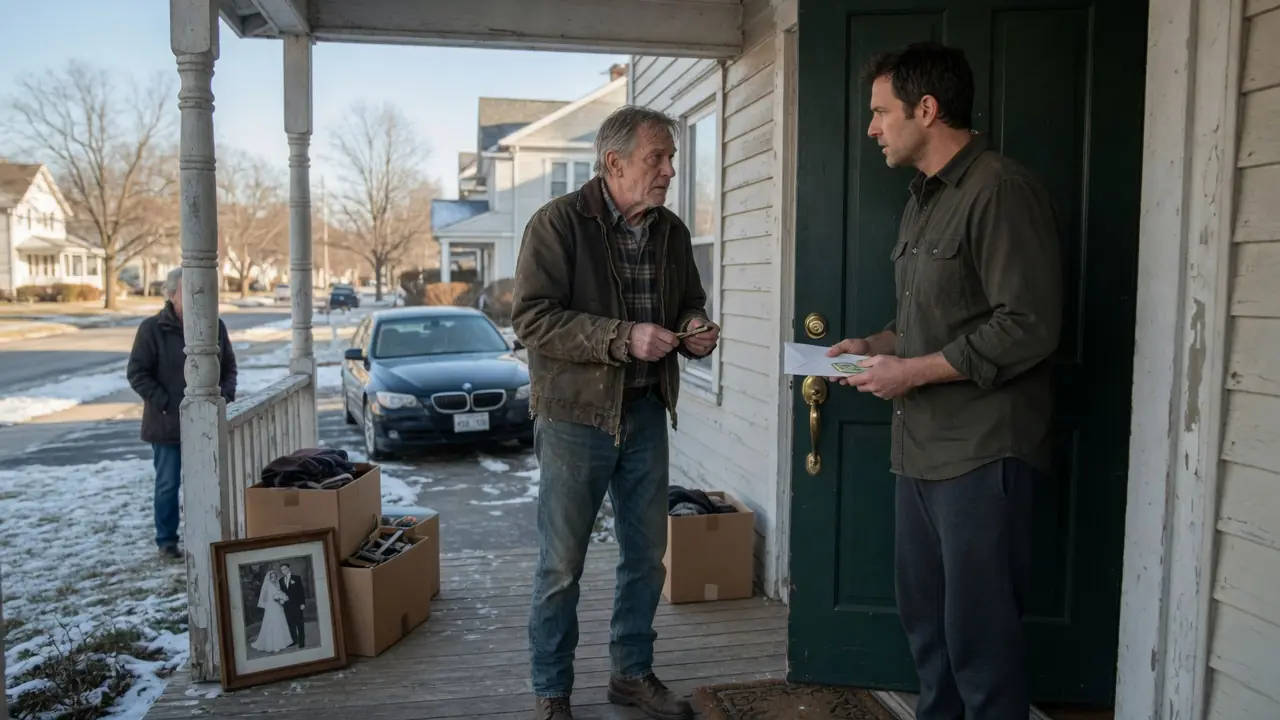
Then he saw the boxes.
Three cardboard boxes sat near the curb as if waiting for trash pickup. Harold walked down slowly, every step feeling unreal.
The first box held his clothes, tossed in without folding. The second held tools: his hammer, his level, the electric sander Eleanor had bought him for his sixty-fifth birthday. The third held photographs.
On top was his wedding photo in a black garbage bag.
The frame was cracked.
The glass was broken.
Harold lifted it out carefully, brushing away the shards. Eleanor smiled from the photograph, young and bright and full of life.
Mrs. Parker from next door stood at the edge of her lawn, staring.
“Harold?” she said softly. “What happened?”
He could not answer.
She looked at the boxes, then at the locked door, and her face tightened.
“This isn’t right.”
“No,” Harold whispered. “It isn’t.”
Mrs. Parker pulled out her phone and took photos of the boxes, the broken frame, and Preston’s truck in the driveway.
“For the record,” she said.
Harold loaded his life into the back of his truck and drove back to Frank’s house.
This time, he did not say he would stay only one night.
For three days, Harold slept on Frank’s couch.
Every morning, he woke and forgot for five merciful seconds. Then he remembered Eleanor was gone, his son had locked him out, and everything he owned was in cardboard boxes in Frank’s living room.
Frank did not ask how long he planned to stay.
He simply made coffee and said, “You have a roof here as long as you need one.”
On the fourth morning, Harold opened the boxes.
He found Eleanor’s gardening journal at the bottom of the photo box. Her careful handwriting filled the pages: lavender by east fence, roses need pruning, Harold says mint is taking over again.
Something was tucked between two pages.
A white business card.
Miriam Hale, Estate Attorney.
On the back, in Eleanor’s handwriting, were six words.
If something happens, call Miriam.
Harold stared at the card.
Frank leaned over his shoulder.
“You better call her.”
The next morning, Harold walked into Miriam Hale’s office carrying the card and the last of his dignity.
The office was on the twelfth floor of a downtown building, with clean windows overlooking Hartford. It looked expensive enough to frighten him, and he almost turned around.
Before he could, the receptionist looked up.
“Mr. Whitaker? Ms. Hale is expecting you.”
Expecting him.
The office door opened, and a woman in her late fifties stepped out. She wore a gray suit and carried herself with the quiet authority of someone who had won many fights without raising her voice.
“Mr. Whitaker,” she said. “I’m Miriam Hale. I’ve been waiting for you.”
Harold sat across from her desk with the business card in his hand.
“You knew my wife?”
“For eleven years,” Miriam said. “Eleanor came to me after a health scare in 2013. It turned out to be nothing serious, but it made her think carefully about what would happen if she died before you.”
Harold swallowed.
“She never told me.”
“She said you would try to fix what she was trying to prevent.”
“What was she trying to prevent?”
Miriam opened a thick file.
“Preston.”
The name landed like a hammer.
“Your wife knew your son had serious financial problems,” Miriam said. “Gambling debts, unpaid loans, failed investments, hidden borrowing. She began documenting everything in 2014.”
Miriam slid a folder across the desk.
Inside were copies of checks, bank transfers, handwritten notes, and receipts.
$18,000 for an investment Preston claimed would double.
$9,000 for business licensing.
$6,500 for emergency medical bills that were never verified.
$14,000 for what Eleanor had written was “probably gambling debt.”
In total, Preston had taken more than $73,000 from his mother over twelve years.
“He never paid her back,” Miriam said. “Not one dollar.”
Harold’s hands trembled.
“I didn’t know.”
“She didn’t want you to know. She believed you would forgive him, help him, and give him access to more.”
“I would have tried,” Harold admitted.
“Yes,” Miriam said gently. “That is exactly what she feared.”
Then she showed him the rest.
The house had indeed been transferred into Eleanor’s sole name in 2021, but not to give it to Preston. It had been moved into a protected estate structure designed to pass directly to Harold after Eleanor’s death.
Preston could not touch it.
Eleanor had also opened a savings account in her own name, built from bookkeeping work Harold never realized she had taken so seriously. There was $186,000 in it. She had a life insurance policy worth $450,000, naming Harold as beneficiary. Stocks, bonds, and retirement accounts brought the total estate to over $1.3 million.
Harold sat back, unable to speak.
For years, he had thought Eleanor was simply keeping busy with part-time work.
She had been building a fortress.
“There is also a defense fund,” Miriam said. “Fifty thousand dollars set aside for legal expenses or emergency protection if Preston tried to force you out, have you declared incompetent, or abandon financial obligations connected to your care.”
Harold looked up.
“She thought of that?”
“She thought of everything.”
A week later, the hospital called.
The administrator said there was an unpaid balance of $48,000 for a surgery Harold had undergone earlier that year. Preston had signed as guarantor when Harold was admitted. Now he had refused payment.
“He told our office,” the administrator said carefully, “‘He is not my responsibility anymore.’”
Harold closed his eyes.
Not my responsibility anymore.
Miriam paid the bill from Eleanor’s defense fund that same day.
Then she added Preston’s refusal to the growing case file.
In March, Preston tried another move.
He invited Harold to a church meeting, claiming he wanted mediation. When Harold arrived, he found Preston, Vanessa, a pastor, and a woman introduced as a cognitive specialist sitting in a circle with papers prepared.
Guardianship papers.
Preston told them Harold was confused, unstable, and unable to manage his affairs because of Parkinson’s and grief.
Harold felt the room spin.
Before the woman could begin asking questions, the door opened.
Miriam Hale walked in.
“This meeting is over,” she said.
Preston stood. “This is a private family matter.”
“No,” Miriam said. “This is attempted elder financial abuse.”
She laid medical records on the table. Harold’s doctor had confirmed his Parkinson’s was mild and his cognitive function normal. A neuropsychological evaluation showed no impairment. Bank records showed Harold had managed his bills responsibly.
Then Miriam produced copies of the forged power of attorney Preston had filed weeks earlier.
The specialist shut her folder.
“This is not what I was told,” she said.
The pastor’s face turned pale.
Mrs. Parker, the neighbor, had come too. She stood in the back with photos of Harold’s boxes on the curb and the broken wedding frame.
“This man was thrown out of his own home the day after burying his wife,” she said. “He is not incompetent. He is being robbed.”
Preston left the church red-faced and furious.
Two nights later, Frank’s garage was spray-painted with one word: LIAR.
Security cameras caught Preston’s BMW in the driveway at 2:17 a.m. They caught him smashing windows, kicking over the mailbox, and driving away.
The police took the report. Miriam added it to the file.
Then, in April, Harold received a message from someone he never expected.
His grandson, Tyler.
Grandpa, I need to talk to you. Please don’t tell Dad.
Harold had not seen Tyler in five years. Preston had slowly cut off contact, claiming Tyler was busy with school, sports, friends, anything that kept him away from his grandparents.
They met at a small diner on Main Street.
Tyler was seventeen now, tall and nervous, with Preston’s jaw but Eleanor’s eyes. He slid into the booth across from Harold and placed an old phone on the table.
“Grandma gave me this in 2019,” he said. “She told me to hide it. She said when the time came, I’d know what to do.”
Harold stared at the phone.
Tyler opened an audio file.
Preston’s voice filled the booth.
“Once the old man is out of the way, we get everything. The house, the insurance, the savings. If he doesn’t cooperate, we’ll have him declared incompetent. Parkinson’s makes it easy.”
Vanessa’s voice answered, “What about Julia?”
“She’ll side with me,” Preston said. “She always does.”
Harold felt sick.
Tyler’s eyes were wet.
“I recorded it because Grandma asked me to,” he said. “She knew Dad would do this.”
“Would you be willing to tell the truth in court?” Harold asked.
Tyler did not hesitate.
“Yes.”
In May, Julia came to Frank’s house crying.
Preston had told her Harold was unstable, addicted to pain medication, and trying to destroy the family. For months, she had not known whom to believe.
Harold played Tyler’s recording.
Julia sat with both hands over her mouth.
When the recording ended, she whispered, “He told me he needed money for Mom’s funeral. I gave him $25,000.”
Harold closed his eyes.
Preston had done it to all of them.
Julia cried for a long time. Then she took Harold’s hand.
“I’m with you, Dad,” she said. “I should have asked sooner. I’m sorry.”
“You’re here now,” Harold said.
That was enough.
By June, Preston was desperate.
Three nights before the will reading, he came to Frank’s house drunk and pounding on the door.
“You think you won?” he shouted from the porch. “You think some paper from Mom changes anything?”
Frank called the police.
Harold stood on the other side of the door.
“Go home, Preston.”
“I need to talk to you.”
“No,” Harold said. “You needed to talk when your mother was alive. You needed to talk before you changed my locks. Before you threw my wedding photo in the trash. Before you tried to call me incompetent.”
The police arrived before Preston could leave.
He was arrested for disorderly conduct and violating warnings from the previous incidents.
As Officer Sullivan led him to the cruiser, Preston looked through Frank’s front window and met Harold’s eyes.
For one second, Harold saw the boy he had raised.
Then the officer guided him into the car.
The will reading took place on June 20th in Miriam Hale’s conference room.
Harold arrived with Frank beside him. Julia came with her husband and children. Tyler came alone and sat next to Harold. Miriam had arranged for an officer to be nearby, just in case.
Preston walked in five minutes late with Vanessa and an attorney.
He looked exhausted but still smug.
At one point, he leaned across the table and whispered to Harold, “Enjoy pretending you matter. I made sure you get nothing.”
Harold said nothing.
Miriam opened a leather folder.
“We are here for the reading of the last will and testament of Eleanor Grace Whitaker.”
Preston folded his arms.
“Let’s get on with it.”
Miriam looked at him calmly.
“There is one final section of the will that must be presented before distribution.”
She nodded to her assistant.
A video appeared on the screen.
Eleanor.
Alive.
Sitting in the very conference room where they now gathered.
Harold forgot how to breathe.
Eleanor wore her blue cardigan. Her hair was neatly pinned. She looked thinner than he remembered, but her eyes were clear and strong.
“Hello, my family,” she said.
Julia began to cry.
Tyler reached for Harold’s hand.
“If you are watching this, then I am gone. I am sorry for the pain this day brings, but I need the truth to be spoken clearly.”
Eleanor looked directly into the camera.
“For eleven years, I have known that my son, Preston, had a gambling problem. I have known about the lies, the unpaid loans, the forged paperwork, and the plans he made to take control of Harold’s life after my death.”
Preston’s face drained of color.
“This is ridiculous,” he muttered.
His lawyer placed a hand on his arm.
Eleanor continued.
“Harold, my love, I am sorry I kept secrets from you. I did it because you have a heart that forgives too quickly. You would have tried to save Preston until there was nothing left of you.”
Harold closed his eyes.
“But I could not let him destroy you,” Eleanor said. “So I planned. I saved. I documented. I protected our home.”
She held up a folder.
“The house at 523 Maple Drive is not Preston’s. It passes directly to Harold. The life insurance, savings, stocks, and retirement accounts also pass to Harold. He is to be protected, housed, and financially secure for the rest of his life.”
Preston stood.
“No.”
Miriam’s voice was sharp.
“Sit down.”
Eleanor’s voice continued, steady as stone.
“To Julia, I leave $100,000, my jewelry, my photographs, and my recipe books.”
Julia sobbed into her husband’s shoulder.
“To Tyler, my brave grandson, I leave a $75,000 education trust. You are not your father’s mistakes. You are your own man, and I am proud of you.”
Tyler wiped his face with his sleeve.
Then Eleanor looked into the camera one final time.
“To Preston, I leave $10,000 and a letter. That money is enough to enter treatment for gambling addiction. I leave no more because love without boundaries becomes surrender, and I refuse to surrender Harold’s future to your destruction.”
Preston’s mouth opened, but no sound came out.
“There is one final section,” Miriam said after the video ended.
Tyler placed the old phone on the table.
He pressed play.
The recording filled the room.
Preston’s own voice spoke every plan he had denied: declaring Harold incompetent, forging documents, taking the estate, using Julia, cutting Tyler off, and leaving Harold with nothing.
Vanessa stood and walked out.
Preston’s attorney gathered his papers.
“I can no longer represent you,” he said.
Preston looked around the room. His mother had exposed him. His wife had left. His son would not look away. His sister sat with tears on her face and disgust in her eyes.
Then Preston collapsed.
His knees buckled, and he fell beside the conference table.
Paramedics checked him and said it was shock. They helped him to a chair, but he would not raise his head.
Miriam finished the reading.
Everything Eleanor had planned held.
Harold got the house back. The insurance came through. The accounts transferred. Julia received her inheritance. Tyler’s trust was funded. Preston received his letter and nothing more.
Six months later, Harold sold the big house.
It was too full of ghosts, and Eleanor had already given him permission to live.
He bought a smaller home near Julia, with a workshop behind it and a garden wide enough for lavender. Tyler moved in during his final year of high school. On weekends, Harold taught him carpentry the way he once had when Tyler was a little boy.
Frank visited often. Julia came every Sunday with her children. The house filled with noise again, not the old noise, but good noise. Laughter. Tools. Coffee cups. Children running through the hall.
Preston eventually entered treatment after losing his house and his marriage. He wrote letters. Tyler read some and set others aside. Harold did not hate his son, but he no longer confused love with rescue.
On the first anniversary of Eleanor’s death, Harold planted lavender along the back fence.
He knelt in the soil with Tyler beside him, pressing the roots carefully into the earth. The scent rose into the cool air, soft and familiar.
“She knew everything,” Tyler said.
Harold smiled sadly.
“She knew enough.”
“Do you think she’d be proud of us?”
Harold looked at the lavender, at his grandson’s steady hands, at the workshop light glowing behind them.
“Yes,” he said. “I think she would.”
That evening, Harold placed Eleanor’s restored wedding photo on the mantel. The cracked glass was gone. The frame had been repaired. In the picture, Eleanor still smiled like she knew something good was coming.
Harold touched the edge of the frame.
“You saved me,” he whispered.
But the truth was bigger than that.
Eleanor had saved the family that was still willing to be saved.
She had not done it with anger. She had not done it with revenge. She had done it with patience, evidence, courage, and a love wise enough to build boundaries before destruction arrived.
Harold had once believed family meant forgiving anything.
Now he knew better.
Family was not the person who used your weakness against you. Family was not the child who threw your life into cardboard boxes and called it practicality. Family was not blood without loyalty.
Family was the friend who opened his door at midnight.
The daughter who came back and chose truth.
The grandson brave enough to hold a recording in shaking hands.
And the wife who loved her husband enough to protect him, even after she was gone.
In the spring, the lavender bloomed.
Harold sat on the porch with Tyler beside him, two mugs of coffee cooling between them. The rebuilt workshop stood open, sawdust bright in the morning light. Somewhere inside the house, Julia’s children were laughing.
For the first time since Eleanor’s death, Harold did not feel homeless.
He felt held.
And in the quiet breeze, carrying the scent of lavender through the yard, it almost felt like Eleanor was sitting beside him, smiling because her final plan had worked exactly the way she knew it would.