Marcus Bennett noticed the first red streak on a Monday morning in late June. He had stepped into his driveway carrying coffee when sunlight hit the south-facing roof of his two-story home and revealed something that had not been there the night before. A bright red line ran diagonally across the center of one of his new black solar panels, thick enough to be visible from the ground. At first Marcus thought a bird, roofing contractor, or tree branch had somehow caused it, but there were no trees close enough to reach the roof and no contractor had been scheduled.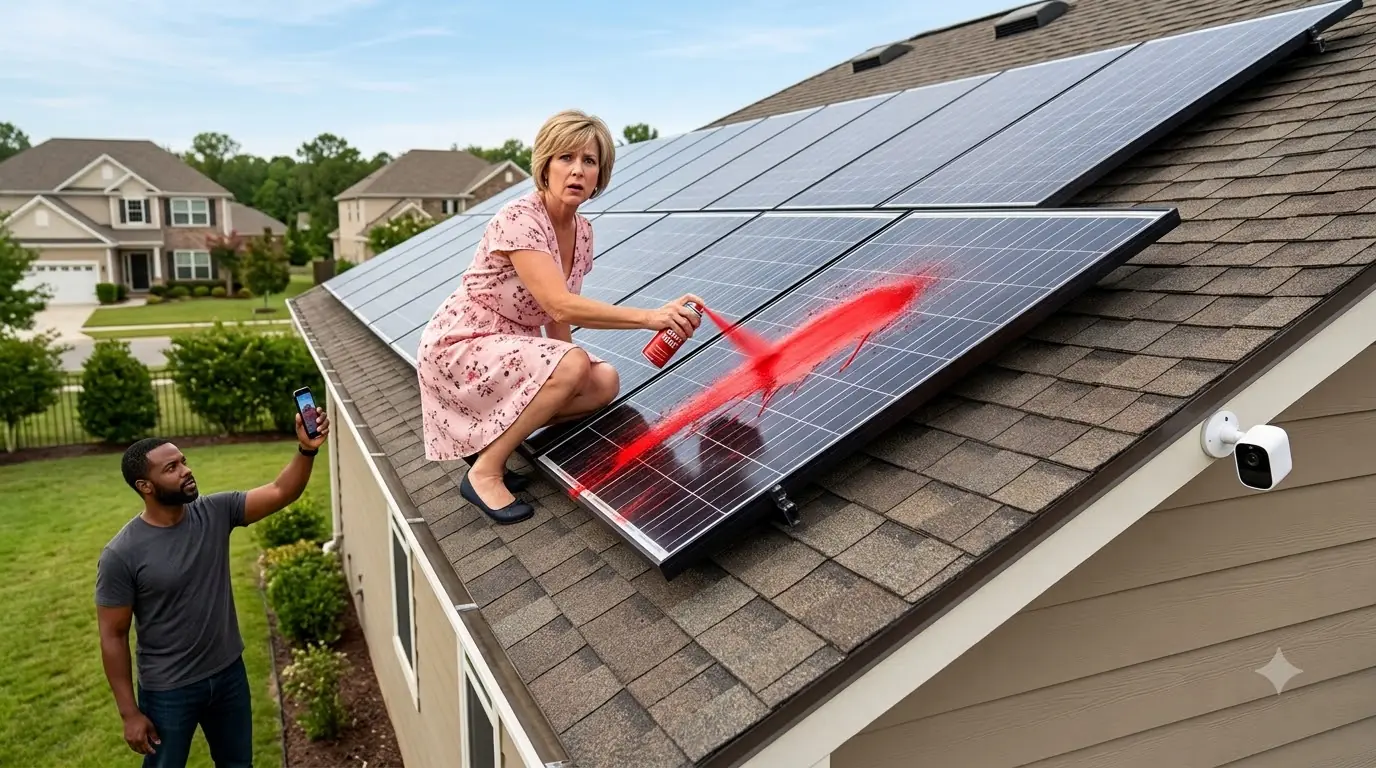
He set his coffee on the hood of his truck and stared upward for almost a full minute. The panels had been installed only six weeks earlier as part of a larger home-energy upgrade that included an electric heat-pump water heater, attic insulation, a smart electrical panel, and battery storage inside the garage. Marcus had spent nearly a year planning the project, obtaining permits, comparing contractors, and submitting every exterior modification required by the Brookhaven Meadows Homeowners Association. He had expected technical problems, inspection delays, perhaps even warranty issues, but he had not expected red paint.
Marcus was forty-two years old, Black American, broad-shouldered, deliberate, and difficult to provoke. He worked as a facilities engineer for a regional hospital network, which meant much of his professional life involved systems that became expensive when people guessed instead of measuring. He believed in logs, photographs, timestamps, inspection reports, and making changes only after understanding the problem. That habit had irritated Linda Carver almost from the day Marcus moved into Brookhaven Meadows.
Linda was fifty-eight, blonde, immaculately dressed, and had served as HOA president for nearly seven years. She favored pale floral dresses, pearl earrings, soft cardigans, and language that made ordinary neighborhood preferences sound like matters of constitutional importance. To residents who agreed with her, Linda was organized and protective of property values. To residents who challenged her, she could become relentless.
Marcus met her during his second week in the neighborhood. She appeared at his front door carrying a binder and welcomed him with a smile before immediately pointing out that the previous owner had left the wrong style of mailbox numbers. Marcus thanked her, ordered the approved numbers, and thought nothing more of it. Three months later, after he installed drought-resistant landscaping along the driveway, Linda sent him his first formal violation.
The plants were not prohibited. The mulch was approved. The landscape border matched the architectural guidelines. Linda nevertheless claimed the arrangement looked “too commercial” and could negatively affect visual continuity. Marcus responded by asking for the exact covenant language supporting the violation.
The notice disappeared two days later without explanation. Marcus assumed that was the end of the disagreement. Instead, he discovered Linda did not forget residents who made her justify decisions.
Over the next year came a series of increasingly peculiar complaints. His garage door had supposedly remained open too long on a Saturday afternoon. His contractor’s van was described as an unauthorized commercial vehicle even though it had been there for less than an hour. His backyard patio lighting was accused of creating excessive nighttime brightness despite being lower wattage than several neighboring properties.
Marcus answered every notice the same way. He stayed polite, cited the rules, attached photographs, and asked for evidence. Most complaints vanished. Linda never acknowledged being wrong.
The solar project changed the relationship completely. Marcus first submitted the architectural application in February, including roof diagrams, panel specifications, electrical drawings, photographs, mounting heights, conduit routes, and the contractor’s license information. State law limited how far an HOA could go in restricting residential solar installations, and Marcus knew the rules before he ever submitted the paperwork. The architectural committee approved the project with minor conditions.
Linda objected anyway. She wrote that black solar panels would “create a visually dominant technological appearance” inconsistent with Brookhaven Meadows’ traditional aesthetic. Marcus responded that the panels were permitted, professionally designed, located on the rear and side roof planes as much as practical, and already approved by the committee. Linda requested reconsideration.
The committee refused. The permit was issued. Installation began three weeks later.
During construction, Linda visited Marcus’s property four times. She photographed the contractor’s ladders, questioned workers about panel placement, asked whether the battery system could be seen from the street, and once attempted to walk into the garage while an electrician was working. Marcus stopped her at the threshold.
“You need to stay outside,” he said. Linda looked offended. “I’m inspecting an HOA-approved improvement.” Marcus shook his head. “You are not the electrical inspector.”
Linda stared at him for several seconds. “You enjoy making simple things difficult.” Marcus answered, “I enjoy keeping uninvited people out of energized work areas.” The electrician behind him covered a smile.
After the system became operational, Marcus’s electric usage from the grid dropped dramatically. During sunny weeks, the house generated almost everything it consumed during daylight hours. The battery shifted excess energy into the evening, reducing peak demand. Marcus liked the numbers more than the environmental symbolism because they represented a measurable improvement in efficiency.
His neighbors noticed too. A retired teacher named Gloria Watkins asked how much the system cost. A young couple three houses down asked whether the battery could power a refrigerator during an outage. Another homeowner wanted the contractor’s information. Within a month, six households had requested solar consultations.
Linda noticed that as well.
At the next HOA meeting she placed “roof-mounted energy systems” on the agenda. She warned that widespread installation could create inconsistent rooflines and pressure homeowners to invest in expensive improvements merely to remain competitive. Marcus sat in the third row listening.
A resident named Harold Klein raised his hand. “Isn’t that what homeowners do? Improve their homes?” Linda replied that improvements should remain consistent with community character. Harold asked, “Does community character mean higher electric bills?”
Several people laughed. Linda did not.
Marcus said nothing during the meeting. He did not need to. The architectural committee had already approved his system, and the law provided additional protection.
Two weeks later, the first red streak appeared.
Marcus called the solar installer before touching anything. A technician named Kevin Morales arrived that afternoon, climbed onto the roof, and confirmed what Marcus had already suspected. It was paint.
“Looks sprayed,” Kevin said when he came down. “Not spilled.” Marcus asked whether the panel was permanently damaged. Kevin said most of the paint could probably be removed, but the cleaning required care because harsh solvents could damage coatings or seals.
Kevin photographed the panel. Marcus did the same. The cleanup cost $285.
Marcus considered the incident strange but did not accuse anyone. He had no evidence explaining how paint reached the roof. He saved the photographs and invoice in a folder labeled SOLAR INCIDENT 1.
Twelve days later, it happened again.
This time two panels had red paint across them. One contained a heavy circular puddle that had dried unevenly, while another carried a long horizontal stripe. The pattern reduced output enough for Marcus’s monitoring application to flag abnormal production.
He called Kevin again.
“Same stuff?” Marcus asked when the technician came down. Kevin nodded. “Looks like it.” Marcus looked at the roof. “Accident twice?” Kevin raised an eyebrow.
Marcus said nothing. Kevin did not either.
Cleanup cost $410.
That evening Marcus installed his first dedicated roof camera. He placed it beneath the rear eave where it could observe the lower solar array and part of the roofline without facing neighboring windows. Another camera covered the side gate. A third watched the driveway.
He told nobody except Dana Whitaker, his attorney and longtime friend. Dana listened while Marcus described the two incidents and asked the obvious question. “Who hates your solar panels?”
Marcus smiled. “One person loudly.” Dana replied, “Loud hatred is not proof.”
“I know.”
“Good. Keep it that way.”
The next incident happened sixteen days later, but the person damaging the panels approached from an angle the camera did not fully cover. Marcus received a motion alert at 6:18 a.m. The roof camera captured a partial figure near the ridge, a hand holding something red, and a splash spreading across a panel.
The face remained outside frame.
Marcus watched the clip repeatedly. The person appeared to be a woman, but that was not enough. He added another camera.
Dana approved of the strategy. “No confrontation yet.” Marcus agreed. “I want a face.”
The fourth incident provided one.
At 7:02 on a Sunday morning, the security system alerted Marcus while he was making breakfast. He opened the live feed and saw Linda Carver on his roof.
For several seconds, Marcus thought he had misidentified her. Then she turned toward the camera.
Short blonde hair. Light pink floral dress. Flat shoes entirely unsuitable for a roof. Red aerosol can in her right hand.
Marcus stared.
Linda crouched beside the upper row of panels with one hand pressed against the shingles. She shook the can, extended her arm, and sprayed a thick line of red paint across the nearest panel.
Marcus stood motionless in the kitchen.
The act felt stranger than he had imagined even after suspecting her. Linda was not a teenager vandalizing property for entertainment. She was the HOA president, nearly sixty years old, crawling across someone else’s roof in a floral dress at seven in the morning with spray paint.
Marcus recorded the live feed separately even though the system automatically stored footage.
Linda sprayed another section.
Marcus walked outside.
He did not shout.
He stood on the back patio and looked upward.
“Morning, Linda.”
Her entire body froze.
For a moment, neither moved.
Then Linda looked down.
Marcus wore a charcoal T-shirt, dark shorts, and house shoes. He held his phone at chest level.
Linda’s expression shifted from shock to anger almost instantly.
“What are you doing out here?”
Marcus nearly laughed.
“This is my backyard.”
She looked toward the gutter.
Then toward the far side of the roof as though calculating how quickly she could leave.
Marcus kept his voice calm.
“Please don’t fall.”
Linda’s face tightened. “I’m not going to fall.”
“Good.”
“What are you doing with that phone?”
“Watching you spray my solar panels.”
Linda looked at the red can in her hand. It was as though she had briefly forgotten it existed.
“This isn’t what you think.”
Marcus raised his eyebrows.
“What do I think?”
Linda stood carefully. “These panels are creating a reflective nuisance.”
Marcus looked at the black glass. “With red paint?”
“The coating reduces glare.”
Marcus stared at her.
“You’re claiming spray paint is an HOA-approved anti-glare treatment?”
She said nothing.
Marcus lifted the phone slightly. “Please keep talking.”
Linda’s eyes narrowed.
“Are you recording me?”
“Yes.”
“You cannot record an HOA officer performing an inspection.”
“You’re on my roof.”
“I have authority to investigate exterior violations.”
“Not by climbing onto my house.”
Linda looked toward the red paint. Then back at Marcus.
“You refused to cooperate.”
“With what?”
“The neighborhood.”
Marcus shook his head.
“That sentence doesn’t mean anything.”
Linda’s voice rose.
“You installed these panels knowing they would change the character of this entire street.”
“They were approved.”
“Because the committee was afraid of the state law.”
“That sounds like a committee problem.”
“You made your house look expensive.”
Marcus paused.
That sentence was different.
“What?”
Linda pointed at the solar array.
“You heard me.”
Marcus lowered the phone slightly.
“No, I want you to say it again.”
She looked down at him.
“These make your house look more expensive than the others.”
Marcus stared.
Linda continued, anger building now that the argument had finally reached the real grievance.
“Every week somebody asks me about solar because of you.”
Marcus said nothing.
“Everyone wants batteries. Everyone wants panels. Everyone wants different roof equipment because Marcus did it.”
Her voice became mocking.
“You’ve created expectations.”
Marcus looked around the backyard.
“For cheaper electricity?”
“For upgrades.”
Linda waved the can.
“People who can’t afford this start feeling like their homes are outdated.”
“That’s why you’re damaging them?”
She hesitated.
Marcus waited.
Linda looked directly at him.
“Yes.”
The word was clear.
Marcus did not move.
Linda continued before realizing what she had admitted.
“I told you repeatedly these panels were bad for neighborhood consistency.”
Marcus glanced toward the roof camera.
Linda followed his eyes.
The camera sat beneath the eave.
Small.
White.
Unmistakable.
Her expression changed.
Marcus looked back at her.
“Anything else?”
Linda’s mouth opened.
No words came.
Marcus pointed toward the camera.
“It records audio too.”
The red can dropped from Linda’s hand.
It landed on the shingles and rolled several feet before stopping against a mounting rail.