When Ethan Cole returned to his Scottsdale mansion after six weeks overseeing a commercial development in Denver, the first thing he noticed was not the new landscaping, the freshly washed driveway, or the pile of packages waiting beneath his covered entryway. It was the black metal fence standing beside his swimming pool, except the fence was not supposed to be there, and neither was nearly one-third of the new pool extension glittering beyond it. Standing on the travertine deck in a pale-pink designer blazer, white trousers, nude heels, and sunglasses pushed into her platinum-blonde hair was Linda Caldwell, president of the Scottsdale Hills Homeowners Association, shouting instructions at two contractors as if she owned the entire six-million-dollar property. Ethan stopped beside the glass doors leading from his outdoor kitchen and stared at the brilliant blue water that now crossed a boundary he had spent thousands of dollars professionally surveying before he ever purchased the mansion.
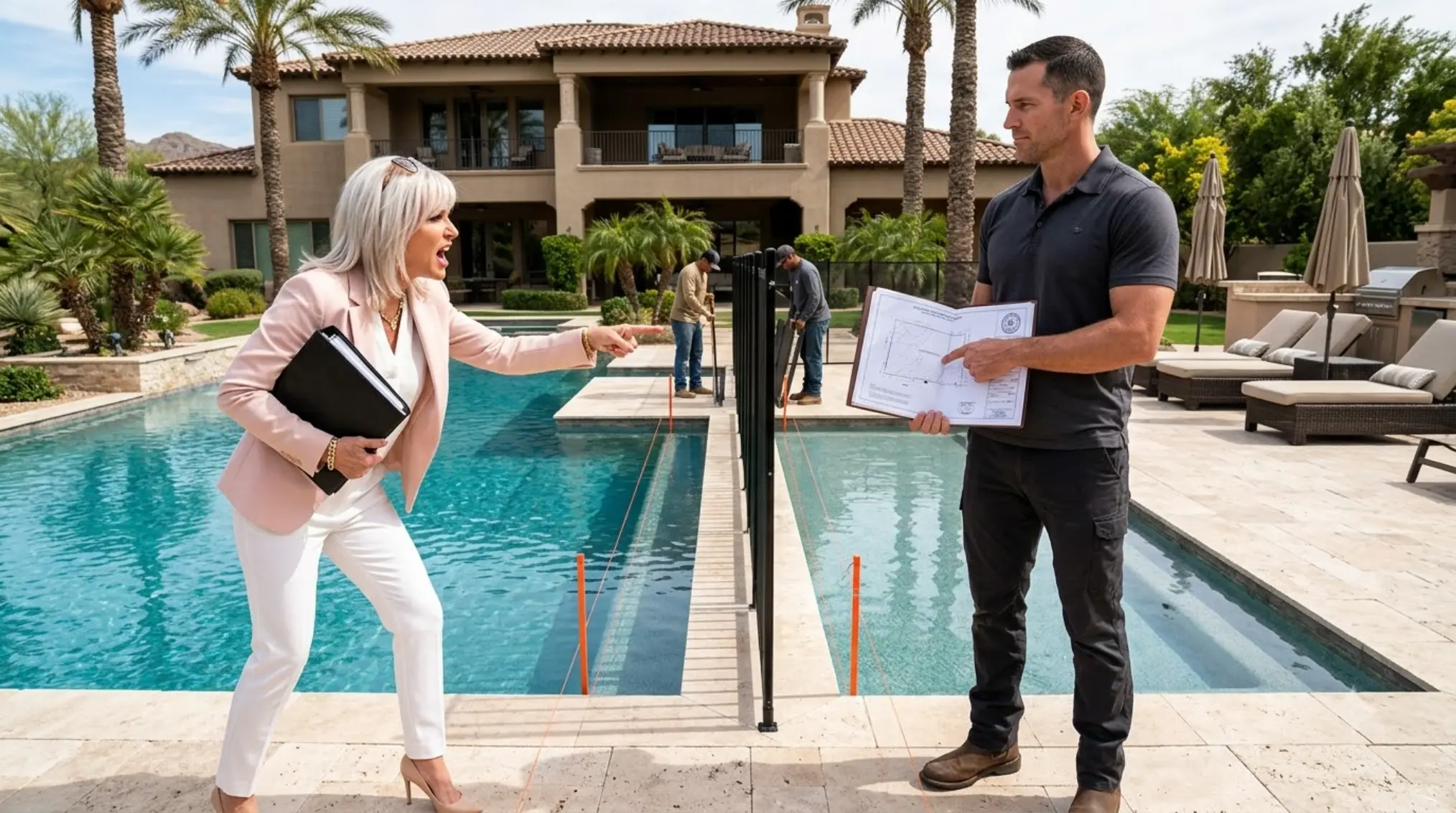
Linda saw him and did not look embarrassed.
She looked irritated.
“Oh, good,” she called, tucking a black HOA binder beneath one arm. “You’re finally back.”
Ethan walked toward the pool without answering, his charcoal polo still creased from the flight and his brown work boots carrying desert dust onto the pale stone deck. At forty-two, he had spent twenty years buying, restoring, and developing high-end residential property across Arizona, and he had learned that the person shouting first in a land dispute was rarely the person holding the strongest documents. He stopped beside an orange survey stake that had been knocked sideways beneath a newly poured section of concrete and looked from the marker to Linda. “Why is that concrete across my boundary line?”
Linda gave him a dismissive smile.
“The board approved a pool-access improvement.”
“My pool?”
“The community pool extension.”
Ethan slowly looked toward his own house, then back at her. The mansion behind him had six bedrooms, a separate guest casita, two outdoor kitchens, a three-car garage, and a pool he had commissioned himself eighteen months earlier after purchasing the property. There had never been a community pool on his deed, never an HOA easement across the rear parcel, and never any document giving Scottsdale Hills permission to pour concrete within his walls.
Linda apparently sensed his disbelief and opened the binder.
“You were gone for over a month, Ethan. The association has received repeated requests for improved recreational access, and this section of your rear parcel connects naturally with the common landscape corridor behind the neighboring homes.” She pointed toward the newly expanded deck as though the sentence settled ownership. “The board voted six to one.”
Ethan looked at her.
“You voted to use my land?”
Linda sighed dramatically.
“You always make these things sound more hostile than they are.”
“You poured concrete on it.”
“We improved it.”
Ethan lowered his gaze toward the water again. The original edge of his pool had ended several feet inside the old survey line, but the HOA’s contractor had removed part of the decorative rear wall and added a wide shallow section with steps and a sun shelf extending toward the common path. A new section of pool decking continued directly across the old boundary, and someone had even relocated two landscaping lights Ethan had personally chosen. Whoever built the extension had worked quickly and expensively.
“How much did this cost?”
Linda straightened.
“That is HOA business.”
“If it’s sitting on my property, it just became my business.”
Her jaw tightened.
Linda had been president for three years and had built her reputation through confidence rather than patience. She drove a pearl-white luxury SUV, arrived at meetings with color-coded binders, spoke about “protecting neighborhood standards” as if Scottsdale Hills were a sovereign nation, and had a habit of turning disagreements into violations before residents had finished asking questions. Most homeowners tolerated her because the subdivision looked immaculate and property values remained high, but Ethan had never confused a well-organized board with ownership authority.
Linda stepped closer.
“You should be grateful.”
“For what?”
“For improvements you didn’t have to pay for.”
Ethan stared at her.
“You built a pool on land you don’t own, and your defense is that I got free concrete?”
The contractor nearest them stopped pretending not to listen.
Linda noticed and lowered her voice.
“Your property boundary is disputed.”
“No, it isn’t.”
“The association’s master site plan says otherwise.”
“My recorded survey says otherwise.”
“The HOA has used that corridor for years.”
“For landscaping.”
“Exactly.”
Ethan shook his head.
“Permission to trim bushes isn’t permission to build a swimming pool.”
Linda’s face reddened.
“You want to fight about three feet of land when you own this entire mansion?”
Ethan looked toward the knocked-over stake.
“Four feet, eleven inches at the widest point.”
She froze.
He pointed toward it.
“That marker was installed by a licensed surveyor before closing.”
Linda glanced at the contractor.
Then quickly back at Ethan.