The first thing Caleb Mercer heard when he returned from his great-grandfather’s funeral was the sound of timber cracking across the lake.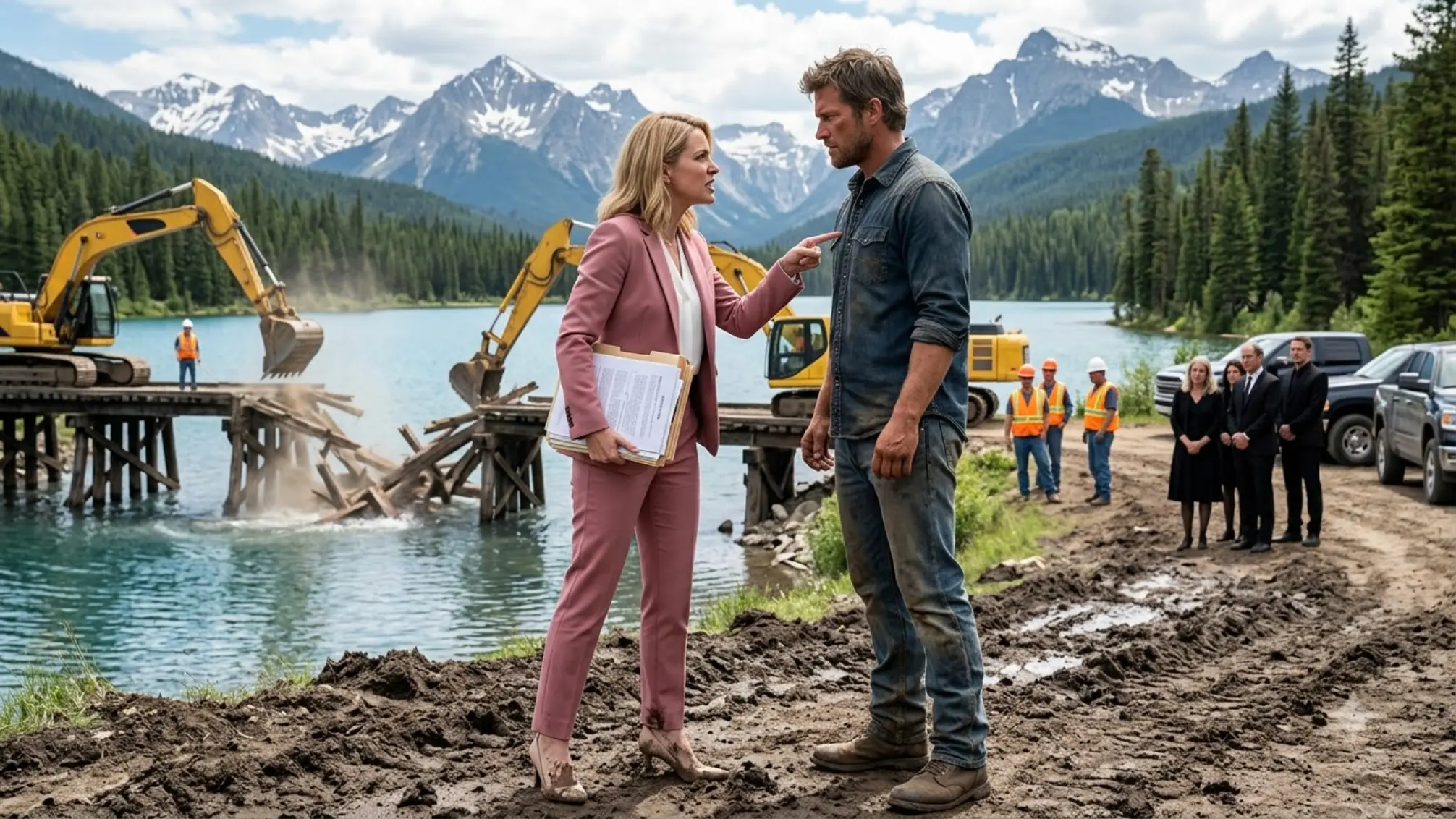
He stopped halfway down the muddy shoreline, still wearing the dark denim shirt and black jeans he had changed into after leaving the cemetery. Across the water, an excavator’s steel bucket descended onto the center span of Mercer Bridge, the hundred-year-old wooden crossing his family had maintained since 1921. One enormous beam splintered, tilted sideways, and disappeared into the cold blue water beneath a cloud of dust.
Standing thirty feet away in a pale pink pantsuit was Vanessa Caldwell.
The developer watched the destruction with a clipboard tucked against her side.
Caleb stared at her.
“You bulldozed it today?”
Vanessa turned.
For half a second, surprise crossed her face.
Then arrogance returned.
“You weren’t supposed to be back until tonight.”
Caleb walked toward her.
Workers in orange safety vests stopped moving.
The excavator operator lifted both hands from the controls.
Vanessa stepped forward as though she intended to control the conversation before Caleb could start one.
“Your family’s bridge is gone, and my resort is going up,” she snapped. “Step aside.”
Caleb looked past her.
Half the bridge had already collapsed.
Weathered timbers floated beside the pilings. The handrails his father had replaced twenty years earlier hung crookedly above the water. One of the carved posts his great-grandfather had installed was split directly through the center.
Caleb turned back to Vanessa.
“You tore it down during a funeral.”
“It was scheduled demolition.”
“You knew whose funeral.”
“I knew your family was unavailable.”
That answer changed something in Caleb’s face.
Vanessa saw it but misunderstood it.
She assumed she had finally made him angry enough to make a mistake.
Instead, Caleb became calm.
“Now you answer to me.”
Vanessa laughed.
“I have permits, crews, and four million dollars behind me.”
Caleb stepped closer.
“Then watch me kill the water, freeze the road, and bury your resort before sunset.”
For the first time, Vanessa stopped smiling.
Six months earlier, Silver Pine Lake had been one of those places wealthy developers described as “undiscovered,” even though families like the Mercers had lived there for generations.
The lake sat between forested mountains in western Montana. A narrow county highway curved along its eastern edge while ranches, cabins, and old logging properties covered the western side.
Caleb’s family owned almost six hundred acres there.
Most people knew him as a rancher.
That description was correct but incomplete.
Caleb managed cattle, repaired fences, cut hay, and maintained irrigation ditches like his father had.
But he also held something far more valuable than the cattle.
Water rights.
Road easements.
And access agreements dating back more than a century.
His great-grandfather, Samuel Mercer, had understood something most newcomers did not.
Land in mountain country was only useful if you could reach it and keep water moving through it.
Samuel purchased narrow strips of shoreline, spring rights, and road corridors piece by piece.
Most looked worthless on modern maps.
They were not.
Caleb had inherited those documents along with the ranch.
For years, nobody cared.
Then Vanessa Caldwell arrived.
She drove into Silver Pine in a white Range Rover wearing sunglasses worth more than some ranchers’ monthly mortgage payments.
Her company, Caldwell Alpine Development, had purchased eighty-two acres on the northwestern shore.
The plan sounded impressive.
Silver Crown Lodge.
Thirty luxury cabins.
Private spa.
Restaurant.
Wedding pavilion.
Boat marina.
Heated outdoor pool.
Estimated investment: four million dollars in phase one.
Local newspapers called it a tourism opportunity.
Vanessa called it the project that would “finally modernize” Silver Pine.
Caleb disliked that phrase immediately.
The first time they met, she stood beside his pasture fence and gestured toward the mountains.
“This place is incredible.”
Caleb nodded.
“That’s why people live here.”
Vanessa laughed as if he had made a joke.
“No, I mean commercially.”
That was the difference between them.
Caleb saw a valley.
Vanessa saw inventory.
At first, the resort did not concern him.
Her land was her land.
If she followed permits, protected the shoreline, and respected neighboring property, Caleb had no interest in stopping her.
Then her engineer contacted him.
The project required construction vehicles to reach the site.
There was a county road from the north, but it was narrow and seasonally restricted.
The easiest route crossed Mercer land.
More specifically, it crossed Mercer Bridge.
The bridge had originally connected the ranch with a logging trail.
Samuel Mercer built it with local timber and stone piers.
Modern vehicles could use it only under limited weight restrictions, but smaller construction trucks could cross.
Vanessa wanted permanent commercial access.
Caleb refused.
Not because he hated the resort.
Because the existing bridge was not designed for hundreds of heavy construction trips.
Vanessa offered him $20,000.
“No.”
“Forty.”
“No.”
“Fifty-five.”
Caleb folded his arms.
“You keep increasing the number like the problem is money.”
“Everything is eventually money.”
“Not that bridge.”
Vanessa looked toward it.
“It’s rotten wood.”
“My great-grandfather built it.”
“And he’s dead.”
Caleb stared at her.
Vanessa smiled.
“Sentiment doesn’t create infrastructure.”
“No.”
Caleb replied calmly.
“But property rights do.”
The meeting ended there.
Two weeks later, Vanessa submitted plans showing a new temporary construction crossing.
Caleb reviewed the county documents.
The proposed crossing sat almost exactly where Mercer Bridge stood.
He called the planning office.
The clerk sounded confused.
“I thought Caldwell had your approval.”
“They don’t.”
“There’s an easement shown.”
“What easement?”
A document arrived by email.
Caleb read it twice.
Recreational Access Easement — 1974.
The language allowed neighboring property owners limited pedestrian and livestock passage across a trail.
It did not authorize commercial construction access.
It did not authorize demolition.
It certainly did not transfer ownership of the bridge.
Caleb hired attorney Rebecca Sloan.
Rebecca spent twenty minutes reading the paperwork.
“They’re stretching this so far it’s almost creative.”
“Can they do it?”
“No.”
“Then why did the county accept it?”
“Because nobody challenged it.”
That became the first warning.
Vanessa was not necessarily relying on legal rights.
She was relying on speed.
If construction started before anyone stopped her, reversing it would become harder.
Caleb filed a formal objection.
Vanessa responded with a letter claiming Mercer Bridge created a “public safety concern.”
Another engineering report called it unstable.
Caleb hired an independent structural engineer.
The report was different.
The bridge needed reinforcement but remained serviceable for private agricultural use.
Vanessa then offered Caleb $100,000.
He declined.
She came to the ranch personally.
“You’re holding an entire community hostage over some old boards.”
Caleb stared at her.
“What community?”
“The jobs this resort creates.”
“You mean your resort.”
“You don’t like outsiders.”
“I don’t like people pretending my property belongs to them.”
Vanessa lowered her voice.
“You’re going to regret making this difficult.”
Caleb smiled faintly.
“Put that in writing.”
She left.
Then Samuel Mercer became ill.
At ninety-eight, Caleb’s great-grandfather had outlived almost everyone who helped build the modern valley.
He still remembered riding horses across the bridge before automobiles regularly used the road.
During his final month, Caleb visited him every evening.
Samuel’s voice had become weak.
One night Caleb told him about Vanessa.
Samuel smiled.
“She wants the bridge?”
“She wants what’s underneath it.”
Samuel looked toward the window.
“Water?”
Caleb nodded.
That surprised him.
“How’d you know?”
Samuel laughed quietly.
“People always think the bridge matters.”
He pointed toward an old filing cabinet.
“Bridge is wood.”
Then he tapped the floor with one finger.
“Land underneath it is power.”
Caleb opened the cabinet after Samuel fell asleep.
Inside were maps.
Handwritten agreements.
Water certificates.
Deeds.
One document changed everything.
In 1936, Samuel’s father had granted a local mill limited access to Mercer Spring, which fed the western shoreline.
The spring now supplied water through an underground line running near Vanessa’s resort site.
Modern county maps incorrectly labeled part of that line as shared utility infrastructure.
It was not.
The water originated entirely on Mercer property.
Another document concerned the road.
The gravel road Vanessa planned to use for resort traffic crossed a 70-foot strip still owned by the Mercer family.
The county maintained it under an agricultural-access agreement.
Commercial use required written consent.
Caleb sat beside Samuel the following morning.
“You knew?”
Samuel smiled.
“Always read old paper.”
Three days later, Samuel died peacefully.
The funeral was scheduled for Tuesday.
The entire Mercer family attended.
Vanessa knew.
Caleb had postponed a county hearing because of it.
At 5:52 that morning, Caldwell Alpine crews arrived at the lake.
Vanessa presented workers with a demolition authorization claiming the bridge was an unsafe obstruction within the project-access corridor.
The excavator started at 6:30.
By 10:15, the center span was down.
Caleb returned from the cemetery shortly after eleven.
And now Vanessa stood in front of him while pieces of his family’s history floated in the lake.
“You have permits, crews, and four million dollars behind me,” she said.
Caleb remembered Samuel’s voice.
Bridge is wood. Land underneath it is power.
Caleb did not shout.
He pulled out his phone.
First call: Rebecca Sloan.
“They demolished it.”
Silence.
“Today?”
“Half of it.”
“Do not touch anything.”
“Wasn’t planning to.”
“I’m filing emergency relief.”
Second call: county utilities.
Caleb identified the Mercer Spring agreement.
“I’m withdrawing all temporary construction-use permissions pending title review.”
The utility manager sounded confused.
“You can’t simply shut down a municipal line.”
“It isn’t municipal.”
“We have maps showing—”
“You have maps.”
Caleb looked at Vanessa.
“I have the deed.”
Third call: county road department.
Caleb notified them that commercial traffic over the Mercer corridor was unauthorized.
Fourth call: the resort’s construction lender.
That one surprised Vanessa.
She heard the name.
“Who are you calling?”
Caleb ignored her.
He spoke to a compliance officer.
“My property is being used as collateral access for a development project without authorization.”
Vanessa’s expression changed.
“You cannot contact my lender.”
Caleb ended the call.
“Already did.”
She stepped closer.
“You’re interfering with a contracted development.”
“You destroyed my property.”
“You’re bluffing.”
Caleb pointed toward the water.
“That bridge was the only thing I was sentimental about.”
Then he pointed toward the mountains.
“Everything else is paperwork.”
By 1:30 p.m., Caldwell Alpine received its first problem.
The county issued a temporary stop-work notice regarding bridge demolition.
At 2:05, the construction lender froze the next project draw pending access verification.
At 2:40, a utility inspector arrived to examine the water-line ownership documents.
Vanessa followed him everywhere.
“This is absurd.”
The inspector ignored her.
At 3:17, he called his supervisor.
By 4:00, the resort’s construction water was shut off.
Not household water.
Not emergency service.
Temporary high-volume construction supply.
Without it, concrete work stopped.
Dust-control trucks stopped.
Site grading slowed.
Then the road issue hit.
The following morning, Caleb installed a legally permitted gate where the construction route crossed Mercer property.
Vanessa arrived within twenty minutes.
“You can’t block this road.”
Caleb held up the deed.
“I own this road.”
“The county maintains it.”
“For agricultural access.”
“My project has permits.”
“Not from me.”
“You’re destroying millions in investment because you’re emotional over a bridge.”
Caleb walked toward her.
“No.”
His voice remained calm.
“You destroyed a bridge because you thought grief made me weak.”
Vanessa stared at him.
“That was your mistake.”
The resort stalled.
Every day cost money.
Workers remained on payroll.
Rented equipment sat unused.
Material deliveries were rerouted through the narrow northern road, adding hours and thousands of dollars.
Concrete trucks could not safely use the route.
Vanessa’s investors began calling.
She blamed Caleb.
Then Rebecca obtained the demolition paperwork.
The authorization contained a problem.
Vanessa’s company had certified that no private ownership dispute existed concerning Mercer Bridge.
That was demonstrably false.
Caleb had filed his objection weeks earlier.
The county’s internal email system contained it.
Someone had checked a box stating otherwise.
Rebecca smiled when she saw it.
“They knew.”
“Who?”
“Vanessa signed the certification.”
The confrontation stopped being merely a property dispute.
Her insurer became involved.
Then the county legal department.
Vanessa tried a different strategy.
She offered Caleb $250,000.
He said no.
Three hundred thousand.
No.
Four hundred.
No.
Finally she exploded.
“What do you want?”
Caleb looked toward the broken bridge.
“Restore what you destroyed.”
“That bridge is obsolete.”
“Then build it back stronger.”
“That could cost half a million dollars.”
“You found four million for a resort.”
Vanessa paced across Rebecca’s conference room.
“And then?”
“Then we discuss access.”
“You’d actually let the resort continue?”
Caleb shrugged.
“I never opposed the resort.”
Vanessa stared at him.
“You shut everything down.”
“You destroyed my bridge.”
“So this is revenge.”
“No.”
Caleb leaned forward.
“This is ownership.”
That distinction drove her crazy.
She wanted him angry because anger could be dismissed.
She wanted him unreasonable because investors could pressure unreasonable people.
Instead, Caleb had clear demands.
Restore the bridge.
Pay damages.
Recognize Mercer ownership.
Negotiate legitimate water use.
Negotiate legitimate road use.
Protect the shoreline.
The investors began wondering why Vanessa had not simply done those things originally.
Then the project audit arrived.
Caldwell Alpine had already spent $1.8 million.
Another $2.2 million remained committed.
Without permanent road and water agreements, the resort valuation collapsed.
The lender refused further funding.
Vanessa’s partners called an emergency meeting.
Three days later, she was removed as sole project manager.
A development executive named Daniel Cross contacted Caleb.
“I’m told you killed the resort.”
Caleb laughed.
“No.”
“Vanessa says you deliberately shut everything down.”
“I stopped unauthorized use of my property.”
Daniel paused.
“Would you negotiate?”
“Yes.”
That answer surprised him.
They met beside the lake.
Daniel looked at the broken bridge.
“This is what started everything?”
“This is where she made it obvious.”
“What do you want rebuilt?”
Caleb handed him Samuel’s original drawings.
Daniel studied them.
“You kept these?”
“My family keeps everything.”
The rebuilt bridge would preserve the original stone piers while using stronger timber and hidden steel reinforcement.
Pedestrian appearance would remain historic.
Weight capacity would increase modestly.
The resort would pay the entire cost.
In return, Caleb agreed to a limited construction-road license with strict weight and time restrictions.
Water use would become a paid commercial agreement based on actual capacity.
No permanent ownership rights would transfer.
Shoreline protections were added.
The deal took six weeks.
Vanessa fought it from the sidelines.
Her investors approved anyway.
Then another consequence arrived.
The county ethics review concluded that Vanessa had knowingly represented the bridge corridor as undisputed despite an active property objection.
Her demolition permit was formally revoked after the fact.
Her contractor’s insurer refused to cover portions of the damage because the ownership dispute had not been properly disclosed.
Caldwell Alpine sued Vanessa personally for part of the resulting losses.
The woman who once stood beside an excavator bragging about four million dollars now faced legal bills of her own.
Construction resumed the following spring.
This time, Caleb stood on the shoreline with Daniel Cross and watched crews work.
Not demolish.
Rebuild.
The first new timber was lowered onto the original stone support.
Caleb touched the weathered section they had preserved.
Samuel would have complained about the steel.
Then secretly admired the engineering.
Maya Mercer, Caleb’s younger cousin, joined him.
“Think Grandpa Sam would like it?”
“He’d call it overbuilt.”
“He called everything overbuilt.”
Caleb smiled.
Across the lake, Silver Crown Lodge slowly took shape.
Cabins rose between pine trees.
The main lodge used stone and timber rather than the reflective glass Vanessa originally planned.
The marina was reduced in size.
Some environmentalists who had opposed the first proposal supported the revised one.
Local contractors received more work.
The project survived.
Vanessa did not remain part of it.
A year later, Silver Crown Lodge opened.
Its marketing materials featured one photograph more than any other.
Mercer Bridge.
Guests loved walking across it.
The resort eventually offered to purchase naming rights.
Caleb refused.
The bridge already had a name.
At the opening ceremony, Daniel asked Caleb to say a few words.
Caleb almost declined.
Then he saw Samuel’s old photograph mounted near the bridge entrance.
He stepped forward.
“My great-grandfather helped build the first version of this bridge more than a century ago.”
Guests listened.
“He didn’t build it for tourists.”
A few people smiled.
“He built it because families needed to cross the water.”
Caleb looked toward the new span.
“Years later, someone looked at it and saw an obstacle.”
He paused.
“That happens a lot with old things.”
He glanced toward the ranch.
“Old bridges.”
“Old deeds.”
“Old agreements.”
“Old families.”
People became quiet.
“We assume new money makes old rights disappear.”
Caleb shook his head.
“It doesn’t.”
He finished simply.
“Build whatever future you want. Just know what ground you’re standing on first.”
The crowd applauded.
Caleb returned to the ranch before dinner.
Crowds were not his thing.
Months later, an envelope arrived from Vanessa.
No return address.
Inside was a newspaper clipping about Silver Crown Lodge’s successful opening.
Across the margin, she had written one sentence.
You got what you wanted.
Caleb stared at it.
Then turned the clipping over.
He wrote:
No. I kept what was already mine.
He never mailed it.
There was no point.
Two years after Samuel’s funeral, Caleb walked across Mercer Bridge at sunrise.
The lake was perfectly still.
The rebuilt boards creaked faintly beneath his boots.
Halfway across, a small brass plaque had been mounted to the inside railing.
Caleb had resisted it initially.
Maya insisted.
It read:
SAMUEL MERCER
1926–2026
“READ THE OLD PAPER.”
Caleb laughed every time he saw it.
Across the water, the resort lights were going dark as morning arrived.
Tourists would wake soon.
Workers would open the restaurant.
Boats would move from the marina.
The place Vanessa had nearly destroyed through impatience had become profitable precisely because the final agreement respected the valley instead of trying to overpower it.
Caleb rested his hands on the railing.
The bridge Vanessa demolished had been valuable because Samuel built it.
But Samuel had understood something deeper.
Wood breaks.
Money moves.
Companies collapse.
Permits expire.
The land remains.
And the documents telling people who actually controls it matter long after everyone who signed them is gone.
Vanessa Caldwell arrived in Silver Pine believing four million dollars made her the most powerful person around the lake.
She had excavators.
Engineers.
Investors.
Lawyers.
Crews.
Caleb had a filing cabinet.
In the end, that filing cabinet stopped everything.
One deed shut the road.
One water certificate stopped construction supply.
One active property objection destroyed the demolition authorization.
And one decision made during his great-grandfather’s funeral transformed Vanessa’s profitable project into a legal emergency.
The irony was that Caleb never wanted her resort destroyed.
She had almost accomplished that herself.
All because she looked at an old wooden bridge and assumed the man who loved it had nothing stronger behind him than sentiment.
She was wrong.
Behind the bridge were a century of property rights.
Behind Caleb was a family that had understood the valley long before developers started putting dollar signs on it.
And behind one broken timber was the sentence Vanessa should have learned before she ever started the excavator:
You can build a four-million-dollar resort anywhere you legally own.
But you do not get to bulldoze someone else’s history to reach it.