The day Dana Whitlock called the police to the water tower, she stood squarely in front of the gate and looked at me the way people look at a burglar caught halfway through a window.
She told the officers I had cut a lock, that I had walked onto homeowners association property, and that there was no reason on earth a man like me needed to be up on that ridge.
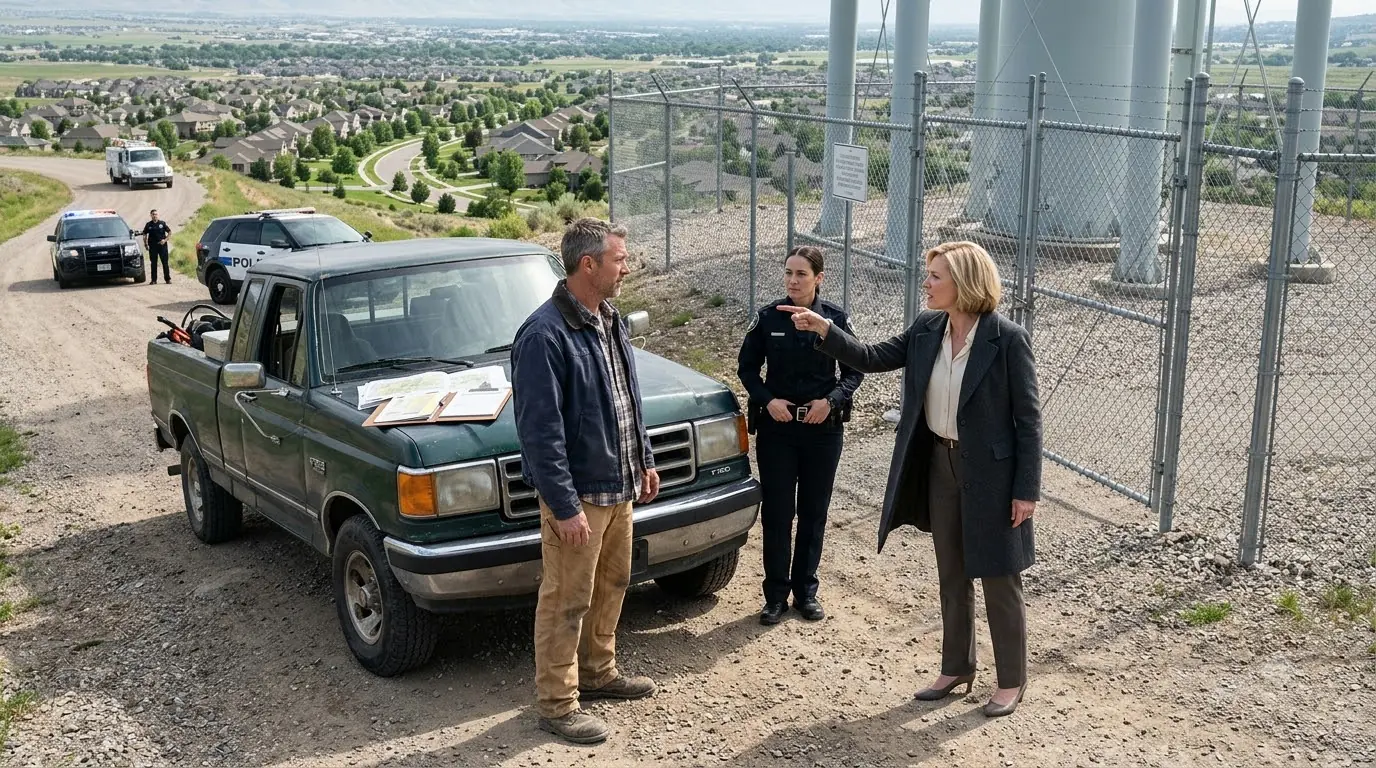
I didn't argue with her. I just raised one hand and pointed at the tank standing above us, the one feeding water to every house she was so proud of.
10 minutes later, utility chief Graham Hensley stepped out of a city truck, looked at Dana for a long moment, and asked her exactly one question. Who told you the association owns this land?
My name is Desmond Avery. I'm 48 years old, and for 19 years I worked as a municipal water systems engineer before I went out on my own as an independent infrastructure consultant.
I know pressure zones and pump curves. I know what a chlorine residual chart looks like on a bad August afternoon.
But more than any of that, I know records, deeds, plats, surveys, easement grants, recorded amendments, the dull paper skeleton underneath every neighborhood in America. Most people never look at it once in their lives.
I spent two decades reading it for a living. And that turned out to be the single most important fact about the year I'm going to tell you about.
Cresthaven Hills is a beautiful subdivision. I'll give it that much, and I'll give it honestly.
Curved streets, mature maples, mailboxes that all match because somebody made them match. Stone entry monuments with the name carved deep and lit from below at night.
206 homes, all built between 1998 and 2004. All of them sitting in the long green bowl underneath a hill called Bellwether Ridge.
From the top of that ridge, you can see the whole development laid out below like a model somebody built on a dining room table. And you can see the water tower.
Because the water tower is the thing everybody sees first. My house is not in Cresthaven Hills.
That distinction is going to matter more than almost anything else in this story. So, let me be precise about it.
My property is a parcel of just under 6 acres on the upper shoulder of Bellwether Ridge. And it existed as a legal parcel decades before anybody drew the first line of the subdivision plat.
The original farmhouse burned down in the 1970s. The family that owned it sold off the lower acreage in pieces over the years.
And the developer who built Cresthaven Hills bought that lower acreage and built around the ridge parcel because they couldn't buy the ridge parcel. It wasn't for sale.
It stayed in that family until I purchased it. And I built a modest two-bedroom on the flat spot near the old foundation.
The city water tower sits near the northern boundary of my land. Not on the association's land.
Not on some vague public strip. Near my northern boundary, inside a fenced utility enclosure that the city water utility owns outright, on ground the city holds by a recorded utility easement dating to 1968.
The dirt and gravel access road that climbs from the county road up to that enclosure runs across roughly 400 feet of my parcel. The city has the recorded right to use it.
Their crews drive it whenever they need to. That's what an easement is.
It's a permission carved into the record and it does not transfer ownership of one single square inch of soil. I understood all of this before I closed.
I read the title work twice, ordered my own survey, and pulled the 1968 easement instrument from the county recorder. I knew exactly what I was buying, land with a city facility on the corner of it, and a public crew coming and going a few times a month.
That didn't bother me. There's something steadying about living next to something that keeps other people alive.
Dana Whitlock did not like it from the very first week. I met her on a Saturday in April at the mailbox cluster at the bottom of the hill.
She was 52, put together in the way that takes real effort, cream blazer on a weekend, sunglasses pushed into her hair, clipboard under one arm like a badge. Three neighbors stood with her.
She looked at my truck first, a 19-year-old pickup with survey stakes in the bed, then at me and asked, in a voice pitched for the group and not for me, "Are you the maintenance man up at the water tower?" I told her no.
I told her I owned the parcel on the ridge and that I just moved in. And I watched something happen behind her eyes that I have seen more times in my life than I'd like to count.
It wasn't confusion. Confusion is fine.
Confusion gets corrected. This was a small, tidy refusal.
She smiled the way you smile at a child who has told you he's the captain of a ship. "Well," she said, "those parcels up there generally belong to the association."
Then she turned back to her neighbors and kept talking about a fence stain color. I didn't argue.
I have learned that arguing with a person's first assumption almost never moves it and I had a well pump to bleed and boxes to unpack. But I remember standing there in the sun with my mail in my hand thinking a thought I'd have plenty of time to revisit later.
She didn't say she wasn't sure. She said the association owned it.
She'd never seen the plat. She'd never pulled a deed.
She'd never called the county in her life. And she said it out loud in front of three people as though it were the weather.
For a few months, that was the whole extent of it. I'd see her SUV on the county road.
She'd wave the way you wave at a stranger. I mowed my own field, hauled my own gravel, waved at the utility crews when they came up.
Then in early autumn, I opened my mailbox and found a cream-colored envelope with a stone monument logo printed on the corner and my name typed neatly on the front from a homeowners association I had never joined, never signed a covenant with, and had no legal relationship to whatsoever. The letter was titled Notice of Unauthorized Access.
I read it standing at the mailbox and then I read it again in the truck because the first time through, I genuinely thought I'd misunderstood the geography. The notice informed me that the area surrounding the water tower had been designated the Cresthaven Hills restricted utility area and that under association policy, access was limited to authorized personnel.
Now, it listed four requirements. I was not to drive on the access lane.
I was not to park any vehicle in the vicinity of the tower. I was not to alter, prune, or remove vegetation in the designated area.