So there I was, standing in my own driveway at nearly 11:00 p.m. while three police cruisers flashed red and blue light across my house.
My neighbors were recording everything on their phones, and Diane Krestler stood beside her white Lexus in sixty-dollar yoga pants, telling the officers that she owned my home and that I was a squatter who refused to leave.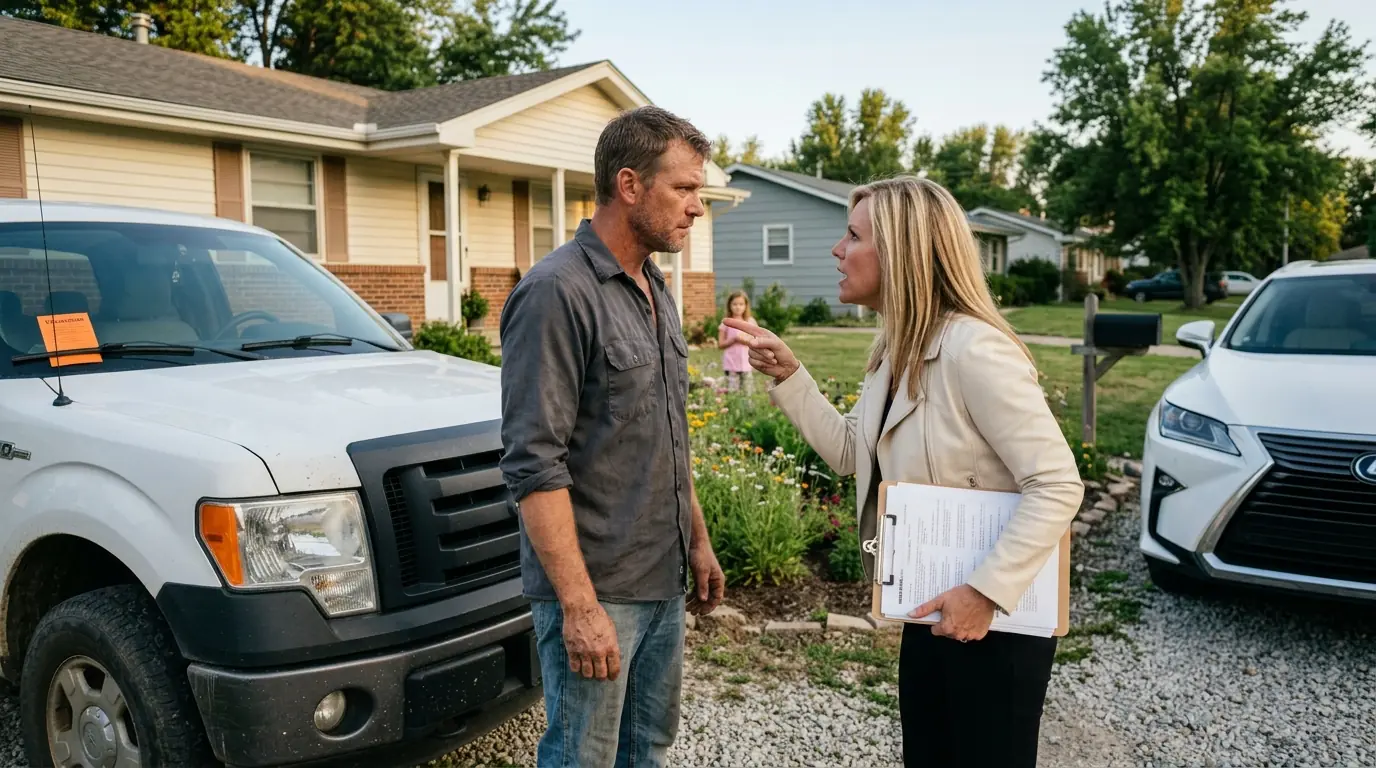
The police believed her long enough to escort me inside and demand proof that I had lived there for twenty years.
What Diane did not know was that the paper trail created by her own corruption would eventually put me in control of every HOA-owned asset in Meadowbrook Estates, including the clubhouse, pool, playground, and common land she treated like a private kingdom.
Let me back up six months. My name is Max Brennan. I am forty-three, a widower, and a single father to Riley, who had just turned nine on the first birthday without her mother there to sing to her. Jenna died eighteen months earlier from ovarian cancer, stage four by the time the doctors found it.
We had seven months from diagnosis to funeral. Seven months of hospital smells, that mixture of antiseptic and fear that seemed to cling to our clothes. Seven months of watching my wife disappear inside her own body while our daughter learned to sit quietly in waiting rooms. The medical bills were still coming, with seventeen thousand dollars left even after insurance.
I am a commercial electrician with twenty years in the trade. I own a small contracting firm with four employees and three trucks, enough work to keep food on the table and Riley in gymnastics.
The house was paid off, thank God. My grandfather left it to me in 2003, a 1970s ranch on two and a half acres along Pinecrest Road, just outside Kansas City.
That house was the only reason we survived Jenna's treatment without losing everything. My property sat inside the boundaries of Meadowbrook Estates, but I was not a member of the homeowners association and never had been.
In 1998, a developer named Lawrence Krestler bought three hundred acres of farmland surrounding my grandfather's place. He planned an entire subdivision, complete with a pool, a clubhouse, and all the usual amenities, and construction began in 2008.
My grandfather refused to sell. He told Krestler that he could build around him, but the Brennan land was not for sale at any price. So they did exactly that. They built around us like water flowing around a rock, creating the strange situation of an independent inholding surrounded by HOA property but not subject to its rules.
The exception was written into my title deed, recorded with the county, and as legally solid as concrete. Once houses started selling, the HOA formed with the usual covenants, approved paint colors, restrictions on visible commercial vehicles, lawn maintenance schedules, and mailbox standards.
None of it applied to me, but somebody put me on the mailing list anyway. Three years before this started, HOA meeting notices began showing up in my mailbox, and I ignored them because the association was not my problem.
Then the violation notices began. My grass was too long. My work truck was an eyesore. My mailbox did not match community standards. I kept ignoring them because they had no legal authority over my property.
That was when Diane Krestler decided I was her personal project. She was in her mid-fifties, with blonde highlights, a real estate license at Hartman Realty, and a face displayed on bus benches all over Kansas City.
She drove a white Lexus SUV with a vanity plate that read SOLD4U and lived in the largest house in Meadowbrook, the one with a koi pond that probably cost more to maintain than my annual salary.
She had also been HOA president for six years. The interesting part was that she was Lawrence Krestler's ex-wife, the same developer who had built around my grandfather's property. Their divorce in 2015 had been messy. She kept the real estate business, and he kept the development headaches.
Diane arrived at my door on a Saturday in July. Riley and I were planting wildflowers in the front yard, native Missouri species selected from Jenna's garden journal.
During her final spring, Jenna had sketched out an entire design with purple coneflowers, black-eyed Susans, and milkweed for monarch butterflies.
Riley was covered in dirt and smiling, the first time I had seen her truly happy in months. Then Diane's Lexus crunched onto my gravel driveway. She stepped out holding a clipboard like a sword, wearing a statement necklace that looked expensive enough to pay for Riley's braces.
"Mr. Brennan, we need to discuss your property compliance issues," she said.
I stood, brushed the dirt from my jeans, and kept my voice polite. "I am not in the HOA, ma'am. I never have been."
I showed her the language in my title deed. I kept a laminated copy in the kitchen drawer because this was not the first time the association had tried to pretend the exception did not exist. It was there in black and white.
Diane laughed, not a chuckle, but a full dismissive laugh. "That is not how this works. Developer mistakes do not override current covenants."
"It is not a mistake. It is recorded legal language."
Her smile never reached her eyes. "We will see about that."
The next morning was Sunday, because of course it was. An orange violation sticker had been plastered across my truck's windshield, with the word VIOLATION printed in three-inch red letters. It was not a legal notice, just a bullying tactic.
I spent twenty minutes scraping it off with a razor blade. The metal scraped against the glass, leaving sticky adhesive residue that reeked of cheap citrus cleaner. My fingers smelled like it even after I washed my hands twice.
Riley watched from the porch. "Why is the mean lady mad at us?"
That was when I knew Diane Krestler was not going to stop. The sticker was only the opening shot.
Two weeks later, I was downtown rewiring a medical office when my phone rang. County code enforcement had received complaints about unpermitted electrical work, an illegal home business, and a failing septic system. None of it was true.
Doug Simmons arrived the following morning. He was a county inspector in his fifties, with tired eyes that suggested he had witnessed every petty neighbor war Missouri could offer. He spent an hour walking my property with a clipboard, checked my electrical permits, and found all of them legitimate.
He tested the septic system with a probe. It was working perfectly and had been pumped six months earlier. Then he inspected my supposed illegal business, which consisted of one desk, one computer, and no employees working from the house.
Doug closed his clipboard. "Off the record, we get three or four of these complaints a month from Meadowbrook. Same person every time."
I remembered reading that false code complaints were public records. "Can I request the complaint history?"
"Absolutely. If somebody is filing repeated bogus reports, you can pursue harassment charges. They may also face fines for wasting county resources." He handed me a form. "Just so you know."
After he left, I spent three hours searching county records online. I found a six-year pattern involving eleven properties targeted by Diane's violation complaints. The owners included elderly residents who could not keep up with landscaping, single mothers with toys in their yards, and a man who restored classic cars.
Eight of those eleven families sold within six months. I cross-referenced the sales and discovered that every property had been listed by Hartman Realty. Diane had been harassing residents until they sold, then collecting six-percent commissions.
It was a shakedown performed with a clipboard and a laminated name badge. I called my friend Reggie that night. We had served together in the National Guard, and he now worked as a paralegal.
"Tortious interference," he said after I finished explaining. "She is using supposed authority for personal profit. You might be able to sue her personally."
"What do I need?"
"Document everything." He tapped his pen against the napkin. "HOAs in Missouri function like quasi-governmental entities in some respects. Their records may be subject to disclosure requirements. Request the financial statements, meeting minutes, contracts, and everything else."
I sent the request by certified mail the following morning. Diane personally delivered the denial three days later, holding the single page as though it were a weapon.
"Attorney-client privilege. Request denied," she said.
"That is not how the Sunshine Law works."
"Take it up with our attorney." She turned away, then stopped. "Oh, and move your truck. It is blocking the street."
It was parked in my own driveway.
The next morning at six, I had an important client meeting. Orange traffic cones blocked my exit. They had no markings and there was no city notice, just another act of harassment.
I moved the cones by hand and threw them into my truck bed. I arrived forty-five minutes late and lost the contract, eight thousand dollars gone. That afternoon, the mother who normally brought Riley home from gymnastics forgot to pick her up.
Riley waited for an hour before I left another job site early to get her. The carpool mother was one of Diane's friends. That night, Riley asked if we should move.
She lay in bed with the stuffed rabbit Jenna had given her tucked under her chin. "Daddy, would it be easier somewhere else?"
I wanted to say yes. After she fell asleep, I found Jenna's garden journal, with pressed flowers and notes in her handwriting. Riley had already asked whether we would have to dig up Mommy's flowers if we moved.
I pulled out my phone and recorded a video statement documenting everything, the stickers, the false complaints, the blocked driveway, the missed carpool pickup, and the lost contract. I built a timeline. Then Doug Simmons texted me a link to an article in the Kansas City Business Journal about real estate trends.
Buried six paragraphs down was a report that Hartman Realty was in acquisition discussions with RE/MAX and that several agents were under ethics review for subdivision steering practices. Diane was vulnerable. If the company discovered that she had abused HOA power to generate commissions, she could lose her license.
I called Reggie's boss the following Monday. Mara Desmond was an attorney who specialized in property disputes. We scheduled a consultation for Wednesday.
The Sunday before that meeting, I walked outside to retrieve my tool bag from the truck. All four tires had been slashed. A security camera I had installed after the traffic cone incident had recorded someone approaching at three in the morning.
The person wore a black hoodie and kept her face hidden, but her height, build, and walk resembled Diane. I stood in the driveway in the smell of shredded rubber and night air, staring at four ruined tires that would cost forty-five hundred dollars to replace. That money had been saved for Riley's birthday trip to Silver Dollar City.
I called the police and filed a report. They told me that without a clear facial identification, they could not do much. I still had the footage, and I knew who I believed was responsible.
Reggie texted me at midnight. "Do not do anything stupid. We meet with Mara on Wednesday. Let her build the case."
I stared at the message for ten minutes, then took screenshots from the security video and added them to my evidence folder. There were seventeen documents now, organized by date and time, with photographs and video files. Diane wanted a war of documentation.
Fine. I was an electrician. I knew how to follow code and document every wire, every connection, and every detail. I would document her all the way into a courtroom.
One week after the tires were slashed, I finally had leverage. Reggie arranged the meeting with Mara Desmond in an office that smelled of leather-bound law books and expensive coffee. She was in her mid-forties and had the kind of presence that suggested she had won awards for intimidating witnesses during cross-examination.
I placed my evidence folder on her desk, seventeen documents in chronological order with color-coded tabs. I tabbed things because I was an electrician. In my trade, we labeled everything because mistakes could kill people.
Mara reviewed the file for twenty minutes, marking pages in red ink with the precision of surgical cuts. "This is a solid harassment case," she said. "Tortious interference and intentional infliction of emotional distress are both possible. But I want to show you something else."
She opened county records on her computer. "I reviewed the financial condition of Meadowbrook Estates HOA. They are not merely petty. They are broke."
The spreadsheet made my stomach drop. The HOA owed three hundred forty thousand dollars to the original developer, and the balloon payment had already come due the previous December. Its reserves held only ninety thousand dollars, nowhere near enough to satisfy the debt.
"They collect twelve hundred dollars a year from one hundred twenty-seven homes," I said. "Where has all the money gone?"
Mara traced several lines on the screen. "Here, here, and here. Krestler Property Solutions received eighteen thousand dollars for consulting without a contract. KPS Landscaping received twenty-two thousand dollars. KPS Property Management received fifteen thousand dollars. Every LLC is registered to Diane's business address."
"She has been stealing from the HOA."
"It appears to be self-dealing, which is illegal under Missouri law. But here is the interesting part. If the debt remains unpaid, the developer can foreclose on the HOA's assets, including the common areas, amenities, pool, clubhouse, playground, and stormwater systems."
I brought the security footage to the police that afternoon and received a case number. The officer was sympathetic but realistic. Without a visible face, they could not identify the vandal beyond a reasonable doubt.
Riley was staying with Jenna's parents that week. I told her it was special grandparent time and did not mention that I wanted her away while the conflict escalated. She was excited about staying up late and watching old movies with her grandmother.
Five days passed without a new violation or a sighting of Diane. I began to think the police report might have scared her. Then August 16 arrived.
At 10:30 that night, I was in the garage working on Riley's birthday present, a wooden dollhouse based on Jenna's sketches. Country music played softly from the radio. The smells of wood glue and polyurethane mixed with heat still rising from the concrete floor.
Red and blue light suddenly flashed across my workbench. Three cruisers slid to a stop outside with their sirens still sounding. I stepped out with my hands visible, my mind racing through possibilities such as a neighborhood break-in or a gas leak.
A young officer approached with one hand near his weapon. "Max Brennan?"
"Yes. What is wrong?"
"We have a report of trespassing and a possible squatter situation. Are you Max Brennan?"
The words did not make sense at first. "I own this property. I have lived here for twenty years."
"The complainant says she recently purchased this house and that you are refusing to leave after being evicted."
Diane's Lexus was parked at the curb. She stepped out wearing yoga pants and a North Face fleece, performing the role of a frightened victim.
"Officers, thank God," she said. "He has been squatting here for months. I tried to be understanding, but I am actually frightened."
"That is insane. I own this house."
The officer raised his hand. "Sir, let her finish."
Diane gave him a packet containing a lease agreement with my surname misspelled and an eviction notice printed on fake letterhead. Both looked as though they had come from a home printer, with the text slightly off-center.
"Do you have proof of ownership?" the officer asked.
"Yes. It is inside."
"I will accompany you."
I walked into my own kitchen under police escort to prove that I lived in my own house. Neighbors stood on their lawns holding up phones. Riley's bedroom window was visible above the porch, its sunflower curtains lit by the night-light she had chosen.
I was grateful she was not home to witness it. I opened the kitchen drawer and removed the deed, title insurance policy, and twenty years of property tax receipts bearing my name and that address.
Sergeant Kowalski, a senior officer in his fifties with the exhausted eyes of someone who had seen every foolish neighbor dispute in Missouri, reviewed everything on his laptop. He checked the county database, my driver's license, and the title record.
Then he turned to Diane, his voice calm and tightly controlled. "Ma'am, this man owns this property outright. We will need to discuss the false documents you provided and your report to law enforcement."
Diane's performance cracked. "I do not understand. The title company said..."
"Ma'am, you need to leave now."
She walked to her Lexus and drove away without another word. Kowalski handed my documents back to me.
"Mr. Brennan, I apologize. We have to respond to all reports, but this one was clearly unfounded."
"Can I press charges?"
"You can file a criminal complaint. I would also speak with a lawyer about civil action."
After the officers left, Herb Vance shuffled over from three houses down. He was elderly and had barely spoken to me since Diane began her campaign.
"That was complete nonsense," he said. "She told us you were cooking meth. It is time we stopped believing her."
At 11:47 p.m., Lisa Cho sent me a text. "I saw everything. Half the neighborhood did. We are done with Diane."
I sat in Riley's room afterward with her stuffed rabbit resting on the pillow. The room still smelled faintly of the lavender spray Jenna used. My daughter had asked to stay additional days with her grandparents because she no longer felt safe at home.
I called Mara at midnight and left a voicemail. "I want to sue over all of it. Let us end this."
Diane went nuclear forty-eight hours after the police left. Lisa texted me at six in the morning with a screenshot from the Meadowbrook Estates community Facebook group, which had 472 members.
Diane's post included a telephoto image of my property. Red circles marked my work truck, the wildflower garden, and peeling paint on the garage. The caption was pure fiction wrapped in the language of a concerned neighbor.
"Shaken after Tuesday's incident. Attempted to discuss violations with a resident who became verbally threatening. Had to call police for my safety. Asking all residents, especially women and children, to avoid contact until this is resolved. Our property values must be protected."
The post had eighty-nine comments within three hours. People thanked her for keeping them safe and blamed residents like me for falling property values. Lisa posted a factual correction, which Diane deleted within twenty minutes.
Herb Vance tried to comment and was removed from the group. By noon, Diane had cross-posted the story to three other community groups and added vague claims about unlicensed contracting.
At one in the afternoon, a downtown renovation client called me. We had spent two weeks negotiating a contract that was almost ready for signature.
"Max, we have received concerns about your company," he said. "Professionalism issues and possible licensing problems. Can we schedule a thirty-minute conference call?"
I supplied proof that my license was current, my insurance active, and my references solid after twenty years in business. He sounded satisfied but cautious.
"We will proceed, but if there are additional incidents, we may have to reconsider."
One more call like that could make me unemployable. Reggie and I spent the weekend buried in paper from the HOA records Diane had finally dumped on my porch.
There were fourteen banker's boxes, deliberately disorganized and partly water-damaged. Technically, she had complied with the records request. Practically, she had tried to make the documents useless.
Reggie brought two law students, and we took over my dining room. The air filled with the smell of musty paper, faded toner, cardboard, too much coffee, and frustration. After eleven hours of sorting, we found what we needed.
Diane's violation records targeted five specific properties, all owned by single mothers or non-white families. Meeting minutes showed her proposing aesthetic standards intended to eliminate what she called undesirable elements. Financial records documented sixty thousand dollars paid to her own LLCs over three years.
There were consulting fees without contracts, unexplained administrative charges, and landscaping services billed twenty percent above market rates. Box nine contained a handwritten note on Hartman Realty letterhead from Diane to another agent.
"Once we clear the holdouts, Meadowbrook becomes a one-hundred-percent compliant premium community. Working three problem properties now. Listings by fall. Commission split."
Reggie photographed the page. "This establishes intent."
"Civilly or criminally?"
"Civilly, definitely. Criminal charges would require the attorney general or a prosecutor. That is larger machinery."
An anonymous package arrived on Tuesday. It was a manila envelope with a Kansas City postmark and no return address. Inside was a USB drive.
I called Reggie before connecting it to a computer. We opened the files together while he listened over speakerphone.
The first folder contained emails showing Diane coordinating with real estate agents to lowball targeted homeowners and encourage sales through violation pressure. One message to Lawrence read, "The Brennan inholding costs us premium pricing on every sale. I will handle it."
The second folder contained HOA financial records and loan documents showing three hundred forty thousand dollars owed to LK Development Holdings, Lawrence's company. The balloon payment had been due the previous December, and the HOA had also missed quarterly payments.
A note had been printed and included with the drive. "She did this to my family too. I kept documentation. Use it. A friend."
"Someone she drove out," I said. "Somebody who wants payback but has already moved away."
Mara reviewed everything on Wednesday. She sat in her office with her coffee forgotten, clicking through files for forty minutes without speaking.
Finally, she looked up. "This is not a neighbor dispute anymore. This may be a conspiracy to commit fraud, and depending on the scope, there could be racketeering implications. The question is whether you want to sue only Diane or dismantle the entire structure that gives her power."
I waited.
"The HOA is in default," she continued. "The developer has already begun foreclosure proceedings against the common assets. What if you bought the debt and became the creditor? You would control the foreclosure and own the assets she has been weaponizing if you successfully credit-bid at the sale."
My throat went dry. "How much would it cost?"
"Distressed debt often sells at a discount. Perhaps two hundred thousand dollars for the full note."
I had $185,412, most of it from Jenna's life insurance policy. It was Riley's future college money, my retirement, and our only significant safety net.
"That is everything I have."
"I know, and it is risky. The developer may refuse to sell. The foreclosure could be challenged. A title problem could cost you everything." Mara closed the laptop. "But if it works, you would control the HOA's common assets instead of merely winning a lawsuit against Diane."
I drove home thinking about Riley's question. Would it be easier to move? I remembered Jenna's voice from the period when we were deciding whether to pursue another exhausting treatment.
"We did not raise our daughter to run from bullies."
That night, I took out the life insurance statement. The balance was $185,412. Then I called the number for Lawrence Krestler listed in the loan documents.
He answered on the second ring. "Hello?"
"Mr. Krestler, my name is Max Brennan. I live in Meadowbrook Estates. I understand that you hold a debt against the HOA."
Silence followed. Then he said, "You are the man with the inholding. Diane complains about you at every closing."
"I would like to buy your note. The entire debt, with a cash closing."
The silence lasted even longer. "Let us talk."
Lawrence chose a Panera near I-70 for Thursday afternoon. The restaurant was half empty and smelled of bread and industrial coffee.
He looked nothing like I expected. He was in his late fifties, with tired eyes and a polo shirt stained near the pocket. He did not look like a predatory developer, just a man who wanted out.
"You really want to purchase the Meadowbrook debt?" he asked. "All three hundred forty thousand dollars of it?"
"You want out. I want leverage. Cash closing."
He laughed and stirred his coffee. "Diane has told half of Kansas City that you are a squatter and a deadbeat. You do not look like either."
"Your ex-wife has been terrorizing me for eighteen months. False police reports, vandalism, interference with my work, and an effort to destroy my business. I have two inches of documentation."
"That sounds like Diane." He nodded as though I had confirmed something. "She identifies somebody who does not fit her vision, makes that person miserable until they sell, and then takes six percent. She has earned about three hundred forty thousand dollars in commissions by driving people out of Meadowbrook."
"The exact amount of the balloon debt."
"I noticed that too. The HOA was supposed to pay me from assessments. Diane kept deferring the payment, opposing fee increases, and voting down transfers while paying her own LLCs for services that did not exist." He took a drink. "I have lawyers, but foreclosure litigation takes years and costs a fortune."
"Then sell me the debt. I will handle the foreclosure."
"What is your offer?"
My mouth went dry. "One hundred eighty-five thousand dollars. I know the face value is three hundred forty thousand, but distressed debt often trades at a significant discount."
"One hundred sixty thousand. Final."
I stared at him. "Why accept that much of a loss?"
"Because foreclosing myself means eighteen months of fighting Diane, fifty thousand dollars in legal fees, and another increase in my blood pressure medication." He leaned forward. "Watching you foreclose would be worth the discount. Our divorce decree also prevents me from taking certain direct actions against the HOA without both parties' consent. You are not bound by that."
"When is the payment due?"
"It was due December fifteenth of last year. They also missed two quarterly payments after that. I accelerated the debt, demanded full payment, and filed the foreclosure notice sixty-two days ago."
My heart kicked hard. "Diane knows?"
"I mailed it by certified mail to the HOA's registered agent. She signed for it on August third and probably threw it aside when she saw LK Development on the envelope."
He showed me the tracking confirmation on his phone. "The foreclosure sale is scheduled for September twenty-eighth, three weeks from today. If you close on the assignment before then, you will be holding the gavel, not me."
I had three weeks to move one hundred sixty thousand dollars and risk almost everything on a legal maneuver I barely understood. "Why are you helping me? You do not know me."
Lawrence's smile disappeared. "Diane told our children that I was abusive during the divorce. It was not true, but they believed her for two years. She cost me relationships, reputation, and one hundred eighty thousand dollars I will never recover. You wiping that smug expression off her face at a public foreclosure sale is worth every penny of the discount."
We agreed to close on September twenty-second. The next nineteen days were a blur of paperwork, Mara working weekends, and me moving money from four accounts.
At three in the afternoon on closing day, I wired one hundred sixty thousand dollars. At four, the assignment was recorded with the county. I owned the HOA's debt.
Diane had six days until foreclosure and no idea that I was now the lienholder. I sat in my truck outside the recorder's office holding stamped documents, my hands trembling as the paper smelled of fresh toner and permanence.
Most of Jenna's life insurance money was gone. Riley's college fund and my retirement were no longer safely sitting in an account. But I was no longer defending myself. I was attacking the structure that had enabled Diane.
I called Reggie. "It is done."
"Jesus. Does Diane know?"
"Not yet. September twenty-eighth, ten in the morning, courthouse steps."
"I am bringing popcorn."
I looked at another packet of wildflower seeds on the passenger seat, intended for Jenna's garden. "Bring a camera too. This should be documented."
Saturday morning, my dining room became a war room. Mara, Reggie, Doug Simmons, Lisa Cho, and Herb Vance gathered around the table. Doug was there off duty and acting only as a concerned resident, while Lisa represented the growing number of homeowners who had lost faith in Diane.
Riley was staying with her grandparents again. The smell of Mara's hazelnut coffee mixed with the lemony furniture polish I had used that morning because I wanted the house to look presentable. A whiteboard borrowed from Riley's school stood in the corner, and markers squeaked while Reggie mapped the timeline.
"What is the goal?" Mara asked.
"Do not become the next tyrant," I said. "Fix the system so nobody else is treated this way."
Herb nodded. "That is the right answer."
Mara drew a flowchart. "Here is how the sale works. On September twenty-eighth at ten in the morning, the special commissioner will auction the HOA-owned assets, including the pool, clubhouse, playground, common areas, and roughly fifteen acres."
"Who can bid?" Lisa asked.
"Anyone who registers, but Max has an advantage. He is the lienholder and can submit a credit bid using the debt itself rather than bringing cash. He can effectively bid the full three hundred forty thousand dollars simply by appearing with the proper documents."
I had read about credit bidding, the lienholder's strongest foreclosure tool, but hearing Mara explain it made the situation real.
"Will Diane try to stop it?" Doug asked.
"Absolutely." Mara wrote four predictions on the board. "First, she will attempt an emergency special assessment, probably charging each household thousands of dollars. Second, she will challenge the validity of the debt assignment. Third, she will seek an injunction to delay the sale. Fourth, she will launch a public smear campaign and make Max appear to be the villain."
"She has already started the fourth one," Lisa said. "Facebook is a nightmare. She has people convinced that Max is a corporate raider planning to steal their pool."
"That is where you come in," Mara replied. "We need residents to know the truth before the sale."
Lisa opened a folder containing simple printed flyers. They explained that Diane had mismanaged HOA funds, filed false reports, and caused the financial crisis. They also stated that I would not impose a special assessment.
"I have forty-two people ready to go door to door tomorrow," Lisa said. "Young families hate the fees. Older residents hate conflict. We will focus on the fact that Max is not demanding money from them."
Doug cleared his throat and placed a letter on the table. "I drafted this for the county commissioners in my personal capacity. It documents the repeated false code complaints originating from Meadowbrook and asks for an investigation into HOA harassment."
"That creates a record protecting Max against retaliation claims," Reggie said. "It may also support county sanctions or a criminal referral if the commissioners find deliberate misuse of government resources."
"After the sale," Mara continued, "assuming Max wins, he will own the common assets, not the private houses. The existing board may still attempt to act, so we will immediately seek to dissolve or restructure the mandatory association."
"Dissolve it," Herb said. "Replace it with a voluntary neighborhood group. No enforcement power and no mandatory fines. Let the pool and clubhouse become community resources funded by voluntary contributions."
"What about genuine safety and maintenance issues?" I asked.
"County code still applies," Doug said. "Abandoned vehicles, health hazards, illegal construction, and real public safety concerns are already our responsibility. Nobody needs an HOA issuing fines over mailbox colors."
Mara wrote our post-foreclosure plan on the board. Dissolve the mandatory enforcement structure. Create a voluntary association. Eliminate architectural restrictions. Keep the pool open through a modest optional membership fee. Direct excess revenue into a scholarship fund in Jenna's name.
"The scholarship matters," Mara said. "Ten thousand dollars annually for local students would show that this is not motivated by profit. It is good optics, but it is also good policy."
Herb leaned forward, his voice rough with emotion. "Son, when you win, and I believe you will, be gracious. Half of these people were frightened of Diane, not loyal to her. Give them a path back."
The room fell quiet. "I am not doing this for revenge," I said. "I am doing it so my daughter learns that broken systems can be repaired and that bullies do not always win."
"Then let us make sure you are ready," Mara said.
She assigned Lisa to the neighborhood information campaign, Doug to submit the county letter, Reggie to prepare legal documents for the sale, and Herb to build support among long-term residents.
"What do I do?" I asked.
"Appear at the courthouse with the assignment, proof of identity, and every document I give you. Let me handle the legal arguments. Your job is to remain the calm, reasonable man correcting a corrupt system." Mara closed her briefcase. "And do not engage with Diane between now and the sale, no matter what she does."
We worked until midnight, refining the strategy and testing possible scenarios. I ordered pizza, and we ate while standing around the whiteboard, making notes and assigning contingencies.
As everyone left, Mara stopped me. "You understand that you can still lose everything. A procedural error, a title defect, or an unexpected bidder could change the outcome."
"I know."
"And you are still doing it?"
I looked at the photograph on my mantel of Jenna and Riley planting the first flowers, both covered in dirt and laughing. "My daughter asked whether we should abandon our home because a bully made her feel unsafe. Yes, I am still doing it."
Mara nodded. "Then let us win."
Diane discovered the debt assignment three days later. I never learned whether Lawrence told someone or whether she finally checked the county records. On Tuesday morning, she called an emergency HOA meeting with only forty-eight hours' notice, violating bylaws that required fourteen days.
The email described a critical financial matter and ordered residents to the clubhouse at seven that evening. Eighty-seven homeowners attended, even though normal meetings drew fewer than twenty. Cars overflowed the parking lot and lined the grass.
I did not attend. Mara's advice was to remain invisible and allow Diane to panic in public. Lisa recorded the entire meeting on her phone.
Diane had prepared a professional PowerPoint presentation titled SAVING OUR COMMUNITY. She blamed unexpected legal costs for the financial crisis. She did not mention the sixty thousand dollars paid to her own companies or the debt she had deferred for years.
"We need to act decisively," she announced. "I am proposing a special assessment of three thousand dollars per household, due within fourteen days. This will resolve our obligations and protect our property values."
The room erupted. Young families said they could not afford it. Retirees on fixed incomes began shouting. A single mother in the back stood in tears because she had recently lost her job and could not pay three thousand dollars in two weeks.
Diane tried to regain control. "I understand that this is difficult, but if we fail to pay, a predatory outside investor will seize control of our amenities. Your property values will collapse overnight."
She never used my name. She kept repeating outside investor and predator.
Lisa stood. "Diane, show us the financial records. Explain how we are broke when we collect more than one hundred fifty thousand dollars every year."
"We can review details later. This is time-sensitive."
"No," Herb Vance said as he slowly rose. He was eighty-nine, a veteran, and one of the original Meadowbrook residents. His voice remained strong. "I reviewed the documents Max Brennan obtained through legal channels. You have been stealing from this HOA for years."
The meeting dissolved into chaos. Some residents demanded answers while others defended Diane. She declared the meeting closed without taking a vote, grabbed her laptop, and escaped through the back door.
In the parking lot, homeowners formed groups and compared information. Lisa distributed the packets we had prepared, including the financial analysis, a timeline of Diane's self-dealing, and a copy of Lawrence's email describing her harassment scheme. Forty people exchanged phone numbers and agreed to attend the foreclosure sale.
The conflict had become public. The following morning, my work truck was vandalized again.
This time, somebody poured paint stripper across the hood. It ate through the clear coat and base paint until the primer showed. Repairs would cost twelve hundred dollars.
My home cameras captured nothing because it happened at a job site. On Thursday, an anonymous complaint reached the Missouri Division of Professional Registration, alleging that I had performed unlicensed electrical work.
The claim was completely false. Every job was permitted, but the state still had to open a file. My license was marked under review in a public database, and two prospective clients withdrew bids because they did not want regulatory uncertainty.
The lost contracts were worth about fifteen thousand dollars. Friday was worse.
Someone connected to Diane through the school contacted child protective services with an anonymous allegation that Riley was frequently unsupervised and living in unsafe conditions. CPS investigator Emma Torres arrived at my door at four that afternoon.
She was in her early thirties, professional, calm, and kind, but she had to follow protocol. She inspected the house, which was clean and organized. Riley's room contained books and toys, the refrigerator was stocked, and there were no safety hazards.
Emma interviewed Riley privately. My daughter sat in her room answering questions while I waited in the kitchen with my stomach twisted into knots. Forty-five minutes felt like six hours.
When Emma emerged, Riley was crying, not because of anything Emma had done, but because she believed she had caused trouble. I held her on the porch steps. She smelled like bubblegum toothpaste, and her small voice shook.
"Did I make you get in trouble, Daddy?"
"No, baby. You did nothing wrong. Somebody told a lie, and this woman had to check. She knows now that it was not true."
Emma closed her laptop. "Mr. Brennan, this report is clearly malicious. I found no evidence of neglect, and I am closing the case immediately."
She paused beside her car. "Off the record, I often see this in custody disputes and neighbor feuds. Document who may have filed the complaint. You may need a restraining order."
After Riley fell asleep, I sat alone in the dark living room. I seriously considered abandoning the foreclosure, selling the house, and moving to another state where nobody knew us.
Reggie arrived at ten that night with a bottle of whiskey. He did not call first. He simply appeared, and we sat on the porch while cicadas filled the September heat with noise.
"You are days from finishing this," he said. "She is desperate because she is losing."
"She called CPS on my child, Reggie."
"I know. That is how you know she has no legitimate options left. People do not do that when they are confident they can win honestly."
He poured two fingers into each glass. "If you quit now, she wins, and she will do this to the next person who does not fit her vision."
My phone buzzed with a text from an unknown number. It was Lawrence.
"I heard Diane called CPS on you. That is low even for her. I have a deposition from our divorce in which she admitted under oath that she filed false complaints against three homeowners to force sales. I will testify in your lawsuit if you want. She has earned it."
A PDF was attached. It contained Diane's sworn testimony describing what she called a property-value enhancement strategy.
I forwarded it to Mara. Her answer came thirty seconds later.
"This supports conspiracy and fraud allegations. We are beyond an ordinary civil dispute now. The attorney general may need to become involved."
Reggie looked at me. "Are you all right?"
I looked at Riley's window, where her night-light cast a soft yellow glow. "Yes. She just made a mistake."
"What mistake?"
"She involved my daughter. Now I am not only repairing a broken HOA." I finished the whiskey. "I am making sure she can never do this to anyone else again."
With ten days remaining before foreclosure, Diane filed for an emergency injunction. She claimed that the debt assignment violated notice requirements and that Lawrence had not given the HOA a fair opportunity to cure the default.
The hearing began at two that afternoon before Judge Patricia Reeves, a woman in her sixties with a reputation for dismantling weak arguments. Diane had hired Gerald Hutchins from a downtown firm, the kind of four-hundred-dollar-an-hour attorney whose polished appearance made opposing counsel nervous.
The courtroom smelled of old wood and floor wax. Mara, Reggie, and I sat together, while Diane whispered urgently to three board members across the aisle.
Hutchins stood with complete confidence. "Your Honor, the assignment of this debt failed to provide my client adequate opportunity to cure the default before transfer."
Mara rose, calm as glass. "Your Honor, the HOA received three certified notices over eighteen months. Mrs. Krestler personally signed for each one."
She handed the judge the tracking receipts. "The balloon payment was due the previous December. The HOA has been in default for nine months."
Judge Reeves studied the documents and looked over her reading glasses. "Counselor, your client signed for notices in August, September, and November. What requirement was not met?"
"Your Honor, the assignment itself required separate notice."
"Show me the statute."
Hutchins searched through his papers and found nothing.
"Motion denied," Judge Reeves said. "The sale will proceed as scheduled."
Her gavel struck once. Outside, reporters were waiting, including Jake Mitchell and a KMBC television crew.
Diane rushed toward them with tears prepared. "This is a travesty. One man's vendetta is destroying our community."
Jake interrupted. "Mrs. Krestler, can you respond to allegations that you paid your own companies sixty thousand dollars in HOA funds?"
She froze in the middle of her sentence.
"What about the eight families who say you harassed them into selling and then collected commissions?"
Diane looked at the camera, then at Hutchins, and walked to her Lexus without answering. Mara stepped between the reporters and me.
"Mr. Brennan will make a statement after the foreclosure sale."
With eight days remaining, Diane launched a digital campaign. A professional website appeared at SaveMeadowbrook.org, filled with drone footage and testimonials from concerned families.
It portrayed me as a corporate raider trying to seize one hundred twenty-seven private homes. I was not touching any privately owned house, only the common assets securing the HOA debt, but fear sold better than facts.
The website included a GoFundMe campaign for her legal defense. It raised fourteen thousand dollars in three days from people outside Meadowbrook who believed her story.
On Wednesday evening, a television station aired a five-minute segment showing Diane crying about families losing everything. The reporter called me afterward.
I emailed him documentation instead of appearing on camera, exactly as Mara advised. After reviewing it, he called back.
"This is completely different from what she described. Can we prepare a follow-up?"
"Talk to the families she drove out. Talk to Lisa Cho and county code enforcement. Then tell the actual story."
Jake and the television reporter coordinated their investigation. They found former residents, including a single mother who received fifty-three violation notices in six months, an interracial couple who sold at a loss after constant harassment, and an elderly man whose wife died during chemotherapy while Diane threatened fines over lawn height.
Thursday's news headline read: HOA PRESIDENT ACCUSED OF SYSTEMATIC HARASSMENT.
Diane seemed not to notice the shift. She was busy updating the fundraiser and playing the victim online.
Five days before the sale, the neighborhood became a battlefield of yard signs. Thirty signs read SAVE MEADOWBROOK ESTATES. Diane's opponents answered with fifty handmade signs reading REFORM, NOT REVENGE.
Carpool arrangements collapsed. Parents avoided one another at school pickup, and former friends crossed the street to avoid conversation.
Riley came home crying after a classmate told her that I was stealing the pool. I held her on the couch, breathing in the scent of her strawberry shampoo while her body shook.
"I am not stealing anything," I said. "Some people made bad decisions with the neighborhood's money. I am trying to repair the damage."
"Why do they think you are mean?"
"Because the person who made those bad decisions is lying. Lies do not win forever, baby. The truth just takes longer."
She looked up with Jenna's green eyes. "Will it be over Friday?"
"Friday. I promise."
On Wednesday, Lawrence sent another message. "She is at one hundred eighteen thousand dollars on GoFundMe. Do not worry. That money cannot satisfy the debt unless the HOA legally applies it, and she is spending it on lawyers. She is panicking."
Mara called Thursday morning. "What is your first-day plan after the sale?"
"I win the bid, and then..."
"That is not enough. The board may still claim authority until we complete the restructuring. Diane will fight every step. Homeowners will be frightened, confused, and angry. Some will blame you even though you saved them from a special assessment."
She paused. "You need an immediate community meeting on Saturday. Explain the voluntary association, the scholarship, and the end of mandatory fees. Let everyone ask questions."
"What about the people who believed her lies?"
"Be gracious. Herb was right. They need a way back to normal."
That night, I could not sleep. I ran through every possibility, an unexpected cash bidder, a procedural trap, a missed title defect, or a last-minute court order.
At three in the morning, I stood in the driveway. The September air had finally cooled after the summer heat, and cicadas filled the darkness. Jenna's purple coneflowers and black-eyed Susans were visible in the moonlight.
Riley wanted to plant more after the sale. By the end of the next day, I would either control the HOA's common assets or lose nearly everything.
At least my daughter would know that her father had fought back. I went inside, set my alarm for six, and laid out my courthouse clothes, clean jeans, a work shirt, and steel-toed boots.
I was not going to dress like somebody else. I would arrive as myself.
Friday, September twenty-eighth, was foreclosure day. The county courthouse sale was scheduled for ten in the morning.
I arrived at 9:15. The parking lot was already half full, and the air smelled of freshly cut courthouse grass and late-September humidity. Cicadas droned while the limestone steps radiated heat.
Nearly two hundred people had gathered, including homeowners, reporters, three television crews, court employees, and curious onlookers. I parked four blocks away and walked in alone.
Mara was already inside dealing with the final paperwork. Reggie waited near the entrance.
"Are you ready?" he asked.
"No. Let us do it anyway."
At 9:45, I reached the courthouse steps. Diane's supporters were waiting.
"Boo!" somebody shouted.
Another person called me a thief. A woman in her fifties spat in my direction, and droplets struck the sidewalk.
Then Lisa Cho appeared with thirty supporters. They formed a human buffer and escorted me through the crowd. Herb Vance walked at the front, eighty-nine years old and steady as granite.
Diane arrived at 9:50 wearing a white suit, with television-ready hair and makeup. Five board members followed her like a security detail, and Gerald Hutchins carried a briefcase that looked more expensive than my truck payment.
The media rushed toward her. Diane stopped and gave them an impromptu press conference.
"This is heartbreaking," she said. "One man's greed is destroying the dreams of one hundred twenty-seven families. We offered a reasonable settlement, and he refused. Remember who chose this."
Her voice cracked at exactly the right moment. It was a complete lie. She had never offered me any settlement.
Mara touched my arm. "Do not answer. Let the sale speak."
At exactly ten, Special Commissioner Walter Grimm stepped to the podium. He was in his seventies and possessed the bored professionalism of a man who had conducted hundreds of foreclosure auctions.
He read the legal description in a flat voice. "All common areas, amenities, and improvements of Meadowbrook Estates Homeowners Association, including the swimming pool facility, clubhouse structure, playground equipment, entrance landscaping, stormwater management systems, and approximately fifteen acres of associated land."
Hearing my neighborhood described like a commodity felt unreal.
"The minimum bid is three hundred forty thousand dollars, representing the outstanding debt plus applicable fees. Do I have an opening bid?"
For thirty seconds, nobody spoke. People murmured and raised phones to record.
I lifted my hand. "Three hundred forty thousand dollars."
My voice sounded steadier than I felt.
Grimm nodded. "Credit bid noted. Any other registered bidder?"
"I object," Diane said.
"Ma'am, I am not a judge. This is a foreclosure sale. I do not hear objections."
Grimm raised his gavel. "Going once."
"Wait!" one of Diane's friends shouted from the crowd. "Five hundred thousand dollars."
Grimm did not look up. "Are you a registered bidder with verified funds?"
"No, but..."
"Invalid bid. Going twice."
Time seemed to stretch. I could hear my heartbeat and smell my own nervous sweat mixed with dust from the courthouse stone.
"Going three times. Sold to Max Brennan for three hundred forty thousand dollars."
The gavel struck at 10:04 a.m. I owned the HOA's common property.
Diane rushed toward me while Hutchins tried and failed to hold her back. "You have ruined everything. Do you understand what you have done?"
I kept my voice calm, as Mara had drilled into me. "I purchased a debt your HOA refused to pay. That is capitalism, Diane. I thought you believed in the free market."
"You planned this from the beginning. You never belonged here."
I removed a folder and held the first document high enough for the cameras. "This is the deed proving that my property was never part of your HOA. It was recorded in 1998, long before you took control of this association."
The realization crossed her face. She had been wrong about my property from the very beginning.
I held up a second set of papers. "These are emails from Lawrence showing that you harassed homeowners to generate real estate commissions. Multiple families were targeted, and eight were forced to sell. You earned roughly three hundred forty thousand dollars in commissions, almost exactly the amount of debt the HOA failed to pay."
The crowd gasped, and camera lenses moved closer.
"This is the police report from the night you falsely claimed you owned my house."
Diane's composure cracked further.
I lifted one final document. "And this is the closed CPS case file from the malicious report alleging that I neglected my daughter because I would not submit to HOA authority that never legally applied to me."
A reporter shouted, "Mrs. Krestler, did you file a false police report?"
Diane stared at me, then at the cameras, then at the papers visible to everyone. "The board will fight this. I will..."
"Diane, stop."
Lawrence Krestler stepped forward from the crowd. I had not known he was attending.
"I gave Max those emails," he said. "You did this to yourself."
Her face passed through shock, betrayal, rage, and fear in a matter of seconds.
"This is not over," she said, then turned toward her Lexus.
Half of her supporters followed. The rest remained, looking uncertain.
Reporters surrounded me, but Mara stepped in. "A brief statement only. Mr. Brennan will restructure the association to serve homeowners fairly, transparently, and voluntarily. There will be a community meeting tomorrow at ten in the clubhouse. Everyone is invited."
A deputy approached through the crowd and handed me papers. Diane had filed a personal civil lawsuit demanding two million dollars for intentional infliction of emotional distress, defamation, and conspiracy.
I laughed before I could stop myself. Mara read the complaint and smiled.
"It is a nuisance action. We will counterclaim for malicious prosecution, defamation, tortious interference, fraud, and every other supported cause of action. Discovery could end her real estate career."
A reporter overheard. "Are you suing her in return?"
"I want to repair the neighborhood and raise my daughter," I said. "But if she keeps attacking us, a jury can decide who caused the harm."
Lisa turned to the crowd. "Community potluck tomorrow at four. Everyone is invited. It is time to begin healing."
People dispersed slowly, some angry, some relieved, and most confused. When the steps were finally quiet, I sat alone on the warm limestone and called Riley's grandmother.
"It is done," I said. "Tell Riley she can come home."
During the first week after the sale, I dissolved the old board's authority over the common property and filed documents creating an interim management structure. It consisted of me and a five-member advisory committee elected by the homeowners at an emergency meeting.
Diane sent a terse resignation email, legally unnecessary because the previous board no longer controlled the assets, but she needed the final word. Saturday morning's community meeting drew one hundred forty homeowners, a record turnout.
The clubhouse was packed. People stood along the walls and spilled onto the patio.
I kept my message simple. "I did not do this to become your king. I did it because the system was broken and hurting people. Effective immediately, there will be no architectural fines, no arbitrary violations, and no mandatory payments to maintain a private enforcement machine."
I explained the new structure. The pool, clubhouse, playground, and common land would become community resources rather than weapons. Residents could join a voluntary neighborhood association, contribute if they were able, and help if they chose.
Questions came quickly. People wanted to know what would happen to property maintenance, public safety, and neighborhood organization.
"County codes still apply," I said. "Actual hazards, abandoned vehicles, dangerous structures, and legitimate health concerns will be handled through county enforcement. Nobody will be fined because a mailbox is the wrong shade of beige."
The proposal passed with 118 votes in favor, nine opposed, and thirteen abstentions. Herb nominated me to serve on the advisory committee, and the nomination passed unanimously.
Four families approached afterward to apologize for believing Diane's stories. They brought casseroles, cookies, and the awkward peace offerings of people who knew they had been wrong.
Riley returned home on Sunday. The first thing she noticed was that neighborhood children were playing outside together again. The tension seemed to have lifted like fog burning away in the morning.
That week, I finished the birthday dollhouse based on Jenna's design. Riley cried when she saw it and asked to place it in the front window so everyone could see Mommy's flowers and her little house.
On Tuesday, I took Riley to a child psychologist to help her process the police incident, the CPS visit, and the months of fear. The therapist spoke to me privately afterward.
"You handled this correctly," she said. "You showed your daughter how to stand up to a bully without becoming one. That is a gift."
The wildflower garden became a neighborhood gathering place. Riley and I planted additional beds filled with native prairie flowers and milkweed for monarch butterflies.
Neighbors helped. Children dug holes, adults hauled mulch, and somebody's grandmother directed traffic with the authority of a battlefield commander.
The air smelled of fresh mulch and purple coneflowers. Children laughed near the playground while Riley held my hand, both of us with dirt beneath our fingernails and September sunlight warming our backs.
One evening, Diane's Lexus passed slowly. She looked at the garden, the families working together, and the children playing. Then she drove on without stopping.
Something in her expression suggested that she finally understood what she had lost. I was no longer angry. I was simply tired and ready to return to a normal life.
Three months later, the voluntary association had eighty-nine member families, roughly seventy percent participation. Pool maintenance was supported through contributions and a modest annual membership fee of two hundred dollars, compared with the former mandatory assessment of twelve hundred dollars.
I established the Jenna Brennan Memorial Scholarship, awarding ten thousand dollars each year to a local high school senior pursuing healthcare or teaching. The first year was funded partly by selling clubhouse naming rights to Meadowbrook Credit Union for twenty-five thousand dollars.
The neighborhood organized quarterly service days involving food-bank work, habitat restoration, youth mentoring, and other projects. Instead of being controlled from above, the community rebuilt itself from within.
Property values actually increased. Buyers were attracted by listings describing Meadowbrook as a reformed community with an optional neighborhood association and no arbitrary HOA enforcement.
Diane lost her real estate license after a state investigation triggered by the news coverage. She filed for bankruptcy and moved to another county.
I never spoke to her again. She dismissed her lawsuit after Mara filed a devastating counterclaim and began discovery.
The settlement included a confidentiality provision and a permanent no-contact agreement protecting Riley and me. Kansas City news outlets featured Meadowbrook as a case study in HOA reform.
Two other Missouri neighborhoods later followed similar paths, with residents purchasing distressed association debt and replacing mandatory enforcement structures with voluntary organizations.
One year later, my electrical business was thriving. I had hired three additional employees, and the client behind the downtown renovation I almost lost gave me two more projects.
Riley made the honor roll, played soccer, and built friendships throughout Meadowbrook regardless of the old divisions. I eventually began dating Emma Torres, the CPS investigator who had handled the false report.
We reconnected at a community food-truck night long after the case was closed. We took everything slowly, and Riley approved.
Meadowbrook became known for monthly events, including a Halloween parade and a summer movie series. They were organized by volunteers and felt genuine in a way the old HOA events never had.
One evening, Riley and I sat on the porch watching the sunset. She leaned against me with her stuffed rabbit in her lap.
"Mommy would be proud, right, Daddy?"
I kissed the top of her head. "Yes, baby. We made something better."
That was how I went from being harassed by an HOA I had never joined to controlling its common property and using that control to build something worth preserving. The fight cost me money, work, sleep, and months of peace, but it taught Riley and me that broken systems could be challenged with patience, documentation, and the law.
Diane had mistaken a laminated name badge for a crown. In the end, the authority she abused disappeared, while the neighborhood she tried to control became stronger without her.