The HOA called police to seize my cornfield on the day of my wife’s funeral.
I was standing in my kitchen, still wearing my black suit from the cemetery, when I saw three squad cars pulling into my driveway.
Vivian Thornridge climbed out of the passenger seat of the lead car.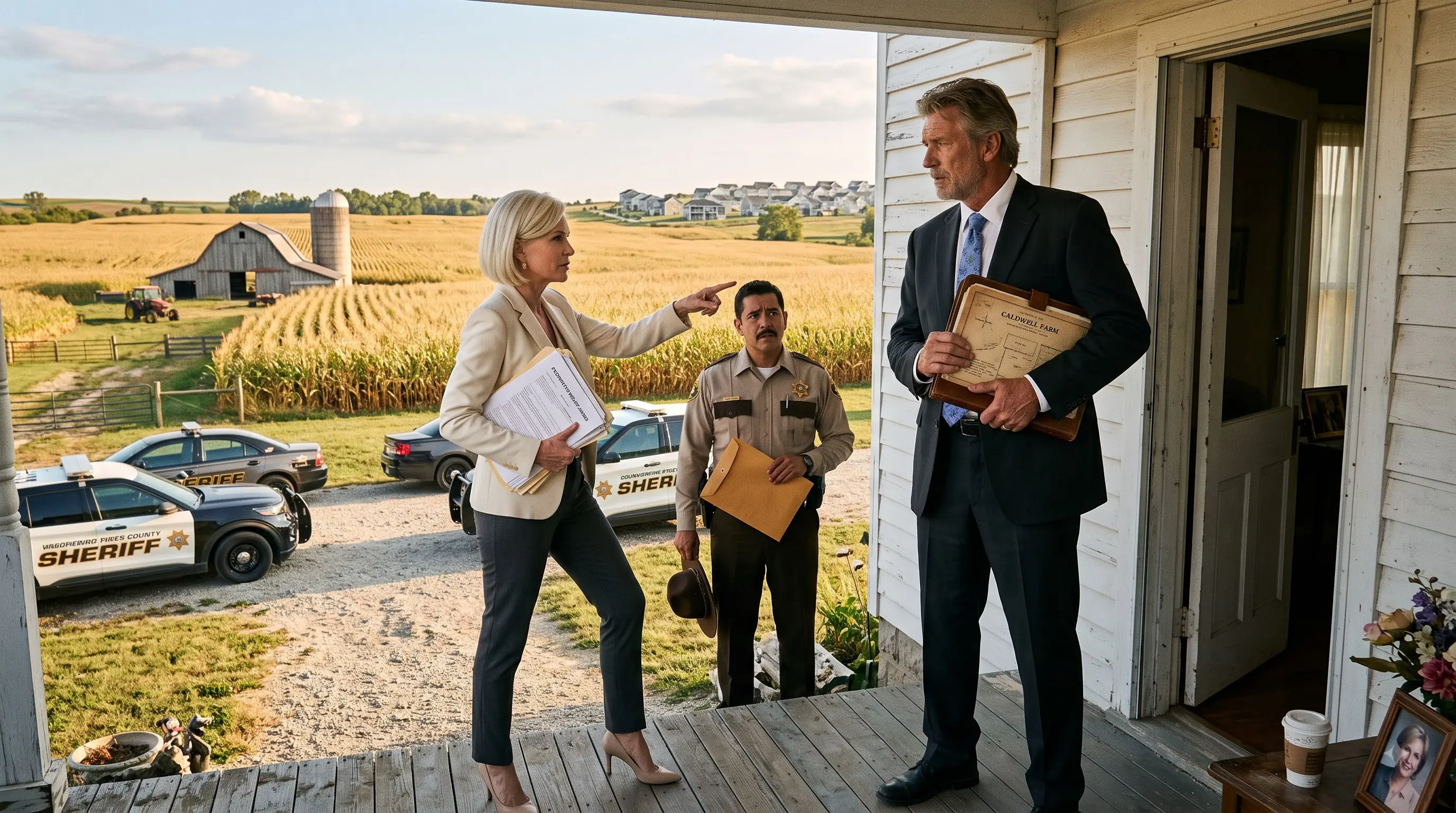
Yes, she actually rode along with the cops, clutching a stack of papers and wearing the kind of smile you see on people who enjoy hurting others.
Deputy Martinez walked up to my porch, hat in hand, looking embarrassed as hell.
“Mr. Caldwell, I’m real sorry about the timing here, but we got a court order saying this corn operation is illegal.”
The smell of coffee gone cold. The sound of handcuffs jingling on the deputy’s belt. The sight of my neighbor, who had waited until my wife died to make her move.
But Vivian had just made the worst mistake of her miserable life.
Seven minutes later, she discovered I owned this entire valley, including the land her house sat on.
Some people have no shame.
But karma has perfect timing.
My name is Ezra Caldwell, and three weeks ago, I buried my wife, Sarah, on the same day our neighbor started planning to steal our farm.
You heard that right.
While I was lowering my wife of twenty-eight years into the ground, Vivian Thornridge was probably at home researching how to seize agricultural property from grieving widowers.
Classy lady, right?
This is Whispering Pines Valley, population eight hundred forty-seven if you count the dogs.
Sarah and I owned two hundred acres of rolling hills, woodland, and the sweetest corn ground in three counties. Only forty acres were actively farmed. The rest was Sarah’s walking trails, where she disappeared for hours with her camera, photographing wildflowers and planning the retirement garden we would never plant together.
Our 1920s farmhouse sits on a hill overlooking the whole valley. The porch creaks like old bones, but it held us through twenty-eight years of morning coffee and sunset conversations.
The smell of diesel fuel from my John Deere mixing with whatever Sarah was baking.
That was home.
Then came Pines Ridge Estates.
Picture this.
Forty-seven McMansions carved into our eastern slope like a fancy scar. Each one costing more than most people make in a decade.
The marketing promised authentic rural living and peaceful agricultural views.
What they got was a front-row seat to actual farming, which apparently was not part of their Instagram fantasy.
Enter Vivian Thornridge, HOA president and professional misery distributor.
Fifty-eight years old. White Lexus SUV cleaner than a surgical instrument. Fingernails so sharp they could probably cut glass.
She moved here eight months ago, right when Sarah started chemo, and became HOA dictator faster than you can say property values.
Her first attack came during Sarah’s second round of treatment.
I was starting my harvester at 6:00 a.m. because that is when farmers work, and here came Vivian clicking across my property in heels that cost more than my seed corn.
“This industrial noise is completely unacceptable,” she announced, clipboard clutched like a weapon. “Surely you can postpone your agricultural activities until civilized hours.”
I was standing there with my wife dying of cancer, trying to keep our farm running, and this woman wanted me to ask permission to work my own land.
“Ma’am,” I said, gripping my coffee mug to keep from saying something I would regret, “corn doesn’t care about your sleep schedule.”
That was when the harassment campaign began.
Noise complaints every week. Environmental violations that did not exist. Anonymous calls about unsafe practices and unsightly equipment.
Code enforcement showed up so often I considered charging them rent.
The smell of fresh harassment mixed with bureaucratic paperwork became my new normal.
Meanwhile, the valley split like a rotten apple.
Longtime neighbors had my back. Marcus, who ran the auto shop. Elderly Silas with his chickens. The church folks who brought casseroles during Sarah’s final weeks.
They understood that farms were here first. They understood that agricultural heritage made this place worth living in.
But the new residents wanted the postcard without the reality.
Scenic views of cornfields, but no fertilizer smells.
Charming farm equipment, but no early morning diesel engines.
Rural peace and quiet, but with suburban convenience and city noise laws.
Every complaint felt like another shovel of dirt on Sarah’s grave. Every bureaucrat with a clipboard felt like another attack on everything we had built together.
The worst part?
Vivian’s timing was surgical.
She escalated every conflict right when Sarah had a bad day. When I was exhausted from hospital visits and sleepless nights.
Looking back, I realized she was studying us, waiting for maximum vulnerability.
Three weeks ago, Sarah lost her battle with cancer.
I held her hand as she whispered, “Don’t let them take our home, Ezra. This land is our love story.”
Two days after the funeral, Vivian filed her first lawsuit.
Today, she was about to learn that some widowers fight back harder than she bargained for.
Two days after Sarah’s funeral, while I was still figuring out how to cook dinner for one, Vivian struck with the precision of a legal sniper.
The certified letter arrived on a Thursday morning, thick as a weapon and twice as threatening.
It was a formal complaint filed with the county, claiming my commercial agricultural operation posed an immediate danger to residential safety.
Commercial operation?
Lady, I was growing corn, not running a chemical factory.
Vivian had hired Augustus Grimm.
Yes, that was his real name, and it fit like a custom-made coffin.
Grimm specialized in what he called property optimization disputes, which was lawyer language for helping rich people steal land from folks who actually worked for a living.
Their weapon of choice?
A dusty 1987 county ordinance about commercial agriculture in residential zones.
Sounds scary until you read the fine print.
It only applied to properties under fifty acres.
My two hundred acres should have laughed that thing out of court.
But grief makes you stupid, and I almost missed that crucial detail.
Thank God for Dolores Martinez, Marcus’s aunt, who had worked county records for thirty-seven years.
Her phone call Friday afternoon cut through my fog like a chainsaw.
“Ezra, honey, something stinks worse than Silas’s chicken coop about these property surveys. Get down here.”
The county records basement smelled like mildew and broken dreams.
Dolores spread maps across a metal table, her finger tracing lines that made my blood pressure spike.
“Look at this mess,” she muttered, comparing recent Pines Ridge surveys to original 1962 aerial photographs. “These new boundaries show your corn operation magically extending into their residential buffer zones. But see this old aerial? Your family’s land is clear as Sarah’s sweet tea.”
I remembered my grandfather Josiah explaining boundary surveys when I was twelve, teaching me that paper trails matter more than fence posts.
“Boy,” he had said, stabbing his finger at property deeds, “when lawyers start moving lines on maps, you better damn well know where the real lines are.”
That wisdom had just saved my farm.
The aerial photos told the truth.
Several Pines Ridge properties showed mysterious boundary adjustments in recent surveys, all creeping toward my farmland like legal cancer.
While I was discovering surveyor fraud, Vivian launched her community pressure campaign with the subtlety of a tornado through a trailer park.
She organized child safety patrols, groups of HOA parents photographing my dangerous equipment twice daily.
Apparently, my John Deere looked like a weapon of mass destruction when shot from dramatic low angles.
Who knew farming was so terrifying?
Murphy’s Diner became gossip central, thick with the smell of bacon grease and small-town drama.
Half the booths supported the grieving widower. Half worried about property values. The coffee tasted like tension.
Marcus slid into my usual booth Saturday morning, phone in hand and steam rising from his ears.
“Ezra, you got to see the social media garbage.”
Vivian’s Facebook group, Concerned Pines Ridge Parents, was a master class in manipulation.
My irrigation system looked industrial and ominous in black-and-white filters. My tractor appeared massive and threatening from ground-level shots.
But the posts hit below the belt.
Recent family tragedy may have affected farmer’s judgment.
Grieving widower shows increasingly erratic behavior around heavy machinery.
She was using Sarah’s death as ammunition.
That was when Vivian made her first critical mistake.
One photograph clearly showed equipment from inside my property line, a spot she had no legal right to access.
The timestamp read 11:00 p.m. Wednesday, two days after filing her complaint.
I had learned evidence collection from watching too many crime shows during Sarah’s chemo treatments.
Trail cameras went up at every property boundary. Screenshots were saved of every social media post. License plates were documented.
The community responded like antibodies fighting infection.
Local farmers started driving solidarity laps past my property. Support Our Farmers signs sprouted on lawns throughout the valley.
Even some newer residents, the ones not drinking Vivian’s poison, started asking uncomfortable questions about HOA overreach.
But Sunday morning brought the real shock.
Fresh surveyor stakes driven deep into Sarah’s favorite walking trails.
These were not weathered old markers. The metal gleamed like surgical instruments, plastic ribbons bright orange as warning flags.
Someone had been measuring my woodland without permission, planning something bigger than noise complaints.
The sound of hammered metal stakes echoed through the trees where Sarah used to collect wildflowers for our kitchen table.
Each stake felt like another nail in the coffin of our memories.
That was when understanding hit like cold water.
This was not about farming violations or community standards.
This was about land acquisition.
And Vivian’s timeline carried an urgency I did not yet understand.
Monday’s mail brought the escalation.
Notice of emergency public safety hearing.
Fifteen days to respond or face immediate property remediation.
Fifteen days to prove my corn was not a weapon of mass destruction.
Fifteen days to honor Sarah’s dying wish that I protect our home.
Fifteen days before Vivian discovered that grief does not make you weak.
It makes you dangerous.
The county hearing felt like my own trial, except I was not sure what crime I was supposed to have committed besides growing corn while grieving.
Vivian transformed the courthouse into her personal theater, packing it with forty-seven HOA members wearing matching Community Safety First T-shirts.
The smell of expensive perfume mixed with righteous indignation hung thick as smoke.
I walked in wearing the same black suit from Sarah’s funeral. It was the only decent one I owned, and I immediately spotted the ambush.
Vivian had a PowerPoint presentation, professional charts, and enough legal ammunition to invade a small country.
Her performance deserved an Oscar for best dramatic nonsense.
“Ladies and gentlemen, we face an unprecedented threat to our children’s safety. A grief-stricken individual operating industrial machinery in an emotionally compromised state.”
The audacity tasted like bile in my throat.
She was weaponizing my wife’s death.
My support team looked like the island of misfit toys.
Three weathered farmers, Marcus still wearing his work clothes, and Dolores clutching a manila folder like it contained nuclear secrets.
We were bringing slingshots to a cannon fight.
But sometimes David wins because he has nothing left to lose.
When hearing officer Patricia Wells called my name, I stood with evidence that made Vivian’s dog-and-pony show look amateur.
Noise measurements proving compliance. Soil tests showing zero contamination. And the crown jewel, that 1962 aerial photo blown up poster size.
“Your Honor,” I said, voice steadier than my nerves, “my family was growing food here when these folks were still living in suburbs complaining about different neighbors.”
A few chuckles came from the farming crowd.
Even Officer Wells hid a smile.
Then Vivian dropped her theatrical bombshell.
“Your Honor, I present Dr. Helena Frost, certified environmental consultant.”
Out strode a woman in a pristine lab coat carrying charts about irrigation contamination and chemical runoff dangers. She had more credentials than a medical convention and spoke with the authority of someone who clearly believed she knew everything about everything.
“This agricultural operation,” Dr. Frost declared, “presents immediate environmental hazards, compounded by the operator’s recent psychological trauma affecting safety judgment.”
The room went church quiet.
Even sympathetic faces looked concerned.
That was when Sarah’s voice echoed in my memory.
Ezra, when someone’s lying to your face, make them prove it where everyone can see.
I pulled out my phone, fingers moving with surgical precision.
Three minutes of internet searching while Dr. Frost continued her expert testimony.
“Dr. Frost,” I interrupted, standing slowly, “could you clarify your environmental science credentials?”
She launched into impressive-sounding qualifications about extensive consulting experience and advanced environmental assessment training.
“Fascinating,” I continued, holding up my phone screen. “Because according to the state professional registry, Helena Frost is a landscape architect from Whispering Oaks Country Club. Golf course design specialist. No environmental science degree. No consulting certification. No expertise in anything except making sand traps look pretty.”
The explosion was immediate.
Officer Wells’s gavel sounded like gunshots as she restored order.
Vivian’s face cycled through colors not found in nature.
“Mrs. Thornridge,” Officer Wells said, her voice cold enough to freeze water, “this is a legal proceeding, not community theater. Your complaint is dismissed for fraudulent evidence and expert witness misrepresentation.”
Victory tasted like sweet revenge mixed with stale courthouse coffee.
But as we filed out, I caught Vivian in heated whispers with lawyer Grimm near the water fountain.
Her words stopped my blood cold.
“The boundary lawsuit gets filed tomorrow. He won’t have time to prepare proper defense while he’s still grieving.”
Marcus heard it, too.
Our eyes met with shared alarm.
Twenty minutes later, I was barely through my front door when Dolores called, breathless with discovery.
“Ezra, honey, you need to sit down. I found something in those 1985 property records that explains everything. Why Vivian moved here, why she’s targeting you specifically, why she waited until Sarah died.”
“What are you talking about?”
“There’s a development agreement with clauses that make her desperation make perfect sense. But this is bigger than land grabbing, Ezra. This is about money. Serious money. And time limits.”
The evening air carried the sound of corn leaves rustling like whispered secrets.
Somewhere across the valley, Vivian was planning her next attack, but she did not know about Dolores’s discovery.
“Can you meet tomorrow morning?” Dolores continued. “Bring Marcus. You’re going to want witnesses when you see what I found.”
“How bad is it?”
“Bad enough that you’ll understand why she attacked you on Sarah’s funeral day. And good enough that we might finally have the weapon to destroy her.”
I sat on our porch swing, watching stars emerge over the cornfields Sarah loved.
The silence felt different now.
Not peaceful.
Loaded with possibility.
Tomorrow, I would learn why Vivian was so desperate for my land.
And why that desperation was about to become her fatal mistake.
The lawsuit landed on my doorstep at 6:00 a.m. like a legal grenade delivered by Deputy Rodriguez, who looked like he would rather be arresting actual criminals.
“Adverse possession claim,” he said, handing me papers thick enough to choke a horse. “Ezra, I’m real sorry about the timing. Nobody thinks this is right.”
Even the sheriff’s department knew Vivian had crossed every moral line in the book.
The legal documents made my morning coffee taste like liquid rage.
She was claiming HOA ownership of twelve acres of woodland, Sarah’s favorite walking trails, based on fifteen years of continuous maintenance and improvement.
Fifteen years.
The HOA had existed for eight months.
Apparently, grief did not just break your heart. It also made you bad at math.
But the cruel genius hit deeper.
She was targeting the exact trails where Sarah spent her final good days photographing wildflowers and planning the retirement we would never have.
Even dead, my wife was not safe from this woman’s greed.
Clayton Hayes spread the property surveys across his desk like a crime scene investigation.
His weathered surveyor hands traced boundary lines with thirty years of experience, and what he found made my blood pressure spike.
“This is artistic fraud,” he muttered, pointing to official-looking documents. “These property stakes have been moved an average of forty-seven feet toward your land. That’s not natural drift. That’s calculated theft.”
We walked my property line in morning air sharp enough to cut glass.
The measuring tape zipped between old iron pins my grandfather had set in 1924 and shiny new stakes that gleamed like surgical instruments.
“GPS technology doesn’t lie,” Clayton explained, taking readings precise to two inches. “These moved boundaries represent roughly 2.3 million dollars in stolen property value.”
My grandfather’s voice echoed from childhood lessons about land ownership.
Boy, property thieves have existed since Cain killed Abel, but they can’t steal what you can prove belongs to you.
That wisdom had just saved my farm.
Then Clayton dropped the bombshell that changed everything.
“Ezra, look at this signature page from the original 1985 development agreement.”
There, in flowing purple ink, was the name Vivian Thornridge.
Project coordinator for Thornridge Construction Company.
“She didn’t just move here randomly,” Clayton said grimly. “She personally oversaw this development eight months ago. Every property line, every boundary marker, every legal description. She knew it all from day one.”
The revelation hit like cold water.
This was not opportunistic land grabbing.
This was premeditated theft with surgical timing.
While I was processing surveyor fraud, Vivian launched her cruelest psychological attack yet.
Memorial Cleanup Day appeared on HOA social media, scheduled for Thursday afternoon during my grief counseling session.
They were targeting Sarah’s trails with garden benches, flower beds, and community improvements designed to support their adverse possession claim.
The timing was surgical cruelty.
She knew I could not be there to stop them.
When I returned from therapy, Sarah’s peaceful woodland looked like suburban Disneyland.
Garden benches sat where my wife used to rest during walks. Manicured flower beds bloomed where she photographed native wildflowers.
They had turned her memory into legal evidence.
The smell of fresh mulch mixed with betrayal created a toxic cocktail in my chest.
I found twenty HOA members in matching T-shirts taking photographs for court documentation.
They were posing beside their “improvements” like tourists at a monument to my wife’s stolen peace.
“Get off my property,” I said, voice shaking with rage that surprised even me. “These are Sarah’s trails. She died three weeks ago, and you’re desecrating her memory.”
Vivian stood among the flower beds like Napoleon surveying conquered territory.
“Mr. Caldwell, this neglected land desperately needed community stewardship. Your obvious grief has prevented proper environmental care.”
“Neglected?”
The word exploded from my throat.
“My wife walked these trails every day until chemo made her too weak to stand. You vultures waited until her body was cold to move in.”
Cell phone cameras captured every heated word for future court battles.
HOA members claimed they were preserving natural beauty while standing on my private property like colonizers planting flags.
But that night, my trail cameras revealed the smoking gun.
Midnight footage showed Vivian and two men in Thornridge Construction coveralls systematically moving survey stakes deeper into my woodland.
License plates clearly visible. GPS coordinates automatically recorded. Systematic property theft documented in high-definition digital evidence.
The next morning, attorney Rebecca Swift called with news that made everything click into place.
“Ezra, I’ve researched Vivian’s background across three counties. She’s used identical boundary dispute tactics on elderly farmers and recent widowers. But here’s the crucial detail. Every case has the same timeline pattern.”
“What kind of pattern?”
“She needs to complete these land acquisitions before January 1. There’s a legal deadline attached to the original development agreement that expires December 31. If she doesn’t secure adjacent properties by then, her entire development empire collapses.”
“How do you know?”
“Because I found the smoking gun in county records. Tomorrow morning, you’re going to see why she attacked you on Sarah’s funeral day, and why that desperation is about to destroy her completely.”
The discovery that changed everything happened in Rebecca’s law office, surrounded by the smell of burnt coffee and legal vengeance.
She had documents spread across her conference table like a battle plan, with Dolores and Marcus as my emotional backup squad.
The morning light streaming through dusty windows made the papers look like evidence of war crimes.
“Ezra,” Rebecca said, sliding a thick folder toward me, “what I’m about to show you will make you understand why that woman attacked you on Sarah’s funeral day.”
The first document stopped my heart.
1985 Whispering Pines Valley Development Agreement.
Stamped and official.
Buried in forty-seven pages of legal nonsense was a clause that explained Vivian’s desperation.
“Land banking provision,” Rebecca explained, her finger stabbing at highlighted text. “Thornridge Construction gets first right of refusal on any property sales within five miles of their development. But look at this expiration date. January 1, 2024. Six weeks from today.”
“Holy hell,” Marcus whispered. “She’s running out of time.”
“Gets worse,” Dolores added, pulling out property records that made my stomach churn. “Four other valley properties since 2021. Same pattern every time. Boundary disputes, expensive lawsuits, forced sales.”
Rebecca spread out the evidence like playing cards.
Elderly farmer Johnson. Four-hundred-thousand-dollar property sold for ninety thousand dollars.
Widow Peterson. Three-hundred-fifty-thousand-dollar land went for seventy-five thousand dollars.
All because manufactured legal problems made their properties unmarketable.
The systematic theft hit me like physical pain.
“How much money are we talking about?”
“Thornridge has stolen roughly 3.2 million dollars in land value over three years. And your two hundred acres? That’s the crown jewel. Worth eight to twelve million for subdivision development.”
Then Rebecca dropped the personal bombshell that made everything crystal clear.
“Vivian’s grandfather Harold lost his farm in 1963. Guess who bought it at foreclosure?”
My mouth went dry.
“My grandfather.”
“Josiah Caldwell. Eight thousand dollars at county auction. Legal and fair, but Harold spent the rest of his life claiming he was cheated. Vivian grew up hearing bedtime stories about evil Caldwells stealing Thornridge family land.”
So Sarah and I were not just victims.
We were targets of sixty-year-old revenge fantasies.
“But here’s where she messed up,” Rebecca said, grinning with prosecutorial bloodlust. “The right of refusal only applies to voluntary sales. Properties taken through lawsuits don’t qualify.”
“Meaning?”
“Every legal attack she launches actually destroys her own development rights. She’s committing economic suicide while trying to steal your land.”
Marcus started laughing so hard he nearly choked on his coffee.
“She’s been playing herself this whole time?”
“Wait. There’s more,” Rebecca continued, producing a document that looked older than Moses.
“Original 1918 land deed from the courthouse basement. Your great-great-grandfather owned this entire valley before any development agreements existed.”
The implications exploded in my brain like fireworks.
“The 1985 agreement is invalid?”
“Completely. The county granted development rights to land they didn’t control.”
“Which means…”
“Which means I can challenge the entire development,” I finished, understanding flooding through me like warm whiskey.
“Not just defend, Ezra. Attack. We can potentially void every property transfer since 1985 and recover millions for theft victims.”
The room fell silent except for the sound of my heart hammering against my ribs.
For the first time since Sarah died, I felt something stronger than grief coursing through my veins.
“What’s our play?”
“County commissioners meeting Tuesday night. All three commissioners who approved Thornridge deals are up for re-election. Perfect timing for maximum public humiliation.”
“And Vivian?”
“She thinks she’s winning. Let her keep believing that until we destroy her in front of the entire community.”
I stood up, Sarah’s wedding ring catching the light on my finger.
“She wanted a war over my wife’s grave. She’s about to get one.”
Sarah’s dining room transformed into mission control for Operation Destroy Vivian.
The same table where my wife used to grade papers was now covered with enough evidence to put half the county in prison.
The air smelled like determination mixed with Marcus’s motor oil and Rebecca’s stress-fueled chain smoking.
Coffee cups multiplied like rabbits among property deeds that would change everything.
“All right, gentlemen,” Rebecca announced, spreading maps like a general planning an invasion. “We’re about to turn Vivian’s own tactics against her. But first, we need bulletproof evidence.”
Clayton arrived hauling surveying equipment that looked like it could guide space shuttles.
His GPS readings made my grandfather’s old transit look like a toy.
And what we discovered would make a saint curse.
“These boundary manipulations are surgical,” he explained, taking measurements precise to within two inches. “Average stake movement, forty-seven feet toward your property. That’s 2.3 million dollars in attempted theft, documented with coordinates no judge could argue with.”
I remembered my grandfather teaching me about surveys when I was twelve, showing me how to read property descriptions and find corner markers.
“Boy,” he had said, “modern liars use fancy equipment, but the truth is still the truth. Technology just makes it harder to hide.”
That lesson was about to save my farm and destroy Vivian’s empire.
Marcus became our intelligence commander, scrolling through Vivian’s social media with the focus of a detective solving murder.
“Look at this coordination. She’s documented her entire criminal conspiracy on Facebook. Even posted photos of your property with captions like, Soon this eyesore will become beautiful community space.”
“She’s been planning this since Sarah got sick,” I realized, watching months of calculated posts.
Every sympathy card. Every casserole delivery.
She had been studying us, waiting for the perfect moment to strike.
Rebecca’s financial investigation revealed why Vivian’s timing was so surgical.
“Thornridge Construction is drowning in debt. Twenty-five million in loans due February 2024, with future development rights as the only collateral. If they don’t acquire adjacent properties before January 1, bankruptcy destroys everything.”
“So she’s not just greedy,” Marcus said. “She’s desperate.”
“Desperate enough to attack a man at his wife’s funeral,” I added grimly.
But desperation makes people sloppy.
Dolores became our deep throat, using three decades of county connections to expose corruption faster than investigative journalists.
“Commissioner Bradley took fifteen thousand dollars from Thornridge. Murphy got twelve thousand. Williams accepted eight thousand in consulting fees for fast-tracking development permits.”
The web of corruption spread like cancer, but it also gave us more targets for public execution.
Community organizing happened with grassroots efficiency that would make political campaigns jealous.
The Valley Heritage Defense Committee grew to sixty members, more than the entire HOA.
Longtime residents who remembered when this valley fed families instead of feeding corporate greed came together.
“Marcus,” I asked, “how many signatures can we get on a petition supporting agricultural heritage?”
“How many do you want? Half these folks remember your grandfather helping their families during the farm crisis. The other half are just furious about property taxes rising because of McMansion developments.”
Rebecca contacted investigative reporter Stella Remy with evidence packets that read like crime novels.
“Media timing is crucial,” she said. “We coordinate legal filings with newspaper releases for maximum public impact. Vivian’s going to face justice in courtrooms and headlines simultaneously.”
Personal preparation cut deepest.
I practiced testimony while wearing Sarah’s favorite tie, blue with tiny cornflowers, the one she bought for our tenth anniversary.
The fabric still carried a hint of her perfume, and speaking about our land while wearing it felt like she was standing beside me.
“Channel your grief into determination,” Rebecca coached. “You’re not just defending property. You’re protecting every rural family from predators like Vivian. You’re proving that ordinary people can defeat systematic corruption.”
The evening before our courthouse ambush, I sat on the porch swing where Sarah and I had planned our retirement.
Stars emerged over cornfields that represented four generations of family sweat.
For the first time since her funeral, I felt something stronger than grief.
I felt the righteous anger of a man protecting his wife’s memory.
“Sarah,” I whispered to the night air, “tomorrow, we honor your love for this land. And we make sure no other widow gets attacked at their spouse’s funeral.”
The corn leaves rustled like applause in the evening breeze.
I swear I could hear her voice.
Give them hell, honey.
Give them hell.
Tuesday night, Vivian Thornridge would discover that attacking grieving widowers was the biggest mistake of her miserable life.
And every farmer in three counties was going to watch her empire crumble on live television.
Justice tasted like sweet revenge mixed with morning coffee.
And it had been brewing since the day she brought cops to my wife’s funeral.
Monday morning brought Vivian’s desperation to DEFCON 1 levels.
She filed a police report claiming I threatened her with a combine harvester while having what she called a grief-induced psychotic break.
The fictional police report read like a rejected script from a bad horror movie.
According to her statement, I aggressively pursued her vehicle with industrial farming equipment while shouting threats about burying her problems in the cornfield.
Deputy Martinez showed up looking like he would rather be investigating actual crimes instead of suburban fantasy novels.
The morning air carried the smell of fresh frustration mixed with his obvious embarrassment as we reviewed security footage on my laptop.
“Ezra, this is getting stupid,” he sighed, watching video of me peacefully harvesting corn while Vivian claimed I had been hunting her with heavy machinery. “According to her timeline, you threatened her at 3:00 p.m. yesterday. This footage shows you were buying feed at the co-op in town.”
Radio chatter from his patrol car provided the soundtrack to our evidence review, timestamps destroying every word of her manufactured drama.
Even small-town cops have limits for rich people’s lies.
But Vivian’s psychological warfare was just getting started.
Channel 8 News received an anonymous tip about an unstable farmer whose recent family tragedy had created public safety hazards.
She coordinated an HOA safety march timed perfectly for evening broadcast ratings.
Forty-seven McMansion residents paraded past my property wearing matching Protect Our Children T-shirts, carrying signs that made my grief sound like terrorism.
Agricultural Accountability Now.
Community Safety Over Individual Rights.
The social media assault launched with military precision.
Facebook posts multiplied like cancer.
Dangerous widower operating heavy machinery near children.
How many kids must be endangered before someone stops this madness?
Recent loss clearly affecting his judgment about community safety.
She had turned Sarah’s death into ammunition for character assassination.
Marcus became my intelligence officer, monitoring their digital coordination with the dedication of a cyber warfare specialist.
“They’re planning something called Documentation Day for Thursday,” he reported, showing me infiltrated HOA messages. “Mass photography of all your equipment for safety violation evidence.”
Thursday morning, I woke up to economic terrorism.
The sound of gushing water where no water should have been gushing drew me outside to find four thousand dollars’ worth of irrigation infrastructure systematically destroyed.
Clean cuts through main supply lines. Deliberately shattered valve assemblies. Electronic controls smashed with surgical precision.
The smell of wet earth mixed with financial ruin filled the dawn air as I surveyed professional-grade sabotage designed to kill my harvest during critical growing season.
Tire tracks in the mud matched the luxury SUV patterns I had been documenting for weeks.
This was not vandalism.
This was agricultural murder.
“Those bastards knew exactly which pipes to cut,” Marcus growled, examining the destruction with a mechanic’s expertise. “This wasn’t random damage. Someone studied your irrigation system before destroying it.”
We photographed evidence while I calculated crop losses that could bankrupt a family farm.
The timing was surgical cruelty.
Too late to replant. Too expensive to repair quickly. Perfectly designed to force a distress sale.
That afternoon, Vivian delivered her coup de grâce.
She appeared on my front porch like death in designer clothing, carrying an offer that would make mob bosses jealous.
Five hundred thousand dollars for twelve acres she did not own, contingent on my agreement to cease agricultural operations within two hundred yards of residential development.
“Mr. Caldwell,” she purred, standing on my property like she already owned it, “recent incidents clearly demonstrate that continued farming exceeds your current emotional capabilities.”
The sheer audacity could choke a horse.
She was offering to buy land she had been stealing while standing on property she had been destroying.
“That’s mighty generous,” I replied, gripping my coffee mug hard enough to crack porcelain. “But I’m not selling Sarah’s walking trails to the woman who brought cops to her funeral.”
Her perfect smile fractured like ice on a pond, the first crack in her sociopathic facade.
“Mr. Caldwell, grief sometimes prevents rational decision-making. I’d hate for additional complications to worsen your already difficult situation.”
The threat hung between us like cordite smoke.
She was not offering money.
She was demanding protection payments.
“Mrs. Thornridge,” I said, stepping close enough that she could smell honest work on my clothes, “you’ve made one fatal miscalculation in your little war against my family.”
She raised an eyebrow.
“You thought grief would break me. Instead, it just made me absolutely fearless.”
Her composure shattered completely as she realized she was not fighting a broken widower.
She was fighting a man with nothing left to lose.
That evening, Rebecca called with intelligence that changed everything.
“Emergency HOA meeting scheduled for tomorrow morning. Topic: Final community action regarding agricultural threat. But here’s the beautiful part. I know exactly what she’s planning.”
“What?”
“She’s going to call in a fake environmental emergency to force immediate property seizure.”
“How do you know?”
“Because federal investigators have been watching her for three weeks, and tomorrow morning she’s going to commit felony fraud in front of witnesses who are actually undercover agents.”
Tuesday morning at 7:23 a.m., Vivian committed the kind of fraud that makes federal agents weep with joy.
Her 911 call reported an environmental catastrophe in progress at my farm, claiming I was spraying toxic chemicals in a grief-induced rage that threatened to poison the entire county’s water supply.
The emergency response looked like a scene from a disaster movie.
Fire trucks, a hazmat team, ambulances, and patrol cars converged on my property with sirens wailing loud enough to wake the dead, including Sarah, who would have laughed herself breathless at this theatrical nonsense.
The smell of diesel exhaust mixed with pure desperation as forty-seven first responders searched for environmental disasters that existed only in Vivian’s imagination.
Deputy Martinez emerged from his cruiser looking like a man who had reached his breaking point.
“Ezra, this is the fifth emergency call this week. Either you’re running a secret chemical weapons program, or somebody’s using 911 like their personal complaint hotline.”
The hazmat team spread across my cornfield with equipment sensitive enough to detect almost anything, finding absolutely nothing except legally applied fertilizer from three weeks earlier.
They looked increasingly annoyed at being dragged out for suburban paranoia.
Environmental inspector Janet Morrison tested soil, water, and air quality with scientific precision that would impress NASA.
Her conclusion carried the authority of twenty years’ experience.
“This farm is cleaner than most city parks. Whoever reported this emergency either failed basic chemistry or is deliberately wasting taxpayer resources.”
But Vivian’s grand finale made her previous lies look like parking tickets.
She produced an emergency court order authorizing immediate property seizure under environmental crisis protocols.
The document looked official enough to fool amateurs, complete with county seal and judicial signature.
That was when Rebecca’s legal education paid off like winning the lottery.
“Mrs. Thornridge,” I announced loud enough for the gathering spectators, “this order is signed by Judge Harrison Miller. Fascinating choice, considering Judge Miller died of a heart attack six months ago. Are you claiming judicial authority from the afterlife?”
The silence that followed could have stopped traffic in three counties.
Deputy Martinez examined the forged document with the expression of a man watching someone commit career suicide.
“Ma’am, presenting falsified court orders to law enforcement is a federal felony. Did your attorney really prepare paperwork signed by dead judges?”
Vivian’s face transitioned through colors not found in earthly rainbows.
“There must be some administrative error,” she stammered, realizing her desperate gambit had just become criminal evidence. “Legal documents sometimes have clerical inconsistencies.”
“Clerical inconsistencies?”
Martinez pulled out handcuffs with the satisfaction of a man finally arresting the right person.
“Lady, you just tried to steal property using court orders from the spirit world.”
The gathering crowd included faces I did not recognize.
Three people in casual clothes taking professional photographs and notes. Their relaxed demeanor did not quite hide the federal agent energy radiating like heat from asphalt.
Channel 8 News arrived because Vivian had called them to film her triumphant property seizure.
Reporter Stella Remy expected environmental crisis footage, but found herself documenting felony fraud in real time.
“Mrs. Thornridge,” Stella said, pushing a microphone toward Vivian’s increasingly panicked face, “can you explain why you presented court documents signed by deceased officials?”
“This is a conspiracy!” Vivian shrieked, her sanity finally snapping like an overloaded cable. “This corrupt farmer has obviously bribed the entire county government!”
The accusation echoed across my property like a confession of complete collapse.
Even her HOA supporters started backing away from the woman accusing local cops of corruption.
That was when the beautiful trap sprang with mechanical precision.
The three mysterious observers stepped forward with badges that shone like justice in morning sunlight.
“Mrs. Thornridge, I’m Agent Rebecca Thompson with the FBI Rural Crime Task Force. You’re under arrest for wire fraud, conspiracy, filing false emergency reports, and systematic elder abuse.”
The sound of handcuffs clicking onto Vivian’s wrists created the most beautiful music I had heard since Sarah’s laughter echoed through our kitchen.
“This investigation has been active for three weeks,” Agent Thompson continued. “Based on evidence of coordinated rural land theft across four counties, your entire operation has been under federal surveillance.”
Vivian’s eyes widened with the realization that while she thought she was hunting me, federal agents had been hunting her.
“Mr. Caldwell,” Agent Thompson said, “we’ll need your testimony about harassment patterns, but I want you to know your case broke this entire conspiracy open. Your wife’s memory is being honored by the justice served today.”
As they loaded Vivian into the federal vehicle, she made one final desperate plea.
“This is persecution of legitimate business practices. I was protecting the community from agricultural hazards.”
“Ma’am,” Agent Thompson replied with the patience reserved for complete idiots, “you filed false emergency reports about pesticide use on a farm that hasn’t applied chemicals in two months. You presented court orders signed by dead judges. You’ve systematically stolen property from elderly farmers and recent widowers.”
The federal car disappeared down my driveway, carrying Vivian toward a future that included orange clothing and small rooms with bars.
Tonight’s county meeting would become a celebration instead of a desperate defense.
And Sarah’s memory would get the justice it always deserved.
The courthouse erupted like a powder keg with three hundred angry citizens crammed into a room built for half that number.
The air tasted like righteous fury mixed with stale coffee and the kind of tension that starts revolutions.
Commissioner Patricia Wells pounded her gavel like she was driving fence posts, trying to restore order to chaos that had been building for months.
Camera crews from four news stations jostled for position while overflow crowds pressed against windows like they were watching the Super Bowl.
“This emergency session addresses federal arrests related to systematic land fraud in our county,” Wells announced, her voice barely audible over the crowd’s rumble.
Rebecca stood to present evidence with prosecutorial precision that would make Supreme Court justices weep.
Charts, timelines, and GPS data projected onto screens while three hundred witnesses watched their community’s biggest scandal unfold in real time.
“Ladies and gentlemen,” Rebecca began, “Vivian Thornridge didn’t just steal land. She orchestrated the largest rural property fraud in Iowa history.”
The evidence hit like physical blows.
Historical maps showing systematic boundary theft. Financial records proving 3.2 million dollars in stolen property. Photographs of moved survey stakes creating fraudulent property lines.
Clayton Hayes delivered technical testimony that made farmers curse and accountants cry.
“Average property stake movement, forty-seven feet toward targeted properties. This represents professional-grade theft requiring surveying equipment and detailed knowledge of legal descriptions.”
Angry murmurs rippled through longtime residents realizing their vulnerable neighbors had been systematically robbed by suburban predators.
Then Commissioner Wells called my name.
The room fell silent as a funeral.
I stood wearing Sarah’s cornflower tie, feeling three hundred pairs of eyes and the weight of four generations watching from wherever farmers go when they die.
“Three weeks ago,” I began, my voice cracking slightly, “I buried my wife, Sarah, in Whispering Pines Cemetery. Twenty-eight years of marriage ended by cancer that stole her piece by piece until all I had left were memories and the land she loved.”
The silence became absolute.
You could hear a pin drop in Kansas.
“That same day, while I was still wearing my funeral suit and trying to figure out how to live without her, Vivian Thornridge brought police to steal my cornfield.”
Gasps echoed like gunshots.
Even people who knew the story looked physically sick hearing it stated so bluntly.
“She waited until my wife’s body was cold in the ground to begin her attack. She used Sarah’s death as evidence that I was mentally unfit to farm. She turned my grief into her weapon.”
The crowd’s anger became palpable, a living thing that filled the room like smoke.
“But here’s what that heartless woman didn’t understand about widowed farmers,” I continued, abandoning any pretense of politeness. “Grief doesn’t make us weak. It makes us absolutely dangerous.”
The courthouse exploded.
Commissioner Wells did not even try to restore order as three hundred people cheered like their team had just won the World Series.
“For sixty years, Vivian blamed my family for her grandfather’s financial problems. But the truth is right here in public records. Harold Thornridge sold his farm voluntarily in 1963 for fair market value. No foreclosure. No theft. No injustice except in her twisted imagination.”
I held up the 1918 deed that started everything.
“My great-great-grandfather bought this valley when Iowa was still frontier. We’ve been growing food here since before this courthouse existed.”
The mic-drop moment arrived with perfect timing.
“Vivian Thornridge thought she could steal my wife’s memory along with my land. Instead, she exposed a criminal conspiracy that robbed millions from rural families across four counties. Now she’s going to federal prison for a very long time.”
The building shook with applause that did not stop for two full minutes.
But the real fireworks started when Commissioner Bradley tried to defend himself.
“These allegations are politically motivated attacks on legitimate business development,” he stammered, sweat visible under television lights.
Agent Thompson stood with federal authority that silenced his excuses.
“Commissioner Bradley, your bank records show fifteen thousand dollars in payments from Thornridge Construction for consulting services you never provided. That’s bribery, and you’re under arrest.”
The handcuffs clicking onto Bradley’s wrists created better entertainment than anything on cable television.
Commissioners Murphy and Williams resigned faster than rats abandoning a sinking ship, their political careers ending with the sound of gavels and public humiliation.
“Emergency elections within sixty days,” Wells declared. “This county deserves honest representation.”
As the meeting ended, the crowd did not leave.
They transformed into a spontaneous block party.
Farmers who had feuded for years shook hands over ancient grudges. Former HOA residents apologized to longtime neighbors for supporting Vivian’s lies.
The smell of justice mixed with autumn air carrying the scent of corn ready for harvest, Sarah’s favorite season, when the valley turned golden with the promise of another year’s growth.
Walking home under stars that had witnessed my family’s century of honest work, I felt Sarah’s presence stronger than any night since her funeral.
Her memory had received the vindication it deserved.
Tomorrow, we would start healing the community.
Two weeks later, justice tasted sweeter than Sarah’s apple pie and twice as satisfying.
Vivian faced twenty-three federal charges, including wire fraud, conspiracy, elder abuse, and filing false emergency reports.
The federal prosecutor called it the most systematic rural land theft scheme in Midwest history, which sounded fancy but basically meant she was in serious trouble from every direction.
Denied bail as a flight risk, she spent her days in orange jumpsuits that clashed horribly with her expensive manicures.
Augustus Grimm, her lawyer, got disbarred faster than you can say fraudulent court documents and faced separate criminal charges for conspiracy.
Thornridge Construction filed bankruptcy within forty-eight hours of Vivian’s arrest, their twenty-five-million-dollar debt load collapsing like a house of cards in a tornado.
The HOA officially dissolved when residents discovered their fees were funding illegal land acquisition schemes instead of community improvements.
But the real satisfaction came from watching justice ripple outward like stones thrown in still water.
Federal investigators recovered 4.2 million dollars in stolen property across four counties, returning land to twelve elderly farmers and three widows who thought they had lost everything to legal manipulation.
Mrs. Peterson got her family farm back.
The Johnson brothers recovered sixty acres stolen through boundary fraud.
Each victory felt like vindication for Sarah’s memory.
Former HOA residents integrated into valley life with surprising grace.
Most were decent people fooled by a master manipulator who weaponized their suburban fears against rural neighbors.
Community potluck dinners replaced homeowner association meetings, and property values stabilized without development pressure threatening agricultural heritage.
Marcus organized the Valley Heritage Festival six months later, combining farming education with community healing.
Former enemies worked side by side grilling corn and telling stories about the woman who tried to steal half the county before federal agents hauled her away in handcuffs.
The Sarah Caldwell Memorial Foundation launched with two hundred thousand dollars in donations from grateful families whose properties had been restored.
We established conservation easements protecting five hundred acres of agricultural land from future development, ensuring this valley fed families instead of corporate greed for generations to come.
The foundation scholarship program sent rural kids to agricultural college, honoring Sarah’s teaching legacy while investing in farming’s future.
The first recipient was Marcus’s niece, Elena, studying sustainable agriculture at Iowa State with dreams of revolutionizing organic farming techniques.
Rebecca’s rural property rights defense network provided free legal assistance for boundary disputes and development fraud across the Midwest.
Clayton offered discounted surveying for elderly landowners, and together they prevented six similar schemes from destroying other farming communities.
Stella Remy’s investigative series won a Pulitzer Prize for exposing systematic rural land theft, bringing national attention to predatory development practices targeting vulnerable agricultural families.
Her documentary, Justice in the Cornfield, aired on PBS, reaching millions of viewers who never knew such corruption existed.
Personal healing came slower but deeper than legal victory.
My daughters returned from college with plans to modernize our farming operation using sustainable techniques Sarah would have loved.
The vegetable garden she dreamed of bloomed beside our farmhouse, tended by granddaughters who never met her but carried her love for growing things.
I still drink coffee on our porch every sunrise, watching corn grow in fields that represent four generations of honest work.
The silence feels different now.
Not empty with loss, but full of purpose and peace.
Sarah’s walking trails became a county nature preserve where families photograph wildflowers and children learn about agricultural heritage.
The biggest surprise?
Three former HOA families bought small acreage and started hobby farms, growing vegetables and raising chickens under guidance from longtime neighbors they once considered enemies.
Community gardens replaced subdivision lawns, and the smell of fresh bread from backyard ovens mixed with morning coffee and diesel fuel from tractors.
One year later, standing in the corn maze shaped like a heart at our memorial festival, I felt Sarah’s presence in every laughing child and every friendship rebuilt from the ashes of Vivian’s hatred.
Evil lost.
Good won.
Community healed.
And sometimes, that is exactly how the story should end.