The HOA called the police to seize my cornfield before I had even put away the black suit I wore to my wife’s funeral.
I was standing in my kitchen when I saw three patrol cars turn into my driveway. Vivian Thornridge climbed out of the passenger side of the lead cruiser, clutching a stack of papers and wearing the kind of satisfied smile that belonged on someone who enjoyed causing pain.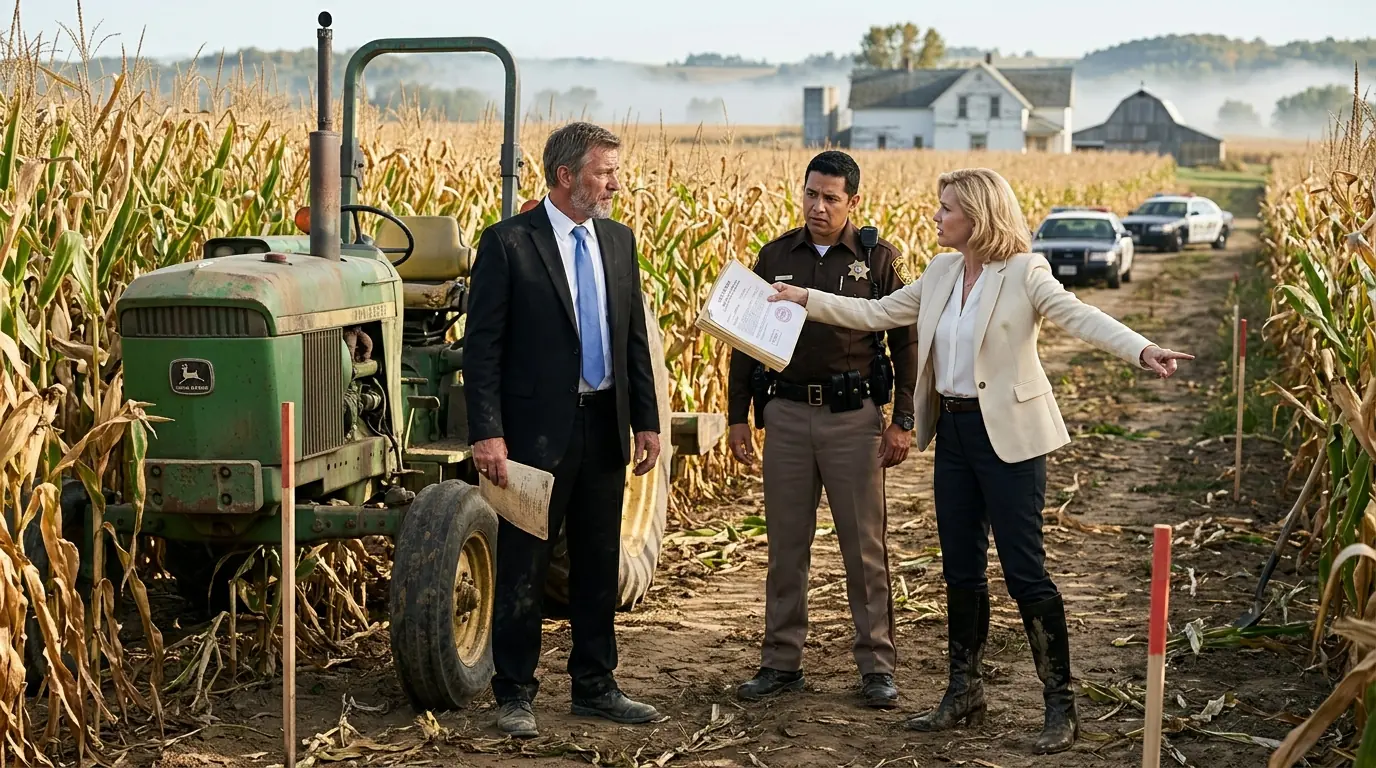
Deputy Martinez walked toward my porch with his hat in his hand. He looked embarrassed before he even spoke.
“Mr. Caldwell, I am truly sorry about the timing, but we received a court order stating that this corn operation is illegal.”
The smell of coffee gone cold filled the kitchen. I could hear the handcuffs shifting against the deputy’s belt while I stared at the neighbor who had waited until my wife died to make her move.
Vivian believed she had finally won.
Seven minutes later, she discovered that I owned the entire valley, including the ground beneath her house.
My name is Ezra Caldwell. Three weeks earlier, I buried my wife, Sarah, after twenty-eight years of marriage. While I was lowering her into the ground, Vivian Thornridge was already preparing the campaign she believed would take our farm away from me.
This was Whispering Pines Valley, a rural Tennessee community with a population of 847, if you counted the dogs.
Sarah and I owned two hundred acres of rolling hills, woodland, and some of the richest corn ground in three counties. Only forty acres were actively farmed. The rest included Sarah’s walking trails, where she disappeared for hours with her camera, photographing wildflowers and planning the retirement garden we would never plant together.
Our farmhouse had been built during the 1920s. It stood on a hill overlooking the valley, and its porch creaked like old bones, but it had carried us through twenty-eight years of morning coffee and sunset conversations.
The smell of diesel from my John Deere mixed with whatever Sarah happened to be baking. That was home.
Then Pines Ridge Estates appeared.
Forty-seven oversized houses were carved into the eastern slope like a polished scar. Each one cost more than many local families would earn in a decade.
The development advertisements promised authentic rural living and peaceful agricultural views. The buyers received front-row seats to actual farming, which apparently had not been included in their fantasy.
They wanted picturesque cornfields without fertilizer smells. They wanted charming tractors without early-morning engines. They wanted rural peace while demanding suburban rules and city conveniences.
Then came Vivian Thornridge.
She was fifty-eight years old, drove a white Lexus SUV cleaner than a surgical instrument, and kept her nails polished into points sharp enough to cut glass.
Vivian moved into Pines Ridge eight months earlier, around the same time Sarah began chemotherapy. She became HOA president almost immediately and treated the position like a private dictatorship.
Her first attack came during Sarah’s second round of treatment.
I had started my harvester at six in the morning because that was when farmers worked. Vivian came across my property in heels that probably cost more than my seed corn.
“This industrial noise is completely unacceptable,” she announced, holding her clipboard as though it were a weapon. “Surely you can postpone your agricultural activities until civilized hours.”
My wife was dying. I was struggling to maintain the farm between hospital appointments and sleepless nights, and this woman expected me to request permission to work my own land.
“Ma’am,” I said, tightening my hand around my coffee mug so I would not say something worse, “corn does not care about your sleeping schedule.”
That was when the harassment campaign began.
Noise complaints arrived every week. Environmental violations appeared for conditions that did not exist. Anonymous callers reported unsafe practices and unsightly equipment.
County code-enforcement officers visited so often that I considered charging them rent.
The smell of fresh harassment mixed with bureaucratic paperwork became my new normal.
Meanwhile, the valley split apart like a rotten apple.
Longtime neighbors stood beside me. Marcus, who operated the auto shop, supported us. So did elderly Silas with his chickens and the church families who brought casseroles during Sarah’s final weeks.
They understood that the farms had existed first. They understood that the agricultural heritage of Whispering Pines was what made the valley worth living in.
Many of the new residents wanted only the postcard.
They wanted the view of a working farm without accepting the work.
Every complaint felt like another shovel of earth landing on Sarah’s grave. Every official carrying a clipboard felt like another attack on everything we had created together.
The worst part was Vivian’s timing.
She escalated every confrontation on the days when Sarah’s condition worsened, when I was exhausted from medical visits and had not slept.
Looking back, I realized Vivian had been studying us. She was waiting for the moment when we would be least capable of defending ourselves.
Three weeks earlier, Sarah lost her battle with cancer.
I held her hand when she whispered her final request.
“Do not let them take our home, Ezra. This land is our love story.”
Two days after the funeral, Vivian filed her first lawsuit.
Three weeks later, she brought law enforcement to my property and tried to seize my cornfield.
She was about to learn that some widowers fought harder than she expected.
Two days after Sarah’s funeral, while I was still learning how to prepare dinner for one person, Vivian struck with the precision of a legal sniper.
The certified letter arrived on a Thursday morning. It was thick, formal, and designed to frighten.
The complaint alleged that my commercial agricultural operation posed an immediate danger to residential safety.
Commercial operation?
I was growing corn, not running an illegal laboratory.
Vivian had hired an attorney named Augustus Grim. That was his real name, and it fit him like a custom-made coffin.
Grim specialized in what he described as property-optimization disputes. In ordinary language, he helped wealthy people take land from families who worked for a living.
Their chosen weapon was a county ordinance from 1987 concerning commercial agriculture inside residential zones.
The language sounded threatening until someone read the details.
The ordinance applied only to parcels smaller than fifty acres.
My two hundred acres should have eliminated the complaint immediately.
Grief made concentration difficult, and I nearly missed that critical detail.
Fortunately, Dolores Martinez called me on Friday afternoon. She was Marcus’s aunt and had worked in the county records department for thirty-seven years.
“Ezra, honey, something smells worse than Silas’s chicken coop in these property surveys. Get down here.”
The county records basement smelled of mildew, dust, and broken dreams.
Dolores spread several maps across a metal table. Her finger traced lines that made my blood pressure rise.
“Look at this mess,” she said.
She compared recent Pines Ridge surveys with aerial photographs taken in 1962.
“These new boundaries show your corn operation somehow extending into their residential buffer zone. But look at the original aerial image. Your family’s land and the later development are separated as clearly as Sarah’s sweet tea.”
I remembered my grandfather Josiah explaining boundary surveys when I was twelve.
He taught me that paper trails mattered more than fence posts.
That lesson helped save my farm.
The old aerial photographs showed the truth.
Several Pines Ridge properties displayed suspicious boundary adjustments in newer surveys. Each alteration moved farther toward my farmland.
While I investigated possible survey fraud, Vivian began a public-pressure campaign with all the subtlety of a tornado passing through a trailer park.
She organized what she called child-safety patrols.
Groups of HOA parents came twice each day to photograph my supposedly dangerous equipment.
Apparently, my John Deere could resemble a weapon of mass destruction when photographed from a dramatic low angle.
Murphy’s Diner became the center of town gossip.
The place smelled of bacon grease, coffee, and small-town conflict. Half the customers supported the grieving widower. The other half worried about property values.
Even the coffee tasted tense.
Marcus slid into my usual booth on Saturday morning with his telephone in one hand and anger rising from him like steam.
“Ezra, you need to see this.”
Vivian had created a social-media group called Concerned Pines Ridge Parents.
It was a master class in manipulation.
Black-and-white filters made my irrigation system look industrial and ominous. Photographs taken from ground level made my tractor appear enormous and threatening.
The captions went even lower.
Recent family tragedy may have affected farmer’s judgment.
Grieving widower displays increasingly erratic behavior around heavy machinery.
Vivian was using Sarah’s death as ammunition.
That was when she made her first significant mistake.
One photograph had clearly been taken from inside my property boundary, from a location Vivian had no legal right to enter.
The timestamp showed eleven o’clock on Wednesday night, two days after she filed the complaint.
I had learned something about evidence collection from watching crime programs during Sarah’s chemotherapy sessions.
Trail cameras went up along every property line.
We saved copies of every social-media post. We recorded license plates, dates, locations, and every unauthorized visit.
The community responded like a healthy body fighting an infection.
Local farmers began driving what they called solidarity laps past my property.
SUPPORT OUR FARMERS signs appeared on lawns throughout the valley.
Even some new residents, the people who had not accepted Vivian’s version of events, began asking uncomfortable questions about HOA authority.
Sunday morning brought the real shock.
I found fresh survey stakes driven into Sarah’s favorite walking trails.
These were not old or weathered markers. The metal was new, and orange plastic ribbons moved in the wind like warning flags.
Someone had entered my woodland without permission and started measuring.
This was bigger than noise complaints.
The sound of metal stakes being hammered into the earth seemed to echo among the trees where Sarah once collected wildflowers for our kitchen table.
Every marker felt like another nail driven through our memories.
Understanding struck me like cold water.
This was not about agricultural violations or community standards.
It was about acquiring land.
Vivian was operating under a deadline I did not yet understand.
Monday’s mail brought another escalation.
NOTICE OF EMERGENCY PUBLIC SAFETY HEARING.
I had fifteen days to respond or face immediate property remediation.
Fifteen days to prove that my cornfield was not a public weapon.
Fifteen days to honor Sarah’s final request.
Vivian believed grief had made me weak.
She had not yet discovered what grief could do when it had nowhere else to go.
The county hearing felt like my own trial, although I still did not understand what crime I had supposedly committed besides growing corn while grieving.
Vivian turned the courthouse into her private theater.
She packed the room with forty-seven HOA members wearing matching COMMUNITY SAFETY FIRST shirts.
Expensive perfume mixed with righteous indignation in the air.
I wore the same black suit from Sarah’s funeral because it was the only decent suit I owned.
The moment I entered, I recognized the ambush.
Vivian had prepared a presentation with professional charts, legal references, and enough visual material to invade a small country.
Her performance deserved an award for dramatic dishonesty.
“Ladies and gentlemen,” she announced, “we face an unprecedented danger to our children’s safety. A grief-stricken individual is operating industrial machinery while emotionally compromised.”
The audacity tasted bitter in my throat.
She was openly using my wife’s death against me.
My support group looked like a gathering of worn-out survivors.
Three weathered farmers sat together. Marcus still wore his mechanic’s clothes. Dolores held a manila folder as though it contained classified evidence.
We appeared to be bringing slingshots into a cannon fight.
Sometimes, however, the person with the slingshot had nothing left to lose.
When Hearing Officer Patricia Wells called my name, I stood with evidence that made Vivian’s performance look amateur.
I presented noise measurements confirming compliance and soil reports showing no contamination.
Then I displayed the 1962 aerial photograph, enlarged to poster size.
“Officer Wells,” I said, my voice steadier than my nerves, “my family was growing food on this land before these residents moved from other suburbs and began complaining about their new neighbors.”
Several farmers chuckled.
Even Officer Wells briefly concealed a smile.
Then Vivian presented her theatrical bombshell.
“Officer Wells, I call Dr. Helena Frost, a certified environmental consultant.”
A woman entered wearing a spotless laboratory coat.
She carried charts about irrigation contamination, chemical runoff, and alleged threats to local water.
She listed credentials with the confidence of someone who expected no one to verify them.
“This agricultural operation presents an immediate environmental hazard,” Dr. Frost declared. “The danger is compounded by the operator’s recent psychological trauma, which may affect his safety judgment.”
The room became silent.
Even people who supported me looked uncertain.
Then I heard Sarah’s voice inside my memory.
Ezra, when someone lies to your face, make them prove it where everyone can see.
I pulled out my telephone.
While Dr. Frost continued her expert testimony, I spent three minutes searching state professional records.
Then I slowly stood.
“Dr. Frost, could you clarify your qualifications in environmental science?”
She launched into impressive-sounding language about extensive consulting experience and advanced environmental-assessment training.
“Fascinating,” I said, raising my telephone. “Because according to the state professional registry, Helena Frost is a landscape architect employed by Whispering Oaks Country Club.”
The room shifted.
“Her specialty is golf-course design. She has no environmental-science degree, no environmental consulting certification, and no recognized expertise beyond making sand traps look attractive.”
The reaction was immediate.
Officer Wells struck the gavel several times to restore order.
Vivian’s face passed through colors I had never seen in nature.
“Mrs. Thornridge,” Officer Wells said, her voice cold enough to freeze water, “this is a legal proceeding, not community theater.”
She reviewed the screen I had provided.
“Your complaint is dismissed due to fraudulent evidence and misrepresentation of an expert witness.”
Victory tasted like stale courthouse coffee mixed with something unexpectedly sweet.
As we left the room, I saw Vivian speaking angrily with Augustus Grim near a water fountain.
Her next words stopped me.
“The boundary lawsuit gets filed tomorrow. He will not have time to prepare a proper defense while he is still grieving.”
Marcus heard her too.
Our eyes met.
Twenty minutes later, I had barely entered my farmhouse when Dolores called.
She sounded breathless.
“Ezra, honey, sit down. I found something in the 1985 property records that explains everything.”
“What did you find?”
“It explains why Vivian moved here, why she targeted you personally, and why she waited until Sarah died.”
I tightened my hand around the telephone.
“What are you talking about?”
“There is a development agreement with clauses that explain her desperation. This is bigger than a simple land grab. It involves serious money and a deadline.”
The evening air carried the sound of corn leaves moving like whispered secrets.
Across the valley, Vivian was planning her next attack.
She did not know about Dolores’s discovery.
“Can you meet tomorrow morning?” Dolores asked. “Bring Marcus. You will want witnesses when you see this.”
“How bad is it?”
“Bad enough to explain why she began the campaign around Sarah’s funeral. Good enough that we may finally have the weapon to stop her.”
I sat on the porch swing and watched stars appear above the fields Sarah loved.
The silence felt different.
It was not peaceful.
It was loaded with possibility.
The next morning, a lawsuit arrived at six o’clock like a legal grenade delivered by Deputy Rodriguez.
He handed me a packet thick enough to choke a horse.
“Adverse-possession claim,” he said. “Ezra, I am sorry about the timing. Nobody thinks this is right.”
Even the sheriff’s department knew Vivian had crossed every moral line available.
The documents made my coffee taste like liquid anger.
Vivian claimed the HOA owned twelve acres of woodland, including Sarah’s favorite walking trails, based upon fifteen years of continuous maintenance and improvement.
Fifteen years.
The HOA had existed for eight months.
Apparently, grief did not only break a person’s heart. According to Vivian, it also made a widower incapable of basic arithmetic.
The cruelty went deeper.
She targeted the exact trails where Sarah spent her final good days photographing wildflowers and planning the retirement we would never have.
Even after death, my wife’s memories were not safe from Vivian’s greed.
Clayton Hayes spread the surveys across his office desk like evidence from a criminal investigation.
His weathered hands traced property lines with thirty years of professional experience.
“This is deliberate survey fraud,” he said.
He pointed toward the newer documents.
“These boundary markers have been shifted an average of forty-seven feet toward your land. That is not natural movement. It is calculated theft.”
We walked my property line in morning air sharp enough to cut glass.
Clayton stretched measuring tape between old iron pins my grandfather had placed in 1924 and the new stakes gleaming among the trees.
“GPS readings do not lie,” he said.
His instruments measured the locations within inches.
“These altered boundaries represent approximately 2.3 million dollars in attempted property theft.”
Again, I remembered my grandfather.
“Property thieves have existed since people first fought over fields,” he once told me. “But they cannot keep what you can prove belongs to you.”
That lesson was still protecting our family.
Then Clayton revealed the detail that changed the shape of the entire conflict.
“Ezra, look at the signature page from the original 1985 development agreement.”
There, in flowing purple ink, was the name Vivian Thornridge.
She had signed as project coordinator for Thornridge Construction Company.
“She did not move here by coincidence,” Clayton said. “She personally oversaw the development plan before Pines Ridge was completed.”
He tapped the map.
“She knew every boundary, legal description, and survey marker from the beginning.”
The revelation struck like cold water.
This was not opportunistic land grabbing.
It had been planned.
While I processed the evidence, Vivian launched her cruelest psychological attack.
A Memorial Cleanup Day appeared on the HOA’s social-media page.
It was scheduled for Thursday afternoon during my grief-counseling appointment.
The target was Sarah’s walking trails.
HOA members planned to install benches, flower beds, and other community improvements that could later support their adverse-possession claim.
The timing was intentional.
Vivian knew I would not be there to stop them.
When I returned from counseling, Sarah’s quiet woodland resembled a suburban theme park.
Garden benches occupied the places where my wife once rested.
Manicured flower beds covered areas where she photographed native wildflowers.
Vivian had transformed Sarah’s memory into manufactured legal evidence.
Fresh mulch mixed with betrayal in the air.
Twenty HOA members wearing matching shirts stood among the new installations, taking photographs for court documentation.
They posed beside their so-called improvements like visitors at a monument to my wife’s stolen peace.
“Get off my property,” I said.
My voice shook with an anger that surprised even me.
“These are Sarah’s trails. She died three weeks ago, and you are trampling over everything she loved.”
Vivian stood among the flower beds like a commander inspecting conquered territory.
“Mr. Caldwell, this neglected land required community stewardship. Your grief has clearly prevented proper environmental care.”
“Neglected?”
The word exploded from me.
“My wife walked these trails every day until chemotherapy made her too weak to stand.”
I looked across the group.
“You waited until her body was in the ground before moving in.”
Cell-phone cameras recorded every word.
HOA members claimed they were preserving nature while standing on private land and planting decorations like flags of conquest.
That night, my trail cameras revealed the evidence Vivian never expected.
Midnight footage showed her and two men wearing Thornridge Construction coveralls moving survey stakes deeper into my woodland.
Their license plates were visible.
The cameras recorded time, location, and GPS coordinates.
The entire theft had been captured in clear digital evidence.
The following morning, attorney Rebecca Swift called with information that connected the remaining pieces.
“I investigated Vivian’s background across three counties,” she said. “She has used nearly identical boundary-dispute tactics against elderly farmers and recently bereaved property owners.”
I sat straighter.
“Every case follows the same timeline. She needs these acquisitions completed before January 1.”
“Why?”
“The original development agreement contains a deadline that expires on December 31. If she does not control the neighboring properties by then, her company’s expansion rights collapse.”
“How do you know?”
“I found the evidence inside county records. Tomorrow morning, you are going to understand why she attacked when Sarah died.”
Rebecca paused.
“You will also understand why her desperation is about to destroy her.”
The discovery that changed everything took place inside Rebecca’s law office, surrounded by burned coffee and the growing desire for legal accountability.
Documents covered the conference table like a battle plan.
Dolores and Marcus sat beside me.
Morning light came through dusty windows and fell across the papers.
“Ezra,” Rebecca said, sliding a thick folder toward me, “what I am about to show you explains why Vivian began her campaign around Sarah’s funeral.”
The first document was the official 1985 Whispering Pines Valley Development Agreement.
Buried inside forty-seven pages was a clause explaining Vivian’s urgency.
“Land-banking provision,” Rebecca said, pointing to the highlighted section. “Thornridge Construction received the first right of refusal on voluntary property sales within five miles of the development.”
She moved her finger farther down the page.
“Look at the expiration date. January 1, 2024. Six weeks from now.”
Marcus stared.
“She is running out of time.”
“It gets worse,” Dolores said.
She produced records involving four other valley properties acquired since 2021.
Every case followed the same pattern.
Manufactured boundary disputes.
Expensive lawsuits.
Owners financially exhausted until they accepted forced sales.
Rebecca spread the cases across the table.
Elderly farmer Johnson owned property valued at four hundred thousand dollars. After years of manufactured legal problems, it sold for ninety thousand.
Widow Peterson’s land was worth three hundred fifty thousand. Thornridge obtained it for seventy-five thousand.
The attacks made the properties difficult to sell to anyone else.
“How much has she taken?” I asked.
“Approximately 3.2 million dollars in land value during the last three years,” Rebecca answered.
She looked toward me.
“Your two hundred acres are the crown jewel. Developed into another subdivision, the property could be worth between eight and twelve million dollars.”
Then Rebecca revealed the personal reason behind Vivian’s obsession.
“Vivian’s grandfather, Harold Thornridge, lost his farm in 1963.”
She opened another record.
“Guess who purchased it at the county sale?”
My mouth became dry.
“My grandfather.”
“Josiah Caldwell paid eight thousand dollars at a lawful county auction. The sale was properly recorded and valued fairly.”
Rebecca folded her hands.
“Harold spent the rest of his life claiming the Caldwell family stole the property. Vivian grew up hearing stories about how your family ruined hers.”
Sarah and I had not been random victims.
We were targets of a sixty-year revenge fantasy.
Rebecca’s expression sharpened.
“Here is where Vivian damaged her own position. The right-of-refusal clause applies only to voluntary sales.”
I looked at the files.
“Properties taken through lawsuits do not qualify?”
“Exactly. Every legal attack she launches destroys the development rights she is trying to preserve.”
Marcus began laughing so hard that he nearly choked on his coffee.
“She has been defeating herself the entire time?”
“Wait,” Rebecca said. “There is more.”
She produced a deed so old that the paper looked fragile.
It was dated 1918.
My great-great-grandfather had owned the entire valley before any later development agreement existed.
The implications spread through my mind.
“The 1985 agreement may be invalid.”
“Completely vulnerable,” Rebecca replied. “The county granted development rights involving land it did not fully control.”
“Which means I can challenge the entire development.”
“Not only defend yourself, Ezra. Attack. We may be able to challenge property transfers going back decades and recover millions for previous victims.”
The room fell silent except for my heart striking against my ribs.
For the first time since Sarah died, something stronger than grief moved through me.
“What is our next step?”
“The county commissioners meet Tuesday evening. The commissioners who supported Thornridge’s deals are all facing reelection.”
Rebecca gathered the records.
“It is the perfect time for public exposure.”
“And Vivian?”
“She believes she is winning. Let her continue believing that until the entire community sees the truth.”
I stood.
Sarah’s wedding ring, which I wore on a chain around my neck, caught the light.
Vivian wanted a war over my wife’s memories.
She was about to receive one.
Sarah’s dining room became our command center.
The table where she once graded papers was now covered with enough evidence to threaten half the county’s leadership.
The room smelled of determination, Marcus’s motor oil, burned coffee, and the smoke Rebecca carried in on her clothing after every tense telephone call.
Coffee cups multiplied between deeds, surveys, photographs, and legal records.
“All right,” Rebecca said, spreading maps across the table. “We are going to use Vivian’s own tactics against her, but every piece of evidence must be beyond dispute.”
Clayton arrived carrying modern surveying equipment.
His GPS readings made my grandfather’s old transit instruments look like toys.
What he documented would have made a patient person curse.
“These manipulations are surgical,” he explained. “The average marker has been moved forty-seven feet toward Ezra’s property.”
He reviewed the calculation.
“That represents 2.3 million dollars in attempted theft, supported by coordinates no competent court can ignore.”
I remembered my grandfather teaching me to read property descriptions and locate corner markers.
“Modern liars may use expensive tools,” he once said. “But the truth remains the truth. Technology only makes it harder to hide.”
That lesson was about to preserve our farm and destroy Vivian’s operation.
Marcus became our information specialist.
He examined Vivian’s social-media pages with the concentration of a detective.
“She documented her own conspiracy,” he said. “Look at these posts.”
Photographs of my property carried captions such as:
Soon this eyesore will become beautiful community space.
“She has been planning this since Sarah became ill,” I said.
Every sympathy card and casserole delivery had been part of the observation.
Vivian waited for the correct moment to strike.
Rebecca’s financial investigation revealed why the timing was so precise.
Thornridge Construction carried twenty-five million dollars in debt due in February 2024. Its future development rights were the primary collateral.
If the company failed to acquire the adjacent properties before January 1, bankruptcy would destroy it.
“So she is not only greedy,” Marcus said. “She is desperate.”
“Desperate enough to attack a man while he was burying his wife,” I replied.
Desperation made people careless.
Dolores used thirty-seven years of county connections to uncover corruption faster than any investigative reporter could have managed alone.
“Commissioner Bradley received fifteen thousand dollars from Thornridge,” she said. “Murphy received twelve thousand. Williams accepted eight thousand in consulting fees for accelerating development permits.”
The web spread through the county government.
It also provided more evidence.
Our community organization grew with remarkable speed.
The Valley Heritage Defense Committee gained sixty members, more than the entire HOA.
These were longtime residents who remembered when the valley fed families instead of feeding corporate greed.
“Marcus, how many signatures can we collect supporting agricultural preservation?”
“How many do you want?” he asked. “Half the valley remembers your grandfather helping during the farm crisis. The rest are angry that McMansion developments are raising their property taxes.”
Rebecca contacted investigative journalist Stella Remy.
The evidence packets read like crime novels.
“Media timing matters,” Rebecca said. “We coordinate the legal filings with the newspaper reports. Vivian needs to face the evidence in court and in public at the same time.”
Preparing personally was more difficult.
I practiced my testimony while wearing Sarah’s favorite tie, blue with tiny cornflowers. She bought it for our tenth wedding anniversary.
The fabric still carried the faintest suggestion of her perfume.
Speaking about our land while wearing it made me feel as though she stood beside me.
“Turn your grief into determination,” Rebecca told me. “You are not defending only your property. You are protecting every rural family from this kind of exploitation.”
The evening before the county meeting, I sat on the porch swing where Sarah and I once planned our retirement.
Stars appeared above fields representing four generations of work.
For the first time since her funeral, I felt something stronger than loss.
I felt the anger of a man protecting his wife’s memory.
“Sarah,” I whispered into the night, “tomorrow we honor your love for this land.”
The corn leaves moved in the evening wind.
I could almost hear her voice.
Give them hell, honey.
Monday morning pushed Vivian’s desperation to its highest level.
She filed a police report claiming I had threatened her with a combine harvester during what she described as a grief-induced psychological episode.
The report read like a rejected scene from a terrible film.
According to Vivian, I aggressively pursued her vehicle with farming equipment while shouting threats about burying her problems inside the cornfield.
Deputy Martinez arrived looking as though he would rather investigate an actual crime.
We reviewed security recordings on my laptop.
“Ezra, this has become ridiculous,” he said.
The video showed me peacefully harvesting corn while Vivian claimed I was chasing her.
“Her report says you threatened her at three o’clock yesterday afternoon.”
He pointed to another timestamp.
“This footage and the co-op receipt show you were buying feed in town.”
Radio communication from his cruiser played in the background while timestamps destroyed Vivian’s entire statement.
Even small-town officers had limits when faced with repeated lies.
Vivian’s psychological campaign continued.
Channel 8 received an anonymous tip about an unstable farmer whose recent personal tragedy had created a public-safety danger.
Vivian coordinated an HOA safety march timed for the evening news.
Forty-seven residents walked past my property wearing matching PROTECT OUR CHILDREN shirts.
They carried signs transforming my grief into a threat.
AGRICULTURAL ACCOUNTABILITY NOW.
COMMUNITY SAFETY OVER INDIVIDUAL RIGHTS.
Social-media posts multiplied.
Dangerous widower operating heavy machinery near children.
How many children must be endangered before someone stops him?
Recent loss clearly affecting his judgment.
Sarah’s death had become material for character assassination.
Marcus monitored their online coordination.
“They are planning something called Documentation Day for Thursday,” he said. “They intend to photograph every piece of your equipment and use the pictures as safety evidence.”
Thursday morning brought economic sabotage.
I awakened to the sound of water rushing where no water should have been flowing.
Outside, I found four thousand dollars’ worth of irrigation equipment deliberately destroyed.
Main supply lines had been cut. Valve assemblies were shattered, and electronic controls were smashed.
Wet earth mixed with the smell of financial ruin in the morning air.
Someone with knowledge of the system had targeted the most important components during a critical stage of the growing season.
Tire tracks in the mud matched the patterns left by the luxury SUVs we had documented.
This was not random vandalism.
It was an attack designed to kill my harvest.
“Whoever did this knew which pipes to cut,” Marcus said as he examined the damage. “They studied the irrigation system first.”
We photographed every detail.
I calculated potential crop losses large enough to bankrupt an ordinary family farm.
The timing was precise.
It was too late to replant and too expensive to repair quickly.
The sabotage had been designed to force a distressed sale.
That afternoon, Vivian appeared on my front porch carrying an offer.
She looked like death dressed in expensive clothing.
The document offered five hundred thousand dollars for twelve acres she did not own, on the condition that I end agricultural activity within two hundred yards of the development.
“Mr. Caldwell,” she said smoothly, “recent incidents clearly demonstrate that farming exceeds your present emotional abilities.”
The audacity nearly took my breath away.
She was offering to purchase land she had been trying to steal while standing on property her people had likely sabotaged.
“That is generous,” I said, gripping my coffee mug. “But I am not selling Sarah’s walking trails to the woman who started this attack while I was burying her.”
Vivian’s perfect smile cracked.
“Grief sometimes prevents rational decision-making. I would hate for additional complications to make your situation more difficult.”
The threat remained between us.
This was not an ordinary offer.
It was a demand.
“Mrs. Thornridge,” I said, stepping closer, “you made one fatal mistake in this campaign against my family.”
Her eyes narrowed.
“You believed grief would break me.”
I lowered my voice.
“Instead, it made me fearless.”
For the first time, Vivian looked uncertain.
That evening, Rebecca called with new information.
“Vivian scheduled an emergency HOA meeting for tomorrow morning. The subject is final community action regarding the agricultural threat.”
“I know what she intends to do,” I said.
“She plans to report a false environmental emergency and use it to justify immediate seizure.”
Rebecca paused.
“What she does not know is that her communications have been monitored.”
“By whom?”
“Federal investigators have been examining her operation for three weeks. Tomorrow, she may commit serious fraud in front of undercover witnesses.”
Tuesday morning at 7:23, Vivian made the emergency call that destroyed her.
She reported an environmental catastrophe at my farm.
According to the call, I was spraying toxic chemicals during a grief-induced episode and threatening the entire county’s water supply.
Emergency vehicles arrived as though responding to a major disaster.
Fire engines, ambulances, hazardous-material crews, and patrol cars converged on the farm with sirens loud enough to wake the dead.
Sarah would have laughed at the spectacle.
Diesel exhaust filled the air as dozens of first responders searched for a chemical emergency existing only inside Vivian’s report.
Deputy Martinez stepped from his cruiser with the expression of a man reaching the end of his patience.
“Ezra, this is the fifth emergency complaint this week. Either you are operating a secret chemical-weapons program, or someone is using emergency services as a personal complaint department.”
The hazardous-material team moved through my cornfield with highly sensitive equipment.
They found nothing except fertilizer legally applied weeks earlier.
The responders became increasingly irritated.
Environmental inspector Janet Morrison tested the soil, water, and air.
Her conclusions carried twenty years of professional authority.
“This farm is cleaner than many public parks,” she said. “The person who reported this either does not understand basic chemistry or deliberately wasted emergency resources.”
Then Vivian produced what she believed would be her final victory.
It was an emergency court order authorizing immediate property seizure under environmental-crisis provisions.
The paper looked official. It carried a county seal and a judge’s signature.
That was when Rebecca’s preparation paid off.
“Mrs. Thornridge,” I said loudly enough for the gathering crowd to hear, “this order is signed by Judge Harrison Miller.”
Vivian lifted her chin.
“Interesting choice,” I continued, “considering Judge Miller died six months ago.”
The silence afterward could have stopped traffic across three counties.
Deputy Martinez examined the document.
His expression changed from confusion to disbelief.
“Ma’am, presenting a falsified court order to law enforcement is a serious felony.”
He looked at the signature again.
“Did your attorney truly prepare an order signed by a dead judge?”
Vivian’s face shifted through several colors.
“There must be an administrative mistake.”
She struggled to maintain her voice.
“Legal documents sometimes contain clerical inconsistencies.”
“Clerical inconsistencies?”
Martinez reached for his handcuffs with the satisfaction of an officer finally addressing the correct suspect.
“You attempted to seize property using an order from a deceased judge.”
Several unfamiliar people stood among the spectators.
Three wore casual clothes and took professional photographs and notes.
Their relaxed manner could not entirely conceal the authority in the way they observed.
Channel 8 arrived because Vivian had invited the station to record her successful seizure.
Reporter Stella Remy expected to cover an environmental emergency.
Instead, she found felony fraud unfolding in real time.
“Mrs. Thornridge,” Stella said, extending a microphone, “can you explain why you presented court documents signed by a deceased official?”
“This is a conspiracy!” Vivian shouted.
Her control broke completely.
“This farmer has corrupted the entire county government.”
Even her HOA supporters began moving away from her.
Accusing local law enforcement of participating in a conspiracy did not improve her position.
Then the three observers stepped forward.
They displayed federal badges.
“Mrs. Thornridge, I am Agent Rebecca Thompson with the FBI Rural Crime Task Force.”
Vivian stared.
“You are under arrest for wire fraud, conspiracy, filing false emergency reports, and systematic exploitation of vulnerable landowners.”
The handcuffs closed around Vivian’s wrists.
It was the most satisfying sound I had heard since Sarah’s laughter last filled our kitchen.
“This investigation has been active for three weeks,” Agent Thompson continued. “We have evidence of coordinated rural land theft across four counties.”
Vivian’s eyes widened.
While she believed she was hunting me, federal investigators had been following her.
Agent Thompson turned toward me.
“Mr. Caldwell, we will need your testimony regarding the harassment, survey alterations, and attempted seizure.”
Her voice softened.
“Your case helped expose the entire operation. The justice served today honors your wife’s memory.”
As officers escorted Vivian toward a federal vehicle, she made one final attempt to justify herself.
“This is persecution of legitimate business activity. I was protecting the community from agricultural hazards.”
“Mrs. Thornridge,” Agent Thompson replied, “you filed false emergency reports about pesticide use on a farm that had not applied chemicals in two months.”
She opened the vehicle door.
“You presented a court order bearing the signature of a dead judge. You also participated in a pattern of property theft targeting elderly farmers and recently bereaved owners.”
The vehicle carried Vivian down my driveway toward a future far different from the one she planned.
That evening’s county meeting became a public reckoning rather than a desperate defense of my farm.
The courthouse was packed with three hundred angry residents, twice the number the room was designed to hold.
The air tasted of stale coffee, righteous anger, and the sort of tension that changed governments.
Commissioner Patricia Wells struck her gavel repeatedly.
Camera crews from four news stations pushed for space while overflow crowds stood near windows and doorways.
“This emergency session concerns federal arrests connected to systematic land fraud inside our county,” Wells announced.
Her voice barely carried above the crowd.
Rebecca rose to present the evidence.
Charts, timelines, surveys, and GPS readings appeared on large screens.
Three hundred witnesses watched the largest scandal in the valley’s history unfold.
“Ladies and gentlemen,” Rebecca began, “Vivian Thornridge did not merely attempt to take one farmer’s land.”
She displayed a county map.
“She organized one of the most systematic rural property-fraud operations in Tennessee history.”
The evidence landed like physical blows.
Historical maps showed altered boundaries.
Financial records documented more than 3.2 million dollars in stolen property value.
Photographs showed survey stakes being moved to manufacture new property lines.
Clayton Hayes gave technical testimony that caused farmers to curse beneath their breath and accountants to study the numbers in disbelief.
“The average boundary stake was moved forty-seven feet toward the targeted property,” he explained. “This required surveying equipment and detailed knowledge of legal descriptions.”
Angry murmurs moved through the crowd.
Longtime residents realized how many vulnerable neighbors had been systematically targeted.
Then Commissioner Wells called my name.
The room became as quiet as a funeral.
I stood wearing Sarah’s cornflower tie.
Three hundred people watched me, along with four generations of family who seemed present from wherever farmers went when their work was finished.
“Three weeks ago,” I began, “I buried my wife, Sarah, in Whispering Pines Cemetery.”
My voice broke slightly.
“Cancer ended twenty-eight years of marriage one piece at a time, until all I had left were memories and the land she loved.”
The silence became absolute.
“While I was still wearing the suit from her funeral and trying to understand how to live without her, Vivian Thornridge began the campaign to steal my cornfield.”
Several people gasped.
“She waited until my wife was gone to escalate the attack. She used Sarah’s death as evidence that I was mentally unfit to farm.”
I looked across the room.
“She transformed my grief into a weapon.”
Anger became almost physical inside the courthouse.
“Here is what she failed to understand about widowed farmers,” I continued. “Grief does not always make us weak.”
I touched Sarah’s tie.
“Sometimes it leaves us with nothing left to fear.”
The courthouse erupted.
Commissioner Wells did not immediately attempt to stop the applause.
“For sixty years, Vivian blamed my family for her grandfather’s financial problems,” I said when the room settled. “The public record tells a different story.”
I held up the 1963 sale documents.
“Harold Thornridge sold his farm voluntarily for fair market value. There was no unlawful foreclosure and no theft.”
Then I raised the 1918 deed.
“My great-great-grandfather purchased this valley before the later development agreements existed.”
I looked toward the commissioners.
“My family grew food here before this courthouse was built.”
The final point landed exactly as Rebecca intended.
“Vivian believed she could steal Sarah’s memories along with my land. Instead, she exposed a criminal conspiracy that took millions of dollars from rural families across four counties.”
I lowered the deed.
“Now the people responsible will answer for it.”
Applause shook the building for nearly two minutes.
The next confrontation began when Commissioner Bradley attempted to defend himself.
“These allegations are politically motivated attacks against legitimate development,” he said.
Sweat showed beneath the television lights.
Agent Thompson stood.
The authority in her voice silenced the room.
“Commissioner Bradley, your bank records show fifteen thousand dollars in payments from Thornridge Construction for consulting services you did not provide.”
Two agents moved toward him.
“That constitutes evidence of bribery. You are under arrest.”
Handcuffs closed around Bradley’s wrists.
Commissioners Murphy and Williams resigned almost immediately. Their careers ended beneath camera lights and public condemnation.
“Emergency elections will be held within sixty days,” Commissioner Wells declared. “This county deserves honest representation.”
When the meeting ended, the crowd did not leave.
The gathering transformed into a spontaneous community celebration.
Farmers who had argued for years shook hands and released old grudges.
Former HOA residents apologized to longtime neighbors for believing Vivian’s lies.
Autumn air entered through the doors, carrying the smell of corn nearing harvest.
It had always been Sarah’s favorite season, when the valley became golden with the promise of another year’s growth.
I walked home beneath stars that had watched a century of my family’s honest work.
For the first time since the funeral, I felt Sarah’s presence without feeling only pain.
Her memory had received the defense it deserved.
The community could begin healing.
Two weeks later, justice tasted sweeter than Sarah’s apple pie.
Vivian faced twenty-three federal charges, including wire fraud, conspiracy, exploitation of vulnerable property owners, and filing false emergency reports.
The prosecutor described it as one of the most organized rural land-theft schemes in the region’s history.
Vivian was denied bail as a flight risk.
The expensive clothing and polished image were gone, replaced by detention uniforms and a small room she could not control.
Augustus Grim was disbarred after investigators connected him to the falsified court orders.
He faced separate conspiracy charges.
Thornridge Construction filed for bankruptcy within forty-eight hours of Vivian’s arrest.
Its twenty-five-million-dollar debt collapsed like a house of cards in a storm.
The Pines Ridge HOA dissolved after residents discovered that their fees had financed illegal land-acquisition efforts rather than legitimate community improvements.
The greatest satisfaction came from watching justice spread outward like circles across still water.
Federal investigators recovered 4.2 million dollars in stolen property across four counties.
Land was returned to twelve elderly farmers and three widows who believed legal manipulation had taken everything from them.
Mrs. Peterson recovered her family farm.
The Johnson brothers received sixty acres that had been taken through boundary fraud.
Every restored parcel felt like another act of respect for Sarah.
Former HOA residents integrated into valley life with surprising grace.
Most had been ordinary people deceived by a skilled manipulator who turned suburban anxieties against rural neighbors.
Community potluck dinners replaced HOA meetings.
Property values stabilized once aggressive development no longer threatened the valley’s agricultural identity.
Six months later, Marcus organized the Valley Heritage Festival.
It combined farming education with community healing.
People who had once viewed each other as enemies stood side by side grilling corn and telling stories about the woman who tried to steal half the county before federal agents led her away.
The Sarah Caldwell Memorial Foundation began with two hundred thousand dollars in donations from families whose properties had been restored.
We established conservation easements protecting five hundred acres of agricultural land from future development.
The valley would continue feeding families rather than feeding corporate greed.
The foundation also created scholarships for rural students attending agricultural colleges.
It honored Sarah’s teaching career while investing in the future she believed in.
The first recipient was Marcus’s niece, Elena.
She enrolled at Iowa State to study sustainable agriculture and dreamed of transforming organic farming methods.
Rebecca created a rural property-rights defense network offering free legal assistance to landowners facing boundary fraud and predatory development.
Clayton provided reduced-cost surveying services to elderly property owners.
Together, they stopped six similar schemes from destroying other farming communities.
Stella Remy’s investigative series received national recognition for exposing systematic rural land theft.
Her documentary, Justice in the Cornfield, aired on public television and reached millions of people who had never known these practices existed.
Personal healing came more slowly than legal victory.
My daughters returned from college with plans to modernize the farm using sustainable methods Sarah would have loved.
The vegetable garden she once dreamed about finally bloomed beside the farmhouse.
Her granddaughters, who never had enough years with her, tended the plants and carried forward her love for growing things.
I still drank coffee on our porch every morning.
I watched corn rise from fields representing four generations of work.
The silence felt different.
It no longer held only loss.
It held purpose and peace.
Sarah’s walking trails became a county nature preserve.
Families photographed wildflowers there, and children learned about the agricultural history of Whispering Pines Valley.
The greatest surprise involved three former HOA families.
They purchased small parcels and began hobby farms.
Longtime neighbors taught them how to grow vegetables and care for chickens.
Community gardens replaced decorative subdivision lawns.
The smell of bread baking in outdoor ovens mixed with morning coffee and diesel fuel from tractors.
One year later, I stood inside a corn maze shaped like a heart during the memorial festival.
I felt Sarah’s presence in every laughing child and every friendship rebuilt from the remains of Vivian’s hatred.
The fields were still ours.
The trails were protected.
The families Vivian had targeted had their land again.
Evil had lost.
The community had healed.
Sometimes, that was exactly how a story deserved to end.