The Black homeowner had learned months earlier that the HOA woman never arrived without a reason.
Sometimes the reason was written on expensive stationery.
Sometimes it appeared as a violation notice taped to his mailbox.
Sometimes it came through a neighborhood email at six in the morning, filled with language about standards, values, appearances, and community expectations.
And sometimes there was no reason at all.
She simply appeared.
At the sidewalk.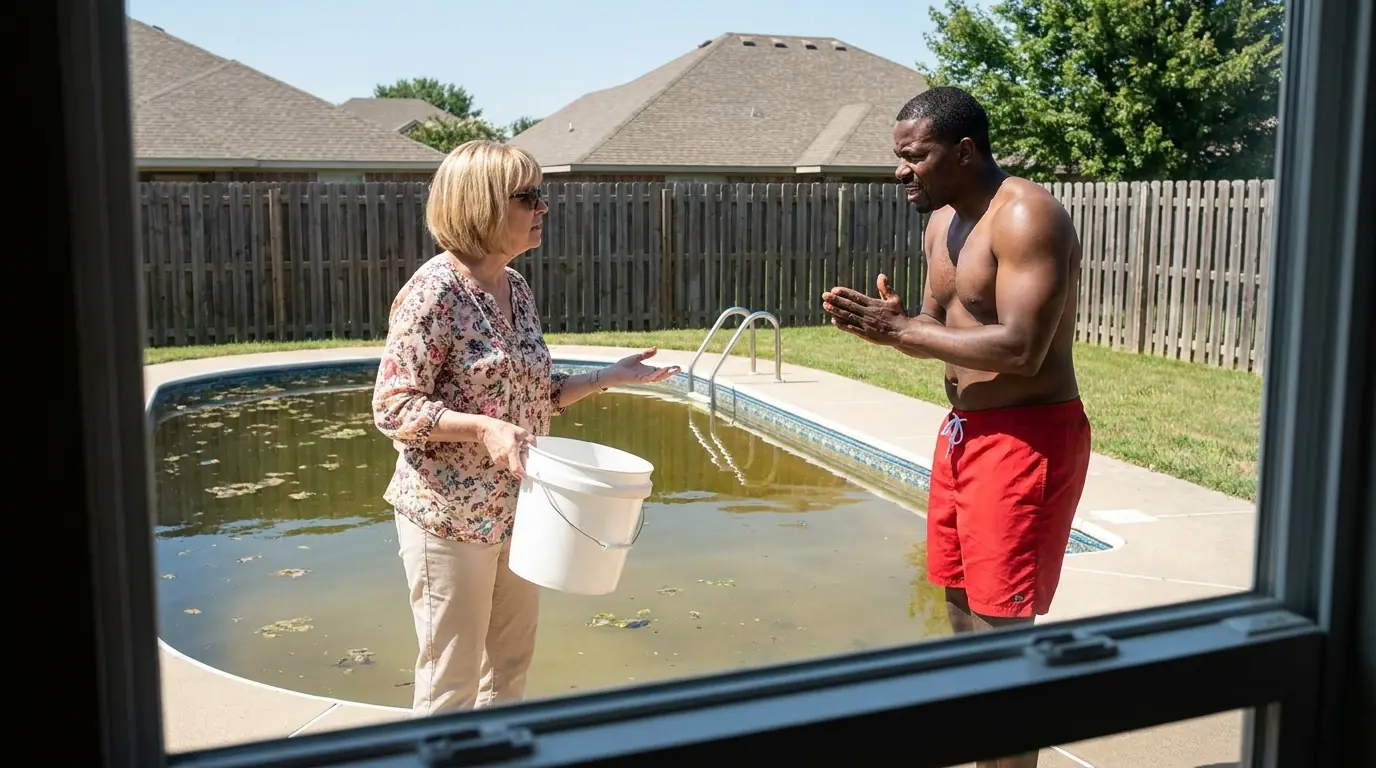
Near his driveway.
Outside the wooden fence surrounding his backyard.
Watching.
The Black homeowner had lived in the American subdivision for almost five years.
The neighborhood was built around wide streets, mature trees, pale stone houses, and backyards large enough for pools, patios, outdoor kitchens, and carefully maintained gardens.
His property sat near the end of a quiet cul-de-sac.
The house had cream-colored siding, gray stonework, tall windows, and a fenced backyard centered around a bright blue swimming pool.
He had installed the pool two summers earlier.
Everything had been permitted.
The plans had been approved.
The required fence was in place.
The drainage system passed inspection.
The pool equipment sat behind a screened enclosure.
Even the landscaping around the deck had been submitted to the HOA because the board insisted on reviewing anything visible above the privacy fence.
Nothing about the property was illegal.
That did not stop the complaints.
The first complaint said the pool pump was too loud.
The homeowner hired a technician.
The equipment tested below the neighborhood noise limit.
The second complaint claimed water was draining toward another property.
A licensed contractor inspected the yard.
Nothing was wrong.
The third complaint accused him of allowing leaves to collect in the pool.
The Black homeowner read that one twice.
Leaves.
In autumn.
Inside an outdoor swimming pool.
He almost framed the letter.
Instead, he photographed the pool, saved the correspondence, and added everything to a folder.
At first, he thought the HOA woman was simply obsessive.
She was a white American woman in her early fifties with a carefully styled blonde bob, dark sunglasses, floral blouses, light-colored pants, expensive handbags, and the permanent expression of someone evaluating a room she did not own.
She served on the HOA board.
Not as president.
Not anymore.
She had held the position for three years before losing a board vote after several homeowners complained that she treated minor guidelines like criminal law.
She remained chair of a compliance committee.
That title seemed to mean whatever she wanted it to mean.
The Black homeowner learned quickly that she loved three words.
“Community property values.”
Everything became about community property values.
A basketball hoop.
Trash cans visible for fifteen minutes after pickup.
A child’s chalk drawing near a driveway.
A work van parked overnight.
A planter that was apparently the wrong shade of gray.
And, eventually, his pool.
The HOA woman first confronted him about it while he was trimming shrubs near his driveway.
She stopped on the sidewalk holding a folder against her chest.
“I need access to your backyard.”
The Black homeowner looked up.
“No.”
Her expression changed.
“I’m conducting a compliance inspection.”
“You can inspect what you can see from common areas.”
“I need to confirm drainage.”
“You don’t.”
She lowered her sunglasses slightly.
“The association has authority.”
“Show me the rule.”
She opened the folder.
He waited.
She found nothing.
The Black homeowner smiled.
“Have a good afternoon.”
She did not move.
“You’re being unnecessarily difficult.”
“No.”
He went back to trimming.
“I’m telling you not to enter my property.”
She stood another fifteen seconds.
Then walked away.
The next morning, he received a violation notice concerning “possible drainage inconsistency.”
Possible.
Not observed.
Not measured.
Possible.
He appealed.
The notice disappeared.
A week later, another appeared.
This one involved “potential safety visibility concerns.”
The Black homeowner asked what that meant.
Nobody could explain.
That notice disappeared too.
The pattern continued until frustration became curiosity.
Why his pool?
Why so much attention?
There were forty-three pools in the subdivision.
Some were larger.
Some closer to neighboring property lines.
Several had visible waterfalls, raised spas, or outdoor lights.
Yet the HOA woman kept returning to his.
One Saturday morning, his doorbell camera recorded her standing outside the side gate.
She did not knock.
She did not ring the bell.
She simply looked at the latch.
Then at the fence.
Then left.
The homeowner watched the recording twice.
He added another camera.
One faced the gate.
Another faced the pool deck.
He did not tell anyone.
Three days later, the gate camera recorded movement shortly after noon.
The Black homeowner was working from inside the house.
He heard nothing.
The gate remained closed.
A shadow crossed the fence.
Then the top of the HOA woman’s blonde head appeared above the wooden boards.
She stood on something outside.
Probably a small step.
Her hands gripped the fence.
She looked into the yard.
The camera captured her face clearly.
She remained there almost a minute.
Then dropped out of view.
The Black homeowner saved the clip.
He called the HOA office.
A young administrator answered.
“I want to report a board member looking over my privacy fence.”
There was a pause.
“Which board member?”
He described her.
Another pause.
“I’ll note it.”
“No.”
The administrator sounded nervous.
“Sir?”
“I want a formal complaint number.”
The administrator hesitated.
“We don’t usually assign numbers for neighbor concerns.”
“She’s not acting as a neighbor.”
Silence.
“She’s using her HOA position.”
The administrator eventually provided an email address.
The homeowner sent the complaint.
Two days passed.
No response.
On the third day, the HOA woman sent him another pool notice.
That was when he stopped believing the system would correct itself.
He contacted an attorney.
The attorney read the correspondence.
Watched the camera footage.
Reviewed the property documents.
Then leaned back.
“She has no standing to enter your fenced yard without notice and permission unless there is an emergency or a very specific association right in the governing documents.”
“There isn’t.”
“I agree.”
“What do I do?”
“Document.”
“I already am.”
“Good.”
The attorney pointed toward the videos.
“Do not provoke her.”
“I don’t.”
“Do not threaten her.”
“I haven’t.”
“If she enters, call police.”
The homeowner nodded.
“And if the HOA keeps sending notices?”
“Appeal everything in writing.”
That became the routine.
Document.
Appeal.
Save.
Wait.
The HOA woman grew more aggressive.
One morning she photographed his driveway from the sidewalk.
Another afternoon she stood near the side fence with two other committee members.
Once, she confronted a pool maintenance worker.
The worker called the homeowner afterward.
“Some woman asked me what chemicals you use.”
“What?”
“She said she was from the HOA.”
“What did you tell her?”
“That I don’t discuss customers.”
The Black homeowner thanked him.
Then saved another note.
Two weeks later, something appeared in the pool.
Not much.
A handful of dirty leaves.
Some soil.
A plastic cup.
The homeowner assumed wind.
Then he checked the camera.
At 5:42 a.m., the HOA woman had approached the fence from outside.
She lifted something above the top.
A small bag.
Then shook it.
Leaves and dirt fell into the yard.
The camera angle did not capture enough detail to prove everything entered the pool.
But it was enough to show deliberate behavior.
The homeowner called local police.
An officer arrived.
Watched the footage.
“You know her?”
“HOA.”
The officer frowned.
“Why is she doing this?”
“That’s what I’d like to know.”
The officer took a report.
No arrest.
No confrontation.
The material was ordinary yard debris.
The HOA woman denied throwing anything.
She claimed she had been “clearing loose vegetation near the property line.”
The homeowner laughed when he heard.
The officer did not.
“Keep the cameras running.”
“I will.”
The HOA board received another formal complaint.
This time it acknowledged receipt.