Marcus opened the envelope and stared at a fine for one million dollars.
It was not from the government. It did not come from a lawsuit.
The fine had been issued by his neighborhood homeowners association because of the color of his mailbox.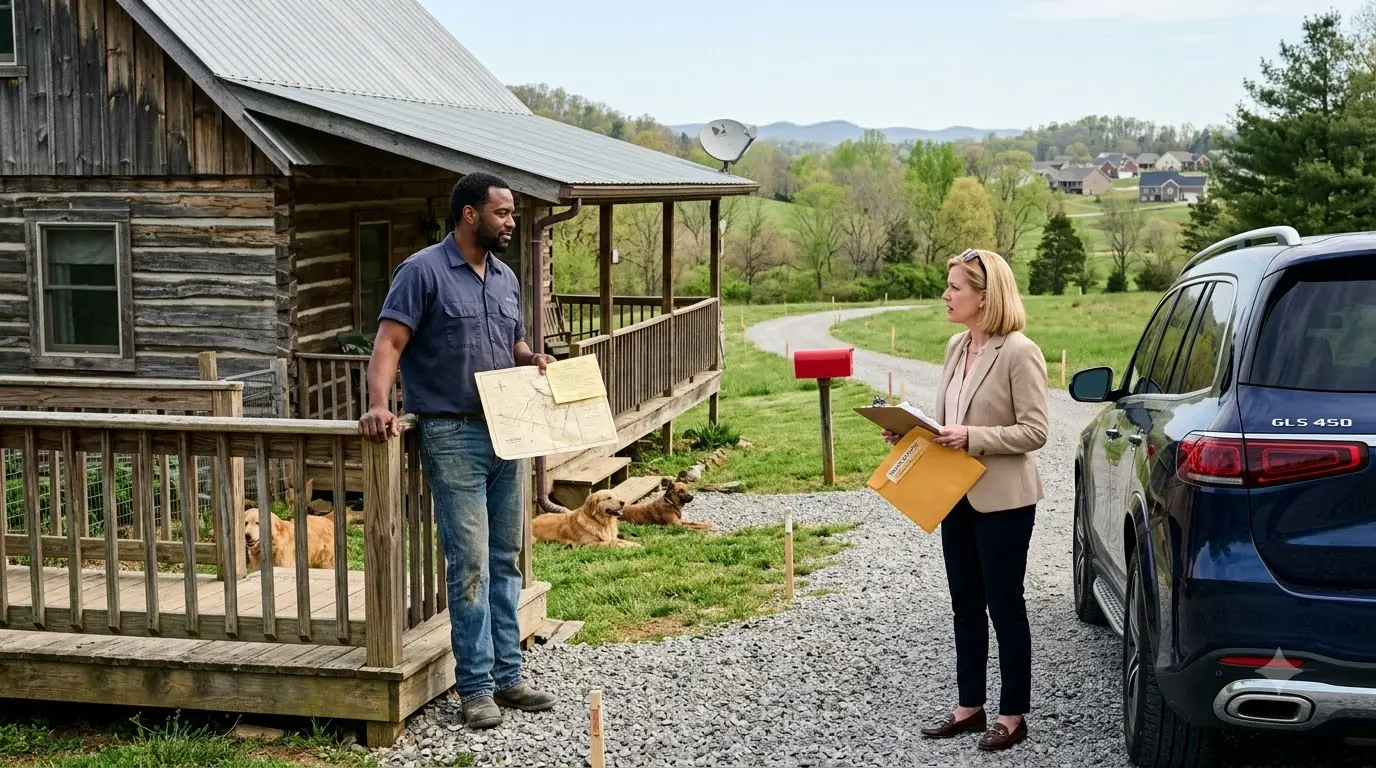
Marcus laughed.
Then he retrieved a document that had been sitting inside his grandfather’s files for nearly forty years.
Very soon, the HOA was no longer laughing.
Neither was Linda Marsh.
Marcus had spent fifteen years saving for that piece of land.
Not a condominium.
Not a townhouse.
Land.
Three acres on the edge of a quiet valley in rural Tennessee, with a hand-built cabin his grandfather had started during the 1970s and Marcus had completed with his own hands.
There had been no contractor and no shortcuts.
Marcus chose every beam, drove every nail, and applied every coat of paint himself.
It was the kind of place a person dreamed about while the city was slowly consuming him.
A creek ran behind the tree line. The mornings were so quiet that Marcus sometimes imagined he could hear the frost melting.
Marcus worked remotely, kept mostly to himself, cared for two dogs, and maintained a vegetable garden.
He moved into the cabin during late autumn and spent his first winter in complete peace.
Then spring arrived.
With spring came the first letter.
It was from the Maplewood Ridge Homeowners Association.
Marcus had not known there was an HOA.
The previous owner never mentioned one. The real estate agent had passed over the subject so quickly that Marcus had not understood it applied to his property.
Still, there it was.
A welcome letter.
A forty-page rulebook.
A list of mandatory aesthetic standards that appeared to have been written by someone who had never placed a hand in soil.
Marcus skimmed the packet, placed it aside, and forgot about it.
That was his first mistake.
Three weeks later, a woman knocked on his door.
She appeared to be in her mid-fifties. She carried a clipboard and wore sunglasses even while standing beneath the covered porch.
She introduced herself as Linda Marsh, president of the Maplewood Ridge HOA.
She did not introduce herself warmly.
“Your mailbox is the wrong shade of green,” she said before Marcus could greet her.
He blinked.
“Excuse me?”
“The approved color is forest green, code 7B4.”
Linda glanced toward the road.
“Yours is closer to sage. That is a violation.”
She wrote something on her clipboard.
Marcus told her politely that he would look into it.
He did not look into it.
Two weeks later, his first fine arrived.
Two hundred fifty dollars for the mailbox.
An additional one hundred fifty dollars because his garden was visible from the road in what the notice described as an unstructured manner.
Marcus stared at that sentence for a long time.
His vegetables were a violation.
He paid the fine reluctantly.
Marcus told himself the argument was not worth the trouble.
Linda interpreted his patience as submission.
During the following four months, the notices continued arriving.
His fire pit was a violation.
His dogs being off leash on his own property were a violation.
A tarp covering his truck during a rainstorm was a violation.
Every letter was more aggressive than the one before it. Each fine was slightly larger, and every notice carried Linda’s looping signature as though she were autographing a masterpiece.
Then came the letter that changed everything.
One million dollars.
Marcus opened it on a Tuesday morning while holding a cup of coffee.
The cup slipped from his hand and struck the floor.
According to the notice, the HOA was fining him one million dollars for accumulated penalties, chronic noncompliance, and what it called an aesthetic damages assessment.
The final violation concerned the angle of his satellite dish.
Marcus did not call an attorney first.
He called his father.
After listening to the entire story, his father asked one question.
“Did you check the deed?”
Marcus had reviewed the modern purchase documents, but he had never closely examined the original property records.
His grandfather had preserved everything.
Inside a battered accordion folder in the back of an old filing cabinet, Marcus found a land survey dated 1974, a county access record, and one handwritten addendum his grandfather had filed with the county clerk almost fifty years earlier.
The HOA had been incorporated in 1989.
Marcus’s grandfather had owned the property since 1971.
When Maplewood Ridge was formed, its founding documents defined the boundaries of HOA jurisdiction.
Those boundaries included Marcus’s parcel.
The problem was that the parcel had been added by mistake.
It was a clerical error that had never been corrected.
Because the land had been owned separately before the HOA existed, the property had been grandfathered outside its jurisdiction.
Marcus did not merely live beyond the association’s authority.
The road Linda Marsh used every time she drove to his cabin ran directly across Marcus’s land.
The Maplewood Ridge HOA had been using that private access road for thirty-five years without a formal easement agreement.
Everyone had assumed it was a county-maintained road.
It was not.
It belonged to Marcus.
Every fine, every threatening letter, and every inspection visit had been built on authority that did not legally exist.
Marcus sat inside his grandfather’s old chair for a long time.
Then he called a property attorney.
When Marcus finished explaining the situation, the attorney remained silent for several seconds.
Finally, he spoke quietly.
“This is a good one.”
Marcus’s attorney sent a formal letter to the HOA.
The letter explained that Marcus’s property was outside the association’s legal boundaries. It demanded that every fine be canceled immediately and instructed the HOA to stop contacting him as though he were a member.
A reasonable person might have expected Linda Marsh to step back.
She did not.
Linda hired her own attorney, called an emergency meeting of the HOA board, and sent Marcus another letter.
The association claimed that decades of implied use had established its authority over the property.
Linda also argued that prolonged community use had transformed the access road into a public easement.
Then the situation stopped being amusing.
The HOA filed a lawsuit seeking permanent legal authority over Marcus’s land.
Linda was attempting to establish jurisdiction over his property before Marcus could formally challenge the neighborhood’s use of his road.
Marcus’s attorney was not concerned.
“She has just made this significantly more expensive for herself,” he said.
They responded with a counter-filing.
Marcus formally notified the HOA that, while the lawsuit remained unresolved, he was revoking all informal permission to use the private road crossing his property.
He did not immediately block the road.
Doing so before the court ruled would have been premature.
Instead, Marcus placed the association on legal notice.
If Maplewood Ridge wanted to continue using the road, it would have to negotiate a written and paid easement.
The road was the only practical entrance and exit for the entire Maplewood Ridge subdivision.
That was when Linda Marsh finally understood what she had started.
The HOA called another emergency community meeting.
Residents who had never cared about Marcus’s satellite dish were suddenly furious with Linda.
Without the road, every home in Maplewood Ridge was effectively landlocked.
Property values depended on it.
Insurance assessments depended on it.
Emergency vehicles used it.
Every resident relied on a road belonging to the quiet man with two dogs, a vegetable garden, and the supposedly incorrect mailbox.
The neighborhood had spent months treating Marcus as though he were an intruder.
In reality, the subdivision depended on his permission every time a resident drove home.
The lawsuit began collapsing almost immediately.
Within six weeks, Linda’s personal attorney withdrew from the case.
Members of the HOA board voted to remove her as president.
The association contacted Marcus’s attorney again.
This time, the message contained no demands.
For the first time, they offered Marcus an apology.
The settlement was straightforward.
Every fine was canceled.
The HOA paid Marcus’s legal expenses from its reserve fund.
The association acknowledged that his parcel was not subject to HOA rules.
Marcus also received the right to negotiate a permanent written easement for the access road.
The final agreement required Maplewood Ridge to pay him a modest annual fee.
The easement renewed automatically, providing Marcus with passive income from a neighborhood he had never asked to join.
There was another consequence that nobody in Maplewood Ridge liked discussing.
After the lawsuit and settlement became part of the public property record, Linda Marsh’s house lost almost forty thousand dollars in appraised value.
Any future buyer would discover the entire legal history.
They would learn that the former HOA president had launched a million-dollar conflict against a neighboring landowner because of a mailbox.
They would also learn that she lost control of the association, damaged the neighborhood’s finances, and exposed the fact that the only access road did not belong to Maplewood Ridge.
One week after the settlement, Marcus repainted his mailbox.
He did not use forest green, code 7B4.
He painted it bright red.
The land belonged to him.
It had always belonged to him.
The road belonged to him too.
Every beam inside the cabin, every row in the garden, and every inch of that mailbox stood on property his grandfather had protected long before Maplewood Ridge existed.
The argument had never truly been about a shade of green.
It was about someone with a clipboard assuming that repetition could become authority and that intimidation could become ownership.
Linda had mistaken Marcus’s silence for weakness.
She mistook his first payment for surrender.
She had not understood that patient people could still keep records.
She also had not understood that one forgotten document inside an old filing cabinet could carry more weight than forty pages of HOA regulations.
Marcus never asked to control the neighborhood.
He did not close the road or force the residents from their homes.
He required only that the association acknowledge the truth, pay for the access it depended upon, and stop pretending it owned land that had never belonged to it.
The bright red mailbox remained beside the road.
Every morning, Linda and the other residents passed it when they entered or left Maplewood Ridge.
It was no longer a violation.
It was a reminder.
Some conflicts were not about paint, gardens, fire pits, dogs, tarps, or satellite dishes.
They were about making certain that the person holding the clipboard never forgot who actually owned the ground beneath the door.