The van door slammed before Grant Hollis could reach his mother.
Two men wearing Brier Crest security jackets had forced sixty-eight-year-old Judith Hollis out of her own driveway and into the rear of an unmarked gray van after she refused to sign away a strip of land she had owned for thirty-one years.
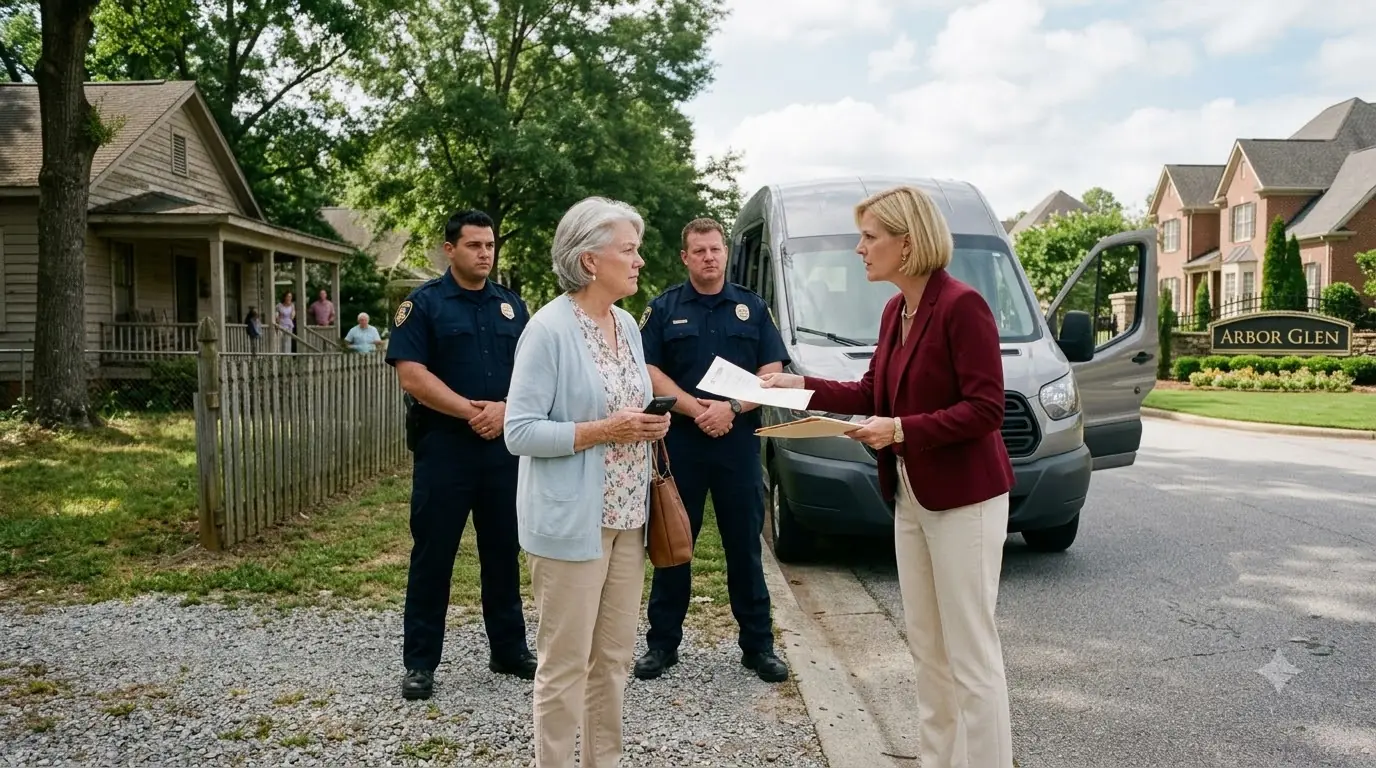
Standing beside the curb in a cream-colored blazer, HOA President Cynthia Voss struck the side of the van with her palm.
“Go.”
The driver pulled away.
Judith was still shouting that she did not consent to leave.
Cynthia watched the van disappear around the bend and checked her watch.
8:23 a.m.
She had less than three hours.
By eleven, a lender expected confirmation that Brier Crest Estates controlled an emergency-access corridor across Judith’s southern property line.
Without it, a $24.7 million financing package for sixty-two new luxury homes could collapse.
Cynthia had tried letters.
Fines.
Survey crews.
Threats.
A lowball purchase offer.
None had worked.
So that morning she tried something she believed would work faster.
Fear.
What Cynthia did not know was that Judith had managed to call her son before Troy Maddox took the phone from her hand.
She got out only a few words.
“Grant, they’re putting me in a van.”
Then the line died.
Grant Hollis was five minutes away.
And he was not alone.
My mother had never sounded afraid of much.
That is the first thing I remember about the call.
Her name was Judith Hollis, and for most of my life she had possessed the irritating calm of someone who had already survived enough things to know panic rarely improved them.
My father dying when I was twenty-three.
A tornado taking half the barn roof.
A winter when the pipes froze for four days.
Cancer scare.
Property disputes.
Neighbors who thought age made her easy to pressure.
None of those things changed her voice the way it sounded at 8:19 that morning.
“Grant.”
Just my name.
Breathing hard.
I sat in the second vehicle of a four-vehicle federal task-force convoy returning from an unrelated operation on the west side of the county.
I was a deputy U.S. marshal assigned to a regional fugitive task force.
We had just completed a pickup connected to a separate federal case and were heading back toward the interstate when my phone rang through the vehicle system.
“Mom?”
“Grant, there are people here.”
“What people?”
“The HOA.”
That was enough to irritate me.
Not frighten me.
I had been hearing about Brier Crest for years.
“They brought a van.”
I sat straighter.
“What van?”
“They’re saying I have to go with them.”
My entire body changed before my brain caught up.
“What do you mean, go with them?”
“I told them no.”
Her breathing became sharper.
“Grant, they’re putting me in a…”
The line cut.
I stared at the screen.
Call ended.
Seven seconds of silence inside our SUV.
Then I keyed the task-force radio.
I did not say my mother had been kidnapped.
Not yet.
Words matter.
Especially when you are angry.
“Possible unlawful detention in progress at my mother’s residence near Brier Crest Estates. Elderly female. Private security personnel. Unmarked gray van. Subject stated she did not consent to transport before call disconnected.”
Supervisory Deputy Paige Ror was in the lead vehicle.
She answered immediately.
“Grant, confirm relation.”
“My mother.”
Another short pause.
“Understood. You are not taking command.”
“Agreed.”
That might sound like a small detail.
It was not.
The woman in the van was my mother.
If I directed the stop, interviews, searches, or evidence handling, every decision afterward could be attacked as personal retaliation.
Paige understood that before I had to say it.
She contacted county dispatch while another task-force member checked the nearby roadway cameras available through law-enforcement channels.
Local deputies were already moving.
We were simply closer.
Then we saw the van.
Gray.
No commercial markings.
Two miles from my mother’s house.
The driver accelerated slightly when our vehicles appeared behind him.
Not a chase.
Not yet.
Paige coordinated the stop.
Lights came on.
The van continued another several hundred yards before slowing near a guardrail where the road widened enough for a safe stop.
Our vehicles boxed the scene without ramming anything.
I could hear banging from the rear even before I opened my door.
Three hard strikes.
Pause.
Then again.
My mother.
I stayed behind Paige.
That required more discipline than almost anything I had done professionally.
She approached the driver’s side.
“Driver, shut the engine off.”
The engine stopped.
“Keys on the dashboard.”
The driver complied.
“Hands visible.”
Troy Maddox stepped out from the passenger side before being told.
Hands raised.
He was forty-three, broad through the shoulders, wearing a dark polo shirt beneath a jacket marked BRIER CREST COMMUNITY SECURITY.
“This is HOA civil enforcement,” he announced.
I looked at him.
Paige did not.
She stayed focused on the vehicle.
“There is no private HOA enforcement authority that permits you to detain and transport a homeowner against her will,” I said.
Troy turned toward me.
“She agreed to come.”
Bang.
Bang.
Bang.
From inside the van.
Paige looked at another deputy.
“Rear door.”
Caleb Driscoll, the second HOA guard, stood near the back.
His face had already lost most of its color.
“Ma’am, I can open it.”
Paige stopped him.
“You step away.”
He did.
Another officer opened the doors.
Judith sat on a narrow bench seat.
Her purse lay upside down on the floor.
Contents scattered.
Reading glasses.
Wallet.
Tissues.
A small notebook.
Her phone.
One shoe had partly slipped off.
Red marks were already appearing along both upper arms where someone had held her.
She looked past Paige and saw me.
For one second, her face broke.
Not crying.
Recognition.
Relief.
Then fury returned.
“I told them no.”
Four words.
That sentence eventually mattered more than almost anything else said that morning.
I moved toward her.
Paige glanced at me.
I stopped.
“Can I?”
She nodded.
I helped my mother out of the van.
Her hands were shaking.
“You hurt?”
“My arms.”
“Anywhere else?”
“No.”
“Did you fall?”
“No.”
“Did they threaten you?”
Judith looked toward Troy.
“They said I wasn’t going home until I signed.”
I felt heat rise through my chest.
Paige heard it too.
She stepped between my mother and the guards.
“Grant, stay with her.”
Good instruction.
I obeyed.
County EMS arrived several minutes later and checked Judith.
Bruising.
Elevated blood pressure.
No major injury.
While that happened, county deputies secured the van pending investigative decisions.
Owen Bradock arrived shortly afterward.
Owen was a senior investigator with the county sheriff’s office.
Early fifties.
Former patrol lieutenant.
The kind of investigator who became quieter when everyone else became louder.
I had worked with him indirectly on fugitive cases.
When he saw me, he did not shake my hand.
“Your mother?”
“Yes.”
“You’re a witness.”
“Yes.”
“You are not interviewing anybody.”
“Understood.”