So, this HOA president literally kicked down my cabin door right when I was having a beer with the state’s attorney general.
She had just committed multiple felonies in front of the one person in the state who could send her straight to prison.
I am talking full-on wood splintering, designer heels clicking on broken glass, the whole nine yards.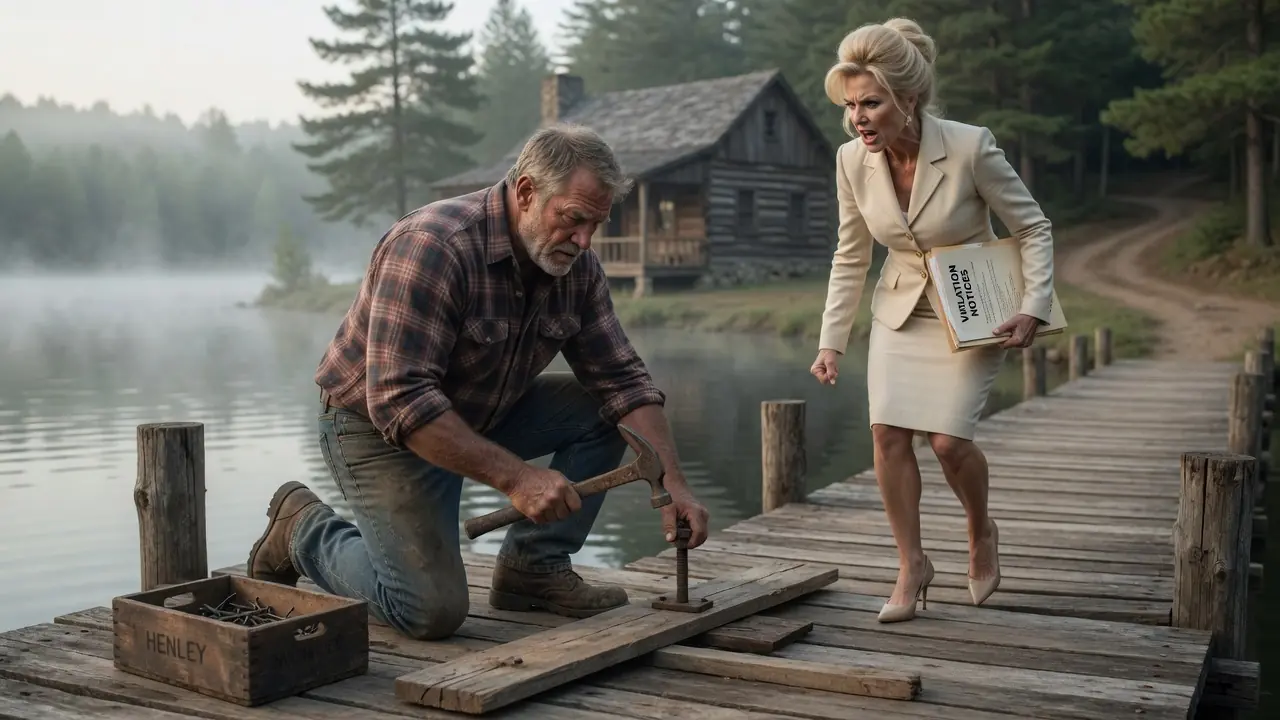
This woman in her thousand-dollar blazer, reeking of that aggressive perfume that probably cost more than my truck payment, stormed into my grandfather’s cabin screaming about violations and jurisdiction like she owned the place.
She had zero clue who she had just barged in on.
Zero clue she was live streaming her own arrest warrant to three thousand followers.
Six months earlier, I thought Delilah Cromwell was just your typical power-drunk neighbor. Turns out, she was running a four-million-dollar embezzlement scheme, and I was about to accidentally burn her entire criminal empire to the ground.
Let me back up and tell you how this whole nightmare started.
Six months ago, life was pretty good.
My name is Marcus Henley. I am fifty-two years old, and after thirty years of crawling through muddy trenches and installing power grids across three counties, I had finally earned my retirement.
The crown jewel was my grandfather’s fishing cabin on Clearwater Lake.
Two acres of pure heaven that Old Pop bought back in 1963 for eight hundred dollars.
Can you believe that?
Eight hundred dollars for lakefront property that is now worth more than most people’s houses.
This was not some fancy McMansion, mind you. We are talking hand-hewn logs, a stone fireplace that Pop built with his own calloused hands, and a screened porch that creaked in all the right places.
I had kept it completely off-grid by choice.
Solar panels humming quietly on the roof, well water that tasted like childhood memories, and a septic system that actually worked better than most city setups.
The morning mist rising off the lake each day reminded me why Pop chose this spot.
He used to say, “The land picks you, not the other way around.”
Smart man.
He also used to say, “Marcus, when someone wants your land real bad, find out why, because it is usually worth more than they are telling you.”
Then she showed up.
Delilah Cromwell rolled into our peaceful lake community like a tornado in designer clothing.
She was fifty-eight years old, fresh from some California subdivision where apparently being neighborhood dictator was a full-time career. She drove a pearl-white Escalade with vanity plates that read RULE ONE.
I am not joking.
She wore her HOA president badge on her blazer like it was a sheriff’s star.
The woman had one mission in life: transform our rustic lakefront into what she called an upscale resort community.
But here is what I did not know then.
Three elderly couples had already sold their cabins to interested buyers within two months of her arrival.
Funny coincidence, right?
Her first act of war came on a Tuesday morning.
I was sitting on Pop’s porch, drinking coffee and watching a pair of loons teach their babies to dive, when I heard sharp clicking sounds on my wooden dock.
Designer heels.
At seven in the morning.
On my private property.
Ten minutes later, she was taping this official-looking notice to my screen door.
Violation Citation: Unsightly dock structure damaging community property values. Fine: $500. Compliance required within 72 hours or daily penalties will accrue.
I had to read it twice.
My weathered dock, the same one Pop and I had reinforced together when I was twelve, was apparently an eyesore threatening the entire neighborhood’s real estate market.
Being a reasonable guy, I walked over to explain that my property actually predated the HOA by about forty years.
You know what she said to me, standing there in my own driveway, hands on her hips like she owned the place?
“Everyone on this lake answers to me, sweetie. Ask the Hendersons how well fighting me worked out for them.”
The Hendersons.
My elderly neighbors, who had mysteriously decided to downsize last month after living here for twenty-three years.
The pieces were not clicking yet, but something cold settled in my stomach.
That was when she started her photography session, circling my cabin like a real estate appraiser, snapping pictures of my solar panels, my vegetable garden, and even my grandfather’s hand-carved porch railings.
The smell of her chemical air freshener wafting from that idling Escalade made me want to gag.
By the end of the week, I had three more citations.
Each one came with escalating fines.
Each one made it crystal clear that Delilah Cromwell had declared war on everything my family had built on this land.
I figured I was dealing with your typical power-tripping neighbor.
Annoying, sure.
But manageable.
What I did not know was that I had just painted a target on my back in a game much bigger and more dangerous than petty HOA politics.
Pop’s words echoed in my head.
Find out why they want your land.
Delilah did not waste time escalating to the big guns.
Three days after my compliance deadline passed, because seriously, I was not tearing down Pop’s dock for some wannabe dictator, a certified letter arrived that made my coffee taste like ash.
Cease and desist.
Violation of community waterway regulations.
The letterhead read Blackstone, Meyer, and Associates, one of those fancy law firms where the partners probably charged more per hour than I made in a month.
The legal gibberish basically said my dock was illegally extending into a community waterway, and I owed three thousand dollars in retroactive violation fees.
Plus, they were threatening to slap a lien on my property if I did not pay up within ten days.
My first instinct was panic.
These people had lawyers.
I had a toolbox and a bad attitude.
But then I remembered something Pop always drilled into me during those long fishing afternoons.
“Marcus, when someone is trying to legal-talk you out of your land, the real truth is always in the county records. Never trust what they tell you. Go find the actual papers.”
So, I drove down to the county courthouse, to that musty basement where all the important stuff gets buried under decades of bureaucratic dust.
The clerk, a sweet lady named Betty, remembered Pop from his fishing tournament days and helped me pull the original property surveys.
I had learned this trick from my union days.
Always check the source documents before some suit tries to buffalo you with fancy letterhead.
What I found made my blood boil.
My grandfather’s lot did not just go to the water’s edge.
It included fifty feet into the lake.
The deed, stamped and official from 1963, was crystal clear.
That dock was not trespassing on community property.
It was sitting smack dab in the middle of my lake.
But here was the real kicker.
The HOA was not established until 1998, thirty-five years after Pop bought his land.
I remembered my old foreman always saying that older properties often had rights that newer developments could not touch.
Grandfathered exemptions that trumped neighborhood association nonsense.
Armed with copies of everything, I marched back to my cabin feeling pretty proud of myself.
That satisfaction lasted exactly until I tried to leave for groceries and found Delilah’s Escalade parked sideways across my driveway.
Not beside it.
Not near it.
Directly blocking it, like she was conducting some kind of one-woman traffic stop.
When I knocked on her window, she rolled it down just enough to speak through the gap.
“Oh, Marcus, I am just reviewing the community parking regulations. This might take a while.”
The mechanical hum of her idling engine mixed with that sickly-sweet air freshener, creating this surreal bubble of passive-aggressive insanity.
Here I was, a grown man who had built half the county’s electrical infrastructure, being held hostage in my own driveway by a suburban tyrant with a power complex.
But Delilah was just getting warmed up.
Within a week, she had organized something called the Lakeside Beautification Committee, which sounded nice until you realized it was basically a hit squad targeting anyone who did not fit her country-club vision.
Suddenly, neighbors who had waved at me for years were crossing the street to avoid eye contact.
Her Facebook posts were masterpieces of passive-aggressive warfare.
Concerned about eyesore properties affecting all our home values. Some people just do not care about the community.
The comment section turned into a feeding frenzy.
People I had known for decades were suddenly experts on property law, parroting Delilah’s talking points like she was some kind of real estate prophet.
Three of my neighbors actually apologized to me privately.
Tom and Susan Martinez pulled me aside during my evening walk and confessed that Delilah had strongly suggested they complain about my property or face their own citation blitz.
Apparently, she had already targeted old Mr. Peterson for having non-regulation window boxes and threatened the young couple with the baby over their unsightly playground equipment.
“She has something on everyone,” Tom whispered, glancing around like Delilah might be hiding in the bushes with a camera. “Her husband works up at the state capital. Connected, you know. Political stuff.”
That hit me like a cold slap.
This was not just neighborhood drama anymore.
This woman had reach beyond our little lake community.
That night, I found orange spray paint covering my mailbox.
Bright, aggressive strokes that spelled out:
COMPLY OR LEAVE.
My security camera, solar-powered and hidden behind a pine tree, caught everything, including Delilah’s license plate as she drove away at 2:30 in the morning.
When I called the sheriff’s office the next morning, guess who showed up?
Deputy Chad Cromwell.
Delilah’s nephew.
He took one look at the vandalism report, shrugged, and said, “Probably just kids. You know how they are.”
The rough texture of that spray paint under my fingers as I tried to scrub it off felt like sandpaper against my soul.
Pop used to say, “Sometimes you need bigger tools for a bigger fight.”
It was time to find some bigger tools.
Delilah’s next move came disguised as civic duty, which somehow made it even more infuriating.
She had figured out that direct confrontation was not working, so she decided to weaponize the entire county bureaucracy against me.
It started with a polite knock on my door from building inspector Dale Morrison, a guy I had actually worked with on several projects over the years.
The awkward look on his face told me everything I needed to know before he even opened his mouth.
“Marcus, I am real sorry about this, but I got a complaint about unpermitted structures on your property. You know I have to follow up on these things.”
Three hours later, Dale had crawled through every inch of my cabin with his clipboard and measuring tape.
His conclusion?
Everything was not only up to code, but actually exceeded current safety standards.
Pop might have been old school, but he had built things to last.
“Whoever filed this complaint,” Dale muttered as he packed up his gear, “either does not know what they are talking about or is just trying to waste everyone’s time.”
The next day brought environmental officer Janet Bennett investigating reports of my septic system contaminating the lake ecosystem.
Again, perfectly functioning.
“Better than most new installations,” she admitted.
Then Fire Marshal Bob Rodriguez showed up to examine my solar panels for hazardous electrical violations.
Clean bill of health there, too.
Each inspection cost me a day of peace and a chunk of my retirement sanity.
But more importantly, each false report was creating an official paper trail that made me look like some kind of problem property owner.
I remembered something my union rep used to warn us about.
Bureaucratic harassment was a classic tactic because it looked legitimate on paper, even when it was pure malicious garbage.
While I was dealing with the inspection parade, Delilah was busy playing her media game.
She managed to get herself interviewed by Channel 7’s community spotlight segment, positioning herself as this concerned citizen fighting to protect our family-friendly lake environment.
The news story was a masterpiece of selective editing.
She showed carefully angled photos that made my cabin look like some kind of backwoods shack, talked about dangerous conditions threatening children’s safety, and painted herself as a brave advocate standing up against irresponsible property owners.
What really got my blood boiling was watching her stand on my dock, the one she claimed was illegally trespassing, while she delivered her concerned-citizen performance for the cameras.
The crisp sound of my phone buzzing with angry texts from neighbors who had seen the story felt like machine-gun fire.
Half the lake community now thought I was some kind of environmental menace.
But here was where Delilah made her first real mistake.
She got greedy.
My old buddy Jake Martinez from the electricians’ union called me up after seeing the news story.
“Marcus, that lady is full of it, and everyone knows it. You built half the clean-energy infrastructure in this county. Your solar setup is the one I use as an example when I am training apprentices.”
Within two days, Jake had organized a parade of my former co-workers to drive by and inspect my property.
Turns out, having twenty master electricians publicly vouch for your work tends to shut down the hazardous-installation narrative pretty quickly.
That was when things started getting interesting.
My lawyer buddy Chuck Davis, who had gone to high school with me, stopped by for a beer and mentioned something that made my ears perk up.
“You know, Marcus, the attorney general’s office has been investigating HOA corruption cases across the state. Several communities are reporting harassment patterns similar to what you are describing.”
“What kind of patterns?” I asked, though I was pretty sure I already knew the answer.
“Elderly homeowners getting hit with frivolous citations. Property values artificially driven down. Mysterious buyers swooping in with cash offers. Ring any bells?”
It rang every bell I had.
Chuck explained that these schemes usually involved someone with political connections providing cover while the harassment campaign drove out longtime residents.
The properties would then get flipped to developers for massive profits.
“The attorney general’s office is looking for witnesses,” Chuck continued. “People who have documented the harassment and can prove the pattern. Someone like you might be exactly what they need.”
The mechanical hum of my refrigerator seemed unnaturally loud as that information sank in.
Delilah was not just some power-drunk neighbor.
She was potentially part of something much bigger and more systematic.
That night, I started a detailed log of every interaction, every citation, every inspection that had mysteriously appeared on my calendar.
I also started researching Delilah’s background more carefully.
Turns out, her husband, Robert Cromwell, was not just some minor state employee.
He was a state party treasurer, a position that gave him access to development plans, zoning changes, and political favors across multiple counties.
The smell of fresh coffee mixing with morning lake air usually calmed me down.
Now it just reminded me how much I had to lose.
This was not about HOA fees anymore.
This was about whether I would be the next victim in someone else’s get-rich-quick scheme.
Delilah’s next phase made everything that came before look like a friendly disagreement.
She had apparently decided that bureaucratic harassment was not moving fast enough, so she switched to full-scale character assassination.
It started with a Facebook post that made my stomach drop.
Urgent safety concerns about aggressive behavior from lakefront resident. Please keep your children away from the Eastern Shore area. Will be filing for protective measures.
Aggressive behavior.
Me.
The guy who had helped organize the annual kids’ fishing derby for fifteen years running.
Within hours, that post had been shared forty-three times.
The comment section turned into a digital mob of people who had never even met me, all convinced I was some kind of dangerous lunatic based on Delilah’s carefully crafted victim narrative.
I always thought something was off about that man.
Heard he threatened an HOA board member.
Thank goodness we have brave people like Delilah looking out for us.
The really sick part was that half those comments came from profiles with generic stock photos.
The kind of fake accounts that political operatives use to amplify messaging.
Delilah was not just spreading lies.
She was orchestrating a professional smear campaign.
Two days later, she filed for a restraining order.
The petition, which became public record, painted me as an unstable individual making verbal threats against community leaders.
Complete fabrication.
But it did not matter.
The filing alone became proof that I was dangerous.
Judge Patricia Harris, who actually knew my family from way back, took one look at Delilah’s evidence and dismissed the request for lack of credible documentation.
But the damage was done.
Now there was an official court document with my name and the word threats on it.
The emotional toll was starting to get to me.
I would sit on Pop’s porch in the evenings, nursing a beer and questioning whether this fight was worth destroying the peaceful retirement I had worked thirty years to earn.
The weight of his leather recliner felt different now.
Less like comfort.
More like the responsibility of carrying on a legacy that someone was systematically trying to erase.
But just when I was starting to consider throwing in the towel, something beautiful happened.
The community started fighting back.
Judge Harris was not the only one who remembered my family.
Retired Judge William “Bill” Carter, who used to fish with Pop back in the seventies, showed up at my door with a thermos of coffee and some unsolicited legal advice.
“Marcus, that woman is playing a game your grandfather would have seen right through. She is counting on you feeling isolated and overwhelmed. Do not give her that satisfaction.”
Bill explained that documented harassment campaigns like this usually indicated larger criminal activity.
“People do not go to this much trouble over petty neighborhood disputes,” he said. “There is money involved here. Big money.”
The local VFW post, where I had been a member for twenty years, issued a statement calling Delilah’s accusations baseless attacks on a decorated community member.
The historical society chimed in, highlighting my cabin’s cultural significance as one of the last original structures on the lake.
Even the environmental group that monitored lake water quality praised my sustainable living model.
It felt like the entire decent part of our community was rallying around me.
The bitter taste of stress was finally giving way to something that felt like hope.
But Delilah was not done.
Not even close.
Her next move was diabolical in its simplicity.
She somehow convinced the utility company to investigate irregularities in my electrical service.
For three days, I had no power while they reviewed my solar grid connection for safety violations.
Then came the false police reports.
Suspicious activity at my cabin during broad daylight.
Loud noises suggesting a potential domestic disturbance when I was clearly alone.
Possible drug activity based on the unusual number of visitors.
Visitors who turned out to be union buddies stopping by to show support.
Each call brought sheriff’s deputies to my door.
Each visit created another incident report.
Each report added to the growing file that made me look like a problematic resident.
The most infuriating part was that Deputy Chad Cromwell was usually the responding officer.
He would show up, ask a few perfunctory questions, and leave with this smirk that said he knew exactly what his aunt was doing.
During one particularly surreal visit, he actually had the nerve to say, “You know, Mr. Henley, if you just apologized to my aunt and brought your property into compliance, all these problems would probably go away.”
That was when I realized this was not just about me anymore.
Delilah was showing other property owners what happened when you did not bend the knee.
The Hendersons, the elderly couple who had mysteriously decided to sell, probably went through this exact same nightmare.
The electronic ping of my phone became a source of anxiety instead of connection.
Every notification could be another neighbor turning against me, another false report, another twist in Delilah’s psychological warfare campaign.
But it also brought messages of support from people I had forgotten even knew me.
The fight was far from over, but I was finally understanding the rules of the game.
The breakthrough came when I was doing the most boring thing imaginable: organizing paperwork for my meeting with the attorney general’s office.
Chuck had arranged the whole thing, explaining that they needed detailed documentation for their statewide HOA corruption investigation.
I was sitting at Pop’s old oak table, surrounded by stacks of citations, inspection reports, and legal threats, when something caught my eye.
One of Delilah’s violation notices had this tiny footer I had never paid attention to before.
Fines payable to Lakeside Estates Community Improvement Fund, account number 847291.
Community Improvement Fund.
That sounded official enough, but something about it nagged at me.
Maybe it was thirty years of reading electrical contracts and spotting the fine print contractors use to take advantage of homeowners.
I decided to dig deeper.
The county clerk’s office had become my second home by this point, so Betty knew exactly what I was looking for when I asked about HOA financial records.
She pulled up the public filings and spread them across the counter like she was dealing cards.
“Here is the thing, Marcus,” she said, adjusting her reading glasses. “Homeowner associations have to file annual reports just like any other organization. Let me show you what I found.”
The numbers did not add up.
Not even close.
Over the past two years, the HOA had collected two hundred and eighty thousand dollars in emergency assessments for lake dock repairs that were never completed.
Another one hundred and fifty thousand had supposedly gone to professional landscaping services provided by Cromwell Grounds and Maintenance, which, according to state business records, was owned by Delilah’s brother-in-law.
But here was the kicker.
The landscaping company had been incorporated exactly three weeks after Delilah became HOA president.
I remembered Pop’s advice about following the money trail.
When someone creates a business right after getting power, they are usually creating it to funnel money to themselves.
The insurance claims were even more blatant.
The HOA had filed for storm damage reimbursement three times in the past eighteen months.
Problem was, I had lived through every storm on this lake, and none of them had caused the kind of damage that would justify ninety-five thousand dollars in insurance payouts.
Betty helped me cross-reference the insurance claims with actual weather reports from the National Weather Service.
The dates did not match up.
The HOA was claiming storm damage on days when the weather had been perfectly clear.
“Marcus,” Betty whispered, even though we were alone in the records room, “this looks like fraud. Plain and simple fraud.”
My hands were actually shaking as I photocopied everything.
The smooth feel of those document pages felt like holding evidence that could change everything.
This was not just harassment anymore.
This was organized theft from the entire lake community.
The property management fees were the final piece of the puzzle.
The HOA was paying five thousand dollars monthly to something called Clearwater Property Solutions for administrative services.
But when I looked up the business registration, the listed address was a P.O. box in the same postal district where Delilah lived.
Everything clicked into place like tumblers in a lock.
Delilah’s harassment campaign was not just about power or personal spite.
She was systematically driving down property values to enable a development scheme while simultaneously embezzling from the community fund.
The elderly couples who had sold their cabins had not just been harassed into leaving.
They had been forced to sell at below-market prices because Delilah’s artificial property value concerns had scared off legitimate buyers.
Those mysterious cash buyers were probably connected to the same development group that was benefiting from the embezzled funds.
I thought about the Hendersons, probably counting their pennies in some cramped apartment, never knowing they had been robbed twice.
Once when they sold their dream home for peanuts.
Again through the fees they had paid into Delilah’s slush fund.
The taste of black coffee had never been so bitter.
This was not just about my cabin anymore.
Delilah had been stealing from everyone, including the neighbors she had convinced to turn against me.
Pop always said that when you find corruption, it is usually bigger than you think.
He was right.
Delilah was not just running an HOA.
She was running a criminal enterprise.
And I was about to hand the evidence to the one person in the state who could shut it down permanently.
That night, I transformed Pop’s back bedroom into something that looked like a police investigation unit.
Maps of the lake property spread across the walls, showing original boundaries versus current HOA claims.
Timeline charts tracking Delilah’s harassment campaign alongside suspicious financial transactions.
Photos, recordings, and documents organized by potential criminal charges.
I felt like one of those television detectives, except instead of hunting serial killers, I was hunting suburban embezzlers.
The attorney general’s office had assigned two prosecutors to my case: Sarah Mitchell and David Bennett.
They arrived the next morning looking like they meant business.
Sarah was this sharp-eyed woman in her forties who reminded me of the safety inspectors who used to keep us honest on job sites.
David was younger, maybe early thirties, but he had this quiet intensity that suggested he had already sent plenty of white-collar criminals to prison.
“Mr. Henley,” Sarah said, spreading the financial documents across Pop’s dining table, “what you have uncovered here goes way beyond simple HOA harassment. This is systematic fraud that could impact dozens of families.”
David pulled out a tablet and started connecting dots I had not even seen.
“We have been investigating similar schemes in four other counties,” he said. “The pattern is always the same. Politically connected individuals use HOA positions to manipulate property values while embezzling community funds.”
That was when they told me about the FBI involvement.
Agent Rebecca Torres from the White Collar Crime Unit had been tracking development fraud across the region.
Apparently, my documentation was the missing piece that could tie together multiple ongoing investigations.
“The beauty of financial crimes,” Agent Torres explained during our video call, “is that everything leaves a paper trail. Your HOA records show classic money laundering, fake invoices, shell companies, and insurance fraud. But we need more than just documents. We need witnesses and recorded evidence of ongoing criminal activity.”
Chuck, my lawyer buddy, had been working behind the scenes, too.
He had connected with seventeen other lakefront families who had experienced similar harassment.
When we gathered them at the VFW hall, their stories painted a picture that made my blood boil.
The Thompsons had paid eight thousand dollars in bogus violation fines before selling their cabin for thirty percent below market value.
The Garcias had been hit with emergency assessments totaling twelve thousand dollars for lake improvements that never materialized.
Old Mrs. Patterson had been so intimidated by Delilah’s legal threats that she had moved in with her daughter in Florida, abandoning the home where she had lived for forty-three years.
Every story followed the same playbook.
Escalating harassment.
Manufactured violations.
Pressure to sell.
And every family had contributed to that Community Improvement Fund that was really just Delilah’s personal piggy bank.
“Here is what most people do not understand about HOA fraud,” explained retired accountant Frank Weber, who had volunteered to help analyze the financial records. “Homeowner associations are required to file Form 1120 tax returns annually if they meet certain income thresholds. Legitimate organizations file religiously. Corrupt ones usually do not because honest accounting would expose the theft.”
Frank had discovered that our HOA had not filed proper tax returns in over two years despite collecting hundreds of thousands in fees and assessments.
That single fact could trigger federal tax-evasion charges on top of everything else.
The technical strategy session felt like planning a military operation.
We had financial evidence, witness testimony, recorded harassment, and documented fraud.
But Agent Torres wanted something bigger.
She wanted to catch Delilah in the act of actively committing crimes.
“The best way to build an airtight case,” she explained, “is to create a situation where the suspect’s criminal behavior is captured by law enforcement in real time. We need her to incriminate herself on camera.”
That was when Chuck suggested the perfect setup.
“The attorney general has been looking for an opportunity to announce new HOA reform legislation,” he said. “What if she held that announcement at Marcus’s cabin? It is symbolically perfect. Protecting homeowner rights in the exact location where those rights were violated.”
Sarah’s eyes lit up.
“And if Delilah’s pattern holds, she will absolutely try to disrupt any suspicious activity at Marcus’s property. Her need to control the situation will override her common sense.”
We spent the next week preparing for what Agent Torres called a controlled confrontation scenario.
Professional recording equipment hidden throughout my cabin.
Undercover officers positioned around the lake.
Multiple law enforcement agencies coordinated for rapid response.
The community coalition had grown, too.
Local media was alerted to potential breaking news. Social media campaigns were ready to counter any false narratives Delilah might try to spin. Support networks were activated for the post-confrontation period.
My old union training kicked in.
When you are planning a complex job, you prepare for every possible scenario and always have backup systems.
We had backup plans for the backup plans.
The trap was set.
Delilah’s pattern of behavior was so predictable that we could practically script her next move.
All we had to do was wait for her to kick down the door.
Literally.
Delilah must have sensed the walls closing in because her behavior went from calculated harassment to full-blown sabotage.
It was like watching a cornered animal lash out in every direction, getting more dangerous as her options disappeared.
The first sign was my solar panels mysteriously malfunctioning on a Tuesday morning.
I woke up to dead batteries and error codes flashing on the inverter display.
When my electrician buddy Jake came out to investigate, he found clear evidence of tampering.
Wire connections had been loosened just enough to disrupt the system without causing obvious damage.
“Marcus, this is professional-level sabotage,” Jake said, photographing the evidence with his phone. “Whoever did this knows electrical systems. They wanted to cause problems without leaving obvious fingerprints.”
But Jake was smarter than Delilah gave him credit for.
He installed a hidden security camera near the electrical panel after the first incident.
Two nights later, we caught her red-handed, creeping around my property at three in the morning with tools in her hands.
The footage was crystal clear.
Delilah Cromwell, HOA president and upstanding community member, vandalizing private property under cover of darkness.
The acrid smell of her cigarette smoke lingered in the morning air, mixing with the pine scent that usually made me feel peaceful.
Next came my boat dock.
I had gone into town for groceries and returned to find my boat drifting halfway across the lake.
The heavy-duty chains I had used to secure it had been cut. Clean, deliberate cuts left metal shavings scattered across the dock planks.
That boat had been Pop’s pride and joy, a 1978 bass boat that still ran like a dream.
Finding it bumping against the opposite shore, its hull scratched from the rocks, felt like someone had desecrated his grave.
But Delilah’s biggest mistake was going after my septic system.
I had just passed a county inspection with flying colors, but suddenly my perfectly functioning system started backing up.
The smell was horrific, that combination of sewage and chemical additives that made your eyes water from fifty feet away.
When the emergency septic service arrived, they found that harsh commercial chemicals had been poured into my system, killing all the beneficial bacteria and creating a toxic mess.
“This is deliberate sabotage,” the technician explained, holding up soil samples that showed chemical contamination. “Someone used commercial-grade acids in your system. This stuff costs serious money and requires specialized knowledge to use.”
The repair bill was thirty-two hundred dollars.
But more importantly, the chemical analysis provided forensic evidence that this was not random vandalism.
It was calculated destruction requiring insider knowledge of septic systems.
While I was dealing with the sewage backup, Delilah was orchestrating her media blitz.
Anonymous accounts flooded social media with posts about my ongoing property violations and deteriorating conditions threatening neighborhood safety.
The bots were so obvious it was almost comical.
Dozens of profiles with generic names posting identical complaints within minutes of each other.
She had also ramped up the intimidation network.
Deputy Chad Cromwell’s patrol presence increased dramatically. He would cruise by my cabin four or five times per day, always slowing down just enough to make his surveillance obvious.
Sometimes he sat in my driveway for twenty minutes, running license plates of anyone who visited.
The building inspector suddenly found code violations in work that had passed inspection just weeks before.
The fire marshal received anonymous tips about fire hazards that did not exist.
Environmental Services got reports about illegal dumping in areas of my property they had already cleared.
It was death by a thousand cuts, designed to exhaust my resources and break my spirit through bureaucratic warfare.
But I was not the only target anymore.
Delilah had started going after my supporters, too.
Jake’s electrical contracting license was suddenly under review for safety violations.
Bill Carter, the retired judge who had been advising me, received a formal complaint with the State Bar Association about improper legal counsel to non-clients.
The VFW post found itself facing a surprise fire safety inspection that threatened to shut down weekly bingo nights.
The historical society was hit with zoning complaints about its downtown office space.
Delilah was systematically attacking anyone who had shown me support, sending a clear message.
Help Marcus Henley, and you become our next target.
The psychological pressure was intense.
Every morning brought new crises, new emergencies, new bureaucratic nightmares to navigate.
The metallic taste of constant stress became as familiar as my morning coffee.
But Delilah’s desperation was also creating opportunities.
Each escalation was being documented by law enforcement.
Every act of sabotage provided additional criminal evidence.
Her network of supporters was starting to distance itself as her behavior became increasingly unhinged.
The attorney general’s office was watching everything, building an airtight case while Delilah dug her hole deeper with every vengeful act.
Agent Torres called it textbook criminal escalation.
“When perpetrators feel cornered,” she said, “they often make increasingly reckless decisions that provide prosecutors with the evidence they need for conviction.”
Delilah was walking straight into our trap.
One sabotaged solar panel at a time.
Delilah’s final play was so audacious it almost worked.
She had figured out through her husband’s political connections that I was not just meeting with some random state official.
I was meeting with Attorney General Patricia Williamson herself.
And instead of backing down, Delilah decided to go nuclear.
Her plan was brilliant in its twisted logic.
She would position herself as the victim of a political conspiracy, claiming that the state’s top prosecutor was targeting her family for partisan reasons.
If she could record herself confronting government corruption at my cabin, she could flip the entire narrative and paint herself as a brave whistleblower standing up to abuse of power.
The first sign of her new strategy came through social media.
She had reached out to Government Accountability Watch, one of those blogger networks that amplifies stories about bureaucratic overreach.
Her pitch was perfect.
Small-town HOA president being persecuted by big government because her husband worked for the opposing political side.
Local family under attack. State officials use harassment investigation to silence political opposition.
That was the headline that started circulating three days before my scheduled meeting.
The story painted me as some kind of deep-state operative working with corrupt prosecutors to destroy an innocent family.
The comment section was flooded with outrage from people who had never heard of our lake community but were absolutely convinced Delilah was being railroaded by partisan prosecutors.
She had tapped into that vein of anti-government sentiment that runs through rural communities, turning herself into a martyr for political persecution.
But Delilah’s master stroke was the livestream setup.
She had arranged to broadcast her confrontation with the attorney general live on social media, framing it as citizen journalism, exposing government corruption in real time.
Her plan was to burst into my cabin during the meeting, record everything, and let her followers spread the footage as proof of official misconduct.
What she did not know was that law enforcement was monitoring her communications.
Agent Torres had obtained warrants for Delilah’s phone and social media accounts weeks earlier.
We knew about the blogger outreach, the livestream plan, even the talking points she had prepared for her “spontaneous” confrontation.
“It is actually perfect,” Agent Torres explained during our final coordination meeting. “She is going to commit multiple felonies on live video while providing us with a real-time confession of her motives. We could not have scripted it better.”
The irony was delicious.
Delilah thought she was setting a trap for us, but she was actually walking into the most thoroughly documented arrest in HOA history.
Her support network was crumbling, too, but she was too obsessed to notice.
The other HOA board members had quietly distanced themselves once the financial irregularities became obvious.
Her husband was facing his own ethics investigation and could not provide political cover anymore.
Even Deputy Chad had been reassigned to different patrol areas after internal affairs started asking questions about his response to vandalism reports.
But Delilah was beyond rational thinking at that point.
The psychological pressure of keeping her fraud scheme hidden while fighting off multiple investigations had pushed her past the breaking point.
She was exhibiting all the classic signs of someone losing control.
Paranoid about neighbors spying on her.
Making increasingly threatening phone calls to anyone who had supported me.
Convinced that everyone was part of some vast conspiracy against her.
The night before the attorney general’s visit, she made threatening calls to four different families, warning them about consequences if they continued collaborating with the investigation.
Each call was recorded by law enforcement.
Each one provided additional evidence of witness intimidation and criminal conspiracy.
I spent that final evening sitting on Pop’s porch, watching the sunset paint the lake in shades of gold and crimson.
The sound of loons calling to each other across the water reminded me why this place was worth fighting for.
Tomorrow would determine whether I would be able to enjoy peaceful evenings like this for the rest of my retirement, or whether I would spend my golden years battling Delilah’s appeals from federal prison.
The cabin felt different that night.
Not just because of the hidden cameras and recording equipment.
Because it had become the center of something much bigger than my personal property dispute.
This was about whether small-time criminals with political connections could terrorize entire communities without consequences.
I pulled out Pop’s worn leather Bible and read the passage he had underlined about David facing Goliath.
He had written in the margin:
Sometimes the little guy wins because he is fighting for something bigger than himself.
The morning would bring Delilah’s final desperate gambit.
She would storm through that door thinking she was about to destroy her enemies, never realizing she was about to destroy herself.
The stage was set.
The cameras were rolling.
Law enforcement was in position.
All we had to do was wait for Delilah to provide the grand finale to her own criminal career.
The taste of anticipation mixed with morning coffee had never been so sweet.
Attorney General Patricia Williamson was nothing like I had expected.
Instead of some intimidating political figure, she was this down-to-earth woman in her fifties who reminded me of my old high school principal.
Tough but fair, with eyes that missed nothing.
She arrived at my cabin at exactly nine in the morning, carrying a thermos of coffee and a briefcase full of evidence that would change everything.
“Mr. Henley,” she said, settling into Pop’s old recliner like she belonged there, “your documentation has helped us build cases against HOA corruption rings in six counties. What you uncovered here is not just local fraud. It is part of a statewide pattern of organized theft.”
We were deep in discussion about the criminal charges when we heard it.
The distinctive roar of Delilah’s Escalade pulling into my driveway way too fast.
Gravel sprayed everywhere like she was conducting some kind of high-speed chase.
Car doors slammed.
Multiple voices shouted instructions about camera angles and audio levels.
Delilah had brought her entire social media production crew for what she thought would be her moment of triumph.
“Here we go,” Agent Torres whispered into her earpiece from her hidden position behind my woodshed.
Attorney General Williamson did not even flinch.
She just calmly continued taking notes about the financial evidence while Delilah’s voice got louder outside, working itself up into righteous fury for her livestream audience.
“This is it, folks,” Delilah’s voice carried clearly through my windows. “We are about to expose the corruption targeting our family. The state’s attorney general is illegally meeting with our harasser, probably planning more government persecution.”
The sound of her designer heels clicking aggressively across my wooden porch was like a countdown timer to disaster.
For her disaster.
Not mine.
Crash.
The door exploded inward like she had used a battering ram instead of her foot.
Wood splintered everywhere.
The attorney general’s coffee mug hit the floor with a ceramic crash that punctuated the moment perfectly.
Delilah stormed into my living room with her phone held high, livestreaming everything, completely oblivious to the fact that she had just committed criminal trespass, breaking and entering, and assault in front of the state’s chief prosecutor.
“I demand to know why the attorney general is secretly meeting with this man,” she screamed, waving her phone around like it was some kind of weapon. “This is government harassment. Political persecution. I have rights.”
The look on her face when Attorney General Williamson calmly stood up and displayed her official identification was absolutely priceless.
Delilah’s livestream captured the exact moment her brain processed what had just happened.
Total frozen terror.
“Mrs. Cromwell,” the attorney general said in that calm, professional tone that probably made hardened criminals lose their nerve, “I am Patricia Williamson, Attorney General of this state. You have just committed multiple felonies in my presence, and your entire criminal performance is being recorded by both my office and your own social media broadcast.”
Delilah’s phone was still livestreaming.
Her followers were watching in real time as their heroic whistleblower turned into a babbling, incoherent mess.
The comment section exploded with confusion and disbelief as people realized they had been supporting a criminal who had just self-destructed on camera.
“I… I was… this is my community. I have jurisdiction here,” Delilah stammered, still somehow thinking her HOA badge gave her authority over state prosecutors.
That was when FBI Agent Torres stepped through my still-open doorway, flanked by two other federal agents.
“Mrs. Cromwell, you are under arrest for fraud, extortion, witness intimidation, and criminal harassment. And thanks to your livestream, we have your confession broadcast to about three thousand witnesses.”
The sound of handcuffs clicking shut echoed through my cabin like the closing of a book.
Delilah’s phone clattered to the floor, still streaming her arrest to an audience that had shrunk from outraged supporters to horrified viewers watching a public meltdown.
“Delilah,” I said, standing up from Pop’s couch with a satisfied smile, “meet the state’s attorney general. She has been wanting to discuss your bookkeeping methods.”
The neighbors who had been drawn by the commotion stood on my porch watching in stunned silence as the woman who had terrorized our community for months was read her rights in my living room.
Mrs. Patterson, who had driven down from her daughter’s place specifically for this moment, had tears streaming down her face.
Sheriff Rodriguez arrived just in time for the walk to the patrol car.
Delilah stumbled in handcuffs past the same dock she had tried to have demolished, past the same solar panels she had claimed were hazardous, past the same cabin she had called an eyesore.
The pearl-white Escalade with its RULE ONE vanity plates was towed away as evidence in the fraud case.
The livestream ended with Delilah’s voice echoing across the lake.
“This is not over. My husband will fix this. You do not know who you are dealing with.”
Actually, Delilah, we knew exactly who we were dealing with.
A criminal.
And criminals face consequences.
Watching Delilah get sentenced three months later felt like Christmas morning.
Federal Judge Michael Harrison did not just throw the book at her.
He launched the entire law library.
Three years in federal prison.
Three hundred and forty thousand dollars in restitution to defrauded homeowners.
A lifetime ban from serving on any HOA board in the United States.
Her husband, Robert, was not far behind.
The ethics investigation revealed he had been using his position as state party treasurer to provide insider information about zoning changes and development plans.
He resigned in disgrace and got eighteen months for conspiracy and abuse of office.
The HOA itself was dissolved faster than sugar in hot coffee.
In its place, we formed the Clearwater Lake Volunteer Association.
Emphasis on volunteer.
No mandatory fees.
No citation authority.
No power-drunk presidents.
Just neighbors working together to keep our little slice of paradise beautiful.
My role in exposing the corruption scheme earned me something I never expected.
Whistleblower compensation from the recovered fraud funds.
Turns out, when you help the feds recover hundreds of thousands in stolen money, they are pretty generous with the rewards.
That check for forty-five thousand dollars felt like vindication for every sleepless night Delilah had caused me.
But the real victory was watching justice ripple outward.
Attorney General Williamson used our case as the foundation for new state legislation that I still cannot believe has my name on it.
The Henley Act requires all HOAs to undergo annual independent financial audits and creates criminal penalties for harassment-based property manipulation schemes.
Three other counties used our evidence to prosecute similar fraud rings.
Turns out, Delilah’s operation was part of a much larger network of politically connected criminals systematically robbing homeowners across rural communities.
The FBI’s final report identified over two dozen related cases spanning five states.
The families who had been driven from their homes started coming back, too.
The Hendersons bought a beautiful new cabin two lots down from mine after their old property’s fraudulent value concerns were legally voided.
Mrs. Patterson moved back from Florida and threw a block party that lasted until sunrise.
Property values did not just recover.
They soared.
Turns out, when you remove the constant threat of harassment and fraudulent citations, people actually want to live in a peaceful lakefront community.
Who would have thought?
The transformation went beyond legal victories.
Our little lake became a model for sustainable community living.
My off-grid cabin, once Delilah’s target for eyesore citations, now hosts monthly tours for people interested in solar power and environmental stewardship.
The state environmental agency featured us in their renewable-energy showcase program.
I established the Pop’s Legacy Scholarship using part of my whistleblower compensation.
Five-hundred-dollar grants for kids entering trade school programs.
Pop always believed that working with your hands was the foundation of an honest life. It seemed fitting to help the next generation learn those same values.
The annual Clearwater Lake Festival became a regional attraction, raising money for veterans’ housing assistance programs.
Last year, we brought in enough to fund three tiny home projects for homeless vets.
The sweet smell of barbecue and the sound of families laughing together replaced the toxic atmosphere Delilah had created.
But the best part was the quiet moments.
I am sitting on Pop’s porch right now, watching the sunset paint the lake in shades of gold and purple.
The loons are calling to each other across the water, their voices echoing off the same hills where Pop taught me to fish sixty years ago.
My solar panels hum peacefully on the roof, powering a life that is finally my own again.
No more certified letters.
No more inspection visits.
No more designer heels clicking across my dock at dawn.
Just the gentle lap of waves against weathered wood and the knowledge that sometimes, if you are stubborn enough and righteous enough, David really can beat Goliath.
The documentary crew finished filming here last month.
HOA Hell: How One Man Took Down a Criminal Empire premieres next spring.
They paid me enough to add a guest cabin where other harassment victims can stay while fighting their own battles.
Because Delilah was not unique.
There are power-drunk HOA dictators in communities across America terrorizing elderly homeowners and stealing from community funds.
But now there is a roadmap for fighting back.
Now there is proof that if you document everything, follow the money, protect your neighbors, and refuse to be scared off your own land, the truth can become louder than any threat.
Pop’s cabin still stands.
The dock still creaks.
The lake still belongs to the morning mist and the loons and the families who love it.
And every time I sit on that porch with a beer in my hand and the water glowing in the evening light, I hear Pop’s voice again.
“The land picks you, Marcus.”
He was right.
And when someone tried to steal it, the land made sure I was stubborn enough to fight back.