Delilah Cromwell kicked down my cabin door while I was having coffee with the state's attorney general. Wood splintered across the floor, broken glass cracked beneath her designer heels, and her phone streamed every second to nearly three thousand followers.
She stormed inside, shouting about violations, jurisdiction, and government persecution as if her HOA badge gave her authority over private property.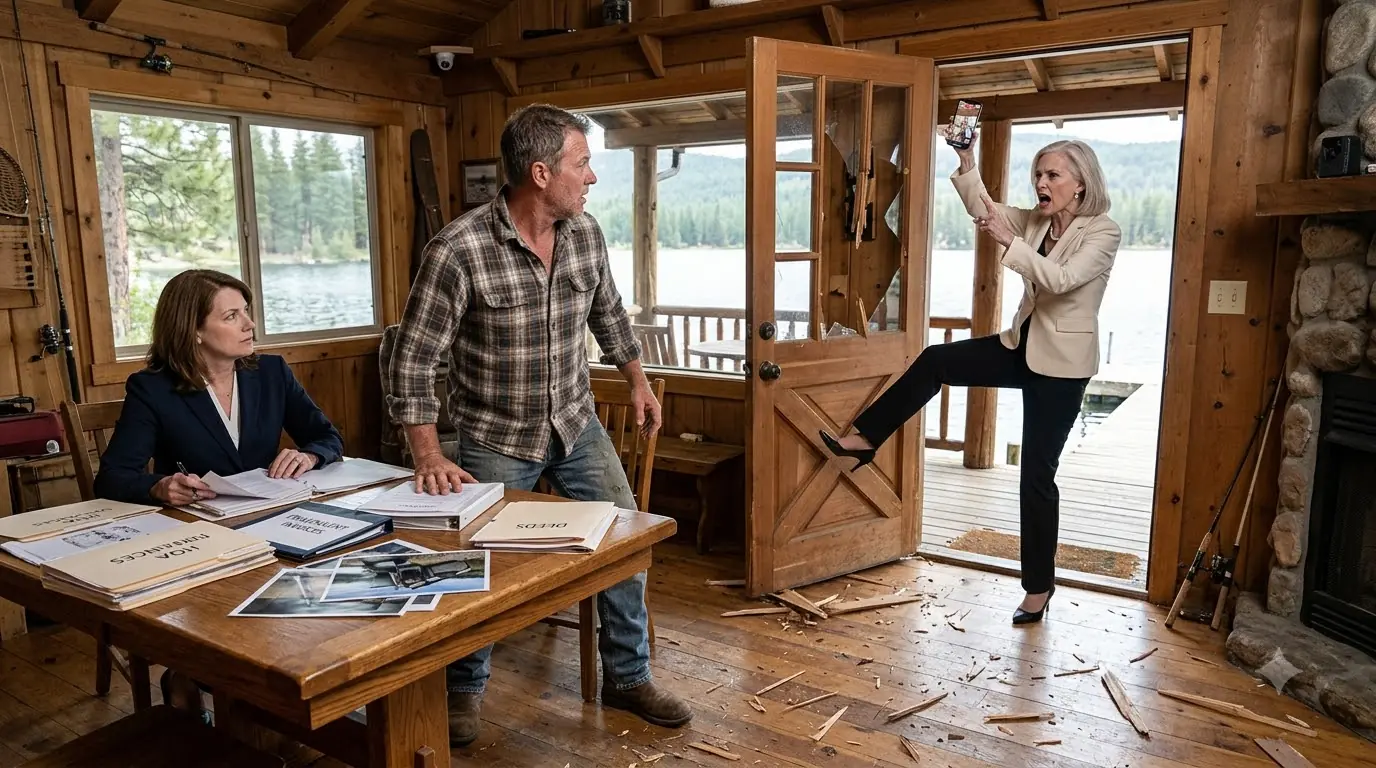
She had no idea that the woman rising calmly from my grandfather's recliner was Attorney General Patricia Williamson, or that FBI agents were listening from positions around the lake.
Six months earlier, I had thought Delilah was only another power-drunk neighbor. By the time she broke through that door, investigators believed she was running a multimillion-dollar fraud and property-manipulation scheme.
My name is Marcus Henley. I was fifty-two and newly retired after thirty years of crawling through muddy trenches and installing electrical grids across three counties.
The best thing I owned was my grandfather's fishing cabin on Clearwater Lake. He had bought the two-acre lakefront parcel in 1963 for eight hundred dollars and built the cabin himself from hand-hewn logs and local stone.
The place was never luxurious. The screened porch creaked, the stone fireplace smoked on damp mornings, and the old dock carried dents from decades of boots, tackle boxes, and children learning to fish.
To me, it was perfect. Solar panels powered the cabin, a well supplied clean water, and the septic system worked better than many newer installations I had helped inspect.
Every morning, mist rose from the lake and curled between the pines. My grandfather used to stand beside me and say, "The land picks you, not the other way around."
He also gave me another warning I never forgot. "Marcus, when somebody wants your land badly, find out why, because it is usually worth more than they are telling you."
Delilah Cromwell arrived in a pearl-white Cadillac Escalade with vanity plates that read RULE ONE. She was fifty-eight, recently relocated from California, and dressed as though every HOA meeting were a televised campaign event.
She wore expensive blazers, sharp heels, and a metal HOA president badge pinned to her lapel like a sheriff's star. Her perfume reached a room before she did.
Her stated goal was to transform our rustic community into what she called an upscale resort neighborhood. Within two months of her arrival, three elderly couples had sold their cabins to unidentified cash buyers.
At the time, I treated that as coincidence. Later, I learned that coincidence was Delilah's favorite disguise.
Her first citation appeared on my screen door at seven one Tuesday morning. I was sitting on the porch drinking coffee and watching loons teach their young to dive when I heard her heels clicking across my dock.
The paper declared my dock an unsightly structure that damaged community property values. It imposed a five-hundred-dollar fine and gave me seventy-two hours to comply before daily penalties began to accrue.
The dock had been reinforced by my grandfather and me when I was twelve. I walked over and explained that my property predated the HOA by decades.
Delilah put both hands on her hips and smiled at me as though I were slow.
"Everyone on this lake answers to me, sweetie. Ask the Hendersons how fighting me worked out for them."
The Hendersons had lived two lots away for twenty-three years. They had recently announced that they were downsizing and moved with a speed that had never made sense to me.
Three elderly couples had made similar exits within Delilah's first two months as president. Each property went to an interested cash buyer before most neighbors even knew it was available.
At the time, Delilah described the sales as proof that the lake was entering a more sophisticated era. I remembered only that the departing owners looked tired, embarrassed, and strangely unwilling to discuss what had happened.
Delilah then circled my cabin taking photographs of the solar panels, vegetable garden, dock, porch rails, and even the hand-carved trim my grandfather had made. By the end of the week, I had three more citations with escalating fines.
None of the notices identified a valid section of my deed or any agreement I had signed. They were designed to look authoritative long enough to frighten me into compliance.
I assumed I was facing a familiar kind of neighborhood bully. I did not yet understand that I had stepped into a larger campaign designed to force people from valuable lakefront land.
Three days after the first compliance deadline passed, a certified letter arrived from Blackstone, Meyer and Associates. It accused me of violating community waterway rules and demanded three thousand dollars in retroactive penalties.
The firm also threatened to place a lien on my cabin if I failed to pay within ten days. The legal language was polished, intimidating, and almost entirely unsupported.
It referred to a community waterway as if the shoreline belonged collectively to the association. It never included a survey, title opinion, or recorded easement supporting the claim.
My first reaction was panic. Delilah had lawyers, political connections, and an organization willing to put official-looking seals on fiction.
Then I remembered my grandfather's advice. He always said that when someone tried to talk you out of land with legal words, the truth was usually waiting in the county records.
I drove to the courthouse and went into the basement archives. Betty, a clerk who remembered my grandfather from local fishing tournaments, helped me locate the original 1963 deed and survey.
The documents showed that my property did not end at the shoreline. It extended fifty feet into Clearwater Lake, placing the entire dock squarely inside my parcel.
The records also showed that the HOA had not been created until 1998, thirty-five years after my grandfather bought the land. My property was not merely older than the association; it carried grandfathered rights the HOA could not lawfully erase.
I made certified copies and drove home feeling that the facts had finally given me solid ground. That confidence lasted until I tried to leave for groceries and found Delilah's Escalade parked sideways across my driveway.
She lowered the window only a few inches. "I am reviewing community parking regulations," she said.
"This might take a while."
Her engine idled while a chemical air freshener leaked through the opening. I stood there realizing that a grown man who had helped build the county's electrical infrastructure was being held inside his own property by a woman pretending to conduct a one-person traffic stop.
Within a week, Delilah created the Lakeside Beautification Committee. The pleasant name concealed a coordinated pressure group targeting anyone who did not fit her resort-community vision.
Neighbors who had waved to me for years began avoiding eye contact. Delilah filled social media with posts about eyesore properties, falling values, dangerous residents, and the need to protect the lake.
The comment sections became an echo chamber. People who had never read my deed repeated Delilah's claims as though she were a land-use expert.
Her posts used slogans such as Lakeside Strong and Protect Property Values. The language made exclusion sound like civic responsibility and intimidation sound like neighborhood improvement.
Tom and Susan Martinez eventually pulled me aside during an evening walk. They admitted Delilah had told them to complain about my property or face a citation campaign of their own.
They said she had threatened Mr. Peterson over nonregulation window boxes and a young family over playground equipment. "She has something on everyone," Tom whispered.
He also told me that Delilah's husband, Robert Cromwell, worked in state politics. That was the moment the situation stopped feeling like ordinary neighborhood conflict.
That night, someone painted COMPLY OR LEAVE across my mailbox in bright orange spray paint. A hidden solar-powered security camera recorded Delilah's license plate leaving my property at two-thirty in the morning.
When I called the sheriff's office, Deputy Chad Cromwell arrived. He was Delilah's nephew.
Chad looked at the video, glanced at the vandalized mailbox, and shrugged. "Probably kids," he said.
The rough paint scraped beneath my fingers when I tried to clean it away. My grandfather's voice returned to me: sometimes a bigger fight required bigger help.
Delilah next weaponized county agencies. Building inspector Dale Morrison arrived with an embarrassed expression and a complaint alleging unpermitted structures.
Dale spent three hours examining the cabin, electrical work, porch, outbuildings, and additions. Everything met code, and much of it exceeded current safety requirements.
"Whoever filed this complaint either does not know construction," he said as he packed his tools, "or they are trying to waste everyone's time."
The next day, environmental officer Janet Bennett investigated a claim that my septic system was polluting the lake. She found it clean and properly functioning.
Fire Marshal Bob Rodriguez inspected the solar installation after another anonymous complaint. He gave it a clean bill of health and said the work was an example of how an off-grid system should be built.
Each inspection cost me time and peace. More importantly, each false complaint created an official record that could be used to portray me as a chronic problem.
Delilah understood that bureaucratic harassment looked legitimate on paper even when every allegation failed. She was building quantity because she could not build truth.
Then Channel 7 aired an interview presenting her as a concerned resident protecting families and property values. The story used carefully framed photographs that made my cabin look neglected and dangerous.
She stood on my dock while telling viewers that the structure trespassed into community water. Watching her perform from the middle of land she had no right to enter made my hands shake.
The story generated angry calls and messages. Half the community seemed ready to believe I was an environmental threat because a polished woman had said so on television.
Delilah made one mistake: she underestimated how many people knew my work. My old union friend Jake Martinez saw the broadcast and began calling electricians who had worked beside me for decades.
Within two days, twenty master electricians publicly vouched for the cabin's electrical and solar systems. Jake told anyone who asked that he used my installation as a training example for apprentices.
My high school friend and attorney, Chuck Davis, came by for a beer after the inspection storm. He listened to the story, examined the citations, and told me the attorney general's office had been investigating HOA corruption in several counties.
The pattern sounded familiar: elderly homeowners received manufactured violations, property values were driven down, and mysterious cash buyers acquired the homes. Political connections often kept local agencies from looking too closely.
Chuck said investigators needed witnesses who had documented the pattern. I realized I had already been collecting exactly what they needed.
That night, I created a detailed log of every citation, blocked driveway, inspection, police visit, social media post, threat, and act of vandalism. I saved photographs, videos, names, dates, and copies of every official record.
I also researched Robert Cromwell. He was not a minor government employee; he was the state Democratic Party treasurer with access to development information, zoning discussions, donors, and political favors.
The morning air no longer calmed me. Every quiet hour felt like time borrowed from people who had decided my land belonged in someone else's investment plan.
Delilah shifted from bureaucracy to character assassination. A post appeared warning parents to keep children away from the eastern shore because of an allegedly aggressive lakefront resident.
She did not need to print my name. Everyone knew who she meant.
Within hours, the post had been shared forty-three times. Comments from unfamiliar accounts described me as unstable, dangerous, and hostile to community leaders.
Many profiles used generic photographs and repeated nearly identical language. The campaign looked less like neighborhood gossip and more like professional political amplification.
Two days later, Delilah petitioned for a restraining order. She accused me of threatening her and other HOA officers.
Judge Patricia Harris reviewed the evidence and dismissed the petition for lack of credible documentation. Even so, the public filing placed my name beside words such as threats and protective order.
The psychological pressure began to wear on me. I sat in my grandfather's old leather recliner at night and wondered whether defending the cabin was worth sacrificing the retirement I had spent thirty years earning.
Then the decent part of the community began to answer. Retired Judge William "Bill" Carter, who had fished with my grandfather in the 1970s, arrived carrying a thermos and direct advice.
"She is counting on you feeling isolated," Bill said.
"People do not build campaigns this elaborate over window boxes and docks. Follow the money."
The local VFW post released a statement calling Delilah's claims baseless attacks on a respected community member. The historical society identified the cabin as one of the lake's remaining original structures.
A regional environmental group praised my off-grid system and sustainable property management. For the first time in months, public support grew faster than Delilah's accusations.
The support did not erase the stress, but it changed its weight. I was no longer carrying the entire fight alone in a cabin that had begun to feel more like a defensive position than a home.
She responded by increasing the pressure. The utility company disconnected my solar-grid interconnection for three days while reviewing another anonymous safety report.
False police calls followed. Deputies arrived for reports of suspicious activity, domestic disturbances even though I lived alone, and possible drug traffic based on the number of friends visiting me.
Deputy Chad Cromwell handled many of the calls. He asked perfunctory questions, wrote reports, and left with a smile that made it clear he understood the purpose of the visits.
During one encounter, he finally said what the campaign was designed to communicate. "If you apologized to my aunt and brought the property into compliance, these problems would probably disappear."
That sentence clarified everything. Delilah was not merely targeting me; she was using me as an example of what happened to anyone who refused to submit.
The Hendersons had probably heard the same bargain in different words. Pay, apologize, sell, or spend every week answering a new accusation.
Messages of support arrived alongside every new problem. Former coworkers, veterans, judges, neighbors, and people I had helped years earlier reminded me that Delilah did not control the entire community.
The real breakthrough came while I was organizing documents for Chuck. At my grandfather's oak table, I noticed a small footer on one of the violation notices.
It instructed homeowners to make payments to the Lakeside Estates Community Improvement Fund, account number 847291. The name sounded official, but the number gave us something concrete to trace.
Betty helped me review public HOA filings at the county clerk's office. The figures did not begin to match the work visible around the lake.
Over two years, the HOA had collected approximately $280,000 in emergency assessments for dock repairs that had never been completed. Another $150,000 had supposedly paid Cromwell Grounds and Maintenance for landscaping.
State records showed that the landscaping company belonged to Delilah's brother-in-law. It had been incorporated three weeks after she became HOA president.
Invoices described large crews, seasonal maintenance, erosion control, and shoreline restoration. Residents could not identify any corresponding work, equipment, or employees.
The insurance records were worse. The HOA had received roughly $95,000 through three storm-damage claims filed during an eighteen-month period.
Betty and I compared the claim dates with National Weather Service records. Several claims described severe storms on days the area had experienced clear or mild weather.
"Marcus," Betty whispered in the empty records room, "this looks like fraud."
The property-management payments completed the picture. The HOA transferred five thousand dollars every month to Clearwater Property Solutions, supposedly for administrative services.
The company's registered address was a post office box in Delilah's postal district. No office, staff roster, website, or ordinary business activity appeared in the public record.
Transfers from the Community Improvement Fund moved through these connected vendors and disappeared into accounts that did not serve the lake. When investigators later traced the wider network, the suspected losses and manipulated property transactions approached four million dollars.
The harassment campaign now had a financial purpose. Delilah was extracting money from homeowners while driving selected residents away and depressing the apparent value of their properties.
The elderly couples who had sold were not simply tired of conflict. They had been isolated, fined, frightened, and pressured into accepting below-market cash offers.
The cash buyers were linked through layered companies to developers who had advance knowledge of proposed zoning and infrastructure changes. Robert's political access helped explain how those buyers knew which parcels would become most valuable.
I thought about the Hendersons living in a smaller apartment after leaving the cabin they had loved for twenty-three years. They had paid into Delilah's funds and then lost value when her campaign made their property appear undesirable.
The investigation was no longer about defending my dock. It was about a system that had taken money, homes, and security from people who believed an HOA existed to protect them.
I turned the cabin's back bedroom into an evidence room. Maps of the lake covered one wall, while timelines connected citations, inspections, financial transfers, property sales, and shell companies.
I organized photographs, recordings, court documents, tax filings, insurance claims, and witness statements by date. Thirty years in electrical work had taught me that complex systems became understandable once every wire was traced to its source.
The attorney general's office assigned prosecutors Sarah Mitchell and David Bennett to review the evidence. They arrived at the cabin the next morning and spent hours at my grandfather's dining table.
Sarah was in her forties, precise and observant. David was younger, but his questions showed the disciplined focus of someone experienced in white-collar cases.
"What you found goes far beyond HOA harassment," Sarah said. "This may involve systematic fraud affecting dozens of families."
David used a tablet to connect the companies, payments, and property transactions. Investigators had seen similar organizations in four other counties.
The pattern remained consistent: politically connected HOA officers manipulated values, created false violations, directed contracts to relatives, and pressured owners to sell. The properties then moved through buyers connected to development interests.
The prosecutors brought FBI Special Agent Rebecca Torres into the case through a secure video call. She worked in a white-collar crime unit investigating regional development fraud.
Torres spoke without drama and asked for source documents rather than conclusions. She wanted original notices, bank records, business filings, weather reports, videos, metadata, and names of every person who could verify a fact independently.
Torres explained that the records indicated fake invoices, shell companies, insurance fraud, tax violations, and possible money laundering. The paper trail was strong, but prosecutors also wanted recorded evidence of current criminal activity and witness intimidation.
Chuck had been working on the community side. He located seventeen lakefront families who had experienced similar treatment.
We met at the VFW hall, where people who had spent months believing they were alone began telling the same story. The similarities were too precise to dismiss.
The Thompsons had paid eight thousand dollars in manufactured violations before selling their cabin for thirty percent below market value. The Garcias had paid twelve thousand dollars in emergency assessments for improvements that never appeared.
Other residents described inspectors arriving after private disagreements with Delilah, buyers appearing soon after legal threats, and social media rumors beginning whenever an owner refused to sell. The stories were not merely similar; they followed the same sequence.
Mrs. Patterson had left the home where she had lived for forty-three years after Delilah threatened litigation and foreclosure. She moved in with her daughter in Florida because remaining at the lake no longer felt safe.
Every family described escalating citations, legal threats, social isolation, pressure to sell, and payments into the same Community Improvement Fund. Their individual disputes formed one coordinated operation when placed side by side.
Retired accountant Frank Weber volunteered to examine the financial records. He discovered that the HOA had failed to file proper federal tax returns for more than two years despite collecting hundreds of thousands of dollars.
Frank explained that legitimate associations meeting the applicable income thresholds filed Form 1120 returns or the appropriate HOA filings. Avoiding those records was often a way to keep honest accounting from revealing theft.
The case now included possible federal tax offenses alongside fraud, extortion, insurance violations, witness intimidation, property sabotage, and conspiracy. Agent Torres believed the evidence could reach beyond Delilah and Robert Cromwell.
Sarah estimated that the conduct could support charges involving mail fraud and wire fraud because certified notices, electronic transfers, online statements, and interstate vendors had all been used to advance the scheme. David cautioned that every charge would depend on proof of intent, which made Delilah's own words increasingly important.
She wanted a controlled confrontation. The goal was to create a lawful situation in which Delilah's next act could be recorded by investigators in real time.
Chuck proposed the location. Attorney General Patricia Williamson was preparing to announce HOA reform legislation, and my cabin represented exactly the kind of property-rights abuse the reforms were meant to stop.
If the attorney general met me there, Delilah would almost certainly interpret the visit as a threat to her control. Her need to confront and dominate might overcome any remaining caution.
The plan required no provocation. We would hold a legitimate meeting on private property and document whatever Delilah independently chose to do.
Agents installed recording equipment inside the cabin and positioned officers around the lake. Prosecutors coordinated with local and federal teams, while community witnesses prepared to preserve any online broadcasts or statements.
We built backup plans for every reasonable scenario. Years of organizing dangerous electrical work had taught me that a system was only as strong as its response to failure.
Undercover officers mapped the shoreline approaches, and agents established positions that would not provoke Delilah or interfere with residents. The hidden equipment recorded the living room, porch, doorway, driveway, and audio around the exterior.
Local media contacts were told only that a significant homeowner-rights announcement might occur. Community volunteers prepared to preserve livestreams and counter false claims with public records once investigators authorized disclosure.
As investigators prepared, Delilah escalated from harassment to sabotage. My solar system failed one Tuesday morning, leaving dead batteries and error codes on the inverter.
Jake examined the installation and found connections loosened with enough skill to interrupt service without causing obvious physical damage. "Whoever did this understands electrical systems," he said.
After that incident, Jake installed another hidden camera near the power equipment. Two nights later, it recorded Delilah entering the property at three in the morning with a screwdriver and wire cutters.
She moved with the confidence of someone who had studied the installation or received technical instructions. She loosened connections, photographed the panel, and left without taking anything.
The image was clear enough to identify her face, clothing, vehicle, and actions. Cigarette smoke still hung faintly near the panel when I found the damage after sunrise.
Next, someone cut the heavy chains securing my grandfather's 1978 bass boat. I returned from the grocery store to find it drifting near the opposite shore with fresh scratches along the hull.
Metal shavings remained on the dock beside clean bolt-cutter marks. The damage felt less like vandalism than an attack on a family grave.
The septic system was hit soon afterward. A system that had passed inspection began backing up and releasing a harsh chemical odor.
The emergency technician found that industrial drain chemicals had destroyed the beneficial bacteria and contaminated the system. He said the material was expensive, specialized, and intentionally introduced.
The repair cost thirty-two hundred dollars. Laboratory testing gave investigators physical evidence that the failure had been created rather than accidental.
The technician preserved samples and documented the commercial-grade chemicals. The material required deliberate handling and could not reasonably have entered the system through normal household use.
While the sabotage continued, anonymous social media accounts repeated claims that my property was deteriorating and threatening public safety. Dozens of profiles posted identical language within minutes of one another.
Deputy Chad increased his patrols around the cabin. He sometimes sat in my driveway for twenty minutes, recording the license plates of visitors.
County offices received new complaints about structures, fire hazards, environmental dumping, and electrical violations that had already been investigated. The purpose was exhaustion through repetition.
The metallic taste of constant stress became as familiar as morning coffee. Every ringing phone could mean another accusation, another lost day, or another friend being dragged into the campaign.
Delilah also targeted the people helping me. Jake's electrical contractor license was suddenly reviewed after an anonymous safety complaint.
Bill Carter faced a complaint accusing him of giving improper legal advice. The VFW hall received a surprise fire inspection, and the historical society faced zoning questions about its office.
The message was deliberate: support Marcus Henley and become the next target. Some people stepped back, but others became more determined.
Every act was now being documented by investigators. Delilah's desperation was generating the evidence the case still needed.
Agent Torres described it as criminal escalation. People losing control often make more reckless choices because the urgency of protecting the scheme becomes stronger than the instinct to avoid detection.
Delilah eventually learned through Robert's political contacts that the visitor coming to my cabin was not a junior investigator. It was Attorney General Patricia Williamson herself.
Instead of retreating, she designed a new narrative. She would present herself as a politically persecuted whistleblower confronting corrupt state officials.
Delilah contacted a blogger network called Government Accountability Watch. Articles began circulating about a small-town HOA president allegedly targeted because her husband worked for an opposing political organization.
The posts described me as a government-connected harasser and accused the attorney general's office of planning partisan retaliation. Readers far from Clearwater Lake accepted the story without seeing any of the records.
Delilah planned to livestream a confrontation at my cabin. She intended to burst into the meeting, accuse the attorney general on camera, and let her followers distribute the footage as evidence of government abuse.
What she did not know was that Agent Torres had obtained lawful warrants for communications relevant to the investigation. The team knew about the blogger campaign, the livestream, and even several talking points Delilah had prepared.
"She is planning to document her own conduct," Torres said during our final briefing.
"Do not interfere with her choices. Let the cameras record what she does."
Delilah's support network had already weakened. Other board members distanced themselves after reviewing the financial irregularities, Robert faced an ethics investigation, and Chad had been reassigned after internal affairs examined his handling of my reports.
Delilah interpreted every consequence as proof of conspiracy. She called neighbors late at night, accused residents of spying, and warned four families that cooperation with investigators would bring consequences.
Those calls were recorded by law enforcement. Each one strengthened potential charges involving intimidation and conspiracy.
The night before the meeting, I sat on my grandfather's porch watching the sunset turn the lake gold and red. Loons called across the water as they had when I was a child.
Hidden cameras now occupied a cabin that had once been only a place of rest. Yet the fight had grown larger than my retirement or one piece of property.
It had become a test of whether connected people could frighten ordinary homeowners from their land without consequence. My grandfather had underlined the story of David and Goliath in his old Bible.
In the margin, he had written, "Sometimes the little person wins because he is fighting for something bigger than himself." I closed the book knowing the next morning would test that sentence.
Attorney General Patricia Williamson arrived at nine o'clock with a thermos and a briefcase. She was in her fifties, direct and observant, with none of the theatrical manner I had expected from a statewide official.
She sat in my grandfather's recliner and began reviewing the evidence. "Your records have helped us connect HOA corruption cases in six counties," she said.
The scheme was broader than one community. Investigators believed organized groups were using associations, political information, shell companies, and targeted property pressure to steal money and acquire land.
We were discussing possible charges when Delilah's Escalade roared into the driveway. Tires threw gravel against the trees and several doors slammed.
Voices outside discussed camera angles and audio levels. Delilah had brought a small social media crew to document what she believed would be her triumph.
"Here we go," Torres whispered through the concealed communications system from behind the woodshed. Patricia Williamson continued taking notes without looking toward the door.
Delilah's voice carried through the windows.
"We are about to expose the corruption targeting our family. The attorney general is secretly meeting with our harasser to plan more persecution."
Her heels struck the porch boards in a hard, rapid rhythm. Then the cabin door burst inward.
The frame cracked, wood splintered across the floor, and Patricia's coffee mug fell and shattered. Delilah stepped through the opening with her phone held high and the livestream running.
"I demand to know why the attorney general is secretly meeting with this man," she shouted. "This is political harassment, and I have jurisdiction in this community."
Attorney General Williamson rose slowly and displayed her credentials. The calm in her face made Delilah's performance look even more frantic.
"Mrs. Cromwell, I am Patricia Williamson, attorney general of this state," she said.
"You have forced entry into a private residence and committed multiple offenses in my presence. Your conduct is being recorded by your broadcast and by law enforcement."
Delilah's expression changed in a single visible moment. Confidence gave way to confusion, and confusion hardened into terror.
Her production crew remained outside, unsure whether to keep filming or run. The phone in her hand continued sending her face, the broken doorway, and the attorney general's credentials to everyone watching.
The livestream comments began racing across her screen. Followers who had expected evidence of government misconduct were watching Delilah stand inside a damaged private home arguing that an HOA badge created jurisdiction over the attorney general.
"This is my community," she stammered. "I have authority here."
FBI Special Agent Rebecca Torres entered through the broken doorway with two federal agents. "Delilah Cromwell, you are under arrest for fraud, extortion, witness intimidation, criminal harassment, and related offenses," Torres said.
She glanced at the phone. "Your livestream has also preserved this incident for several thousand witnesses."
Handcuffs closed around Delilah's wrists. Her phone fell to the floor but continued streaming as agents advised her of her rights.
The sound echoed through the cabin with a finality no citation or legal letter had ever possessed. For months, Delilah had used official language as a weapon; now actual legal authority was speaking to her.
I stood beside my grandfather's couch and looked at the woman who had spent six months trying to convince me that I was powerless. "Delilah, meet the state's attorney general," I said.
"She has questions about your bookkeeping."
Neighbors gathered on the porch and along the driveway. Mrs. Patterson had traveled back from Florida and stood crying near the railing.
Sheriff Rodriguez arrived as agents escorted Delilah outside. She walked past the dock she had called illegal, the solar panels she had called hazardous, and the cabin she had called an eyesore.
Residents who had once avoided my eyes stood along the path. Some looked angry, others ashamed, and several held copies of the same violation notices that had once made them feel powerless.
The Escalade with the RULE ONE plates was seized as evidence. As Delilah was placed into a vehicle, she shouted that Robert would fix everything.
Investigators already knew Robert could not fix it. His own records were becoming part of the same case.
Three months later, Federal Judge Michael Harrison sentenced Delilah to three years in federal prison. The court also ordered approximately $340,000 in restitution and barred her from serving on an HOA board again.
At sentencing, prosecutors presented the financial records, witness accounts, sabotage evidence, intimidation calls, and Delilah's own livestream. The video that was supposed to rescue her reputation instead showed the court how completely she believed ordinary rules did not apply to her.
Robert Cromwell's ethics investigation revealed that he had used his political position to provide information about zoning changes and development plans. He resigned and later received an eighteen-month sentence for conspiracy and abuse of office.
Deputy Chad Cromwell cooperated with investigators after internal affairs confronted him with dispatch records, incident reports, and video evidence. His law-enforcement career ended, and his role became part of the broader corruption investigation.
Lakeside Estates HOA dissolved. In its place, residents created the Clearwater Lake Volunteer Association.
The new group had no mandatory fines, no citation authority, and no president empowered to police private lives. Neighbors contributed voluntarily to shoreline cleanup, emergency work, and community events.
Recovered funds and whistleblower provisions produced a forty-five-thousand-dollar award for my assistance. The money could not restore every peaceful night Delilah had taken, but it represented public acknowledgment that documenting the truth had mattered.
The larger victory spread beyond the lake. Patricia Williamson used the case when advocating for stronger HOA financial oversight and homeowner protections.
The resulting reforms became known publicly as the Henley Act. They required independent financial audits for qualifying associations and created stronger criminal penalties for harassment connected to property-manipulation schemes.
The law also strengthened access to financial records and reporting channels for homeowners who suspected misuse of association funds. Patricia insisted the legislation was not about punishing functioning communities; it was about preventing private organizations from operating like unaccountable governments.
Evidence from Clearwater Lake supported prosecutions in three additional counties. The FBI's final regional report linked related conduct to more than two dozen cases across five states.
Families who had been pressured out began returning. The Hendersons purchased another cabin two lots from mine after investigators unwound the fraudulent claims that had damaged their original sale.
Mrs. Patterson returned from Florida. Her welcome-home block party lasted until sunrise.
Property values recovered once residents no longer feared surprise fines, manufactured violations, or coordinated intimidation. People wanted to live beside a lake where neighbors acted like neighbors instead of informants for an association president.
My cabin changed from the community's supposed eyesore into a demonstration site for solar power, water conservation, and responsible off-grid living. The state environmental agency included it in a renewable-energy showcase.
I used part of the whistleblower award to establish Pop's Legacy Scholarship. The program offered five-hundred-dollar grants to students entering trade-school programs.
My grandfather believed honest work with skilled hands could support a family and strengthen a community. Helping young people learn those trades felt like the right way to keep his name alive.
The annual Clearwater Lake Festival grew into a regional fundraiser for veterans' housing. One year, it raised enough to support three small-home projects for veterans without stable housing.
The lake sounded different after the case ended. Children laughed on docks, neighbors shared food, and conversations no longer stopped when an Escalade turned the corner.
The sweetest moments remained the quiet ones. I could sit on Pop's porch, watch gold and purple spread across the water, and hear the solar equipment hum without waiting for another certified letter or deputy at the door.
The loons still called across the same hills where my grandfather had taught me to fish. The dock still carried his repairs, the porch still creaked, and the stone fireplace still held the marks of his hands.
A documentary crew later filmed the story at the lake. The project, titled HOA Hell: How One Man Took Down a Criminal Empire, focused on how one property dispute exposed a network of financial and political misconduct.
I never cared much about seeing myself on a screen. What mattered was that other homeowners might recognize the warning signs before intimidation cost them their savings or their homes.
The production payment allowed me to add a small guest cabin for homeowners dealing with similar harassment. People fighting powerful associations sometimes needed a safe place to organize papers, contact lawyers, and remember that they were not alone.
Delilah had believed power came from titles, connections, threats, and the ability to make other people afraid. She lost because she confused silence with surrender and paperwork with truth.
My grandfather's lesson had survived another generation. When someone wanted your land badly enough to frighten you from it, you had to ask why.
The answer at Clearwater Lake was money, control, and a network that depended on ordinary people believing resistance was impossible. Once the records were opened and the witnesses stood together, that network collapsed.
I still live in the cabin. The solar panels remain on the roof, the old bass boat is secured at the repaired dock, and the screen door was rebuilt with stronger hinges.
Sometimes I notice the small differences in the new wood where Delilah broke through. I chose not to hide every mark.
The damage reminds me that the door held long enough for the truth to arrive. It also reminds me that no badge from a private association gives anyone ownership of another person's dignity, home, or history.
Delilah entered my cabin believing she was about to expose a conspiracy against her. Instead, she broadcast the final evidence of her own choices.
She had spent months trying to erase my grandfather's place from the lake. In the end, that cabin became the room where her criminal operation came apart.
The land had picked my family long before an HOA existed. When the fight ended, the lake was still there, the porch was still standing, and the people who had been frightened into silence finally had their voices back.