“Why won’t this master key open your car?”
That was the first thing I heard at 7:12 a.m. on what should have been a peaceful morning.
I stepped onto my porch with coffee still steaming in my hand, only to find Karen Allen, our neighborhood’s self-appointed HOA enforcer, hunched over the driver’s door of my truck. 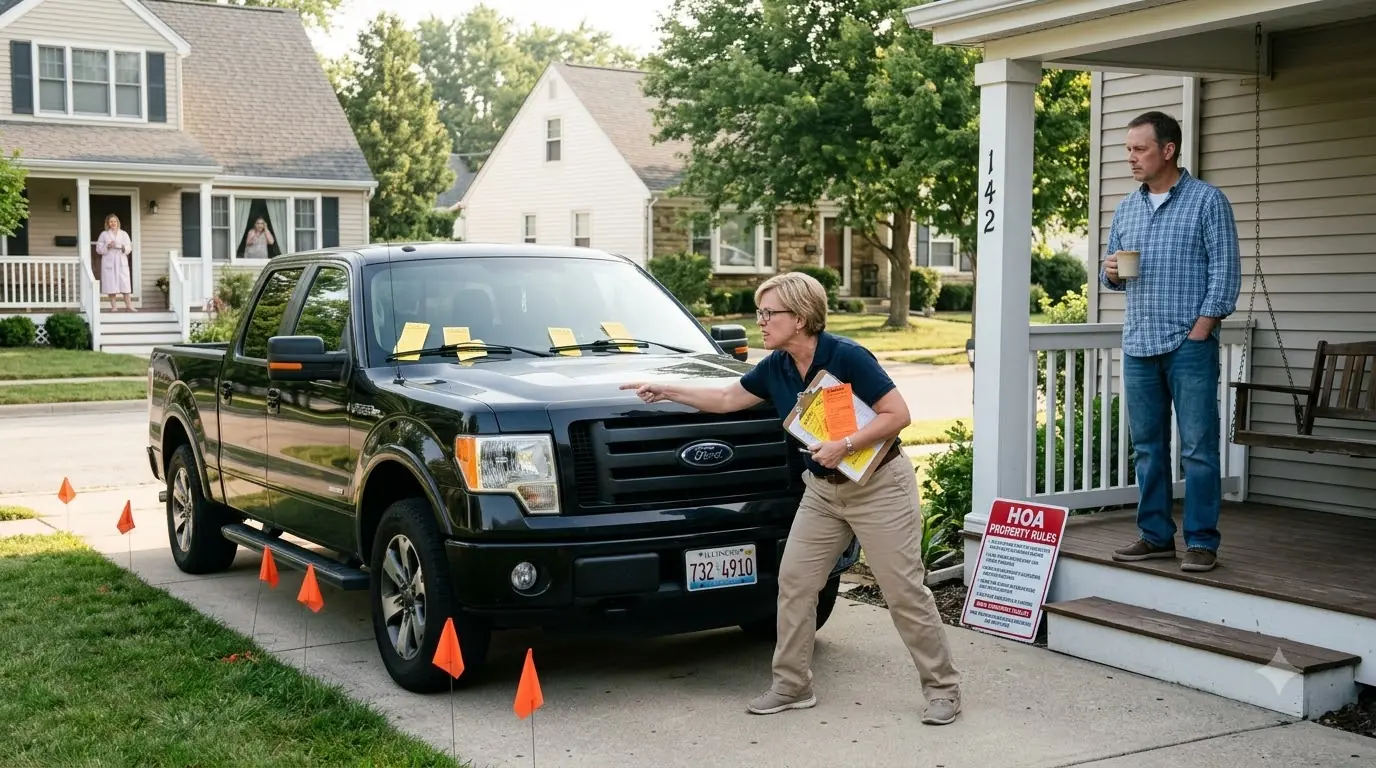
She was forcing a shiny brass key into the lock with the concentration of someone trying to defuse a bomb.
She spun toward me with theatrical outrage.
“All vehicles in this neighborhood must allow HOA emergency access. Your refusal is highly suspicious,” she declared.
I had not said a single word.
When her supposedly universal key failed again, she gasped, pulled out her phone, and dialed 911 directly in front of me.
“Hello? Yes, there is a noncompliant male preventing a mandatory HOA safety inspection of his vehicle.”
She pointed at me as though I had stolen the truck.
What Karen did not know was that the suspicious, noncompliant man she had just reported was the county sheriff.
I had dealt with unreasonable people before. It came with wearing a badge. Nothing, however, had prepared me for the level of creative nonsense Karen could weaponize on an ordinary morning.
Before she attempted to unlock my truck with her so-called master key, I genuinely believed she was simply an excessively enthusiastic HOA president with too much free time and too many clipboards.
I had been wrong before.
Never this spectacularly.
To understand how Karen reached the point of calling 911 on the county sheriff without recognizing him, I have to go back several years to when I first moved into the quiet cul-de-sac near the edge of the HOA’s jurisdiction.
My house sat directly along the boundary of the association’s authority. It was close enough for Karen to see, monitor, and develop opinions about, but far enough outside the official boundary that she technically controlled no part of my land.
That technicality became the greatest frustration of her entire existence.
The first time Karen introduced herself, she did not say hello or welcome me to the neighborhood.
She marched up my driveway with a clipboard tucked under her arm like a prosecutor preparing for trial.
“Law enforcement vehicles may create unnecessary alarm,” she said, nodding toward my patrol cruiser. “I’ll need you to park that somewhere else.”
It took me a moment to process the absurdity of the request.
I politely explained that the cruiser was legally registered, legally parked, and not subject to her personal discomfort.
Karen forced a smile that never reached her eyes. She made a note on her clipboard and walked away as though she were preparing paperwork for my future eviction.
That was only the beginning.
Several days later, I found a sheet of paper taped to the cruiser’s windshield.
In bold letters, it read:
“Unauthorized Government Imagery Visible from Public View. Fine: $45.”
Government imagery?
She meant the sheriff’s badge painted on the door.
I laughed aloud, peeled the paper from the windshield, and placed it inside a binder.
At that point, I had no idea how thick the binder would become or how many separate categories I would eventually need for Karen’s imaginary violations.
During the following year, I received an unbelievable collection of HOA citations that were not citations at all. They were papers Karen designed and printed at home.
Once, she attempted to fine me for leaving tire marks on my driveway after a rainstorm.
She called it unauthorized terrain modification.
Another time, she accused me of visual intimidation because she disliked the way sunlight reflected from the chrome grille of my truck.
The moment that truly changed everything came when she asked me to provide the HOA with a copy of my vehicle keys for emergency purposes.
I looked directly at her.
“Absolutely not.”
Karen blinked, visibly stunned that anyone had denied her.
She cleared her throat, lifted her chin, and said, “We’ll revisit this.”
I should have understood that those words meant trouble.
Eventually came the morning when she forced a brass key into my truck’s lock and called 911.
A deputy arrived and explained exactly whose truck she was attempting to inspect.
Karen stood completely still for several seconds, her expression resembling a frozen computer screen.
Then she stormed away in humiliation.
Humiliation did not discourage Karen.
It fueled her.
By the following morning, bright pink flyers were taped to mailboxes, lamp posts, and trash containers throughout the neighborhood.
They were impossible to miss, partly because of the glitter glue and partly because of the hysterical title printed entirely in capital letters.
“URGENT COMMUNITY ACTION REQUIRED: STOP THE NONCOMPLIANT VEHICLE.”
Karen had drawn tiny stars around the heading as though she were advertising a school bake sale.
The flyer described my truck as a community risk. It claimed that I refused to participate in HOA-approved vehicle safety protocols and demanded that residents vote to require all neighborhood vehicles to provide universal HOA access credentials.
In ordinary language, Karen wanted a key to every resident’s car.
My neighbor Mark came to my door that afternoon with one of the flyers in his hand.
“Is this about you?” he asked while rubbing his temples.
“Apparently.”
He groaned.
“She fined me last week because my car is too red. She said the color was visually aggressive.”
I was not surprised.
Karen’s interpretation of HOA rules had never been connected to reality, but her new vehicle crusade had reached an entirely different level.
That evening, I found a bright yellow notice beneath my windshield wiper.
“Notice of Parking Violation: Excessive Vehicle Presence. Fine: $65.”
Excessive presence.
In my own driveway.
I added the notice to the binder.
The following day, Karen held what she described as an emergency HOA meeting.
Someone recorded the meeting and sent the video to me, perhaps as entertainment and perhaps as evidence.
Watching it felt like witnessing a political rally hosted by someone who had read half of a leadership textbook and decided she was prepared for world domination.
Karen’s presentation included a pie chart identifying my truck as the primary cause of community instability.
She displayed a blurry photograph of the vehicle taken from a suspiciously low angle.
Another slide was titled “Potential Threat Indicators.”
The listed indicators were size, color, reflectiveness, authority symbolism, and owner noncompliance.
Karen concluded by declaring that immediate action was necessary to restore driveway harmony.
One resident raised a hesitant hand.
“Isn’t that the sheriff’s truck?”
Karen answered sharply.
“Authority does not exempt anyone from community standards.”
Hearing that actually made me laugh.
I could not have invented the statement if I tried.
The laughter did not last long.
By the next morning, three more notices had appeared on my truck.
“Reflective Paint Disturbance.”
“Unauthorized Law Enforcement Symbols.”
“Driveway Shadow Imbalance.”
Driveway shadow imbalance.
Karen was attempting to fine me for the shape of my truck’s shadow.
That was when I understood that the situation had moved beyond an ordinary neighborhood disagreement.
Karen was escalating toward something larger, louder, and significantly more irrational.
She was not merely annoyed by my truck.
She was obsessed with controlling it, controlling me, and controlling everything she believed fell within the spirit of the HOA.
The central problem was that my driveway did not belong to the HOA.
I began documenting everything, not only as a resident, but as a sheriff.
I collected photographs of every flyer and notice, screenshots of her emails, recordings of HOA meetings, statements from neighbors who also felt targeted, and copies of the master-key policies she claimed existed.
I was not building a case out of personal resentment.
I was documenting her conduct because I could see exactly where she was heading.
She was moving toward a legal collision.
The next morning, Karen proved that even my expectations were not unreasonable enough.
I stepped outside and found twenty-six small neon-orange flags planted along my driveway in two perfectly straight rows.
They resembled a ceremonial runway leading directly toward my truck.
Every flag carried the same message:
“HOA Claim Pending. Vehicle Access Gate Under Review.”
A gate.
Karen was planning to place a gate across my driveway so she could control access to my own vehicle.
I recognized the pattern immediately.
Those orthopedic sandals never lied.
I crouched down, examined her work, and understood something important.
Karen was no longer merely reacting.
She was planning.
She had declared war without realizing she had crossed the most dangerous possible boundary.
The legal one.
I stood there studying the precise rows of neon flags.
The early sunlight made them glow like landing lights, directing every eye toward my truck.
The display was dramatic, irrational, and unmistakably Karen.
I removed one flag and read it again to ensure I was not misunderstanding.
“HOA Claim Pending. Vehicle Access Gate Under Review.”
She intended to build a gate across my private driveway to regulate access to my own truck.
I took a long breath and allowed the absurdity to settle.
Karen had not merely crossed the line.
She had sprinted past it and continued running like she was training for the HOA Olympics.
This stunt felt different from the earlier ones.
It was strategic.
She had probably spent half the night placing those flags, repeating rule numbers that did not exist, and imagining herself laying the foundation for a new era of neighborhood control.
I was not angry.
I was fascinated.
During an interrogation, there is sometimes a moment when you realize a suspect is about to incriminate themselves without assistance.
Karen was not sabotaging me.
She was building the case against herself.
I photographed the flags from every angle.
I documented the footprints, spacing, location, and distance between the markers and my driveway.
The evidence would be useful when authorities with actual jurisdiction reviewed the situation.
My phone buzzed.
Mark had sent me a message.
“Check your driveway. She has lost her mind.”
I replied with a photograph of the flags.
His response arrived immediately.
“Oh my God. She’s building runways now.”
I laughed.
The morning performance was not finished.
Several minutes later, I heard the familiar clacking of Karen’s sandals approaching along the street.
I did not need to turn around.
Her footsteps were as recognizable as her voice.
She appeared at the bottom of the driveway with the clipboard pressed against her chest like a sacred artifact.
“Good morning,” she said with strained politeness.
“I’m sure it is,” I replied, still holding one of her flags.
She adjusted her sunglasses.
“I see you discovered the preliminary markers. The HOA has initiated a vehicle-access evaluation for community safety.”
“On my property?”
“Property boundaries are fluid where safety concerns are involved.”
I raised an eyebrow.
“Fluid?”
“Yes. As acting HOA president, I have full authority to take precautionary measures when a resident refuses compliance.”
She nodded toward the truck.
“Your vehicle’s defiance is well documented.”
I nearly choked.
“My truck’s defiance?”
“It refused universal access.”
Karen spoke as though that sentence belonged to the English language.
I remained silent for a moment because I could not decide which part to address first.
Eventually, I pointed toward the flags.
“You placed these here yourself?”
“Of course I did,” she said proudly. “The board was unanimous.”
My eyes narrowed.
That was either a lie or an extreme interpretation of events.
I knew the board members were tired of Karen. Several had quietly apologized to me for her behavior.
“Unanimous?” I asked.
Karen shifted her weight.
“Unanimous in spirit.”
The spirit of the board.
A useful concept when actual votes did not exist.
I stepped toward her, remaining polite but firm.
“Karen, this is private property. You are trespassing. These flags and the gate you are proposing have no legal standing.”
“Not yet.”
That answer made me pause.
Karen tightened her grip on the clipboard.
“I will draft an amendment for the next HOA meeting. The community will vote to place every vehicle within visual proximity of HOA land under shared authority. It’s progressive.”
“It’s illegal.”
She dismissed the statement with a scoff.
“Laws adapt. Communities evolve.”
Then, almost with excitement, she added, “Residents deserve protection from rogue vehicles.”
My truck had become a rogue vehicle.
Wonderful.
I took another photograph, capturing Karen standing proudly among the flags.
She noticed and stiffened.
“What are you doing?”
“Documenting.”
She recognized the danger in that word.
“You cannot intimidate me,” she snapped, although her voice wavered. “I will not be threatened by someone who believes he is above community standards.”
I smiled.
“Karen, I think you’re forgetting something.”
“And what is that?”
“You called 911 on the sheriff.”
Her face flushed pink, whether from anger or embarrassment, I could not tell.
“That was a misunderstanding.”
“You told dispatch that I refused an HOA vehicle inspection.”
“I stand by that.”
“You described me as suspicious.”
“You were suspicious.”
“I was holding coffee.”
Karen pressed her lips into a thin line.
She clearly did not enjoy revisiting her humiliation.
Without another word, she turned and marched away.
She left me with a driveway full of orange flags and the certainty that the matter was not finished.
That afternoon, I returned from town and found a tow truck parked suspiciously close to my driveway.
The driver stood beside it, studying a piece of paper as though it had been written in an ancient language.
I parked and approached.
“Everything all right?”
He looked at me, then at the paper, then back at me.
“A woman from the HOA said this truck was abandoned and needed to be removed.”
“Abandoned?”
“She said it had not moved in weeks.”
“I drove it yesterday.”
The tow truck driver blinked.
“She also said the owner refused required safety inspections.”
I pointed toward the sheriff’s emblem on the door.
“I’m the owner.”
The color drained from his face.
“Oh. She didn’t mention that.”
“I’m sure she didn’t.”
He folded the paper and shoved it into his pocket as though it were cursed.
“Sorry, sir. I’m leaving now.”
The driver climbed into his tow truck and departed with the urgency of someone escaping a crime scene.
I looked at my driveway, the remaining flags, and the disappearing truck.
This was no longer simple pettiness.
It was deliberate escalation.
Karen was trying to create a narrative in which I was the problem, the danger, and the threat to the neighborhood.
After two decades in law enforcement, I knew that people who built false narratives eventually trapped themselves inside them.
That evening, while the sky turned orange and purple, I removed each flag.
One by one.
It was the quiet, methodical dismantling of Karen’s imaginary empire.
I arranged the flags in a pile, photographed the cleared ground, and stored them inside a box labeled:
“Evidence: Vehicle Incidents.”
The truth was obvious.
The master key had been her opening move.
The flags represented an expansion.
I could feel that she was preparing something larger, probably involving clipboards, signatures, and a new authority she had invented in her mind.
I was preparing too.
I intended to meet each escalation with documentation, patience, and, when necessary, the weight of real law.
There was room for only one sheriff in the neighborhood.
It was not Karen.
I woke the following morning expecting peace.
After the tow truck incident, I naively believed Karen might take a day away from her imaginary conflict.
Perhaps she would cool down, bake cookies, or yell at a cloud.
Anything other than targeting my vehicle again.
The universe had different plans.
When I stepped outside with coffee in my hand, I stopped.
My truck, which had been parked quietly and legally in my own driveway, was shackled.
A large yellow wheel clamp had been fastened to the front tire like a medieval punishment device for misbehaving vehicles.
For several seconds, I could only stare.
The stenciled letters across the device read:
“HOA IMPOUND. NONCOMPLIANT VEHICLE.”
There was not enough caffeine in the county for this.
I placed the coffee on the hood and crouched beside the clamp.
It was made of heavy metal and had likely damaged the wheel.
A laminated tag hung from the lock.
“Release Fee: $350.”
“Processing Fee: $25.”
“Administrative Fee: $15.”
“Total Due: $390.”
Karen had awakened that morning and chosen to approach grand theft.
Behind me, I heard the unmistakable sound of triumphant sandals.
I did not turn around.
“Well,” Karen called with her arms crossed. “Perhaps now you will learn to respect community authority.”
I stood slowly.
“You placed a wheel clamp on my truck.”
“It is not merely your truck,” she snapped. “It is a community-adjacent vehicle subject to oversight. Immobilization became necessary after repeated violations.”
I exhaled through my nose, the way I did before reading someone their rights.
“Karen, this is illegal.”
“No,” she corrected while tapping her clipboard. “This is proactive neighborhood safety enforcement.”
“You immobilized a law enforcement vehicle.”
“A vehicle used to intimidate residents,” she answered. “Frankly, you should thank me for holding you accountable.”
I laughed.
Not because the situation was funny, but because I had two choices.
Lose my mind or enjoy the performance.
By then, the performance had completely left the rails.
“Karen, remove the clamp.”
She recoiled.
“Absolutely not. You will pay the release fee like everyone else.”
“No one else has a wheel clamp on their vehicle.”
“No one else has been this noncompliant.”
Her voice cracked at the end, as though she were moments away from demanding a documentary about her suffering.
“You cannot impound someone’s vehicle,” I said. “Especially when the vehicle is not on HOA property.”
Karen smiled.
“We will see what the board says.”
“The board authorized this?”
“Yes.”
At that moment, my neighbor Jill appeared behind her front curtain.
She made eye contact with me and shook her head vigorously.
No.
The board had absolutely not authorized the clamp.
Karen recognized that she had been exposed and changed her answer.
“They did not oppose it.”
“That is not the same thing.”
“It is in spirit.”
The HOA spirit.
The place where reality went to die.
I removed my phone.
Karen stiffened but attempted to remain confident.
I photographed the clamp, Karen, the tire, and the driveway.
She scoffed.
“You think photographs frighten me?”
“No, but they will assist the police.”
Karen’s lips parted.
“Police? You wouldn’t dare.”
“I would.”
I called the nonemergency dispatch line and requested a deputy for the unlawful immobilization of a vehicle.
Because I was personally involved and off duty, I could not handle the complaint myself.
Policy was policy.
Karen began to panic.
“You’re weaponizing law enforcement. This is harassment.”
I pointed toward the clamp.
“You immobilized a government vehicle.”
Before she could respond, a familiar patrol cruiser appeared.
Deputy Hernandez stepped out, looked once at the clamp, and turned toward me with an expression that said, “Not again.”
“Morning, Sheriff,” he said quietly.
Karen threw up her hands.
“Finally, someone reasonable. Officer, arrest him for refusing to comply with HOA impoundment protocol.”
Hernandez stared at her for several seconds.
“Ma’am, there is no HOA impoundment protocol.”
“There should be.”
“That is not how laws are created.”
Karen pointed her pen toward the clamp.
“This vehicle is out of compliance. I tried the master key…”
“Stop,” I said, raising one finger. “Do not confess to additional offenses.”
Hernandez sighed and opened his notebook.
“Ms. Allen, did you place this device on the sheriff’s truck?”
“I issued a lawful community corrective action.”
“Did you purchase this clamp online?”
“Yes,” she said proudly. “It’s heavy-duty and available in several colors.”
“Ma’am, you cannot immobilize property you do not own. This may constitute tampering and vehicle interference.”
Karen gasped.
“Vehicle interference? How dare you imply…”
“He is not implying anything,” I said. “He is explaining the law.”
“This is oppression of the HOA!” Karen shouted.
If hysterical righteousness could generate electricity, Karen could have powered the county.
Hernandez issued an official warning and instructed her to remove the clamp immediately.
She refused.
He repeated the instruction.
She refused again.
Finally, Hernandez said, “If you do not remove it, law enforcement will.”
Karen glared at him with enough hostility to remove paint.
Then she marched toward the truck, fought with the lock, and pulled the clamp from the wheel as though she were tearing betrayal from her soul.
She dragged it down the street while muttering about tyranny and rogue vehicles.
Her retreat did not last long.
Two days later, she returned with reinforcements.
Not people.
Paperwork.
Karen distributed glossy homemade brochures titled:
“The Great Vehicle Harmony Initiative.”
She taped them to every door in the neighborhood.
The proposed regulations included mandatory HOA access keys for all vehicles, HOA-controlled parking rotation schedules, monthly driveway compliance inspections, and fines for visually disruptive automobile silhouettes.
I laughed so hard that I had to sit down.
Karen was not laughing.
She was doubling down.
That week, she sent me thirteen separate violations.
“Parking Too Confidently.”
“Vehicle Presence Exceeding Comfort Threshold.”
“Potential Intimidation Due to Height.”
“License Plate Numerically Aggressive.”
“Unauthorized Reflective Surfaces.”
“Excessive Durability.”
“Owner Attitude Noncompliant.”
“Truck Windows Too Transparent.”
“Driving Patterns Unpredictable.”
“Tire Grooves Emotionally Sharp.”
“Paint Color Too Authoritative.”
“Shadow Cast Exceeds Forty-Five Feet.”
“Sheriff Emblem Improper for Suburban Setting.”
Each one was more absurd than the previous one.
I documented everything.
I started a second binder.
Then a third.
When Karen realized she was not intimidating me, she changed tactics.
The next escalation arrived on a quiet Wednesday morning.
I returned from the grocery store and found a plywood barricade erected across the entrance to my driveway.
It had been spray-painted with the words:
“HOA PARKING ZONE. AUTHORIZED VEHICLES ONLY.”
Plastic ties held the structure together.
A laminated sign hung from the center.
“Violators Will Be Fined.”
I stepped out of my truck and stared.
“She has lost her mind.”
Then I walked over, lifted the entire structure with one hand, and placed it beside a tree.
It weighed approximately eight pounds.
I attached a note.
“Nice decoration. Wrong house.”
The following day, a city inspector knocked on my door.
“We received a complaint about a dangerous illegal parking structure on this property.”
Karen had accidentally reported her own barricade.
I showed it to him.
He looked at the plywood and laughed.
“This is not compliant with building codes or reality.”
The inspector photographed it, wrote several notes, and left while still laughing.
Karen watched from across the street with her arms folded, looking like a kettle left over high heat.
She did not speak that day.
Her silence was worse.
It appeared calculated and focused.
I had seen the same expression on people determined to dig their own graves and blame the shovel.
The clamp and barricade were only the beginning.
Karen was preparing something larger and more theatrical, something she believed would finally force me to recognize her authority.
She did not understand that she was walking directly into a legal disaster.
For once, I would not need to do much.
She was creating the consequences herself.
An unnatural silence settled over the neighborhood after the barricade incident.
It did not feel peaceful.
It felt like the stillness before a tornado touched the ground.
Karen disappeared for almost forty-eight hours.
For someone who survived through constant micromanagement, silence did not mean surrender.
It meant preparation.
Her next disaster arrived on the third morning.
I opened my mailbox expecting bills, advertisements, and perhaps another lawn-care brochure.
Instead, a thick glossy packet fell into my hand.
The cover displayed a winding suburban street with animated sparkles surrounding parked cars, as though depicting a magical parking paradise.
Across the top were the words:
“The Community Vehicle Harmony Initiative.”
Below that:
“Presented by the Bluff Neighborhood Mobility Council.”
A council?
No such council existed.
I leaned against the mailbox and opened the packet.
The first page carried a letter from the desk of “Acting Coordinator K. Allen.”
Karen had rebranded herself.
Whenever she invented a new title, conditions deteriorated.
The letter stated that due to recent vehicular disturbances caused by resistance to universal access policies, the neighborhood would implement mandatory new regulations.
Mandatory was one of Karen’s favorite words.
The following pages presented a collection of rules, each more unlawful than the last.
All vehicles must be registered with the Mobility Council.
Owners must provide emergency-access keys upon request.
Driveways may be inspected without advance notice.
Parking spaces may be reassigned for harmony redistribution.
Unauthorized vehicle silhouette patterns will result in penalties.
Vehicle silhouette patterns.
A real person had typed those words.
The final page contained the section Karen cared about most.
“Mobility Harmony Contribution Fee: $89.”
“Due Within Five Days.”
She included a QR code that directed residents to a PayPal account called the Bluff Vehicle Safety Fund.
I laughed aloud beside the mailbox at 7:30 in the morning.
At that point, amusement was the only rational response.
Then I looked up and stopped laughing.
Karen stood across the street beside her Prius.
She wore a navy blazer, tan trousers, and a fake earpiece that was clearly connected to nothing.
She watched me read the packet with the expression of someone waiting for undeserved praise.
I held it up.
“A new council?”
Karen nodded proudly.
“Created because of community demand.”
“What community?”
“Residents have expressed overwhelming concern.”
“Name one resident.”
She blinked.
“Concerns may remain anonymous for safety.”
“Safety from what? My truck’s shadow?”
Karen refused to acknowledge the sarcasm.
She approached and lowered her voice as though sharing confidential information.
“Your vehicle has become a symbol of disorder. People are frightened.”
She continued.
“A strong neighborhood cannot operate while residents feel threatened by unpredictable silhouettes.”
My truck had become a silhouette-based threat.
Incredible.
I closed the packet.
“Karen, this is fraud.”
She stiffened.
“This is community leadership.”
“What you are doing is illegal.”
“What I am doing,” she said, pointing the clipboard toward the sky, “is necessary.”
“For whom?”
“For everyone.”
Delusion radiated from her.
“You cannot invent organizations to collect fees,” I said. “You cannot demand keys to private vehicles. You cannot fine people for shadows.”
Karen smiled tightly.
“We will see what the legal advisory panel thinks.”
“Who serves on the panel?”
She hesitated.
“I do.”
I nearly choked.
“You created the council, appointed yourself coordinator, and then established a legal advisory panel composed entirely of yourself?”
She crossed her arms.
“Someone has to take responsibility.”
“And that person is always you.”
“Exactly.”
I rubbed my forehead.
“Do you hear how strange that sounds?”
“I hear how necessary it sounds.”
Karen did not need another organization.
She needed a hobby.
Before I could continue, she pushed a clipboard toward me.
“Sign the compliance acknowledgment.”
I did not touch it.
“No.”
“Very well.”
She wrote something on her form.
“Refusal to Acknowledge Notice. Additional Fee: $13.”
Not ten dollars.
Not fifteen.
Thirteen.
Karen operated according to chaos mathematics.
She walked away with the satisfaction of a cat that believed it had caught a mouse.
I was not the mouse.
I was the sheriff.
Karen was attaching paperwork to her own downfall.
Inside my house, I arranged the evidence across the dining table.
The new packet.
The fines.
Photographs of the barricade.
The wheel clamp.
Messages from neighbors showing their own violations.
There was enough material to cover the walls of a courtroom.
I called the sheriff’s office, not in my official capacity, but as a citizen reporting conduct that affected me personally.
Department policy required an uninvolved deputy to manage the complaint.
Hernandez took the report.
“Bluff Neighborhood Mobility Council,” he repeated. “I have never heard of it.”
“It did not exist until this morning.”
He whistled.
“She truly does not know when to stop.”
“No, she does not.”
“Send me everything. This may constitute attempted fraud.”
I emailed the documents, photographs, timestamps, and electronic payment links.
Hernandez said he would begin verifying Karen’s claims, which meant proving that none of them were legitimate.
That evening, I sat on the porch rereading her booklet and wondering whether silhouette patterns should become a running joke at the station.
Jill approached carefully.
She looked around to confirm that Karen was not nearby.
“Can we talk?” she whispered.
“Of course.”
She moved closer.
“The HOA board needs your help. We are finished with her. We cannot manage this anymore.”
I raised an eyebrow.
“What happened now?”
“She said the board must create a parking brigade. She wants weekly driveway inspections.”
Jill continued.
“She attempted to fine one board member because her sport utility vehicle felt rebellious.”
I rubbed my eyes.
“I wish I could say I’m surprised.”
“She is out of control. We want to remove her from office, but we need evidence. Solid, provable information that she cannot explain away later.”
I gestured through the window toward the dining table, where the paperwork resembled a crime laboratory display.
“I have evidence.”
Jill’s eyes widened.
“How much?”
“Three binders so far.”
She released a breath like someone seeing daylight for the first time in months.
“This might work, but you have to attend the meeting. It is Friday.”
“I’ll be there.”
Jill hesitated.
“One more question. Is it true she called 911 on you?”
“Yes.”
“And she did not know you were the sheriff?”
“Correct.”
Jill covered her face.
“This is worse than I thought.”
“Yes, it is.”
She left after promising that the board would prepare a formal motion to remove Karen.
Karen was not going to remain quiet.
She had sensed resistance and smelled rebellion.
Like any ruler whose imaginary regime was collapsing, she intensified her efforts.
The next morning, another packet appeared.
“Emergency Vehicle Harmony Audit.”
“Mandatory Participation Required.”
The form threatened a $150 nonparticipation fee.
Karen also left a handwritten note beneath my doormat.
“Your resistance strengthens my resolve.”
Who wrote villain speeches to their neighbors?
That afternoon, several confused residents approached me.
“She fined me for washing my car too loudly,” one man said.
“She said my headlights are too assertive,” another resident added.
A third man held up his notice.
“She fined me for insufficient wheel humility.”
Wheel humility.
That was a new one.
Karen was not only unraveling.
She was pulling the entire neighborhood into the chaos.
Every absurd fine, invented regulation, and desperate power grab produced more evidence.
Evidence that would end her presidency.
Evidence that would end the campaign against my truck.
Evidence that might eventually expose her to actual legal consequences.
By Friday evening, the neighborhood would no longer be ruled by a clipboard tyrant.
Karen did not know it yet, but she was preparing to lose everything she had constructed.
All because she believed she possessed the right to open my truck with a brass key.
I arrived at the HOA meeting thirty minutes early.
It was not because I was eager to watch Karen collapse.
The board had asked me to help set up the projector, chairs, and what they called security measures.
They did not mean physical security.
They meant emotional preparation.
The board members understood Karen well enough to expect a theatrical breakdown.
Nobody wanted her climbing onto a table and shouting about vehicular insurrection again.
The community center already carried a low, nervous energy.
Residents whispered in small groups.
Some carried copies of Karen’s Mobility Harmony packet as though they were presenting evidence in court.
Others held phones displaying screenshots of fines she had sent at random hours.
One resident printed an eighteen-by-twenty-four-inch poster of the wheel-humility violation.
Beneath it, he had written:
“How Is This Real?”
Even I stopped to admire it.
Jill approached with a clipboard.
Her hair was pulled into the tight, stressed bun of someone who had reached the end of her patience.
“She does not know what we’re planning,” she whispered.
“She will know in approximately twenty minutes.”
Jill nodded.
“Good. The board is united. That has not happened in ten years.”
“That is what happens when tyranny arrives wearing orthopedic sandals.”
She struggled not to laugh.
“Stay close when the meeting begins. She is going to make this difficult.”
Karen could not breathe without making something difficult.
Residents continued entering.
Some took seats, while others stood along the walls like spectators waiting for a boxing match.
The room smelled faintly of coffee, anxiety, and resentment.
Standard HOA conditions.
Everyone waited for the performance.
Right on schedule, the door slammed open.
Karen entered like royalty arriving for a coronation.
She wore the navy blazer, fake earpiece, and carried the clipboard across one forearm like a sacred object.
A stack of Mobility Council packets rested beneath her other arm.
The room groaned collectively.
“There will be order,” she announced.
“The meeting has not started,” someone muttered.
Karen ignored the remark.
She marched to the front and positioned herself beside the podium, glaring at the board as though daring anyone to challenge her.
Jill stepped forward.
“Thank you all for coming. Tonight’s meeting will address…”
“I will be conducting tonight’s meeting,” Karen interrupted. “Given the heightened threat level to neighborhood vehicular harmony.”
“No,” Jill said.
The entire room froze.
Karen blinked.
She was not accustomed to hearing that word.
“No?” she repeated.
“That is correct,” Jill replied. “The board will conduct the meeting. You will sit down.”
Karen’s jaw dropped.
“Sit down?”
“Yes. In the audience, like everyone else.”
Karen’s eyes moved toward me, searching for support.
I folded my arms and leaned against the wall.
I was not there to rescue her.
I was there to observe, document, and allow her to destroy her own defense.
“I am the HOA president,” Karen said through clenched teeth.
“For now,” someone whispered from the back.
Karen spun around.
“Who said that?”
Nobody answered.
Jill cleared her throat.
“Please take your seat.”
Karen did not move at first.
Her authority was slipping, and she could feel it.
Eventually, she released an angry huff and dropped into a metal chair in the front row.
The meeting began.
Jill introduced the agenda and thanked everyone for attending.
Then she reached the subject everyone had been waiting to hear.
“Tonight, the board will address the concerning actions of our HOA president. These include unauthorized fines, fraudulent documents, attempts to collect money through a nonexistent organization, and repeated harassment of multiple residents.”
Murmurs moved throughout the room.
Karen jumped to her feet.
“Lies. All of it. I did what was necessary to protect the community from vehicular anarchy.”
“Sit down,” Jill said.
Surprisingly, Karen obeyed.
Jill gestured toward me.
That was my cue.
I walked to the front carrying a simple folder.
I did not need theatrics.
I had evidence.
“Good evening. Most of you know me as a neighbor. Some of you recently learned that I am also the county sheriff.”
I placed the folder on the table.
“I have lived here for three years. Until recently, I never imagined that I would need to speak at an HOA meeting.”
The room responded with uneasy laughter.
“I want to explain the sequence of events that led the board to call this meeting.”
I opened the folder and arranged printed photographs and documents across the table.
“First, Karen attempted to open my truck using what she described as a master key.”
I displayed a photograph of her standing beside the vehicle with the brass key in her hand.
“She then called 911 and described me as a suspicious person who refused an HOA vehicle inspection.”
Several people gasped.
“She did not know she was reporting the sheriff.”
A murmur moved across the audience.
Many residents already knew the story, but hearing it presented formally gave it greater weight.
I moved to the next page.
“After that incident, Karen issued dozens of unauthorized fines. Many of you received similar documents.”
I pointed toward the papers residents had brought.
“Charges included aggressive headlights, noncompliant wheel angles, and emotional lawn imbalance caused by vehicle placement.”
I paused.
“None of these are legitimate violations. They do not appear in the HOA bylaws.”
Residents nodded.
Whispers became angrier.
“Karen then placed a wheel clamp on my truck.”
A photograph of the yellow boot appeared on the projector.
Karen made a strangled sound but did not interrupt.
Not yet.
“She also contacted a tow company and attempted to have the truck removed by falsely claiming it was abandoned.”
I continued through the evidence.
The plywood barricade.
The orange flags marking an imaginary HOA property claim.
The fraudulent Mobility Harmony Council.
The payment demands.
The QR code directing residents to her personal electronic payment account.
“She attempted to collect money through an unregistered organization. That conduct may constitute attempted fraud.”
Karen could no longer contain herself.
“I was acting in the interest of the community.”
“Karen,” I said gently, “you immobilized a sheriff’s truck with a clamp you purchased online.”
“That clamp was high quality!” she shouted.
A man near the back began laughing.
Jill raised one hand.
“Order, please.”
The rest of the room was no longer amused.
Residents were angry about being manipulated, fined, and forced into chaos by a woman who believed she owned their driveways.
I completed the presentation and closed the folder.
“The evidence has been submitted to the county, and the investigation is ongoing. The HOA board, however, may act tonight regarding Karen’s position.”
One board member stood.
“I move for the immediate removal of Karen Allen as HOA president.”
The room erupted in applause.
Karen jumped to her feet with wild eyes.
“No. You cannot do this. I am the only person holding this community together.”
She pointed around the room.
“Without me, you will descend into parking disorder.”
Jill did not react.
“All in favor?”
Hands rose throughout the room.
Dozens of them.
A wave of residents exhausted by Karen’s rule.
It was beautiful.
“All opposed?”
Karen raised her hand.
She was alone.
Her arm trembled with fury.
Jill nodded.
“The motion carries. Karen Allen is removed as HOA president, effective immediately.”
The collective exhale felt like the first breeze after a long drought.
Karen stood completely still, like someone had disconnected her thoughts.
Then she grabbed her clipboard, pointed at me, and shouted.
“This is not over. You cannot escape harmony. I will return stronger than ever.”
She marched from the room and slammed the door hard enough to shake the frame.
Silence followed.
Then the community center filled with applause.
People cheered, laughed, and hugged one another.
I watched the door.
I knew something the others did not.
Karen was not finished.
She did not retreat.
She regrouped.
I suspected her next move would make everything before it look reasonable.
The evening following Karen’s removal was the most peaceful the neighborhood had felt in months.
Residents remained outside their homes and spoke along the sidewalks.
People watered plants, walked dogs, and stopped glancing over their shoulders for a woman charging toward them in a pastel blazer.
Someone joked that they could finally wash their car without violating vehicular emotional etiquette.
Relief was real.
Peace, however, was rarely the end of a story.
It was often the eye of the storm.
Karen did not appear the following day.
She remained absent the day after that.
Most residents believed she had finally withdrawn in humiliation to reorganize her imaginary committees.
I knew better.
Karen did not accept defeat.
She repackaged it.
The first sign arrived in my mailbox on Friday morning.
It was a professionally printed envelope made from heavy linen paper and sealed with a gold circular sticker.
It looked like an invitation to a royal event.
The return address listed only:
“P.O. Box 214.”
“Bluff County Oversight Initiative.”
I sighed before opening it.
Inside was a formal notice.
“Dear Resident,
Due to recent concerns involving vehicle compliance and driveway harmony, you are required to attend a mandatory mediation session with the Bluff Community Oversight Initiative, BCOI.
Failure to appear may result in additional action.”
The signature at the bottom was written in exaggerated script.
“Acting Coordinator K. Allen.”
Karen had reinvented herself again.
She no longer controlled the HOA, so she created a private organization that imitated local government.
The envelope also included a voluntary community contribution form requesting $140 for a driveway beautification project.
Once again, the QR code led to a PayPal account registered in Karen’s name.
She was moving confidently into fraud territory.
I photographed every page and placed them in the increasingly crowded fourth volume of Karen evidence.
Less than ten minutes later, the doorbell rang.
My son stood outside.
He was not in uniform, but he carried himself the same way he always did, alert, steady, and patient.
I invited him inside and handed him the letter.
He read the first paragraph and shook his head.
“She is trying to recreate the HOA.”
“Not recreate. Reincarnate.”
“She sent the same letter to at least six residents. Someone brought a copy to the sheriff’s office this morning.”
I poured him coffee.
“She has doubled down.”
“She has moved beyond doubling down,” he replied. “This is no longer simple harassment. She may be impersonating authority and attempting to collect fraudulent fees.”
“Can charges be filed?”
“Not yet. We can investigate.”
That was the balance the department needed to maintain.
Professional distance.
Procedural caution.
My son handled matters according to policy, and I respected that.
He placed the letter on the table.
“Dad, she is unraveling. Be careful.”
“I’m always careful.”
He gave me a look.
“Fine. I’m usually careful.”
We laughed, but concern remained in the room like humidity before a storm.
The next strange event occurred that night.
At 11:47 p.m., my motion sensor activated.
I opened the security feed, expecting to see a raccoon.
Instead, I saw Karen.
She wore a reflective vest, cargo trousers, gloves, and carried a tape measure, clipboard, and what appeared to be a stud finder.
She paced along the border of my driveway like a surveyor conducting an intensely personal investigation.
At one point, she knelt and measured the angle of my truck’s front tire.
She wrote something quickly.
Then she measured the distance between the truck and the lawn.
More writing.
Finally, she pressed the stud finder against the fender as though she expected it to reveal government secrets.
I stepped onto the porch and folded my arms.
“Good evening, Karen.”
She gasped and dropped the tape measure.
“I was conducting an assessment.”
“At midnight?”
“Timing is irrelevant when harmony is threatened.”
“Karen, leave my property.”
“I possess authority under the Oversight Initiative.”
“No. You have a reflective vest you purchased online.”
“It is a uniform.”
“It is a vest.”
“A uniform.”
“A vest, Karen.”
She stamped one foot like a child denied a treat.
“You are obstructing justice.”
“No. I am preventing trespassing.”
I pointed toward the camera.
“You are being recorded.”
Karen froze.
Documentation remained her greatest weakness.
She did not fear authority or resistance.
She feared evidence.
She slowly backed away while muttering.
“This will not stop harmony. This will not stop the initiative.”
Then she vanished into the darkness of the cul-de-sac, her reflective vest sparkling like a confused firefly.
The following morning, half the neighborhood received envelopes identical to mine.
Some residents asked whether I knew anything about the organization.
Others asked whether Karen truly possessed the power to fine them again.
“No,” I told them. “She has no authority.”
“But she threatened legal action,” one neighbor whispered.
“She also threatens shadows. You will be fine.”
Not everyone was reassured.
Karen had conditioned people to fear her clipboard for years.
Undoing that fear required time.
By noon, I had collected eleven additional letters from residents who did not trust themselves to avoid burning the documents.
I forwarded everything to Hernandez.
He called twenty minutes later.
“I believe we have sufficient evidence for charges. The initiative is not registered with the state. It does not legally exist. She is creating false documents and representing them as official authority.”
“Do what you need to do.”
Hernandez hesitated.
“There is one problem.”
“What?”
“She is probably expecting retaliation. She may have a public breakdown before we can serve the papers.”
He was right.
The breakdown arrived that afternoon.
I was working in the garage when I heard shouting from the street.
Karen stood beside her Prius, waving an enormous rolled poster like a battle flag.
“The community is at risk!” she shouted. “The sheriff’s vehicle threatens harmony!”
Residents looked from behind curtains.
Several came outside.
Everyone appeared exhausted.
Karen unrolled the poster.
It was an enlarged satellite photograph of the neighborhood.
My truck had been circled in red marker and surrounded with arrows and handwritten labels.
“Unknown Vehicle Energy Zone.”
“Potential Disruption Field.”
“Driveway Dominance Risk.”
A child down the street whispered, “Is he a superhero?”
Karen spun toward him.
“No. He is a menace.”
At that moment, two sheriff’s vehicles entered the street.
Karen’s face paled.
Deputy Hernandez stepped out and approached calmly.
“Karen Allen, we need to speak with you.”
She lifted her chest.
“Finally. Justice has arrived.”
“Yes,” Hernandez said. “It has.”
He handed her a packet.
Karen read the first lines.
Then she screamed.
It was not an ordinary scream.
It was the sound of an imaginary empire collapsing beneath actual law.
“You cannot do this. I am the initiative.”
“No,” Hernandez replied. “You are being charged with harassment, falsifying documents, and attempting to operate an unlicensed organization.”
“My initiative is legal.”
“It does not exist.”
“It exists spiritually.”
“A spiritual HOA does not possess legal authority.”
Karen stamped her feet, waved her arms, called herself a guardian of peace, and accused me of organizing a coup.
I stood nearby with my arms folded.
When she finally ran out of breath, Hernandez continued.
“Ma’am, you are formally ordered to cease every oversight activity. You are not to contact residents with demands, directives, or payment notices.”
He met her eyes.
“If you violate the order, additional action will follow.”
Karen stared at me.
“This is your doing.”
“No,” I replied. “This is your doing.”
She climbed into her Prius, slammed the door, and drove away.
For the first time, she did not shout through the window.
She did not look back.
That evening, the neighborhood felt lighter.
Parents walked with their children.
Teenagers used their skateboards.
Dogs barked without receiving noise citations.
The shadow of Karen’s clipboard rule disappeared like morning mist.
Peace did not last forever with someone like Karen.
I knew she was not finished permanently.
She was merely finished there.
People like Karen did not disappear.
They relocated.
Her departure should have felt like complete victory.
Residents enjoyed life without threats involving vehicular disharmony or shadow violations.
Children played basketball in driveways.
People washed cars at ordinary volume.
The air no longer seemed to smell of printer ink and unreasonable fines.
Yet I had learned something during my career.
Peace after chaos often felt fragile, like placing a glass ball near the edge of a table.
With Karen, the feeling was stronger because she had never apologized, admitted wrongdoing, or promised self-reflection.
She left angry.
Humiliated.
Planning.
While the neighborhood relaxed, I remained prepared.
I did not expect revenge in the traditional sense.
Karen was not a criminal mastermind.
She was relentless.
She would invent another authority, rename another organization, and preach a new collection of regulations nobody requested.
Days passed quietly.
Then one week.
Then two.
The sheriff’s office continued processing the case, and Karen complied with the cease-and-desist order.
Hernandez kept me informed.
“She is keeping her distance.”
“Probably drawing new maps,” I said.
Then came the night that confirmed my suspicions.
It was close to midnight.
I was reading on the porch and enjoying the rare stillness.
Moonlight cast long shadows across the yard. Crickets created the only sound.
Then my trail camera sent an alert.
“Motion Detected: Back Fence.”
I opened the feed expecting deer or raccoons.
The figure was human.
A woman stood directly outside the legal boundary of my property.
She did not cross the line or approach the house.
She remained completely still, staring toward my home.
Medium height.
Reflective vest.
Even through grainy night vision, I knew who it was.
Karen.
She stood there for nearly ten minutes.
She did not take a single step.
Perhaps she was mourning her lost territory.
Perhaps she was calculating imaginary measurements.
Perhaps she was promising herself that she would rise like an HOA phoenix from laminated ashes.
Eventually, she turned and disappeared among the trees.
Technically, she had obeyed the order.
She had remained outside my land.
The message was still clear.
She had not let go.
The following morning, I reviewed the recording.
Karen had carried no tools, letters, or laminated instructions.
She had not spoken or threatened anyone.
She merely stood there like the ghost of a failed bureaucracy.
A different person might have felt frightened.
For me, it confirmed something I already understood.
Karen’s war had never truly been against me, my truck, or shadows she considered noncompliant.
Her war was against irrelevance.
She was losing.
Two weeks later, the final chapter arrived in a form I did not expect.
A courier delivered a package without a return address.
It was addressed to:
“Sheriff’s Dad, Cabin 12.”
Karen’s humor possessed all the sharpness of a marshmallow.
I opened it carefully, expecting loose glitter or homemade regulations.
The box contained pink tissue paper.
Beneath it sat a smaller silver container, like a gift from a passive-aggressive fairy.
Inside was a glitter device.
It had been disabled.
The glitter remained harmlessly at the bottom of the box, serving as a symbolic threat.
A note was attached to the lid.
“This is what restraint looks like. You are fortunate I am taking the high road.”
I stared at it.
Karen was not directly threatening me.
She was performing one final act of petty rebellion to remind me that she had not vanished.
She was relocating.
My son visited that evening.
I showed him the package.
He shook his head.
“She mailed you a disabled glitter device as a peace offering and threat?”
“Symbolic artistry. The highest level of HOA creativity.”
He laughed.
“She is not coming back, Dad. At least not here.”
“I know.”
“But she is not finished.”
“No. People like her never are.”
Spring arrived.
The lake thawed, and the soil softened.
My home felt alive again.
I planted tomatoes and peppers, repaired the paint on the porch swing, and replaced the lights along the path.
Even the wildlife appeared calmer without Karen shouting about aggressive squirrels.
The neighborhood returned to something resembling normal.
Leonard, the new HOA president, sent me a handwritten letter thanking me for my patience during what he called the Great Vehicle Crisis.
That was his phrase, not mine.
He included a jar of homemade jam.
Peace began to feel possible.
I was starting to believe the story had finally ended.
Then Tanya, who worked part-time at the county records office, arrived with a folder and concern on her face.
“You need to see this.”
The folder contained documents for a new HOA being organized approximately thirty miles south in a recently built development.
The application was incomplete, careless, and missing several signatures.
One section, however, had been completed clearly.
“Proposed HOA President: Karen Allen.”
I closed the folder slowly.
“She is starting again,” Tanya said. “New neighborhood. New people to control. They do not know her history.”
“They will.”
“Are you going to warn them?”
I considered the question.
“No. Some lessons cannot be taught. They have to be experienced.”
Tanya exhaled.
“At least she is no longer here.”
“Exactly.”
That was enough for me.
Months passed.
My son was promoted to chief deputy.
The neighborhood regained its sanity.
Sometimes, while sitting on the porch with coffee, I remembered the chaos Karen had introduced into our lives.
The memories no longer made me angry.
They made me grateful.
A person cannot fully appreciate peace without surviving several storms.
Even storms dressed in pastel cardigans and carrying unauthorized master keys.
One morning, a new couple walked along the trail with their dog.
They stopped near the fork where Karen had once placed her plywood barricade.
They looked around uncertainly, then continued toward the lake.
I waved.
They waved back.
In that moment, I understood something simple.
Community does not require control.
It does not require invented authority.
It does not require fines, citations, or laminated threats.
Sometimes, community requires only a wave, a shared path, an open space, and the absence of someone shouting about vehicle silhouettes.
Karen was gone.
My home was mine again.
The neighborhood was free.
Somewhere thirty miles south, another HOA board was unknowingly preparing to learn that wherever Karen went, her clipboard followed.
Real authority does not come from titles, clipboards, or invented regulations.
It comes from responsibility, respect, and understanding the boundaries of one’s role.
Karen constructed her world from imaginary control.
When reality resisted, she collapsed beneath the weight of her own inventions.
There will always be people who attempt to force their will upon others, not because they are correct, but because they fear losing relevance.
The best response is to stand your ground, document the truth, and allow their actions to speak louder than your frustration.