The smell of motor oil and metal shavings still clung to my uniform as I pulled into my driveway.
After twelve hours at the shop, I was exhausted and wanted nothing more than to see my baby, the 1967 Camaro SS I had spent eighteen months rebuilding from a rusted shell into something close to perfection.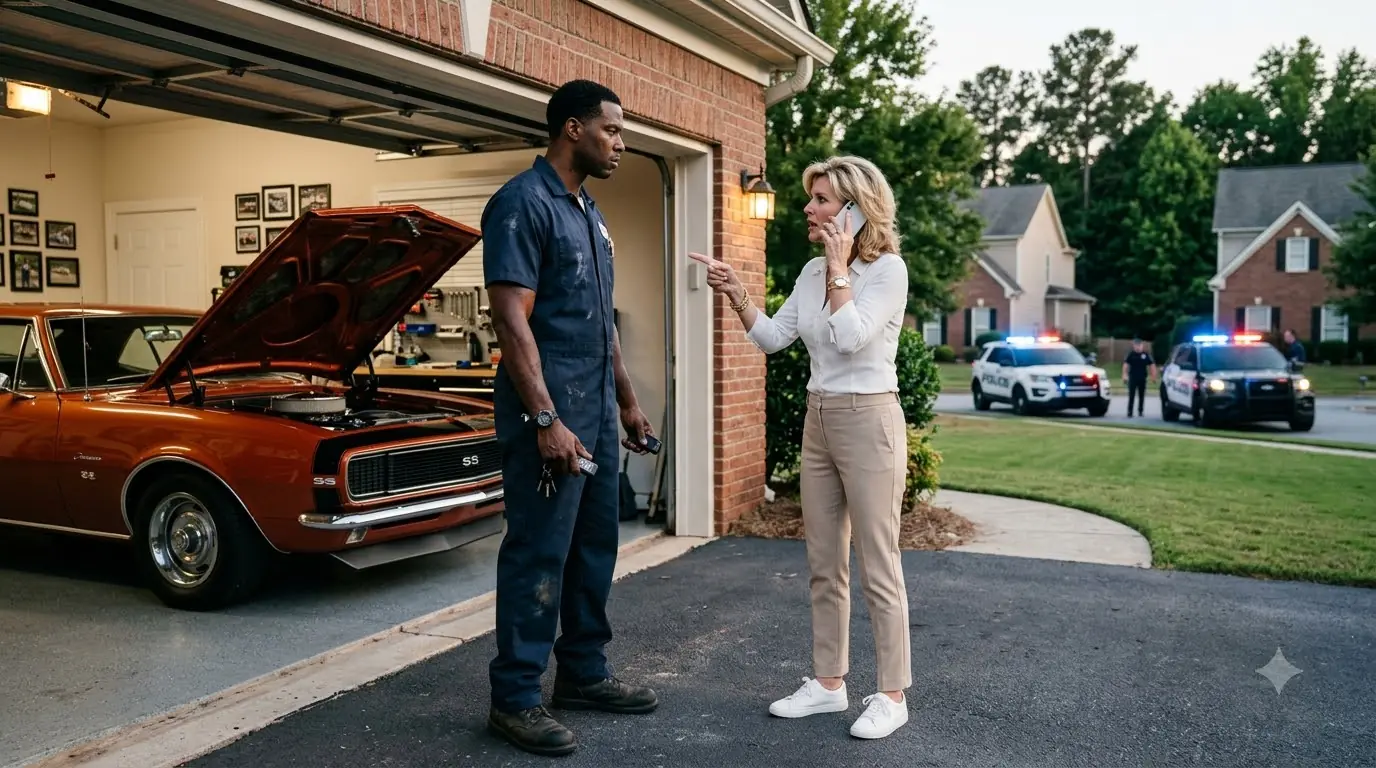
I pressed the garage remote. The door groaned open, revealing chrome bright enough to blind a person and orange paint so deep it looked almost liquid.
That was when my world exploded.
“Thief! Someone call 911! He stole my car!”
My neighbor and HOA president, Brenda Wilson, came charging across the lawn like an enraged guard dog. Her cell phone was already pressed to her ear.
“Yes, there is a Black man stealing my car right now,” she shouted. “Send everyone.”
Police sirens were already wailing in the distance.
She had called before confronting me or asking a single question.
I stood in my own driveway, holding my own keys, looking at my own car, and realizing I might be arrested for stealing property that had never belonged to anyone but me.
My name is Marcus Rodriguez, and I am a third-generation mechanic. My grandfather taught my father, my father taught me, and the Rodriguez family had been keeping cars running in that town for sixty years.
When my divorce became final the previous spring, after my former wife decided grease beneath a man’s fingernails was no longer attractive, I used what little I had left to purchase a modest house in Willowbrook Estates. It was a middle-class HOA community where the lawns were perfect, the mailboxes matched, and everyone supposedly minded their own business.
At least, that was what the real estate agent promised.
The Camaro was not some impulsive midlife-crisis purchase. I found it at an estate sale eighteen months earlier, a rusted-out shell most people would have hauled to a scrapyard for thirty dollars.
Beneath all that decay, I saw pure American muscle waiting to breathe again.
For $3,200, the car was mine.
Every weekend for a year and a half became part of my personal resurrection project. I installed a rebuilt 350 small-block engine, a Turbo 400 transmission, and an entirely new suspension system.
The paintwork alone required four months of sanding, priming, painting, and wet sanding until the Hugger Orange finish looked bright enough to distract low-flying aircraft.
I documented every bolt, gasket, part, and drop of sweat with photographs for insurance purposes. I kept every receipt inside a three-ring binder thicker than a telephone directory.
The smell of fresh primer and metal shavings became my Saturday-morning cologne. Coffee regularly went cold on my workbench while I lost myself in the calm concentration of mechanical precision.
Then there was Brenda Wilson, the human embodiment of an HOA fever dream.
Brenda had moved to Willowbrook five years earlier and immediately appointed herself queen of everything. She was a real estate agent who drove a white BMW that received professional detailing more often than most people cleaned their kitchens.
Her manicured nails had never touched actual work. Her highlighted hair seemed to defy gravity, and her smile could freeze antifreeze.
She had served as HOA president for three consecutive years, unopposed because nobody else wanted to volunteer for full-time neighborhood enforcement duty.
Her specialty was weaponizing paperwork.
Trash cans left outside twelve minutes after pickup.
Fence posts measuring two and one-eighth inches instead of the approved two inches.
Mailbox lettering that did not match the Willowbrook standard.
The woman once cited me because my grass supposedly exceeded the two-and-a-half-inch maximum. She arrived carrying an actual ruler.
“Just maintaining community standards,” she told me with that artificial smile.
Two weeks before the garage-door incident, she marched over while I was bleeding the Camaro’s brakes. The sound of my impact wrench apparently offended her delicate sensibilities.
“Excuse me, but there is a noise ordinance,” she announced. “No power tools after six in the evening.”
I wiped my hands on a shop rag and remained diplomatic.
“Actually, the city ordinance permits hobby work until nine. I would be happy to show you the documentation.”
Her smile turned cold.
“We will see about that. This kind of industrial activity affects property values.”
She said “industrial activity” as though I were operating an illegal laboratory instead of restoring a piece of American automotive history.
The day everything exploded began with Brenda’s monthly pool-party extravaganza. On Saturday morning, her backyard filled with neighborhood women sipping mimosas and pretending to care about one another’s vacation photographs.
I could hear the artificial laughter through my garage walls.
Then Brenda’s voice cut through the chatter like fingernails against glass.
“Oh, that is my new Camaro. I just purchased it from a classic-car dealer in Phoenix. Forty-five thousand dollars, but completely worth it. They are shipping it next week.”
My socket wrench fell from my hand and clattered onto the concrete floor.
She was showing people photographs on her telephone. From what I could see through the open side door of my garage, the car in those photographs looked nearly identical to mine.
Brenda stood there accepting their impressed reactions as though she had personally invented the internal-combustion engine.
That afternoon, I needed brake fluid, so I started the Camaro and backed out slowly. The 350 engine’s rumble echoed across the houses like mechanical thunder, deep, primal, and absolutely beautiful.
When I returned an hour later, Brenda stood in her driveway like a statue of suburban rage. Her arms were crossed, her face was flushed, and she stared at my car with the intensity of a hawk watching a field mouse.
I nodded politely.
She did not respond.
She continued staring holes through my Camaro with those predatory eyes.
That night, I imagined she spent hours online constructing her delusion one digital brick at a time. Somehow, she convinced herself that I had stolen the car she claimed to have purchased.
By morning, she had transformed from an annoying neighbor into something much more dangerous, a woman with authority, a grievance, and a willingness to involve armed police officers.
When two patrol cars screeched into my driveway with their lights flashing, I knew my peaceful Saturday evening was finished.
Four officers emerged as though they were responding to an armed robbery, which, according to Brenda’s dramatic emergency call, they probably believed they were.
Officer Daniel Rodriguez, a twenty-year veteran with kind eyes and the patient demeanor of a man who had witnessed every possible form of neighborhood insanity, approached with one hand resting casually near his belt.
His younger partner, Officer Morgan, looked as though he could bench-press a squad car for exercise. He moved beside Rodriguez with a notebook ready.
“Good evening, sir,” Officer Rodriguez said. “We received a report about a stolen vehicle at this address.”
The absurdity struck me like a brick against the forehead.
“A stolen vehicle? Officer, this is my car, inside my garage, at my house. That would be like accusing me of stealing my own refrigerator.”
Brenda appeared beside the officers like an angry suburban ghost, still gripping her phone with white knuckles.
“That is him. That is the car thief. I purchased that exact Camaro yesterday for forty-five thousand dollars.”
I took a deep breath, tasting the lingering exhaust fumes from my perfectly legal muscle car while trying not to laugh at the cosmic joke my life had become.
Stay calm, I reminded myself.
My father always said documentation defeated desperation every time.
“Officers, I can prove ownership immediately.”
I removed my phone and opened the photograph album I had obsessively maintained.
“This car has belonged to me for eighteen months. I rebuilt every part of it from the ground up.”
Officer Rodriguez studied the progression photographs with genuine interest. The images documented the rusted shell, the stripped chassis, the bodywork, the paint, the installation of the engine, and the finished interior.
His eyebrows rose while he moved through photographs of me lowering the engine block, priming body panels, and stitching parts of the upholstery.
“That is serious craftsmanship,” he said, enlarging a photograph of the engine bay. “Do you do this professionally?”
“Family business. My grandfather would have chased me around the shop with a wrench if I had produced careless work.”
Meanwhile, Brenda appeared to be experiencing a complete psychological collapse.
“He is lying. Look at these.”
She shoved several printed photographs toward the officers. They had clearly been downloaded from a dealership website only minutes before she called 911.
“I transferred the money yesterday. The dealer was supposed to ship the car this week.”
Officer Morgan examined her evidence with the enthusiasm of a man reviewing tax forms.
They were generic dealership photographs. There were no vehicle-identification numbers, no signed documents, and nothing proving that the car in those images was connected to the Camaro inside my garage.
“Ma’am, do you have purchase documentation?” Officer Morgan asked. “A bill of sale, wire-transfer receipt, dealer information, or a vehicle-identification number?”
Brenda’s face turned approximately the same color as a fire engine.
“It is all being processed. The dealer said paperwork takes time with classic cars.”
While she invented her explanation, I searched through my garage workbench like an automotive archaeologist.
I found the three-ring binder containing the complete genealogy of my mechanical baby.
“Here is my registration,” I said, handing Officer Rodriguez the most important piece of vehicle-ownership evidence.
The registration was eighteen months old. It showed my name, my address, and the same vehicle-identification number stamped into the Camaro.
His flashlight moved across the official state document.
Every number, date, and signature matched.
“I also have the insurance policy.”
I turned to the next plastic sleeve.
“My insurance company required restoration photographs for agreed-value coverage.”
Officer Morgan continued writing notes, occasionally glancing toward Brenda’s increasingly creative explanations.
She was unraveling faster than a cheaply made sweater. I began to feel almost sorry for her.
Almost.
“He obviously forged everything,” Brenda declared. “He is probably operating some sophisticated identity-theft scheme.”
That accusation told me it was time to use the strongest document in the binder.
From the final sleeve, I removed a piece of yellow legal paper. Its edges were soft from handling and memory, and the writing belonged to a ninety-three-year-old widow with a trembling hand.
“1967 Chevrolet Camaro. Condition as-is. Extensive rust damage throughout. $3,200 cash. Buyer accepts all responsibility.”
Beneath the description was a signature that looked as though it belonged inside a historical archive.
Eleanor Hutchinson Estate Sale.
The document included her telephone number and the date from eighteen months earlier.
Officer Rodriguez examined the handwritten bill of sale as though I had uncovered buried treasure.
“This is the original purchase document?”
“Yes. Eleanor was selling several of her late husband’s project cars. She was one of the kindest people I had ever met. She made me promise to bring the Camaro back after I completed the restoration.”
The silence that followed was so complete I could hear a sprinkler system operating three houses away.
Officer Morgan closed his notebook with the finality of a judge lowering a gavel.
“Ma’am, this gentleman has a clear chain of ownership extending more than a year. Your evidence consists of internet printouts.”
Officer Rodriguez’s tone changed to the special register officers reserve for people experiencing public meltdowns.
“Ma’am, I need to advise you that knowingly filing a false police report is a misdemeanor in this state. People have received serious penalties for deliberately providing false information to law enforcement.”
The color drained from Brenda’s face.
“There must have been a terrible misunderstanding. The stress of shopping for a classic car can be confusing.”
Her eyes told a different story.
As the officers prepared to leave, I saw Brenda watching me through her living-room window. Her expression carried the cold calculation of a chess player already planning the next move.
The conflict was not over.
That had only been the first round.
Monday morning struck with the subtlety of a diesel engine backfiring.
I was walking toward my mailbox in yesterday’s work clothes, carrying a mug of steaming coffee, when I saw an official HOA violation notice tucked inside like a venomous snake.
NOTICE OF COVENANT VIOLATION: UNAUTHORIZED COMMERCIAL VEHICLE STORAGE.
The citation claimed my work van, a perfectly ordinary Ford Transit with “Rodriguez Family Auto” painted on the side, violated community standards.
The fine was two hundred dollars, with a forty-eight-hour compliance deadline.
At the bottom, Brenda’s signature flourished as though she had just approved my execution.
Through my kitchen window, I watched her power-walk past my driveway while shooting suspicious glances at the van. Her usual morning route had somehow expanded to include repeated trips past my house.
I counted seventeen passes.
Most homeowners do not realize that HOA covenants are legal contracts, not suggestions written by overzealous neighborhood officials.
My divorce attorney had taught me that everything left a paper trail and that paper trails rarely lied.
I spent my lunch break at the county courthouse searching public records.
What I discovered was better than finding a winning lottery ticket in my back pocket.
I purchased my van in 2017, three years before Willowbrook adopted its commercial-vehicle restriction in 2020.
Vehicles owned before the rule changed were automatically protected under the grandfather clause. The HOA could not enforce the restriction retroactively.
Brenda could complain until she lost her voice, but she had no lawful authority to order the van removed.
I drafted a response that would have made my father proud, attached copies of the purchase records and applicable covenant language, and hand-delivered everything to the HOA management office.
The receptionist’s eyes widened as she read my rebuttal. She appeared to be calculating how much trouble her star board member had just created.
“Oh, dear,” she whispered, as though watching a collision unfold in slow motion. “Mrs. Wilson is not going to appreciate this development.”
She was correct.
By Wednesday, my mailbox had become Brenda’s personal complaint-distribution center.
Three additional violation notices appeared.
One alleged that there were oil stains on my driveway, despite the fact that I power-washed it every month with the dedication of a monk.
Another accused my garage of producing excessive automotive odors. Apparently, the honest smell of lubricant and determination offended Brenda’s delicate suburban sensibilities.
The third accused me of creating noise during hours when the city and HOA rules clearly permitted hobby work.
She was covering me with paperwork, hoping something would remain long enough to cause damage.
That was when I made the smartest investment of the entire conflict.
I installed four high-definition security cameras around my property. Every angle was recorded to protected cloud storage, and the night-vision system could have detected a mosquito landing on my mailbox.
The footage revealed Brenda’s new hobby.
Property-line surveillance.
Every morning, she walked the shared boundary with her phone, photographing my fence and measuring distances with a collapsible yardstick that probably cost more than my monthly grocery budget.
She had transformed watching her neighbors into a competitive sport.
Thursday evening brought her attempt at a stronger measure, an emergency HOA board meeting to address my “ongoing violations.”
The notice appeared in my mailbox at four in the afternoon for a meeting scheduled at seven that evening. It was barely sufficient notice and clearly intended to prevent me from preparing a defense.
I entered the community center expecting an unfair hearing and found something even more pathetic.
Three middle-aged women sat around a conference table as though organizing a church fundraiser.
Brenda occupied the central seat.
Beside her sat her nervous lieutenant, Clara, who looked as though she apologized whenever she breathed too loudly.
The third woman was Janet, whose primary qualification for board service appeared to be nodding enthusiastically whenever Brenda spoke.
“Where is the rest of the board?” I asked, taking a chair opposite the improvised tribunal.
Brenda smiled coldly.
“This group is sufficient for tonight’s business. We are implementing an emergency ban on all automotive-repair activity, effective immediately. Previous violations will carry a five-hundred-dollar fine.”
I opened the HOA bylaws on my phone. I had spent the afternoon reading and memorizing them.
Knowledge was power, but applied knowledge could become a tactical weapon.
“That is an interesting theory,” I said, “but Section 4.3 requires seven days’ advance notice for any meeting involving a vote.”
I continued scrolling.
“Section 4.7 requires five board members to establish a quorum for official action.”
I looked around the mostly empty room.
“I count three people, which gives this meeting approximately the same authority as an informal neighborhood book club.”
Clara’s face turned the color of overcooked shrimp.
“Well, this is only a preliminary discussion,” Brenda said.
“Section 2.9 states that board members who attempt to conduct official business during an invalid meeting may create personal liability for themselves.”
I had done my homework.
Three hours of legal research and a pot of strong coffee had prepared me.
Brenda’s composure shattered like safety glass.
“You think you are so intelligent, do you not? Coming into our neighborhood with your people and your activities.”
The prejudice in her voice could have stripped paint.
My father taught me something valuable about confronting bullies.
Remain calm.
Stay with the facts.
Allow unreasonable people to expose themselves through their own words.
“I believe I am a homeowner who reads contracts before signing them,” I replied. “A strange concept, perhaps.”
Later that evening, my neighbor Tom appeared in my driveway, looking apologetic and slightly embarrassed.
“Most of us believe she has completely lost control,” he confided. “Would you like to get coffee tomorrow? I think it is time we talked.”
Friday morning brought an unexpected doorbell at 7:15.
Dave Martinez from City Code Enforcement stood on my porch holding a clipboard. His eyes carried the exhausted stare of a person who had spent too many years mediating disputes between neighbors.
“Sorry to disturb you this early, Mr. Rodriguez. We received an anonymous complaint alleging unlicensed commercial automobile repair. Would you mind if I inspected the garage?”
I let him inside.
Morning light illuminated my weekend sanctuary.
The smell of metal polish and clean motor oil hung in the air like expensive aftershave. Every tool had a designated place on pegboard walls organized well enough to make a watchmaker jealous.
Dave’s tension disappeared the moment he stepped inside.
“This is cleaner than the shop that services my truck.”
He ran one finger along my workbench and found no dust or grease.
“What do you do for work?”
“My family owns a mechanic business. Everything here is personal hobby work, weekends only. No customers and no payments.”
He nodded and wrote notes while admiring my engine-hoist setup.
“The anonymous complainant claimed you were operating an illegal business from the property. I see no evidence of commercial activity, customer vehicles, or financial transactions.”
He closed his notebook.
“You are completely compliant.”
As Dave climbed into his city vehicle, he stopped with one foot on the running board.
“Off the record, I have visited this neighborhood four times this month. It is the same voice making different complaints every time. That woman needs an interest that does not involve my department.”
Brenda’s next move arrived through certified mail.
She had filed a formal complaint with my homeowner’s insurance company, claiming that my garage activities created an unacceptable fire hazard threatening nearby properties.
The notice demanded an immediate inspection and warned of possible policy cancellation.
When my insurance agent, Bill, arrived on Tuesday afternoon, I prepared for bureaucratic trouble.
Instead, I found a fellow car enthusiast who spent the first ten minutes studying the Camaro’s engine bay as though it were a famous work of art.
“Someone is clearly trying to create problems for you,” he said while signing his inspection report. “Your fire-safety system exceeds many commercial standards.”
He gestured toward the neighboring garages.
“Half the garages in communities like this are more dangerous because of improperly stored fuel, propane tanks, and overloaded extension cords.”
The insurance company responded by sending Brenda a formal cease-and-desist notice. The letter warned that continued fraudulent complaints could expose her to legal consequences.
Our neighborhood authority figure had also discovered the most powerful weapon of modern social conflict.
Social media.
The Willowbrook Neighborhood Watch Facebook group appeared overnight.
Brenda’s first post featured photographs of my work van and garage, accompanied by language filled with coded assumptions about who belonged in the community.
“Just concerned about maintaining our beautiful community standards,” she wrote with artificial sweetness. “Some recent activities may be more appropriate in an industrial zone. Do you agree?”
Tom showed me the screenshots over coffee. His face was red with anger.
“Twenty-three people joined during the first hour. It is like watching a garbage fire. You know it is unpleasant, but you cannot look away.”
The comment section became a public arena.
Several neighbors defended me and shared their own stories about Brenda’s conduct. Others remained silent, probably calculating the social cost of opposing the HOA president.
Brenda’s digital authority began collapsing when she deleted comments that disagreed with her.
Nothing ignites suburban anger faster than obvious censorship.
The group split into opposing sides, debating free expression, property rights, community standards, and Brenda’s leadership.
On Sunday morning, the conflict moved onto my property.
Two dozen roofing nails had been scattered across my driveway like metallic confetti, positioned to puncture unsuspecting tires.
My security cameras recorded a person entering at two in the morning. The individual wore a dark hooded jacket and moved with the nervous energy of someone attempting a serious offense for the first time.
The footage was not perfect, but the distinctive hurried walking style looked familiar.
Brenda always walked as though she were late for an argument.
Officer Morgan treated my police report seriously, especially after I described the escalating pattern of harassment.
“This is a classic intimidation progression,” he said while photographing the nails. “Document everything. Cases like this may continue quietly for months and then develop into criminal charges very quickly.”
While reviewing hours of camera footage, I noticed something that made my coffee go cold.
Brenda’s morning routine now included detailed reconnaissance. She walked the property line with her phone, measured distances, and photographed multiple angles.
This was no longer random harassment.
She appeared to be collecting information for a larger plan.
Wednesday’s mail brought an anonymous letter printed on ordinary white paper.
“People like you do not belong here. Leave voluntarily or face escalating consequences.”
There was no signature or return address.
However, the paper matched Brenda’s HOA notices. It carried the same watermark and appeared to have been produced by the same printer.
My divorce attorney had taught me enough about document comparison to recognize those details.
Detective Elena Martinez, who had been assigned to my growing case file, studied the letter with professional interest.
“Anonymous threats involving discriminatory targeting may qualify for enhanced prosecution under both state and federal law,” she explained. “We are building a substantial criminal case concerning your neighbor’s conduct.”
That evening, Tom’s coffee-shop coalition expanded to six households.
Each family arrived carrying its own collection of Brenda-related documents.
Mike, a lawyer, had been fined because the lettering on his mailbox was supposedly unauthorized.
Sarah, an accountant, had received a violation notice after planting flowers without approval from the architectural committee.
“It is time for coordinated resistance,” Tom declared while stirring sugar into his coffee with revolutionary intensity. “Individual complaints are ignored. Collective action produces results.”
As we shared stories and discussed legal strategies, I realized Brenda had accidentally created her worst possible opposition.
A united neighborhood coalition with legitimate grievances and professional expertise.
The person who believed she was hunting isolated homeowners had become the subject of organized scrutiny.
Friday afternoon found me in the county courthouse basement, a fluorescent-lit administrative maze that smelled like old coffee and paper dust.
The records clerk, a woman who appeared to have been filing documents since the Carter administration, directed me toward Research Room B with the enthusiasm of someone indicating the nearest public restroom.
“HOA financial records are stored with the corporate filings,” she said, sliding a dusty box toward me. “Good luck understanding that mess.”
Three hours later, surrounded by paper stacks that looked as though a storm had struck an accounting office, I discovered why Brenda protected those records so aggressively.
Willowbrook’s financial statements appeared to be a masterclass in creative fraud.
Fifteen thousand dollars had been paid to BNB Property Solutions for vaguely defined consulting services.
Another $8,500 went to Brenda’s Best Gardens for landscaping that residents had never seen.
Twelve thousand dollars had been paid to Wilson and Associates for legal services beginning at approximately the same time Brenda’s divorce proceedings started.
The most revealing detail was that all three businesses shared one address.
1247 Maple Lane.
Brenda’s house.
A search of the state business registry confirmed what I already suspected.
BNB Property Solutions listed Brenda Wilson as the sole proprietor and had been created six months after her divorce filing.
Brenda’s Best Gardens had been officially dissolved the previous year after completing no documented projects.
Wilson and Associates belonged to her former husband’s law firm, which explained her need to move money through complicated channels during their dispute.
Our elected HOA president appeared to have been systematically taking neighborhood funds and directing them toward her personal legal and financial problems.
The questionable payments totaled approximately seventy-eight thousand dollars across two years.
The discovery that made my hands shake was not only the theft.
It was the targeting pattern beneath it.
I cross-referenced complaint dates with recent real-estate sales and uncovered Brenda’s apparent business model.
She targeted selected homeowners with escalating violations until they became exhausted and sold below market value.
Then she used her real-estate license to arrange rapid sales to investor contacts.
She earned commissions on the transactions and appeared to receive additional benefits from buyers acquiring distressed properties.
Three families had left Willowbrook during the previous year after receiving Brenda’s special attention.
The Henderson family sold forty thousand dollars below appraisal after months of citations involving their son’s basketball hoop and claims of excessive noise.
The Patel family surrendered and moved after repeated complaints concerning cooking odors that Brenda described as inconsistent with community standards.
My situation fit the same pattern.
I was a single homeowner without a family network in the neighborhood, and my property was worth approximately $380,000.
I was an ideal target for a pressured sale.
The most astonishing revelation was buried inside a stack of foreclosure notices.
When I found it, I laughed aloud in the silent research room.
Brenda’s own house was in default.
She owed twenty-three thousand dollars in HOA dues to the association she controlled.
There were also unpaid taxes, attorney fees, and substantial credit-card debt.
Her foreclosure hearing was scheduled exactly four weeks later.
The irony was so perfect it belonged inside a country song.
The HOA president who terrorized neighbors over minor rule violations had failed to pay her own assessments for more than a year.
Everything became clear.
The increasing desperation.
The escalating harassment.
The willingness to file false reports.
Brenda was not only an authority-hungry neighborhood official.
She was facing financial collapse, and a commission from the forced sale of my property might have been her final opportunity to avoid losing everything.
The Camaro incident gave her the excuse to accelerate the pressure.
I copied every relevant page. My hands trembled slightly as the machine processed document after document.
The copies cost seventeen dollars.
It was some of the best money I had ever spent.
While walking toward my truck in the courthouse parking lot, I called Tom.
“Are you sitting down? What I found changes everything.”
The conflict was about to shift from survival to offense.
Brenda had no idea the walls were closing around her.
Saturday morning transformed Tom’s garage into the command center for our neighborhood investigation.
The air smelled of coffee, motor oil, and the pleasant promise of accountability.
Our mismatched group of suburban residents gathered around an old folding table.
Tom had assembled what I could only describe as the perfect team for neighborhood resistance.
Sarah Morgan was a forensic accountant who could identify irregular transactions the way a tracking dog followed a scent.
Mike Patterson was a semiretired corporate attorney whose idea of entertainment involved dismantling dishonest witnesses during depositions.
Linda Martinez was a high-school teacher with organizational skills that would have impressed a space agency.
Carlos Mendes was a contractor who understood nearly every building-code provision and technical loophole in the three-county area.
“Good grief,” Sarah said as she spread Brenda’s financial records across the table like an investigator reviewing evidence. “This embezzlement technique has all the subtlety of a brick through a window.”
Mike adjusted his reading glasses and studied the documents with the focused expression of a predator spotting weakness.
“Seventy-eight thousand dollars in questionable transactions. The paper trail is remarkably clear. We also have a documented harassment pattern.”
He looked around the table.
“Prosecutors appreciate cases with evidence this organized.”
Linda created one of her signature color-coded timelines on a large poster board. She mapped harassment campaigns against property sales with the precision of a teacher who had spent twenty years convincing teenagers to understand algebra.
“Look at the pattern,” she said. “She selects vulnerable families, escalates citations for months, and then mysteriously produces investor buyers when the owners finally break.”
Carlos leaned back and released a long whistle.
“She is using HOA money to pay personal legal expenses. That is not sophisticated wrongdoing. That is reckless wrongdoing.”
Our plan emerged during two hours of increasingly caffeinated discussion.
Carlos volunteered to strengthen security throughout the neighborhood with cameras, motion sensors, night vision, and protected cloud backups.
“If she so much as looks sideways at someone’s mailbox, we will have it documented in clear video.”
Linda moved into full teacher mode and designed standardized incident-report forms.
Each form included dates, times, witnesses, photographs, and related police-report numbers.
“We are creating a case file strong enough to survive any challenge.”
Sarah contacted professional colleagues who owed her favors.
“We will complete an independent audit that meets the standards used in federal litigation.”
Mike explained HOA corporate governance as though discussing his favorite hobby, which it apparently was.
“Board members have fiduciary responsibilities under state law. Each fraudulent transaction may create personal liability.”
He tapped the records.
“She is not only stealing. She is dismantling the legal protection normally provided by the corporation.”
The annual board election was approaching at the ideal moment.
Tom, Sarah, and Mike planned to run for the three available positions.
If successful, control would move from Brenda’s loyal committee to our reform coalition.
“We file the criminal complaint on Tuesday,” Mike said while arranging police reports with satisfaction. “The evidence supports embezzlement, harassment, false reporting, and potentially several additional offenses.”
Linda led the public-information effort.
She designed professional flyers explaining the missing money and coordinated a factual social-media campaign.
“We make the financial evidence part of every household’s dinner conversation.”
The impact was enormous.
Seventy-eight thousand dollars taken from forty households meant each family had effectively lost nearly two thousand dollars.
When ordinary parents discovered that their HOA president had been taking money from them, neighborhood revolutions became easy to organize.
Carlos suggested contacting the media.
“An HOA president accused of financial misconduct while selectively targeting a Black homeowner is exactly the kind of public-interest story local news stations investigate.”
Our psychological strategy was simple.
We would allow Brenda to believe she was winning while we continued constructing a legal case around her.
I would maintain my ordinary routines, appear unaware of her larger schemes, and allow her desperation to create additional evidence.
“It is the legal equivalent of allowing an opponent to exhaust herself,” Mike explained. “Let her continue making reckless moves while we document every one.”
The timing was almost poetic.
Brenda’s foreclosure hearing was three weeks away.
The independent audit would be complete in two weeks.
Board elections were four weeks away.
Several consequences were approaching at once.
Sarah had already contacted Janet Mills, an investigative reporter at Channel 7 known for exposing municipal and suburban corruption.
“HOA fraud stories attract significant public interest,” Sarah said. “She wants to examine everything.”
Mike also discovered another threat to Brenda’s professional future.
Her real-estate license renewal was due in six weeks and required disclosure of pending criminal matters.
A fraud conviction could result in permanent revocation.
“Financial collapse combined with professional consequences,” Mike said quietly. “She has placed herself in a terrible position.”
As the meeting ended, Tom placed one hand on my shoulder.
“Two months ago, you were the quiet mechanic who kept to himself. Now you are helping organize a neighborhood reform movement.”
I studied the evidence walls, schedules, and legal plans.
The transformation from isolated target to community organizer felt unreal, almost like discovering an ability I never knew I possessed.
“Sometimes bullies choose the wrong victim,” I said. “Brenda is about to learn that.”
The case was prepared.
Now we waited for Brenda to trigger her own destruction.
Monday morning brought the sound of panic in Brenda’s voice echoing across the neighborhood like an alarm.
At seven, she paced her driveway with her phone against her ear, gesturing wildly at anyone unfortunate enough to make eye contact.
“I need an emergency board meeting tonight. Something is happening, and I need legal protection.”
From my kitchen window, I watched her attempt to rally her shrinking base of support.
Clara walked over reluctantly, looking as though she would have preferred a dental procedure.
Janet followed several minutes later, but doubt was already visible in her posture.
By noon, an emergency assessment notice appeared in every mailbox.
The letter demanded five hundred dollars from each household for immediate legal defense against “outside agitators attempting to destabilize community governance.”
It also claimed I was preparing to sue the entire HOA and demanded immediate payment for attorneys.
Brenda did not know that Tom attended her improvised three-person meeting from the community-center parking lot with a digital recorder.
The device captured every desperate word.
“They are investigating our finances,” Brenda’s voice said when Tom played the recording later. “I do not know how much they understand, but we need to control the story before this gets out of hand.”
Clara’s response was barely audible.
“Brenda, perhaps we should simply cooperate.”
“No. I worked too hard building this community to let them destroy everything. If I must leave town, fine, but I am not going down alone.”
The recording was clear enough for court.
Mike’s smile when he heard it could have powered the neighborhood streetlights.
Wednesday night brought Brenda’s first act of obvious desperation.
My cameras recorded her entering my property at 2:47 in the morning while dressed in black yoga pants and a dark hooded jacket.
The disguise fooled no one.
She carried several items apparently intended for vandalism and staged evidence. Among them were containers of motor oil she placed behind my garage, presumably to create the appearance of an environmental violation.
Brenda had never been accused of criminal brilliance.
She spent approximately fifteen minutes arranging the material while standing beneath my motion-activated floodlight.
The camera captured a clear image of her face, her BMW’s license plate, and her attempt to manufacture evidence.
A code-enforcement inspector arrived Thursday morning.
He discovered the planted oil containers immediately.
They still carried price stickers from the hardware store.
When the inspector explained that unopened containers of new motor oil did not establish environmental contamination, Brenda’s account collapsed.
“Ma’am, knowingly filing fraudulent environmental complaints may result in serious legal consequences,” he said, barely concealing his irritation. “I am documenting this incident and forwarding it to our investigative unit.”
Brenda’s social-media breakdown began that afternoon and continued through the weekend.
The Willowbrook Neighborhood Watch group became her personal outlet for increasingly unrestrained claims about outsiders, property values, and the destruction of community character.
Her two-in-the-morning post on Friday became particularly useful evidence.
“Some people do not understand that communities have standards. When certain elements enter established neighborhoods and change their character, decent residents must take action to protect their investments.”
We saved the screenshot and forwarded it to the legal team.
Saturday brought the attempted bribe that further damaged her position.
Carlos was installing cameras at Linda’s house when Brenda approached with the subtlety of a desperate salesperson at the end of the month.
“I know Marcus is paying you people to lie about me,” she said, removing a thick envelope. “Two thousand dollars in cash if you forget about those security cameras and stop helping with this harassment campaign.”
Carlos continued installing the equipment while recording the conversation on his phone.
“Ma’am, I am helping residents protect their property. You should speak with an attorney.”
“I do not need attorneys. I need this neighborhood under control.”
Her voice climbed in pitch.
“That man has turned everyone against me with lies and manipulation.”
The desperation was impossible to miss.
Brenda was unraveling in real time, and each frantic decision created more evidence for the prosecution file.
Sunday evening brought another false police report.
She claimed I threatened her with a weapon during a driveway confrontation that never happened.
The responding officers found me inside my garage, covered in grease and repairing a neighbor’s transmission in the presence of three witnesses.
Officer Morgan’s patience had officially disappeared.
“Ma’am, this is your fourth false report in two weeks. You are exposing yourself to criminal charges.”
The preliminary audit arrived Monday through Sarah’s encrypted email.
The numbers were worse than our original estimate.
Brenda had not only redirected seventy-eight thousand dollars.
She had systematically overcharged households for services that did not exist and kept the excess.
The estimated theft had risen to approximately ninety-six thousand dollars over thirty months.
Our neighborhood authority figure was not merely broke and desperate.
She appeared to be a repeat offender who had run out of victims and time.
The endgame was accelerating beyond anything we had predicted.
Brenda was completing most of the work against herself.
Tuesday night’s break-in looked like a failed scene from a poorly written robbery film.
At 2:33 in the morning, while normal people were sleeping, Brenda entered the HOA management office using a master key she was not authorized to possess after hours.
The security footage showed her feeding documents into an industrial shredder with no attempt at subtlety.
A silent alarm activated before she finished.
Officer Rodriguez arrived and found her surrounded by shredded paper that had once been HOA financial records.
“Ma’am, step away from the computer and place your hands where I can see them,” he ordered.
Brenda responded with the dramatic intensity of daytime television.
“You do not understand. They are destroying everything I built. This community was perfect before people like them arrived.”
The smell of overheated electronics and panic filled the office while she was restrained and advised of her rights.
When I later watched the footage, I almost felt sorry for her.
Almost.
Then I remembered the false reports, the discriminatory threats, and the nails scattered across my driveway.
Her bail was set at twenty-five thousand dollars, an amount far beyond her available resources.
She spent three days inside the county jail, probably the first place she had ever stayed where there was no manager available to receive her complaints.
While Brenda remained in custody, Clara made the decision that permanently sealed her former friend’s fate.
She visited the jail carrying a digital recorder inside her purse.
What she captured sounded like evidence written specifically for a prosecutor.
“I need your help, Clara,” Brenda said through the jail telephone.
Her desperation was unmistakable.
“There is money inside my garage behind the water heater. Cash. We can disappear before this becomes worse.”
Clara’s nervous response was barely audible.
“Brenda, I cannot do that.”
“Fifty thousand dollars. Help me, and we start again somewhere nobody knows us.”
Mike released a low whistle after hearing the recording.
“She admitted the existence of hidden money, proposed conspiracy, demonstrated flight risk, and attempted obstruction while already in custody.”
He shook his head.
“She is confessing faster than investigators can organize the evidence.”
Thursday evening’s emergency neighborhood meeting filled the community center beyond capacity.
The air carried righteous anger and the distinctive aroma of community-center coffee strong enough to remove paint.
Forty-three households attended.
The combined frustration could have powered a city.
Tom presented Sarah’s completed audit with the satisfaction of a card player revealing an unbeatable hand.
The numbers were staggering.
Brenda had not taken only seventy-eight or ninety-six thousand dollars.
The final total involving false vendor payments, inflated service contracts, and kickback arrangements reached $112,000 across three years.
“Every family in this room was systematically robbed,” Tom announced.
The crowd responded with gasps and several creative expressions of outrage.
“The average loss per household was approximately $2,800.”
The vote of no confidence was nearly unanimous.
Janet abstained while looking as though she wanted to tunnel through the floor and emerge in another country.
Thirty-three households formally demanded Brenda’s immediate removal, criminal prosecution, and full restitution with interest.
Friday morning brought the media attention Brenda had always craved, although not in the role she imagined.
Channel 7 arrived at dawn, followed by crews from competing stations that had heard about the suburban scandal.
Investigative reporter Janet Mills interviewed residents with the enthusiasm of someone who had discovered award-worthy material.
The evening news opened with the story of an HOA president arrested during a major embezzlement investigation.
The report included Brenda’s booking photograph and security footage showing her destroying records.
My interview required every ounce of diplomacy I had learned during my divorce.
“This is not about revenge,” I told the camera, choosing each word carefully. “It is about accountability when people abuse positions of trust.”
The story spread across social media faster than gossip at a school reunion.
Discussions about HOA misconduct began trending nationally as thousands of people shared their own experiences and praised the neighborhood for organizing against abuse.
Brenda’s real-estate career collapsed.
Her brokerage suspended her license immediately.
Former clients filed complaints regarding suspicious transactions, and her professional reputation became impossible to repair.
The foreclosure auction proceeded without ceremony.
Brenda’s house sold for $280,000, approximately seventy thousand dollars below market value. Criminal investigations and television crews rarely encouraged enthusiastic bidding.
At three in the morning on Saturday, she posted a final confession-style video on Facebook.
Her makeup was smeared, and she blamed almost everyone except herself for the consequences of her decisions.
“I was only trying to protect our community,” she cried into the camera. “Sometimes good people must make difficult decisions.”
The comment section became a public accounting of years of accumulated grievances.
The video disappeared within hours.
The screenshots remained.
Her rule over Willowbrook had ended.
The sentencing hearing occurred on a crisp Thursday morning and felt like the final episode of an unusually satisfying reality series.
The courthouse parking lot resembled a neighborhood reunion.
More than forty residents arrived together, carpooling as though attending the most important sporting event of the year.
Judge Patricia Hernandez’s courtroom was filled beyond capacity.
Every bench held faces I had come to recognize as allies during the previous three months.
The smell of courthouse coffee mixed with nervous energy and the anticipation of people who had waited too long for accountability.
Brenda sat at the defense table wearing an orange jail uniform that clashed dramatically with her highlighted hair.
She looked exhausted beside her overworked public defender.
The woman who once terrorized a neighborhood with clipboard authority now appeared diminished and uncertain.
Channel 7’s cameras were positioned outside for maximum coverage. Janet Mills had secured a front-row seat for what she had already described as the most important HOA case she had covered.
When Judge Hernandez invited victim-impact statements, I stood first.
My heart struck my ribs as though attempting to escape.
Three months earlier, I had been a quiet mechanic who kept to himself.
Now I was speaking for an entire neighborhood.
“Your Honor, this case began when a woman called 911 because I opened my own garage door,” I said, surprised by the steadiness of my voice. “But it was never truly about a car.”
I looked toward the judge.
“It was about power, control, prejudice, and what happens when someone decides she can terrorize neighbors without consequences.”
I described the escalating harassment, the false police reports, and the systematic theft that took thousands of dollars from every family.
Most of all, I spoke about fear.
Brenda weaponized authority to make people afraid inside their own homes.
“She did not only take our money,” I continued, making eye contact with Brenda even though she refused to look back. “She took our peace of mind, our sense of community, and our belief that neighbors protect one another instead of preying upon one another.”
Tom spoke next.
His voice carried the authority of someone who had spent years observing human nature at both its worst and best.
Sarah presented the financial evidence with forensic precision.
Linda described what children learned by watching adults stand together against corruption.
When it was Brenda’s turn, her attorney presented every possible explanation.
Mental-health struggles.
Divorce-related trauma.
Financial pressure.
Every explanation except complete personal responsibility.
“My client deeply regrets her conduct,” the public defender said. “She is willing to make restitution and participate in counseling.”
Brenda finally stood to address the court.
What followed sounded like audacity wrapped in tears.
“I never intended to hurt anyone,” she said, pressing tissues against her eyes. “This community meant everything to me.”
She drew a shaky breath.
“I was trying to maintain standards and protect property values. Sometimes people do not understand that leadership requires difficult decisions.”
The courtroom’s collective disbelief was almost audible.
Even her attorney looked as though he wanted to hide beneath the defense table.
Judge Hernandez had heard enough.
“Ms. Wilson, in thirty years on this bench, I have rarely encountered such a systematic abuse of fiduciary responsibility combined with discriminatory harassment and criminal intimidation.”
She paused and studied Brenda.
“You occupied a position of trust and used it to steal from the residents who elected you.”
The judge’s voice remained calm but carried absolute authority.
“You targeted a minority homeowner through false police reports that could have produced a tragic outcome. You destroyed evidence, attempted to flee the jurisdiction, and even now resist full responsibility for your conduct.”
Brenda stood motionless.
“This court sentences you to four years in state prison, full restitution of $112,000 plus court costs, and five years of supervised probation following your release.”
The gavel struck.
The courtroom erupted in applause that Judge Hernandez did not immediately attempt to stop.
Forty households receiving justice produced a sound different from ordinary applause.
It was deeper and more satisfying, like the universe correcting something that had remained wrong for too long.
As Brenda was escorted away, she finally looked toward our section of the courtroom.
The expression on her face was not remorse.
It was concentrated anger toward the people who dared to hold her accountable.
Outside on the courthouse steps, cameras recorded while neighbors celebrated.
A reporter extended a microphone toward me.
“Mr. Rodriguez, what advice would you give homeowners facing HOA abuse?”
I thought about everything we had endured.
The fear.
The documentation.
The organizing.
The months of preparation that led to that moment.
“Document everything. Build community. Truth wins.”
The six words spread widely within hours and became a rallying phrase for people advocating HOA reform.
Standing in the sunlight, surrounded by neighbors who had become family through shared struggle, I understood something important.
We had not only defeated a bully.
We discovered what a real community could accomplish when good people chose to stand together.
The American dream was not solely about individual success.
It was about neighbors protecting neighbors, laws serving everyone equally, and ordinary people becoming extraordinary when circumstances demanded it.
Six months after Brenda’s sentencing, Willowbrook Estates had transformed from a place ruled by fear into something resembling an actual community.
The tension that once hung over the neighborhood had been replaced by the smell of Saturday barbecues and the sound of children playing freely in their yards.
Our new HOA board consisted of Tom as president, Sarah as treasurer, and Mike overseeing legal matters.
They introduced radical ideas such as transparency, advance notice, and common sense.
Monthly financial reports were published online.
Board meetings were announced properly.
Violation notices required photographic evidence and reasonable correction periods.
The community-garden project Brenda would once have cited into extinction now flourished in a formerly restricted area behind the clubhouse.
Linda coordinated planting schedules with the efficiency of a military planner.
Watching neighbors who had barely spoken before exchange tomato seedlings felt better than therapy.
Property values, ironically, increased fifteen percent after Brenda’s removal.
Apparently, buyers preferred neighborhoods known for defeating corruption rather than communities known for financial misconduct and discriminatory harassment.
Restitution payments arrived across twelve months.
Each household recovered stolen money plus interest.
Watching residents reduce credit-card debt, repair their homes, and plan family vacations with returned funds felt like economic justice in action.
Brenda’s prison life was significantly less comfortable than her former lifestyle.
According to Clara, who maintained limited contact through a mixture of guilt and curiosity, the former HOA president worked inside the prison laundry for sixty cents an hour and shared a cell with a woman convicted of armed robbery.
Film students from State University transformed our experience into a documentary titled Garage Door Justice: An American Story.
The film won a regional festival and was later selected for national distribution.
I donated my appearance fees to establish the Willowbrook Automotive Education Scholarship.
The program was partially supported by restitution money, which felt like justice with a mechanical twist.
Three teenagers had already received assistance to attend technical college and study automotive repair.
Watching Diego Martinez, Linda’s nephew, graduate from community college with an associate degree in automotive technology meant more to me than any car-show trophy.
My personal life also changed in ways I never expected.
Sarah and I had been dating slowly and carefully for four months.
We bonded over our shared experience confronting bullies and discovered that forensic accountants and mechanics had more in common than either profession might suggest.
The Camaro that began the entire story became famous in classic-car circles.
Magazines described it as the car that defeated an abusive HOA president.
I received multiple offers to sell it.
Some things were not for sale, especially vehicles that accidentally became symbols of standing against institutional prejudice and neighborhood tyranny.
I continued attending car shows every Sunday.
Now I often brought neighborhood children who wanted to learn about engines, restoration work, and the satisfaction of repairing something with their own hands.
Teaching Carlos Junior how to adjust valve clearances while his father watched proudly was worth more than any commission Brenda could have earned.
The legal precedent created by our case began appearing in HOA fraud prosecutions across three states.
Mike received invitations to speak at legal conferences about fiduciary-duty violations.
Our documentation methods became part of community-organizing workshops across the country.
The state legislature passed the Willowbrook Act, requiring annual financial audits for every HOA with a budget exceeding fifty thousand dollars.
The governor invited several of us to the bill-signing ceremony.
The photographs were enjoyable, but the true victory was knowing other communities might avoid what we endured.
Messages arrived from people in other states facing similar harassment.
One came from a military veteran in Phoenix whose HOA president had been targeting him.
I began advising other communities without charge, sharing the documentation and coalition-building methods that worked for Willowbrook.
Our neighborhood block parties became monthly traditions.
Everyone contributed food, stories, tools, and advice.
Watching children from different families play together while adults exchanged grilling tips and home-repair knowledge felt like discovering what suburban neighborhoods were always supposed to be.
As I sat inside my garage, I could hear Tom’s lawn mower and smell Linda’s weekend baking drifting through the open window.
They were the sounds and smells of a healthy community.
Productive activity.
Voluntary cooperation.
People choosing to help one another instead of tearing one another down.
The Camaro remained parked beneath the lights, its Hugger Orange paint reflecting every tool along the wall.
It was still my car.
It had always been my car.
But now it carried a history larger than metal, paint, or horsepower.
A woman tried to use fear, paperwork, prejudice, and authority to make me leave my own home.
Instead, she taught an entire neighborhood how powerful ordinary people could become when they documented the truth and refused to stand alone.