The first thing Margaret learned that morning was that a badge does not have to be loud to ruin your whole performance.
At 7:12 a.m., I was standing on the front steps of our old white house with a screwdriver in one hand and pine dust stuck to my knuckles when two police cruisers rolled up our gravel drive like they had been summoned to a bank robbery instead of a porch repair.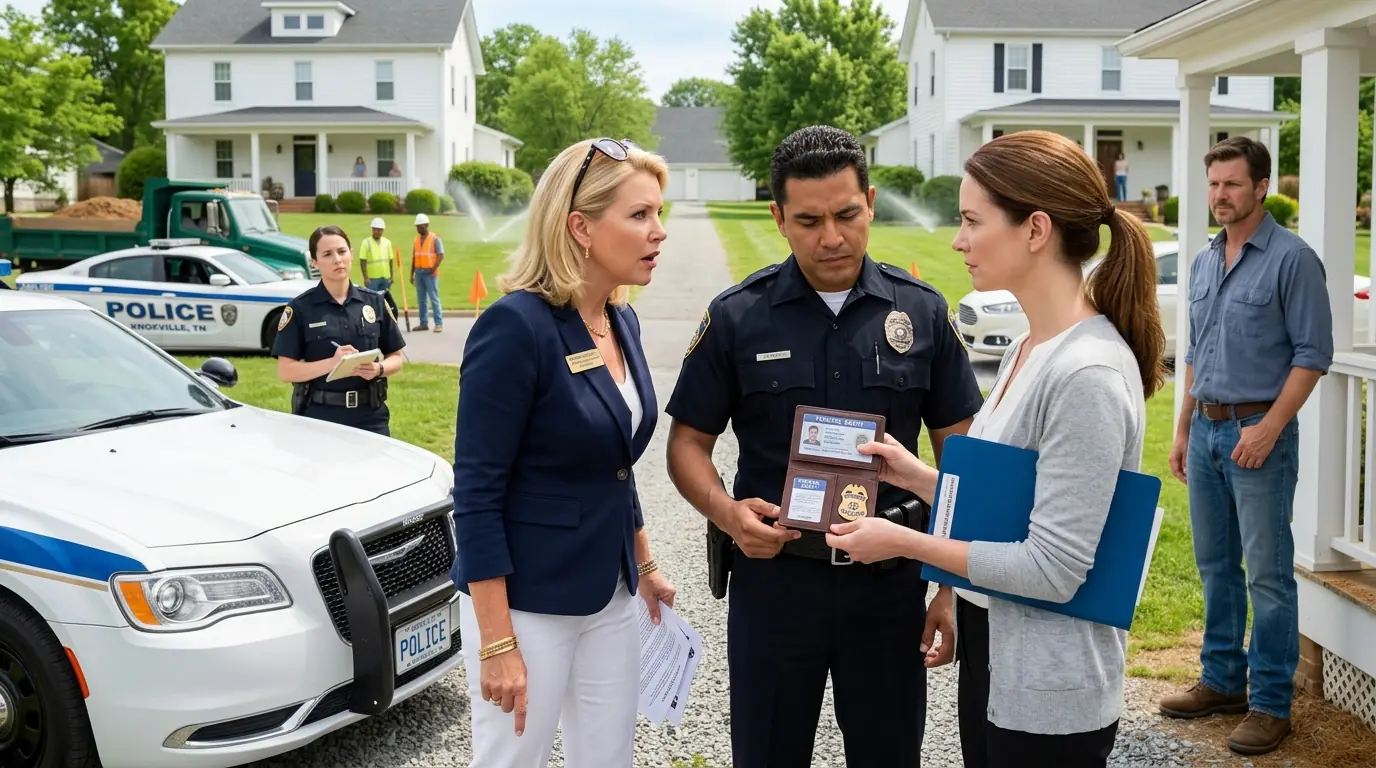
The red and blue lights washed over the garage door, over the half-painted railing, over my wife Claire’s bare feet as she stepped outside holding a mug of coffee that smelled like cinnamon and burnt sugar.
Across the driveway, Margaret Whitmore stood beside her pearl-white Lexus with one hand on her hip and the other pointing straight at me, her gold bracelets clicking like tiny warning bells. She had that smile again, the one she used when she wanted people to think cruelty was just community leadership with lipstick on.
“That’s him, officer,” she said loud enough for the whole cul-de-sac to hear. “He refuses to obey HOA authority, and his wife has been pretending to be federal to intimidate me.”
Claire went still.
Not scared.
Not confused.
Just still in that way a room gets still right before the truth walks in and shuts the door behind it.
Her coffee slipped a little in her hand, dark drops tapping the porch boards near her toes, and I remember the sound clearly because everything else seemed to go quiet around it.
The sprinklers hissed across the street. A morning dove called from the power line. Somewhere behind Maggie’s house, a leaf blower coughed to life and died again.
I looked at the officers, then at Maggie, then at the little plastic HOA sign she had planted in our yard the night before like a flag on conquered territory.
Cedar Ridge Estates Common Access Area.
Those words had been stuck in my head since sunrise.
Every letter smug and crooked under the morning light.
I had pulled the sign out carefully, set it against the fence, and taken a picture before touching anything else.
That was when Maggie came racing over in her Lexus, tires crunching gravel, perfume spilling out before she even opened the door.
Five minutes later, the cops were here.
My name is Daniel Mercer, and three weeks before that morning, my wife and I thought we had bought peace.
One acre at the edge of Cedar Ridge.
An old farmhouse with peeling trim, a detached workshop, and a line of maple trees that turned the driveway gold when the sun hit them right.
The realtor had said it was outside the HOA.
The county map said it, too.
Thirty-eight feet outside, measured clean in red ink across the survey Claire had folded into our closing folder.
I remember her tapping that line with her fingernail and saying, “Keep this copy close.”
Back then, I thought she meant for taxes, permits, maybe a property dispute someday.
I did not know she was planting the first nail in Maggie Whitmore’s coffin.
And I sure did not know that by the time those cruisers rolled up, Maggie had already handed us every document we needed.
Three weeks earlier, Cedar Ridge looked harmless enough to fool anyone with a tired heart and a moving truck full of second-hand furniture.
The neighborhood sat outside Knoxville, Tennessee, where the roads rolled soft between old oaks and split-rail fences, and every mailbox seemed polished for a magazine photo.
Claire and I had spent almost two years looking for a place that did not feel like it was trying to impress strangers.
I wanted a workshop where I could rebuild cabinets and fix small engines on weekends.
Claire wanted a kitchen window facing trees instead of another driveway.
After fifteen years in rentals, after too many neighbors who treated shared walls like suggestions, that little white farmhouse felt like a clean breath.
The porch sagged on the left side. The gutters needed replacing. The back steps creaked like an old ship when you put weight on them.
But the bones were good.
And the land was ours.
One full acre with a gravel drive, a detached two-car workshop, and maples tall enough to shade the whole front yard by noon.
At closing, the title officer slid the survey across a conference table that smelled like toner, stale coffee, and floor polish.
There it was, clean as daylight.
Parcel 17B.
Not included in the Cedar Ridge Estates Homeowners Association covenant.
Not subject to assessments.
Not bound by architectural control.
I had been a county building inspector years before, so I knew enough to ask twice.
The title officer smiled, tapped the red boundary line, and said, “You are outside their jurisdiction by thirty-eight feet at the narrowest point.”
Claire did not smile.
She just took a photo of the survey, folded the paper once, and slid it into a blue folder she carried everywhere.
That was Claire.
Calm hands.
Quiet eyes.
Most people in Cedar Ridge probably saw her as an ordinary white suburban wife with a laptop bag and plain black flats. They saw the low ponytail, the soft gray cardigan, and the travel mug in her hand every morning.
They did not see the federal training, the years of compliance work, or the way she could spot a forged form faster than I could spot a crooked door frame.
She never advertised her job.
She said real authority did not need porch lights and parade music.
Our first weekend there, I replaced rotted boards on the front steps while Claire unpacked dishes inside. The air smelled like sawdust, wet grass, and the lemon cleaner she liked to use on old cabinets.
Around 11:00, a pearl-white Lexus rolled to a stop at the edge of our driveway.
A woman stepped out wearing pressed cream slacks, oversized sunglasses, and a smile so polished it felt rented.
She looked at the peeling trim, then at my work boots, then at the old pickup back near the workshop.
“You must be the new owners,” she said.
Her voice was sweet enough to make my teeth ache.
“I am Margaret Whitmore, president of Cedar Ridge Estates. Around here, we care deeply about standards.”
Claire appeared in the doorway behind me, wiping her hands on a towel.
I nodded and said we were glad to be settling in.
Maggie lifted a glossy welcome packet from her purse and held it out like a court order.
“Wonderful. Then we will need your signatures for homeowners association enrollment before any exterior work continues.”
The porch board under my boot gave a dry little groan.
I remember that sound because it was the first warning.
I told her politely that our property was not part of the homeowners association.
Maggie tilted her head, still smiling, but something in her eyes cooled by ten degrees.
“Oh, honey,” she said, looking past me toward Claire. “Every home at this entrance benefits from our community. Some people just need help understanding their obligations.”
Claire did not answer.
She only looked at the packet, then at the Lexus, then at the tiny gold name badge pinned to Maggie’s blouse.
And without saying a word, she stepped back inside and opened the blue folder.
Maggie did not like being answered with paper.
I learned that about her in the first ten minutes.
Claire came back with the blue folder tucked against her ribs and placed the county survey on the temporary workbench I had made from two sawhorses and an old door.
The breeze lifted one corner of it, and I held it down with a paint can that still smelled sharp and fresh in the morning heat.
Claire pointed to the red boundary line, then to our parcel number, then to the printed note at the bottom stating the property was excluded from Cedar Ridge Estates covenants.
She did not raise her voice.
She did not even lean forward.
“Mrs. Whitmore, this home is not part of your association,” she said. “We checked it during closing.”
Maggie glanced at the paper the way a queen might glance at a parking ticket.
Just long enough to acknowledge it existed, not long enough to respect it.
“That is an old survey,” she said. “Our board has updated community standards since then.”
I wiped pine dust off my fingers with a rag and asked if she had a recorded amendment with the county.
Her smile tightened.
The cicadas buzzed in the maple trees, loud and electric, filling the silence she left behind.
“The county is not the only authority that matters in a planned community,” she said.
That was when I knew she was not confused.
Confused people ask questions.
Maggie issued conclusions.
She stepped closer to the porch and looked at the exposed boards, the primer cans, the stack of cedar railing pieces, and my pickup with ladders strapped to the rack. Every detail seemed to offend her personally.
“Exterior work requires architectural review,” she said. “Work vehicles cannot remain visible from the road. Unapproved porch colors must be corrected. And that workshop will need an inspection by our compliance committee.”
Claire folded the survey once, perfectly along the crease.
“Your compliance committee has no authority here.”
Maggie looked at her then, really looked at her, and her expression changed.
Not fear.
Not yet.
Something smaller and meaner.
Irritation at being corrected by someone she had already decided should be quiet.
“Sweetheart,” Maggie said, and the word landed cold on the porch boards, “I have managed this neighborhood for eleven years. I know what belongs to Cedar Ridge.”
Claire slid the survey back into the folder.
“Then you should know where it ends.”
For one second, Maggie stopped smiling.
Her fingers tightened around the welcome packet until the glossy paper bent.
Then the mask came right back.
“I can see this will require a formal process.”
She turned toward me as if Claire had vanished.
“Mr. Mercer, you have seven days to submit your enrollment form and exterior improvement application. Otherwise, we will begin enforcement.”
She placed the packet on the edge of my workbench, right on top of a board I had just sanded smooth, then walked back to her Lexus with that careful little stride people use when they think the ground is beneath them in more ways than one.
The engine purred to life.
Her tires cracked over the gravel.
The smell of her perfume hung in the driveway after she left, heavy and fake, fighting with the honest scent of cut wood.
I picked up the packet.
It was thick, maybe forty pages full of rules about mailbox fonts, approved mulch colors, holiday decorations, basketball hoops, trash bins, and paint palettes with names like Colonial Fog and Heritage Cream.
On the last page, there was a signature line already marked with a yellow tab.
Claire took one look at it and said, “Do not sign anything.”
I laughed once because back then, it still felt ridiculous.
“You think she will come back?”
Claire opened the folder again, pulled out her phone, and photographed every page of Maggie’s packet on the porch rail. The camera made soft clicking sounds in the warm air.
“People like that always come back,” she said. “The question is whether they come back with mistakes in writing.”
Three days later, the first envelope arrived.
Thick white paper.
Cedar Ridge logo.
My name spelled correctly, but the legal address wrong by one digit.
The violation was for unauthorized exterior construction visible from a community entrance.
The fine was two hundred fifty dollars, due immediately.
I remember the paper feeling too smooth between my fingers, like it had been chosen to make a lie feel official.
Claire read it at the kitchen table while the refrigerator hummed behind her. Then she circled the wrong address in blue ink, circled the missing covenant reference, and wrote the date in the corner.
She did not look angry.
That worried me more than anger would have.
She just slid it into the folder and said, “Good. She started a trail.”
The second envelope arrived the next morning before the dew had burned off the grass.
Then came the third one that afternoon, hand delivered by a thin man in a Cedar Ridge polo shirt who would not step past the driveway line once Claire lifted her phone and started recording.
The paper smelled like fresh ink and office toner.
That warm machine smell you get when someone has been printing lies in a hurry.
Violation for commercial vehicle storage because my pickup had a ladder rack.
Violation for unapproved exterior color because the porch primer was white instead of Heritage Cream.
Violation for visible refuse because I had stacked old railing boards beside the workshop for one afternoon.
Each notice had the same sentence printed near the bottom in bold black letters.
Failure to comply will result in enforcement.
That word kept showing up like a drumbeat.
Enforcement.
Enforcement.
Enforcement.
But the details were sloppy.
One notice used the wrong street number. Another listed our parcel as 17C, which belonged to a drainage strip on the Cedar Ridge side of the road.
The third claimed we had signed community covenants on April 14, except Claire and I had closed on the house in May.
Claire sat at our kitchen table that night with the blue folder open, a legal pad beside her, and a cheap blue pen clicking softly between her fingers.
The house still smelled like cardboard boxes, lemon cleaner, and the frozen lasagna I had burned around the edges because I was too distracted to set the oven timer right.
“She is moving fast,” I said.
Claire drew a neat line under the incorrect parcel number.
“No. She is moving careless.”
I wanted to drive to Maggie’s house, knock on that glossy black door, and make her look at every single mistake.
But Claire knew paperwork the way I knew load-bearing walls.
She told me to respond once, politely, in writing.
So I did.
I sent a certified letter with a copy of our deed, the county survey, and a simple statement that our property was not part of Cedar Ridge Estates, and that any further collection attempts would be disputed.
The post office clerk stamped the receipt with a heavy thud that sounded more satisfying than it should have.
For two days, nothing happened.
The neighborhood went quiet except for sprinklers ticking in perfect little arcs and golf carts whispering past our maple trees.
Then Maggie changed tactics.
She stopped sending paper to us and started performing for everyone else.
On Thursday evening, a post appeared on the Cedar Ridge community page, shared by three neighbors before dinner. It did not name me, not directly, but it described a non-compliant entrance property creating safety concerns, lowering neighborhood standards, and refusing to participate in shared maintenance responsibilities.
Someone commented that outsiders always wanted the benefits without paying dues.
Another said work trucks made neighborhoods look temporary.
Maggie replied with a little folded-hands symbol and wrote, “We are pursuing all lawful remedies.”
Claire read it once, took a screenshot, and slid her phone across the table to me.
“Notice the phrase shared maintenance,” she said. “She is building a story.”
The next morning, I found two orange survey flags stuck near our ditch, fluttering in the breeze like warning flames.
They were not from the county.
They were not from any surveyor I had hired.
One was planted three feet inside our property line, right where the maple roots lifted the soil.
I pulled up the security camera footage from the workshop.
At 6:18 a.m., Maggie’s Lexus rolled into view.
A landscaping truck followed, green with gold letters on the side.
Whitmore Outdoor Design, her brother’s company, though I did not know that yet.
The camera caught a man stepping out and pushing flags into our yard while Maggie stood by the road holding a travel mug, nodding like she was supervising a public works project.
I felt my pulse in my jaw.
Claire watched the footage without blinking.
“Save the original file,” she said.
By noon, a temporary plastic sign had appeared at the end of our gravel drive.
Cedar Ridge Estates Future Common Access Improvement.
The letters were crooked, but the message was clear.
Maggie was not trying to enforce rules anymore.
She was trying to make our land look like it had already become hers.
That plastic sign stayed there for exactly nine minutes.
Long enough for me to photograph it from six angles.
Long enough for the workshop camera to capture where it stood.
And long enough for Claire to walk the property line with the county survey folded in one hand like a quiet weapon.
The morning air had that damp Tennessee heaviness that makes fresh soil smell darker, almost metallic. Every step I took through the grass left my boots wet at the edges.
The signpost had been shoved deep into our yard, past the ditch, past the old split rail, past the red line marked on the survey.
It was not a mistake.
Mistakes happen at edges.
This was three full feet inside our land.
I knelt beside it and took a close-up of the hole, the tire tracks, the orange flags, and the muddy print left by some expensive landscaping boot.
Claire stood behind me, her phone recording, her face calm in a way that made the back of my neck tighten.
“Say the date and time,” she said.
So I did.
My voice sounded strange on the recording, flatter than I felt.
Then I pulled the sign out with both hands, slow and careful, and laid it against the fence where it could not fall, bend, or disappear.
I did not break it.
I did not throw it.
I treated Maggie’s little fake monument better than she had treated our deed.
By lunchtime, she had turned it into a neighborhood emergency.
Her post hit the community page with the kind of polished outrage that sounded rehearsed in a bathroom mirror.
She claimed I had removed official Cedar Ridge access signage, interfered with a safety improvement project, and created a hostile environment for volunteers.
Volunteers.
That word almost made me laugh.
The video on my camera showed her brother’s landscaping crew stepping out of a paid company truck, but Maggie called them volunteers because fraud always sounds nicer when you dress it up for a homeowners association newsletter.
Comments stacked up fast.
Some neighbors asked why a non-association property had association signage on it.
Those comments vanished within minutes.
Others piled on because that was easier than thinking.
One woman wrote that people who refuse standards should not live near nice communities.
Another said our old pickup made the entrance look like a contractor lot.
Claire screenshotted every post before it could be edited.
Click.
Click.
Click.
The sound of her phone camera became the soundtrack of that week.
Then the certified letter came.
It was thicker than the others, with a return address from a law office I later learned had not reviewed the contents before Maggie mailed it under their letterhead.
Inside was a notice of forced compliance and intent to assess shared access fees.
It claimed Cedar Ridge had maintained our roadside frontage for years, that our driveway served as a visual entry corridor, and that continued refusal to participate could result in liens, access restrictions, and referral to local law enforcement.
The paragraph about law enforcement was underlined in blue ink, probably by Maggie herself.
Claire read that part twice.
The kitchen was quiet except for the hum of the refrigerator and the soft tick of the ceiling fan chain tapping the glass light cover.
She placed the letter beside the earlier notices, lining up the dates with surgical care.
“She just put the threat in writing,” she said. “That matters.”
I asked her why she sounded like she had been waiting for that.
Claire looked at the stack of papers, then at the security monitor showing our empty driveway, then at me.
“Because people who misuse authority usually escalate when paperwork stops working.”
That evening, Maggie came back with two board members and a man carrying a clipboard.
They stood at the end of the drive, not quite crossing the line this time, while Maggie spoke as if she were addressing a courtroom.
“This entrance affects all of us,” she said. “You cannot benefit from Cedar Ridge and reject responsibility.”
I told her again that we were not members.
Her smile thinned.
“Then maybe we need an officer to explain community obligations in terms you understand.”
Claire stepped onto the porch behind me, the blue folder tucked under her arm.
Maggie looked at her and said, “And you should stop pretending your little government job changes anything here.”
The porch went so quiet I could hear a maple leaf scrape across the boards.
Claire did not answer.
She only watched Maggie walk back to her Lexus.
And for the first time, I saw something colder than patience in my wife’s eyes.
By Saturday morning, the air around our house felt charged, like a storm had rolled in without clouds.
I was on the porch before 7:00, replacing the last warped railing board. The drill hummed against my palm, and the smell of cut cedar rose warm from the steps.
Claire was inside making coffee, and through the open kitchen window, I could hear the quiet clink of her mug against the counter.
For a few minutes, it almost felt normal.
Then I heard tires on gravel.
Not the slow roll of a neighbor passing by.
Fast.
Angry.
Maggie’s pearl-white Lexus swung into the driveway entrance and stopped crooked near the ditch, half on asphalt, half on our grass.
She stepped out wearing a navy blazer, white pants, and that gold name badge like it had been issued by the Supreme Court.
Behind her, the same green landscaping truck idled at the curb. Its engine rattled low, diesel mixing with the smell of wet leaves and sawdust.
Maggie did not say good morning.
She pointed at the fence where I had leaned her plastic sign two days earlier.
“You have Cedar Ridge property,” she said.
I set the drill down on the porch rail.
The bit ticked once against the wood.
“Your sign was on my land. I removed it carefully. It is right there.”
She looked at it like evidence had personally offended her.
“That sign marks a community access improvement approved by the board.”
I wiped my hands on my jeans and walked down the steps, stopping several feet from her.
“Your board cannot approve work on property it does not own.”
Her face tightened, but her voice got sweeter.
That was how Maggie worked.
The worse the lie, the softer the wrapper.
“Daniel, I tried to be neighborly. I tried to educate you, but your refusal to cooperate is becoming a safety concern.”
I saw her phone already open in her hand.
Not dialing yet.
Waiting for the right audience.
Claire stepped onto the porch with her coffee, wearing a gray cardigan over a plain white shirt, her hair still damp from the shower.
She looked at Maggie, then at the truck, then at the security camera over the workshop door.
“Mrs. Whitmore, are your contractors here to place another sign?”
Maggie laughed once, sharp and dry.
“They are volunteers assisting with community maintenance.”
Claire took one slow sip of coffee.
“They arrived in a commercial vehicle with your brother’s company name on it.”
That did it.
Maggie’s smile disappeared so fast it felt like someone had cut the string holding it up.
She lifted her phone and pressed three numbers.
I remember the sound of her acrylic nail tapping the screen.
Tiny.
Hard.
Final.
“Yes, I need officers at Cedar Ridge Estates,” she said, turning her body so her voice carried toward the road. “A non-compliant property owner is interfering with homeowners association enforcement and removing community signage.”
She paused, looked directly at Claire, and added, “His wife is claiming federal authority to intimidate residents.”
Claire lowered her mug.
A drop of coffee slid over the rim and darkened the porch board near her bare foot.
She did not look angry.
She looked disappointed.
And somehow, that was worse.
Fifteen minutes later, two police cruisers came up the gravel drive, lights flashing against the maple trunks.
Maggie walked toward them before the doors even opened, talking fast, hands moving, painting herself as the guardian of order.
I stayed where I was.
Claire came down the steps beside me, the blue folder under one arm.
The older officer, a broad-shouldered man named Officer Ramirez, asked everyone to slow down and explain.
Maggie jumped in first, waving the forced compliance notice like it was a warrant.
She said I had refused lawful community authority, disturbed a shared access project, and taken property that belonged to Cedar Ridge.
Then she pointed at Claire.
“And she keeps implying she works for the federal government, which I consider a threat.”
Officer Ramirez turned to Claire with professional caution.
“Ma’am, can you clarify that?”
Claire set her coffee on the porch rail, opened her wallet, and held out her federal identification.
The morning changed shape.
Even the landscaping truck seemed quieter.
Ramirez studied the identification, then straightened slightly.
His partner stopped writing.
Maggie’s mouth opened, but no sound came out.
Claire’s voice stayed low and even.
“Officer, my name is Claire Mercer. I am a special agent with the United States Department of Housing and Urban Development, Office of Inspector General. I am not here in an official capacity regarding my own property, but this woman has now made a police report involving a federal employee, a disputed property claim, and documented attempts to enforce homeowners association authority outside recorded jurisdiction. You should know that before anyone writes this up as a neighbor disagreement.”
Maggie blinked behind her sunglasses.
For the first time since I met her, she looked smaller than her clipboard.
Officer Ramirez handed Claire’s identification back with both hands, the way people handle something once they understand it can become part of a report.
The red and blue lights kept spinning across our garage door, but the whole scene had lost its cheap neighborhood drama feeling.
It felt procedural now.
Clean.
Documented.
Maggie must have sensed it, too, because she started talking faster, her voice climbing in that polished panic of someone trying to outrun the facts.
“This is exactly what I mean,” she said. “She flashes that thing around to frighten people. We have a community to protect.”
Claire slid the identification back into her wallet and looked at Officer Ramirez, not Maggie.
“For the record, I have not threatened Mrs. Whitmore. I have repeatedly asked her to stop asserting authority over property not recorded within her association.”
Ramirez nodded once and turned to me.
“Mr. Mercer, do you have documentation showing the property status?”
I almost laughed because our entire dining room had become documentation.
Claire handed me the blue folder, and I opened it on the hood of the nearest cruiser.
The metal was warm from the engine.
Page by page, I laid out the deed, the survey, the title exception, the certified letter receipt, the violation notices with wrong parcel numbers, the screenshots from the community page, and still images from the workshop camera showing Maggie’s brother’s landscaping truck at our property line before sunrise.
The papers clicked softly in the breeze.
Maggie’s bracelets stopped making noise.
Ramirez studied the survey first.
His partner, Officer Levitt, leaned closer and traced the red boundary line with the tip of his pen.
“This says they are outside the association,” Levitt said.
Maggie snapped, “That is an outdated interpretation.”
Claire turned her head slightly.
“Recorded boundaries are not interpretations.”
The words landed flat and heavy.
No drama.
No raised voice.
Just a door closing.
Ramirez asked Maggie for her authority to enforce on our parcel.
She produced the forced compliance notice, the glossy welcome packet, and a printed map with our driveway highlighted yellow.
I recognized it immediately.
The map had no county stamp, no surveyor seal, no recording number.
It looked like someone had printed it from a real estate website and dressed it up with a highlighter.
Ramirez looked at it, then at Maggie.
“Who prepared this?”
Maggie lifted her chin.
“Our board reviewed access needs for the entrance corridor.”
“That was not my question,” he said.
That was the first crack I heard.
Not in his voice.
In her confidence.
Claire opened her phone and played the workshop camera clip.
The tiny speaker made everything sound thin, but the picture was clear.
Maggie’s Lexus.
The green truck.
The orange flags.
The sign going into our grass.
On the video, Maggie pointed twice toward our yard like she owned the morning.
I watched her real face as she watched her recorded face.
The color drained slowly from her cheeks, starting at her jaw and moving up under the sunglasses.
Then Claire did something I did not expect.
She stepped back from the cruiser and said, “Officer, I need to be very clear. Because this involves my personal residence, I will not investigate it myself. But my office has already received prior complaints about Cedar Ridge Estates involving improper assessment pressure against non-member properties and possible misuse of housing-related fees. This incident needs to be documented accurately and referred through the appropriate channels.”
Maggie froze so completely that even her sunglasses seemed too loud.
That was the part she had not known.
Claire had not brought the federal government into our driveway.
Maggie had dragged her own history there and parked it behind a police cruiser.
Ramirez asked Claire if she wanted to make a statement.
She said yes, but only as a property owner and witness.
Then she gave him the cleanest statement I had ever heard.
Dates.
Times.
Exact language.
No insults.
No guesses.
Just facts stacked like bricks.
When Maggie tried to interrupt, Ramirez held up one hand and said, “Ma’am, you will have your turn.”
A simple sentence, but it changed the temperature of the driveway.
For three weeks, Maggie had been speaking over everyone.
Now she had to wait.
Officer Levitt photographed the fake sign leaning against our fence.
Ramirez took copies of the notices.
The landscaping truck driver suddenly remembered he had another job and asked if he was free to leave.
Ramirez told him to provide his name first.
The man looked at Maggie.
Maggie looked at the ground.
And I finally understood what Claire had meant about letting people keep walking.
Maggie had not stepped into a trap we built.
She had built it herself, one official-looking lie at a time.
The police report did not explode Cedar Ridge overnight.
That is not how real trouble works.
Real trouble moves through offices, inboxes, county counters, and stamped envelopes.
It smells like printer toner and old carpet.
It sounds like a clerk saying, “We will need copies of everything,” while a scanner drags your life across a glass bed one page at a time.
By Monday morning, Claire and I were standing at the Knox County Register of Deeds with the blue folder open between us and a stack of copies thick enough to make my wrist ache.
The clerk, a woman named Mrs. Harlan with silver hair and no patience for nonsense, pulled up our parcel on her monitor.
Her eyebrows rose once.
“You are not in Cedar Ridge,” she said. “Not even close enough for an honest mistake.”
She printed a certified boundary confirmation, stamped it so hard the counter jumped, and handed it to me still warm from the machine.
That sound, the stamp hitting paper, felt like a hammer driving the first nail into Maggie’s perfect little kingdom.
By Wednesday, the county planning office had opened a complaint.
By Friday, the state homeowners association oversight division had requested Cedar Ridge’s assessment records, board minutes, boundary maps, and communications about our property.
Claire stayed careful.
She did not make calls from our kitchen pretending to be on duty.
She did not use her badge like a club.
She filled out witness statements, disclosed the personal conflict, and stepped aside so another office could handle the pattern.
That made it worse for Maggie, not better, because now there were strangers reading her paperwork with clean eyes.
The first crack inside Cedar Ridge came from a retired school teacher named Helen Porter, who lived two streets over.
She knocked on our door holding a folder of her own, her hands trembling around the edges.
The air smelled like rain and the coffee Claire had just poured.
Helen said Maggie had forced her late husband to pay three years of shared access fees, even though their lot had never joined the association, either.
Then came a widower named Paul Renner.
Then a young couple with a baby stroller.
Then an older man who whispered that he had paid fines because Maggie said liens could ruin his credit.
One by one, they brought letters, invoices, screenshots, and receipts.
Same language.
Same threats.
Same yellow-highlighted maps with no county seal.
Maggie had not been protecting standards.
She had been manufacturing authority and selling fear by the envelope.
The special board meeting happened ten days after the police came to our driveway.
Claire and I sat in the back of the Cedar Ridge clubhouse under fluorescent lights that buzzed like trapped insects.
The room smelled like carpet cleaner, perfume, and nervous sweat.
Maggie sat at the front table in a cream blazer, chin high, smile sharp, surrounded by board members who suddenly looked very interested in their own hands.
She opened with her usual voice, soft and polished, talking about community integrity and difficult homeowners.
Then the county representative stood up.
He was a plain man in a brown jacket with a folder thinner than mine, but heavier in every way that mattered.
He read the certified boundary confirmation aloud.
He read the rule about recorded covenants.
He read the list of parcels Cedar Ridge had attempted to assess without recorded membership.
Maggie interrupted three times before Officer Ramirez, standing quietly near the door, said, “Ma’am, let him finish.”
The room went silent.
The county representative placed one document on the table.
“Cedar Ridge Estates has no authority over the Mercer property,” he said. “Nor can this association expand its jurisdiction by vote, notice, signage, or informal map revision.”
Maggie’s face flushed pink under the fluorescent lights.
Then she made the mistake Claire had predicted.
She stood up, pointed at me, and said, “That entrance belongs to the community because we have treated it that way for years.”
Claire leaned close to me and whispered, “There it is.”
Because in one sentence, Maggie admitted the whole scheme.
Not ownership.
Not recorded authority.
Just treatment.
Just pretending long enough to make people tired.
The board secretary stopped typing.
The county man looked up slowly.
Officer Ramirez wrote something down.
And Maggie, still standing in front of everyone, finally realized the room was not following her anymore.
The room stayed quiet long enough for the fluorescent buzz to feel loud.
Maggie stood at the front table with one hand pressed against her folder, the other still pointing in my direction, but the power had drained out of the gesture.
It looked less like an accusation now and more like a person trying to hold up a wall that had already cracked behind her.
The county representative asked for the board’s financial records related to shared access fees.
The board treasurer, a nervous man named Alan Reeves, opened a laptop with shaking fingers.
The keys clicked softly.
Maggie told him to stop.
Alan did not.
That was the second sound of her kingdom coming apart.
Not sirens.
Not shouting.
Just a tired treasurer deciding he did not want to go down with a woman who had confused a neighborhood with a throne.
The records showed payments from seven properties that were not legally part of Cedar Ridge. They showed landscaping invoices from Whitmore Outdoor Design for entrance corridor maintenance that had never been approved by the county and, in our case, had happened on land Cedar Ridge did not own.
The numbers were not dramatic at first glance.
Two hundred dollars here.
Four hundred there.
Monthly fees dressed up as shared improvements.
But fraud does not need fireworks.
Sometimes it wears a cream blazer and files the same false charge until honest people get too exhausted to fight.
Maggie tried one last time.
She said it was all a misunderstanding.
She said the maps had been informal.
She said the board had relied on historical community practice.
Claire sat beside me, hands folded, federal identification hidden back in her purse where it belonged.
She did not need to show it again.
The papers were doing the talking now.
Three weeks later, the plastic sign was gone from our fence.
The orange flags were gone from our ditch.
And a certified letter arrived stating every violation against us had been withdrawn with prejudice.
I liked that phrase more than I expected.
With prejudice.
It meant they could not clean up the lie, put on fresh perfume, and bring it back later.
Cedar Ridge was ordered to refund improper fees to the non-member properties.
The state opened a formal review of the association’s collection practices.
Maggie resigned before the next monthly meeting, though everyone knew resign was just the polite word they used when the chair had already been pulled out from under her.
Her brother’s landscaping company lost its Cedar Ridge contract.
Alan Reeves turned over the financial files.
Helen Porter got a check in the mail and cried on our porch while Claire held her hand and I pretended not to notice, because some people deserve privacy when relief finally reaches them.
As for us, we finished the porch.
I painted the railings plain white.
Not Heritage Cream.
Not Colonial Fog.
Just white, because the house looked honest that way.
I replaced the crooked address sign at the end of the drive with cedar I sanded myself in the workshop, the same workshop Maggie had called an eyesore.
Claire stood beside me that evening with a new mug of coffee, steam lifting into the cool Tennessee air while the maple leaves scratched softly across the gravel.
No badge.
No courtroom speech.
No victory parade.
Just my wife, our house, and a county boundary line that had been there the whole time.
A neighbor’s golf cart slowed near the entrance, then kept going.
Nobody waved a rule book.
Nobody planted a sign.
The quiet felt earned.
I looked at the porch, at the sealed folder on the kitchen table through the window, and at the place where Maggie’s fake marker had once stood.
And I finally understood what Claire had known from the beginning.
Justice does not always arrive with thunder.
Sometimes it comes in a blue folder carried by a calm woman in black flats, waiting patiently for the right stamp to hit the right piece of paper.