At 4:18 on a Thursday afternoon, Malik Carter was pushing two bicycles down Hawthorne Lane and thinking about whether his mother would believe him.
One bike was blue.
That one belonged to him.
The other was red.
That one had disappeared three days earlier from the front porch of his aunt’s house.
Malik had spent those three days hearing his seven-year-old cousin Jayden ask the same question.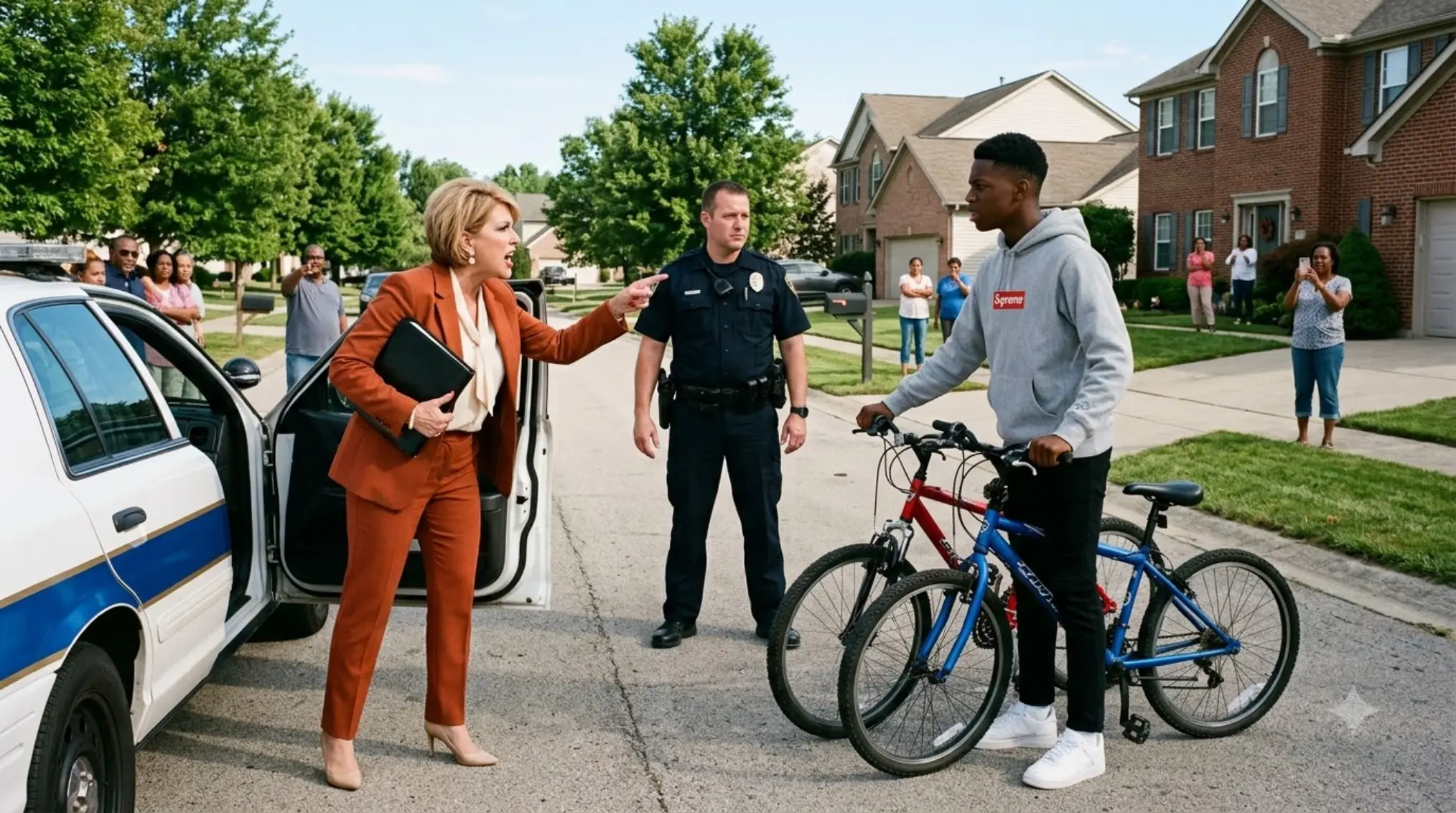
“Think somebody’s gonna bring it back?”
Malik had never lied well to children.
“I don’t know.”
Jayden would stare at the empty place beside the porch steps.
Then nod as if he understood.
The bicycle was not expensive.
A department-store mountain bike.
Red frame.
Black handlebars.
A silver bell Jayden rang constantly until everyone in the family threatened to remove it.
To Jayden, none of that mattered.
It was the first bicycle he had learned to ride without training wheels.
That made it irreplaceable in the way children understood value better than adults sometimes did.
Malik had been angry about the theft from the beginning.
Not dramatic anger.
Focused anger.
He had ridden around after school each day checking alleys, playgrounds, drainage areas, and the wooded path behind Bridgestone Estates.
His mother told him not to chase anybody if he found it.
His father told him the same thing.
“Call us.”
“I know.”
“Call the police.”
“I know.”
“Malik.”
“I said I know.”
His father narrowed his eyes.
“Knowing and doing are different.”
Malik hated when adults said things that were annoyingly correct.
Thursday afternoon, his persistence paid off.
He was riding the blue bike beside the stormwater channel near the eastern edge of the subdivision when he saw something red between tall weeds.
Malik stopped.
At first he thought it was trash.
Then sunlight caught chrome.
He jumped off the bike.
Pushed through the grass.
There it was.
Red frame.
Black handlebars.
Silver bell.
Jayden’s bike.
Malik stared.
Then laughed.
“Man.”
The front tire was partly flat.
The chain had come loose.
Mud covered the rear frame.
But the bicycle was there.
Malik immediately took out his phone.
He photographed it exactly where he found it.
His father had taught him that after the police report was filed.
“If you ever find stolen property, don’t start moving everything first.”
“Why?”
“Because where you find something can matter.”
Malik took four pictures.
Then called his aunt.
No answer.
He called his mother.
Voicemail.
He sent both of them the photos.
FOUND IT.
Then another thought occurred to him.
The police report.
He opened the screenshot his aunt had sent the family.
The red bike’s serial number ended in 9147.
Malik crouched.
Mud covered the stamped number underneath the crank housing.
He wiped it with his sleeve.
His grin widened.
He was about to call the non-emergency number when he heard voices near the service road.
Two older boys.
Maybe seventeen.
One wore a black hoodie.
The other had a backpack.
Malik recognized neither.
They saw him.
The boy in the hoodie stopped.
“Yo.”
Malik stood.
The boy looked toward the red bicycle.
Then Malik.
“What you doing?”
Malik immediately understood.
“That bike yours?”
The boy smiled.
“You asking questions now?”
Malik stepped backward.
His mother’s voice appeared inside his head.
Do not chase anybody.
His father’s voice followed.
Call us.
Good advice suddenly seemed much more useful.
Malik took out his phone.
The older boy swore.
“Come on.”
Both teenagers turned and ran toward the drainage path.
Malik did not follow.
He recorded about eight seconds of them running away.
Then called police.
The dispatcher told him an officer could meet him near the street.
Malik gave the location.
Then waited.
Ten minutes.
Nobody came.
Fifteen.
Malik became impatient.
He decided to walk both bicycles toward his aunt’s house rather than leave Jayden’s bike unattended.
That decision placed him on Hawthorne Lane at exactly the wrong moment.
Or perhaps exactly the right one.
Because Debra Whitmore was leaving an HOA committee meeting.
Debra was fifty-eight years old and had been president of the Bridgestone Estates Homeowners Association for six years.
She treated that position with the seriousness some people reserved for federal office.
She wore an expensive burnt-orange pantsuit over a cream blouse, beige heels, pearl earrings, and a gold bracelet that clicked against the black HOA enforcement binder tucked beneath her left arm.
Her blonde hair had been styled that morning.
Her makeup was perfect.
Her mood was not.
The meeting had gone badly.
Three homeowners had challenged the HOA’s new landscaping fines.
One resident wanted records showing how enforcement decisions were made.
Another asked why certain streets received warning letters constantly while others seemed ignored.
Debra considered the questions insulting.
She walked toward her SUV while dictating notes into her phone.
Then she saw Malik.
Gray Supreme hoodie.
Black pants.
White sneakers.
Two bicycles.
One red.
One blue.
Debra stopped.
She watched him pass one driveway.
Then another.
She had seen Malik before.
His family lived near the western entrance.
The Carters had moved into Bridgestone Estates eighteen months earlier.
Debra knew that because she knew almost every new owner.
More accurately, she knew every new owner whose choices annoyed her.
The Carters had annoyed her early.
Malik’s father, Terrence Carter, challenged an HOA fine involving a basketball hoop.
The covenant prohibited permanent structures within a particular setback.
The hoop was portable.
Debra fined them anyway.
Terrence requested the board minutes supporting the interpretation.
The fine disappeared two weeks later.
Debra remembered.
Then there was the holiday decoration dispute.
Then Malik and three friends had been photographed playing basketball in the street after the HOA received a complaint about “unsupervised teens.”
No rule prohibited it.
Debra sent a warning anyway.
Terrence replied with the actual covenant language.
Debra remembered that too.
Now she saw Malik pushing two bikes.
Her first thought was not:
Maybe one belongs to a friend.
Not:
Maybe he repaired one.
Not even:
I recognize that child from the neighborhood.
Her first thought was:
Where did he get the second bicycle?
She stepped into the road.
“Hey!”
Malik looked over.
He continued walking.
Debra raised her voice.
“You! Stop.”
Malik slowed.
He recognized her.
Everybody under eighteen in Bridgestone Estates recognized Debra.
She had once interrupted a birthday party because balloons tied to a mailbox violated what she called “visual consistency.”
Malik stopped reluctantly.
“What?”
Debra approached.
“Where did you get those?”
Malik looked at the bicycles.
“Mine and my cousin’s.”
“Your cousin.”
“Yes.”
She pointed toward the red one.
“Whose is that?”
“I literally just said.”
Debra’s eyes narrowed.
“Don’t get smart.”
Malik stared.
“I’m going home.”
He started walking again.
Debra stepped in front of him.
“Wait.”
Malik stopped.
“Move.”
Her mouth opened in disbelief.
“Excuse me?”
“You’re blocking me.”
“Because I’m asking you a question.”
“And I answered.”
Debra looked around.
Several neighbors were outside.
Perfect.
She raised her voice.
“Two bicycles have been reported missing around here recently.”
That was not true.
She knew about no such report.
But the sentence sounded useful.
Malik frowned.
“This one was reported stolen.”
Debra seized on the word.
“Exactly.”
Malik stared at her.
“No.”
He pointed toward the red bike.
“It was stolen from my cousin. I found it.”
Debra laughed.
It was quick.
Sharp.
Dismissive.
Malik’s expression changed.
“What’s funny?”
“You expect me to believe you just happened to find a stolen bicycle?”
“Yes.”
“Where?”
“Drainage ditch.”
“That’s convenient.”
Malik took out his phone.
“I have pictures.”
Debra stepped backward immediately.
“Don’t come toward me.”
Malik looked at the distance between them.
“I wasn’t.”
“You’re getting aggressive.”
He stared.
“I’m holding two bikes.”
Debra took out her own phone.
Malik shook his head.
“Seriously?”
“I’m calling police.”
“Go ahead.”
That answer surprised her.
She had expected fear.
Malik looked toward his screen.
“I already called them.”
Debra froze.
“What?”
“I called when I found the bike.”
She recovered quickly.
“Good.”
Her chin lifted.
“Then they can sort this out.”
Malik began pushing the bikes again.
Debra pointed.
“You stay right there.”
He stopped.
“No.”
“You’re leaving the scene.”
“What scene?”
“Potential theft.”
Malik laughed once.
He could not help it.