The sheriff's cruiser rolled up my gravel driveway at 6:00 a.m., lights flashing, all because some HOA Karen had called 911 over me splitting firewood on my own mountain land.
I stepped outside in boots and flannel, the chainsaw still warm in my hand. Deputy Rodriguez was already shaking his head like he knew the complaint was bogus.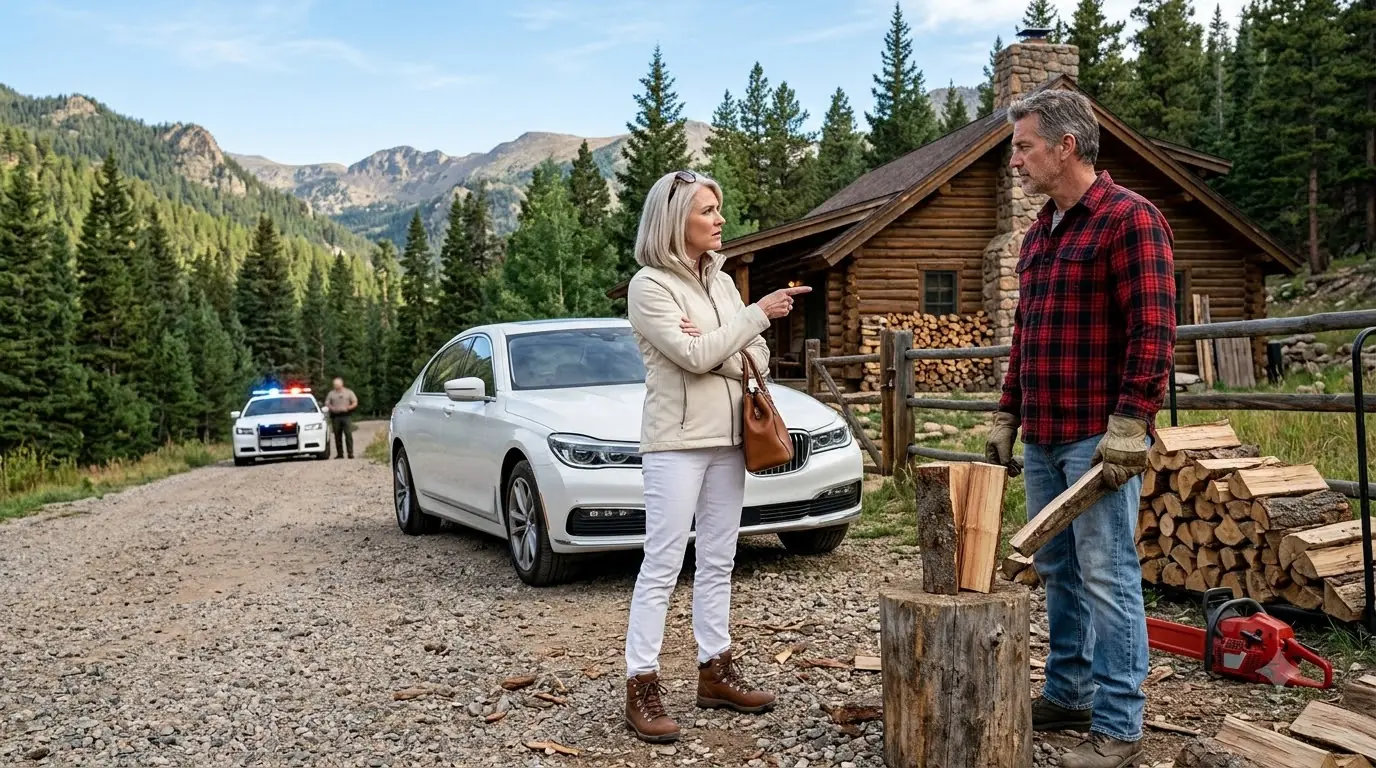
Right there in my driveway sat Brenda High Tower in her gleaming white BMW, parked across the way, designer sunglasses on, arms crossed, glaring up at my cabin like it personally offended her.
She had moved into the valley six months earlier and instantly started treating lifelong locals like me as trash ruining her perfect view. What she did not know was that I did not merely own this cabin.
I quietly controlled the mineral and water rights beneath every acre around here, including the land beneath her new house. That one phone call was about to destroy everything she had come here for.
Let me back up and tell you how I ended up in this mountain paradise in the first place. My name is Marcus Thornfield. Friends call me Mac, and three years ago, I was just another burned-out Air Force logistics officer looking for somewhere quiet to heal after burying my wife, Sarah.
Cancer took her at fifty-one, ending twenty-three years of marriage in eight months of chemotherapy and hospital rooms that reeked of industrial disinfectant and crushed hope.
The life insurance payout was decent, and Sarah had always dreamed of a mountain cabin where she could paint watercolors of the sunrise over pine trees. Whispering Pines Valley caught my eye in a Craigslist ad: forty acres for $180,000 cash, seller motivated.
I bought it sight unseen because the photograph showed exactly what Sarah would have loved. Nothing but wilderness was stretching to the horizon and a creek so clear that you could count the pebbles on the bottom.
I spent the next year building our dream cabin with my own hands, 1,200 square feet of lodgepole pine and stone, with solar panels gleaming on the roof like technological prayer flags.
Every morning at 7:00 a.m. sharp, I fired up my chainsaw to split firewood, letting the sharp crack of oak echo off the granite cliffs while the scent of sawdust mixed with mountain coffee. The valley held maybe forty homes scattered across roughly 1,200 acres of pure mountain paradise.
Most of my neighbors were like me: veterans, retirees, artists, and people who had traded corporate stress for the simple pleasure of chopping their own firewood and knowing every star in an unpolluted sky.
Then the invasion began. Eighteen months ago, Derek High Tower started building Pines Vista Estates, twelve McMansions crammed onto land that should have held four decent cabins.
Each house cost more than a Ferrari and was designed for technology executives who wanted mountain views without mountain living. Derek's wife, Brenda, was the crown jewel of entitlement.
Picture a suburban soccer mother who had watched one too many home-renovation shows and decided she was qualified to redesign God's creation. Her silver hair was shellacked into helmet perfection, her designer hiking boots had never touched actual dirt, and her attitude could make a grizzly bear apologize for existing.
Their $850,000 glass monument to suburban anxiety stuck out like a space station among our log cabins. Where we had stone chimneys breathing wood smoke into crisp morning air, they had steel and glass reflecting sunlight like an architectural middle finger pointed at the mountains.
Within six months, Brenda had militarized the valley's first-ever HOA with herself as supreme commander. Her opening salvo targeted Walt Kowalski's vintage Chevrolet.
Apparently, a 1987 pickup truck was diminishing the aesthetic integrity of our mountain community. Next came Elena Santos's tomato garden, which Brenda declared inappropriately agricultural for a residential setting.
But I was her white whale. My property sat at the valley's highest point, visible from every fancy window below. Every morning when I split wood, every afternoon when I ran my furniture shop, and every weekend when I took my ATV for a trail ride, Brenda could see me through her floor-to-ceiling windows, living exactly the life she had moved there to escape.
Legally speaking, Brenda had about as much authority over my property as she did over the moon. When I called to explain this politely, her mask slipped completely. "Listen here, you backwoods redneck. We're going to civilize this place whether you like it or not." That was when I realized this was not about noise ordinances or property values. This was war, and Brenda High Tower had just made the biggest tactical error of her privileged life.
Two weeks after our charming phone conversation, Brenda launched her first official attack. A FedEx truck rumbled up my gravel driveway, diesel exhaust mixing with the morning pine scent, carrying a thick envelope that felt heavy with expensive trouble. Kensington and Associates, Attorneys at Law, was one of those $400-an-hour San Francisco firms that charged more per hour than most people made in a week. The return address alone was designed to make ordinary people panic.
The cease-and-desist letter was a masterpiece of legal intimidation. Three pages of fancy letterhead claimed that my ongoing nuisance activities were causing irreparable harm to property values and residential tranquility. They threatened a lawsuit for damages exceeding $50,000 unless I immediately stopped all commercial woodworking operations, excessive noise generation, and unsightly storage of materials.
Attached were forty-seven photographs of my property taken with what must have been a telephoto lens. My woodshed, solar panels, and even my mailbox were labeled as aesthetic violations, as though I were running a criminal operation instead of making custom furniture. I poured myself coffee strong enough to wake the dead and read through their demands again. Those city lawyers had clearly never tangled with a military logistics officer who had spent twenty years dealing with Pentagon bureaucrats and calling out colonels when they were wrong.
It was time for research. The county law library smelled like old books and frustrated citizens, with fluorescent lights humming overhead as I dove into Colorado agricultural law. Three days later, I had found my ammunition. Back in my Air Force days, I learned that every problem had a regulation somewhere, and every regulation had an exception if you knew where to look.
Colorado's right-to-farm statute protected agricultural activities that predated residential development. Custom furniture making from locally sourced timber definitely qualified as agricultural processing. Brenda's fancy lawyers had just threatened a man whose woodworking business was more legally protected than a bald eagle's nest. I drafted my response on letterhead I designed myself: Thornfield Mountain Enterprises LLC.
It was one page in plain English, explaining that my activities were protected under state agricultural statutes and suggesting that Kensington and Associates might want to research rural property rights before embarrassing themselves in court. But that was when things became really interesting. While I was playing legal chess, my neighbors Walt Kowalski and Elena Santos appeared on my porch with coffee and intelligence.
Walt, seventy-eight years old and weathered like granite, had been watching Brenda's operation with the sharp eyes of an old logger who had seen plenty of schemes in his time. "That woman's been mighty busy," he said, settling into my porch rocker with a grunt. The morning air carried the distant sound of Brenda's BMW purring down valley roads like a predator on patrol. "She's taking pictures of everybody's property, not just yours. She's been asking very specific questions about who owns what."
Elena nodded, her work-roughened hands wrapped around a steaming mug. "Derek showed up at my place last week with a folder full of paperwork. He offered me $50,000 over market value, cash, no inspection needed. He said he was helping longtime residents maximize their investment potential."
My coffee suddenly tasted bitter. "How many others has he approached?"
"At least six that I know of," Elena said. "Always the same pitch. Cash offers way above asking price, quick closings, no questions asked."
Walt leaned forward, his logger's instincts as sharp as a crosscut saw. "I've been watching them at night, too. Derek's been prowling around with surveying equipment after dark. I saw him twice this week with a GPS unit and clipboard, walking property lines like he was planning something."
That was when the real picture snapped into focus, like a rifle scope finding its target. This was not about my chainsaw or Elena's tomato garden. Brenda and Derek were systematically cataloging every property in the valley, making strategic cash offers, and using legal threats to pressure holdouts. The harassment was not personal. It was business reconnaissance.
I installed my first trail camera that evening, a cellular model I had researched online. Twenty years of military procurement had taught me that the best surveillance gear did not always come from government contractors. It came from hunters who needed to catch poachers. For less than $200, I could monitor my entire property line and receive real-time photographs on my phone.
The next morning brought Brenda's escalation. A county inspector knocked on my door with a clipboard and a bad attitude, claiming that my woodworking violated home-business permit requirements. The citation threatened a $5,000 fine if I could not produce proper documentation within forty-eight hours. Most people would have panicked, but two decades of Air Force logistics had taught me that paperwork problems usually had paperwork solutions.
I spent the afternoon at the county office obtaining every permit my operation might conceivably need: a business license, fire-safety compliance, an environmental-impact waiver, and even a cottage-industry certification that probably was not required but looked official as hell. By Friday, my little woodworking shop was more legally bulletproof than a government contract. But Brenda had made a critical error. She had underestimated mountain-folk solidarity.
Word spread through our valley faster than wildfire in an August drought. Elena organized coffee meetings where neighbors compared their encounters with Derek. Walt started logging every suspicious vehicle that entered the valley. As for me, I kept splitting wood every morning at 7:00 a.m. sharp, my chainsaw announcing dawn like a mechanical rooster.
The sweet scent of fresh oak shavings drifted across the valley as I stacked cord after cord, perfectly visible from Brenda's floor-to-ceiling windows. She could document whatever she wanted. I was only getting started.
Brenda's next move came disguised as concerned citizenship. Over the next two weeks, the county fire marshal showed up to investigate anonymous reports about improper wood storage. The environmental agency sent an inspector after someone claimed I was illegally dumping sawdust into the creek. Even the postal service became involved when multiple concerned citizens complained that my mailbox was insufficiently visible from the road.
Each visit ended with the same apologetic shrug from county employees who clearly knew they were being weaponized by someone with too much time and too little sense. The fire marshal actually complimented my wood-storage setup before writing "no violations found" on his clipboard. But the truly creative harassment began when my equipment started mysteriously malfunctioning.
First, my chainsaw developed what mechanics call sugar in the gas tank, a classic sabotage technique that turns a fuel system into expensive scrap metal. The repair shop in town shook their heads when they saw the crystallized mess clogging my carburetor. "I've seen this before," the mechanic said, wiping his hands on an oily rag. "It usually happens to people who anger the wrong neighbors."
Then my ATV tires were slashed while it sat parked behind my cabin. They were not merely punctured. All four had been professionally cut in perfectly straight lines with something razor-sharp. The acrid smell of rubber and betrayed trust hung in the mountain air as I stared at $800 worth of deliberate destruction.
That was when I decided to upgrade my security. My old trail cameras had been doing their job, but I needed better coverage. A quick online search led me to a cellular surveillance system that hunters used to catch poachers, with motion-activated cameras that uploaded photographs instantly to a secure server. The setup cost me $600, but it covered every approach to my property with military-grade precision.
Two days later, I got my money's worth. At 2:17 a.m., my phone buzzed with an alert: motion detected at Camera Three. The image showed a figure in dark clothing and a baseball cap skulking near my shed with what looked like a Slim Jim and a small crowbar. The intruder's face was hidden, but the body language screamed guilty conscience.
I slipped on my boots and grabbed a flashlight, moving through the darkness with the silent efficiency the Air Force had drilled into me during night exercises. The metallic taste of adrenaline filled my mouth as I approached my shed, pine needles crunching softly underfoot. The intruder was gone, but evidence remained. There were pry marks on my shed door and a small pile of metal shavings where someone had tried to force the lock.
The intruder had also spilled gasoline from a container apparently dropped when my motion lights came on. The sharp chemical smell mixed with mountain air told the entire story. Someone had planned to destroy more than tires. By morning, my phone held three more photographs: the same figure retreating toward the road, climbing into what looked suspiciously like a white Tesla Model S, and the license plate clear as day in my infrared camera's final image.
It was Derek High Tower's license plate.
The community response was swift and furious. Elena organized what she diplomatically called a neighborhood-watch meeting, but it actually resembled a war council of angry mountain residents. Twelve neighbors gathered in Walt's living room, the air thick with coffee steam and righteous anger.
"This has gone far beyond property disputes," said Jim Murphy, a retired surveyor who had lived in the valley for thirty years. "Breaking and entering, vandalism. That's criminal behavior."
Walt nodded grimly, his old hands steady as granite. "I've been watching the High Towers closely since our last talk. Derek has been making the rounds again, but this time he isn't offering to buy. He's threatening people."
Elena's voice carried the steel of a woman who had taught middle school for thirty years. "He told the Hendersons that property values were going to collapse if certain problematic residents did not adapt to community standards. He made it sound like a friendly warning, but the threat was as clear as mountain stream water."
That was when I realized Brenda and Derek had escalated beyond harassment into what the military calls active measures: systematic intimidation designed to force compliance through fear. But they had chosen the wrong valley to terrorize. By the meeting's end, we had a plan.
Elena would document every threatening interaction and file complaints with the sheriff's department. Jim would research Derek's business connections and property purchases. Walt would coordinate round-the-clock surveillance of suspicious vehicles. I would keep doing exactly what I had been doing, splitting wood, building furniture, and living my life while my upgraded cameras gathered evidence of every illegal move Derek made.
Two days later, Brenda filed for a restraining order, claiming I had threatened violence against her. The petition cited my military background and alleged arsenal of weapons as evidence that I was dangerous and unstable. The hearing was scheduled for the following Tuesday.
Most people would have been intimidated by the legal system bearing down on them. However, twenty years of dealing with military bureaucracy had taught me that the best defense against false accusations was overwhelming documentation of the truth. I started preparing my evidence folder: photographs of the sabotage, cell-tower records proving Derek's presence during the break-in attempts, witness statements from twelve neighbors, and my complete military service record showing twenty years of exemplary conduct.
Brenda could play her legal games. I had bigger fish to fry, and Derek High Tower was about to discover that sabotaging a veteran's property was the worst mistake of his privileged life.
Brenda's next escalation came on a Tuesday evening while I was in town picking up lumber at Henderson's Hardware. My phone exploded with calls from Walt, Elena, and three other neighbors, all asking the same frantic question. "Mac, are you okay? The whole cavalry is heading to your place."
I could hear sirens wailing in the background as Walt explained. "Brenda called 911 reporting gunshots and screaming from your property. She said she saw smoke and people running around like some kind of firefight was happening. The sheriff's department, a fire truck, and even paramedics are racing up your driveway."
The taste of instant rage filled my mouth as I accelerated my pickup toward home. Twenty minutes later, I arrived to find three sheriff's vehicles, a fire truck, and an ambulance parked in my driveway like a disaster-movie set. Red and blue lights strobed against the pine trees while diesel exhaust mixed with the evening mountain air.
Deputy Rodriguez met me at my gate looking embarrassed. "Mac, we got a call about gunshots and possible injuries. Do you mind if we take a look around?"
I handed him my receipt from Henderson's Hardware, timestamped forty-three minutes earlier. "I've been in town buying two-by-fours, Deputy. The store has security cameras if you need confirmation."
We walked the property together while his radio crackled with frustrated voices. There were no bullet holes, no blood, and no evidence of any disturbance. The only smoke was the faint scent from my wood stove, and the only creatures running were probably deer spooked by all the sirens.
"This is the third false report in six weeks," Rodriguez said quietly as the fire truck rumbled away. "It is always the same complainant, and every report has been completely bogus. I just wanted you to know that we're keeping track."
His warning carried weight. In my Air Force days, I had seen plenty of situations where legitimate emergencies were ignored because someone had cried wolf too many times. Brenda was burning through her credibility faster than kindling in a campfire, but she was not finished.
The next morning, Brenda contacted Jake Morrison at the Valley Tribune with a story about a dangerous mountain man threatening our peaceful community. The article made me sound like a survivalist lunatic with post-traumatic stress disorder, hoarding weapons and terrorizing innocent families who had moved there for mountain tranquility.
"Local HOA president Brenda High Tower expressed concern about Marcus Thornfield, whose military background and isolated lifestyle have raised red flags among newer residents," the article read. "We're just trying to protect our families," High Tower told the Tribune. "This man has extensive weapons training and clearly resents anyone who doesn't fit his idea of mountain living."
The article included a photograph of my cabin taken with a telephoto lens, making my modest home look like a fortress. They had even managed to get a shot of my gun safe through a window, which they described as an arsenal visible from outside the residence.
I was reading the character assassination over morning coffee when Elena knocked on my door with a broad grin and a folder full of papers. "You're going to love this," she said, settling into my kitchen chair. "Remember how I used to work at the county assessor's office? I still have friends there, and they owe me a few favors."
She spread Derek's property-purchase records across my table like a poker player revealing a royal flush. Mountain Vista Development LLC, Derek's company, had purchased eight properties in the valley over the past eighteen months. Every purchase was well above market value, and every seller had been systematically harassed by the HOA before agreeing to sell.
"Look at this pattern," Elena said, pointing to the dates. "HOA complaint, thirty days of escalating harassment, then suddenly the owner receives a cash offer that is hard to refuse. Derek has been playing this game since day one."
Walt appeared at my door as if summoned by the smell of scandal. "It gets better," he said, producing his own folder. "I talked to my friend Jim at the courthouse yesterday. Derek has been requesting mining surveys and water-rights documents for the entire valley, not just recent records. He has been researching historical records going back to the 1800s."
The pieces clicked together like a puzzle solving itself. Derek was not merely buying properties for a development scheme. He was researching something larger, something that required intimate knowledge of old land grants and mineral rights. That was when my phone rang with the call that changed everything.
"Mr. Thornfield, this is Rebecca Owen from First Mountain Bank. I'm calling about the safe-deposit box you inherited from your aunt's estate three years ago. Our records show that you've never accessed it, and we're required to notify you before our next audit."
I had completely forgotten about Aunt Martha's safe-deposit box. She had been my great-aunt on my mother's side, a woman I had met perhaps twice at family reunions. When she died, her lawyer had mentioned some personal effects and documents I inherited, but I had been too busy dealing with Sarah's medical bills to pay attention.
"I'll be in tomorrow morning to access it," I told Rebecca, feeling something stir in my gut like a premonition.
Meanwhile, Brenda's newspaper article was backfiring spectacularly. By afternoon, fifteen neighbors had signed a statement supporting my character. The local VFW post offered legal assistance. Even the hardware-store owner called to say he had told the Tribune reporter that I was one of the most decent customers he had ever served.
The real surprise came that evening when Deputy Rodriguez called with unofficial advice. "Mac, you need to be extra careful. We ran Derek High Tower's background for this false-report investigation, and some interesting information came up. He has been involved in three similar development projects in other rural areas. Each time, longtime residents ended up selling after experiencing what they described as systematic harassment campaigns."
The metallic taste of realization filled my mouth as Rodriguez continued. "I can't prove anything yet, but this looks like a pattern. These people aren't just annoying neighbors. They're running a con game."
After Rodriguez hung up, I sat on my porch listening to the evening sounds of the valley I had grown to love. Somewhere in Aunt Martha's forgotten safe-deposit box might be the key to understanding what Derek was really after. The next morning, I was going to find out.
First Mountain Bank smelled like old money and fresh anxiety when I walked through its brass doors the next morning. Rebecca Owen led me to the vault, her heels clicking against polished marble floors that had probably seen a century of mountain families storing their most precious secrets. Aunt Martha's safe-deposit box was smaller than I expected, just large enough for documents and perhaps some family jewelry. The metal lid opened with a soft whisper, revealing a collection of yellowed papers that looked older than the bank itself.
Sarah's death certificate and insurance papers sat on top, reminders of bureaucratic grief I would rather have forgotten. Beneath those modern documents lay something that made my hands tremble: a leather portfolio tied with string and containing papers so old that the edges crumbled at my touch. The top document bore an official seal from 1923 and the name Ezra Thornfield written in fountain-pen ink that had faded to brown.
As I read the archaic legal language, my coffee grew cold and my world shifted on its axis. It was a grant of mineral and water rights to Ezra Thornfield and his heirs in perpetuity, encompassing all subsurface minerals and water sources within the surveyed boundaries of Whispering Pines Valley, totaling 2,847 acres. The document included a hand-drawn survey map showing the entire valley, with Clearwater Creek marked as the primary water source and exclusive rights retained.
Every property Derek had purchased, every lot Brenda's HOA claimed to govern, and every square foot of Pines Vista Estates sat on land where my great-grandfather had retained the mineral and water rights nearly a century earlier. I called Elena from my truck, my hands shaking as I held the phone. "I need you and Walt at my place immediately. Bring coffee and prepare to have your minds blown."
An hour later, we sat around my kitchen table staring at documents that changed everything. Walt, who had worked for the county his entire career, whistled softly as he examined the survey map. "Mac, this deed predates every land division in the valley. When they subdivided Ezra's original claim in 1962, they sold only the surface rights. These mineral and water rights never transferred."
Elena traced the creek's path with her finger. "That means Derek's resort development would need massive water access for pools, spas, and landscaping. Without your water rights, his entire project is worthless."
"Every investor he has courted, every loan application he has submitted, and every promise he has made about secured resources is built on land he cannot actually develop," I finished.
The beautiful irony hit me like an avalanche of justice. Derek had spent more than $2 million purchasing surface rights to properties that could not legally support his development plans. Every harassment campaign, legal threat, and midnight sabotage attempt had been designed to drive me out of the valley before I discovered what I already controlled.
Walt leaned back in his chair, a grin spreading across his weathered face. "That pompous man has been trying to steal water rights he doesn't even know you have."
I pulled out my phone and called Morrison Legal Services in town. "Mr. Morrison, this is Mac Thornfield. I need to retain your services for something that is going to make your month very interesting."
Attorney Morrison arrived within two hours. He examined the documents with the hungry expression of a lawyer who had just found a winning lottery ticket and confirmed what I already knew. The deed was legitimate, enforceable, and absolutely bulletproof.
"Mr. Thornfield," he said, adjusting his glasses, "you do not merely own water rights to Clearwater Creek. You own the subsurface mineral rights under every property in this valley. Derek High Tower's company has been selling investors access to resources you control."
The sweet taste of pending victory filled my mouth as the full scope of Derek's error became clear. He had researched historical mining claims, studied water-rights law, and methodically purchased valley properties. Yet he had missed the one document that mattered most, the original Thornfield deed that overrode every subsequent land sale.
Brenda thought she was dealing with a hillbilly who split firewood too loudly. Derek believed he was intimidating a lonely widower who did not understand property law. They had no idea they had declared war on the man who legally controlled the resources beneath their feet. It was time to show them what real mountain justice looked like.
The war council convened in my living room that evening with the intensity of generals planning a major operation. Walt brought his surveyor's knowledge and forty years of county connections. Elena arrived with her teacher's organizational skills and a network that reached every longtime resident in the valley. Attorney Morrison came armed with legal strategy and a predatory gleam in his eyes that suggested he had been waiting his entire career for a case this satisfying.
"Here is our objective," I said, spreading the 1923 deed across my coffee table like a battle map. "Derek has scheduled his major investor presentation three weeks from Friday. He is promising those Silicon Valley investors locked-in water rights and guaranteed environmental approval. We are going to let him make those promises, then destroy his credibility in front of everyone who matters."
Morrison adjusted his glasses, already calculating the legal sequence. "The foundation is rock solid. I will file formal water-rights claims with the county tomorrow, establish your standing to challenge any development permits, and request mandatory environmental-impact reviews. Once that paperwork enters the system, Derek's project stops dead."
Elena pulled out a notebook that looked capable of organizing a military campaign. "I've been tracking Derek's property purchases through my friend at the assessor's office. He used shell companies to hide the full scope: Mountain Vista Development, Pines Investment LLC, and Summit Holdings Corporation. They are all registered to the same address, and they all purchased properties after orchestrated harassment campaigns."
Walt leaned forward, his old hands steady as the mountains. "I've been watching them operate for months. Derek has a pattern. Anonymous complaints create problems, then cash offers appear to solve them. He has done it to six families already. It is always the same playbook."
That was when I realized that legal paperwork alone would not stop Derek's operation. We needed to catch him in the act, document his fraud, and expose his systematic deception to investors and law enforcement. It was time for real reconnaissance.
Over the next week, we implemented what I privately called Operation Mountain Justice. Elena infiltrated Brenda's private social-media group using a false account, gaining access to their planning discussions and timeline details. The intelligence was pure gold. Derek had promised investors that all regulatory obstacles would be resolved before their site visit and that water rights were fully secured through strategic property acquisition.
Meanwhile, Walt coordinated with Jim Murphy and five other longtime residents to document every suspicious vehicle entering the valley. They created a surveillance network that would have made an intelligence agency proud. Retired people with time on their hands and decades of resentment toward entitled outsiders proved remarkably effective.
My contribution was more technical. I invested in a professional-grade surveillance system covering not only my property but strategic viewing points throughout the valley. Hidden cameras monitored Derek's illegal creek access, documented his crews trespassing, and recorded every violation of environmental regulations committed by his operation.
The equipment came from a military contractor specializing in border security: motion-activated cameras with night vision, cellular upload capability, and GPS tracking that created evidence suitable for court proceedings. For less than $3,000, I had built a surveillance network capable of tracking Derek's every move without his knowing that he was being watched.
The psychological operation was even more satisfying. I continued playing the role of a desperate seller, feeding Derek carefully crafted misinformation about neighbors who might sell cheaply. Every conversation was recorded, every promise documented, and every lie preserved for future prosecution.
Derek's greed made him sloppy. He revealed details about his investor timeline, financing requirements, and offshore accounts used to conceal money. The beauty was watching him dig his own grave while believing he was winning. He bragged about neutralizing environmental opposition and eliminating problematic residents, never realizing that every word was being preserved for his eventual criminal trial.
Elena's social-media campaign proved equally effective. Her Save Whispering Pines group attracted three hundred members in ten days, including environmental activists, local reporters, and three county commissioners who had been looking for a reason to investigate Derek's suspicious permit applications.
Meanwhile, Morrison prepared our legal nuclear option: cease-and-desist letters for Derek's investor presentation, environmental injunctions to halt construction, and criminal-fraud complaints ready for immediate filing. We would allow Derek to make his promises to investors, then systematically destroy every claim with documented evidence.
The timeline was perfect. Derek's presentation was scheduled for Friday evening at the Pines Vista Clubhouse. Our revelation would continue Saturday morning at Brenda's emergency HOA meeting, which she had called to discuss declining property values allegedly caused by problematic residents.
Walt's nephew, Jake, the investigative reporter, would publish his exposé in Sunday's regional newspaper, complete with photographs of Derek's illegal activities and recordings of his fraudulent promises. By Monday morning, Derek would face criminal investigations, civil lawsuits, and complete financial ruin.
The most satisfying part was Derek's ignorance. He still believed he was intimidating a lonely widower who did not understand property law. Right up until Friday evening, he would be congratulating himself for acquiring another mountain valley for development. He had no idea that the man he had been harassing controlled the water rights that made his entire project possible and was about to destroy everything he had worked for in front of the investors whose money he had already spent.
Sometimes the best revenge is simply allowing greedy people to reveal their true nature to the wrong audience.
With his investor presentation two weeks away, Derek's behavior shifted from calculated harassment to barely controlled panic. The Silicon Valley investors were flying in for site visits, his construction loans required environmental approvals within thirty days, and somehow his supposedly foolproof intimidation campaign had failed to drive me out of the valley. Derek decided to become creative.
The bribery attempt came on a Wednesday morning disguised as a neighborly visit. Derek's Tesla crunched up my gravel driveway, its pristine white paint looking obscene against honest dirt and working tools. He climbed out wearing hiking boots that had never seen a trail and a forced smile that would not have fooled a tourist.
"Mac, I think we got off on the wrong foot," he said, extending his hand as if we were old friends instead of mortal enemies. "I'd like to make things right between us."
I let him sweat for a moment before shaking his soft palm with my callused hand. "What did you have in mind, Derek?"
"I know Brenda can be a little intense about community standards, and I realize your property has sentimental value." He paused and pulled out an envelope thick enough to choke a horse. "I'm prepared to offer $500,000 cash for your land. No inspection, no contingencies, and closing in two weeks."
The crisp scent of fresh bills mixed with Derek's nervous sweat as he fanned out hundred-dollar notes like a dealer making a purchase. Five hundred thousand dollars was more than triple what I had paid for the property, enough to buy a mansion elsewhere in the state.
"That's generous," I said, playing my role perfectly. "But this place means everything to me. Sarah and I planned to grow old here."
Derek's mask slipped just enough to reveal the predator underneath. "Mac, let me be completely honest. This valley is changing whether you like it or not. You can profit from that change, or you can be crushed by it. There are ways to make life very difficult for people who don't adapt."
The metallic taste of pure rage filled my mouth, but I kept my voice level. "Is that a threat, Derek?"
"It is simply reality. Sometimes accidents happen to stubborn people. Equipment failures, permit problems, tax audits. Life becomes complicated when you fight progress."
Every word was being recorded by the miniature recorder Elena had helped conceal in my shirt pocket. Derek's casual mention of accidents was enough to add witness-intimidation allegations to his growing list of crimes.
His desperation manifested in ways beyond bribery. Over the next week, my surveillance cameras captured a systematic sabotage campaign that escalated far beyond amateur tire slashing. Someone contaminated my well water by pouring motor oil down the wellhead, an environmental crime that could have poisoned the entire valley's groundwater.
My solar-panel array suffered accidental damage from a falling tree branch that showed clear saw marks where it had been cut. Phone lines to my cabin were severed three times, always during hours when Derek's crew was documented in the area.
The intimidation campaign spread beyond my property. Derek's associates, two men in expensive suits who looked as if they had watched too many crime films, visited Elena and Walt with offers to buy their properties at inflated prices. When both refused, the conversations became threatening.
Elena recorded her encounter on her phone. "Derek suggested that our property taxes might face extra scrutiny if we continued obstructing community-improvement efforts. He mentioned that elderly residents sometimes struggle with complex tax situations."
Walt's visit was more direct. "Those city men implied that my old pickup might develop mechanical problems if I kept interfering with their business. They even mentioned that rural accidents sometimes take a while for emergency services to reach."
Derek's greatest mistake was underestimating the solidarity of mountain communities. Instead of terrorizing residents into submission, his threats triggered a defensive response that would have made early frontier militias proud. Walt organized round-the-clock neighborhood-watch rotations. Elena created encrypted communication channels between resistant residents, and Jim Murphy documented every Derek sighting with GPS coordinates and timestamps.
My surveillance network captured everything: Derek's crew illegally tapping Clearwater Creek to test flow rates, surveyors trespassing on private property to gather soil samples, and, most damaging of all, Derek himself directing his men to make life miserable for anyone who refused to sell.
The water theft was particularly serious. Derek had installed an illegal pump upstream from the main valley settlement, diverting enough water to lower everyone's well levels during the dry season. Elena's vegetable garden withered when her irrigation water turned brackish from contamination. Walt's livestock pond dropped three feet in two weeks.
Instead of driving us out, Derek's escalation created the evidence we needed to destroy him. Every illegal act was documented, every threat recorded, and every environmental violation photographed with legal precision.
Meanwhile, Brenda continued pursuing her restraining-order petition, painting me as a dangerous veteran with post-traumatic stress disorder who had threatened violence against innocent families. The hearing was scheduled for the Monday after Derek's investor presentation. As I prepared my evidence folders and witness statements, I could not help smiling.
Derek believed he was closing in for the kill, pressuring a desperate man into submission through superior resources and ruthless tactics. He had no idea that he was about to face the worst week of his privileged life.
Derek's collapse began the moment I showed him the 1923 deed during our final negotiation meeting. I had invited him to my cabin under the pretense of accepting his cash offer. With Elena and Walt hidden in my basement, recording everything through concealed microphones, the real purpose was gathering evidence for his inevitable prosecution.
"This is impossible," Derek sputtered, his face turning the color of overripe tomatoes as he stared at Ezra Thornfield's water-rights documentation. "I researched every mineral claim, every historical survey, and every property transfer in this valley. There is no way some backwoods ancestor of yours owns the subsurface rights to the entire development."
I poured myself coffee with the calm satisfaction of a man who had just played his winning hand. "Derek, you researched everything except the one document that actually matters. My great-grandfather retained the mineral and water rights when the original claim was subdivided in 1962. Every property purchase you made included only surface rights."
The rich smell of fresh mountain coffee mixed with Derek's panicked perspiration as reality crashed over him like an avalanche. He had spent $2.5 million on property purchases, eighteen months orchestrating systematic harassment, and countless hours making promises to investors about secured water access. All of it was worthless without the rights I had inherited and forgotten until his scheme forced me to investigate.
"You're lying," Derek said, his voice cracking. "This deed is probably forged. I'll have my lawyers prove it is fraudulent."
"Go ahead," I replied, sliding certified copies across my kitchen table. "These documents are archived in three different locations, validated by the State Historical Society, and confirmed by two independent land attorneys. Your lawyers can examine them as much as they want."
Derek then revealed how desperate he had become. He tried to snatch the documents from my table, as if destroying copies could erase the original deed. When I calmly moved the papers out of reach, he threatened everything from lawsuits to physical violence.
"You mountain people don't understand what you're dealing with," Derek hissed, his mask of civility completely shredded. "I have investors who committed $15 million based on my guarantees. If this project fails because of your claims, I'll make sure you never have a peaceful moment for the rest of your life."
Every threat was being recorded in high-definition audio, adding witness intimidation and criminal coercion to Derek's growing legal problems. His desperation drove him to even more reckless decisions.
The next morning, Brenda filed an emergency injunction claiming that my assertion of water rights was a fraudulent extortion scheme designed to interfere with legitimate business operations. She demanded that the county freeze all property transactions pending an investigation and suggested that I was mentally unstable because of combat-related trauma and social isolation.
The filing was a masterpiece of projection and desperation, accusing me of exactly what Derek had been doing to valley residents for the past year. Judge Martinez had seen enough frivolous HOA complaints to recognize tactical litigation when it landed on her desk.
Meanwhile, Derek launched a character-assassination campaign that would have made the worst political demagogues proud. He contacted Jake Morrison at the Valley Tribune, claiming that I was extorting legitimate developers through fraudulent historical documents. He hired a private investigator to search my military records for anything suggesting mental instability or violent tendencies.
Most damaging of all, Derek spread rumors through Brenda's social network that I was a dangerous isolationist stockpiling weapons and threatening families with children. The whisper campaign was designed to turn community sentiment against me before the truth about his fraud could spread.
But Derek's smear tactics backfired spectacularly. Elena's counterintelligence network had infiltrated every communication channel Brenda and Derek used. Within hours of Derek's lies appearing, Elena circulated documented evidence of his bribery attempts, environmental crimes, and systematic harassment of elderly residents.
The community response was swift and decisive. Walt organized a public meeting where twelve neighbors testified about Derek's intimidation tactics. Elena presented photographs of his illegal water diversion and contaminated wells. Jim Murphy displayed property-purchase records showing Derek's pattern of harassment followed by acquisition across multiple rural communities.
By Thursday evening, Derek faced criminal complaints for environmental destruction, civil lawsuits for fraud and intimidation, and complete community ostracism. His carefully constructed image as a visionary developer bringing prosperity to rural areas had collapsed into the reality of a predatory swindler targeting vulnerable communities.
The real blow came when Derek's Silicon Valley investors began asking uncomfortable questions. Elena's social-media campaign reached environmental organizations that contacted Derek's financial backers directly. Wealthy technology executives suddenly received detailed documentation of Derek's illegal activities from groups backed by lawyers and political connections.
The final straw was Derek's pathetic attempt to forge competing water-rights documents. My surveillance cameras caught his crew trying to age newly printed papers with coffee stains and sandpaper, creating supposedly historical documents to support Derek's false claims to water access. Computer-forensic analysis proved that the papers had been created on Derek's office printer using modern paper and toner.
Instead of supporting his position, the forgery attempt added federal fraud allegations to his legal troubles. As Friday's investor presentation approached, Derek was trapped in a web of his own making: criminal investigations pending, civil litigation mounting, community opposition organized, and no legal path forward for his development project. He had cornered himself, and the following night I intended to finish the job.
Friday evening arrived with the crisp clarity of mountain justice finally coming home to roost. The Pines Vista Clubhouse buzzed with nervous energy as Derek's Silicon Valley investors arrived in rental cars that probably cost more than most valley residents earned in six months. Twelve technology executives in expensive casual clothing carried financial portfolios and wore the confident expressions of men accustomed to turning rural land into profit margins.
Derek had transformed the clubhouse into a presentation theater, complete with projector screens showing architectural renderings of Whispering Pines Luxury Resort and Spa. The plans promised a $47 million paradise with boutique hotel suites, a championship golf course, world-class spa facilities, and exclusive access to pristine mountain wilderness.
I slipped into the back row with Walt, Elena, and Attorney Morrison, my phone recording everything as Derek's presentation began. The smell of expensive coffee and nervous sweat filled the room while he launched into his pitch.
"Gentlemen, you are looking at the last undeveloped luxury destination within two hours of Denver," Derek said, his voice carrying the practiced confidence of a man who had sold this dream before. "Whispering Pines represents a unique opportunity to create an exclusive retreat that will generate premium returns for decades."
He clicked through financial projections showing fifteen-percent annual returns, occupancy rates supposedly guaranteed by strategic partnerships with luxury travel companies, and construction timelines promising a grand opening within eighteen months. Every slide reinforced his central promise: this was a sure investment backed by comprehensive due diligence and secured resource access.
"Our water rights are fully secured through strategic property acquisition," Derek announced, displaying a map showing his purchases throughout the valley. "Environmental approvals are proceeding on schedule, and we have successfully addressed all community concerns through our local HOA partnership."
That was when I stood. "Derek, before your investors sign anything, there is something they should know about the water rights you just guaranteed."
The room fell silent except for the projector's electronic hum. Derek's face turned pale as mountain snow when he realized his carefully orchestrated presentation was about to become a public reckoning.
"This is a private meeting, Thornfield. You're trespassing."
"Actually, you invited me here to discuss selling my water rights," I replied calmly, raising my phone to display the 1923 deed. "I thought your investors should see what they are really buying into."
I walked to the front while Derek sputtered protests. Attorney Morrison distributed copies of the Thornfield deed to every investor, his movements as precise as a funeral director arranging a burial.
"Gentlemen, this document grants my family exclusive water rights throughout this valley," I announced, my voice carrying the authority of twenty years of military service. "Derek's resort cannot legally operate without access to Clearwater Creek, water rights he does not own and cannot obtain without my agreement."
The lead investor, a thin man with wire-rimmed glasses who had been nodding throughout Derek's presentation, examined the deed with growing alarm. "Mr. High Tower, is this document legitimate?"
Derek's desperation transformed him from a polished salesman into a cornered animal. "It is obviously a forgery. This mountain man is trying to extort legitimate developers."
That was when Morrison delivered the decisive blow. "Mr. High Tower claimed these documents were fraudulent, so Mr. Thornfield had them independently verified." He produced certification letters from the State Historical Society, two law firms, and the county clerk's office. "These water rights are legitimate and legally enforceable."
The true devastation came when Morrison played audio recordings of Derek's bribery attempts, environmental crimes, and threats against valley residents. The investors' confident expressions melted into horror as they heard Derek discussing contamination of my well and remarking that accidents happened to people who refused to cooperate.
"Jesus Christ," the lead investor whispered, closing his portfolio with the finality of a coffin lid. "Derek, did you know about this fraud when you accepted our funding?"
Derek's breakdown was spectacular and complete. He accused me of conspiring to destroy a legitimate business, blamed his investors for failing to understand rural-development challenges, and threatened everyone present with lawsuits that would bankrupt the entire community.
His rant continued until Walt stood with the quiet authority of a man who had seen plenty of city bullies come and go. "Son, you've been caught red-handed defrauding these people and terrorizing our community. It is time to close your mouth and accept the consequences."
The investors fled like tourists escaping an avalanche, their $15 million in funding evaporating faster than morning mist. Derek stormed out promising revenge, while Brenda sat in stunned silence, finally understanding that her HOA presidency had become worthless.
The next morning, our community meeting packed the valley center with eighty-five people, three reporters, and county officials who had driven up specifically to witness the exposure of Derek's scheme. Jake Morrison's livestream attracted two thousand viewers as I presented the complete timeline of Derek's fraud.
By Sunday, Derek faced federal criminal charges, civil lawsuits totaling $23 million, and bankruptcy proceedings that would strip away everything he had taken from rural communities across three states. Mountain justice had finally come home to roost.
Six months later, Whispering Pines Valley had transformed into something Sarah would have loved: a genuine community bound by shared values instead of HOA regulations and property values. Derek High Tower was serving three years in federal prison for wire fraud, environmental crimes, and witness intimidation.
The federal investigation uncovered his systematic targeting of rural communities across Colorado, Montana, and Wyoming, where he had used identical tactics to defraud investors and terrorize longtime residents. His asset-forfeiture settlement provided restitution to dozens of families he had harmed, while his development company became a cautionary tale studied in business-ethics classes.
Brenda fled back to San Francisco the week after Derek's arrest. She filed for divorce and abandoned their glass monstrosity to foreclosure proceedings. The house sold for half its original price to a retired park ranger and his wife, who immediately installed wooden shutters and a stone chimney that looked as though it belonged in the mountains.
The real victory was what I did with my new power as the valley's water-rights owner. Instead of selling those rights for millions to another development company, I established the Clearwater Creek Conservation Trust. The trust granted every valley resident permanent water access at cost while protecting our creek from commercial exploitation forever.
Environmental organizations called it a model for private conservation that other communities could replicate. The paperwork creating the trust was simple enough: as long as water flowed through Whispering Pines Valley, it would remain available to residents, wildlife, and the ecosystem that made our mountains special. No corporation could ever again threaten our community with water scarcity or price manipulation.
My woodworking business exploded after the national media attention. Orders for custom mountain furniture became backlogged for eight months, with a waiting list that included celebrities who had read about the mountain man who defeated a Silicon Valley developer. The irony was perfect. Derek's attempt to destroy my simple life created more success than I had ever imagined.
The best part was watching our community heal from his divisive tactics. Walt Kowalski was elected president of our new resident council, which focused on mutual aid instead of property restrictions. Elena Santos organized monthly potluck dinners where neighbors shared tools, knowledge, and friendship instead of HOA complaints.
Even some of Derek's former supporters joined our gatherings once they realized cooperation worked better than competition. We established the Sarah Thornfield Memorial Scholarship for rural students pursuing environmental studies, funded by licensing our conservation story to documentary filmmakers and ecotourism companies.
The first recipient was Elena's granddaughter, Maria, who had been inspired by our water-rights battle to study environmental law. The annual Whispering Pines Folk Festival became a celebration of everything Derek had tried to eliminate: rural culture, environmental stewardship, and community resilience.
Five hundred visitors attended the festival's first year, with all proceeds supporting local families and volunteer fire-department equipment. My custom-furniture raffle alone raised $15,000 for medical emergencies and equipment repairs.
These days, I still split firewood every morning at seven sharp, but now the sound echoes across a valley where neighbors wave instead of calling the police. My chainsaw has become a morning alarm clock that people actually appreciate, signaling another day in a community that chose cooperation over conflict.
The best part happens every evening when I sit on my porch watching the sunset paint the mountains gold. Rosa Santos, Elena's sister and a widow who understands the weight of loss, often joins me with coffee and conversation that flows as naturally as Clearwater Creek.
We are taking things slowly, two people who learned that the best relationships grow like mountain pines: strong roots, patient growth, and foundations deep enough to weather any storm.
My cabin still overlooks the entire valley, but now I see neighbors tending gardens instead of planning harassment campaigns. Children play in the creek Derek tried to steal, their laughter mixing with the evening sounds of a healthy ecosystem.
Wood smoke rises from chimneys throughout our community, carrying the scent of home fires tended by people who chose to stay and build something lasting. Sometimes the best revenge is simply outlasting the people who try to destroy your peace.