The morning mist had barely lifted from Pine Ridge Lake when Margaret Windham planted herself between Theo Blackstone and the old wooden boat launch. Behind her, a newly installed white fence cut across the fishing path, while two private security guards stood beside a sheriff’s deputy who clearly wished he were anywhere else. Margaret wore a cream blazer, white trousers, and designer shoes already stained by the damp gravel, yet she held herself as though she were addressing a corporate boardroom instead of an elderly fisherman carrying a tackle box. Theo stood inches from her with the dark lake behind him, his weathered face calm even as she pressed the edge of an HOA sign against his chest.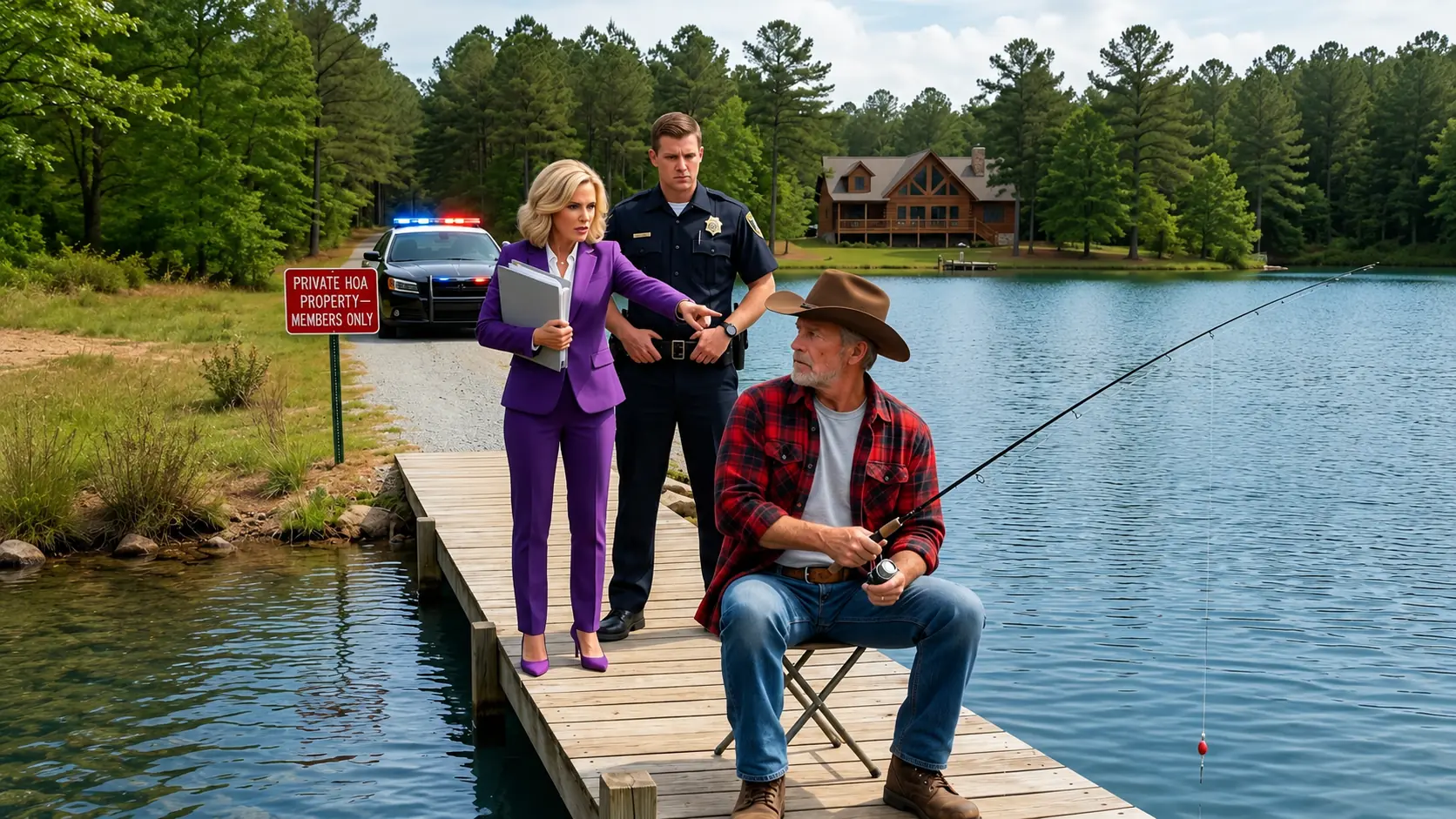
For twenty-three years, Theo had fished from that exact spot before sunrise. He had moved to the lake after cancer took his wife, Sarah, at forty-eight, leaving him with a grief too large for conversation and too heavy for an empty suburban house. His grandfather’s two-acre property had contained little more than raw land, pine trees, and a view of the water when Theo inherited it. He built the cabin himself because keeping his hands busy was the only thing that made the pain loosen its grip.
The lake became part of his survival. Every morning, he listened to the loons, smelled the wet pine needles, and cast his line while pale mist drifted across the spring-fed water. He was not trying to catch trophies or prove anything to anyone. He was simply returning to the place where silence no longer felt like punishment.
Pine Ridge had once been a quiet collection of old cabins and modest homes occupied by veterans, teachers, mechanics, and retirees. Neighbors borrowed tools without paperwork, shared fish without charging fees, and repaired one another’s docks before storms. Nobody cared whether a truck was rusted or whether a lawn had weeds. That changed when expensive homes began appearing around the shore and Margaret arrived in a white BMW carrying enough confidence for the entire county.
She had purchased an eight-hundred-thousand-dollar lakefront house after a lucrative divorce settlement and immediately began speaking as though she had rescued the community from itself. Within two weeks, she organized a meeting about property values, liability, and the urgent need for professional management. Her presentation included graphs, charts, and photographs of cracked docks labeled as examples of “unregulated recreational risk.” By the end of the evening, she had convinced eight newer property owners to sign papers creating the Pine Ridge Lake Homeowners Association.
The older residents refused to join. Margaret responded by sending certified letters declaring membership mandatory and setting the monthly fee at two hundred dollars. The money, she claimed, would fund maintenance, security, landscaping inspections, and management of the lake as a common community asset. She never produced a deed showing the association owned the water. She simply repeated the claim until people became frightened that questioning her might cost them their homes.
Theo called her once and tried to remain polite. He explained that he had no interest in joining an organization that did not exist when he bought his property. Margaret told him participation was not optional because everyone’s investment depended on unified enforcement. Theo replied that he had a home, not an investment portfolio, and she hung up without another word.
Two weeks later, laminated signs appeared along the shoreline. They declared the lake private HOA property and threatened fines against unauthorized fishermen. Margaret placed cameras near the boat launch and used binoculars from her deck to photograph Theo each morning. When he continued fishing, she filed a complaint accusing him of trespassing.
Deputy Charlie Morrison arrived during sunrise with an embarrassed expression. His father had worked construction with Theo’s father, and he knew the old fisherman had used the lake for decades. Still, Margaret had filed formal paperwork, and Charlie said he needed Theo to pack up until ownership could be clarified. Margaret watched from her deck with her arms folded, wearing a satisfied smile that Theo would remember long after the deputy left.
Theo closed the lid of his metal tackle box. The snap echoed across the water, sharper than the cry of the birds. He did not argue, threaten, or demand sympathy. He simply looked at Margaret and understood that she had mistaken restraint for surrender.
The next day, he discovered she had documented his fishing trips with photographs and submitted them as evidence of repeated criminal trespass. She also scheduled an emergency enforcement meeting to discuss “problem residents” refusing community standards. Four other families received violations the same afternoon. Betty Kowalski was fined because her late husband’s garden gnomes supposedly damaged neighborhood aesthetics, while Frank Martinez was threatened over an old vegetable garden that existed before Margaret had ever seen the lake.
The notices frightened them because Margaret used legal language designed to sound final. Betty arrived at Theo’s cabin holding a letter that demanded fifty dollars for every day she refused to remove the gnomes. Her hands trembled as she explained that her husband had bought one every anniversary until he died. Theo read the letter twice, folded it carefully, and promised she would not pay a cent.
He began at the county courthouse. The land records office smelled of toner, dusty folders, and coffee that had been sitting in the pot since dawn. Joyce Miller, a clerk who had worked there for decades, studied Margaret’s HOA filing through thick glasses and immediately found missing property descriptions, boundary surveys, and evidence of legal authority. The association existed only as a neighborhood group and had never completed the requirements necessary to control property or impose fines.
Joyce pulled the original survey maps from the 1960s. One document suggested Theo’s parcel extended farther into the water than anyone expected, while another referred to mineral rights transferred from the Thompson Mining Company. The language was unusual enough that Joyce advised him to investigate the older deeds before confronting Margaret. Theo thanked her and left carrying copies of every map she could legally provide.
While he researched, Margaret hired a young private security guard to patrol the boat launch. Theo arrived the next morning with his fishing rod and calmly asked what authority the man possessed. The guard admitted Margaret had told him only to photograph anyone using the water without permission. Theo cast his lure past the new sign, wished the guard a pleasant morning, and continued fishing until the embarrassed young man quit three days later.
Margaret replaced him with an attorney. The cease-and-desist letter demanded five hundred dollars in administrative fees and threatened court action if Theo continued entering what it called restricted HOA waters. He received it while repairing Betty’s porch step. Instead of becoming frightened, Theo laughed, because the attorney had relied entirely on Margaret’s unsupported claim that the association owned the lake.
Her next move was a white vinyl fence across the traditional fishing path. Frank had walked that route every morning since 1987 under his doctor’s advice, but Margaret stood beside the new barrier and told him that times had changed. She claimed safety and liability required controlled access. Frank turned around quietly, his humiliation visible in the slow way he lowered his head.
That fence changed the fight. Until then, Theo had been protecting his own routine, but now Margaret was using fabricated authority to isolate elderly residents and erase traditions older than her house. He hired a licensed surveyor named Jake Patterson to map his property precisely. Jake discovered the lot extended thirty feet into the lake and found additional references to mining claims associated with Theo’s grandfather.
An anonymous note appeared in Theo’s mailbox that evening. It contained only one sentence instructing him to check Thompson Mining Company records at the state archives. Someone inside Margaret’s shrinking coalition had begun to understand the danger. Theo packed his grandfather’s deed, drove to the capital, and spent three days reading brittle corporate documents beneath fluorescent lights.
Thompson Mining had once purchased comprehensive mineral and water rights to Pine Ridge Lake while searching for copper. The mining effort failed, but the company retained legal ownership of the lake bottom, surface-water usage, and related access rights. When the company dissolved, those rights passed through a holding company to one of its partners: Theo’s grandfather. They later transferred to Theo’s father and finally to Theo in 1999.
Theo stared at the chain of ownership until the meaning settled over him. He did not merely possess permission to fish near his cabin. He owned the entire lake bottom, along with the water rights Margaret had been charging neighbors to use. Every dock permit fee, fishing fine, and monthly lake assessment she collected was based on property she had no legal claim to control.
Attorney Samuel Bennett confirmed it. In his quiet office at the county seat, he examined the deeds, mining records, inheritance documents, and tax history before leaning back in his chair. He explained that older mineral conveyances often included broader rights than modern buyers realized. In Theo’s case, the language granted ownership from the surface water down to the lakebed, together with permanent access for fishing, boating, swimming, extraction, and recreation.
Margaret’s association had been trespassing on Theo’s property while accusing him of trespassing on his own. Worse, she had collected money from families for access and installed fences, cameras, and signs without his permission. Bennett offered to file an immediate injunction, but Theo asked him to wait. Margaret had scheduled a public county meeting where she planned to request official enforcement powers, and Theo wanted her claims recorded before revealing the truth.
During the days before the meeting, Margaret grew more aggressive. She reported Theo’s dock to environmental regulators, accused his boat of being abandoned, and contacted his employer with warnings that he was unstable. Every complaint failed, but each one entered the evidence file Bennett was preparing. Margaret believed volume could substitute for truth.
She also hired a private investigator. The final report found no criminal record, unpaid taxes, or financial vulnerability, but it did mention unusual mineral-right ownership associated with Theo’s family. Margaret ignored that line because it did not fit the story she had already decided to tell. To her, Theo was merely a stubborn old widower who lacked the resources to oppose her.
Dale Pemberton, the association’s nervous treasurer, visited Theo and offered reduced monthly fees in exchange for restricted fishing hours. Theo declined without revealing what he had learned. Dale warned him that Margaret would not back down. Theo replied that some people continued digging because nobody had told them they were already standing inside the grave.
The meeting was scheduled for Wednesday evening. Margaret reserved front-row seats, invited three neighboring HOA presidents, hired a photographer, and booked the community center for a victory celebration afterward. She prepared a polished presentation describing uncontrolled lake access as a threat to safety, property values, and environmental stability. Her final slide requested county recognition of the HOA as the official managing authority for Pine Ridge Lake.
Theo prepared only a single manila folder. Bennett created copies of the deed chain, mining transfer, tax records, survey maps, and evidence of unauthorized structures. Joyce organized the harassment timeline, while Betty contacted the other families who had received false violations. Deputy Morrison quietly confirmed that Margaret expected him to arrest Theo immediately after the meeting.
The night before the hearing, Theo sat on his porch listening to the loons. The lake reflected the moon in broken silver lines, and he remembered Sarah sitting beside him during the first year they owned the cabin. She had once told him that peaceful people were often misunderstood because bullies assumed silence meant weakness. Theo wished she could have seen what Margaret was about to learn.
Wednesday morning, he followed his normal routine. He stood at the boat launch and cast his line into the mist while Margaret watched from her deck. Within minutes, Deputy Morrison arrived because she had filed another trespass complaint. Theo packed his tackle without protest, knowing it would be the final time anyone removed him from that shore.
Margaret spent the afternoon rehearsing. She arrived at the county building two hours early in a cream suit, accompanied by supporters wearing matching navy blazers. Poster boards displayed photographs of Theo’s tackle box, dock, boat, and cabin as evidence of unregulated activity. She had even labeled his ordinary fishing equipment a potential commercial operation.
Theo entered fifteen minutes before the meeting, still wearing his faded flannel shirt and heavy work boots. He carried the tackle box in one hand and his folder in the other. The contrast pleased Margaret, who mistook his appearance for defeat. Her photographer captured images of her smiling as Theo walked to the back row.
After routine county matters, Commissioner Williams announced the Pine Ridge Lake access dispute. Margaret approached the podium with the confidence of someone already composing her victory statement. She described herself as the representative of responsible homeowners and accused noncompliant residents of placing investments at risk. Every slide reinforced the same false assumption: no clear private ownership existed.
She displayed photographs of Theo fishing and demanded authority to fine, remove, and arrest anyone entering the water without HOA approval. Her supporters applauded when she finished. Dale remained seated with his hands folded tightly in his lap. Deputy Morrison waited near the rear doors, visibly uncomfortable.
Commissioner Williams asked whether anyone wished to respond.
Theo raised his hand.
He walked to the podium slowly, the sound of his boots crossing the room carrying through the silence. Margaret leaned back in her chair with her arms crossed, expecting excuses. Theo opened his folder and thanked the commissioners for allowing the public process to work.
“Ms. Windham said no clear private ownership exists,” he began. “I’d like to correct that misunderstanding.”
He placed a certified deed on the desk.
The county seal gleamed beneath the meeting-room lights. Theo explained how Thompson Mining had purchased complete water and mineral rights in 1943 and how those rights passed through his family. He produced the inheritance documents, tax receipts, and comprehensive lake survey establishing uninterrupted ownership.
Commissioner Williams leaned forward.
“Mr. Blackstone, are you saying you own part of the lake?”
Theo looked directly at Margaret.
“No, sir. I own the entire lake bottom and every legal water right attached to it.”
Whispers erupted across the room.
Margaret rose so quickly that her chair struck the wall. “That is impossible.”
Bennett stood from the center aisle. “It is documented, recorded, taxed, and legally enforceable.”
He introduced himself and walked the commissioners through the chain of title. Every transfer had been filed correctly. Every annual tax payment had been made by Theo. Margaret’s property, like the others surrounding the lake, ended at the high-water mark.
Joyce confirmed the land records. The county assessor confirmed the tax history. The surveyor confirmed Theo’s boundaries and the ownership of the lakebed.
Dale removed his HOA badge.
“I resign,” he announced. “Immediately.”
Margaret spun toward him. “Sit down.”
“No.”
Her remaining supporters shifted away from her as though embarrassment might spread by contact. The neighboring HOA presidents closed their binders and stopped making eye contact. Even the photographer she hired began taking pictures of Margaret’s expression instead of her presentation.
Commissioner Williams reviewed the documents during a short recess. When the board returned, he announced that Theo’s ownership was valid and that Margaret’s association possessed no authority to collect lake-access fees, impose violations, or restrict the water. The fences, cameras, and signs had been installed on private property and would need to be removed.
Deputy Morrison stepped forward.
“Just so I understand,” he said, looking at Margaret, “you called us here to arrest Mr. Blackstone for standing on his own property?”
Laughter broke across the room.
Margaret grabbed her purse and attempted to leave. Bennett blocked the aisle without touching her and handed Deputy Morrison copies of the fee records, harassment complaints, and unauthorized construction evidence. Theo then produced the certified notice demanding that Margaret and her association immediately stop entering or controlling the lake.
She looked at him with open hatred.
“You planned this.”
“You documented it for me.”
“You humiliated me.”
“No,” Theo said. “You invited the crowd.”
A reporter caught Margaret near the exit and asked whether she intended to refund the money collected from residents. Margaret refused to answer. The camera followed her into the parking lot as she rushed toward her BMW, leaving her victory celebration, catered food, and hired photographer behind.
The county ordered every unauthorized structure removed within seventy-two hours. The white fence disappeared first, followed by the cameras and laminated signs. Neighbors gathered the following weekend to repair the path and fill the holes left by Margaret’s posts. Former HOA members brought tools, food, and apologies.
Betty placed her garden gnomes back exactly where they had always stood. She added one new figure holding a tiny fishing rod and positioned it facing Margaret’s property. Frank resumed his morning walks along the restored path. Theo repaired the old boat launch with help from three families Margaret had previously frightened away.
The association collapsed. Without legal authority, a treasurer, or willing members, it could no longer collect fees. Several residents demanded refunds, while Bennett prepared claims for those who had paid fines under false pretenses. Margaret listed her home for sale two weeks later and left Pine Ridge before the season changed.
Theo could have closed the lake to everyone. The deed gave him that power, but power had never been what he wanted. He created a simple access agreement allowing neighbors to fish, swim, and boat without fees as long as they respected the shore, avoided littering, and left others in peace.
At the boat launch, he installed a modest wooden sign:
BLACKSTONE FAMILY LAKE
ALL NEIGHBORS WELCOME
FISH RESPONSIBLY
The following spring, the community held its first lake cleanup. Children collected bottles from the shoreline while adults repaired fish habitats and removed debris. Bennett and Joyce hosted a property-rights workshop at the local library so other residents could learn how to verify deeds, boundaries, and HOA claims before surrendering money or authority.
Theo returned to fishing every dawn. Sometimes Betty joined him with coffee, and sometimes Frank sat quietly on the dock after his walk. They rarely spoke because the lake did not require conversation. The mist, the pines, and the sound of a lure touching water were enough.
One morning, Deputy Morrison stopped by in plain clothes carrying an old fishing rod. He asked whether the owner allowed guests. Theo looked across the lake, then handed him a spare chair.
“Only if they know how to stay quiet.”
Charlie smiled and sat beside him.
Across the water, the house Margaret once occupied belonged to a young family whose children fished from the dock every weekend. Their laughter drifted across the surface without permits, fees, cameras, or threats. Theo listened and thought of Sarah, his grandfather, and everyone Margaret had tried to silence.
She had believed authority came from laminated signs, expensive clothing, and the confidence to threaten people who seemed weaker. Theo understood something she never did. Real ownership did not need to shout.
It waited inside deeds, records, boundaries, and years of responsibility.
Margaret had called the sheriff because Theo refused to leave her lake.
Then she discovered the lake had never belonged to her at all.