He had been asleep inside his two-story home in Wakefield Oaks, an expensive planned community outside Raleigh, North Carolina, when the security application on his phone produced a silent alert. Someone nearby was attempting to imitate his wireless network.
The signal used a name almost identical to his.
Ryan’s private network was called CarterHome_5G.
The unknown network called itself CarterHome5G.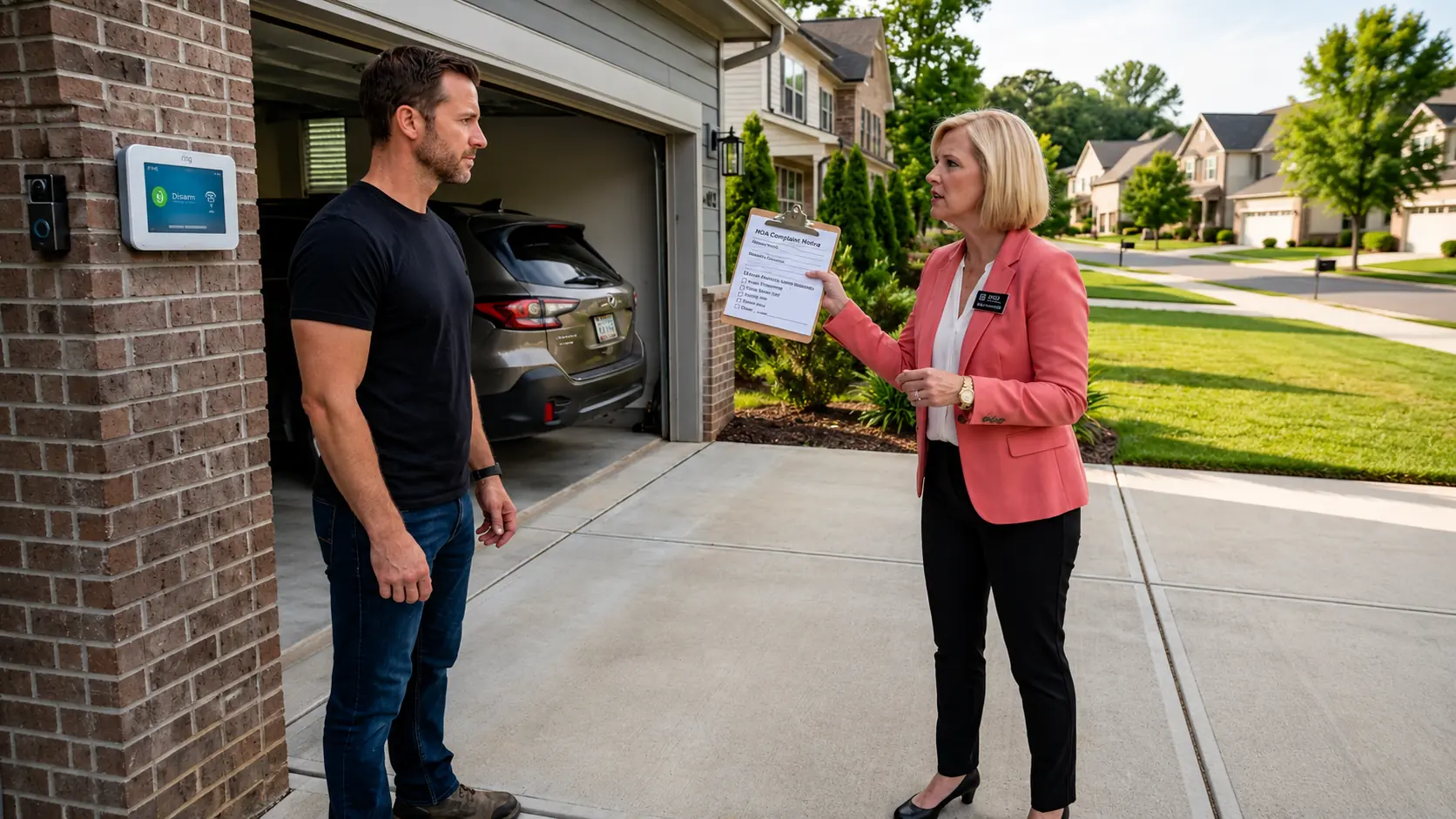
Most homeowners would have dismissed the difference as a router error. Ryan sat upright immediately.
At thirty-nine, he worked as a digital-forensics consultant who helped financial institutions, hospitals, and government agencies investigate network intrusions. He had spent fifteen years examining attacks that began with details most people ignored: one changed letter, a false login page, an unfamiliar device, or a signal appearing at the wrong hour.
He opened his laptop and began monitoring the local wireless environment.
The false network disappeared within forty seconds.
Before vanishing, it attempted to redirect three devices inside Ryan’s home: his living-room television, the smart thermostat, and the security camera overlooking his driveway.
Nothing connected because Ryan had separated every category of device onto isolated networks. His personal computers could not communicate directly with the thermostat. The cameras stored footage locally instead of sending it automatically to a cloud service. His front-door lock did not accept outside commands without a physical security token.
Ryan had designed the house that way because he trusted systems only after testing them.
Someone had just tested his.
The next morning, he walked his twelve-year-old daughter, Sophie, toward the school bus stop. Ryan had raised her alone since his wife, Megan, died from complications following surgery four years earlier. Sophie inherited her mother’s gray-green eyes, her stubborn patience, and her habit of asking questions adults hoped children would not notice.
“Why were you awake last night?” she asked.
“How do you know I was awake?”
“The hallway light came on.”
“I received a work alert.”
“Was somebody hacking us?”
Ryan looked down at her.
“Why would you think that?”
“You always turn on the hallway light when you’re checking the router.”
He smiled despite himself.
“You notice too much.”
“That means yes.”
“It means I’m investigating something.”
Sophie adjusted the straps of her backpack.
“Are we safe?”
“Yes.”
Ryan gave the answer confidently because it was true. The attempt had failed, and whoever created the false network had gained nothing.
But someone had been close enough to broadcast a strong signal near his home.
That concerned him.
Wakefield Oaks contained 184 houses arranged around a clubhouse, two small lakes, and a network of landscaped walking paths. The neighborhood had private security cameras at both entrances, automatic license-plate readers, and an HOA board that treated minor landscaping issues like national emergencies.
Linda Barrett had served as HOA president for three years.
She was fifty-five, with a sharp blonde bob, narrow blue eyes, and a rigid posture that made every conversation feel like an inspection. Linda wore coral-pink or light-pink blazers to most community meetings, always accompanied by an HOA badge and a thick clipboard.
She claimed the bright colors made her approachable.
No resident had ever described her that way.
Ryan’s first disagreement with Linda occurred two weeks after he moved into Wakefield Oaks. She demanded access to the camera mounted above his garage because the device faced part of a community sidewalk.
Ryan explained that the camera recorded only his driveway and stored footage on private equipment.
Linda sent him a violation notice anyway.
The notice disappeared after Ryan requested the specific section of the governing documents that gave the HOA authority over privately owned security cameras.
She never provided one.
A month later, she ordered residents to register every smart doorbell, wireless camera, digital lock, and home-automation controller with the HOA’s “Neighborhood Technology Committee.”
Ryan refused.
Linda responded with another warning.
He answered with a formal letter explaining that the association had no legal authority to demand passwords, encryption keys, private recordings, device serial numbers, or remote access to equipment inside his property.
After that, she stopped contacting him directly.
Until the false network appeared.
Ryan spent the next three evenings monitoring wireless traffic around the neighborhood. He drove slowly through Wakefield Oaks with a concealed receiver inside his SUV, mapping unusual signals without entering private property.
The false networks appeared in clusters.
One imitated the Wi-Fi belonging to an elderly couple on Hawthorne Lane.
Another copied the network name used by a family near the lake.
A third appeared outside the home of Dr. Alicia Morgan, a pediatric surgeon who had recently challenged the HOA over a wheelchair ramp installed for her visiting father.
Every copied signal behaved the same way.
It appeared late at night, attempted to redirect nearby devices, and disappeared before ordinary users would notice.
The strongest transmissions came from the area surrounding Linda Barrett’s home.
Ryan contacted Detective Maya Brooks with the North Carolina State Bureau of Investigation’s cybercrime unit. He had worked with Maya on several previous cases involving stolen medical records and financial fraud.
He described what he had discovered.
“Can you prove the broadcasts came from Linda’s property?” Maya asked.
“Not yet.”
“Could they be part of an authorized community system?”
“Authorized systems do not imitate private network names.”
“What would the attacker gain?”
“Credentials, camera access, smart-device control, browsing data, or entry into personal computers.”
Maya remained quiet for a moment.
“Has anyone reported theft?”
“Not to police.”
“That wasn’t my question.”
Ryan opened a folder of HOA complaints he had collected from public neighborhood forums.
“Residents have reported unexplained camera outages, false alarm activations, unauthorized smart-lock attempts, and private information appearing in violation notices.”
“What kind of private information?”
“One family received a notice accusing them of operating a home business because shipping invoices were visible inside their garage. The HOA included details that could not be seen from the street.”
Maya’s voice sharpened.
“Anything else?”
“A couple was fined for allowing a guest to live with them for more than thirty days. The board cited dates matching private driveway-camera records.”
“Did the homeowners provide the footage?”
“They say no.”
Ryan sent her the signal logs.
Maya promised to begin the process of obtaining legal authorization for a deeper investigation.
Until then, Ryan was instructed not to confront Linda.
He agreed.
Linda confronted him first.
On Monday afternoon, Ryan was repairing a motion sensor beside his garage when a white HOA utility cart stopped at the edge of his driveway.
Linda stepped out wearing a fitted light-pink blazer over a white blouse, black trousers, and low heels. Her HOA badge was pinned beside a round button reading CONNECTED COMMUNITY LEADER.
She carried a clipboard and a tablet.
“Mr. Carter.”
Ryan remained beside the garage wall.
“Linda.”
She walked directly onto his driveway.
“I need your Wi-Fi password now.”
Ryan stared at her.
“Excuse me... no.”
“It is required for the neighborhood grid.”
“There is no neighborhood grid connected to my home.”
“There will be.”
Linda turned the clipboard toward him. The top page was titled Mandatory Community Network Integration Form.
Ryan read the first paragraph.
The form requested the homeowner’s network name, password, router model, security-camera login information, smart-lock credentials, alarm code, and permission for remote diagnostic access.
It was not merely inappropriate.
It was dangerous.
Ryan looked at her.
“Who created this document?”
“The Technology Committee.”
“Who is on the committee?”
“That information is internal.”
“You’re asking for access to every connected device inside my house.”
“It’s for the neighborhood grid. Give it.”
Ryan stepped between Linda and the smart-home control panel near his garage.
“No.”
Her expression hardened.
“This is not optional.”
“It is not lawful.”
“The board approved it unanimously.”
“The board cannot vote itself access to my private network.”
Linda lifted her chin.
“You agreed to community technology standards when you purchased this home.”
“I agreed that exterior equipment would meet installation guidelines. I did not authorize you to enter my computers.”
“You’re being dramatic.”
“You’re requesting the password protecting my daughter’s devices, financial records, cameras, and home-security system.”
“The HOA would never examine personal data.”
“Then you do not need access.”
Linda tapped the clipboard sharply.
“Every cooperative homeowner has already complied.”
Ryan knew that was false. He had spoken with six neighbors that morning. None had received the form.
“Which homeowner gave you a password?”
“I will not violate resident confidentiality.”
“You’re standing on my driveway asking me to violate mine.”
Linda took another step.
“If you refuse, the board will impose a daily technology-compliance fine.”
“How much?”
“Five hundred dollars.”
“Show me the governing provision.”
“The board’s emergency security authority.”
“There is no such authority.”
“There is now.”
Ryan almost admired the confidence required to invent rules while standing in front of someone who had already read every page of the community documents.
“Leave my property.”
Linda’s eyes narrowed.
“You are interfering with neighborhood security.”
“I’m protecting my home from an unauthorized access attempt.”
“What access attempt?”
The question came too quickly.
Ryan watched her face.
“I didn’t say when it happened.”
Linda gripped the clipboard more tightly.
“You have complained about network security before.”
“No. I complained about your camera-registration demand.”
“That is what I meant.”
Ryan raised his phone.
“Try taking my password. Cybercrime officers are tracing your house.”
For the first time, Linda’s confidence broke.
Only for a second.
Then she laughed.
“You expect me to believe police are investigating a community Wi-Fi program?”
“I expect you to leave.”
“I will return tomorrow with the association attorney.”
“Bring him.”
“I’ll bring security too.”
“Bring everyone whose name appears on that form.”
Linda pointed toward him.
“You moved into this neighborhood and immediately decided the rules did not apply to you.”
“I decided rules must actually exist before you enforce them.”
“You are putting every family at risk.”
“No. Whoever is broadcasting fake networks is doing that.”
Linda’s face became still.
Ryan continued.
“Whoever built the system made several mistakes.”
She said nothing.
“The copied networks use identical timing patterns. The transmitting equipment rotates through the same hardware addresses. And every signal becomes strongest near one house.”
Linda stepped backward.
“You’re trying to frighten me.”
“No.”
Ryan held her stare.
“I’m giving you one chance to stop.”
She turned and marched toward the utility cart.
“You will receive the maximum fine before sunset.”
Ryan watched her drive away.
Then he looked toward the camera above his garage.
It had recorded everything.
Maya arrived forty minutes later in an unmarked sedan. Ryan transferred the footage and showed her the form Linda had left behind in her anger.
Maya read the requested information twice.
“This form asks residents to surrender complete access.”
“Yes.”
“Any legitimate technology contractor would refuse to deploy this.”
“That assumes the contractor is legitimate.”
Maya examined the footer.
The document listed a company called Community Grid Solutions LLC.
A search of state business records revealed the company had been created fourteen months earlier. Its registered address was a private mailbox in Raleigh.
The organizer was Eric Barrett.
Linda’s thirty-year-old son.
Financial records required a warrant, but the public registration was enough to establish a direct link.
Maya looked at Ryan.
“We’re moving faster.”
The cybercrime unit obtained court authorization to monitor the rogue broadcasts and seize records associated with Community Grid Solutions. Investigators installed receivers outside the neighborhood on public property.
Within two nights, they documented more than sixty unauthorized attempts to imitate resident networks.
Several attempts successfully captured login information.
The stolen credentials traveled through an encrypted connection to a server inside Linda’s home.
Investigators also discovered that the HOA’s entrance cameras were sending duplicate recordings to the same server. License-plate data, visitor logs, delivery times, and residents’ movements had been copied for more than a year.
Then a resident named Jennifer Walsh reported a strange incident.
Her teenage son returned home from school and found the front door unlocked. Nothing had been stolen, but the smart-lock history showed that an administrator code opened the door at 1:17 p.m.
Jennifer had never created an administrator code.
The manufacturer confirmed the code was added remotely through her compromised Wi-Fi account.
Maya called Ryan immediately.
“This is no longer only unauthorized network access.”
“Someone entered the house?”
“We don’t know yet. The door camera was disabled three minutes before the lock opened.”
“Who did Jennifer recently challenge?”
“The HOA fined her for parking a medical-care vehicle overnight.”
Ryan already knew the answer.
Linda had wanted access to Jennifer’s house.
The question was why.
A search warrant was prepared for Linda’s residence, the HOA office, and a small equipment room beneath the community clubhouse.
Before officers could execute it, Linda called an emergency HOA meeting.
Every homeowner received a message claiming the neighborhood faced an immediate cyberattack caused by residents who refused to join the community grid. The notice identified Ryan as the primary security risk.
His name appeared in bold letters.
Linda accused him of disrupting cameras, interfering with access systems, and exposing families to criminals.
Sophie read the notice before Ryan returned from work.
“Is she saying you’re a hacker?”
“She’s saying many things.”
“People at school will see it.”
“I know.”
“Can’t you make her delete it?”
“Not yet.”
Sophie looked angry enough to cry.
“She’s lying about you.”
Ryan crouched in front of her.
“Facts do not stop being facts because someone sends a louder email.”
“That doesn’t help when everybody believes the email first.”
She was right.
Ryan had spent years telling clients to trust evidence, but children lived in a world where lies traveled faster than investigations.
“I’m sorry you’re caught in this.”
“Did you do anything wrong?”
“No.”
“Then I’m okay.”
She hugged him briefly before heading upstairs.
Ryan remained near the kitchen table, looking at the HOA notice on his phone.
Linda had now threatened his daughter’s sense of safety.
He still did not contact her.
At seven that evening, the clubhouse filled with residents.
Linda stood at the front wearing another light-pink blazer, surrounded by presentation screens showing maps of the neighborhood. Eric Barrett operated a laptop beside her. He wore an expensive sweater and introduced himself as the founder of Community Grid Solutions.
Ryan sat near the rear with Maya, who wore plain clothes and carried court documents inside a black folder.
Linda began without allowing questions.
“Wakefield Oaks is under coordinated digital attack.”
A map displayed red circles around several houses.
“The attack originates from unregistered private technology operating outside HOA supervision.”
The screen changed to a photograph of Ryan’s house.
Residents turned toward him.
Linda pointed.
“Mr. Carter has refused every reasonable security requirement. His private equipment has interfered with our neighborhood systems and placed all of us at risk.”
Ryan raised one hand.
“May I respond?”
“You will have time after the board votes.”
“What are you asking them to approve?”
“Immediate mandatory integration.”
The next slide displayed the same form Linda brought to his driveway.
Residents began whispering when they saw requests for passwords, camera access, lock credentials, and alarm codes.
Dr. Alicia Morgan stood.
“You want my security password?”
“The system requires centralized administration.”
“No.”
Linda’s expression tightened.
“This is not an individual choice.”
A man near the front raised his hand.
“Did you already access our cameras?”
“Only devices enrolled in the pilot program.”
“I never enrolled.”
Linda ignored him.
Ryan stood.
“Where is the data stored?”
Eric answered.
“Secure regional infrastructure.”
“Which region?”
“That is proprietary.”
“What encryption standard?”
“Industry standard.”
“That is not an answer.”
Linda pointed toward Ryan.
“This obstruction is exactly why emergency authority is necessary.”
Maya quietly sent a message.
Outside, unmarked vehicles began moving toward Linda’s house.
Ryan looked at Eric.
“Does Community Grid Solutions possess a state security-services license?”
Eric closed the laptop slightly.
“We provide technology consulting.”
“Does it hold cybersecurity insurance?”
“That is irrelevant.”
“Does it have authorization to collect license plates, visitor records, home-camera footage, or smart-lock credentials?”
Linda stepped between them.
“You are not conducting an interrogation.”
“No.”
Ryan looked toward the clubhouse windows.
“She is.”
Blue lights appeared beyond the trees.
The room fell silent.
Several marked patrol vehicles entered the neighborhood from both gates. State cybercrime investigators followed in dark SUVs, while another team turned toward the clubhouse.
Linda stared through the glass.
“What did you do?”
Ryan remained calm.
“I refused to give you my password.”
Maya stood and displayed her identification.
“Linda Barrett and Eric Barrett, do not touch the laptop or any mobile device.”
Eric immediately reached toward the keyboard.
Maya caught his wrist.
“Step away.”
Linda’s voice rose.
“This is an HOA meeting. You have no authority here.”
Maya opened the black folder.
“This warrant authorizes the search of the clubhouse equipment room, Community Grid Solutions, your residence, your vehicles, and every device used to operate the unauthorized network.”
Residents began standing.
Linda looked toward the screens.
“The network belongs to the association.”
“The association did not approve what we found.”
“The board voted.”
“Your meeting records show no vote authorizing credential theft, copied networks, remote entry into private homes, or interception of personal data.”
Jennifer Walsh moved through the crowd.
“You opened my front door.”
Linda faced her.
“I did no such thing.”
Maya looked toward Eric.
“The administrator code came from his server.”
Eric’s face lost color.
Officers entered the clubhouse and secured the laptop. A second team moved downstairs to the locked equipment room.
Inside, they discovered rows of small network devices configured to imitate residents’ Wi-Fi signals. Several computers stored camera recordings, browsing histories, email credentials, scanned documents, and photographs collected from private devices.
One folder contained information organized by address.
Each homeowner had a file.
Some contained financial details.
Others contained family schedules, medical appointments, visitor photographs, and private conversations captured through compromised smart speakers.
Ryan’s file was marked HIGH RISK.
Sophie’s school schedule appeared inside it.
Ryan stared at the screen.
Maya saw his expression.
“We’ll document it.”
“They tracked my daughter.”
“Yes.”
Linda stood several feet away between two officers.
“I never approved information about children.”
Eric turned toward her.
“You told me to gather leverage.”
The clubhouse became completely silent.
Linda looked at her son.
“Stop talking.”
“You said we needed information to make residents cooperate.”
“I said compliance data.”
“You used Jennifer’s code.”
“You opened the door.”
“You told me the violation photographs were inside.”
Jennifer stepped forward, but an officer gently stopped her.
“What were you looking for?” she demanded.
Linda said nothing.
Investigators later found the answer inside Jennifer’s home-office computer. She had collected evidence showing HOA funds transferred to Community Grid Solutions through inflated technology contracts.
Linda wanted the files before Jennifer could give them to other board members.
The network had begun as a financial scheme.
The HOA paid Eric’s company nearly $480,000 for community cybersecurity services that were never independently reviewed. Linda received part of the money through a consulting company hidden behind several transfers.
When homeowners questioned the expenses, Linda and Eric used stolen information to pressure them.
One resident withdrew an audit request after Linda threatened to expose an undisclosed medical condition.
Another stopped challenging landscaping contracts after private messages about his struggling marriage appeared anonymously in his mailbox.
A third family sold their home after the HOA repeatedly cited information obtained from cameras inside their garage.
The neighborhood grid was never designed to protect residents.
It was designed to control them.
Officers searched Linda’s house until after midnight.
Patrol vehicles surrounded the property while investigators carried out computers, routers, storage drives, cameras, and boxes of HOA records. Neighbors watched from sidewalks as the woman who demanded access to every home lost control of her own front door.
Ryan remained with Sophie across the street.
Linda emerged wearing the same light-pink blazer, though the confidence had disappeared from her posture. Her hands were secured in front of her.
She saw Ryan.
“This is your fault.”
Ryan looked at the officers around her house.
“You built the network.”
“You turned everyone against me.”
“You recorded them.”
“I protected this neighborhood.”
“You collected their passwords.”
“People cannot be trusted to make responsible security decisions.”
Ryan’s expression became cold.
“That sentence is why you should never control anyone’s security.”
Linda looked toward Sophie.
“You don’t understand what your father has done.”
Ryan stepped between them.
“Do not speak to my daughter.”
An officer guided Linda toward the patrol car.
She twisted back toward Ryan.
“You think this community will thank you when every system stops working?”
“The real systems will keep working.”
“What real systems?”
“Locks people control themselves. Cameras they own. Passwords they never gave you.”
The patrol-car door closed.
Eric was taken into custody minutes later.
The emergency HOA board resigned before sunrise.
During the following weeks, investigators notified every affected resident. More than 130 households had data stored inside Linda’s system. Seventy-one had experienced confirmed credential theft. Twenty-three smart-home systems had received unauthorized commands.
The state required the HOA to fund professional security repairs for every resident.
Passwords were reset.
Compromised routers were replaced.
Smart locks were reprogrammed.
Private recordings were identified and secured as evidence.
Ryan volunteered to lead free workshops explaining how residents could protect their networks without surrendering control to anyone. He refused payment.
At the first session, Jennifer asked the question many people were thinking.
“How did we let this happen?”
Ryan stood beside a simple diagram of a home network.
“Because the request arrived with an HOA badge instead of a criminal warning.”
No one spoke.
“People assume danger looks secretive. Sometimes it arrives with a clipboard, a committee name, and a deadline.”
Dr. Morgan raised her hand.
“What should we have asked?”
“Who needs access? Why do they need it? What exact information will they collect? Where will it be stored? Who can see it? How do we remove access?”
“And if they refuse to answer?”
“Do not give them anything.”
Linda and Eric were eventually charged with computer trespass, identity theft, unlawful interception, burglary conspiracy, extortion, fraud, and illegal access to protected devices. Additional charges involved HOA funds routed through their private company.
Eric accepted a plea agreement and testified against his mother.
Linda insisted the system was an aggressive security program misunderstood by technically uninformed residents.
The evidence showed otherwise.
Prosecutors played her recorded driveway confrontation with Ryan.
“I need your Wi-Fi password now.”
Then they displayed the files taken from her server.
The jury saw home addresses, private recordings, stolen credentials, financial records, medical information, and Sophie’s school schedule.
Linda was convicted on the most serious charges.
She received thirteen years in prison and was ordered to pay restitution with her son and their company.
Wakefield Oaks rewrote its technology rules completely.
The HOA could maintain entrance cameras and clubhouse systems, but it could not request passwords, private recordings, device access, or household network information. Every technology contract required independent review and approval by homeowners.
Jennifer became the new board treasurer.
Dr. Morgan chaired a privacy committee with no authority to access anyone’s devices. Its job was education, not control.
Ryan refused every invitation to run for president.
“I already have a full-time job,” he said. “And nobody should trust one person with that much unsupervised access.”
Months later, he stood in his driveway replacing the motion sensor Linda had interrupted on the day of her demand.
Sophie held the ladder steady.
“Is the neighborhood safe now?” she asked.
“Safer.”
“Not completely safe?”
“No system is completely safe.”
She frowned.
“That sounds like something from one of your workshops.”
“It is.”
“What makes it safer?”
Ryan tightened the final screw.
“People learned to ask questions.”
Sophie looked toward Linda’s former house. A new family had moved in, and the equipment used to operate the illegal network was gone.
“Would all this have happened if you gave her the password?”
Ryan climbed down.
“It might have taken longer to discover.”
“But you knew not to.”
“Yes.”
“How?”
“Because a password is not just a word.”
He closed the toolbox.
“It is permission. Anyone demanding permission without explaining exactly why they need it should not receive it.”
Sophie nodded toward the house.
“So what’s our new password?”
Ryan stared at her.
“Nice try.”
She laughed and ran toward the front door.
Wakefield Oaks had once treated Linda’s authority as something residents could not challenge. She placed the HOA logo on a form, called surveillance a security program, and expected fear of fines to overcome common sense.
For a long time, it worked.
Then she walked onto Ryan Carter’s driveway and demanded entry into the wrong home.
He did not shout.
He did not threaten her.
He simply said no, preserved the evidence, and allowed her own network to reveal where every stolen signal led.
Straight back to her house.