Marcus Bennett heard the impact before he saw what had happened.
It came through the open kitchen window as a hard metallic crack followed by the scrape of plastic against concrete. Marcus stopped halfway through pouring coffee and looked toward the front of his house.
For a second, everything went quiet.
Then a woman shouted.
“I warned you people about this thing!”
Marcus set the coffee pot down.
He already knew the voice.
Cynthia Holloway.
He moved through the foyer, opened the front door, and stepped onto the porch.
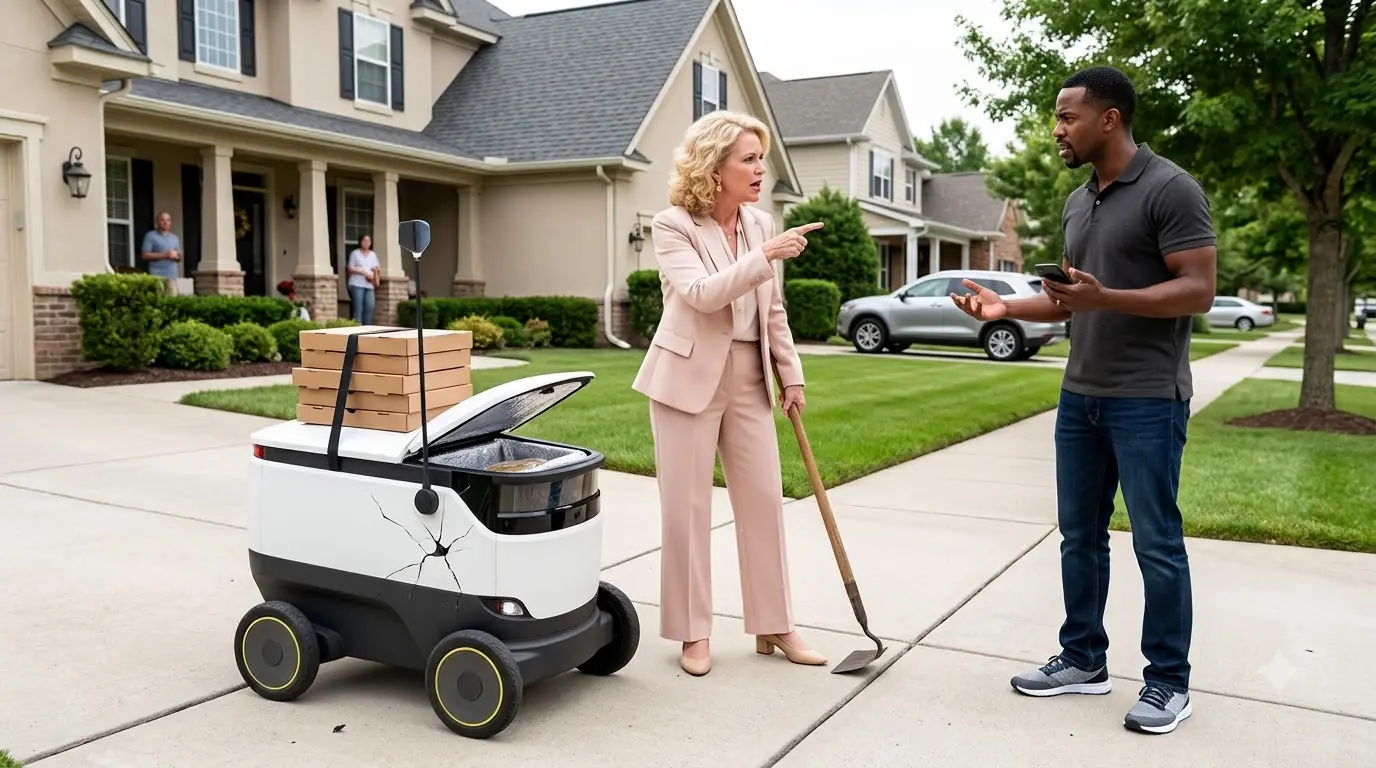
The white delivery robot was sitting crooked in the middle of his driveway.
One of its side panels had cracked open.
Two cardboard meal boxes were still strapped across the top platform, but the black securing band had shifted. The front-left wheel sat at an unnatural angle. A blue status light that normally ran smoothly along the side now blinked irregularly.
And beside it stood Cynthia Holloway holding a wooden-handled garden hoe.
She looked almost absurdly polished for somebody who had apparently just struck a robot.
Cynthia was fifty-six, fair-skinned, blonde, and always dressed as though someone might photograph her for a neighborhood magazine. That afternoon she wore a pale blush-pink tailored blazer with matching trousers, a cream blouse, small gold earrings, and beige heels.
Her shoulder-length blonde hair had been arranged in soft curls.
Her expression was not apologetic.
It was furious.
Marcus stared at the damaged machine.
Then he looked at the hoe.
Then back at Cynthia.
“What did you do?”
Cynthia pointed at the robot.
“I stopped it.”
Marcus stepped off the porch.
“Stopped it how?”
“You know exactly how.”
“No, Cynthia. I don’t.”
She gave him the tight smile she used when she believed a conversation had already been settled in her favor.
“These machines are not authorized in Brookstone Preserve.”
Marcus walked closer.
“You hit it?”
“It was operating on private community streets.”
“You hit it with a garden tool?”
“I removed an unauthorized hazard.”
Marcus looked at the cracked panel again.
A few neighbors had begun appearing.
Across the street, Greg Palmer stood near his mailbox.
Two houses down, a woman named Denise Holloway, no relation to Cynthia, had stepped out onto her porch.
Someone farther down the sidewalk lifted a phone.
Marcus kept his voice low.
“That machine belongs to me.”
Cynthia scoffed.
“Then you should have kept it on your property.”
“It was on my driveway when you hit it.”
“It was heading toward the sidewalk.”
Marcus pulled his phone from his pocket.
“Good.”
Cynthia frowned.
“What?”
“Say that again.”
Her expression hardened.
“Don’t try to intimidate me.”
“I’m not.”
Marcus opened the robot-control application.
“Say exactly what you just said.”
Cynthia pointed the hoe toward the machine.
“I said I stopped an unauthorized commercial device from entering a residential common area.”
Marcus looked at the screen.
The robot had been traveling at 2.8 miles per hour before the impact.
Its location log showed it had never left his driveway.
He tapped another menu.
Impact detected: 3:42:17 p.m.
External force, left side.
Camera buffer saved automatically.
Marcus looked up.
“You hit it while it was still on my property.”
Cynthia crossed her arms.
“Your driveway is subject to HOA jurisdiction.”
“That does not make my property yours.”
“You signed community covenants.”
“I signed rules about maintenance.”
“You signed more than that.”
Marcus looked at the machine.
One corner of the upper compartment had popped loose.
Something silver was visible inside.
Cynthia noticed it too.
She took one step closer.
Marcus raised a hand.
“Don’t touch it.”
Her head snapped toward him.
“Excuse me?”
“You’ve already damaged it. Don’t touch anything else.”
“You don’t order me around.”
“This is my property.”
“I am the HOA president.”
“That doesn’t change the sentence.”
The neighbors watching from across the street became very still.
Cynthia’s jaw tightened.
Marcus knew that expression.
He had seen it at board meetings.
He had seen it at his own front door.
He had seen it the previous summer when she tried to fine him for replacing two drought-damaged shrubs with a variety that had been approved by the landscape committee three years earlier.
Cynthia Holloway did not enjoy hearing no.
She enjoyed hearing no even less when other people could hear it.
She lowered the hoe.
“Open it.”
Marcus stared at her.
“What?”
“If you’re going to pretend this is some important machine, open it.”
Marcus did not move.
Cynthia gestured toward the boxes.
“What is it carrying? Hamburgers?”
Marcus’s expression changed.
Not dramatically.
Just enough that Cynthia noticed.
She smiled.
“That’s what I thought.”
Marcus looked at the cracked compartment.
“No.”
“No what?”
“It isn’t hamburgers.”
Cynthia stepped closer.
“Then open it.”
Marcus hesitated.
Not because he was hiding anything.
Because the machine had been scheduled to make three deliveries.
Its route had been approved.
Its payload had been sealed.
And he had no intention of opening somebody else’s meal package on his driveway merely to satisfy Cynthia Holloway’s curiosity.
He crouched beside the robot instead.
The upper locking mechanism had partially disengaged from the impact.
Through the gap, he could see the edge of the insulated interior.
One container had shifted forward.
The white label was visible.
Cynthia bent slightly.
Then she read it.
Her expression changed.
POST-DISCHARGE CARDIAC MEAL PLAN.
RECIPIENT: EVELYN PRICE.
LOW SODIUM.
DIETITIAN APPROVED.
KEEP REFRIGERATED.
Cynthia stopped smiling.
Marcus looked at her.
She looked deeper into the compartment.
There were several packages.
Not takeout.
Not pizza.
Not hamburgers.
Sealed, labeled meals.
Each packed inside temperature-controlled liners.
One read:
ARTHUR COLEMAN.
DIABETIC-FRIENDLY MEAL PROGRAM.
Another:
MARJORIE WELLS.
RENAL DIET.
COUNTY SENIOR NUTRITION PILOT.
Cynthia straightened.
“What is this?”
Marcus stood.
“A delivery.”
“I can see that.”
“So why did you ask?”
“What kind of delivery?”
Marcus looked around at the neighbors now watching closely.
Then back at Cynthia.
“Medically tailored meals.”
Cynthia’s grip tightened around the hoe.
“For who?”
“People who can’t easily leave home.”
She stared at the labels again.
“These are residents here?”
“One is.”
“Which one?”
“That’s not your business.”
Cynthia’s mouth opened.
Marcus continued.
“The other deliveries are outside the subdivision.”
She looked toward the robot.
“You’re running a commercial operation from your house.”
“No.”
“You just admitted it.”
“I said the robot was making deliveries.”
“That’s commercial activity.”
Marcus shook his head.
“It’s a pilot program.”
Cynthia paused.
“What pilot program?”
Marcus pointed toward the inner compartment.
“Look at the silver box.”
She did.
A small sealed unit was fixed against the interior wall.
A municipal property tag was visible.
FULTON COUNTY MOBILITY LAB.
AUTONOMOUS DELIVERY SAFETY PILOT.
Cynthia’s face lost another degree of color.
Marcus watched her read it.
Then she looked at him.
“What is that?”
“Data recorder.”
Her eyes narrowed.
“For what?”
“The robot.”
“What does it record?”
Marcus looked toward the damaged wheel.
“Location.”
Cynthia said nothing.
“Speed.”
Silence.
“Temperature.”
Her expression tightened.
“System status.”
He paused.
“And incident video.”
Cynthia stared at him.
One of the neighbors across the street whispered something.
Cynthia heard it.
“Incident video?”
Marcus lifted his phone.
“The robot records continuously when moving.”
“That’s illegal.”
“No.”
“You can’t film people without permission.”
“It films public travel space for obstacle avoidance.”
“This is a private HOA.”
“The streets are publicly maintained.”
Cynthia looked toward the robot again.
Then toward the front-facing sensor unit.
A circular camera sat behind the dark glass panel.
For the first time since Marcus stepped outside, Cynthia looked uncertain.
“What did it record?”
Marcus did not answer immediately.
Cynthia took a step toward him.
“What did it record?”
Marcus looked at the wooden hoe in her hand.
“What do you think?”