“Punch it, Cody. Just punch it. That sign doesn’t mean a thing.”
Tessa Hulcom stood in tennis whites and a pink visor, waving a massive Hulcom Paving dump truck toward my covered bridge, a structure posted for a maximum of 10,000 pounds.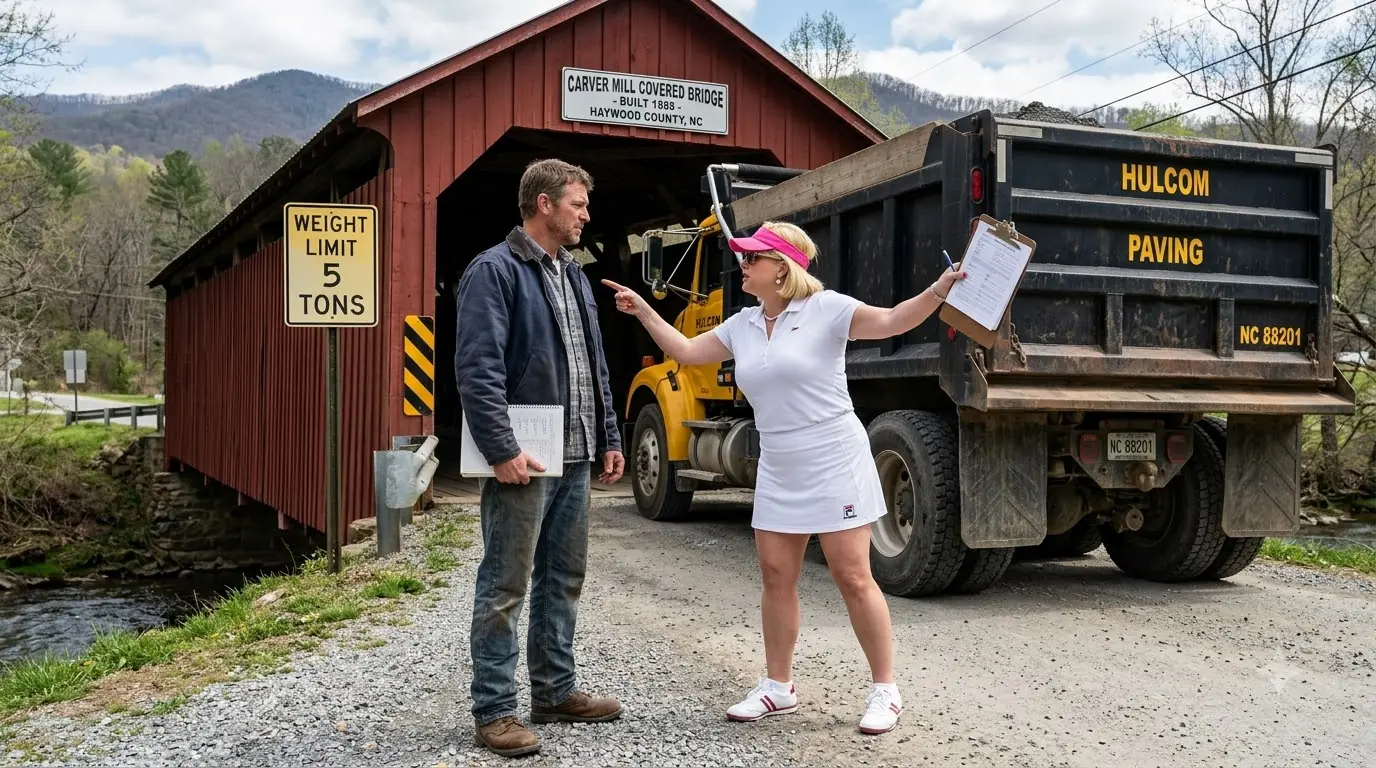
The bridge was called Carver Mill Bridge.
My great-grandfather built it in 1923. My father rebuilt it in 2008, eight months before he taught me how to drive a piling properly. The dump truck approaching it that morning weighed more than five times the posted limit.
My eleven-year-old daughter, Tully, had warned Tessa six hours earlier to stay away from our property.
Tessa had not listened.
The first crack came while the truck was barely crawling across the span.
The second came when the rear axle punched through the deck planks thirty-two feet beyond the south portal.
I did not yell.
I did not move.
I simply stepped behind a cedar stump and watched the monitoring dashboard in front of me turn green.
Twenty-two minutes later, the situation that Tessa Hulcom had spent nearly two years creating was no longer a private dispute over an old bridge.
Multiple agencies were arriving.
Evidence was already moving through official channels.
And before the morning was over, the woman who had spent months telling me that the rules did not apply to her would finally understand exactly how wrong she had been.
My name is Brennan Carver.
I’m forty-four years old, and I’m the third generation of Carver men responsible for keeping a covered bridge standing over Sourwood Creek in Haywood County, North Carolina.
Carver Mill Bridge is 156 feet long, a single-span Town lattice truss bridge covered in cedar siding stained the same dark red my great-grandfather Augustus Carver mixed by hand in 1923.
Augustus built it from white oak cut from the back of his farm.
He and his brothers finished the bridge in seventy-one days.
They built it because the only crossing over Sourwood Creek had been a washed-out wagon ford. During a March flood, a neighbor named Esau Lynn had been swept away trying to get home.
Augustus believed a man should not lose his life simply because there was no safe way across a creek.
My grandfather, Cyrus Carver, looked after the bridge for forty-eight years.
My father, Wendell Carver, inherited that responsibility after him.
In 2008, severe weather damaged the south truss badly enough that the bridge needed a major rebuild. My father handled the restoration using materials I helped him source and load.
He passed away in February of last year.
Heart attack.
Saturday morning.
He was mowing the upstream bank with a push mower he had owned since 1991.
He was sixty-eight years old.
He had completed half of his second pass when his heart stopped.
Two days after his funeral, I drove to the bridge alone.
I put my forehead against the cedar siding and stood there until my hands stopped shaking.
The bridge smelled like cedar tar, creek water, and the inside of my father’s old truck.
Standing there, I finally understood that I had inherited more than land and timber.
I had inherited a responsibility.
The bridge has a posted weight limit of five tons.
Ten thousand pounds.
For ordinary residential traffic, that is more than enough.
For heavy commercial equipment, it is nowhere close.
That number is not sentimental.
It is not arbitrary.
It comes from engineering.
My father redid the load calculations during the 2008 restoration with help from a Tennessee professor named Eldred Ashby, who specialized in historic timber spans.
The five-ton limit is the safe number.
I know because I checked the calculations myself.
I am a North Carolina licensed professional engineer.
I run Carver Engineering Services from a converted feed store in Waynesville. My specialty is historic bridge restoration.
The work is small, careful, and usually quiet.
I also have a daughter.
Her full name is Tulia, but everybody who knows her calls her Tully.
She is eleven years old and lives primarily with me. Every other weekend she stays with her mother, Adrienne, in Asheville.
Adrienne and I divorced in 2021.
Nobody cheated.
Nobody threw furniture.
Nobody became a villain.
We simply reached the difficult conclusion that we worked better as parents than as husband and wife.
We remained on good terms.
We co-parent like adults.
Tully believes both of us are strange, which I consider evidence that she is developing normally.
About six years ago, a development called Eagle Ridge Mountain Estates was built on the high plateau above my farm.
Forty-two custom homes.
Gated entrance.
Clubhouse.
Infinity pool.
Decorative deer on the gateposts.
The type of mountain development built to look rustic while somehow requiring millions of dollars to accomplish it.
The only practical road into Eagle Ridge crosses Sourwood Creek.
It crosses on Carver Mill Bridge.
My grandfather had granted a recorded easement to the original Eagle Ridge developer in 1971.
The easement permitted residential traffic.
It specifically prohibited heavy commercial vehicles, construction equipment, and anything exceeding the posted bridge limit.
For the first several years, the arrangement worked.
Residents drove across in pickups, SUVs, sedans, and the occasional horse trailer light enough to remain within the bridge’s capacity.
Then Tessa Hulcom became president of the Eagle Ridge HOA in the summer of 2022.
Tessa was forty-three, blonde, polished, and slightly heavyset, with a carefully cultivated smile that always seemed to arrive half a second before anything sincere could.
Her husband, Roland Hulcom, operated Hulcom Paving and Excavation out of Maggie Valley.
They lived in one of the largest homes in Eagle Ridge.
Three Range Rovers.
A horse trailer.
A daughter attending private school in Asheville who, by every account I ever heard, was a perfectly nice kid.
A concrete truck.
A roll-off dumpster.
A moving van.
Then it became larger.
The first concrete truck crossed my bridge on a Tuesday morning in October 2022.
I was in my Waynesville office drafting load calculations for a stone arch restoration near Marshall when my phone buzzed with a motion alert from one of the trail cameras my father had installed near the bridge in 2018.
He had originally installed them because hunters occasionally treated the bridge approach like a public pull-off.
I opened the video.
A large concrete truck bearing the Hulcom Paving logo was rolling across Carver Mill Bridge.
It was loaded.
Even without a scale, I knew enough from the vehicle configuration to understand that it was many times heavier than the bridge limit.
I was in my truck within minutes.
By the time I reached Eagle Ridge, the concrete truck was already inside the development pouring a foundation for a new house on Lot 28.
Tessa Hulcom stood in the cul-de-sac wearing a peach blouse, phone in hand.
She saw my F-150 approach.
Her smile did not change.
“Brennan. Good morning.”
“Tessa. That concrete truck just crossed my bridge.”
“It did. They have a foundation to pour.”
“The bridge is rated for ten thousand pounds. That truck is several times heavier than that.”
She tilted her head.
“Brennan, ranchers have been driving cattle trailers over that bridge for decades. A concrete truck is not the end of the world.”
“The easement does not permit commercial vehicles. The posted weight limit exists for a reason. Your contractor is going to damage my bridge.”
Her smile became brighter.
“If you’re uncomfortable with the way our community uses the easement, you’re welcome to file a lawsuit. Until you do, the contractors are going to keep coming. We have eleven new builds scheduled.”
She paused.
“Roland thinks you should consider replacing that old thing with something modern.”
There it was.
Roland Hulcom wanted a modern steel-and-concrete span.
If I paid for one, his company could run commercial equipment across Sourwood Creek without worrying about a bridge designed in 1923.
I drove home that afternoon and pulled my father’s bridge files from the corner cabinet.
Then I pulled my field notes.
Then the recorded easement.
I sat at the kitchen table and read every page until I knew the document by heart.
After that, I called the North Carolina Department of Transportation district office in Sylva.
I spoke with a bridge engineer named Granger Pelum.
Granger knew Carver Mill Bridge.
He had inspected it twice during his career.
When I described the concrete truck, he went quiet.
“Brennan, a single severely overweight crossing on a historic timber truss can create damage that doesn’t show immediately.”
He explained what I already knew but needed to hear from another engineer.
Deck members compress.
Connections loosen.
Timber develops fractures.
One crossing might not destroy the bridge.
Repeated crossings could.
“If they keep doing it,” he said, “you are eventually going to have a structural failure.”
There was a pause.
I could hear papers moving on his end.
Granger had known my father.
He had signed off on the 2008 restoration after spending hours walking the bridge with Wendell on a rainy April afternoon.
He was sixty-one and only a few years from retirement.
When he spoke again, his voice changed.
“Brennan, I’ll tell you something I’ve been looking at for almost two years. There’s a pattern in western North Carolina. Small private bridges get used by developments that should be paying for proper commercial access. The heavy traffic damages the bridge, and eventually somebody proposes replacing it.”
He had files involving other private crossings.
Different towns.
Different developments.
Same pattern.
“Can DOT stop them?” I asked.
“Not directly. The easement itself is private property law. But commercial vehicles still have regulations. If you can document what is crossing, when it crosses, and where it goes, other agencies may become interested.”
I asked what mattered most.
“Documentation?”
“Documentation.”
I almost smiled.
That was something I could do.
That evening, Tully rode with me to the bridge.
She carried my flashlight while I inspected the deck, trusses, connections, and lower structural members.
I found three new stress fractures along the south truss.
They had not been there during my previous inspection six weeks earlier.
Two were hairline.
The third ran several feet along the underside of one timber member.
My father would have called it a warning.
I called it a clock.
I marked each fracture.
Photographed each one with a scale reference.
Logged each in the bridge inspection notebook my father had started in 1989 and that I had continued maintaining after 2008.
When I finished, I sat on the creek bank with my elbows on my knees.
Tully sat beside me in muddy rubber boots.
She put one hand on my arm.
“Daddy, is the bridge going to break?”
I told her the truth.
“It might, kiddo. If we don’t stop them.”
She thought for a second.
“Then we stop them.”
Tessa Hulcom did not wait for me to file anything.
Three days after our conversation about the concrete truck, a thick manila envelope arrived.
Inside was a sixteen-page document titled Amendment to the Sourwood Creek Crossing Easement.
It was dated retroactively to January 1, 2022.
The document claimed to modernize the easement by removing restrictions on commercial vehicles, removing references to the weight limit, and giving the HOA broad access rights for community development.
It carried Tessa’s signature.
Roland’s.
Two HOA board members named Felton Brackett and Daria Pell.
It did not carry mine.
That mattered because the HOA did not own my land.
The easement burdened my property.
Only the property owner had authority to agree to that kind of amendment.
The HOA had effectively written a document declaring that it could rewrite my private property rights without my consent.
I scanned every page.
Then I sent the entire thing to my attorney in Asheville, Whitlock Trit, a slow-talking land-use specialist who had spent twenty-seven years fighting real-estate cases across western North Carolina.
He called me back eight minutes later.
“Brennan, do not lose this document.”
“I have three copies.”
“Make five.”
“What do you think?”
“I think they just handed us evidence that four HOA officers knowingly believe they can change a private easement without the landowner.”
“What do I send back?”
“Nothing.”
“Nothing?”
“Nothing.”
He explained his reasoning.
If I immediately wrote Tessa a legal lesson, I might make her more careful.
If I remained quiet, she might continue documenting her own conduct.
“Let her dig,” Whitlock said.
So I stayed silent.
Tessa interpreted my silence as surrender.
The trucks kept coming.
Then she involved Tully.
That changed everything.
It happened on a Wednesday afternoon.
Tully was at an after-school pottery program when Tessa appeared at the elementary school front office.
She signed in claiming to be a family friend and asked to speak privately with Tully before pickup.
The front office assistant, a young woman named Juny Eubanks, hesitated.
A sign on her desk clearly stated that visitors needed parent or guardian authorization.
Juny told Tessa she would have to call me first.
Tessa raised her voice.
Loud enough that the principal, Mrs. Greer, came from her office.
Mrs. Greer asked a single question that Juny later remembered word for word.
“Mrs. Hulcom, what is your specific business with this child?”
Tessa stumbled through an explanation about wanting to discuss something involving Tully’s father.
Mrs. Greer asked her to leave.
Tessa left.
Juny called me immediately.
I contacted the Haywood County Sheriff’s Office and filed a report.
The deputy who came to my office that evening was Carmine Doyle.
Carmine was in his late fifties, sun-worn, deliberate, and had known my father since both of them served in the volunteer fire department in the late 1980s.
He sat across from me holding coffee.
“Brennan, I knew Wendell thirty-five years.”
I nodded.
“He’d be sitting right here beside you if he could.”
Then he asked what I needed.
I gave him the file.
The next morning, Carmine drove his cruiser to the bridge and parked near the approach with his lights visible.
He stayed for two hours.
Three Hulcom Paving trucks approached.
All three turned around rather than cross with a sheriff’s cruiser watching.
By the end of that week, Adrienne called me.
She and her husband had discussed the situation.
Tully would stay with them for the next two weekends until things settled down.
Adrienne had never before asked to change our custody routine unexpectedly.
When she suggested it without me asking, I knew the school incident had frightened her too.
I thanked her.
Then she said something I will remember for the rest of my life.
“Brennan, you’re a good dad. When you talk to your father at that bridge, tell him he raised a good son.”
I cried in my truck for ten minutes after that call.
When I finally pulled into my driveway, Tully was sitting on the porch with a library book.
She saw my face.
She did not ask a question.
She walked over, opened the passenger door, climbed in beside me, and sat there quietly until I could drive again.
That night I called Whitlock.
“I want the declaratory judgment filed.”
“All right.”
“I also want the commercial vehicle documentation going to the appropriate transportation authorities.”
“Okay.”
“And I want a separate environmental file started.”
Whitlock paused.
“Brennan, are you preparing for a trial or a war?”
“Both.”
The declaratory judgment petition was filed in Haywood County court in November.
Twenty-eight pages.
Forty-three exhibits.
The original easement.
Photographs.
Vehicle records.
Messages from Tessa.
Bridge inspection reports going back through my father’s restoration.
By Wednesday, Tessa had retained an attorney from Atlanta.
His name was Whitman Cross.
Tall.
Polished.
Six foot three.
Expensive watch.
Patient smile.
The kind of lawyer who had spent two decades representing developers against people who usually ran out of money before they ran out of principle.
Whitman Cross arrived at my farm on a Friday afternoon without an appointment.
He walked into my barn office while I was finishing calculations for a small footbridge project in Yancey County.
“Mr. Carver, may I have ten minutes?”
“You may have five.”
He sat down without being invited.
“I represent the Eagle Ridge Mountain Estates HOA. The board has authorized me to present a generous offer.”
I kept working.
“The HOA will purchase Carver Mill Bridge for two hundred twenty thousand dollars. We will replace it with a modern steel-and-concrete structure at HOA expense. You retain ownership of the riverbank. You are released from maintenance responsibility. Your lawsuit disappears.”
I did not answer for several seconds.
Then I set down my pencil.
“Mr. Cross, Carver Mill Bridge is a historic structure. It is not for sale.”
“This offer is significantly above—”
“The lawsuit isn’t about money.”
He stopped.
“It’s about whether commercial vehicles have the right to destroy a century-old bridge. If your client follows the easement, the dispute ends. If your client continues violating it, the case continues.”
Cross placed his business card on my desk.
“Mr. Carver, I have handled much larger disputes than this.”
“I’m sure.”
“I’m asking politely.”
“And I’m answering politely.”
His smile thinned.
He stood and left.
I called Whitlock afterward.
When I described the conversation, Whitlock laughed.
“Cross gets expensive fast. Tessa may enjoy acting like the HOA has unlimited money, but it doesn’t.”
The legal pressure was increasing.
But so was the traffic.
Concrete trucks.
Dumpsters.
Equipment trailers.
By the third week of November, I had documented forty-one separate commercial crossings.
Forty-one times heavy vehicles had crossed a bridge where the easement specifically prohibited them.
Forty-one pieces of evidence.
On a cold Sunday morning, I crawled beneath the bridge again.
Tully was home from her mother’s.
I found three more stress fractures.
One connection had shifted visibly.
A center timber member showed a new hairline split.
I sat on a rock in the creek bed and looked up at the structure my great-grandfather had built.
Tully stood on the bank holding my notebook.
“Daddy?”
“Yeah?”
“What does it sound like when a bridge gives up?”
I remembered something my father once said.
“He told me it sounds like an old dog easing down onto a porch. A slow groan.”
Tully thought about that.
“The bridge isn’t going to give up.”
“You sound pretty sure.”
“Granddad would be mad.”
I climbed the bank.
We walked back to the truck holding hands while November wind pulled the final sourwood leaves from the trees.
I thought the case was about trucks.
Then Pernell Brigham walked into my office.
He arrived on a Friday morning in December.
Seventy-three years old.
Retired hydrologist with the U.S. Forest Service.
He still wore an old olive Forest Service jacket that looked as though it had been issued sometime around 1991.
He had spent thirty-eight years walking western North Carolina watersheds with sampling equipment and a notebook.
He set a thick green folder on my desk.
“Mr. Carver, I’ve been waiting two years for somebody to take Tessa and Roland Hulcom to court.”
He opened a topographic map.
His finger landed on a hollow above Sourwood Creek, inside the Eagle Ridge area but away from the public roads.
Then he showed me aerial photographs taken over roughly two years.
The first showed a mostly empty hollow.
Later images showed something growing.
Construction debris.
Old asphalt.
Painted lumber.
Drywall.
Pipe.
Demolition material.
By the most recent photograph, the dumping area covered several acres.
Worse, the fill sat directly in a headwater seep feeding Sourwood Creek.
Pernell looked at me.
“That is not ordinary construction fill.”
He had spent years documenting trucks moving material into the hollow.
The source, according to his records, included Hulcom-associated jobs and contractors willing to pay less than legitimate disposal rates.
He believed Roland had turned the hollow into an illegal disposal site.
Then Pernell showed me water results.
He had sampled Sourwood Creek downstream over multiple months and under different conditions.
The results showed contamination that demanded official attention.
He had maintained records carefully enough that the material could be reviewed by environmental regulators.
“There are downstream wells,” he said. “Families use them.”
I stared at the pages.
For months, I had believed the trucks were simply damaging my bridge.
Now I understood they might have been transporting material connected to something far larger.
“How long have you been doing this?” I asked.
“Two years and four months.”
“Why didn’t you file it?”
“I did what I could. But one retired hydrologist complaining about a hidden hollow is easy to ignore.”
He looked at the legal files on my desk.
“You have the property dispute. You have the vehicles. You have a route. You have the bridge.”
He tapped his folder.
“I have the destination.”
I called Whitlock.
The case changed that morning.
What had been a fight over an easement became a much larger evidence package involving commercial traffic, possible environmental violations, financial records, and a private historic structure being used as the access point.
Whitlock coordinated with the appropriate authorities.
State agencies.
Transportation officials.
Environmental investigators.
Local law enforcement.
The sheriff’s office.
Others joined as the evidence grew.
The goal was not to confront Tessa directly.
The goal was to document enough that nobody could later claim misunderstanding.
Pernell’s two years of records became the backbone.
My bridge records showed the traffic.
Vehicle images connected trucks to crossings.
Aerial documentation connected them to the hidden disposal area.
Water testing showed why the dumping mattered.
What we needed next was a clean, coordinated record of what happened during one major commercial crossing from beginning to end.
I brought in two specialists from a Tennessee structural monitoring company called Ridgeline Instruments.
Their lead technician was Cordelia Hatchet, a woman in her mid-fifties with gray streaks in her hair and decades of experience monitoring heavy vehicle loads and bridge behavior.
Her assistant was Jasper Whitlow, twenty-six, a licensed drone operator from Bryson City.
Together, we built a monitoring system around the bridge.
The details were technical, but the concept was simple.
If a heavy commercial vehicle crossed Carver Mill Bridge, we wanted to know its approximate weight, identity, direction, and destination.
Cameras documented plates and vehicle appearance.
Structural sensors logged the load event.
Trail cameras recorded movement toward the hidden hollow.
A drone could document dumping activity from a lawful observation position when necessary.
Everything flowed into a central evidence dashboard.
Nothing confronted the truck.
Nothing altered the bridge.
Nothing forced a driver to do anything.
The system simply watched.
Whitlock arranged for evidence notifications to be distributed to the agencies already involved in the investigation when a qualifying event occurred.
He visited my barn after the monitoring network had been tested.
The dashboard cycled through sample events.
He stood watching for several minutes.
Then he looked at me.
“When this goes live, everyone sees the same event.”
“That’s the point.”
“No more agency saying another department has the file.”
“That’s the point.”
“No more Tessa saying nobody knows what those trucks are doing.”
“That is definitely the point.”
Pernell had been following the company’s visible work schedule.
A particularly heavy load was expected the following Tuesday.
Roland was expected on site.
Tessa was expected to be in the development.
And by coincidence, Channel 13 had scheduled a lifestyle segment about Eagle Ridge that morning.
The development had been marketing itself aggressively.
The television crew planned to film the clubhouse and infinity pool.
Whitlock looked at me.
“We let the evidence speak.”
That Monday night, the monitoring system went live.
I sat at the kitchen table with black coffee and watched the dashboard indicators turn green.
Tully had gone to bed an hour earlier wearing an old Smokies hoodie and one mismatched sock.
The kitchen smelled like oatmeal cookies she had baked after finishing math homework.
Outside, a January cold front moved down from the Smokies.
Somewhere south, a Hulcom Paving dump truck was heading north.
I went to bed after one.
I barely slept.
By six the next morning, I was near the bridge with coffee, a laptop, and a radio.
Pernell was already upstream.
Jasper was positioned where he could legally observe the hollow.
Whitlock monitored remotely from Asheville.
Granger Pelum at NCDOT had been briefed.
Environmental investigators were aware of the expected movement.
Sheriff Carmine Doyle had deputies positioned nearby, close enough to respond but far enough away not to alter normal traffic.
Tessa made her first appearance at 7:14 that morning.
Her white Range Rover pulled into my driveway.
She walked toward my porch in tennis whites and a pink visor, phone in hand.
I was not home.
Tully was.
When Tessa knocked, my daughter opened the door holding a bowl of cereal.
Tessa crouched down.
“Sweetie, is your daddy home? I have a really wonderful surprise for him.”
Tully looked at her without smiling.
“Ma’am, my dad said if you come close to me again, he’s going to tell the judge about it at the next court hearing.”
Tessa’s smile held.
Her eyes did not.
“He also said you can wait on the porch. He’ll be home later.”
Tessa stood.
She returned to the Range Rover.
She did not go home.
She drove toward the bridge.
The monitoring system logged her vehicle.
She crossed legally because her SUV was under the posted limit.
Then she drove uphill toward Eagle Ridge, where Roland was already waiting near one of the construction sites.
At 8:01, the Channel 13 news van arrived at the Eagle Ridge clubhouse.
Reporter Felicity Atherton began preparing what she believed would be a routine lifestyle feature.
Thirteen minutes later, Pernell’s voice came over the radio.
“Brennan, truck is getting close.”
I answered.
“Understood.”
The heavy dump truck appeared around the last highway curve.
Yellow and gray against the winter sky.
The driver was Cody Reams.
He had worked for Hulcom Paving for years.
He had crossed my bridge many times since October.
Nothing catastrophic had happened before.
That history was probably the reason he believed Roland when Roland said the posted limit was merely paperwork.
Cody had a wife.
Two children.
He had no idea that the company decisions made above him had placed him at the center of a legal investigation.
I looked once more at the dashboard.
The system was ready.
The truck reached the bridge approach shortly after 8:19.
The monitoring system registered the vehicle as dramatically above the posted limit.
Cameras identified the truck.
The evidence alert triggered.
Within seconds, the agencies already involved in the case began receiving the same timestamped record.
My phone started ringing.
I ignored it.
There was nothing useful I could add in that moment.
The evidence was speaking.
The dump truck moved slowly onto Carver Mill Bridge.
Then I heard it.
The first crack.
Deep.
Low.
A timber sound you feel in your chest before your mind fully recognizes it.
Cody heard it too.
The truck accelerated slightly.
That made everything worse.
The second crack was louder.
Then part of the rear axle dropped through the deck.
The truck lurched.
The load shifted.
The bridge groaned under a weight it had never been designed to carry.
The rear wheels settled into the broken decking while the front of the truck remained supported closer to the opposite side.
The south truss bowed visibly.
Cody opened the cab.
He looked down.
Then back at the loaded bed.
Then at the distorted structure beneath him.
He climbed out.
He slipped once on the cold approach, recovered, and began moving away from the bridge on foot.
Pernell came over the radio.
“Brennan, activity at the hollow stopped. Roland’s on the phone. Tessa’s moving toward the bridge.”
“Understood.”
Her Range Rover appeared at 8:23.
She stopped near the north portal.
The driver’s door flew open.
Tessa stepped out in tennis whites and the pink visor.
She stared at the dump truck.
The broken deck.
The bowed truss.
Then she saw me thirty yards downstream beside the cedar stump.
I raised one hand.
She pointed at me.
“You did this!”
I did not answer.
I had not driven the truck.
I had not overloaded it.
I had not told Cody the sign meant nothing.
I had documented what Tessa and Roland had already decided to do.
In the distance, sirens were approaching.
The Channel 13 crew heard the bridge failure from higher on the mountain and began moving toward the scene.
Felicity Atherton arrived with her cameraman as law enforcement began closing the road.
I looked at the dashboard.
Confirmation after confirmation.
The monitoring event had been preserved.
The first sheriff’s cruiser arrived around 8:31.
Carmine Doyle drove slowly down the access road with emergency lights visible and stopped his cruiser to prevent additional vehicles from approaching the bridge.
He stepped out.
“Brennan, you all right?”
“I’m fine.”
“The bridge?”
“Not fine.”
“Anybody hurt?”
“Driver got out. He went north on foot.”
Deputies found Cody a short distance away.
He was winded and frightened.
He surrendered without resistance.
He handed over his commercial license.
The first thing he asked was whether he would still be able to see his daughter on her seventh birthday that weekend.
That question stayed with me.
Cody had made the wrong decision.
But he was also an employee who had spent years being told the bridge could handle what his company sent across it.
Consequences rarely land only on the people who create the culture.
Environmental investigators arrived next.
Pernell handed over his green folder.
Two years of photographs.
Sampling records.
Maps.
Vehicle observations.
The investigators began documenting the creek and coordinating additional sampling.
One of them looked through the first few pages.
Then looked back at Pernell.
“You kept all of this yourself?”
“Yes, ma’am.”
“For two years?”
“Two years and four months.”
“You’re going to be busy.”
Pernell smiled.
“I’m retired. My calendar is flexible.”
Granger Pelum arrived from NCDOT and immediately inspected the bridge.
He photographed the fractures.
The failed decking.
The south truss.
The connections.
After walking the accessible portions, he came back toward me.
“It’s repairable.”
I exhaled for what felt like the first time that morning.
“But nobody crosses it until it is stabilized and inspected properly.”
“Understood.”
“Brennan.”
I looked at him.
“Your father built that rebuild well.”
I looked toward the bowed timber.
“So did Augustus.”
Granger nodded.
“So did Augustus.”
Channel 13 had filmed nearly everything from the moment the crew reached the bridge.
The broken deck.
Cody leaving the truck.
Sheriff Doyle blocking access.
Investigators arriving.
Then Tessa made the worst possible decision she could have made in front of a television camera.
She walked directly toward Felicity Atherton.
“This is a setup.”
Felicity turned slightly.
Tessa pointed toward me.
“This man sabotaged his own bridge. He lured an innocent driver onto it because he has been harassing our community for years.”
Felicity had worked western North Carolina news long enough not to chase the loudest statement without asking the next question.
“Mrs. Hulcom, you are currently president of the Eagle Ridge Mountain Estates HOA?”
“Yes.”
“And you are married to Roland Hulcom of Hulcom Paving and Excavation?”
“Yes.”
“Is the dump truck currently stuck in Mr. Carver’s bridge owned or operated by Hulcom Paving?”
Tessa hesitated.
“Yes, but—”
“And was it carrying material toward property associated with Eagle Ridge?”
Tessa’s expression changed.
For the first time, the smile disappeared completely.
“I think I need a lawyer.”
The camera continued recording.
An environmental investigator approached and asked Tessa to remain available while the scene was secured.
By then, officers had enough information from the broader investigation to begin taking formal action against multiple individuals.
Roland was being questioned near the hidden dumping area, where investigators had also found Hulcom trucks and fresh material.
The entire thing happened quickly.
Not because the investigation had been created that morning.
Because the morning was the final documented piece placed on top of months and years of evidence.
Tessa had spent nearly two years assuming nobody had assembled the full picture.
She had seen me as one engineer with an old bridge.
She had seen Pernell as one retired Forest Service man with photographs.
She had seen local deputies as temporary obstacles.
She had seen environmental complaints as paperwork.
She had seen weight limits as signs.
What she had never understood was what happened when all those small records became one file.
Before the morning was over, Tessa and Roland were taken into custody for questioning connected to the larger investigation.
Tessa cried quietly as officers escorted her away.
The pink visor came off.
Her carefully controlled appearance had finally broken down.
Roland was detained separately near the back hollow.
Jasper’s aerial footage documented the site from above.
The images would later become part of the government’s evidence.
I stood on the upstream bank with my hands in my pockets.
The winter sun was rising over Sourwood Creek.
Carver Mill Bridge was damaged.
But it was standing.
The south truss had bowed.
The deck had failed beneath the truck.
Yet the old bridge had held long enough to keep the situation from becoming much worse.
By midmorning, the empire Tessa and Roland Hulcom had spent years building had begun to collapse under the weight of its own records.
The bridge took six months to repair.
Granger Pelum worked with a team of timber-span specialists from Asheville.
They stabilized the south side.
Replaced damaged decking.
Repaired compromised timber members.
Reworked connections.
Then they restained the cedar siding the same dark red my great-grandfather had used a century earlier.
The restoration cost was ultimately covered through funds recovered during the legal proceedings against the Hulcom operation.
The environmental investigation expanded.
The hidden disposal site was formally examined.
Contaminated material was removed or contained under government supervision.
Contractors who had used the site became part of separate investigations.
Financial records produced additional problems for Roland.
The business he had built on low-cost hauling and disposal could not survive the scrutiny.
Hulcom Paving and Excavation was eventually dissolved.
The federal cases took months.
Pernell testified.
So did environmental specialists.
Transportation officials.
Contractors.
Drivers.
I testified about the bridge.
My father’s inspection records.
The easement.
The unauthorized amendment.
The forty-one documented commercial crossings.
The structural progression from the first new fractures to the final deck failure.
The defense tried to argue that everyone had believed the bridge could carry the trucks.
That argument weakened every time the posted sign appeared in evidence.
Five tons.
Ten thousand pounds.
Not hidden.
Not ambiguous.
Not a suggestion.
The unauthorized easement amendment became another problem.
Four HOA officials had signed a document claiming rights they did not possess.
The document I had originally wanted to answer immediately became one of the clearest records of bad faith.
Whitlock had been right.
Sometimes silence gives bad decisions room to finish documenting themselves.
Tessa and Roland were eventually convicted on multiple charges arising from the illegal disposal operation, financial conduct, and related violations.
Roland received the longer sentence.
Tessa also received a substantial federal sentence.
The exact numbers mattered less to me than the fact that neither would be directing commercial traffic across Carver Mill Bridge again.
Their attorney, Whitman Cross, withdrew from representing the matter after the arrests as the investigation expanded beyond the original property dispute.
Eagle Ridge Mountain Estates went through a board recall.
A new HOA president was elected.
Her name was Lucinda Garner.
Sixty-five years old.
Retired high-school history teacher.
On her first day, she sent me a handwritten note.
“Mr. Carver,
Please consider our forty-two households the friendliest neighbors in Haywood County. We will honor the easement and the bridge limit. Anything heavier than ordinary residential traffic can find another route.
Respectfully,
Lucinda Garner.”
I framed it.
It still hangs in my office beside a photograph of my father standing on Carver Mill Bridge during the 2008 restoration.
Pernell Brigham testified at multiple proceedings.
Afterward, a newspaper reporter asked what he was proudest of after thirty-eight years in Forest Service work.
He did not mention a famous project.
He did not mention a promotion.
He said it was the two years he had spent quietly photographing a hollow nobody wanted to notice.
That answer stayed with me.
I used part of the restoration settlement and other recovered funds to do something Tully and I had discussed since the morning of the bridge failure.
We created the Carver Heritage Bridge Trust.
It is named in honor of my father, Wendell Carver.
The trust provides engineering assistance to owners of historic timber bridges across North Carolina, Tennessee, Virginia, and Georgia when those structures are threatened by inappropriate heavy traffic.
We help pay for inspections.
We connect landowners with legal specialists.
We help them document structural conditions.
We help them understand what their bridges can safely carry before somebody else decides a posted number is inconvenient.
By the end of the trust’s first year, we had helped owners of nineteen historic bridges across the southern Appalachians.
Several had serious structural problems nobody had properly documented.
Some were stabilized before further damage occurred.
Tully insisted we do one more thing.
A memorial garden.
We planted it on the upstream bank of Sourwood Creek in a small clearing that catches the late-afternoon light.
Burr oak saplings.
Mountain laurel.
Carolina rhododendron.
And one bench.
The bench was made from timber removed from the damaged south side of the bridge during restoration.
On the back is a small bronze plaque.
WENDELL CARVER
HE BUILT THINGS TO LAST.
We dedicated the garden on the first anniversary of the morning the bridge failed.
About ninety people came.
Adrienne drove from Asheville with her husband.
Pernell wore the same old Forest Service jacket.
Granger arrived in an NCDOT polo.
Whitlock brought his wife and reminded Tully that she still owed him the oatmeal-cookie recipe she had promised two months earlier.
Sheriff Carmine Doyle gave the opening remarks.
Then Tully walked toward the bench.
She was twelve by then.
Navy dress.
Her grandfather’s old field watch on her wrist.
She held a single note card.
For someone who talks constantly at home, she looked surprisingly serious standing in front of ninety people.
She read four lines she had written herself.
“This is a bridge.
This is also a promise.
The Carvers do not break promises.
Neither does the bridge.”
The creek bank went completely quiet.
For maybe three seconds.
Then someone started clapping.
Then everybody did.
I looked across at the bridge.
The cedar siding was dark red again.
The repaired south truss stood straight.
The January failure had left marks if you knew where to look.
I knew where to look.
So did Tully.
That was all right.
A structure does not have to be untouched to be strong.
Sometimes the repaired places are the places that tell you what the structure survived.
My great-grandfather Augustus built Carver Mill Bridge because a neighbor had once been unable to cross Sourwood Creek safely.
My grandfather Cyrus protected it for almost half a century.
My father Wendell rebuilt it because he believed some things deserved more effort than replacement.
And I nearly watched it fail because people who did not own it decided the rules protecting it were inconvenient.
The bridge survived because no single person had to carry the fight alone.
An engineer kept inspection records.
A retired hydrologist kept photographs.
A sheriff took a report seriously.
A school principal protected a child.
A transportation engineer respected a posted load limit.
An attorney knew when silence was more useful than an argument.
A television reporter asked one more question.
And an eleven-year-old girl believed that if her grandfather had built something worth keeping, her father ought to fight for it.
The morning the truck broke through the deck lasted less than an hour.
But that morning had been built from two years of decisions.
Truck after truck.
Warning after warning.
Document after document.
Each one had seemed small to Tessa Hulcom.
A sign could be ignored.
An easement could be rewritten.
A bridge owner could be intimidated.
A retired hydrologist could be dismissed.
A child could be approached.
An attorney could scare a small-town engineer into selling.
A hidden dumping site could remain hidden.
A historic bridge could carry one more load.
One more.
One more.
Until it could not.
That is the thing about limits.
They do not become meaningless because somebody powerful dislikes them.
A weight limit is still a weight limit.
A property boundary is still a property boundary.
A legal agreement is still a legal agreement.
And a century-old structure does not care how expensive your house is, what title appears beneath your name, or how confidently you tell a driver to ignore the sign.
Physics does not negotiate with an HOA president.
Neither does evidence.
These days, Tully and I still walk Carver Mill Bridge together.
She is older now.
Taller.
She knows the inspection routine almost as well as I do.
She checks the cedar siding while I examine the structural members.
Sometimes she carries my flashlight.
Sometimes she tells me I am holding it wrong, which I choose to interpret as confidence rather than disrespect.
Every once in a while, we sit on Wendell’s bench upstream.
The creek moves beneath the bridge exactly as it did when Augustus stood there in 1923.
The development still exists above us.
Families still drive home across Carver Mill Bridge.
The new HOA follows the easement.
Heavy commercial vehicles use another route.
And the five-ton sign still stands at the approach.
Fresh paint.
Black letters.
Impossible to miss.
One afternoon, not long after the restoration, Tully stopped beside it.
She looked at the sign.
Then at me.
“You know what the funny part is?”
“What?”
“The sign was right the whole time.”
I laughed.
“Yes, ma’am.”
“All of that happened because she thought a sign didn’t mean anything.”
“That’s one way of putting it.”
Tully looked toward the bridge.
“Granddad would’ve been mad.”
I put my hand on her shoulder.
“He would have.”
Then she smiled.
“But he’d like the repair.”
That one took me a second.
I looked at the dark red siding.
The new timber worked carefully into the old.
The repaired structure carrying ordinary families home across Sourwood Creek.
“Yeah,” I said.
“I think he would.”