This Karen literally chained my driveway shut and told me I was trespassing on my own family land. Worst decision of her life.
I'd been gone three years and came home to find steel chains and a private community sign blocking the mountain road my great-grandfather built in 1923.
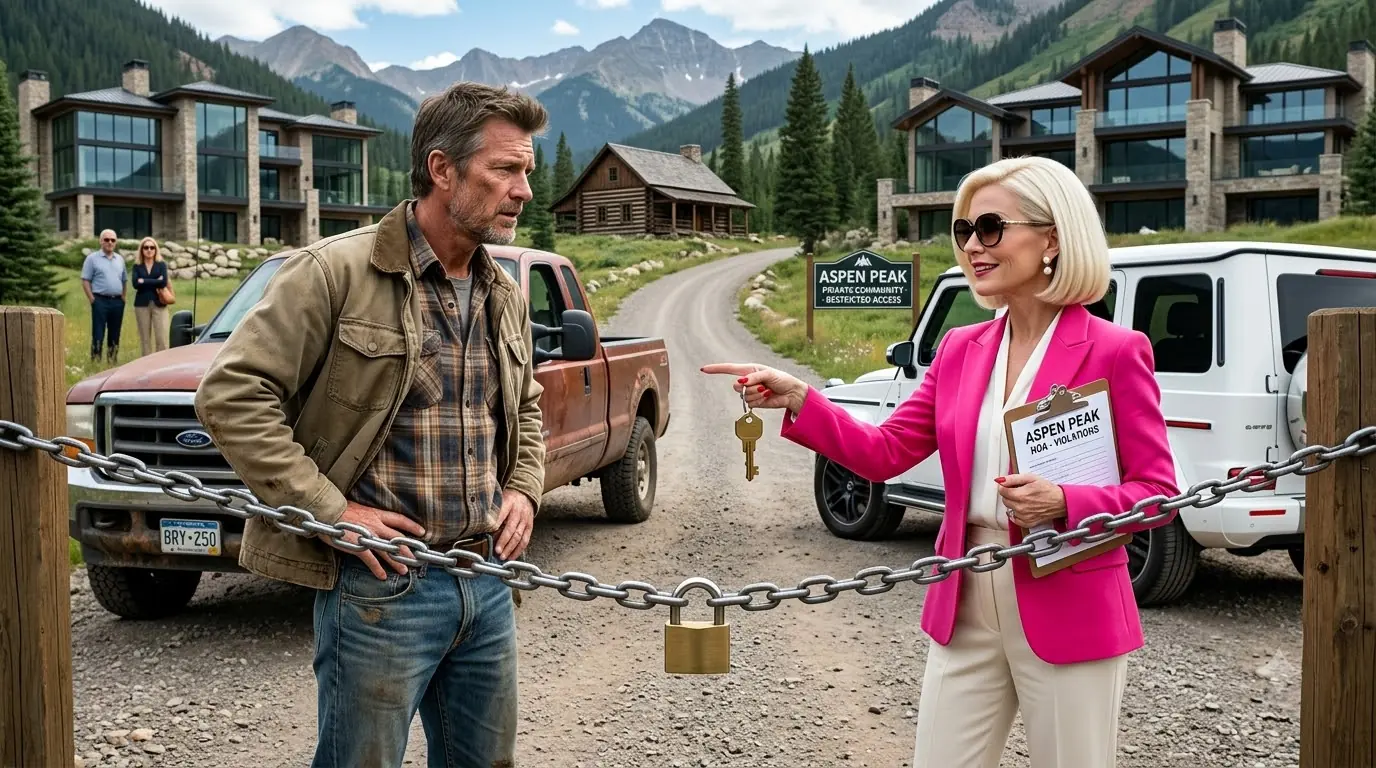
But here's what blew my mind. While I was away, eight multi-million-dollar mansions had sprouted like ugly weeds in my pristine valley.
The crunch of gravel under my boots should have felt like home. Instead, that crisp pine scent I'd dreamed about got choked by some woman's overpowering designer perfume as she climbed out of her white Range Rover like she owned the mountain.
Blonde bob, clipboard weapon, attitude sharper than broken glass.
"Well, well, the hermit returns. This is private property now, and you're trespassing."
I kept my voice dead calm. "Ma'am, that's my cabin up there. My family's owned this land since 1923."
Her smile could have frozen lava. "Not anymore, it isn't."
Here's what this HOA queen didn't know. I didn't just own that century-old cabin. I owned the mineral rights under every single one of her precious mansions.
My name's Declan Forester, Deck to anyone who's not trying to serve me legal papers. I'm 48.
I spent most of my adult life working oil rigs from Texas to North Dakota. The kind of work that leaves your hands permanently stained black and your back screaming by 40.
But it paid the bills when life decided to kick me in the teeth.
My great-grandfather homesteaded this valley in 1923. Three hundred and twenty acres of pristine Colorado wilderness, anchored by a hand-built log cabin tough enough to survive nearly a century of mountain storms.
That cabin wasn't just shelter. It was legacy.
It was the place where three generations of Foresters learned that nobody owes you anything, and self-reliance isn't just a motto. It's survival.
Then my mom got Alzheimer's.
Suddenly, I was sending every paycheck to the best memory care facility in Denver, working North Dakota's fracking fields while she slowly forgot my name.
The taste of petroleum still haunts my morning coffee. A constant reminder of what I sacrificed to give her dignity in those final years.
The cabin sat empty, collecting dust and memories while I collected paychecks in the frozen wasteland.
She passed six months ago. Peaceful, finally free.
With funeral arrangements settled and my conscience clear, I was ready to come home and remember how to be human again.
Should have known it wouldn't be that simple.
The valley that greeted me looked like a luxury magazine threw up on my childhood. Where wildflower meadows used to bloom, perfect green lawns stretched like artificial carpets.
The chemical bite of fertilizer had murdered the sweet mountain wildflower scent.
Eight glass-and-steel monstrosities dominated the landscape. Each one worth more money than my family had seen in three generations.
And ruling over this environmental crime scene like some discount Disney villain was Vivian Ashworth.
Picture your worst HOA nightmare. Give her a Dallas real estate license and enough money to buy a small country.
Fifty-four years old, blonde bob sharp enough to cut glass, and the kind of smile that says she's calculating your net worth while pretending to care about your day.
Word around town was she'd swooped in two years ago through some shell company, bought up land faster than a poker player with marked cards, then immediately crowned herself queen of Pine Ridge Estates.
After our roadside meet-cute, Queen Viv handed me a manila envelope thicker than a phone book. Forty-seven separate violation notices for the cabin that predated her great-grandparents by about 50 years.
Get this. Non-compliant roof color.
Apparently, my great-grandfather's natural cedar shingles, weathered to a beautiful silver gray by decades of mountain weather, didn't match their architectural palette.
Unauthorized outbuildings. That would be the 1920s root cellar that kept my family from starving during the Great Depression.
Landscaping violations, because apparently God's own wildflowers aren't on their approved plant list.
The grand total was $73,500, plus $500 per day until I achieved compliance.
But here's what really crawled under my skin. It wasn't just highway robbery disguised as community standards.
It was the way she said "certain types" with that particular tone that makes your jaw clench. The way her nose wrinkled when mountain wind carried the honest scent of work clothes, the subtle digs about transient lifestyles and questionable associations.
This woman had never worked a day of real labor in her manicured life. But somehow, I was the neighborhood cancer threatening her precious property values.
The paperwork gave me 30 days. Pay up or face a property lien and foreclosure.
Thirty days to comply with rules I'd never agreed to, from an organization I'd never joined, over land my family had owned since before her parents were born.
That evening, I drove my rust-bucket F-250 to the county courthouse, diesel engine coughing like an old smoker.
Jolene Carpenter was locking up. She'd been clerk there since Carter was president.
"Deck Forester," she said, her smile mixing warmth with sympathy. "Welcome home, honey. I'm real sorry about your mother."
After thanking her, I asked about the HOA filings. Jolene's expression shifted from friendly to funeral-director serious.
"Lot of politics around that development. Things got rushed through faster than a greased pig at County Fair."
The HOA covenant documents, filed just 18 months earlier, read like a dictator's wet dream. Page after page of legal jargon giving Vivian Ashworth power over everything from mailbox colors to how often you could have guests.
But here's where it got interesting. My signature was nowhere on those documents.
Not on any of them.
Knowledge nugget. In Colorado, HOA covenants require unanimous consent from all affected property owners to be legally binding.
Takeaway: Just because your neighbors signed doesn't mean you're automatically bound. Always verify your property is actually included in the legal documents.
Driving home under stars clearer than my legal situation, one question burned in my brain. How does a brand-new HOA claim authority over a century-old homestead they can't legally touch?
What I didn't know yet was that my family had left me something way more valuable than just that old cabin.
A week later, I'm enjoying my morning coffee on the cabin porch. Real coffee, not the motor oil they served at North Dakota truck stops.
Then the peaceful mountain silence gets shattered by the crunch of expensive tires on gravel.
Three vehicles roll up my driveway like some kind of suburban invasion force. Viv's white Range Rover leads the parade, followed by two BMW SUVs packed with people who look like they got lost on their way to a country club.
The smell of their collective cologne reaches me before they even get out. Apparently, mountain air isn't fresh enough without adding designer fragrances.
Viv emerges wearing what can only be described as a safari costume from REI's most expensive rack. Designer hiking boots so pristine they've clearly never touched actual dirt.
Behind her come three other middle-aged specimens in matching outfits, clutching clipboards and cameras like they're documenting a war zone.
"Morning, Mr. Forester," she calls out with the kind of fake sweetness that makes your teeth hurt. "We're here for your mandatory architectural compliance inspection."
I stay planted in my chair, savoring coffee that tastes like freedom. "That's odd. Don't recall sending out invitations."
"The HOA architectural review committee has full authority to inspect all properties for covenant compliance," she announces, waving papers like a magic wand. "Section 4.7 of the community bylaws."
Her little committee starts clicking away with their cameras. My cabin, my truck, my woodpile, probably my morning stubble if they could zoom in close enough.
The rapid-fire sound of shutters mixes with their whispered commentary about structural deficiencies and aesthetic disasters.
"Ma'am," I say, standing up nice and slow. "This is private property. You weren't invited, and you sure as hell don't have permission to turn my home into your personal photo shoot."
Viv's smile turns sharklike. "Actually, we do. Section 4.7 clearly states that the architectural committee..."
"Section 4.7 of covenants I never signed," I cut her off. "Documents that don't apply to property that was never legally included."
"Now, I'm asking you politely once to get off my land."
Her face goes from pale to lobster red in about three seconds.
She herds her committee back toward their vehicles like a frustrated camp counselor, but not before rolling down her window for one parting shot.
"You'll regret this attitude, Mr. Forester. We have ways of dealing with troublemakers who don't respect community standards."
The next morning, my mailbox looks like a paper bomb went off.
Fourteen separate violation notices, each one stamped with official HOA letterhead and signed in Viv's aggressive handwriting that looks like angry chicken scratches.
Unpermitted structures. My great-grandfather's 1920s outhouse, now a charming historical feature, apparently violates modern setback requirements.
Improper vehicle storage. My F-250 parked in my own driveway doesn't meet their precious aesthetic standards.
Landscaping non-compliance. Wildflowers that have been blooming here since the Cretaceous period aren't on their approved plant list.
But my personal favorite was unauthorized outdoor equipment storage.
These people were fining me for a splitting maul and a stack of firewood. Tools that kept my family warm for generations were now apparently eyesores threatening their property values.
Each violation carried a $500 fine with daily penalties until corrected.
The paper cuts on my fingers felt like tiny revenge as I sorted through their bureaucratic blitzkrieg.
That's when I noticed something that made me smile for the first time all week.
Mini twist. The metadata on their violation photos showed timestamps from three days before their supposed inspection visit.
These clowns had been trespassing on my property all week, photographing my home from multiple angles, planning their paper assault like some kind of suburban military operation.
Time for my counterpunch.
Radio Shack still exists in small mountain towns. Bless their obsolete hearts.
I spent the afternoon there picking up a trail-camera system, six units with night vision, motion detection, and audio recording.
Colorado's a one-party consent state, and this is my property, so every word they speak here belongs to me.
Within 48 hours, I struck gold.
The cameras caught Viv and two committee members creeping around my property at dawn like discount ninjas, taking more photos and holding what looked like war-council meetings right there on my land.
The audio quality was restaurant clear.
"We need documentation of every possible violation," Viv's voice comes through perfectly. "The more we can stack up, the faster we can pressure him into selling."
"What about environmental violations?" one committee member asks. "Could we claim his septic system is contaminating groundwater?"
"Brilliant," Viv says. "I'll call County Health tomorrow. Emergency contamination concerns always get immediate response."
Knowledge nugget. Photographing private property from public areas is usually legal, but trespassing to gather evidence is criminal behavior that can void any legal proceedings based on that evidence.
Takeaway: Trail cameras are worth their weight in gold when fighting HOA harassment. Bullies depend on operating in shadows, so drag them into the light.
Armed with video evidence of their conspiracy, I had options. Call the sheriff, file harassment charges, lawyer up, and go nuclear.
Instead, I decided to let them keep digging their own grave.
Twenty-five years on oil rigs teaches you patience. When you're working with equipment that'll kill you if you rush, you learn to think three moves ahead.
Viv was operating on pure emotion and suburban entitlement. I was playing chess while she was still learning checkers.
Right on schedule, my phone rings the next morning.
"Deck, it's Earl Dawkins from County Health. Got a complaint about septic violations at your place. Now, I know your grandfather built everything to last, but regulations require me to investigate."
"Earl, come on up anytime. Bring your full testing kit. I want everything documented officially."
Three hours later, Earl's shaking his head like he can't believe what he's seeing.
"Son, your septic system is cleaner than most brand-new installations. Whoever filed this complaint was either completely ignorant or flat-out lying."
I hand him a USB drive loaded with selected highlights from my trail-camera collection.
"Earl, I think you'll find this makes for fascinating viewing, especially the part where they discuss filing false environmental complaints."
As his county truck disappears down the mountain trail, I pour myself another cup of that good coffee and watch storm clouds building over the valley.
The air smells like rain and incoming justice.
Viv thought she was playing hardball. She had no idea the game had just changed completely.
Two days after Earl's visit, I'm splitting firewood behind the cabin when I hear vehicles coming up the mountain again.
Not the purr of luxury SUVs this time. The aggressive rumble of county trucks mixed with the whine of what sounds like a news van.
Three official vehicles park in my driveway. County Health Department, building inspector, and some guy with a clipboard who introduces himself as a state environmental compliance officer.
Behind them, a local news crew is setting up cameras like they're expecting a disaster movie.
Earl Dawkins climbs out of the health department truck looking embarrassed as hell.
"Deck, I'm real sorry about this. Got three more complaints yesterday. Anonymous tips about immediate public health hazards and environmental contamination. State says I have to follow up with the full hazmat team."
The building inspector, a thin guy named Peterson who looks like he'd rather be anywhere else, starts taking photos of my cabin's foundation.
"Someone reported structural instabilities and code violations that could affect neighboring properties."
Meanwhile, the environmental officer, whose badge says his name is Rodriguez, is suiting up in protective gear like he's about to enter Chernobyl.
"We've received reports of possible groundwater contamination, illegal septic discharge, and improper waste disposal."
I can smell the setup from a mile away. The timing's too perfect, the complaints too coordinated.
But what really pisses me off is the news crew filming everything, making it look like my family's century-old homestead is some kind of toxic waste dump.
"Gentlemen," I say, keeping my voice level despite wanting to throw someone down the mountain. "Y'all are welcome to inspect whatever you need, but I'd appreciate knowing who filed these complaints."