“Get out of that pool before my son drags you out.”
The command shattered the quiet of the Saturday afternoon. Sheriff Nathan Cole had been floating on his back beneath a cloudless August sky, enjoying the first peaceful hour he had found in weeks, when the side gate to his backyard swung open without permission. Standing on the pool deck was Cynthia Hargrave, the fifty-year-old president of the Brookstone Hills HOA, dressed in a fitted pale-pink pantsuit and nude heels completely unsuited for wet concrete.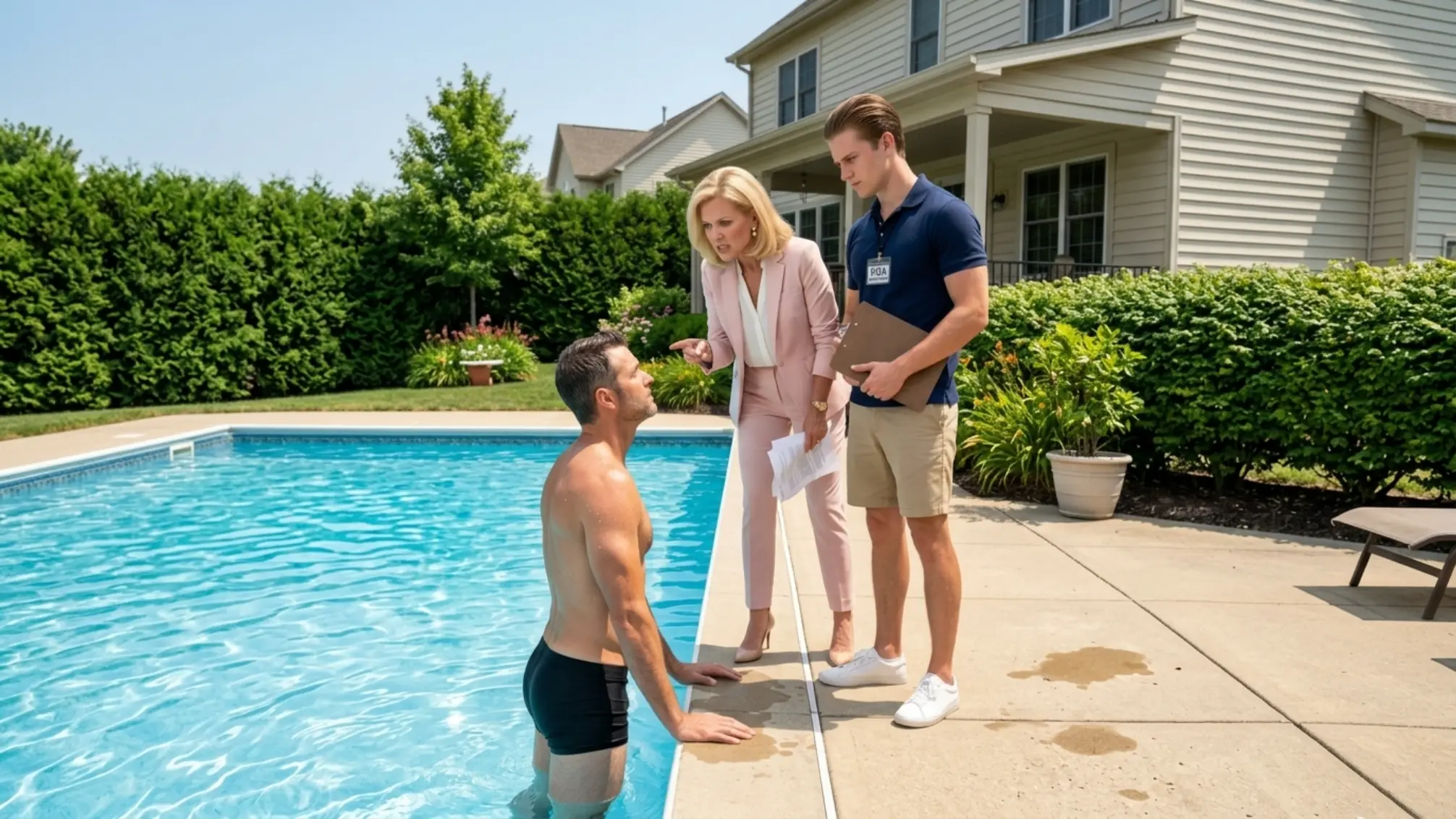
Beside her stood her twenty-five-year-old son, Trevor, wearing a navy polo shirt, khaki shorts, and a laminated badge that read HOA ENFORCEMENT COORDINATOR. He carried a clipboard beneath one arm and a set of bolt cutters in the other hand. Neither of them had knocked, called ahead, or asked permission to enter Nathan’s fenced backyard.
Nathan remained in the water, one arm resting against the pool edge.
“Did you just walk into my yard and order me out of my own pool?”
Cynthia raised a thick violation notice. “This pool is now under HOA compliance control. Your access has been suspended.”
Trevor stepped closer to the water. “You heard her. Climb out.”
Nathan studied him without moving. Water ran from his dark hair onto his forehead, but his expression remained calm. He had spent eleven years handling armed suspects, violent domestic calls, hostage situations, and men who believed shouting could replace authority.
Trevor did not frighten him.
Cynthia mistook his silence for hesitation. “You have sixty seconds to collect your towel and leave the pool area. After that, Trevor is authorized to remove you.”
Nathan glanced at the fake badge clipped to Trevor’s shirt. “Authorized by whom?”
“My mother is the HOA president.”
“That isn’t an answer.”
Trevor’s face tightened. “Say that again when you’re standing up.”
Nathan placed both hands on the edge and slowly lifted himself from the water. He wore black swim trunks and nothing else, but the moment his tall athletic frame rose above the pool deck, Trevor took an involuntary step backward.
Nathan noticed.
Cynthia did too, and embarrassment made her more aggressive.
“Do not try to intimidate us,” she snapped. “You are already in violation of HOA Pool Safety Ordinance 12B.”
Nathan picked up the towel from his chair and wiped water from his face. “There is no HOA authority over this pool.”
“All pools inside Brookstone Hills fall under our jurisdiction.”
“This one is listed as a private residential amenity on my deed.”
“HOA rules override personal use agreements.”
Nathan lowered the towel. “A deed is not a personal use agreement.”
Cynthia pushed the violation notice toward his chest. “You have fourteen days to pay a $250 fine. Failure to comply will result in additional penalties and a lien against this property.”
Nathan did not take the paper.
Trevor shoved the clipboard beneath one arm and raised the bolt cutters. “You want me to make him take it?”
Nathan looked directly at him. “You should put those down.”
Trevor smiled. “Or what?”
“Or this conversation becomes evidence.”
The smile faltered for half a second.
Neither Cynthia nor Trevor had noticed the two security cameras mounted beneath the roofline. One faced the pool gate. The other covered the entire deck, including the exact spot where they stood. Every word, gesture, threat, and unauthorized entry was already being stored in the cloud.
Nathan did not tell them.
People behaved differently when they knew they were being recorded. He wanted Cynthia and Trevor to finish showing him who they were.
Eight months earlier, Nathan had purchased the four-bedroom house at the end of Willow Bend Lane. The property had a private fenced yard, an in-ground pool, and enough distance from downtown for him to stop hearing sirens while trying to sleep.
He had moved without announcing his occupation.
In Brookstone Hills, he was simply Nathan Cole, the quiet man in Lot 14B who left early, returned late, and sometimes drove an unmarked black SUV. He wanted neighbors to speak to him as a person rather than as the county sheriff.
Cynthia Hargrave had interpreted his privacy as weakness.
She ran the HOA like a private government. Meetings began exactly when she entered, rules changed whenever someone challenged her, and fines appeared in mailboxes before residents understood what they had supposedly done wrong. She had surrounded herself with three board members who approved nearly every motion she introduced.
Trevor held no elected position.
His mother had created the title “enforcement coordinator” and handed it to him without a vote. He drove through the neighborhood photographing vehicles, measuring grass, inspecting fences, and leaving threats beneath windshield wipers. Most homeowners obeyed because no one knew how much authority he truly possessed.
Nathan began paying attention after his first HOA meeting.
During the meeting, Cynthia announced eleven violations by name and address, publicly humiliating residents over flowerpots, mailbox colors, and driveway cracks. When Nathan asked why his monthly bill included a community pool maintenance charge despite his private pool, she smiled at him like an impatient teacher.
“All pool-adjacent properties contribute to neighborhood aquatic infrastructure,” she said.
The phrase sounded official.
It meant nothing.
Nathan ordered the recorded covenants from the county office. Section 7.4 governed the single community pool beside the clubhouse. It described guest limits, maintenance responsibilities, access cards, and operating hours.
It said nothing about privately owned residential pools.
Cynthia had simply expanded the rule because no one had forced her to prove she could.
Nathan began documenting.
He spoke with Harold and Margaret Patterson, a retired couple fined $800 for placing a ceramic garden gnome beside their roses. He met Sandra Ruiz, a single mother forced to hire an “HOA-approved” contractor who charged three times the normal price to repair a small driveway crack. He examined dated records from a retired teacher fined after Cynthia changed the approved fence colors two weeks after his fence had been painted.
The pattern was consistent.
Cynthia created uncertainty, Trevor delivered threats, and frightened residents paid.
Nathan kept every notice, invoice, email, and meeting record in a manila folder inside his home office. He was not yet acting officially. He was simply building an accurate record before deciding whether the problem was personal misconduct, civil abuse, or something criminal.
Then Trevor entered his backyard.
The first incident occurred three weeks before the confrontation in the pink pantsuit. Nathan had been swimming when the gate opened and Trevor marched onto the deck with his clipboard and homemade badge.
“This pool is now HOA community property,” Trevor announced.
Nathan initially believed he had misheard him.
Trevor explained that private pools were subject to HOA authorization and that Nathan did not possess a current access card. He photographed Nathan in the water and gave him sixty seconds to leave.
“Do you know whose pool this is?” Nathan asked.
“I don’t care whose name is on the lease.”
Nathan almost smiled. He owned the property outright, and Trevor did not even understand the difference between a lease and a recorded deed.
Instead of arguing, Nathan climbed from the pool and allowed Trevor to continue talking. Trevor documented the confrontation on his phone, wrote notes on his clipboard, and promised a formal fine.
He believed Nathan had surrendered.
What he had actually done was record himself entering private property, asserting false authority, photographing the homeowner without justification, and threatening removal. The cameras above him captured every second.
Two days later, Cynthia and Trevor arrived at Nathan’s front door with a $250 fine. Cynthia refused to identify the covenant authorizing it and repeatedly stated that the ordinance “spoke for itself.”
Trevor added one revealing sentence.
“We already removed three other residents from their pools this month.”
Nathan looked at him carefully. “Three?”
Trevor nodded proudly. “You aren’t special.”
Nathan accepted the paper and closed the door.
The statement transformed a personal dispute into evidence of a broader practice. If Cynthia’s invented ordinance had been used against four private pool owners, then the HOA had collected money and restricted property access under authority it did not possess.
Nathan requested one year of board minutes.
The records showed Pool Safety Ordinance 12B had passed with only two votes. The HOA bylaws required three affirmative votes for amendments. Three other rules Cynthia regularly enforced had been adopted the same improper way.
Every one of them was procedurally invalid.
Nathan forwarded the records to Deputy County Attorney Ellen Marsh, a prosecutor he had worked with for years. He did not ask her to act yet. He asked her to review the documents and tell him whether his reading was correct.
Her response came twenty minutes later.
Call me before you do anything. This is worse than you think.
Cynthia’s preferred contractor had made quarterly payments to an LLC registered under her maiden name. Several fines appeared designed to force residents toward that contractor. The HOA’s financial records suggested that rule enforcement was not merely about control.
It might also be profitable.
Nathan continued waiting because Cynthia was still building the case against herself.
Eleven days after the first pool confrontation, he woke to find a steel padlock attached to his pool gate. An orange notice declared that access had been suspended pending HOA review.
The camera recorded Trevor entering at 6:28 in the morning with tools.
He crossed Nathan’s side yard, opened a private gate, and locked the pool without a court order, board vote, or valid notice. He remained on the lawn afterward, waiting for Nathan to discover it.
Nathan walked outside at 7:15.
Trevor stood with his arms folded. “HOA access suspension.”
Nathan examined the lock. “Did you put this here?”
“You ignored the fine.”
“That wasn’t my question.”
Trevor leaned closer. “You’re learning that we don’t make empty threats.”
Nathan nodded once. “All right.”
He went back inside.
Trevor remained outside for several minutes, apparently disappointed that Nathan had not shouted or attempted to cut the lock while being watched. After he left, Nathan called a locksmith, preserved the padlock, and saved the recording in three locations.
The act met every element of unlawful interference with private residential property access under county law.
Ellen agreed.
Still, Nathan waited.
Cynthia believed the absence of immediate consequences proved she was untouchable. She sent another email threatening to place a compliance lien against Nathan’s house. Then she scheduled a public HOA meeting to vote on the lien and distribute another round of humiliation.
Nathan attended quietly.
Cynthia stood behind the podium in a white blazer and described him as hostile, dangerous, and unwilling to follow community standards. Trevor displayed photographs he had taken inside Nathan’s backyard as evidence of unauthorized pool use.
When Cynthia invited Nathan to respond, he stood holding his manila folder.
“How many votes passed Ordinance 12B?” he asked.
“The ordinance was properly adopted.”
“How many votes?”
“This is not a courtroom.”
Nathan turned one page. “Does Section 7.4 mention private residential pools?”
“Our legal interpretation covers all neighborhood aquatic facilities.”
“Has an attorney provided that interpretation in writing?”
Cynthia stared at him. “Are you finished?”
“Not remotely.”
The board approved the lien threat by three votes to two. Cynthia smiled as if she had won. Trevor clicked his pen and wrote something in his binder.
Nathan thanked them and left.
One week later, certified letters arrived at Cynthia’s home, Trevor’s apartment, and the homes of all three board members who supported the lien. Each letter requested their attendance at a legal conference inside the county sheriff’s office.
Cynthia assumed the meeting was civil mediation.
She had no idea Nathan had signed the letters himself.
Before that conference could occur, she decided to confront him one final time. She wanted him frightened enough to pay the fine and withdraw his challenge before county officials examined the records.
That was why she and Trevor entered his backyard on Saturday afternoon.
Now Cynthia stood beside the pool in her pale-pink suit, pressing the violation notice against Nathan’s wet chest.
“Your little questions at the meeting changed nothing,” she said. “The board approved the lien.”
Nathan looked down at the paper. “You entered my property to threaten me with an invalid lien?”
“I entered HOA-governed space.”
“My gate says private property.”
“Your sign does not overrule community standards.”
Trevor moved closer until only a few feet separated them. “Stop talking like you’re some lawyer.”
Nathan met his stare. “Put down the bolt cutters.”
Trevor lifted them higher. “Make me.”
Cynthia smiled thinly. “Trevor, remove him from the pool area.”
Her son stepped forward.
Nathan did not retreat.
“Think carefully,” he said.
Trevor shoved one hand against Nathan’s shoulder.
It was not a powerful strike, but it was deliberate.
Nathan remained exactly where he stood.
Trevor looked surprised.
Nathan glanced at the hand still touching him. “That was your last free mistake.”
Trevor pulled his arm back. “You threatening me?”
“No. I’m giving you the opportunity to stop.”
Cynthia stepped between them, her face flushed. “You do not speak to my son that way.”
“He entered my yard carrying bolt cutters and put his hands on me.”
“He is an HOA officer.”
“There is no such position.”
“I created it.”
“That is not how authority works.”
Cynthia jabbed one finger into Nathan’s chest. “Authority works because people obey it.”
Nathan looked at her finger, then at her face. “That sentence is going to sound excellent during your interview.”
For the first time, uncertainty crossed her expression.
“What interview?”
Nathan walked toward a small table near the back door. Cynthia and Trevor followed, apparently afraid he might call for help. He picked up his phone and opened the security application.
Four camera views appeared on the screen.
Trevor saw himself entering through the gate.
His face changed.
Nathan scrolled backward to the earlier recording showing Trevor installing the padlock before sunrise. Then he opened another folder containing the photographs, board records, invoices, and recorded covenant.
Cynthia stared at the screen. “Recording us without consent is illegal.”
“Not on my property.”
“Delete it.”
“No.”
Trevor grabbed for the phone.
Nathan moved it aside and caught Trevor’s wrist before he touched it. The motion was fast, controlled, and effortless. Trevor froze as Nathan held him in place.
“Let go of me,” he hissed.
“Step back.”
Trevor tried to pull free and failed.
Cynthia lifted her phone. “I’m calling the police.”
Nathan released her son immediately. “Please do.”
Trevor rubbed his wrist. “You’re going to jail for assault.”
Nathan picked up his towel and draped it across his shoulders. “Call them.”
Cynthia dialed 911 and reported that a violent homeowner had attacked an HOA employee during a lawful inspection. She said Nathan was aggressive, dangerous, and refusing to leave a restricted pool.
Nathan listened without interrupting.
When she finished, she raised her chin. “They will remove you in handcuffs.”
“From my house?”
“From HOA-controlled property.”
Two patrol cars arrived nine minutes later.
The officers entered through the side gate and stopped when they saw Nathan standing barefoot beside the pool. One of them recognized him immediately.
“Sheriff?”
Cynthia turned toward Nathan so quickly that one heel slipped on the wet concrete. Trevor stared from the officer to Nathan and then to the cameras above the deck.
The second deputy straightened. “Sir, dispatch said there was an assault.”
“There was unauthorized entry, property interference, attempted seizure of a phone, and one physical shove,” Nathan replied. “Every second is recorded.”
Cynthia looked between them. “Why did he call you Sheriff?”
Nathan picked up his identification from the table and handed it to the first deputy.
“Because I am Nathan Cole, county sheriff.”
The color drained from Trevor’s face.
Cynthia recovered first. “That does not place him above HOA rules.”
“No,” Nathan said. “The deed, county code, and your own covenants do that.”
Trevor stepped backward toward the gate.
One deputy moved into his path. “Stay here.”
Cynthia’s voice sharpened. “My son has done nothing wrong.”
“He entered private property repeatedly,” Nathan said. “He installed a padlock on this gate without legal authority. Today he brought bolt cutters, threatened physical removal, shoved me, and attempted to grab evidence.”
“That is a lie.”
Nathan held up the phone. “Then the cameras will protect you.”
Silence followed.
The first deputy watched the recordings. He saw Trevor opening the gate, Cynthia threatening a lien, the bolt cutters rising, and Trevor placing his hand against Nathan’s shoulder.
When the video ended, the deputy looked at Trevor. “Place the bolt cutters on the ground.”
Trevor did not move.
“Now.”
The tool struck the concrete with a heavy metallic sound.
Cynthia began speaking rapidly about board authority, community safety, and a civil dispute notation from an earlier police visit. Nathan opened the manila folder and gave the deputies the recorded deed, the invalid amendment records, and Ellen’s preliminary legal review.
“This is not just today’s incident,” he explained. “The county attorney is reviewing years of unauthorized enforcement and potential financial misconduct.”
Cynthia stared at him. “You investigated me?”
“I documented you.”
“You targeted my family.”
“You entered my home.”
Trevor looked toward the open gate again.
The deputy stepped closer. “Hands behind your back.”
Cynthia screamed. “You will not arrest my son.”
Trevor resisted when the deputy reached for his arm. He pulled away and attempted to turn, but the second officer controlled his movement and secured the cuffs.
Cynthia grabbed the deputy’s shoulder.
Nathan caught her wrist before she made contact. “Do not touch him.”
She stared at him with pure hatred. “You ruined everything.”
Nathan released her. “You built everything on fear and fake rules. I only opened the records.”
Trevor was arrested for trespassing, unlawful interference with private property access, attempted evidence seizure, and misdemeanor assault. Cynthia received a criminal trespass citation that afternoon and was later charged in connection with falsified enforcement documents and misuse of HOA funds.
The certified county meeting proceeded without them.
Investigators confirmed that four HOA amendments were invalid because Cynthia passed them without the required votes. Every fine issued under those rules became challengeable. The threatened lien against Nathan’s property was withdrawn before it could be recorded.
The financial audit found more than $14,000 in improper fines.
Residents received refunds.
Sandra recovered the $1,200 she paid to the preferred contractor. The Pattersons received their $800 gnome fine. Roy received reimbursement and a written admission that his fence had complied with the rules when it was painted.
Cynthia resigned as HOA president before the board could remove her.
Her three allies followed.
Trevor accepted a plea requiring community service, restitution, and a permanent prohibition from representing himself as an HOA official. His homemade badge was entered into evidence alongside the bolt cutters and the padlock he had placed on Nathan’s gate.
Brookstone Hills held its first legitimate election in three years.
The new board included residents Cynthia had previously intimidated. Meetings became shorter, fines became rare, and rules could no longer change simply because one person wanted them to.
Months later, Nathan returned to his pool on another quiet Saturday afternoon.
The gate stood unlocked.
The brass key with the orange 14B tag remained beside the back door, exactly where it belonged. The manila folder stayed inside his office, complete with every notice, recording, and invalid rule.
Nathan floated beneath the afternoon sun.
No one entered his yard.
No clipboard appeared over the fence. No fake officer ordered him from the water. No woman in a pink suit arrived to explain that owning property did not give him authority over it.
Cynthia’s greatest mistake was not failing to recognize the sheriff.
It was believing an ordinary homeowner deserved less protection than one.
Nathan’s badge revealed who he was, but the badge had never created his rights. The pool had always belonged to him. The gate had always been private, and the rules had always required evidence, procedure, and lawful authority.
Cynthia and Trevor believed power meant entering someone’s property and forcing him to obey.
Nathan understood power differently.
Real power was remaining calm while people documented their own misconduct, preserving every detail, and waiting until the truth could no longer be shouted down.
Trevor had threatened to drag a man from his own pool.
Instead, deputies led him from that backyard in handcuffs.
And Cynthia’s pale-pink suit did nothing to protect the kingdom she had built on rules that had never legally existed.