“This vehicle violates HOA rules. I want it hooked up and hauled away right now.”
Brenda Hartwell’s voice carried across the quiet driveway of Seabrook Point as she pointed one sharp finger toward the orange-and-white rescue boat parked behind Daniel Mercer’s truck. Her fitted red blazer and matching skirt looked untouched by the humid North Carolina afternoon, and her beige heels clicked angrily against the concrete as she marched toward the trailer hitch. Behind her sunglasses, her blue eyes had the rigid confidence of a woman who believed an HOA folder could outrank any explanation placed in front of her.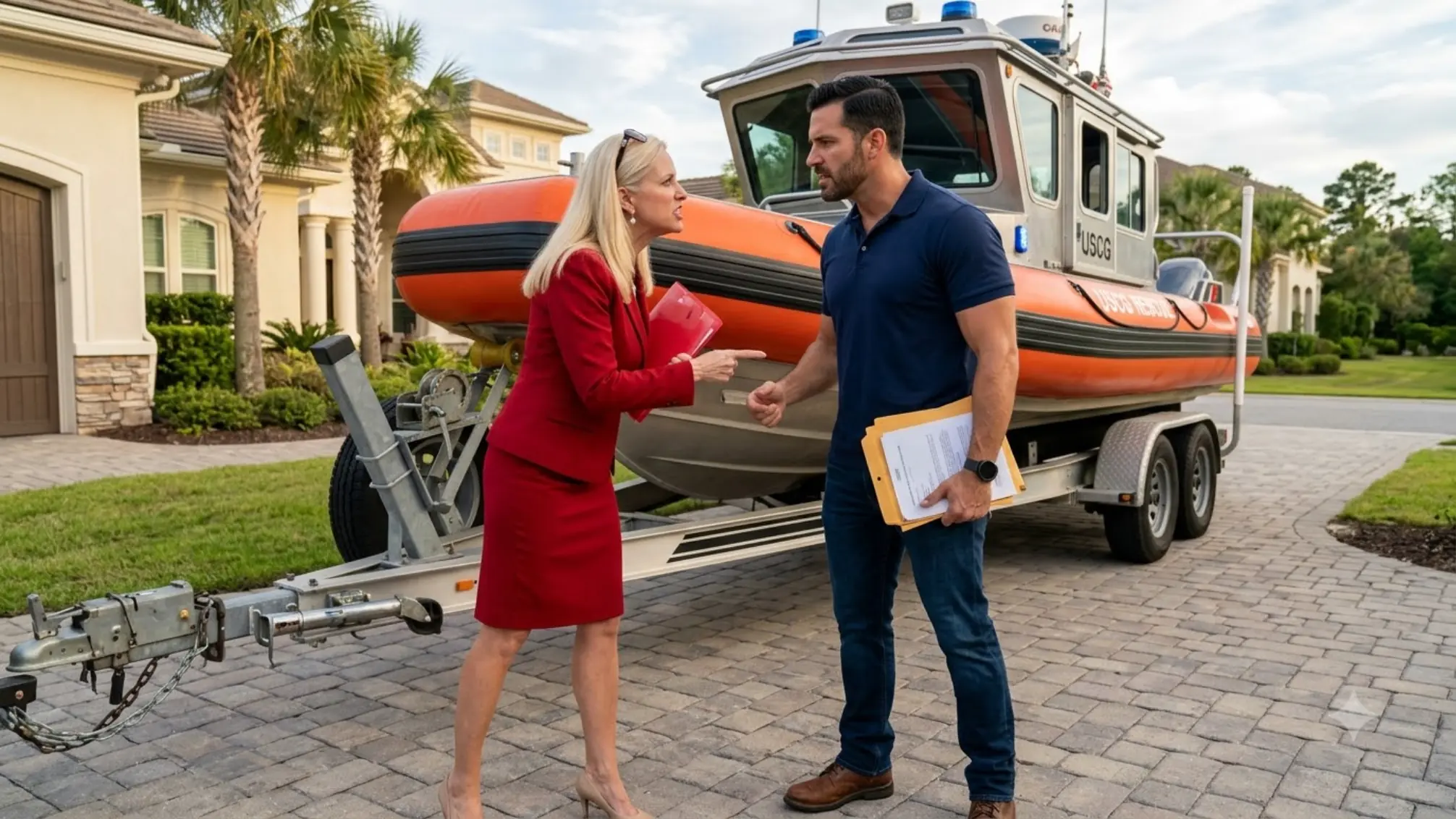
Daniel stepped between Brenda and the trailer.
He was thirty-nine, broad-shouldered, with lightly tanned skin, short dark hair, and a trimmed beard. He wore a navy polo shirt, jeans, and brown work shoes, and he held a sealed plastic document pouch against his side. His expression remained controlled, but his jaw tightened when Brenda reached toward the trailer’s emergency brake.
“Touch that trailer,” Daniel said, “and you’ll interfere with an active rescue deployment.”
Brenda slapped a violation notice against his chest.
“It’s a vacation boat, and my authority outranks your excuses.”
Daniel lifted the sealed pouch.
“Then call the tow truck. Coast Guard command is already coming to meet it.”
Brenda laughed.
The sound was short, loud, and full of contempt.
“You expect me to believe the Coast Guard stores rescue boats in suburban driveways?”
Daniel looked at the orange emergency markings, the reinforced hull, the sealed medical compartment, and the government identification plate mounted beside the console.
“I expect you to read before you threaten someone.”
Brenda turned toward the street.
A tow truck waited beside the neighborhood mailbox, its yellow lights flashing. The driver, a heavyset man named Curtis Lane, leaned against the open door and watched the confrontation with growing uncertainty. Brenda waved him forward as if Daniel had said nothing.
“Back up to the trailer,” she ordered. “The board authorized immediate removal.”
Curtis did not move.
“Ma’am, he says it’s government equipment.”
“He says a lot of things.”
Daniel opened the document pouch and removed a laminated transfer order.
The vessel was officially designated CG Auxiliary Rescue Craft 27-B, temporarily assigned to the Cape Fear Maritime Response Partnership. It belonged to a joint emergency program supported by the United States Coast Guard, county marine rescue, and several certified civilian operators. Daniel was one of those operators.
The boat was not normally stored at his house.
It had arrived less than three hours earlier because a mechanical failure had disabled the trailer vehicle at the county emergency dock. Daniel’s property was the nearest secure location with enough clearance for the replacement truck scheduled to arrive that afternoon.
The vessel was supposed to remain in his driveway for six hours.
Brenda had noticed it within twenty minutes.
Her first message accused Daniel of storing an unauthorized recreational boat. He replied with the temporary deployment authorization and explained that emergency command would collect it before evening. Brenda responded by issuing a five-hundred-dollar violation and ordering removal within thirty minutes.
When Daniel refused, she called the towing company used by Seabrook Point.
She never opened the attachment he sent.
Now she pointed toward the neighborhood entrance.
“I have photographs showing this boat has been parked here since noon.”
“It arrived at twelve forty-two.”
“That proves my case.”
“It proves it has been here for less than three hours.”
“Our rules prohibit visible watercraft.”
Daniel pulled another page from the pouch.
“Section nine permits temporary emergency and public-service vehicles.”
Brenda crossed her arms.
“That clause refers to ambulances and fire engines.”
“It says emergency-service vehicles.”
“The board decides what the words mean.”
“No. The document decides what the words mean.”
Brenda stepped closer.
“You have been difficult since the day you moved here.”
Daniel looked at her.
“I moved here eight months ago.”
“And in eight months, you have challenged six notices.”
“All six were withdrawn.”
“Because the board chose not to waste time on you.”
“Because none of them cited a real violation.”
Brenda’s mouth tightened.
The conflict between them had started with a mailbox.
Three days after Daniel purchased the gray coastal-style house on Harbor Pine Lane, Brenda left a notice claiming the mailbox post was the wrong shade of white. Daniel found the approved architectural plan from the previous owner showing the exact color and submitted it with his appeal.
The violation disappeared.
Two weeks later, Brenda cited his truck for displaying a commercial logo, even though the small emblem belonged to the county maritime volunteer program. When Daniel provided the vehicle exemption, she withdrew that charge too.
Then came the complaints about his radio antenna, medical storage cabinet, and emergency equipment cases inside the garage. Each time, Brenda described them as evidence that Daniel was operating an illegal business.
He was not.
Daniel worked as a marine-engine systems specialist for a private shipyard. Outside working hours, he volunteered with a regional water-rescue program. He had completed navigation, first-aid, rescue-swimmer support, and emergency communications training.
The equipment in his garage was approved for volunteer deployment.
Brenda never cared.
What bothered her was not the equipment itself. It was the fact that Daniel required her to prove every claim in writing. She was accustomed to residents paying small fines rather than risking legal costs or neighborhood embarrassment.
Daniel saved every notice.
He photographed every interaction.
He read every rule.
That made him dangerous to someone whose authority depended on people not checking.
Curtis finally walked toward the trailer.
“I need to see the registration before I hook anything.”
Brenda pointed at him.
“You work for the HOA.”
“I work for Lane Recovery. The HOA called me.”
“And you will be paid when the vehicle is removed.”
Curtis looked at Daniel.
“Can I see the paperwork?”
Daniel handed him the laminated order.
Curtis read the heading and immediately stopped touching the hitch.
“This says federal emergency assignment.”
Brenda snatched the page from his hand.
“It says auxiliary partnership. That means private volunteers.”
Daniel took the page back.
“It means the vessel is operating under official rescue authority.”
“It’s still sitting in my neighborhood.”
“Not your neighborhood. Our neighborhood.”
Brenda stepped close enough that the folder pressed against his arm.
“I am president of Seabrook Point.”
Daniel looked down at her.
“That makes you responsible for following the rules, not inventing them.”
Her face reddened.
She turned toward Curtis again.
“Hook it up.”
Curtis shook his head.
“I’m not touching a rescue boat without confirmation.”
“I am confirming it.”
“You’re not the owner.”
“The HOA has enforcement authority.”
Daniel placed one hand on the trailer frame.
“If you move this vessel, the steering lock may be damaged. The medical compartment is sealed, and the electronic navigation system is calibrated for deployment.”
Brenda smiled coldly.
“Then perhaps you should have considered that before creating a violation.”
Daniel’s phone rang.
The screen displayed Cape Fear Response Command.
He answered on speaker.
“This is Mercer.”
A woman’s voice came through.
“Daniel, this is Commander Alicia Warren. Replacement vehicle is twelve minutes out. We may have an active call forming offshore.”
Daniel looked at Brenda.
“What happened?”
“Charter vessel lost engine power near Frying Pan Shoals. Six people aboard, including two children. Weather is moving faster than forecast. Station crew is preparing, but Rescue Craft 27-B may be needed for shallow transfer if they drift toward the shoal.”
Brenda stared at the phone.
Daniel spoke calmly.
“The boat is secure, but the HOA president has called a tow company.”
Silence followed.
Then Commander Warren’s voice sharpened.
“Has anyone touched the vessel?”
“Not yet.”
“Do not allow the trailer to move. I’m contacting county dispatch and the Coast Guard duty officer.”
Brenda leaned toward the phone.
“This is Brenda Hartwell, president of Seabrook Point. The vehicle violates private property rules.”
Commander Warren did not raise her voice.
“Mrs. Hartwell, that vessel is assigned to an active marine emergency network. Interfering with its deployment may delay a rescue.”
“You cannot override our covenants.”
“I am not discussing landscaping restrictions. I am instructing you not to obstruct rescue equipment.”
Brenda laughed nervously.
“There is no rescue. This is a scare tactic.”
Daniel looked at her.
“You heard the call.”
“I heard a woman making claims over a telephone.”
Commander Warren answered immediately.
“You will hear them again in person. I am four minutes from your gate.”
The call ended.
Curtis walked back toward his tow truck.
“I’m done.”
Brenda followed him.
“You are under contract.”
“Our contract does not include towing emergency vessels.”
“I’ll report your company.”
“Go ahead.”
She grabbed his arm.
Curtis pulled away without touching her.
“Do not put your hands on me.”
Brenda turned toward Daniel, furious.
“This is your fault.”
“The boat was scheduled to leave before sunset.”
“You could have parked it somewhere else.”
“The emergency dock’s trailer vehicle failed.”
“Then the county should have found space.”
“They did. Here.”
“You never received HOA approval.”
“Emergency vehicles don’t need your personal permission for temporary storage.”
Brenda opened her folder and removed another notice.
“Then I am assessing five hundred dollars per hour until it leaves.”
Daniel took the paper.
The notice had been prepared before the tow truck arrived. It accused him of storing a recreational watercraft and operating a commercial marina from his residence.
He looked at her.
“You wrote that I’m operating a marina?”
“You have marine equipment.”
“I have one rescue boat temporarily parked in a driveway.”
“You also have fuel containers.”
“Sealed emergency containers approved for transportation.”
“And radios.”
“Rescue radios.”
“And life jackets.”
Daniel stared at her.
“You’re using safety equipment as proof of an illegal marina?”
Brenda pointed toward the house.
“I know what I’ve seen inside your garage.”
Daniel went still.
The garage door had remained closed all week.
“How did you see inside?”
Brenda realized her mistake.
“I’ve seen photographs.”
“Taken by whom?”
“Neighborhood inspection staff.”
“No inspection was scheduled.”
“The HOA does not require your permission to observe exterior conditions.”
“The equipment is inside.”
She stepped backward.
Daniel raised his phone and started recording.
“Have you entered my garage?”
“No.”
“Has anyone acting for the HOA entered it?”
“No.”
“Then explain how you know what is stored behind a closed door.”
Brenda clutched the folder.
“I refuse to be interrogated in the street.”
“You came here threatening to tow rescue equipment.”
Before she could answer, two vehicles entered Harbor Pine Lane.
The first was a white county emergency-management SUV with blue lights flashing. The second was a dark utility truck displaying official maritime-response markings.
Commander Alicia Warren stepped out of the SUV.
She was forty-six, with dark hair tied neatly behind her head and a calm expression shaped by years of handling emergencies where panic wasted time. She wore a navy operational uniform with a Coast Guard identification badge clipped above her chest pocket.
Two county rescue technicians followed her.
Brenda raised her HOA folder as if preparing to challenge them.
Commander Warren walked directly to the trailer and checked the hitch seal.
“Has it moved?”
Daniel shook his head.
“No.”
“Navigation power?”
“Maintained.”
“Medical compartment?”
“Still sealed.”
Commander Warren looked at Curtis’s tow truck.
“Who called for removal?”
Brenda stepped forward.
“I did. This watercraft violates our community rules.”
Commander Warren faced her.
“This is not a recreational watercraft.”
“It looks like a boat.”
“It is a rescue vessel.”
“It does not matter what you call it.”
“It matters to the people waiting offshore.”
A rescue technician opened the electronic console and began running a deployment check. Another inspected the propeller lock, emergency fuel, and radio antenna.
Brenda watched them.
“You cannot perform maintenance in this driveway.”
Commander Warren turned slowly.
“We are not performing routine maintenance. We are preparing an assigned vessel for emergency response.”
“The HOA prohibits mechanical work.”
Daniel almost laughed, but the situation had become too serious.
Commander Warren held out her hand.
“May I see the rule you believe authorizes you to delay this rescue?”
Brenda handed her the violation notice instead.
Warren read it.
“This identifies the boat as a recreational vehicle.”
“That is what it is.”
“No.”
“You’re wearing a uniform and saying otherwise.”
Commander Warren looked at the official seal mounted on the hull.
“The rescue designation is visible from where you are standing.”
“Anyone can paint a symbol.”
Daniel pointed at the government identification plate.
“She ignored the plate.”
One of the technicians interrupted.
“Commander, we have updated coordinates. Charter vessel is drifting northeast. Station crew is launching, but they’re requesting this craft at Masonboro staging.”
Warren nodded.
“How long?”
“Replacement truck is three minutes out.”
Brenda moved between the technician and the trailer.
“No vehicle leaves until the violation is resolved.”
The entire driveway became silent.
Commander Warren took one step closer.
“Move away from the trailer.”
Brenda held her ground.
“I have authority on association property.”
“This driveway belongs to Mr. Mercer.”
“The covenants grant enforcement access.”
“Not control over rescue deployment.”
Brenda placed one hand on the trailer tongue.
“I will have it immobilized.”
Daniel immediately stepped beside her.
“Take your hand off it.”
She pointed into his face.
“Do not threaten me.”
“I’m warning you not to touch emergency equipment.”
“I can touch anything placed in violation.”
Commander Warren spoke into her radio.
“Dispatch, request law enforcement to Harbor Pine Lane. Individual is physically obstructing assigned rescue craft.”
Brenda released the trailer.
“You called the police on me?”
“You were told repeatedly to move.”
“This is harassment.”
“No. This is documentation.”
The replacement response truck arrived at the end of the driveway. Its driver waited, unable to connect while Brenda remained near the hitch.
Daniel moved the sealed documents aside and guided the truck backward.
Brenda stepped in front of him again.
“I am ordering you to stop.”
Daniel’s voice dropped.
“Six people are drifting offshore.”
“That is not my responsibility.”
Commander Warren looked directly at her.
“It became your responsibility when you chose to interfere.”
Police arrived less than two minutes later.
Officer Michael Torres listened while Commander Warren explained the vessel’s assignment. Daniel provided the temporary-storage authorization, the HOA exemption, and the prepared deployment order.
Brenda offered her violation notice.
Torres read both documents.
“Mrs. Hartwell, move to the sidewalk.”
“I am enforcing community law.”
“These are private covenants, not criminal law.”
“The vessel is illegally parked.”
“The governing document includes an emergency-service exemption.”
“I interpret that differently.”
“The people operating it do not.”
Brenda looked around at the technicians, police officers, and neighbors gathering near the street.
She realized she was losing control of the audience.
“This entire performance has been arranged to embarrass me.”
Daniel tightened the final trailer connection.
“No one invited you here.”
The rescue technician confirmed the lights and brakes.
Commander Warren signed the release form.
The truck began pulling the vessel from the driveway.
Brenda suddenly grabbed the trailer’s safety chain.
Daniel shouted.
“Let go!”
The chain tightened as the truck moved several inches. Brenda stumbled forward but refused to release it until Officer Torres took her wrist and pulled her away.
“You could have been dragged under the trailer,” he said.
“She’s stealing HOA-controlled property!”
“It does not belong to the HOA.”
Brenda struggled against his grip.
Officer Torres placed her in handcuffs for her own safety and ordered her to remain beside the patrol car while the rescue vessel departed.
The orange-and-white boat disappeared around the corner.
Daniel watched until the trailer cleared the neighborhood gate.
Commander Warren remained behind long enough to provide the police with her identification and written statement. Before leaving, she spoke quietly to Daniel.
“We’ll update you after deployment.”
He nodded.
“Bring them back.”
“That is the plan.”
Brenda heard the exchange.
She still refused to accept what had happened.
“This neighborhood will fine him for every minute that boat was present.”
Officer Torres looked at her.
“You should stop talking.”
“I have constitutional rights.”
“You do. You also have a body camera recording you.”
Her face changed.
The officers did not immediately arrest her for the attempted tow. They issued a formal warning against further interference and began documenting whether her actions had crossed into obstruction of emergency operations.
The situation might have ended with a board hearing and legal threats.
Then Daniel showed Officer Torres the recording in which Brenda revealed knowledge of the equipment inside his locked garage.
That created a separate problem.
Police asked Daniel whether he had noticed missing items or signs of entry.
He had.
Two weeks earlier, a radio battery had been moved from a shelf. A sealed medical bag appeared slightly open. Daniel assumed he had forgotten to close it properly.
Now he checked the garage door logs.
The electronic opener recorded an unauthorized activation at 11:18 on a Tuesday morning while Daniel was at work. The device used was not one of his registered remotes.
Security footage from the side yard had been interrupted for six minutes during that same period.
Someone had entered.
The following morning, investigators obtained records from the HOA office. Brenda had billed the association for a locksmith visit to Daniel’s address, describing it as an “emergency compliance access inspection.”
No emergency existed.
No notice had been sent.
The locksmith told police that Brenda presented documents claiming the HOA had authority to inspect suspected commercial operations. He opened the side garage door while she entered and photographed the equipment.
Brenda had not merely guessed what was inside.
She had broken in.
The photographs were found inside Daniel’s HOA file, along with notes listing the value of the rescue radios, navigation devices, medical equipment, and specialized tools.
One handwritten page read:
Marine equipment can support commercial-use finding. Repeated penalties may force property sale or asset surrender.
Daniel’s name appeared beside a second note.
County connection makes direct confrontation risky. Use vehicle violations first.
The attempted boat tow had not been a spontaneous overreaction.
Brenda had been building a case against him for months.
Investigators reviewed complaints from other residents.
A retired couple had been fined for operating a repair business after Brenda entered their detached workshop without permission. A widow received violations for storing “commercial inventory” after HOA inspectors photographed her late husband’s woodworking tools.
Another family surrendered a small fishing boat to settle twelve thousand dollars in disputed penalties.
The boat was later transferred to Brenda’s brother.
Financial records revealed that Brenda and her brother operated a private resale company. When homeowners could not pay invented fines, she offered settlements involving vehicles, tools, trailers, or equipment.
The items were sold through online auctions.
The HOA records described them as voluntary property transfers.
The rescue vessel was different because Brenda believed it belonged to Daniel.
She intended to have it towed to a private impound lot controlled by a company owned by her cousin. Once there, she planned to claim storage fees and force Daniel to prove ownership before release.
If he failed to pay quickly, the boat could be classified as abandoned.
Messages recovered from her phone revealed the plan.
Her son had sent her a photograph of the vessel shortly after it arrived.
That rescue-style boat would sell for serious money.
Brenda replied:
Not his if it violates the covenants. I’m having it removed.
Her son answered:
Cousin’s yard?
Yes. Paperwork first.
The messages destroyed Brenda’s claim that she believed the tow was ordinary HOA enforcement.
She knew the boat had rescue markings.
She simply believed the association’s towing process would allow her family to control it.
That evening, Commander Warren called Daniel.
The stranded charter vessel had drifted dangerously close to shallow water before the rescue teams arrived. Rescue Craft 27-B transferred two children and an injured passenger from the larger Coast Guard boat to a protected inlet where ambulances waited.
All six people survived.
The boat returned to the emergency dock after midnight.
Daniel sat at his kitchen table when Warren delivered the news.
“How close was it?” he asked.
“Closer than I like.”
“Would the tow delay have mattered?”
She paused.
“Another twenty minutes could have changed our options.”
Daniel looked through the window toward the empty driveway.
Brenda had treated the boat like an object she could seize.
Offshore, it had become the difference between a controlled transfer and a far more dangerous rescue.
The State Attorney’s Office reviewed the case after police connected the false violations, unauthorized entries, and property transfers. Brenda faced charges involving attempted theft, burglary, fraudulent HOA records, obstruction, and conspiracy.
Her brother and cousin were investigated for receiving property obtained through coercive settlements.
The tow company was cleared after Curtis provided the contract, call records, and his refusal to touch the vessel.
At the emergency HOA meeting, Brenda claimed she was the victim of an exaggerated misunderstanding. She appeared in a navy suit and read a prepared statement accusing Daniel of exploiting his government connections.
Daniel waited until she finished.
Then Commander Warren entered the clubhouse.
She carried the deployment report.
“The vessel Mrs. Hartwell attempted to tow completed an emergency transfer involving six civilians,” Warren told the board. “The delay created by her actions was documented in our operational timeline.”
Brenda stood.
“This is a private association meeting.”
Warren looked at the residents filling the room.
“I was invited by homeowners whose safety rules were used to obstruct a rescue.”
The deployment report included timestamps showing exactly when Brenda blocked the hitch, when police were called, when the vessel departed, and when it reached the staging point.
There was no room left for interpretation.
The entire board resigned after a forensic review found that several directors had signed blank violation forms and approved payments to companies connected to Brenda’s family.
Residents elected an interim committee.
Temporary rules suspended all private towing until every contract could be reviewed. Emergency-service vehicles received explicit protection, and no HOA officer could enter private property without written consent, a genuine emergency, or a court order.
Daniel refused nomination for president.
He joined the records committee for six months and helped create a system requiring evidence, exact rule citations, and independent review before fines could be imposed.
Brenda eventually accepted a plea agreement after her cousin provided business records showing that multiple seized items had been sold through the family company. Restitution was ordered for the affected homeowners, and Brenda was permanently prohibited from serving on an HOA board or managing residential property.
During sentencing, she asked to speak.
“I believed I was protecting Seabrook Point from unauthorized commercial activity.”
Daniel sat behind Commander Warren.
The judge allowed him to respond.
“You called a marked rescue vessel a vacation boat after reading its deployment order,” Daniel said. “Then you tried to block it while six people were drifting offshore.”
Brenda lowered her eyes.
“You weren’t protecting the neighborhood. You were trying to control property that never belonged to you.”
A year later, Rescue Craft 27-B returned to Harbor Pine Lane.
This time, it arrived for Seabrook Point’s public emergency-preparedness day. Children toured the vessel while rescue technicians explained its medical compartment, navigation equipment, and shallow-water capabilities.
A small plaque near the console described the offshore rescue completed the previous year.
Daniel stood beside the trailer as a boy examined the orange hull.
“Is this the boat the HOA lady tried to tow?” the child asked.
Daniel smiled faintly.
“It is.”
“Didn’t she see the Coast Guard symbol?”
“She saw it.”
“Then why did she think it was a vacation boat?”
Daniel looked toward the clean driveway where Brenda had once stood holding her folder.
“Because calling it a vacation boat made it easier for her to pretend she had the right to take it.”
The boy considered that answer.
“Did it save people?”
“Yes.”
“How many?”
“Six.”
The child touched the trailer carefully.
This time, no one shouted at him.
Across the neighborhood, the new HOA president spoke with residents beside a table covered in clearly printed rules and emergency contacts. No tow truck waited near the entrance. No private folder overruled official evidence.
The rescue vessel left before sunset exactly as scheduled.
Daniel watched it turn onto the coastal highway, its orange hull visible until the truck disappeared beyond the trees.
Brenda had believed the boat’s value came from what her family could sell it for.
She learned too late that its real value was measured in the lives waiting for it to arrive.