"Sure, hand over the pool keys."
That was the first thing out of his mouth. Not a question, an order.
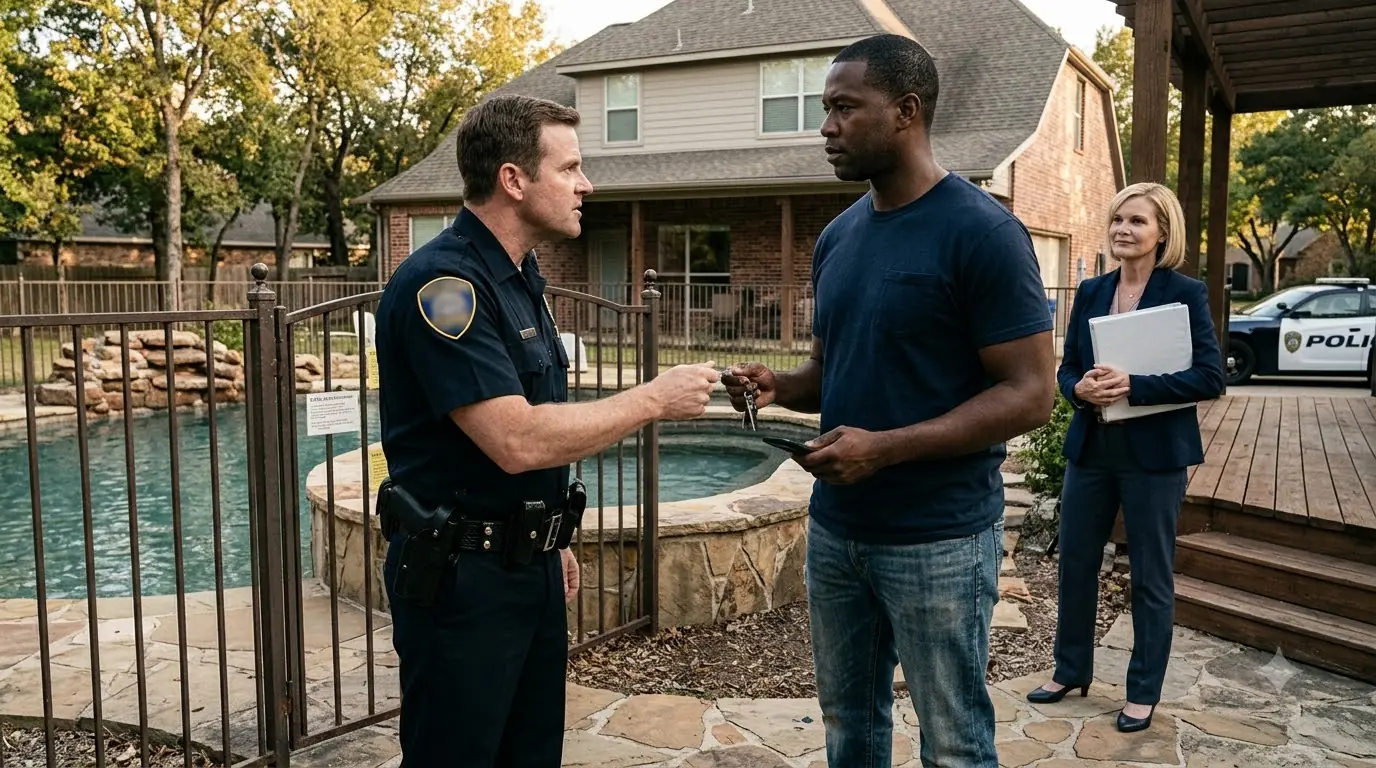
Karen stood a few feet behind him, arms crossed, smirking like she'd just called in an air strike.
I looked at the badge, then back at her.
"You really sent your husband for this."
She didn't blink.
"You've ignored three notices," she said. "The pool belongs to the community."
He tightened his jaw, proud to be her muscle.
I kept my tone flat.
"It's on my property."
"Not according to her," he said.
Karen stepped closer, her voice sharp.
"Don't play dumb. You either cooperate, or we'll escalate."
I could feel the heat rising off both of them. One was flexing authority, while the other fed on it.
But underneath my silence, I was smiling.
Because while she thought this was about pool keys, it wasn't.
It was about power.
And she had just walked into my investigation without realizing it.
So when he said again, "Keys. Now," I stepped closer and told him, calm and steady, "You might want to check who you're threatening, Officer."
They didn't know it yet, but I was already investigating them.
When the patrol car finally rolled away, I stood there for a second, staring at the reflection of its lights fading off the water.
My hands were steady.
My heart wasn't.
It's not every day your neighbor sends her husband in uniform to take your pool keys.
The truth was, this wasn't just about a pool.
It never is with people like her.
It's about control. It's about making sure everyone knows who runs the neighborhood.
My name's Cole.
I moved back here last spring after my dad passed.
The house had been in our family since the 1970s, built by his own hands.
Stone pool, cedar porch, everything carved out of sweat and stubborn pride.
I came back to restore it, not to fight over it.
The HOA showed up six weeks later.
New board, new rules, same script.
And leading it was Karen Langford, retired realtor, self-appointed queen of property values.
She spoke like every sentence should be printed on a brochure.
Always smiling.
Always watching.
The first notice came two days after our welcome meeting.
"Unapproved structure detected. Pool requires inspection."
My dad's pool, the one she called a liability.
I ignored it.
Then came the fines.
Then the letters.
Then tonight.
She thought she'd scare me by sending her badge-wearing husband.
She had no idea intimidation is just another kind of paperwork.
And I've spent most of my life dealing with worse.
What she didn't know yet was that this fight wasn't staying on her turf.
It was about to move to mine.
I grew up on this property long before there were fences, forms, or rules.
Back then, it was just me, my dad, and a patch of wild land that smelled like pine and gasoline.
The pool wasn't built by contractors.
It was carved out by hand.
Pops mixed concrete in a wheelbarrow, laid stone by stone, and told me, "Never let anyone claim what you've built."
I didn't understand it then.
Now it's the line I live by.
Every summer had the same rhythm.
The chirp of cicadas, the thump of his hammer, the hiss of water filling the basin.
Pops didn't believe in shortcuts.
"If you build it right," he'd say, "you only have to build it once."
He treated that pool like proof that work and freedom were the same thing.
When he died, I promised I'd keep both alive.
So when I moved back, I cleaned the leaves out, fixed the filter, and patched the cracks.
For a few months, it felt like he was still here.
Then Karen showed up.
It started with a friendly knock.
"Welcome to the neighborhood," she said, voice bright, eyes sharp.
She wore a blazer even though it was July and handed me a glossy pamphlet titled Community Harmony Guidelines.
I skimmed it and smiled politely.
She smiled wider, like she'd just handed me a leash.
A week later, she cornered me at the HOA meeting.
The room smelled like coffee and control.
She flipped through her binder and said loudly enough for everyone to hear, "Mr. Cole, you have an unregistered water structure on your property."
There was laughter from the back row.
"It's a pool," I said.
"Unregistered," she repeated, savoring the word.
"It's been here since before the association existed."
"Then it's definitely non-compliant."
That was when I realized Karen didn't care about safety or paperwork.
She cared about power.
And she wasn't doing it alone.
Her husband, Officer Langford, was never far behind.
You'd see his cruiser on random nights parked just close enough to my driveway for the headlights to hit my mailbox.
No ticket.
No reason.
Just presence.
The kind that says, We're watching.
The first night it happened, I stood on the porch with a beer and watched the clock tick past midnight.
The cruiser didn't move.
I didn't either.
He wanted me to feel cornered.
I wanted him to know I didn't scare easily.
After that, I started keeping records.
Dates.
Photos.
Copies of every letter.
My dad taught me construction.
My years with the bureau taught me documentation.
You learn fast that truth only matters when you can prove it.
The next few weeks felt like a slow invasion.
Every time I stepped outside, there was something new.
A bright yellow notice tacked to the gate.
A drone hovering overhead.
A neighbor pretending to walk a dog while taking pictures.
Karen called it community vigilance.
I called it stalking.
One morning, I caught her standing near the fence holding a clipboard like a badge.
She didn't even flinch when I said, "You know that's trespassing, right?"
She smiled.
"Just verifying compliance."
Then she glanced toward the pool.
"We can't have unauthorized pools drawing water from the community supply."
I almost laughed.
The pool was fed from the same spring my dad had tapped forty years earlier.
A natural source that ran straight through the hill.
No community line.
No shared meter.
Just groundwater and gravity.
That's when I started digging into the bylaws.
Page after page of HOA jargon.
Noise limits.
Fence colors.
Lawn heights.
But not a single clause giving them control over that natural water source.
Then I pulled county plat maps and old deed records.
The spring wasn't even within the HOA boundary.
There was no recorded easement giving them control over my private pool or that water source.
That didn't stop them from trying.
The following weekend, Karen escalated.
A letter arrived marked URGENT.
Inside was an invoice.
$2,500 fine for illegal community water use.
No hearing.
No meaningful warning.
Just debt by declaration.
I walked to Karen's house that afternoon.
She was trimming roses in her front yard, visor tilted, smile fixed.
"Is this a joke?" I asked, waving the paper.
"Rules are rules," she said. "You'll find the payment details on the back."
"I don't owe you a dime."
She stepped closer, lowering her voice.
"You think you're different because that pool was your daddy's."
Her smile vanished.
"Around here, we do things by the book."
"Whose book?"
"Mine," she answered without hesitation.
I remember the sound of her pruning shears snapping closed.