The garage smelled like wax, gasoline, and rain-cooled concrete when I lifted the door and froze.
For a few seconds, my brain refused to understand what my eyes were seeing.
My midnight-blue Lamborghini Huracán sat in the middle of the garage like it had gone twelve rounds with a wrecking ball. 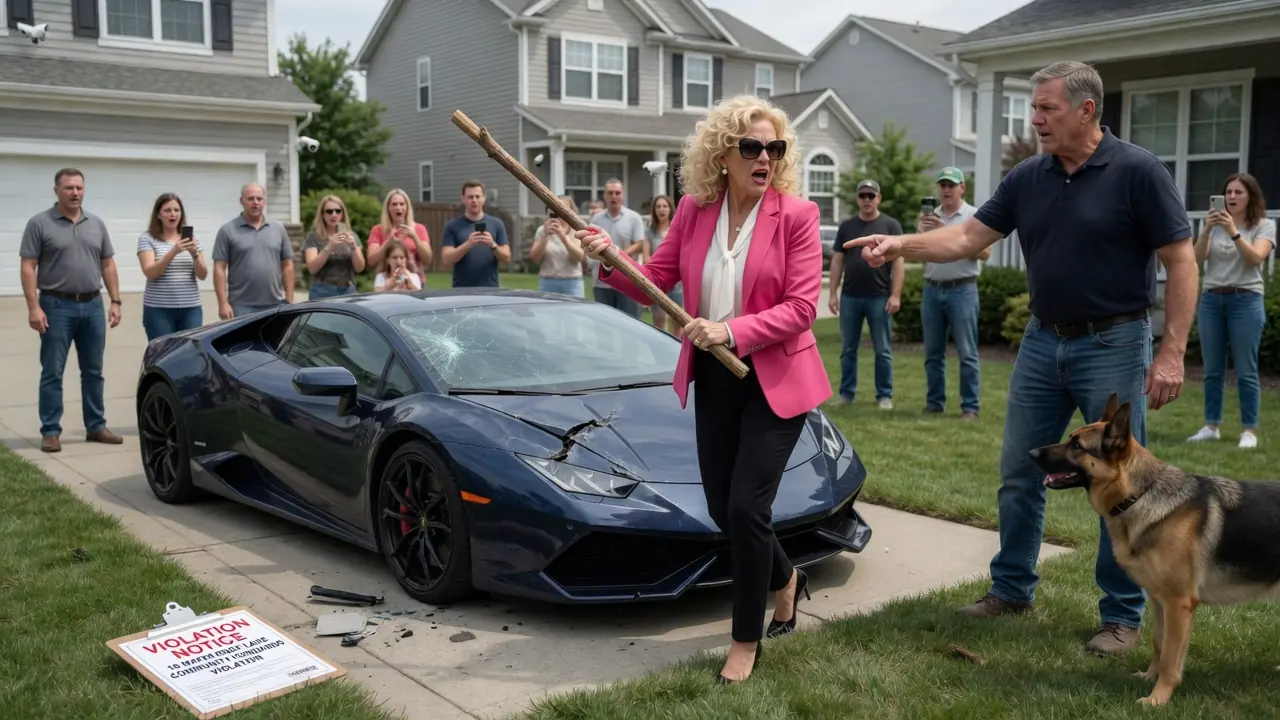
The windshield was spiderwebbed from corner to corner. The hood was cratered in six places. Both side mirrors hung by wires like broken bones.
The front bumper had been ripped loose, the golden bull emblem gone from the grille as if someone had wanted to tear the heart out of the car.
For a full beat, all I heard was the soft tick of cooling metal, though the engine had not been running.
Then I realized the ticking was not the car.
It was my own breath going shallow.
I stepped inside slowly.
The soles of my boots crunched over broken glass. The smell of coolant and cracked plastic mixed with the wax I had used two days earlier. That bothered me more than I expected. I had spent Saturday morning detailing every inch of that car, polishing the paint until it looked like moonlight had been poured over deep water.
Now the paint was scarred.
The windshield was destroyed.
The tires were slashed.
The passenger door hung open at an unnatural angle.
This was not random vandalism.
This was hatred with a schedule.
I crouched near the rear wheel, scanning the floor the way I had scanned roads for pressure plates and disturbed sand years earlier. Old instincts do not retire just because a man comes home and buys a house in a quiet neighborhood.
That was when I saw it.
A tiny fleck of pink nail polish stuck to a shard of glass.
Rose-pink.
Glossy.
Too familiar.
My stomach went cold.
Karen Whitmore wore that color on her nails every time she marched through Maple Ridge Estates with her clipboard, sunglasses, and manufactured authority. She was the HOA secretary, the woman who had timed my garage door with a stopwatch, preached property values like scripture, and called me a show-off soldier because I dared to own something beautiful after surviving twenty years of war.
I had stared down mortars with steadier hands.
But this?
This was personal.
I reached for my phone, opened the security app, and pulled up the feed from the garage camera.
The footage loaded.
Saturday night.
Empty driveway.
Rain misting under the streetlights.
Nothing moved until 2:07 a.m.
Then there she was.
Karen Whitmore marched up my driveway in a pink cardigan, black leggings, white sneakers, and her hair tied in a tight blonde knot. In both hands, she carried a sledgehammer like the crowned queen of the cul-de-sac.
She paused at my garage.
Looked left.
Looked right.
Then bent down and forced the emergency release with the confidence of someone who had studied my property for weeks.
A second later, she stepped inside.
The camera caught everything.
The first swing hit the windshield.
The second caved in the hood.
The third sent glass scattering across the concrete.
Again and again, she swung the hammer with both hands, her face twisted with a kind of rage I had only seen in people who believed they were entitled to destroy whatever made them feel small.
Twenty minutes.
That was how long she stayed.
Twenty full minutes of metal, glass, and jealousy.
Then she walked out, breathing hard, hair loose now, cardigan slipping off one shoulder. She turned back toward the car, lifted the hammer slightly in her right hand, and smiled.
I watched the clip twice.
Then a third time.
My hands stopped shaking.
That was when I knew the situation had changed.
Karen Whitmore had spent months trying to provoke me into becoming the unstable veteran she wanted the neighborhood to fear.
She had tried paperwork.
Rumors.
False complaints.
Public humiliation.
Now she had crossed the line from harassment into felony property damage.
And she had done it directly in front of my cameras.
“Got you,” I whispered.
My name is John Davis.
I am fifty-one years old, retired Army, twenty years active service, two bad knees, one scar along my left ribs, and a German Shepherd named Duke who trusts almost no one and is usually right.
I bought the house at 18 Maple Ridge Lane fifteen years earlier, back when the neighborhood was still just a peaceful cul-de-sac lined with old oaks, wide driveways, and families who waved because waving was easier than suspicion.
Maple Ridge Estates had been everything I dreamed of during deployments.
Quiet.
Predictable.
A place where sprinklers hissed at sunrise, kids rode scooters until dinner, dogs barked behind fences, and the loudest argument on most days involved whether someone had parked too close to a mailbox.
After years of sand, sweat, and noise, quiet felt like a luxury.
I had seen places where quiet only arrived after something terrible happened. So when I moved into Maple Ridge, I did not take peace for granted. I repaired the deck. Planted two maple trees. Built a small workbench in the garage. Adopted Duke from a veteran rescue program. Learned the names of the kids who rode past my house on bikes.
For fifteen years, it was home.
Then someone decided we needed an HOA.
At first, I did not mind.
The board sent friendly newsletters about community pride and maintaining standards. They trimmed the shrubs around the entrance sign, repainted the mailboxes, repaired the old common fence, and threw a barbecue to celebrate the new “community improvement era.”
It sounded neighborly.
Reasonable.
Harmless.
Then I met Karen Whitmore.
Karen was in her mid-fifties, always dressed like she was attending a hostile board meeting even when she was only fetching the mail. Blonde curls stiff as a helmet. Oversized designer sunglasses. Pearl earrings. Red or pink nails. A collection of blazers in colors loud enough to stop traffic. She carried a laminated rule book and a clipboard everywhere, as if she expected someone to violate Section 4B before lunch.
The first time we spoke, I was walking Duke.
She stopped me in the middle of the street and said, “Do you have an approved leash length?”
I thought she was joking.
She was not.
She handed me a printed sheet about standard leash dimensions and reminded me that some homeowners preferred shorter leads for “aesthetic harmony.”
I stared at her for a second, waiting for a hidden camera crew to jump out.
Nobody came.
“Ma’am,” I said, looking down at Duke, who was sitting calmly beside my boot, “he’s a dog, not a parade float.”
Her lips tightened.
“Some residents have concerns about large breeds.”
“Some residents should find hobbies.”
Her sunglasses hid her eyes, but I felt the glare behind them.
That was our first conversation.
I laughed it off at the time. You meet plenty of control freaks in the military, but they usually wear rank on their collars, not pearls.
Still, something in Karen’s tone stayed with me.
Something brittle.
Something hungry.
She was not just enforcing rules.
She was looking for enemies.
The rest of the board was fine.
Tom Harris, the HOA president, was a retired high school history teacher with a careful voice and a permanent expression of mild exhaustion. He had helped me with a fence permit once and apologized three times for how long the form was.
Sarah Lopez, a realtor, kept things organized. She had common sense, which in HOA politics made her practically revolutionary.
Bob Carter, a gruff Vietnam veteran, handled maintenance. He mostly preferred fishing, silence, and telling Karen no in as few words as possible.
They all tried to keep the HOA balanced.
But Karen wanted an empire.
Her power trips started small.
Trash cans left out five minutes past pickup.
Grass allegedly one inch too tall.
Mailboxes not polished enough.
A child’s sidewalk chalk declared “temporary visual clutter.”
The Burgers across the street hung a patriotic banner for Memorial Day, and Karen called it unauthorized signage.
Bob’s garden hose was apparently the wrong shade of green.
The Johnsons installed solar panels, and Karen claimed they disturbed neighborhood symmetry.
Every week brought new drama.
Every meeting ended with Karen lecturing people about standards, order, and property values.
Property values became her religion.
The bylaws became her Bible.
And the clipboard was her weapon.
The turning point came the day my Lamborghini rolled into the neighborhood.
It was a midnight-blue Huracán EVO with a 5.2-liter naturally aspirated V10, a low, wide stance, and paint so deep it looked black until sunlight touched it. Then it turned blue like a storm cloud over the ocean.
To some people, maybe it looked like showing off.
To me, it was survival given shape.
I had bought it after years of saving deployment bonuses, disability compensation, careful investments, and one lucky stock move that paid off better than anything I had expected. I had no wife, no children, no expensive vacations, no drinking habit, and very little patience for people who thought veterans were supposed to live modestly forever to make others comfortable.
The car was not about ego.
It was a reward.
A symbol.
A reminder that I had come home alive.
The first weekend I parked it in my driveway, kids gathered at the edge of the lawn with wide eyes. Adults stopped to ask questions. Tom gave me a thumbs-up from across the street. Bob whistled and said, “Damn, Davis, that thing looks like it outruns bad decisions.”
Everyone loved it.
Everyone except Karen.
She appeared that afternoon wearing a hot-pink blazer, white capri pants, red lipstick, pearl earrings, and a smile thin enough to cut paper.
Her clipboard was tucked against her chest.
“Beautiful car,” she said.
There was no beauty in the way she said it.
It sounded like she had discovered a dead animal on the sidewalk.
“Thanks,” I said.
“Though I’m not sure a commercial-grade vehicle aligns with HOA guidelines.”
I blinked.
“Commercial-grade?”
“Yes.”
“It’s a car, Karen. Not a bulldozer.”
She sniffed.
“Some of us find that such displays can affect property values.”
I smiled the way you smile when your rifle jams during training.
Tight.
Forced.
Impatient.
“Good thing I’m not selling property, then.”
Her jaw twitched.
She scribbled something on her clipboard and walked away.
That was our first skirmish.
Over the next few weeks, her patrols became routine.
I would catch her walking slowly past my house, pretending to check mailboxes while her eyes scanned my garage. Once I saw her crouch near my lawn, taking photos of a patch of clover.
The next day, a letter arrived.
Notice of Weed Infestation.
Corrective Action Required Within 48 Hours.
I almost laughed.
The landscaping crew mowed that yard twice a week, but Karen was not after the grass.
She was testing me.
When I called Tom, he groaned.
“Ignore it, John. Clover isn’t even classified as a weed here. Karen’s overenthusiastic.”
“Overenthusiastic?” I repeated. “That’s one word for it.”
He lowered his voice.
“Between you and me, she’s been issuing violations without board approval. We’ve warned her twice. If she keeps it up, we’ll vote her out.”
I appreciated his calm.
But I knew bullies like Karen.
Warnings did not stop them.
Consequences did.
By early summer, her obsession escalated.
She called animal control claiming Duke was a dangerous breed after he barked once from behind my fence. She told the Burgers their kids were “creating unsafe wheel-based activity” by riding bikes in the cul-de-sac. She sent Bob a citation for “nonconforming hose visibility.” Bob mailed it back with two words written across the bottom.
Go fish.
Karen did not appreciate it.
One Saturday, I was in my garage detailing the Lamborghini.
The door was open. Music played low from an old speaker. Duke lay nearby, head on his paws, watching me work with the bored patience of a dog who had seen me polish the same car for two hours.
I had just started waxing the hood when a shadow blocked the sunlight.
“Excuse me.”
Karen’s voice sliced through the garage.
I turned.
She stood at the edge of my driveway in a bright yellow blazer, oversized sunglasses, red nails wrapped around her clipboard, and a phone already in her other hand.
“You cannot operate a commercial garage here,” she said.
I looked around.
At the bucket.
The sponge.
The microfiber towels.
The bottle of wax.
“I’m cleaning my car.”
“You have equipment, chemicals, noise, and an open garage.”
“Karen, the only client here is me.”
She raised her phone and started filming.
“I am documenting this violation.”
I stood slowly.
Military calm is not the absence of anger. It is anger placed in formation.
“You are trespassing,” I said. “Please leave my property.”
“This is public enforcement.”
“No, it’s harassment with accessories.”
Her lips tightened.
“As HOA secretary, I have authority to ensure compliance.”
“Then comply with my request to leave my property.”
For one second, the mask slipped.
Her eyes hardened behind the sunglasses.
“You’ll regret this.”
Then she walked away.
By Monday, I had three violation letters.
Excessive noise.
Commercial activity.
Failure to maintain a closed garage policy.
There was no closed garage policy.
Tom confirmed it later, sounding like a man trying to hold a dam together with printer paper.
“She’s out of control, John. We’re calling an emergency board meeting next week.”
“Do that,” I said. “But I’ll handle myself in the meantime.”
I was not angry yet.
Just alert.
In the Army, we called it yellow level.
Calm, but ready.
I could tell this was not over.
Karen’s need for control was not about rules. It was about power. And when people like that feel power slipping away, they look for something or someone to destroy.
Every day after that, I noticed her presence.
The glint of her phone lens through her blinds.
The slow deliberate pace of her car as she circled the block.
Her shoes stopping near my mailbox.
Her shadow crossing the driveway at odd hours.
Once, I caught her writing notes while staring at my garage door timer on her phone.
She was literally clocking how long the garage door stayed open.
Most nights, I sat on the porch with a beer in my hand and Duke at my feet, watching the sunset turn the street gold.
Peace had a different flavor now.
Bitter at the edges.
I had seen men unravel in combat zones. I had seen obsession take root in people who had too little control over their own lives and too much desire to control everyone else’s.
I saw that same madness creeping behind Karen’s polished smile.
Then one evening, Tom stopped by.
He held two coffees and wore the expression of a man asking a favor from a grenade.
“We’re trying to vote her off the board,” he said quietly. “But she’s threatening to sue the HOA for discrimination.”
“On what grounds?”
“Apparently, we’re targeting her because she’s a single woman.”
I chuckled darkly.
“Tell her I’ll write a character reference. Enemy combatant. High persistence.”
Tom smirked, but his eyes stayed worried.
“Just keep your head down, John. You know how litigious people get.”
I nodded.
But inside, I was already running scenarios.
Legal.
Physical.
Financial.
Old habits die hard.
The next morning, I installed new security cameras around the house.
High-definition.
Motion-activated.
Cloud-synced.
One facing the driveway.
One inside the garage.
One covering the side gate.
One angled toward the street.
Years of deployment taught me one thing.
The worst threats are not always the loudest.
Sometimes they smile before they strike.
And lately, Karen had been smiling a lot.
By early July, I had started counting how many times a day Karen’s shadow crossed my driveway.
Three times before lunch.
Twice in the evening.
Sometimes she stopped right in front of my mailbox, pretending to tie her shoe while her phone camera conveniently pointed at my garage.
Other times, she walked the length of my fence line exactly thirty feet from Duke, glaring like I was running a criminal empire under my roof.
I was not new to surveillance.
I had lived under drones, insurgent scopes, and hostile eyes for months at a time.
But this was different.
This was suburban obsession.
The kind that brewed over envy and fermented into delusion.
The first true warning came from the café near the highway.
I stopped in one morning for coffee, and the barista, a woman named Kim who lived two streets over, leaned across the counter.
“Hey, John,” she said quietly. “Are you okay?”
“Depends what rumor I’m answering.”
She winced.
“So you heard?”
“Apparently not.”
She lowered her voice.
“Karen’s been saying you’re being investigated by the HOA. She says you’re running an unlicensed business out of your garage. Some kind of luxury car detailing operation.”
I laughed once.
“That’s impressive. I have one car and no customers.”
“She said strangers come by late at night.”
“The strangers are VA physical therapists. I’m rehabbing my knee.”
Kim’s face tightened.
“She’s posting about it on the neighborhood app. Not using your name, but everyone knows who she means.”
I thanked her and walked out with my coffee tasting bitter before I took a sip.
Karen was not just harassing me anymore.
She was shaping the narrative.
That was more dangerous than letters.
A false story told early enough can make truth sound defensive.
When I got home, I found Tom waiting on my porch.
His face looked ten years older than it had a month ago.
“We had another meeting,” he said.
“Let me guess. Karen.”
“She’s accusing you of endangering the community. Says your car chemicals could cause an explosion.”
“So now I’m a terrorist.”
“She didn’t use that word.”
“But she aimed at it.”
Tom sighed.
“She’s also implying your military background makes you volatile.”
That one landed differently.
Not because it was new.
Because it was familiar.
Some people hear veteran and immediately see danger, damage, instability. They want to praise service on holidays and fear the people who rendered it the rest of the year.
I looked at Tom.
“And the board?”
“Sarah, Bob, and I don’t believe her. But a few residents are nervous. Rumors spread faster than facts.”
I stared toward Karen’s house.
Her curtains were closed.
Of course they were.
Cowards love concealment almost as much as authority.
That night, I opened my old deployment chest.
Inside were medals, photographs, folded uniforms, letters, and one small black notebook I had carried overseas. On the inside cover, I had written a line from my commanding officer.
Don’t fight anger with anger.
Fight it with preparation.
So I prepared.
I upgraded my camera storage to off-site cloud backup. I installed additional floodlights. I added a silent alarm that pinged my phone whenever motion was detected near the garage. I checked every lock, every latch, every side window.
Call it paranoia if you want.
I call it surviving long enough to learn patterns.
The HOA meeting happened on a Thursday evening at the community center.
Against my better judgment, I went.
I wanted to see how deep Karen’s claws had sunk.
The room buzzed with low chatter when I walked in. Folding chairs filled the space. A pot of burnt coffee sat near the door. Someone had brought store cookies, probably to soften the fact that everyone was about to argue over grass height and garage doors.
Karen sat at the front.
She wore a red blazer, gold necklace, white blouse, and a stack of folders so tall it looked like she was preparing for federal court.
When she saw me, her lips curved.
“Ah, Mr. Davis,” she said sweetly. “So glad you could join us.”
Tom nodded from the board table.
“Let’s keep this civil, please.”
Karen wasted no time.
“The board has received multiple complaints regarding Mr. Davis’s activities,” she began, “including alleged chemical storage, noise disturbances, and possible unregistered business practices.”
I leaned forward.
“And by multiple, you mean you?”
A few people chuckled.
Karen ignored me.
“Additionally, I would like to propose a new amendment. Garages must remain closed except during vehicle entry and exit. And vehicles exceeding seventy-five decibels of engine noise must not operate within the neighborhood.”
Tom blinked.
“Karen, that would ban half the cars in the city.”
“Maybe so,” she said. “But we must protect our property values from excess.”
Excess.
The word hung in the air like a veiled insult.
Everyone knew who she meant.
I stood slowly.
“You know what’s excessive, Karen?”
Her eyes narrowed.
“Spending your retirement spying on neighbors,” I said. “Fabricating violations. Trespassing on private property. Calling animal control on a dog behind a fence. Threatening children over bikes. Harassing families until they stop using their own yards.”
The room went quiet.
Tom shifted, but he did not stop me.
I continued.
“You don’t care about community. You care about control.”
Karen’s face reddened.
“Your aggression is exactly why residents feel unsafe.”
“No,” I said. “Residents feel unsafe because you are a bully with a clipboard.”
Bob muttered from the board table, “He’s not wrong.”
Karen slammed her folder shut.
“I will not be disrespected by someone who hides behind his service record.”
That one hit below the belt.
The room went dead silent.
I stared at her.
“I did not serve for respect, Karen,” I said. “I served so you could have the freedom to be this insufferable.”
Someone in the back whispered, “Damn.”
Karen grabbed her folders and stormed out before the vote could continue.
Tom called a recess.
He walked over to me, rubbing his forehead.
“John, I think you just made her your full-time enemy.”
I looked toward the door she had slammed behind her.
“She already was.”
After that night, things got darker.
I started finding small scratches on the Lamborghini’s door.
The motion lights flicked on randomly at two or three in the morning, but every time I checked the footage, whoever triggered them stayed just outside the frame.
One morning, I found a note under my windshield wiper.
Enjoy it while it lasts, soldier.
My blood ran cold.
It was not a warning.
It was a promise.
So I set my trap.
That Saturday morning smelled like rain and gasoline.
I loaded my overnight bag into the back of my Honda Accord, gave Duke an extra scoop of kibble for Mrs. Berger, who would be feeding him, and glanced at the Lamborghini one last time before locking the garage.
The midnight-blue paint gleamed even under gray clouds.
Perfect.
Untouched.
Peaceful.
I was driving two hours north to my sister’s place. She had two kids, a traveling husband, and a dishwasher that sounded like a dying lawn mower. I made it a point to visit every few weeks. Family kept me grounded. It reminded me that not every fight required armor.
As I pulled out of the driveway, I saw Karen’s curtains twitch.
A flash of blonde hair.
A phone camera.
I waved just to be petty.
She did not wave back.
I did not think about her for the next thirty-six hours.
I spent Saturday helping my sister fix a porch railing, playing cards with my nephews, and pretending I did not check my security app every hour. Nothing happened during the day. Nothing happened Saturday evening. At 11:30 p.m., I checked the feed again.
Driveway empty.
Garage closed.
Street quiet.
At 2:07 a.m., while I was asleep in my sister’s guest room, Karen made her move.
I got home Sunday just after seven in the evening.
The street was calm.
Lights glowed behind tidy windows.
Sprinklers had clicked on somewhere, absurd after all that rain.
The cul-de-sac looked like the kind of place where nothing bad ever happened unless someone left a trash can out too late.
I parked the Accord, carried my duffel inside, greeted Duke, sorted through mail, and made coffee because driving always made me restless.
Then I decided to check the garage.
It was not because I heard anything.
It was instinct.
When I opened the door, the world tilted.
The Lamborghini looked like a corpse.
The windshield shattered.
The hood cratered.
The tires slashed.
The mirrors broken.
The bumper hanging.
The passenger door twisted.
The emblem gone.
For a moment, I was back in another country, standing near the wreckage of a vehicle after an explosion, counting damage before emotion had permission to arrive.
Then I saw the pink nail polish.
Then the footage.
Then the truth.
I called 911.
The dispatcher’s voice was calm.
“Sir, please confirm no one is injured.”
“Just the Lamborghini.”
There was a tiny pause.
Then she said, “Understood. Officers are on the way. Please do not confront the suspect.”
“Oh, I won’t,” I said. “She already buried herself.”
While I waited, I called USAA.
The agent asked for details. I gave them carefully. Veteran policy. Comprehensive coverage. Vandalism. Police en route. Security footage available. Estimated damages enormous.
“We’ve handled complicated claims before, Mr. Davis,” she said. “Make sure you obtain the police report number. Do not move the vehicle until the adjuster inspects it.”
“I wasn’t planning to drive it.”
She paused.
“I suppose not.”
Twenty minutes later, red and blue lights flickered across the ruined car.
Officer Willow stepped into my garage with the kind of calm that comes from seeing too much and wasting no movement. He was tall, maybe mid-thirties, with tired eyes and a voice that stayed level even when the situation did not.
He circled the car once.
Let out a low whistle.
“This was not a burglary.”
“No.”
“Nothing else missing?”
“Not unless she stole my patience.”
He crouched by the tire marks and broken glass.
“This is personal.”
“I know who did it.”
I handed him my phone.
He watched the footage in silence.
The sledgehammer came down once.
Twice.
Five times.
Ten.
His jaw hardened.
“That is about as clear as evidence gets.”
“She confessed too, if we can get her talking.”
He looked at me.
“You want to press charges?”
“Absolutely.”
He nodded.
“Let’s make it official. But first, let’s see if she wants to help our case.”
He held up his recorder.
“Call her.”
I dialed Karen’s number and put it on speaker.
It rang twice.
“What do you want, John?” she snapped.
“Someone destroyed my car this weekend while I was out of town,” I said evenly. “Do you know anything about it?”
A pause.
Then, “Why would I know anything about your stupid car?”
“You’ve been complaining about it for weeks. And I have security footage of someone who looks exactly like you.”
Her laugh came sharp and ugly.
“Good. I’m glad someone finally did something about that ridiculous show-off machine.”
Officer Willow pointed at the phone, silently telling me to keep going.
“You think it should be destroyed?”
“I think it was an eyesore,” she hissed. “Every night I had to look at that thing and remember you, some washed-up soldier acting like you’re better than everyone else.”
“I earned what I have.”
“You live off pity checks,” she snapped. “You people come back from war expecting everyone to worship you. Well, I’m not impressed.”
“Karen,” I said, keeping my voice steady, “are you saying you destroyed my car?”
“Damn right I did. And I’d do it again.”
Officer Willow leaned toward the phone.
“Mrs. Whitmore, this is Officer Willow with the Millfield Police Department. You have just confessed to felony vandalism. We will be at your residence shortly.”
There was a gasp.
A clatter.
Then the line went dead.
Willow looked at me.
“She made that easy.”
Twenty minutes later, the cul-de-sac glowed red and blue.
Karen stood on her porch in a robe, her face pale, her hair disheveled, and the sledgehammer leaning against the railing like a prop she had forgotten to hide.
When officers moved toward her, she started screaming.
Not apologizing.
Not denying.
Screaming.
About injustice.
About veterans getting special treatment.
About how no one should be allowed to flaunt that kind of money in a “modest family community.”
About how I had ruined the aesthetic integrity of Maple Ridge Estates.
Officer Willow read her rights while she shrieked that he was part of the conspiracy.
Tom came out of his house in slippers, face grave.
Sarah stood beside him, one hand over her mouth.
Bob leaned on his cane at the edge of his driveway and said, loud enough for everyone to hear, “Told you she was nuts.”
Karen saw me standing on my porch.
Her face twisted.
“You ruined my life!”
I said nothing.
I did not need to.
As the patrol car pulled away, her voice echoed down the street.
“This isn’t over!”
Officer Willow turned toward me.
“She is not getting out of this one easily. Felony property damage. Open and shut.”
I looked at Karen’s empty porch.
“I wish I believed that was the end.”
Willow studied me.
“You think she’ll come back?”
“I think people like her would rather burn down the street than admit they lit the match.”
He nodded slowly.
“Then keep the cameras on.”
I tried to sleep that night.
I really did.
But sleep did not come.
Not because of the car.
Because of the look in Karen’s eyes when she said, This isn’t over.
I had heard versions of that sentence before from people who had something left to lose and just enough desperation to become dangerous.
The next morning, the USAA adjuster arrived.
He was young, polished, and clearly not prepared for the crime scene in my garage. His jaw dropped when he saw the Lamborghini.
“Wow,” he said softly. “This is targeted.”
“You sure you don’t live next to an ex-wife?”
“Worse,” I muttered. “An HOA Karen.”
He laughed nervously, then got to work.
Photos.
Measurements.
Parts estimates.
Damage reports.
Windshield.
Body panels.
Mirrors.
Doors.
Tires.
Paint.
Labor.
Imported parts.
The numbers climbed fast.
“We’ll cover it,” he said. “Your policy is strong. Repairs will take six to eight weeks, maybe less if we can expedite parts.”
“Good.”
But my mind was not on the car anymore.
It was on Karen.
By Monday afternoon, the neighborhood buzzed like a hornet’s nest.
Word spread fast when an HOA secretary gets arrested for vandalizing a Lamborghini with a sledgehammer. Some neighbors stopped by pretending to check in, but their eyes lingered on the garage like tourists at a battlefield. Others avoided eye contact and slipped into their houses, ashamed perhaps, or only afraid of being associated with the scandal.
Tom brought over a formal letter signed by the board.
Apology.
Condemnation.
Immediate suspension of Karen’s HOA authority.
Emergency meeting scheduled.
Full review of policies.
I read it once.
Then set it on the porch table.
“This should have happened before she picked up a hammer,” I said.
Tom looked down.
“You’re right.”
That mattered.
Not the letter.
The admission.
“We should have stopped her earlier,” he said. “She was harassing people for months, and we kept calling it overenthusiasm because that was easier than confrontation.”
“Bullies love people who avoid confrontation.”
He nodded.
“I know that now.”
Sarah called that evening.
“John,” she said, voice low, “I just wanted to warn you. Karen is out on bail.”
I closed my eyes.
“Of course she is.”
“Her sister posted it. She’s already telling people the footage is fake and that you framed her.”
“That’s rich.”
“She’s also claiming you threatened her. She’s using the PTSD angle again.”
I felt my hand tighten around the phone.
“Of course she is.”
“Be careful,” Sarah said. “You humiliated her.”
“No,” I said. “She humiliated herself.”
“Yes. But people like Karen never see it that way.”
After we hung up, I walked the property line.
Duke followed me, alert and quiet.
I checked every camera.
Every lock.
Every blind spot.
At 6:42 p.m., one camera near the side gate flickered with static for less than a second.
Too fast to prove anything.
Too strange to ignore.
I adjusted the angle and added another camera facing the driveway.
Then I moved Duke’s bed inside near the front door.
By Wednesday, Karen had turned from criminal defendant into neighborhood ghost.
Her blinds stayed closed.
Her driveway sat empty.
No pink blazer appeared on the sidewalk.
No clipboard.
No patrols.
No notes.
But silence, I had learned, was not always peace.
Sometimes it was reload time.
Thursday afternoon, I was in the driveway speaking with the insurance adjuster. He had returned for follow-up photos and to confirm repair timelines. I was signing a digital form on his tablet when I heard a front door slam across the street.
I looked up.
Karen stood on her porch.
Her hair was loose. Her face was pale and blotchy. She wore the same pink cardigan from the footage, now wrinkled and stained.
In one hand, she carried the sledgehammer.
The adjuster’s eyes widened.
“Uh, should I leave?”
“Now,” I said.
He backed toward his car, already dialing 911.
Karen stormed across the street.
“John Davis!” she screamed. “You destroyed me!”
I stepped away from the Lamborghini’s empty garage bay and faced her.
“Karen, stop.”
“You destroyed my reputation, my job, my life!”
“You did that when you committed a felony.”
“You set me up!”
“You walked into my garage with a hammer.”
“The footage is fake!”
“Then why did you confess on a recorded call?”
Her face twisted so sharply it almost looked painful.
“You think you’re untouchable,” she shrieked. “Hiding behind cameras. Hiding behind police. Hiding behind your stupid uniform.”
“I’m not wearing one.”
“You’re always wearing it,” she spat. “You people never take it off. You think it makes you better.”
She raised the hammer.
The street seemed to narrow.
Sound dropped away.
In combat, panic kills. Training survives.
My left foot shifted back. My shoulders squared. My breathing slowed.
“Karen,” I said, voice hard now, “do not swing that hammer.”
She charged.
The first swing came down fast, wild, aimed at my shoulder.
I sidestepped.
Grabbed her wrist.
Twisted with her momentum instead of fighting it.
The hammer clanged against the concrete.
She screamed and lunged at me, nails slicing the air near my face.
“I’ll kill you!”
“Stand down!” I barked.
She lunged again.
So I did what training demanded.
One controlled strike.
Enough to stop the attack.
Not enough to maim.
Her body folded immediately, collapsing to the driveway as if someone had cut strings from a puppet.
The adjuster stood near his car, phone shaking in his hand.
“Oh my God,” he whispered.
“Tell dispatch she attacked me with the hammer,” I said. “Tell them she’s unconscious but breathing.”
Paramedics arrived within minutes.
Police followed.
Officer Willow stepped out of his cruiser, took one look at Karen on the ground, and rubbed his eyes.
“You have got to be kidding me.”
“She came back,” I said.
“With the hammer?”
“Same one.”
Willow exhaled.
“Of course she did.”
They checked her pulse. She was fine. Bruised jaw, wounded pride, shattered delusion, but alive.
When she regained consciousness, she began screaming immediately.
“He hit me! He assaulted me! He attacked an unarmed woman!”
Willow looked at the hammer lying six feet away.
“Ma’am, that is not unarmed.”
“She’s lying,” Karen shouted. “He’s dangerous. He’s always been dangerous.”
Willow turned to me.
“Camera footage?”
“Three angles.”
“Good.”
We reviewed it right there in the driveway.
Everything was clear.
Karen crossing the street.
Hammer raised.
Her first swing.
The disarm.
Her second lunge.
The controlled strike.
Willow nodded.
“Self-defense. Clean.”
Karen heard him and started sobbing.
Not with remorse.
With outrage that reality had refused to obey her.
“You can’t do this to me,” she cried as officers cuffed her again. “This is my neighborhood. I built standards here. I protected these people.”
Bob Carter, watching from across the street, called out, “Lady, you attacked a man with a hammer twice. The only standard you built is crazy.”
Even Willow looked like he wanted to laugh.
This time, the judge denied bail.
Karen Whitmore was not coming home.
Not before trial.
The next weeks were strange.
Maple Ridge Estates became quiet in a way that felt unfamiliar.
No letters arrived.
No clipboard shadows crossed the driveway.
No one measured lawns or complained about hoses.
Children rode bikes in the cul-de-sac again.
The Burgers rehung their patriotic banner.
Bob placed a giant plastic flamingo in his yard for three days just to see what freedom felt like.
No one cited him.
The HOA held an emergency meeting and rewrote its charter.
No single officer could issue violations without board review.
All enforcement required photo evidence and policy citations.
Anonymous complaints had to be investigated before action.
Board members could be removed by emergency vote for abuse of authority.
Karen’s name was not mentioned in the final document, but her fingerprints were on every reform.
Tom apologized publicly.
So did Sarah.
Bob only said, “Took long enough.”
I appreciated all three responses.
The Lamborghini went to a specialty repair facility.
For six weeks, I drove the Honda and felt oddly relieved not to be a target of admiration or resentment. Still, the empty garage bothered me. Not because I needed the car there, but because Karen had tried to turn something I loved into a source of anxiety.
That is what people like her do.
They cannot simply hate what you have.
They want you to hate having it.
The trial happened in September.
I did not want to go, but the prosecutor said my testimony would make the case airtight. So I put on a dark suit, polished my shoes, and sat in the courtroom while Karen Whitmore walked in wearing gray, her hair cut shorter, her shoulders hunched.
She looked smaller.
Not humbled.
Small.
There is a difference.
The prosecutor played the footage.
The first attack.
The confession call.
The second attack.
The jurors watched in silence.
Some shook their heads.
One woman covered her mouth when the hammer hit the windshield.
Karen’s attorney argued emotional instability, temporary breakdown, community pressure, lack of prior violent criminal history, and “misguided frustration.”
The judge listened.
Then he asked one question.
“Did your client return to the victim’s property with the same weapon after being arrested for the first incident?”
The lawyer hesitated.
“Yes, Your Honor.”
The judge leaned back.
“Then this court is less interested in frustration and more interested in escalation.”
Karen was convicted of felony vandalism, trespassing, assault with a deadly weapon, and violation of bail conditions.
Five years.
Mandatory psychiatric evaluation.
Restitution to my insurance company.
A permanent restraining order.
When the sentence was read, Karen cried.
The sound did not move me.
It did not satisfy me either.
It just existed.
One more consequence in a long chain of choices she had insisted on making.
Outside the courthouse, Officer Willow stood beside his cruiser.
“You all right?” he asked.
“Yeah.”
“Doesn’t always feel good when justice lands, does it?”
“No,” I said. “It just feels heavy.”
He nodded.
“That’s usually how you know it’s real.”
The Lamborghini came home two weeks later.
The repair shop had done remarkable work. The paint gleamed again. The mirrors were new. The windshield flawless. The emblem restored. The hood looked untouched by violence, as if Karen’s rage had never landed there.
But I knew.
Duke knew too.
He sniffed the front bumper, sneezed, and barked once.
“Yeah,” I said, running one hand over the polished hood. “I missed it too.”
The neighborhood slowly healed.
Karen’s house sat empty for months, blinds drawn, weeds creeping through the mulch she had once guarded like sacred land. Eventually, a young family bought it. They painted the shutters navy, hung wind chimes on the porch, and planted sunflowers near the mailbox.
They had twin daughters who rode scooters in the street and a golden retriever that Duke tolerated with old-man patience.
They never asked about Karen.
No one volunteered the full story.
Some ghosts lose power when nobody feeds them.
Life became beautifully boring.
I washed the Lamborghini on Saturday mornings with the garage door open.
Music low.
Duke nearby.
Neighbors waved.
Kids stopped to ask questions.
Sometimes one of them would ask, “Is that the car from the HOA story?”
I would smile.
“Yeah.”
“Did the mean lady really hit it with a hammer?”
“She did.”
“Why?”
That question always made adults uncomfortable.
Children ask it cleanly.
Why do people destroy what is not theirs?
Why do grown-ups act worse than kids?
Why does envy turn into cruelty?
I usually answered, “Because she forgot other people’s happiness wasn’t an attack on her.”
Most kids did not fully understand that.
Some adults did not either.
One evening, about six months after the verdict, I took the Lamborghini out on the highway.
The sky was clear. The road opened ahead. The engine sang behind me with that perfect mechanical symphony only Italian engineering can make. For the first time in months, the sound did not feel like an invitation for judgment.
It felt like freedom.
At a red light, a boy in the next lane rolled down his window.
“Hey, mister!” he called. “Cool car!”
I grinned.
“Thanks, kid.”
He pointed. “Is that the one from the news?”
I chuckled.
“Yeah. But the story isn’t really about the car.”
“What’s it about?”
The light turned green.
I looked ahead.
“It’s about what you do when someone tries to take your peace away.”
He frowned, confused but smiling.
Then the light changed, and I drove.
That night, I parked in the garage and sat there for a while after shutting off the engine.
The car ticked softly as it cooled.
Duke waited by the door, tail wagging.
The garage smelled like wax and gasoline again, but no longer like violation.
People think stories like this are about revenge.
They are not.
Revenge would have been me crossing the street with rage in my hands. Revenge would have been shouting, threatening, smashing, becoming the unstable man Karen wanted everyone to believe I was.
But I did not give her that.
I gave her cameras.
Police reports.
Courtrooms.
Evidence.
Patience.
I gave justice enough room to do its work.
That was the victory.
Not watching Karen fall.
Not getting the car repaired.
Not hearing the judge read the sentence.
The victory was looking in the mirror afterward and recognizing myself.
Karen destroyed glass, metal, paint, and plastic.
But she did not destroy me.
She tried to turn my peace into a battlefield, but she forgot something important.
I knew battlefields.
I knew how to wait.
I knew how to stay disciplined when anger begged for command.
And I knew that real strength is not measured by how loudly you strike back.
It is measured by how firmly you stand when someone tries to drag you into their storm.
In the end, Karen Whitmore was not defeated by my fists, my service record, or even my Lamborghini.
She was defeated by her own envy.
Her own arrogance.
Her own belief that rules were weapons and people were targets.
She thought power meant controlling everyone around her.
She thought property values mattered more than decency.
She thought a clipboard made her important.
Then she picked up a sledgehammer and showed the whole neighborhood who she really was.
Now, when I sit on my porch in the evening with Duke at my feet, Maple Ridge Estates feels quiet again.
Not perfect.
No neighborhood is.
But quiet.
Kids ride bikes.
Tom waves from his driveway.
Sarah stops by with real estate gossip.
Bob keeps the flamingo in his garage for emergencies.
The new HOA sends newsletters that are short, polite, and blessedly boring.
And my garage door stays open as long as I want it to.
Sometimes, as the sun drops low and the Lamborghini catches the last blue light of evening, I think about Karen across the street, about the empty house, the trial, the hammer, the rage that consumed her.
I do not feel sorry for her.
But I understand the warning she became.
Envy is a fire that convinces you someone else is burning when really, you are the one turning to ash.
Peace is fragile.
But it is worth defending.
Whether you are on a battlefield or a suburban street, there will always be people who mistake kindness for weakness and restraint for fear. They will push, provoke, accuse, and attack, hoping you will become the villain they need.
Do not give them the satisfaction.
Stay calm.
Stay prepared.
Document everything.
And when justice finally arrives, let it speak louder than rage ever could.
Because at the end of the day, justice does not always need to be loud.
Sometimes it just needs a camera, a timestamp, and enough patience to let the truth walk into court on its own.