I came home one afternoon to find my own garage locked shut with someone else’s lock. My padlock had been cut off and left on my workbench like a trophy.
Taped to the door was a notice that read, “Temporary HOA storage.
Speak to Compliance Director Renata Weston Carr if you have questions.” It was not a request or an apology. It was a directive posted on my own property, on land that had been in my family since 1971. 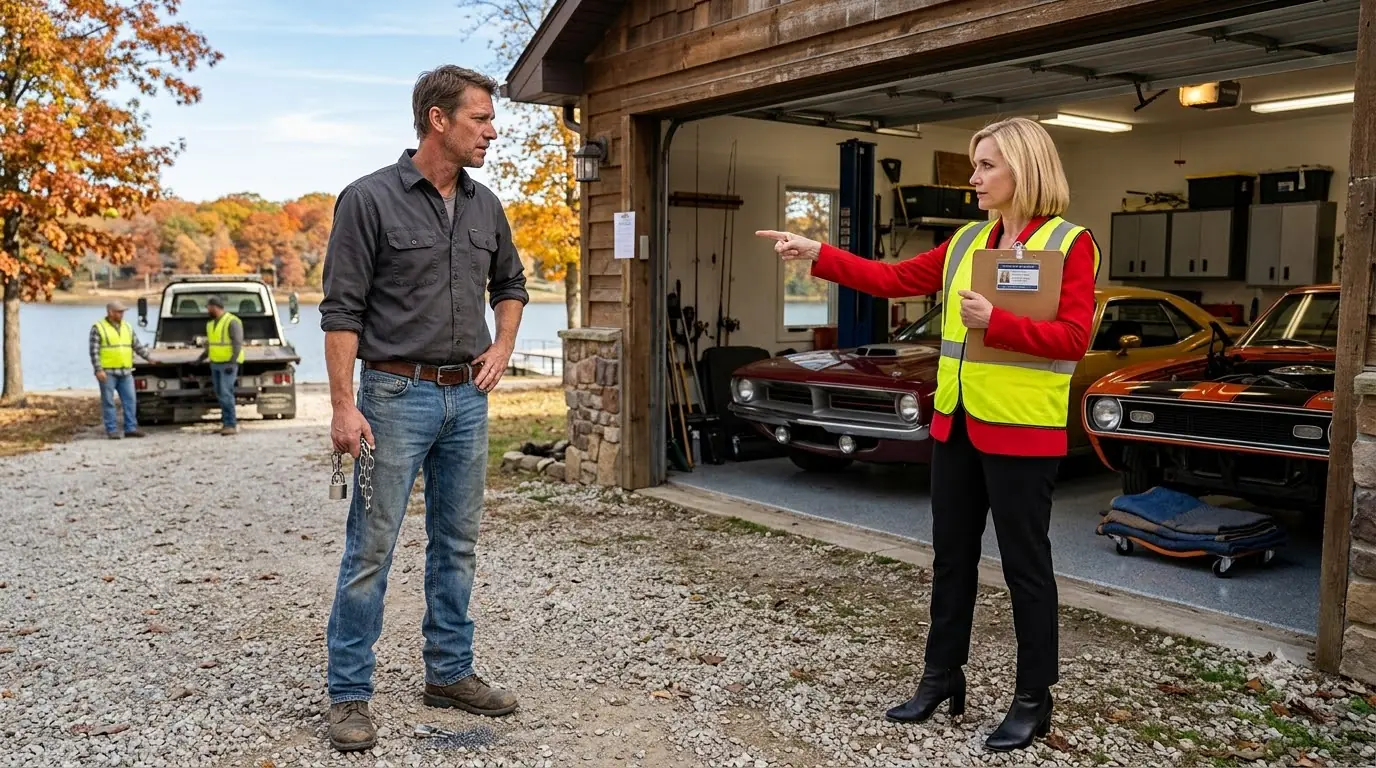
Someone had walked onto my property, cut my lock, rolled three classic cars into my garage, and left me a note telling me whom to contact if I had questions.
What Renata Weston Carr did not know was that I was not a member of her HOA. I had never joined for a day, never paid a dollar, and never signed a single document. She had no authority over me. By the end of the dispute, those cars would cost her $25,200, and that would be the least of her problems. The property sits on the western edge of Caldwell Lake in central Missouri, a crescent-shaped stretch of water most locals call the Old Kettle because of the way the far bank curves. My grandfather, Elwood Pruitt, bought four acres there in 1971 for what he liked to describe as a strong handshake and a case of Pabst.
He was not entirely joking. The deed was filed at the county recorder’s office in March of that year, stamped and recorded before the surrounding subdivision, Whispering Pines Estates, existed as anything more than a surveyor’s sketch. That timing mattered. Elwood built a two-bay garage near the water’s edge and called it the boathouse, even though it never held boats.
Over the decades, it housed a 1968 Ford F-100 with a cracked dashboard that smelled like gun oil and cedar, a chest freezer that hummed year-round, and roughly forty years of fishing tackle, propane canisters, and the kind of organized chaos only old men and artists seem able to create. When Elwood died, the property passed to my father, Dale. When Dale’s knees gave out and he moved to Branson to be closer to my sister, the lake property came to me. My name is Garrett Pruitt. I was forty-four, a mechanical engineer, and semi-retired after a software acquisition went better than expected. I am also the kind of man who prefers the company of a torque wrench to most cocktail parties. I renovated the garage with a new roof, an epoxy floor, upgraded electrical service, and a vehicle lift I installed myself. The smell of fresh concrete and WD-40 in the morning is one of life’s legitimate pleasures, and I am not apologizing for that. Whispering Pines Estates was developed in the late 1980s and expanded twice. It wraps around three sides of my property like a horseshoe, a fact that generated years of confusion, assumptions, and eventually Renata Weston Carr. Renata had moved into the subdivision six years before the events of this story and had become, by every account, a force of nature in the bureaucratic sense.
She had turned community standards enforcement into something approaching a personal religion. She wore lanyards with laminated identification badges to neighborhood meetings and handed out business cards that read “Compliance Director,” a title she had invented and bestowed upon herself after maneuvering her way to the top of the HOA board. She drove a white Cadillac Escalade with a vanity plate that read RULES. I am not making that up. Renata’s authority rested on one foundational assumption: that everyone around the lake belonged to the HOA.
The subdivision covenants, conditions, and restrictions had been amended three times, and each amendment quietly expanded the claimed community boundary a little farther. On the version of the HOA map Renata distributed in welcome packets, my four acres sat squarely inside Whispering Pines Estates. A map and a deed, however, are two different things. Elwood’s deed predated the HOA by eighteen years. I had endured minor run-ins with Renata before, including a letter claiming my gravel driveway violated “aesthetic continuity standards” and another concerning a tarp I had left on my truck for two weeks.
I ignored both because they were addressed to “Whispering Pines Homeowner,” and I was not one. I assumed she would eventually figure it out because I believed people like Renata were ultimately rational beneath the lanyard. I was wrong. The first real escalation came on a Tuesday in October. The air smelled like dying leaves and distant wood smoke, that particular Missouri autumn scent that makes you want to pour a bourbon and stay outside until your fingers go numb. I had been in the garage all morning rebuilding a carburetor when I heard gravel crunching outside. I looked up and saw a flatbed truck backing toward my garage doors. Behind it, parked at the end of my driveway with the confidence of a woman who had never once doubted herself, stood Renata Weston Carr. She held a clipboard and wore a reflective safety vest over a blazer. “You’re blocking,” she called, as though I were the one who had arrived uninvited. “We need access to the storage space.” I set down my ratchet. “I’m sorry. Whose storage space?” She smiled the kind of smile that had already rehearsed the conversation. “The HOA has requisitioned this facility for winter vehicle storage. You should have received the notice.” She held up a sheet of paper. “Compliance Directive 74B, temporary seasonal use of underutilized community structures.” I had never received any notice because I was not in the HOA. Renata was not interested in discussing that yet, and that became my first mistake. I let the trucks unload because I was confused. That is the honest answer. When someone arrives with clipboards, reflective vests, and official-sounding alphanumeric codes, the brain takes a moment to decide whether the situation is real or whether something has been missed. In that moment of hesitation, two flatbeds unloaded three classic cars into my garage. The first was a 1972 Chevelle SS in deep burgundy, genuinely beautiful. The second was a 1965 Mustang fastback with a bad respray in a shade close to old mustard, which was a crime in its own right. The third was a Pontiac GTO Judge, partially disassembled and wrapped in moving blankets, pushed in on a dolly by two men in coveralls who smelled like cigarettes and transmission fluid and clearly had no idea whose property they were entering. Renata handed me a single-page form. “Sign here acknowledging receipt of storage units.” “I’m not signing anything,” I said. “That’s fine. Your non-signature will be noted as noncompliance.” She said it cheerfully, the kind of cheerfulness that means a person has already won the argument in her own mind. She left before I could properly articulate what I was feeling, which was a slow-building, low-frequency fury, like an engine cold-started in January that needs several minutes before it will run clean. I stood in my own garage, now smelling like three strangers’ oil pans, and looked at the severed padlock on my workbench. They had left it there like a calling card. Most people would have called the HOA office and started yelling. I understood the impulse, but I had been an engineer long enough to know that yelling is what people do when they do not yet have a plan. I went inside, made coffee, and started reading. First, I reviewed Missouri property law, focusing on trespass, unauthorized storage, and lien rights. The basic principle was clear enough: property deliberately left on someone else’s land without permission could create liability, and written notice of reasonable storage charges could support a lien claim against the stored items if the charges went unpaid. I did not act immediately. Patience is a weapon. The second thing I reviewed was Whispering Pines Estates’ governing documents, which were available through the county recorder because the HOA filings had been recorded. I spent two hours comparing the covenants with subdivision plats and found something important. The CC&Rs defined the HOA boundary using the 1989 plat map, and my property was expressly carved out as non-HOA land in the original filing. It was there in black and white, on file since 1989. I printed the document, placed it in a folder, and made a cup of tea. The satisfaction of finding a structural flaw in someone else’s argument is an underrated pleasure. It sits somewhere between cracking a stubborn bolt loose and watching a perfect weld cool. The next morning, I called the HOA’s official number and asked to speak with someone about a billing matter. The woman who answered was cheerful and clearly was not Renata. She confirmed that my property appeared in the system as a member parcel. “Can you tell me the date the property was enrolled?” I asked. She put me on hold and came back two minutes later. “Our records show it was added during the 2019 boundary amendment.” “Great,” I said. “Can you email me the documentation showing my consent to that enrollment?” There was a pause. “I would have to check with the compliance director.” “That would be wonderful. I’ll wait for her call.” Renata called that afternoon. Her voice had a different texture than it did in person, slightly clipped, with the cheerfulness operating at perhaps seventy percent. “Mr. Pruitt, I understand you have questions about your enrollment.” “Not really questions,” I said. “More of a statement. My property predates your HOA by almost twenty years. I was never enrolled with my consent. I am not a member, so the vehicles in my garage are trespassing.” There was a long pause. “The boundary amendment was voted on by the board.” “Right. Your board, which I am not part of because I am not a member. Do you want to discuss the storage fees I will be invoicing, or should we begin with a trespass complaint?” She hung up. Just like that, the game changed. Renata’s response was to go on offense, the classic move of escalating the paperwork when the target pushes back. Within forty-eight hours, I received three notices in my mailbox. One cited my gravel driveway, one cited unauthorized structural modifications to the garage, and the third accused me of violating community aesthetics because of a tarp on my fishing boat, which had been inside my garage for three months. The letters were dense with phrases like “community cohesion mandate” and “shared environmental stewardship zone.” They sounded official until you read them twice and realized they carried the legal weight of a strongly worded diary entry. I photographed all three and saved them in a folder labeled “Renata’s Greatest Hits.” She still was not finished. A week after the phone call, I came home to find her in my driveway with a woman I did not recognize. They were not near the front door. They were around the side of the house near the garage, and the second woman was taking photographs. Renata had a clipboard, of course, and wore the reflective vest again, this time over a wool coat. “Can I help you?” I called from twenty feet away. Renata turned without flinching. “Annual property inspection. All HOA members are subject to—” “Stop.” I raised a hand. “You are on private property. You were not invited. You have no authority here because I am not an HOA member, and the woman photographing my garage is trespassing.” The photographer, a young woman who looked like an intern and held only a phone, appeared to want to disappear. Renata squared her shoulders. “The board’s legal counsel has reviewed your claim of non-membership and advised us that the 2019 amendment—” “Is not binding on me because I never consented to enrollment,” I said. “That is not merely my interpretation. That is the governing rule. A board vote does not create consent for a non-member landowner.” Renata looked down at her clipboard in the way people do when they need a moment to regroup. I had learned that Missouri law required affirmative consent before an existing property could be drawn into an expanded common-interest boundary. A unanimous vote by people who did not own my land could not substitute for my written agreement. I had not yet sent a cease-and-desist letter because I was still documenting the pattern. I smiled pleasantly and said, “You both need to leave.” They left. Renata walked to her Escalade with the precise, controlled stride of a woman who was furious and determined not to show it. The photographer hurried after her. Before Renata closed the vehicle door, I heard her say, quietly but not quietly enough, “He has no idea what this property is worth.” That comment stayed with me. She had not said what the case was worth or what the dispute was worth. She had said the property. I went back inside while dry leaves scraped across the gravel and the faint petroleum smell from the garage drifted toward the house. Then I began reviewing Whispering Pines Estates’ financial reports. Missouri required the organization to file annual disclosures with the county, and three years back I found a line item titled “Lakefront Development Feasibility Study.” The study covered land that included my four acres. Someone had been planning something, and Renata’s vehicle storage operation began to look less like a bureaucratic mistake and more like an attempt to establish a history of HOA control over my property. If the HOA could demonstrate repeated access, enforcement, and use, someone might later argue that my land had functionally belonged within its authority for years. This was not about three cars. It was about the land. My coffee went cold while I read, and something in me shifted from anger to focus. It felt like a lens snapping into place: clear, calm, and ready. I was finished waiting for Renata to become reasonable. I was going to build a trap. Before building anything, I made two calls. The first was to a property-rights attorney named Clifton Bower in Jefferson City. Clifton had a reputation for genuinely enjoying fights with HOAs, not because he was combative by nature, but because, as he told me during our first conversation, homeowners associations were among the last places in American civil life where people routinely accepted authority they had never actually agreed to. His voice sounded like gravel wrapped in flannel, and he discussed legal strategy the way a woodworker discusses joinery, with quiet and detailed appreciation. Clifton reviewed my deed, the HOA filing history, and the 2019 amendment within forty-eight hours. His conclusion was unambiguous. I had never been lawfully enrolled in Whispering Pines Estates, the 2019 amendment was void as applied to my land, and every compliance notice Renata had sent could support a pattern of harassment against a non-member. Then he gave me advice that made me smile. “Do not send a cease-and-desist letter yet,” he said. “Let her keep going. Every letter she sends, every photograph her intern takes, every notice she files adds evidence to the pattern. You want that pattern on the record before you shut it down.” I hung up and made my second call to a neighbor across the water, a retired county assessor named Vern Stubblefield. Vern was seventy-one, drove a 1991 Bronco that had been repainted at least four times, and knew every piece of land on Caldwell Lake the way some people know Bible verses, complete with chapter, verse, and context. “Renata’s development plan,” I said when he answered. There was a pause. Then Vern said quietly, “So you found it.” He had known about the feasibility study for two years. A developer called Mercer Capital Group had been quietly buying options on Whispering Pines properties near the waterline. The unofficial plan was to consolidate lakefront parcels and build a boutique marina and resort. My four acres sat at the point of maximum lake exposure. Without my land, the project had a gap; with it, the developer would control nearly a mile of uninterrupted waterfront. Renata was on Mercer Capital Group’s informal advisory board. A public business-license disclosure showed a $40,000 consulting retainer. She was not simply an HOA zealot. She was an HOA zealot with a financial stake in establishing control over my parcel. The HOA filings, feasibility study, and consulting disclosure were all sitting in public records for anyone willing to look. I called Clifton back with what Vern had found. “That changes things considerably,” he said, and I could hear him writing. “She is not merely overstepping as an HOA officer. She may be using her position to benefit a third party that is paying her. That creates a serious conflict of interest and opens claims beyond simple trespass.” “How much time do you need to build the complete picture?” I asked. “Give me six weeks. In the meantime, let her store the cars. Do not move them or touch them. Just start the meter.” “The storage lien,” I said. “Exactly.” That evening, I typed a formal letter on stationery with a header I had made myself: “Pruitt Property, Caldwell Lake, Missouri. Established 1971.” I sent it by certified mail to the HOA office, to Renata’s home address, and to the registered owners of all three vehicles. I had obtained the ownership information through a public records request. The letter stated that the cars had been placed on private property without consent, that storage would be charged at seventy-five dollars per vehicle per day, and that unpaid balances could result in liens against the vehicles. Three cars at seventy-five dollars each came to $225 per day. Six weeks, at Clifton’s request, would total $9,450. I sealed the envelopes while the garage outside smelled faintly of the Chevelle’s exhaust. Someone had recently started the engine inside my garage without permission. I decided to let the vehicles remain and let the meter run. A well-laid trap should not be sprung before it becomes worth springing. Three weeks into Clifton’s six-week timeline, he called on a Thursday morning with a voice pitched slightly above its usual flannel-and-gravel register. “Garrett, I need you to sit down.” “I’m already sitting.” I was at the kitchen table looking over the lake, which was steel gray and flat in the December cold. “The Chevelle,” he said. “The burgundy one.” “What about it?” “I ran the VIN. It is registered personally to Renata Weston Carr.” I let that settle. “She stored her own car in my garage.” “One of the three. The Mustang belongs to her brother-in-law. The GTO belongs to a Delaware LLC that traces back to Renata as well.” Two of the three cars were hers directly or indirectly. The invoices sent to the registered owners had all reached her circle. She knew the charges were accumulating and had offered no response, challenge, or payment. Either she believed she was untouchable, or she did not believe I would follow through. Both assumptions would prove wrong. The GTO’s Delaware LLC had been formed in 2021 with a stated business purpose of classic-vehicle acquisition and management. In a credit application Clifton obtained through related litigation, the LLC listed “expected future value of lakefront storage and restoration facilities at Caldwell Lake, Missouri” among its anticipated assets. Renata had not only put vehicles in my garage. She had referred to the use of my property as a business resource in a financial document. “Is that fraud?” I asked. “It is a very interesting question,” Clifton replied, which is lawyer language for yes, or at least yes enough to keep digging. There was more. Vern had visited the recorder’s office in person and found a draft easement prepared in 2022. It was never filed, but it proposed granting Whispering Pines Estates perpetual community access across my lakefront. The document came from a firm with a long relationship with Mercer Capital Group. It had not been recorded because it required my signature, which no one had requested and which I would never have given. The existence of the draft showed that someone had planned either to obtain my signature or to argue later that established HOA use made it unnecessary. I stared at the lake for a long time. Winter light lay on the water without warmth, only a flat white glare. Elwood had bought that ground with a handshake and a case of beer, fished from an aluminum boat patched with electrical tape, and cared for the place without ever pretending it was a grand estate. It was simply good land with good water and good memories. Someone had been quietly and methodically trying to take it. I called Clifton back. “Change of plan,” I said. “I do not want merely to win. I want this to become a lesson.” “Define lesson.” “Public, documented, and final.” There was a pause. Then he said, “I’ll start drafting.” The next three weeks were among the most productive of my life. I am an engineer by training and temperament, which means that once I decide to solve a problem, I solve it with systems. I built a four-tab, color-coded spreadsheet tracking every legal claim, item of evidence, piece of correspondence, and dollar owed. Every Friday, I printed weekly invoices for three cars at seventy-five dollars per day and sent them by certified mail to Renata and the relevant entities. None were paid. All were signed for. The delivery receipts went into a folder labeled Exhibit B. Clifton was building the legal architecture around them. The trespass and storage-lien claim formed the foundation, straightforward and thoroughly documented. The second action was a complaint regarding the HOA’s unauthorized 2019 boundary expansion. If the amendment were formally voided as applied to my property, it could unravel enforcement against several other contested parcels. Clifton had already spoken to two older Caldwell Lake landowners who had been receiving HOA bills for years despite never consenting to membership. They were interested in joining as co-complainants. The third action concerned Renata’s undisclosed arrangement with Mercer Capital Group. As an officer of a nonprofit homeowners association, she had duties concerning conflicts of interest when board decisions benefited an entity paying her. She had used her compliance position to requisition my garage, creating a record of HOA use that could support a future access argument, while receiving $40,000 from a developer that needed my property. It was a conflict of interest wearing a reflective safety vest. Vern contributed something equally practical. He knew nearly everyone on the lake and began making calm, neighborly phone calls. “Did you know a developer is studying the lakefront? Did you know HOA reserve money may have funded a feasibility study members never approved?” Within two weeks, Vern assembled a loose coalition of fourteen landowners, some HOA members and some not, who were paying close attention. I also rebuilt the physical security around the garage. I rehung the original door with new hinges, a reinforced frame, and a solid-core panel. I installed four motion-triggered cameras with cloud storage, covering every approach. Then I photographed and cataloged each car, every scratch, ding, missing part, and existing defect. If anything happened to a classic car while it sat on my property, the owner would likely try to make it my problem. I dated and timestamped the records and had two condition reports notarized. I also called the county sheriff’s non-emergency line and filed a formal report of trespass and unauthorized storage, naming Renata and the two LLCs. The young deputy taking the report sounded more accustomed to barking dogs and noise complaints, but he filed it. The final piece was a local journalist named Delphine Marsh. She wrote a weekly regional column called “Your Property, Your Rights” and had followed Whispering Pines Estates from a distance for years. Two years earlier, she had covered complaints about the 2019 boundary amendment, though no one had pursued a legal challenge. I gave her the broad outline under an embargo. Delphine listened, took notes, and asked two sharp questions. Then she said, “When are you planning the public moment?” I gave her the date. “I’ll be there,” she said. By then, the garage had taken on the surreal feeling of a museum exhibit. Three beautiful old cars sat under LED shop lights on my epoxy floor, all carefully documented, while an invoice climbed past six thousand dollars and continued upward. Every morning, I checked the cameras, updated the spreadsheet, and thought, tick, tick, tick. Outside, December sharpened into the kind of cold that smells like iron and turns the lake into a mirror. Renata made her next move in January. Whispering Pines Estates held quarterly meetings in the community room of the Caldwell Lake Recreation Center, a cinder-block building with fluorescent lights, folding chairs, and the permanent smell of old coffee and carpet cleaner. Vern attended every one and reported back with the detail and calm of a war correspondent who had decided the conflict was mostly absurd. At the January meeting, Renata gave what she called a “Community Property Rights Briefing.” It was a PowerPoint presentation arguing that my four acres belonged to the HOA and that my noncompliance threatened the community’s long-term planning. She cited the 2019 amendment and a legal opinion prepared not by an attorney but by a paralegal service that had apparently not studied the relevant issues in depth. She displayed a map on which my property was shaded yellow. The legend identified it as a “Non-Cooperative Parcel.” According to Vern, the room was divided. Older residents who remembered the area before the 2019 expansion looked uneasy. A retired contractor named Beaumont Doyle asked whether the HOA possessed a consent document signed by the property owner. Renata replied that the board vote constituted community consent. Beaumont told her that was not an answer. After the meeting, Renata sent a certified letter to the Caldwell Lake Township Zoning Board claiming my garage renovation lacked permits and requesting an inspection. It was an aggressive move that could have created leverage if she had been right. If she was wrong, it would create another exhibit. I pulled my structural, electrical, roofing, and lift-installation permits, all properly filed, inspected, approved, and closed. My father had taught me that if you work on property, you do it correctly and file the paperwork. I sent the records to the zoning board before an inspection was scheduled, along with a cover letter from Clifton noting that the complaint appeared retaliatory given the active dispute. We requested that the board place that context in its official file. The inspector arrived a few days later. His name was Cecil, a laconic, sunburned man who appeared to have spent thirty years seeing every possible version of a garage. He compared the work with the permits, looked around for about twenty minutes, and said, “Everything looks fine.” His written report contained one useful line: “Inspection initiated by third-party complaint. No violations found.” Another exhibit, courtesy of Renata. The smear campaign followed. In late January, an anonymous post appeared in the closed Whispering Pines Facebook group claiming that a “non-cooperative property owner” was interfering with community resources and violating county ordinances. The account had been created three days earlier. Vern sent me a screenshot with one message: “She’s scared.” He was right. Anonymous posts, zoning complaints, and PowerPoint presentations were the tools of someone whose substantive leverage was disappearing. Renata was creating noise to imitate momentum. That week, my storage invoice reached $8,175, past due, with no response. I printed it, filed it, and returned to work. One thing I will say for Renata is that she had good taste in cars. The Chevelle was beautiful even under fluorescent lights in a Missouri winter. Cars from that era have an honesty to them, every component visible and purposeful, nothing hidden beneath decorative plastic. The Mustang’s paint was unfortunate, and the GTO’s orange finish belonged to the wrong period entirely. Elwood would have disapproved. February brought the coldest week of the year and evidence that Renata had attempted to bribe someone. The target was Beaumont Doyle, the retired contractor who had asked the inconvenient question at the January meeting. Over the previous month, Beaumont had joined Vern’s coalition. He was not a lawyer or a hothead. He was simply a man who had spent forty years building things correctly and had a near-physical aversion to people who cut corners. Through the HOA treasurer, Renata offered Beaumont a forty-percent reduction in annual dues for three years if he withdrew his objection to the boundary expansion and signed a statement supporting the HOA’s position. Beaumont did not confront her. He wrote a detailed memorandum of the conversation, dated it, and mailed copies to Clifton and me. Then he called and asked, “Is this what I think it is?” “It could be viewed as an inducement to provide false testimony,” Clifton said after reviewing the details. “Depending on how far the matter develops, it may raise witness-tampering issues. At minimum, it is a serious ethical problem.” Beaumont’s memorandum became another exhibit. The coalition grew from fourteen to nineteen. Three new members were current HOA homeowners who discovered that reserve funds intended for roads and common-area repairs had partly financed the private lakefront feasibility study. Vague unease turned into specific anger. Delphine called in mid-February and said she already had enough for an article. We agreed to wait for the public moment so the facts would land in the right room. That room was the Caldwell Lake Township annual public meeting, scheduled for the first Saturday in March. The gathering took place in a century-old limestone hall with creaking wooden floors and a high ceiling that made every voice echo. The meeting was open to the public. The county commissioner attended, and local television sometimes sent a camera crew when the agenda appeared interesting. I submitted a two-line agenda item: “Property Rights Dispute, Caldwell Lake Western Parcel. Presentation by Garrett Pruitt, Property Owner.” The township clerk confirmed that it had been accepted. Renata saw the item and prepared. During the two weeks before the meeting, she made three final moves. First, she hired an actual attorney who sent Clifton a proposal for a shared-use agreement. The HOA offered me five hundred dollars per year in exchange for formal access to my garage. Clifton declined politely. Second, Renata objected to the continued use of the garage as a “non-residential structure,” a creative but nonsensical argument concerning a two-bay garage on residential property. Third, she called the county commissioner’s office and attempted to have my agenda item removed as a private legal dispute unsuitable for public discussion. The commissioner declined. The township clerk told me about the call when I arrived to set up. I thanked her and connected my laptop to the projector. The hall smelled like old wood, radiator heat, and either stale coffee or the memory of coffee. I placed my evidence folder on the table in front of me. It contained photographs, deeds, invoices, Beaumont’s memorandum, the feasibility study, Renata’s consulting disclosure, the car condition reports, certified-mail receipts, and nineteen color-coded exhibit tabs. Across the room, Renata sat in the third row wearing a blazer without the reflective vest. Her attorney sat beside her. Delphine Marsh waited at the back with a notebook, with Vern next to her and Beaumont nearby, arms crossed and patient. The commissioner called the meeting to order. My trap was not physical or theatrical. It consisted of paper, law, and an eighteen-year gap between Elwood’s deed and the HOA’s creation. It had been waiting in county records for someone foolish enough to give it teeth. When my agenda item was called, I walked to the front and displayed my first slide. It was Elwood’s original deed, filed March 14, 1971, showing the property boundary in black ink and dated eighteen years before Whispering Pines Estates existed. I left it on the screen for a moment. “My name is Garrett Pruitt,” I said. “My grandfather bought this land in 1971. My father inherited it, and I own it now. I am not a member of the Whispering Pines Estates Homeowners Association. I have never signed a consent form, paid dues, voted in an election, or otherwise affiliated my property with that organization.” I continued, “That is not a matter of opinion. It is a fact documented at the county recorder’s office and confirmed through the HOA’s own original filings.” Then I changed slides. The next screen showed the 2019 amendment beside the governing consent requirement, with the relevant sections highlighted. “In November of last year, three vehicles were placed in my private garage without my consent under the claimed authority of HOA Compliance Director Renata Weston Carr. Ms. Weston Carr is in this room today.” I did not point at her or turn toward her. “Two of those vehicles are registered either to Ms. Weston Carr personally or to an LLC she controls.” I continued, “She used my property without permission while receiving a $40,000 consulting retainer from Mercer Capital Group, a developer with an active interest in consolidating lakefront property at Caldwell Lake, including my parcel.” The room became silent in a way that was not empty but loaded. Chairs shifted. Someone exhaled sharply. I clicked through the invoices, certified-mail receipts, and calculations. Three vehicles had remained for 112 days at seventy-five dollars per vehicle per day. The unpaid total was $25,200. Clifton had filed the lien paperwork with the county that morning, attaching the debt to the vehicles and preventing clean sale or transfer until the balance was satisfied. “Ms. Weston Carr’s attorney was informed of the lien this morning,” I said. Then I displayed Beaumont Doyle’s memorandum with appropriate identifying information redacted. “There is also documentation of an attempt to induce a community member to provide a favorable statement in exchange for a financial benefit. That documentation has been sent to the county sheriff’s office and the Missouri Attorney General’s Consumer Protection Division.” I looked up from the laptop. “I am not asking this township to decide my private legal claims today. I am placing facts on the public record. I want my neighbors to know that HOA reserve funds, contributed for roads and common-area maintenance, were used toward a private developer’s feasibility study without a member vote. I also want Ms. Weston Carr to have the opportunity to respond in this room, publicly, with witnesses present.” I stepped away from the lectern. The room erupted, not into chaos but into controlled detonation. People spoke urgently to the neighbors beside them. Beaumont stood and said, “I can confirm the inducement. I have a signed memorandum.” A woman in the second row told another resident that she had known something was wrong with the reserve fund. Renata’s attorney leaned close and whispered to her. During the four minutes of my presentation, her expression had moved through several stages before arriving at the look of someone who had played a card and watched it fail. She stood. “This is a private legal matter.” “This is a public meeting,” the commissioner replied mildly. “You have listened to Mr. Pruitt’s presentation. You are welcome to respond.” Renata sat back down. Delphine was writing quickly. A regional television crew, tipped off by Delphine, had arrived five minutes before the meeting and set up quietly at the rear. The red camera light had been on since Elwood’s deed appeared on the screen. There was no theatrical mic drop. I placed my nineteen-tab evidence folder on the township clerk’s table so it could be reviewed as part of the record. Then I returned to my seat. Vern reached over and shook my hand without saying anything. That was enough. The legal resolution took four months, fast by legal standards and ordinary for a dispute like ours. Renata’s attorney paid the full $25,200 on behalf of the relevant owners and LLCs as a condition of releasing the liens. The vehicles were removed on a gray April morning by the same flatbed company that had delivered them. I watched from the garage doorway with coffee in my hand. The Chevelle left last. It really was a beautiful car. The Missouri authorities formally voided the 2019 HOA boundary amendment as applied to my property and two neighboring non-member parcels because written consent had never been obtained. The ruling was published in a state regulatory bulletin, dry reading but important. In the years that followed, other property owners cited the decision in their own HOA disputes. Renata Weston Carr resigned as compliance director two weeks after the town hall. The board elected a retired schoolteacher named Phyllis, who, according to everyone I knew, made the organization considerably less adversarial. Mercer Capital Group terminated Renata’s consulting arrangement and shelved the marina-and-resort proposal after it became clear that my land was unavailable and the economics did not work without it. The investigation into the attempted inducement of Beaumont remained open at the last update I received. I will not pretend to know how that issue was ultimately resolved. What happened to the land itself is the part I prefer to remember. Shortly after the legal matters settled, Vern called me with an idea involving the Caldwell Lake Preservation Society. The society had spent years working on water quality and shoreline conservation. It had long wanted a public nature-access point on the western shore but had never secured suitable waterfront property. Vern suggested a voluntary conservation easement, not the fabricated access arrangement Renata had tried to create, but a lawful agreement made with the owner’s consent. I spoke with Clifton, and Clifton spoke with the society. We structured the agreement carefully. The easement granted permanent public walking access along fifty feet of shoreline in exchange for a modest tax reduction and a conservation restriction protecting the water’s edge from future development. My four acres remained mine. Elwood’s garage remained mine. The part Renata and Mercer Capital Group had tried to commodify was protected for public use in perpetuity. The Preservation Society held a small dedication in May. Vern attended, as did Beaumont and Delphine, who wrote a front-page regional article about it. A local high school biology class used the access point for a water-quality study that spring. The shoreline that nearly became part of a private resort instead became a place where students could test lake water and families could walk. The scholarship was Beaumont’s idea. He described the $25,200 recovery as “a pretty clean piece of money,” meaning it came from a wrong that had been corrected rather than from any real loss of mine. We placed half of it into a scholarship fund at the county community college for students studying environmental science or property law. The first recipient was a twenty-year-old from Caldwell who hoped to work for the state environmental agency. I think Elwood would have appreciated that. He was not sentimental, but he understood that land is more than acreage. It is history, community, and the particular smell of lake water on a November morning when the air is cold enough to make your eyes water. He bought the place for a handshake and a case of beer. I kept it with a folder containing nineteen color-coded exhibits. Not a bad deal.I came home one afternoon to find my own garage locked shut with someone else’s lock. My padlock had been cut off and left on my workbench like a trophy. Taped to the door was a notice that read, “Temporary HOA storage. Speak to Compliance Director Renata Weston Carr if you have questions.” It was not a request or an apology. It was a directive posted on my own property, on land that had been in my family since 1971.
Someone had walked onto my property, cut my lock, rolled three classic cars into my garage, and left me a note telling me whom to contact if I had questions. What Renata Weston Carr did not know was that I was not a member of her HOA. I had never joined for a day, never paid a dollar, and never signed a single document. She had no authority over me. By the end of the dispute, those cars would cost her $25,200, and that would be the least of her problems.
The property sits on the western edge of Caldwell Lake in central Missouri, a crescent-shaped stretch of water most locals call the Old Kettle because of the way the far bank curves. My grandfather, Elwood Pruitt, bought four acres there in 1971 for what he liked to describe as a strong handshake and a case of Pabst. He was not entirely joking. The deed was filed at the county recorder’s office in March of that year, stamped and recorded before the surrounding subdivision, Whispering Pines Estates, existed as anything more than a surveyor’s sketch.
That timing mattered. Elwood built a two-bay garage near the water’s edge and called it the boathouse, even though it never held boats. Over the decades, it housed a 1968 Ford F-100 with a cracked dashboard that smelled like gun oil and cedar, a chest freezer that hummed year-round, and roughly forty years of fishing tackle, propane canisters, and the kind of organized chaos only old men and artists seem able to create. When Elwood died, the property passed to my father, Dale. When Dale’s knees gave out and he moved to Branson to be closer to my sister, the lake property came to me.
My name is Garrett Pruitt. I was forty-four, a mechanical engineer, and semi-retired after a software acquisition went better than expected. I am also the kind of man who prefers the company of a torque wrench to most cocktail parties. I renovated the garage with a new roof, an epoxy floor, upgraded electrical service, and a vehicle lift I installed myself. The smell of fresh concrete and WD-40 in the morning is one of life’s legitimate pleasures, and I am not apologizing for that.
She drove a white Cadillac Escalade with a vanity plate that read RULES. I am not making that up. Renata’s authority rested on one foundational assumption: that everyone around the lake belonged to the HOA. The subdivision covenants, conditions, and restrictions had been amended three times, and each amendment quietly expanded the claimed community boundary a little farther. On the version of the HOA map Renata distributed in welcome packets, my four acres sat squarely inside Whispering Pines Estates.
A map and a deed, however, are two different things. Elwood’s deed predated the HOA by eighteen years. I had endured minor run-ins with Renata before, including a letter claiming my gravel driveway violated “aesthetic continuity standards” and another concerning a tarp I had left on my truck for two weeks. I ignored both because they were addressed to “Whispering Pines Homeowner,” and I was not one. I assumed she would eventually figure it out because I believed people like Renata were ultimately rational beneath the lanyard.
I was wrong. The first real escalation came on a Tuesday in October. The air smelled like dying leaves and distant wood smoke, that particular Missouri autumn scent that makes you want to pour a bourbon and stay outside until your fingers go numb. I had been in the garage all morning rebuilding a carburetor when I heard gravel crunching outside. I looked up and saw a flatbed truck backing toward my garage doors.
Behind it, parked at the end of my driveway with the confidence of a woman who had never once doubted herself, stood Renata Weston Carr. She held a clipboard and wore a reflective safety vest over a blazer. “You’re blocking,” she called, as though I were the one who had arrived uninvited. “We need access to the storage space.”
I set down my ratchet. “I’m sorry. Whose storage space?”
She smiled the kind of smile that had already rehearsed the conversation. “The HOA has requisitioned this facility for winter vehicle storage. You should have received the notice.” She held up a sheet of paper. “Compliance Directive 74B, temporary seasonal use of underutilized community structures.”
I had never received any notice because I was not in the HOA. Renata was not interested in discussing that yet, and that became my first mistake. I let the trucks unload because I was confused. That is the honest answer. When someone arrives with clipboards, reflective vests, and official-sounding alphanumeric codes, the brain takes a moment to decide whether the situation is real or whether something has been missed.
In that moment of hesitation, two flatbeds unloaded three classic cars into my garage. The first was a 1972 Chevelle SS in deep burgundy, genuinely beautiful. The second was a 1965 Mustang fastback with a bad respray in a shade close to old mustard, which was a crime in its own right. The third was a Pontiac GTO Judge, partially disassembled and wrapped in moving blankets, pushed in on a dolly by two men in coveralls who smelled like cigarettes and transmission fluid and clearly had no idea whose property they were entering.
Renata handed me a single-page form. “Sign here acknowledging receipt of storage units.”
“I’m not signing anything,” I said.
“That’s fine. Your non-signature will be noted as noncompliance.”
She said it cheerfully, the kind of cheerfulness that means a person has already won the argument in her own mind. She left before I could properly articulate what I was feeling, which was a slow-building, low-frequency fury, like an engine cold-started in January that needs several minutes before it will run clean. I stood in my own garage, now smelling like three strangers’ oil pans, and looked at the severed padlock on my workbench. They had left it there like a calling card.
Most people would have called the HOA office and started yelling. I understood the impulse, but I had been an engineer long enough to know that yelling is what people do when they do not yet have a plan. I went inside, made coffee, and started reading. First, I reviewed Missouri property law, focusing on trespass, unauthorized storage, and lien rights. The basic principle was clear enough: property deliberately left on someone else’s land without permission could create liability, and written notice of reasonable storage charges could support a lien claim against the stored items if the charges went unpaid.
I did not act immediately. Patience is a weapon. The second thing I reviewed was Whispering Pines Estates’ governing documents, which were available through the county recorder because the HOA filings had been recorded. I spent two hours comparing the covenants with subdivision plats and found something important. The CC&Rs defined the HOA boundary using the 1989 plat map, and my property was expressly carved out as non-HOA land in the original filing.
It was there in black and white, on file since 1989. I printed the document, placed it in a folder, and made a cup of tea. The satisfaction of finding a structural flaw in someone else’s argument is an underrated pleasure. It sits somewhere between cracking a stubborn bolt loose and watching a perfect weld cool. The next morning, I called the HOA’s official number and asked to speak with someone about a billing matter.
The woman who answered was cheerful and clearly was not Renata. She confirmed that my property appeared in the system as a member parcel. “Can you tell me the date the property was enrolled?” I asked. She put me on hold and came back two minutes later. “Our records show it was added during the 2019 boundary amendment.”
“Great,” I said. “Can you email me the documentation showing my consent to that enrollment?”
There was a pause. “I would have to check with the compliance director.”
“That would be wonderful. I’ll wait for her call.”
Renata called that afternoon. Her voice had a different texture than it did in person, slightly clipped, with the cheerfulness operating at perhaps seventy percent. “Mr. Pruitt, I understand you have questions about your enrollment.”
“Not really questions,” I said. “More of a statement. My property predates your HOA by almost twenty years. I was never enrolled with my consent. I am not a member, so the vehicles in my garage are trespassing.”
There was a long pause. “The boundary amendment was voted on by the board.”
“Right. Your board, which I am not part of because I am not a member. Do you want to discuss the storage fees I will be invoicing, or should we begin with a trespass complaint?”
She hung up. Just like that, the game changed. Renata’s response was to go on offense, the classic move of escalating the paperwork when the target pushes back. Within forty-eight hours, I received three notices in my mailbox. One cited my gravel driveway, one cited unauthorized structural modifications to the garage, and the third accused me of violating community aesthetics because of a tarp on my fishing boat, which had been inside my garage for three months.
The letters were dense with phrases like “community cohesion mandate” and “shared environmental stewardship zone.” They sounded official until you read them twice and realized they carried the legal weight of a strongly worded diary entry. I photographed all three and saved them in a folder labeled “Renata’s Greatest Hits.” She still was not finished. A week after the phone call, I came home to find her in my driveway with a woman I did not recognize.
They were not near the front door. They were around the side of the house near the garage, and the second woman was taking photographs. Renata had a clipboard, of course, and wore the reflective vest again, this time over a wool coat. “Can I help you?” I called from twenty feet away.
Renata turned without flinching. “Annual property inspection. All HOA members are subject to—”
“Stop.” I raised a hand. “You are on private property. You were not invited. You have no authority here because I am not an HOA member, and the woman photographing my garage is trespassing.”
The photographer, a young woman who looked like an intern and held only a phone, appeared to want to disappear. Renata squared her shoulders. “The board’s legal counsel has reviewed your claim of non-membership and advised us that the 2019 amendment—”
“Is not binding on me because I never consented to enrollment,” I said. “That is not merely my interpretation. That is the governing rule. A board vote does not create consent for a non-member landowner.”
Renata looked down at her clipboard in the way people do when they need a moment to regroup. I had learned that Missouri law required affirmative consent before an existing property could be drawn into an expanded common-interest boundary. A unanimous vote by people who did not own my land could not substitute for my written agreement. I had not yet sent a cease-and-desist letter because I was still documenting the pattern. I smiled pleasantly and said, “You both need to leave.”
They left. Renata walked to her Escalade with the precise, controlled stride of a woman who was furious and determined not to show it. The photographer hurried after her. Before Renata closed the vehicle door, I heard her say, quietly but not quietly enough, “He has no idea what this property is worth.”
That comment stayed with me. She had not said what the case was worth or what the dispute was worth. She had said the property. I went back inside while dry leaves scraped across the gravel and the faint petroleum smell from the garage drifted toward the house. Then I began reviewing Whispering Pines Estates’ financial reports.
Missouri required the organization to file annual disclosures with the county, and three years back I found a line item titled “Lakefront Development Feasibility Study.” The study covered land that included my four acres. Someone had been planning something, and Renata’s vehicle storage operation began to look less like a bureaucratic mistake and more like an attempt to establish a history of HOA control over my property. If the HOA could demonstrate repeated access, enforcement, and use, someone might later argue that my land had functionally belonged within its authority for years.
This was not about three cars. It was about the land. My coffee went cold while I read, and something in me shifted from anger to focus. It felt like a lens snapping into place: clear, calm, and ready. I was finished waiting for Renata to become reasonable. I was going to build a trap.
Before building anything, I made two calls. The first was to a property-rights attorney named Clifton Bower in Jefferson City. Clifton had a reputation for genuinely enjoying fights with HOAs, not because he was combative by nature, but because, as he told me during our first conversation, homeowners associations were among the last places in American civil life where people routinely accepted authority they had never actually agreed to. His voice sounded like gravel wrapped in flannel, and he discussed legal strategy the way a woodworker discusses joinery, with quiet and detailed appreciation.
Clifton reviewed my deed, the HOA filing history, and the 2019 amendment within forty-eight hours. His conclusion was unambiguous. I had never been lawfully enrolled in Whispering Pines Estates, the 2019 amendment was void as applied to my land, and every compliance notice Renata had sent could support a pattern of harassment against a non-member. Then he gave me advice that made me smile.
“Do not send a cease-and-desist letter yet,” he said. “Let her keep going. Every letter she sends, every photograph her intern takes, every notice she files adds evidence to the pattern. You want that pattern on the record before you shut it down.”
I hung up and made my second call to a neighbor across the water, a retired county assessor named Vern Stubblefield. Vern was seventy-one, drove a 1991 Bronco that had been repainted at least four times, and knew every piece of land on Caldwell Lake the way some people know Bible verses, complete with chapter, verse, and context. “Renata’s development plan,” I said when he answered.
There was a pause. Then Vern said quietly, “So you found it.”
He had known about the feasibility study for two years. A developer called Mercer Capital Group had been quietly buying options on Whispering Pines properties near the waterline. The unofficial plan was to consolidate lakefront parcels and build a boutique marina and resort. My four acres sat at the point of maximum lake exposure. Without my land, the project had a gap; with it, the developer would control nearly a mile of uninterrupted waterfront.
Renata was on Mercer Capital Group’s informal advisory board. A public business-license disclosure showed a $40,000 consulting retainer. She was not simply an HOA zealot. She was an HOA zealot with a financial stake in establishing control over my parcel. The HOA filings, feasibility study, and consulting disclosure were all sitting in public records for anyone willing to look.
I called Clifton back with what Vern had found. “That changes things considerably,” he said, and I could hear him writing. “She is not merely overstepping as an HOA officer. She may be using her position to benefit a third party that is paying her. That creates a serious conflict of interest and opens claims beyond simple trespass.”
“How much time do you need to build the complete picture?” I asked.
“Give me six weeks. In the meantime, let her store the cars. Do not move them or touch them. Just start the meter.”
“The storage lien,” I said.
“Exactly.”
That evening, I typed a formal letter on stationery with a header I had made myself: “Pruitt Property, Caldwell Lake, Missouri. Established 1971.” I sent it by certified mail to the HOA office, to Renata’s home address, and to the registered owners of all three vehicles. I had obtained the ownership information through a public records request. The letter stated that the cars had been placed on private property without consent, that storage would be charged at seventy-five dollars per vehicle per day, and that unpaid balances could result in liens against the vehicles.
Three cars at seventy-five dollars each came to $225 per day. Six weeks, at Clifton’s request, would total $9,450. I sealed the envelopes while the garage outside smelled faintly of the Chevelle’s exhaust. Someone had recently started the engine inside my garage without permission. I decided to let the vehicles remain and let the meter run.
A well-laid trap should not be sprung before it becomes worth springing. Three weeks into Clifton’s six-week timeline, he called on a Thursday morning with a voice pitched slightly above its usual flannel-and-gravel register. “Garrett, I need you to sit down.”
“I’m already sitting.” I was at the kitchen table looking over the lake, which was steel gray and flat in the December cold.
“The Chevelle,” he said. “The burgundy one.”
“What about it?”
“I ran the VIN. It is registered personally to Renata Weston Carr.”
I let that settle. “She stored her own car in my garage.”
“One of the three. The Mustang belongs to her brother-in-law. The GTO belongs to a Delaware LLC that traces back to Renata as well.”
Two of the three cars were hers directly or indirectly. The invoices sent to the registered owners had all reached her circle. She knew the charges were accumulating and had offered no response, challenge, or payment. Either she believed she was untouchable, or she did not believe I would follow through. Both assumptions would prove wrong.
The GTO’s Delaware LLC had been formed in 2021 with a stated business purpose of classic-vehicle acquisition and management. In a credit application Clifton obtained through related litigation, the LLC listed “expected future value of lakefront storage and restoration facilities at Caldwell Lake, Missouri” among its anticipated assets. Renata had not only put vehicles in my garage. She had referred to the use of my property as a business resource in a financial document.
“Is that fraud?” I asked.
“It is a very interesting question,” Clifton replied, which is lawyer language for yes, or at least yes enough to keep digging.
There was more. Vern had visited the recorder’s office in person and found a draft easement prepared in 2022. It was never filed, but it proposed granting Whispering Pines Estates perpetual community access across my lakefront. The document came from a firm with a long relationship with Mercer Capital Group. It had not been recorded because it required my signature, which no one had requested and which I would never have given.
The existence of the draft showed that someone had planned either to obtain my signature or to argue later that established HOA use made it unnecessary. I stared at the lake for a long time. Winter light lay on the water without warmth, only a flat white glare. Elwood had bought that ground with a handshake and a case of beer, fished from an aluminum boat patched with electrical tape, and cared for the place without ever pretending it was a grand estate.
It was simply good land with good water and good memories. Someone had been quietly and methodically trying to take it. I called Clifton back. “Change of plan,” I said. “I do not want merely to win. I want this to become a lesson.”
“Define lesson.”
“Public, documented, and final.”
There was a pause. Then he said, “I’ll start drafting.”
The next three weeks were among the most productive of my life. I am an engineer by training and temperament, which means that once I decide to solve a problem, I solve it with systems. I built a four-tab, color-coded spreadsheet tracking every legal claim, item of evidence, piece of correspondence, and dollar owed. Every Friday, I printed weekly invoices for three cars at seventy-five dollars per day and sent them by certified mail to Renata and the relevant entities.
None were paid. All were signed for. The delivery receipts went into a folder labeled Exhibit B. Clifton was building the legal architecture around them. The trespass and storage-lien claim formed the foundation, straightforward and thoroughly documented.
The second action was a complaint regarding the HOA’s unauthorized 2019 boundary expansion. If the amendment were formally voided as applied to my property, it could unravel enforcement against several other contested parcels. Clifton had already spoken to two older Caldwell Lake landowners who had been receiving HOA bills for years despite never consenting to membership. They were interested in joining as co-complainants.
The third action concerned Renata’s undisclosed arrangement with Mercer Capital Group. As an officer of a nonprofit homeowners association, she had duties concerning conflicts of interest when board decisions benefited an entity paying her. She had used her compliance position to requisition my garage, creating a record of HOA use that could support a future access argument, while receiving $40,000 from a developer that needed my property. It was a conflict of interest wearing a reflective safety vest.
Vern contributed something equally practical. He knew nearly everyone on the lake and began making calm, neighborly phone calls. “Did you know a developer is studying the lakefront? Did you know HOA reserve money may have funded a feasibility study members never approved?” Within two weeks, Vern assembled a loose coalition of fourteen landowners, some HOA members and some not, who were paying close attention.
I also rebuilt the physical security around the garage. I rehung the original door with new hinges, a reinforced frame, and a solid-core panel. I installed four motion-triggered cameras with cloud storage, covering every approach. Then I photographed and cataloged each car, every scratch, ding, missing part, and existing defect.
If anything happened to a classic car while it sat on my property, the owner would likely try to make it my problem. I dated and timestamped the records and had two condition reports notarized. I also called the county sheriff’s non-emergency line and filed a formal report of trespass and unauthorized storage, naming Renata and the two LLCs. The young deputy taking the report sounded more accustomed to barking dogs and noise complaints, but he filed it.
The final piece was a local journalist named Delphine Marsh. She wrote a weekly regional column called “Your Property, Your Rights” and had followed Whispering Pines Estates from a distance for years. Two years earlier, she had covered complaints about the 2019 boundary amendment, though no one had pursued a legal challenge. I gave her the broad outline under an embargo.
Delphine listened, took notes, and asked two sharp questions. Then she said, “When are you planning the public moment?”
I gave her the date.
“I’ll be there,” she said.
By then, the garage had taken on the surreal feeling of a museum exhibit. Three beautiful old cars sat under LED shop lights on my epoxy floor, all carefully documented, while an invoice climbed past six thousand dollars and continued upward. Every morning, I checked the cameras, updated the spreadsheet, and thought, tick, tick, tick. Outside, December sharpened into the kind of cold that smells like iron and turns the lake into a mirror.
Renata made her next move in January. Whispering Pines Estates held quarterly meetings in the community room of the Caldwell Lake Recreation Center, a cinder-block building with fluorescent lights, folding chairs, and the permanent smell of old coffee and carpet cleaner. Vern attended every one and reported back with the detail and calm of a war correspondent who had decided the conflict was mostly absurd. At the January meeting, Renata gave what she called a “Community Property Rights Briefing.”
It was a PowerPoint presentation arguing that my four acres belonged to the HOA and that my noncompliance threatened the community’s long-term planning. She cited the 2019 amendment and a legal opinion prepared not by an attorney but by a paralegal service that had apparently not studied the relevant issues in depth. She displayed a map on which my property was shaded yellow. The legend identified it as a “Non-Cooperative Parcel.”
According to Vern, the room was divided. Older residents who remembered the area before the 2019 expansion looked uneasy. A retired contractor named Beaumont Doyle asked whether the HOA possessed a consent document signed by the property owner. Renata replied that the board vote constituted community consent. Beaumont told her that was not an answer.
After the meeting, Renata sent a certified letter to the Caldwell Lake Township Zoning Board claiming my garage renovation lacked permits and requesting an inspection. It was an aggressive move that could have created leverage if she had been right. If she was wrong, it would create another exhibit. I pulled my structural, electrical, roofing, and lift-installation permits, all properly filed, inspected, approved, and closed.
My father had taught me that if you work on property, you do it correctly and file the paperwork. I sent the records to the zoning board before an inspection was scheduled, along with a cover letter from Clifton noting that the complaint appeared retaliatory given the active dispute. We requested that the board place that context in its official file. The inspector arrived a few days later.
His name was Cecil, a laconic, sunburned man who appeared to have spent thirty years seeing every possible version of a garage. He compared the work with the permits, looked around for about twenty minutes, and said, “Everything looks fine.” His written report contained one useful line: “Inspection initiated by third-party complaint. No violations found.” Another exhibit, courtesy of Renata.
The smear campaign followed. In late January, an anonymous post appeared in the closed Whispering Pines Facebook group claiming that a “non-cooperative property owner” was interfering with community resources and violating county ordinances. The account had been created three days earlier. Vern sent me a screenshot with one message: “She’s scared.”
He was right. Anonymous posts, zoning complaints, and PowerPoint presentations were the tools of someone whose substantive leverage was disappearing. Renata was creating noise to imitate momentum. That week, my storage invoice reached $8,175, past due, with no response. I printed it, filed it, and returned to work.
One thing I will say for Renata is that she had good taste in cars. The Chevelle was beautiful even under fluorescent lights in a Missouri winter. Cars from that era have an honesty to them, every component visible and purposeful, nothing hidden beneath decorative plastic. The Mustang’s paint was unfortunate, and the GTO’s orange finish belonged to the wrong period entirely. Elwood would have disapproved.
February brought the coldest week of the year and evidence that Renata had attempted to bribe someone. The target was Beaumont Doyle, the retired contractor who had asked the inconvenient question at the January meeting. Over the previous month, Beaumont had joined Vern’s coalition. He was not a lawyer or a hothead. He was simply a man who had spent forty years building things correctly and had a near-physical aversion to people who cut corners.
Through the HOA treasurer, Renata offered Beaumont a forty-percent reduction in annual dues for three years if he withdrew his objection to the boundary expansion and signed a statement supporting the HOA’s position. Beaumont did not confront her. He wrote a detailed memorandum of the conversation, dated it, and mailed copies to Clifton and me. Then he called and asked, “Is this what I think it is?”
“It could be viewed as an inducement to provide false testimony,” Clifton said after reviewing the details. “Depending on how far the matter develops, it may raise witness-tampering issues. At minimum, it is a serious ethical problem.”
Beaumont’s memorandum became another exhibit. The coalition grew from fourteen to nineteen. Three new members were current HOA homeowners who discovered that reserve funds intended for roads and common-area repairs had partly financed the private lakefront feasibility study. Vague unease turned into specific anger.
Delphine called in mid-February and said she already had enough for an article. We agreed to wait for the public moment so the facts would land in the right room. That room was the Caldwell Lake Township annual public meeting, scheduled for the first Saturday in March. The gathering took place in a century-old limestone hall with creaking wooden floors and a high ceiling that made every voice echo.
The meeting was open to the public. The county commissioner attended, and local television sometimes sent a camera crew when the agenda appeared interesting. I submitted a two-line agenda item: “Property Rights Dispute, Caldwell Lake Western Parcel. Presentation by Garrett Pruitt, Property Owner.” The township clerk confirmed that it had been accepted.
Renata saw the item and prepared. During the two weeks before the meeting, she made three final moves. First, she hired an actual attorney who sent Clifton a proposal for a shared-use agreement. The HOA offered me five hundred dollars per year in exchange for formal access to my garage.
Clifton declined politely. Second, Renata objected to the continued use of the garage as a “non-residential structure,” a creative but nonsensical argument concerning a two-bay garage on residential property. Third, she called the county commissioner’s office and attempted to have my agenda item removed as a private legal dispute unsuitable for public discussion. The commissioner declined.
The township clerk told me about the call when I arrived to set up. I thanked her and connected my laptop to the projector. The hall smelled like old wood, radiator heat, and either stale coffee or the memory of coffee. I placed my evidence folder on the table in front of me.
It contained photographs, deeds, invoices, Beaumont’s memorandum, the feasibility study, Renata’s consulting disclosure, the car condition reports, certified-mail receipts, and nineteen color-coded exhibit tabs. Across the room, Renata sat in the third row wearing a blazer without the reflective vest. Her attorney sat beside her. Delphine Marsh waited at the back with a notebook, with Vern next to her and Beaumont nearby, arms crossed and patient.
The commissioner called the meeting to order. My trap was not physical or theatrical. It consisted of paper, law, and an eighteen-year gap between Elwood’s deed and the HOA’s creation. It had been waiting in county records for someone foolish enough to give it teeth.
When my agenda item was called, I walked to the front and displayed my first slide. It was Elwood’s original deed, filed March 14, 1971, showing the property boundary in black ink and dated eighteen years before Whispering Pines Estates existed. I left it on the screen for a moment.
“My name is Garrett Pruitt,” I said. “My grandfather bought this land in 1971. My father inherited it, and I own it now. I am not a member of the Whispering Pines Estates Homeowners Association. I have never signed a consent form, paid dues, voted in an election, or otherwise affiliated my property with that organization.”
I continued, “That is not a matter of opinion. It is a fact documented at the county recorder’s office and confirmed through the HOA’s own original filings.” Then I changed slides. The next screen showed the 2019 amendment beside the governing consent requirement, with the relevant sections highlighted.
“In November of last year, three vehicles were placed in my private garage without my consent under the claimed authority of HOA Compliance Director Renata Weston Carr. Ms. Weston Carr is in this room today.” I did not point at her or turn toward her. “Two of those vehicles are registered either to Ms. Weston Carr personally or to an LLC she controls.”
I continued, “She used my property without permission while receiving a $40,000 consulting retainer from Mercer Capital Group, a developer with an active interest in consolidating lakefront property at Caldwell Lake, including my parcel.” The room became silent in a way that was not empty but loaded. Chairs shifted. Someone exhaled sharply.
I clicked through the invoices, certified-mail receipts, and calculations. Three vehicles had remained for 112 days at seventy-five dollars per vehicle per day. The unpaid total was $25,200. Clifton had filed the lien paperwork with the county that morning, attaching the debt to the vehicles and preventing clean sale or transfer until the balance was satisfied.
“Ms. Weston Carr’s attorney was informed of the lien this morning,” I said. Then I displayed Beaumont Doyle’s memorandum with appropriate identifying information redacted. “There is also documentation of an attempt to induce a community member to provide a favorable statement in exchange for a financial benefit. That documentation has been sent to the county sheriff’s office and the Missouri Attorney General’s Consumer Protection Division.”
I looked up from the laptop. “I am not asking this township to decide my private legal claims today. I am placing facts on the public record. I want my neighbors to know that HOA reserve funds, contributed for roads and common-area maintenance, were used toward a private developer’s feasibility study without a member vote. I also want Ms. Weston Carr to have the opportunity to respond in this room, publicly, with witnesses present.”
I stepped away from the lectern. The room erupted, not into chaos but into controlled detonation. People spoke urgently to the neighbors beside them. Beaumont stood and said, “I can confirm the inducement. I have a signed memorandum.” A woman in the second row told another resident that she had known something was wrong with the reserve fund.
Renata’s attorney leaned close and whispered to her. During the four minutes of my presentation, her expression had moved through several stages before arriving at the look of someone who had played a card and watched it fail. She stood. “This is a private legal matter.”
“This is a public meeting,” the commissioner replied mildly. “You have listened to Mr. Pruitt’s presentation. You are welcome to respond.”
Renata sat back down. Delphine was writing quickly. A regional television crew, tipped off by Delphine, had arrived five minutes before the meeting and set up quietly at the rear. The red camera light had been on since Elwood’s deed appeared on the screen.
There was no theatrical mic drop. I placed my nineteen-tab evidence folder on the township clerk’s table so it could be reviewed as part of the record. Then I returned to my seat. Vern reached over and shook my hand without saying anything. That was enough.
The legal resolution took four months, fast by legal standards and ordinary for a dispute like ours. Renata’s attorney paid the full $25,200 on behalf of the relevant owners and LLCs as a condition of releasing the liens. The vehicles were removed on a gray April morning by the same flatbed company that had delivered them. I watched from the garage doorway with coffee in my hand.
The Chevelle left last. It really was a beautiful car. The Missouri authorities formally voided the 2019 HOA boundary amendment as applied to my property and two neighboring non-member parcels because written consent had never been obtained. The ruling was published in a state regulatory bulletin, dry reading but important.
In the years that followed, other property owners cited the decision in their own HOA disputes. Renata Weston Carr resigned as compliance director two weeks after the town hall. The board elected a retired schoolteacher named Phyllis, who, according to everyone I knew, made the organization considerably less adversarial. Mercer Capital Group terminated Renata’s consulting arrangement and shelved the marina-and-resort proposal after it became clear that my land was unavailable and the economics did not work without it.
The investigation into the attempted inducement of Beaumont remained open at the last update I received. I will not pretend to know how that issue was ultimately resolved. What happened to the land itself is the part I prefer to remember. Shortly after the legal matters settled, Vern called me with an idea involving the Caldwell Lake Preservation Society.
The society had spent years working on water quality and shoreline conservation. It had long wanted a public nature-access point on the western shore but had never secured suitable waterfront property. Vern suggested a voluntary conservation easement, not the fabricated access arrangement Renata had tried to create, but a lawful agreement made with the owner’s consent. I spoke with Clifton, and Clifton spoke with the society.
We structured the agreement carefully. The easement granted permanent public walking access along fifty feet of shoreline in exchange for a modest tax reduction and a conservation restriction protecting the water’s edge from future development. My four acres remained mine. Elwood’s garage remained mine. The part Renata and Mercer Capital Group had tried to commodify was protected for public use in perpetuity.
The Preservation Society held a small dedication in May. Vern attended, as did Beaumont and Delphine, who wrote a front-page regional article about it. A local high school biology class used the access point for a water-quality study that spring. The shoreline that nearly became part of a private resort instead became a place where students could test lake water and families could walk.
The scholarship was Beaumont’s idea. He described the $25,200 recovery as “a pretty clean piece of money,” meaning it came from a wrong that had been corrected rather than from any real loss of mine. We placed half of it into a scholarship fund at the county community college for students studying environmental science or property law. The first recipient was a twenty-year-old from Caldwell who hoped to work for the state environmental agency.
I think Elwood would have appreciated that. He was not sentimental, but he understood that land is more than acreage. It is history, community, and the particular smell of lake water on a November morning when the air is cold enough to make your eyes water. He bought the place for a handshake and a case of beer.
I kept it with a folder containing nineteen color-coded exhibits. Not a bad deal.