She dumped her junk inside my garage.
Eight full months.
No permission, no payment, and not one word of thanks.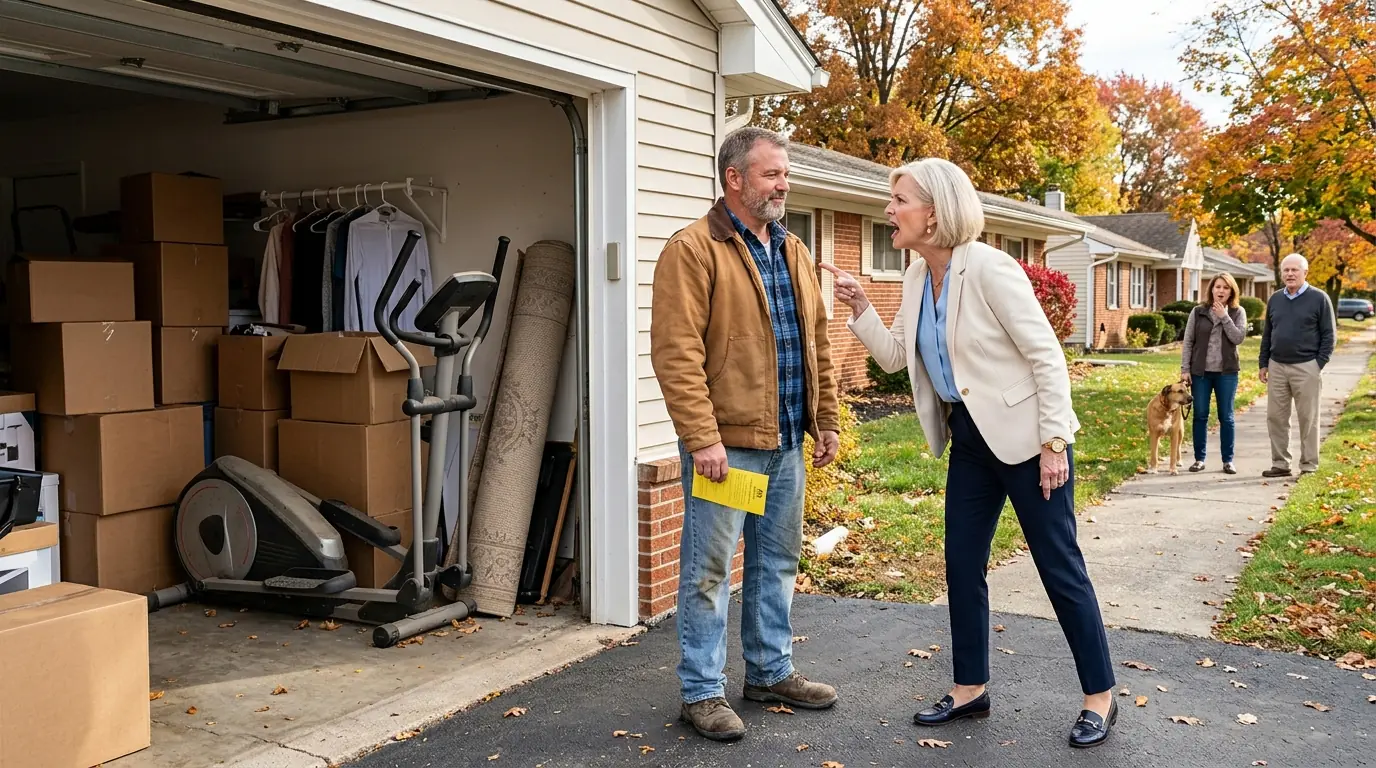
There were boxes stacked almost to the ceiling, a dead elliptical machine, a clothing rack wrapped in plastic, and a rolled-up rug that smelled like bad decisions, cat hair, cedar, and cheap wine.
Then the HOA fine arrived.
One hundred and fifty dollars.
Official letterhead.
Violation notice.
Garage aesthetics.
Every piece of clutter inside that garage belonged to the woman who had signed the fine.
I called her.
She answered in the falsely sweet voice she used whenever she believed she held all the power.
“Derek, darling, the HOA has standards. A man in your position should understand that.”
“A man in my position?”
I smiled.
“You are right, Constance. I’ll fix it tonight.”
She ended the call sounding satisfied.
That was a serious mistake.
It was a freezing November evening when I stood in my driveway with the garage door wide open. Her property stared back at me beneath the single bare bulb I still had not replaced.
I knew exactly what I was going to do.
By morning, Constance Whitfield would have a terrible day.
I would have my garage back.
Before I explain what happened that night, you need to understand who I am and, more importantly, who Constance was.
My name is Derek Callaway. I was fifty-four years old, a retired pipe fitter, a part-time handyman, and a full-time man who wanted to drink coffee on Saturday mornings without receiving certified letters from a neighbor.
I lived in a ranch-style house inside Maplerest Estates, a suburb outside Columbus, Ohio. The development had eighty-seven homes, one community pool, and a Facebook group where grown adults argued about leaf blowers after midnight.
You probably know the kind of neighborhood.
My garage was everything to me.
The walls were covered with pegboard, and every tool had a labeled outline. The concrete floor was clean enough to eat from, although I never tested that claim.
The space smelled of WD-40, sawdust, and occasionally fresh grease.
It was the honest kind of smell.
The kind that meant something had been repaired that day.
I rebuilt small engines on weekends. It had taken me eleven years to make that garage exactly right.
Eleven years.
I had lived alone since my youngest child left for college. It was only me, my tools, and a 1998 Ford Ranger that I kept alive through mechanical skill and pure stubbornness.
Then there was Constance Whitfield.
She was sixty-one, the president of our HOA board, and a retired employee of the county zoning office. Somewhere during that career, she had apparently discovered that she enjoyed telling other adults what they could and could not do.
She drove a spotless white Cadillac SUV.
She wore linen blazers in August.
August.
She always looked as though she were moments away from issuing a citation.
Constance did not speak to neighbors so much as process them like paperwork.
Her husband, Ron, tended roses in their front yard with the distant expression of a man who had stopped arguing sometime during the Obama administration.
I respected Ron.
Ron had accepted certain realities that I had not yet learned to accept.
The HOA board had five members.
Three voted according to whichever direction Constance pointed.
The remaining member was Gary Ostrowski, sixty-seven, a retired electrician with forearms like bridge cables. Gary had been quietly waiting for Constance to destroy herself for three years.
Gary would become important later.
Very important.
Before the garage situation, Constance already had a system.
The north side of Maplerest contained the larger homes, decorative garage doors, and vehicles that had never been purchased used. Those homeowners received courtesy telephone calls when something violated community rules.
Sometimes they received a friendly knock.
Sometimes they got a quiet warning over the fence.
The south side had ranch houses, work trucks, and men like me.
We received certified letters every time.
I learned that six months before the garage incident.
A friend and I spent four days rebuilding the transmission in his pickup. The truck remained parked in front of my house during the work.
It ran perfectly when we finished.
It simply was not attractive.
Constance did not knock.
She did not call.
She sent certified mail citing municipal code 18-4B and charged me a seventy-five-dollar administrative fee.
I drove the truck around the block after completing the repair, not because I needed to prove anything to Constance, but because I needed to prove something to myself.
Then I paid the fine and moved on.
That was my first mistake.
You should never allow someone like Constance to walk away believing she has won without resistance.
Three months later, she appeared at my front door on a Sunday afternoon.
She carried a grocery-store cookie tray still sealed inside its plastic container. The price sticker had been half removed.
Constance wore the smile that never reached her eyes.
She needed a small favor.
Her bonus room was supposedly being remodeled, and the contractor needed additional space. She asked whether she could place a few boxes in my garage for two or perhaps three weeks.
Temporary, she said.
I looked at the cookie tray.
Then I looked at her smile.
Being a fundamentally decent human being who apparently required a harsher lesson, I agreed.
I should have demanded the arrangement in writing.
I should have asked what she meant by a few boxes.
I should have handed the cookies back and closed the door.
Instead, a moving van arrived the following morning.
Its diesel engine was loud enough to shake my kitchen windows at seven o’clock.
Seventeen boxes came off that truck.
Then came an elliptical machine that appeared not to have been used since 2019.
After that came a plastic-wrapped clothes rack.
Finally, the movers unloaded a Persian-style rug that smelled of cat hair, cedar, and something older and sadder beneath it.
The rug occupied the entire rear corner of my garage.
For eight months, it radiated judgment.
Two weeks became one month.
One month became four.
I sent Constance two polite text messages asking when she planned to retrieve her belongings.
Both messages were marked as read.
Neither received an answer.
By the fifth month, I could no longer fit my Ford Ranger inside my own garage.
I began paying my friend Hank sixty dollars each month to keep it on his property down the road.
Sixty dollars a month.
That number would matter.
The morning I received the violation notice, I did not shout.
I did not throw anything.
I did not immediately send an angry message.
I poured a second cup of coffee, put on my boots, and walked into the garage.
I stood in the cold November air with the notice in one hand and the coffee mug in the other.
Seventeen boxes were stacked against the wall.
The dead elliptical machine occupied one corner.
The rug leaned against another wall as though it owned the property.
My breath created small clouds in front of my face. The concrete remained cold even through the soles of my boots.
Somewhere beneath the smell of cedar, dust, cat hair, and that old rug, I could barely detect the WD-40 and sawdust that once defined the space.
I made a decision.
There would be no shouting.
No drama.
No mistakes.
I returned to the house, collected my telephone, and began photographing everything methodically.
I photographed every box, every label, and every visible section of the garage.
I documented the crack in the elliptical machine’s handlebar.
I photographed the clothes rack leaning against my tool chest as though it had become comfortable there.
I saved screenshots of both unanswered messages I had sent Constance. The blue read receipts and timestamps sat there like quiet evidence.
I photographed the violation notice beside the date displayed on my telephone and then again beside the mailbox where it had arrived.
Afterward, I found a blue spiral notebook purchased from Walgreens for eighty-nine cents.
I sat at my kitchen table and wrote everything down by hand.
Every date.
Every dollar.
The transmission fine.
The Sunday cookie tray.
The seventeen boxes.
The five months of sixty-dollar parking charges at Hank’s property.
I recorded everything in chronological order and in ink.
That notebook became the most important object I owned during the next three months.
I did not know that yet.
I was about to learn.
That same afternoon, I hand-delivered a written notice to Constance’s house.
The note was polite and only one page long.
I explained that, according to the HOA’s own violation notice, my garage had to be cleared immediately. I requested reimbursement for the one-hundred-and-fifty-dollar fine and the costs of parking my Ranger elsewhere.
I gave her fourteen days to remove the property.
Constance did not respond directly to me.
Instead, she sent an email to the entire HOA board and copied me into the thread.
I genuinely appreciated that decision later.
The email informed the board that Derek Callaway had become hostile and uncooperative. It claimed I was refusing to honor a verbal community agreement.
She used the word disruptive twice.
Constance mentioned neither the fine she had issued nor the eight months of free storage.
She also failed to mention the money I had spent every month because my own vehicle no longer fit inside my own garage.
Through the glass door of her house, I could see Ron in the backyard tending his roses in forty-degree weather.
He worked with the focused serenity of a monk.
I circled the date of the next HOA meeting on my calendar.
It was the first meeting I had attended during eleven years in Maplerest Estates.
The community center on a Wednesday evening smelled like burnt coffee and low-grade institutional disappointment.
There were folding chairs and fluorescent lights humming at a frequency that seemed designed to make everyone slightly hostile.
Approximately fifteen homeowners sat throughout the room.
Constance occupied the front table in a linen blazer, running the agenda like a woman who had long ago made peace with the sound of her own voice.
She did not look at me once.
When public comments opened, I stood and read from a prepared statement.
I did not raise my voice.
I did not add emotion.
I listed eight months of storage, seventeen boxes, one elliptical machine, one rug, one clothing rack, four hundred and eighty dollars in displaced parking costs, and a one-hundred-and-fifty-dollar fine issued by the same board member whose belongings directly caused the cited condition.
I placed a copy of the statement on the board table.
Then I returned to my seat.
The coffee maker dripped in the corner.
For three full seconds, that was the only sound inside the room.
Gary Ostrowski sat at the far end of the table.
He slowly leaned forward and looked down the row toward Constance with the calm, patient expression of a man watching a chess match finally reach the position he had predicted.
Constance thanked me for expressing my concerns.
She announced that the board would review the matter internally.
Then she moved to the next agenda item without breaking her rhythm.
There was no visible reaction.
Pure glacial control.
After the meeting, however, she appeared beside me in the parking lot.
Gravel moved beneath our shoes. The air was sharp and cold, and nearly everyone else had already reached their vehicles.
Constance lowered her voice.
Her smile remained in place.
The blazer was somehow still perfectly crisp at nine-thirty in the evening.
“Derek, I would hate for a property like yours to come up for a county reassessment.”
She tilted her head.
“These reviews happen. Sometimes randomly.”
I held her gaze.
I felt the cold air in my lungs and listened to the last few vehicles leaving the parking lot.
“Good to know,” I said.
Then I climbed into the Ranger and drove home.
During the entire drive, I kept thinking about the moving van.
It had arrived at seven in the morning eight months earlier and rattled a magnet from my refrigerator.
I had not given the vehicle much thought.
It was a large commercial van with a professional logo printed on the side.
When I reached home, I searched the registration.
The van belonged to an active business entity registered with the Ohio Secretary of State.
The owner of record was Constance A. Whitfield.
The company was named Whitfield Interiors LLC.
I sat at my kitchen table and allowed that information to settle.
There had been no personal bonus-room remodel.
Constance had not been clearing belongings from her own home.
She was operating a registered interior-design and property-staging business.
My garage had been used as a commercial storage facility for client inventory.
For eight months, she had paid nothing.
During those same months, I paid sixty dollars each month to park my vehicle elsewhere.
Then she fined me because her commercial inventory created clutter.
I opened the blue notebook and wrote the discovery in capital letters.
I underlined it twice and drew a circle around the entire entry.
Years earlier, I had read about something called a possessory lien.
It was a legal claim that could potentially attach to property left in another person’s custody when the owner owed that person money for costs connected to the property.
At the time, I treated the information as an interesting piece of legal trivia.
Now I was thinking about it differently.
I called Pete Drummond.
Pete had been one of my friends since high school and later became a paralegal.
He was the kind of person who answered a telephone at nine-fifteen at night when you told him the issue was genuinely important.
“Pete, what happens if someone uses private residential property for commercial storage without permission or compensation?”
There were four seconds of silence.
“Derek,” he said slowly, “that is a genuinely interesting question.”
Pete called the following morning at seven forty-five.
I was drinking my second coffee with the blue notebook open on the kitchen table.
The Ranger remained at Hank’s property because I still could not fit it inside my garage.
Pete went directly to the point.
“Here is the situation under Ohio law,” he said. “When someone leaves personal property in your custody and owes you direct costs connected to that property, you may have a possessory lien claim.”
He cited Ohio Revised Code Section 1333.41.
“The law can recognize that you have effectively been turned into an involuntary storage provider. It may allow a claim against the stored property as compensation for documented costs.”
I wrote down the statute number.
Then I drew a box around it.
“What do I actually need to do?”
“Send formal written notice. Give her a reasonable cure period. Fourteen days is common.”
Pete continued.
“If she neither pays nor removes the property within that period, you may be able to dispose of it through a reasonable method to recover documented expenses.”
He paused.
“Derek, your records are unusually thorough. Most people do not have this kind of paper trail.”
I owed that part to thirty years in the trades.
Pipe fitting teaches a person that the job-site argument you lose is usually the one where the other person wrote everything down and you did not.
I had been keeping records by instinct.
The instinct turned out to be correct.
Pete prepared a formal demand letter that week.
It was written on professional letterhead and used precise language.
A letter from a legal office reads very differently from a handwritten note delivered by a neighbor.
The document listed eight months of unauthorized commercial storage.
It included four hundred and eighty dollars in displaced parking costs and one hundred and fifty dollars in wrongfully imposed fines.
It formally notified Constance of my intention to exercise possessory-lien rights if payment and removal did not occur within fourteen calendar days.
The letter went by certified mail.
The green return-receipt card went directly into the blue notebook.
Then I waited.
I should have anticipated that Constance would not reply to me.
There was no call.
No knock.
Ron did not appear at the curb holding a check and wearing a tired expression.
Three days after delivery, my telephone buzzed with a text message from Gary.
“Emergency board meeting tonight. Not properly noticed. I’m attending.”
I attended too.
Constance had called the session herself.
The HOA’s governing documents required forty-eight hours of advance notice to homeowners.
There was no public notice.
No posted agenda.
Only a telephone chain connecting Constance to the three board members who reliably voted with her.
She introduced an emergency resolution granting the board president authority to negotiate and settle community property disputes on behalf of homeowners.
In ordinary language, Constance was attempting to give herself official HOA authority to neutralize my legal claim.
Gary objected immediately.
He cited the bylaws by chapter, section, and page number.
He identified the advance-notice requirement, the quorum rules, and the specific provision prohibiting an emergency session without a documented urgent cause.
Gary spoke like a man who had read all sixty-two pages so many times that the page numbers lived inside his memory.
He had been waiting patiently for a moment when that knowledge would matter.
Constance overruled him.
She forced the vote through with her three reliable supporters.
The resolution passed.
Gary had recorded the entire meeting on his telephone.
He told me afterward while we stood beneath the buzzing exterior light of the community center.
Dead leaves moved across the cold parking lot.
“I charge my phone completely before every meeting,” he said. “I’ve been doing it for two years.”
Gary did not sound satisfied.
He sounded like a man who had completed his homework.
“I assumed she would eventually do something worth preserving.”
I saved the recording with the rest of my evidence.
Two days after the certified letter was confirmed as delivered, Constance appeared at my door.
There was no cookie tray.
Only the blazer, the smile, and Ron sitting inside the Cadillac at the curb.
He wore the expression of a man mentally tending his roses from a safe distance.
Constance told me to abandon the legal nonsense.
She insisted the items were personal belongings and fully protected.
She said she would involve her actual attorney if I continued.
She emphasized the word actual as though paralegals were equivalent to people who once glanced at a legal book during a flight.
I made a mental note to tell Pete.
He would appreciate it.
My telephone was recording from the breast pocket of my shirt.
Ohio allows a participant in a conversation to record it without notifying the other person.
I had confirmed that online the previous evening.
The search took approximately forty-five seconds.
Those forty-five seconds would become extremely valuable.
“I completely understand,” I told Constance. “I’ll be in touch.”
She left looking satisfied.
Ron pulled the Cadillac away from the curb with the quiet relief of a man whose duties were complete for the evening.
I closed the door and removed my telephone.
The entire conversation had been recorded clearly.
That was not even the most important discovery of the week.
I had been reading the HOA’s complete governing documents, all sixty-two pages. Gary quietly forwarded the Covenants, Conditions, and Restrictions after the improperly conducted meeting.
Inside Section 9, Paragraph 4, buried beneath language so dry that I nearly fell asleep, I found something important.
“No board member or officer shall initiate, escalate, or adjudicate any dispute in which that member or officer holds a direct personal or financial interest.”
Constance had personally signed my violation notice as board president.
Her property directly caused the alleged violation.
The governing documents prohibited exactly what she had done.
The fine was not only unfair.
It was invalid from the moment her pen touched the paper.
I wrote “Section 9, Paragraph 4” inside the blue notebook.
Then I underlined it three times.
I leaned back and looked at everything spread across my kitchen table.
The certified-mail receipt.
The audio recording.
The LLC registration.
The conflict-of-interest clause.
The parking receipts from Hank’s property.
For the first time since the moving van shook my kitchen window, I felt calm.
I had more evidence than I needed.
The remaining decision was when and how to use it.
Constance was about to make another mistake.
It was the kind that would make all my preparation feel almost too easy.
The fourteen-day deadline passed like any ordinary Tuesday.
There was no payment.
No removal.
No telephone call.
On the thirteenth day, at eleven-twenty at night, I received one text message.
“Derek, I’ll be in touch soon.”
Eight words.
After eight months of free storage.
After six hundred and thirty dollars in direct documented expenses.
After a formal demand letter sent through certified mail with a confirmed signature.
Eight words at eleven-twenty at night.
The read receipt remained active.
I wrote the date and time inside the blue notebook.
Underneath it, I added one sentence.
“She still thinks this is her game.”
Pete confirmed what I already believed.
The cure period had expired without compliance.
According to his assessment, my possessory-lien rights had become enforceable. I could proceed with a reasonable disposal of the stored property to recover my documented expenses.
Everything was ready.
I did not act immediately.
Thirty years in the trades teaches a lesson no classroom explains quite as effectively.
The person who acts the instant he has enough leverage rarely receives as much as the person who waits for the other side to make one last unnecessary mistake.
Constance had been making mistakes steadily for eight months.
I saw no reason to interrupt her.
She did not disappoint.
At the next properly noticed HOA meeting, Constance introduced something she called the Community Property Standards Initiative.
Gary had previously submitted a written demand for compliance with meeting-notice rules, so she could no longer convene another secret session without creating an additional recorded violation.
The new proposal required homeowners to submit their properties for inspection before holding any outdoor gathering.
Barbecues.
Birthday parties.
Graduation cookouts.
Every event would require prior board review and approval.
Prior approval from Constance.
I sat in the rear row and listened while she described control as community service.
“We are simply maintaining the standards we all value,” she said. “A small administrative step protects everyone’s investment.”
The three dependable board members nodded at the correct moment.
A person could have set a calendar by them.
When public comments opened, I stood and asked a single question.
My tone was calm and almost pleasant.
I asked whether the board president was required to recuse herself from all matters related to our ongoing property dispute under Section 9, Paragraph 4.
Then I asked whether that recusal extended to proposed regulations affecting the parties involved.
I read the provision aloud.
Word for word.
Slowly.
The nodding stopped.
Paul, an insurance agent seated at the end of the board table, had served for two years without producing an original position anyone could remember.
He stared down at his agenda with the expression of a man who had just noticed that the floor might not be structurally sound.
Constance’s smile remained fixed.
Her eyes changed for only half a second.
There was a recalculation.
The look of someone adjusting a plan she assumed was already complete.
She thanked me for my procedural contribution.
Then she pushed the vote through.
Four to one.
Gary cast the opposing vote.
The initiative passed.
Something had still changed inside the room.
It was like the shift in air pressure before a storm.
Paul folded his agenda in half.
He did not open it again.
Outside, the November cold bit the back of my neck as I crossed the parking lot.
My breath was visible, and the gravel sounded harder beneath my boots.
Two weeks later, the county assessor’s office called.
My property had been selected for a routine reinspection.
No specific reason was provided.
After the call ended, I stood at my kitchen window and looked toward the garage.
My neighbor, Burl Hutchins, had told me something the previous Thursday.
Burl was seventy-one and had worked for thirty-one years as a rural mail carrier.
He had observed our neighborhood from street level almost every day for three decades.
He noticed everything and remembered most of it.
Burl had seen Constance’s white Cadillac in the county municipal-building parking lot during the middle of the morning.
He remembered the approximate time because Constance rarely left the development before eleven on weekdays.
A mail route never truly leaves a carrier.
It becomes a permanent operating system.
I called the assessor’s office again.
I asked whether the review had been initiated through a complaint submitted by a third party.
The employee would not identify anyone.
Before saying “routine flagging,” she paused for half a second.
That pause communicated more than the words.
Constance had followed through on her parking-lot threat.
She had used a county office as a pressure tool against a neighbor holding a legal claim against her.
I recorded the date, time, employee’s name, and the pause.
Then I wrote another sentence.
“She just documented the threat she made.”
That was what Constance never understood about paper trails.
They move in both directions.
Every attempt to pressure me created another record.
Every overreach became another brick.
Constance had been handing me bricks for months.
One certified letter.
One late-night text message.
One county-office visit at a time.
Eventually, I had enough to build something she would have difficulty escaping.
By the middle of November, the evidence looked like this.
Possessory-lien rights documented and activated.
An improperly convened board meeting preserved through an audio recording.
A written conflict-of-interest violation under the CC&Rs.
A direct threat recorded legally.
A county reassessment request connected through a documented timeline to that threat.
A wrongful fine invalid under the HOA’s governing rules.
Eight months of commercial storage for Whitfield Interiors LLC inside my residential garage without compensation.
That was one side of the ledger.
On the other side, Constance possessed one text message promising she would contact me soon and a plan she still believed was secret.
Burl heard her speaking to another neighbor.
Their voices traveled clearly across the cold front yard, as voices often do in November.
Constance said she needed the staging inventory returned before Thanksgiving for a client delivery.
Burl had observed her using a rental-van website and comparing cargo dimensions.
She intended to arrive, collect everything, and drive away.
No payment.
No acknowledgment.
No consequences.
She had no idea what I was preparing.
That was the detail I enjoyed most.
It was not merely the legal position or the documentation.
Constance was measuring cargo space while I sat at my kitchen table developing a plan she could not see, prevent, or reverse after it began.
I opened my laptop and went to Facebook Marketplace.
Before writing the listing, I wanted to know precisely what was stored inside my garage.
Pete had spent three days examining the public records connected to Whitfield Interiors LLC.
Nothing he obtained was private.
The information was available through the Ohio Secretary of State’s business registry to anyone willing to spend twenty minutes searching.
Most people do not search.
Pete searches everything.
He called on a Tuesday evening while I was inside the garage cleaning the workbench.
I was not truly cleaning.
I was reorganizing the half of the space that remained mine.
That section still smelled of sawdust and honest work rather than cedar and someone else’s regret.
“Whitfield Interiors filed business taxes last year,” Pete said. “It is an active interior-design and property-staging consultancy. She has operated it from her home for at least three years.”
I placed the shop rag on the bench.
“What about the property in my garage?”
“That is where it becomes interesting.”
I heard him turning pages.
“You photographed the labels when the property first arrived.”
“Every label is timestamped.”
“Two boxes are marked ‘Staging Master Suite, Lot 14’ and ‘Staging Living, Farnsworth Account.’”
Pete paused.
“Those are not personal belongings. They are client inventory.”
The rug, elliptical machine, framed prints, decorative pillows, tile samples, and staging accessories were all equipment used to prepare houses for sale.
There had been no bonus-room renovation.
Constance had cleared business inventory connected to her clients and placed it inside my residential garage.
There was no disclosure.
No compensation.
She never asked whether I agreed to become an unpaid commercial warehouse for eight months.
Then she fined me for the aesthetic effect of her own inventory.
I sat on my wooden stool beneath the bare bulb.
The concrete was cold beneath my boots.
As I processed the information, it almost seemed as though the smell of WD-40 was reclaiming the air from the cedar.
Pete explained what the commercial classification changed.
Using another person’s residential property for undisclosed commercial purposes could create several legal issues.
There was a possible zoning issue if a business operated or stored commercial inventory inside a residential zone without the required approvals.
There were liability problems connected to damaged or lost client property.
Then there was what Pete called the cleanest argument.
Unjust enrichment.
The principle was straightforward.
When one person receives a significant benefit at another person’s expense without paying or possessing a legal justification, a court can require compensation for the benefit received.
Eight months of commercial storage at a conservative rate of one hundred dollars per month, combined with parking costs and the wrongful fine, placed the potential damages between twelve hundred and fifteen hundred dollars.
Ohio small-claims courts handled disputes up to several thousand dollars.
No expensive attorney was necessary.
The filing fee was less than one hundred dollars.
A person could appear with documentation and explain the truth.
I had once read that small-claims courts were designed so ordinary people with legitimate grievances could pursue what they were owed without hiring an expensive legal team.
Sitting inside my half-reclaimed garage, I finally understood what that meant.
Pete finished his explanation.
I thanked him and ended the call.
For another minute, I sat quietly beneath the bare bulb.
Every tool on the pegboard remained inside its labeled outline.
Half the garage was still mine.
Still organized.
Still correct.
I thought about Constance comparing rental vans on her telephone.
She planned to remove everything without a word, a payment, or any acknowledgment of the eight months it had cost me.
I opened Facebook Marketplace again.
This time, I started writing.
The listing required forty-five minutes.
Not because I was uncertain about what to say.
I knew exactly what to write.
I wanted every word to be accurate.
The previous evening, Pete had reviewed the legal position with me once more.
He explained it slowly, the way a tradesman explains load calculations to an apprentice who must understand everything before touching a pipe.
The fourteen-day cure period had expired.
Notice had been properly delivered and confirmed.
My direct costs included four hundred and eighty dollars in parking expenses and one hundred and fifty dollars in fines.
A conservative estimate of fair commercial storage value added eight hundred dollars.
The total exceeded the estimated value of the stored property.
Under the legal position Pete described, disposal through a reasonable method could be defensible as collection against the debt.
I was not secretly stealing property.
I was not acting impulsively.
I was using an available asset to recover a documented debt after formal notice and an expired cure period.
“Document the condition of every item before anyone touches it,” Pete told me. “Make a timestamped video walkthrough. Ensure every object is visible.”
I had the camera ready.
That afternoon, I called Gary and explained the plan and its legal basis.
Gary listened without interrupting.
His silence was the silence of a man comparing everything he heard with rules he already knew.
“I will be available by telephone throughout the evening,” he said.
That was Gary’s version of enthusiastic support.
I sent a text message to Burl.
“Tonight I’m clearing the garage. Watch for vehicles arriving from Constance’s direction.”
He answered four minutes later.
“Already in my chair. Coffee ready.”
Burl was seventy-one, retired, and operating a neighborhood observation post before seven in the evening with a hot beverage.
I cannot overstate how much Burl Hutchins contributed simply by being exactly who he was.
I also filed a small-claims complaint through the court’s online filing system that afternoon.
The complaint requested six hundred and thirty dollars, representing the wrongful fine and five months of documented parking expenses.
I kept the claim specific and comfortably below the jurisdictional limit.
The confirmation page was printed and placed inside the blue notebook.
At eight forty-five that evening, I recorded the video walkthrough.
It lasted approximately ninety seconds.
I narrated the condition of every visible item while the timestamp ran.
Then I photographed the entire garage from corner to corner one final time.
Everything was uploaded to a cloud folder Pete could access.
At nine seventeen, I posted the listing.
“Free pickup tonight. First come, first served. Miscellaneous household and staging items, including boxes, framed art, decorative pillows, area rug, exercise equipment, and clothing rack. No holds. Address provided through private message. Everything must be gone by morning.”
Eleven minutes later, I had twenty-three messages.
What followed was one of the most quietly joyful experiences of my adult life.
A college student named Marcus arrived at nine forty-five in a pickup truck.
He was practically vibrating with the energy of someone who had just found a Persian-style rug for free on a Wednesday night.
Marcus and his roommate rolled it into the truck bed in less than four minutes.
They shook my hand and drove away.
The rug that occupied my rear corner and judged me for eight months disappeared before ten o’clock.
The elliptical machine went to a woman named Tina.
She had been attempting to return to regular exercise after knee surgery.
Tina brought her nephew to lift it.
He appeared to be approximately nineteen and did not speak once, but he worked with impressive efficiency.
They left in eight minutes.
The boxes still carried Constance’s client labels.
“Master Suite, Lot 14.”
“Farnsworth Account.”
Two families divided their contents as though they had discovered an extraordinary free yard sale.
They received decorative pillows, framed art, tile samples, small accessories, and labeled envelopes of staging materials.
One woman lifted a framed watercolor painting of a lighthouse.
“This is actually very nice,” she said.
It was.
Constance possessed good taste in staging inventory.
I will give her that.
A young couple took the clothes rack for their laundry room.
They left a thank-you note inside my screen door.
I found it at midnight.
It was the most civilized thing connected to the garage during the previous eight months.
By eleven thirty-five, the garage was empty.
I stood in the center beneath the bare bulb.
My boots rested on the cold concrete, and the November night pressed against the walls.
I breathed.
Only breathed.
The smell of cedar, cat hair, and old wine had disappeared.
WD-40 and sawdust had returned.
Faintly, but unmistakably.
The honest baseline smell of a space that belonged to me again.
Eleven years of making the garage exactly right.
Eight months of having it taken away.
Now, at eleven thirty-five on a Wednesday night in November, it was mine again.
I switched off the bulb and entered the house.
I made a cup of tea I did not particularly want and drank it while standing at the kitchen window.
The garage was dark and empty.
Somewhere across the neighborhood, Constance was asleep and confident in her plan.
Perhaps she was measuring cargo space in her dreams.
By morning, there would be nothing left to measure.
Burl sent a message at seven twenty-two the next morning.
“She just arrived.”
I was already awake.
Coffee in hand.
Blue notebook open on the kitchen table.
Telephone facing upward.
I had slept better than I had in months.
I waited with the calm of a man who had already completed the work and was watching the result arrive on schedule.
Burl’s messages came over the following eleven minutes like dispatches from someone born for the assignment.
The white Cadillac parked outside at seven twenty-three.
Constance walked through my side gate and approached the garage.
Burl reported that the garage door went up.
Then nothing happened for three full minutes.
Only Burl watching with coffee slowly cooling inside his cup.
Constance stood in the empty garage, attempting to process something her mind was not ready to accept.
She returned to the Cadillac and began using her telephone.
According to Burl, she was typing quickly and aggressively rather than speaking.
It was the kind of typing that rarely produced anything useful.
Then she returned to the garage.
Constance removed one of my tools from the pegboard.
Burl could not identify which tool from his position.
She placed it back.
Then she continued staring at the clean concrete and empty air where eight months of commercial inventory had previously stood.
At seven thirty-three, Constance left.
She did not knock on my door.
She did not ring the bell.
She walked to the Cadillac, entered, and drove away.
Burl sent one final message.
“She did not look well, Derek.”
I finished my coffee.
Then I reread his updates twice, poured another cup, and waited for what I knew would happen next.
The first message arrived at seven forty-four.
Eleven text messages followed within nine minutes.
The first was clipped and formal.
“Derek, what has happened to the items stored in your garage?”
The messages deteriorated with impressive speed.
By the fourth, Constance demanded to know what I had done with her property.
By the seventh, she began using capital letters.
By the ninth, she stated that she would have me arrested.
The threat appeared twice more before the messages stopped.
I captured screenshots of each one.
I did not reply.
I forwarded everything to Pete.
He responded six minutes later.
“Beautiful. Do not answer. Let her continue.”
At approximately nine o’clock, an officer from the Columbus Police Department knocked on my door.
It was a non-emergency response.
The officer was polite and appeared like someone dispatched to resolve a situation he already suspected was civil.
I invited him inside and offered coffee.
He declined but appreciated the offer.
I placed the blue notebook on the kitchen table.
Then I walked him through the entire sequence.
The certified demand letter.
The signed green return-receipt card.
Timestamped photographs of every item from the beginning.
The lien notice.
The HOA violation notice Constance issued.
The eleven messages from that morning, already printed and placed inside the notebook because I completed that task at eight.
The recording of the parking-lot threat.
The LLC registration.
The conflict-of-interest provision.
The officer reviewed everything with the careful attention of a person who understood the difference between a complaint and documentation.
He made a telephone call and briefly consulted someone.
When he returned, he confirmed what we expected.
“This appears to be a civil dispute, sir. You should continue working with legal counsel.”
He gave me a card.
I thanked him.
Through the kitchen window, I saw Constance’s Cadillac parked across the street.
It remained there for four minutes after the officer departed.
Then it slowly drove away.
I felt no particular rush of triumph.
Only the quiet satisfaction of knowing my paperwork was in order.
By noon, Constance had posted inside the Maplerest Estates Facebook group.
She was careful not to identify me directly.
She claimed a neighbor had taken advantage of a vulnerable situation and removed valuable property without consent.
Constance used the word predatory twice.
She included a photograph taken through the open garage door showing the empty interior.
She asked whether other residents had experienced similar behavior from people pretending to be helpful neighbors.
I read the post while sitting on the wooden stool inside my empty garage.
The space smelled completely like mine again.
Within thirty minutes, the post received fourteen comments.
Four expressed sympathy toward Constance.
They came from the board’s dependable supporters and their spouses, apparently working in shifts.
Seven people asked for clarification.
Constance could not provide it without damaging her own position.
Three comments asked specific questions she had no safe way to answer.
One came from Gary Ostrowski.
He had clearly watched the conversation with the patience of a man who had practiced patience for three years.
Gary’s comment contained six sentences.
“Before we form community opinions, I want to ensure everyone has the complete context. There is a significant amount of documented history that has not been shared. I am willing to provide it privately to any resident who is interested. I will not publish it without permission, but there are two sides to this dispute. The side that has not yet been told is considerably more complete.”
Gary did not shout.
He made no direct accusation.
He simply opened a door and waited to see who entered.
Within twenty-two minutes, nine people reacted with interest.
Constance deleted the post.
Gary had already captured a screenshot.
So had I.
It turned out that at least six other neighbors had done the same.
I laughed for the first time in months.
The sound bounced from the clean garage walls and returned to me.
Then I laughed again.
Sometimes events resolve themselves in ways tidier than anyone has the right to expect.
Six days later, a letter arrived from an attorney named Harold Frink of Frink and Associates, Real Estate and Closing Law.
The office was on the north side of Columbus.
The letter used heavy cream stationery and included the word “herein” four times in its first paragraph.
That is often how a person recognizes someone trying to sound more dangerous than they are.
The letter accused me of unlawfully converting property belonging to Constance Whitfield.
It demanded replacement of all removed items, which Constance valued at four thousand two hundred dollars.
It threatened a civil action.
The phrases “without further delay” and “legal remedies” appeared several times.
I read the letter at my kitchen table while drinking coffee.
Then I scanned it and sent it to Pete.
He called nine minutes later.
I could hear the smile in his voice.
“Harold Frink is a real-estate closing attorney. He prepares purchase agreements and handles title work.”
Pete continued.
“He has not filed a civil-litigation case in this county in four years. This letter is theater, Derek. Expensive stationery, but theater.”
“What do I do?”
“Nothing yet. Record the date. Let her continue paying Harold to write frightening letters.”
I wrote the date inside the blue notebook.
Then I added another observation.
“She is paying a closing attorney to send threatening stationery. She is frightened.”
Realizing that Constance was frightened was more useful than almost anything else that occurred that week.
Frightened people make mistakes.
They overreach.
Overreach creates documentation.
I spent the next ten days constructing a physical binder.
It was a three-ring binder with labeled tabs.
The kind of binder you bring into a meeting when you want the opposing side to understand, from the moment it touches the table, that you are more organized than they are.
Tab one contained all timestamped photographs from the first day through the evening of the Marketplace listing.
Tab two held the certified demand letter and signed return receipt.
Tab three contained both text-message chains.
The polite messages Constance ignored.
The eleven-message explosion after she found the garage empty.
Tab four contained photocopies of every page from the blue notebook.
Tab five contained Pete’s typed transcript of the recorded parking-lot threat with timestamps.
Tab six included a transcript of Gary’s recording from the improperly convened emergency meeting.
Tab seven contained Section 9, Paragraph 4 of the CC&Rs, highlighted.
Tab eight contained the public registration documents for Whitfield Interiors LLC.
Tab nine contained the county-assessor notice and my handwritten timeline connecting it to Constance’s threat.
Tab ten held screenshots from the Facebook discussion.
Constance’s original post.
Gary’s response.
The deletion timestamp.
The finished binder contained forty-seven pages.
It smelled of fresh printer ink and completed business.
Maplerest Estates scheduled its annual homeowners meeting for the first week of December.
That was the meeting when board elections occurred.
Gary confirmed that any homeowner with a documented governance complaint could present it to the full membership before voting.
I confirmed that I would attend.
Four days before the meeting, Constance visited my house one final time.
Ron stood slightly behind her and to the left with both hands inside his jacket pockets.
He looked like a man fulfilling an obligation he had not designed and could not escape.
The roses were finished for the season.
Ron had nothing left to tend.
He appeared to miss them.
Constance offered me an envelope containing three hundred dollars in cash.
She acknowledged that there had been misunderstandings on both sides.
She said she wanted us to move forward as neighbors.
The familiar smile remained in place.
Three hundred dollars.
My direct documented costs were six hundred and thirty.
That did not include eight months of commercial storage at market value.
It did not account for the threat involving the assessor, the eleven hostile messages, or the four-thousand-two-hundred-dollar demand from Harold Frink and his heavy cream stationery.
Three hundred dollars.
“I’ll consider it,” I said.
Then I closed the door.
I remained in the hallway for a moment before opening the blue notebook.
“Offered $300. Filed claim for $630. She knows she is losing.”
That evening, I telephoned Shelby Ames.
Shelby was a reporter with the Westerville Courier who had previously covered HOA governance disputes.
She had a reputation for disliking attempts to pressure sources into silence.
I gave her a twenty-minute summary and emailed several key documents from the binder.
Shelby asked whether she could attend the annual meeting.
I explained that it was open to residents and the public.
She said she would be present.
I ended the call, finished my coffee, and went to bed at ten-thirty.
I slept the way a man sleeps when everything that needs preparation is ready and only morning remains.
The Maplerest Estates annual homeowners meeting drew forty-one people.
That may not sound extraordinary.
In a community of eighty-seven homes, where ordinary meetings attracted approximately fifteen people and one pot of burnt coffee, forty-one residents on a cold December Tuesday meant information had traveled.
Several people stood against the rear wall.
One person brought a personal folding chair.
The fluorescent lights hummed with their familiar hostile frequency.
The coffee was burnt.
Of course it was.
Some things are constant.
Shelby Ames occupied the second row with a notebook and digital recorder on the chair beside her.
She was thirty-four and possessed the particular stillness of a reporter who understood that the most useful thing during a contentious public meeting was to remain quiet and allow people to speak.
Constance noticed her immediately.
“Who invited the press?”
She spoke loudly enough for the first three rows to hear.
Several homeowners shrugged.
Gary answered calmly.
“It is a public meeting, Constance.”
She straightened her linen blazer.
December.
Still linen.
I will never stop finding that impressive.
Constance called the meeting to order.
She handled the early agenda with her usual competence.
Treasurer’s report.
Committee updates.
Maintenance schedule for the pool enclosure.
She moved through every item with the smooth authority of someone who had run those meetings for years and expected to continue indefinitely.
Constance did not look at me.
She did not look at Gary.
She focused on the agenda and the three board members who supported her.
She commanded the room like a general who had not yet been informed that the supply lines had been cut.
The meeting reached board elections.
The floor opened for governance comments.
I stood.
I wore a clean flannel shirt and carried the binder.
I thanked the community for its time and explained that I had a documented governance complaint to present before voting proceeded.
My voice remained steady.
I had stood in louder rooms with more at stake, reading instrument measurements in conditions where an error could injure someone.
This was a community center with folding chairs, forty-one neighbors, and a woman in a linen blazer who had made a series of increasingly poor decisions.
I began with the timeline.
The Sunday cookie tray.
The seventeen boxes.
Eight months of storage.
Sixty dollars each month.
The violation notice.
The demand letter.
The expired cure period.
The lien claim.
I proceeded item by item.
Date by date.
Dollar by dollar.
My tone was that of a tradesman reading a work order.
I did not perform outrage.
I accounted for facts.
The room became completely silent.
Even the coffee maker stopped dripping.
When I reached the emergency board meeting, Gary produced his telephone.
He played thirty seconds of audio.
Constance’s voice was clear and unmistakable as she overruled Gary’s bylaw objection and forced a vote during an improperly noticed meeting.
Three homeowners exchanged glances.
One woman placed a hand over her mouth.
It was not an expression of shock.
It was recognition.
The expression of someone hearing confirmed what she had suspected for years.
I placed the Whitfield Interiors LLC registration beside photographs of the labeled boxes.
Commercial staging inventory for paying clients.
Stored for eight months inside a neighbor’s residential garage.
No disclosure.
No payment.
The understanding inside the room changed.
It was not dramatic.
Only a shift of a few degrees.
The kind of pressure change felt when an entire group comprehends something at the same moment.
Then I explained the assessor timeline.
Constance’s threat after the meeting.
Her Cadillac observed at the municipal building.
The reassessment call two weeks later.
The employee’s hesitation before describing it as routine.
“That is not accurate,” Constance said.
It was the first time she interrupted.
Her voice was tight rather than calm.
A thin fracture had appeared inside the glacial control.
Someone at the rear of the room spoke clearly.
“Let him finish.”
I finished.
A three-page summary from the binder was placed before each board member.
I provided another copy to Shelby.
Then I said what I had decided several weeks earlier while assembling the binder at my kitchen table.
“I do not want anyone removed. I do not want drama.”
I looked across the room.
“I want the fine reversed, the debt satisfied, and an independent governance review so this cannot happen to anyone else sitting inside these chairs.”
Then I returned to my seat.
The forty-one neighbors applauded.
It was not a standing ovation or a theatrical explosion.
It was the honest sound of people recognizing something true and choosing to acknowledge it.
Constance attempted a rebuttal.
She used the phrases “personal vendetta” and “procedural irregularities.”
She mentioned community standards twice.
Then Paul looked down at the binder summary.
Paul, the insurance agent who had followed Constance’s position during two full years of meetings, lifted his eyes.
“I believe we should postpone the election and schedule a governance review.”
The sentence was short.
Inside the fluorescent light and burnt-coffee smell of the Maplerest Estates Community Center, it sounded like the foundation giving way.
The election was postponed.
A formal motion for a governance review was made.
Gary seconded it before the words were fully spoken.
Three weeks later, I received a default judgment in Franklin County small-claims court.
Constance did not appear.
The judgment awarded six hundred and thirty dollars plus filing costs.
I printed the order and placed it inside the blue notebook behind everything else.
It was both the least exciting and most satisfying six hundred and thirty dollars I had ever collected.
The governance review required six weeks.
An independent reviewer examined the binder, recordings, CC&R provisions, and eighteen months of board-meeting records.
She worked thoroughly and without hurry.
Her final report used the dry language of official findings.
It was still as damaging as official language could be.
There were three formal conclusions.
First, the emergency board meeting had been improperly convened, and every resolution passed during it was void.
Second, the violation notice issued to Derek Callaway had been signed by a board officer with a direct personal interest in the matter. That violated Section 9, Paragraph 4, making the fine invalid and requiring its reversal.
Third, the board had to implement a written conflict-of-interest and recusal policy within ninety days and report compliance to the oversight authority.
The findings became public record.
Shelby published her article in the Westerville Courier during the week of their release.
It was detailed, fair, and fully sourced.
Two regional news organizations republished the story within four days.
The second headline read:
“HOA President Fined Neighbor for Clutter Created by Her Own Business Inventory.”
The headline was accurate.
It was not gentle.
Constance refused to comment.
At the January board meeting, she announced that she was stepping away from her role to focus on her business.
She used the same measured tone she used for everything.
The linen blazer appeared one final time.
The smile remained in place.
Her voice carried the carefully constructed dignity of someone refusing to acknowledge what had happened.
There was no apology.
She did not address the affected residents.
Constance read a prepared statement, folded the paper, and left before the meeting ended.
According to everyone present, Ron looked like a man who had quietly waited for that moment for years.
Whitfield Interiors LLC was dissolved the following spring.
Gary Ostrowski became interim board president by unanimous approval at the February meeting.
His first action was to distribute the complete HOA governing documents to every homeowner.
That had not been done for seven years.
His second action reduced the administrative fine for minor violations from seventy-five dollars to twenty-five.
The new process also required a courtesy call before any written violation notice could be issued.
They were small changes.
Real changes.
The kind that did not become headlines but allowed a neighborhood to operate like a community.
The Ford Ranger returned to my garage in February.
It was the first time in nine months.
On a Saturday morning, I drove it inside and parked it exactly where it belonged.
Then I stood for a moment and looked around.
Clean concrete.
WD-40.
Sawdust.
Every tool resting inside its labeled place on the pegboard.
Eleven years of work remained.
Exactly right.
Some things are worth protecting.
That could have been the end of the story.
There was one more part.
During the spring, Burl suggested an idea at one of the informal Saturday gatherings that had begun inside my garage.
At first, only a few neighbors came for coffee.
Burl proposed turning the gatherings into a monthly skills exchange, rotating among garages throughout the development.
Neighbors could teach other neighbors practical knowledge.
Basic electrical work.
Plumbing.
Vehicle diagnostics.
Small-engine maintenance.
Furniture repair.
Food preservation.
The kind of knowledge that once passed naturally between neighbors before people somehow stopped sharing it.
We called it the Maplerest Skills Exchange.
Nine people attended the first session.
Sixteen attended the second.
By April, there was a waiting list.
Under Gary’s quiet leadership, the HOA formally supported the program and allocated five hundred dollars from the community fund for tools, materials, and supplies.
The gatherings smelled of sawdust, chili, engine grease, and good coffee.
They became the best thing to happen inside Maplerest Estates in years.
Possibly ever.
At Burl’s suggestion, we created a small scholarship alongside the exchange.
The Maplerest Trade Scholarship was funded through voluntary contributions from neighbors.
It was awarded to a graduating high-school student pursuing vocational or technical certification.
The first award was five hundred dollars.
It went to a seventeen-year-old named Caleb, who wanted to become an HVAC technician.
I shook Caleb’s hand during the presentation and thought about the blue notebook resting inside my filing cabinet.
Every entry had been worth keeping.
One Marketplace listing posted at nine seventeen on a November night had cleared every box, rack, rug, and piece of staging inventory by morning.
The property was distributed throughout Columbus to people who believed they had discovered the best free listing of the week.
Constance entered my garage the next morning and found clean concrete.
That is the image I remember most clearly.
Not the annual meeting.
Not Paul finally breaking from Constance in front of forty-one neighbors.
Not even the small-claims judgment she failed to contest.
I remember one man learning a statute number, purchasing an eighty-nine-cent notebook, and possessing enough patience to allow the opposing side to continue making mistakes.
Gary recorded the illegal meeting because he kept his telephone charged.
Burl watched from his chair at seven in the morning because noticing the neighborhood had become part of him.
Shelby attended with a recorder because it was a public meeting and nobody could legally stop her.
I did not succeed alone.
I simply began writing first.
Eventually, a seventeen-year-old named Caleb received a five-hundred-dollar scholarship to begin HVAC training because one woman selected the wrong garage to treat as a free commercial warehouse.
Petty authority possesses one important weakness.
It assumes ordinary people will not bother learning the rules, recording the dates, keeping the receipts, or showing up to the meeting.
The moment someone does, the outcome may already be decided.
The notebook outlasted the blazer.