“You don’t belong in this neighborhood,” Vanessa Whitmore snapped, pointing at the dark-blue BMW in Marcus Cole’s driveway. “Hand my son those keys before I have the car seized.”
Marcus stood beside the front fender with his arms folded across his chest. At thirty-nine, he was tall, broad-shouldered, and strong from years of working as an aircraft mechanic, but his expression remained controlled. “Say ‘my car’ one more time,” he replied, “and I’ll enjoy watching you explain that lie to the police.”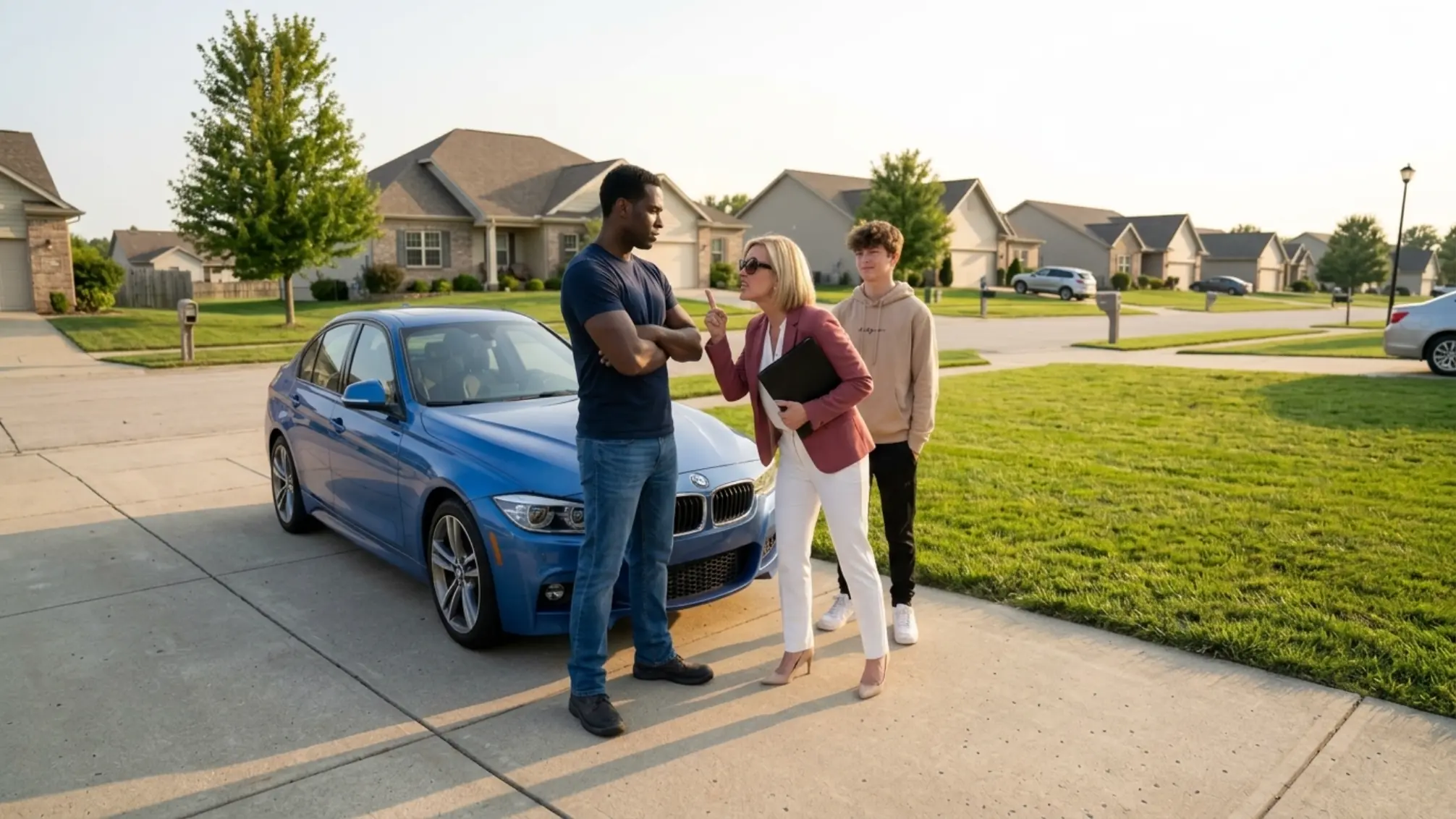
Behind Vanessa stood her seventeen-year-old son, Dylan, wearing a beige designer hoodie, black jeans, and white sneakers. He smiled as though his mother had already won. “Keep stalling, old man. Once Mom makes the call, that BMW is mine.”
Marcus looked past him toward the entrance of the neighborhood. “Good. Stay right there when the officer reads whose name is already on the theft report.”
Dylan’s smile weakened.
Vanessa did not notice. She adjusted the thick black folder under her arm and stepped closer to Marcus, forcing him to smell the expensive perfume surrounding her like another layer of authority. Her fitted dark-pink blazer, white trousers, oversized sunglasses, and gold jewelry were carefully chosen for public confrontations. She always dressed as though every argument might become a campaign photograph.
“You filed a false police report against my son?” she demanded.
“I filed an accurate report about someone entering my garage and trying to take my car.”
“Dylan borrowed it.”
“He never had permission.”
“He wanted to see whether the vehicle violated HOA noise regulations.”
Marcus almost laughed. “By starting it at two in the morning?”
Vanessa’s mouth tightened.
The confrontation had begun ten minutes earlier, but the dispute had been growing for nearly four months. Marcus had moved into Briarwood Hills after accepting a maintenance-supervisor position at a private aviation company outside Charlotte, North Carolina. The neighborhood offered quiet streets, a strong elementary school, and a small backyard where his nine-year-old daughter, Ava, could play safely.
Marcus had been raising Ava alone since his wife, Danielle, died from complications after emergency surgery three years earlier. Grief had changed the shape of their lives, but it had not destroyed them. Marcus worked, cooked, attended school meetings, braided Ava’s hair badly enough that she eventually taught him how to improve, and never missed the Friday evening movie ritual Danielle had started.
The BMW had belonged to Danielle.
It was a 2002 BMW M5 in deep metallic blue, purchased used during the first year of their marriage. Danielle loved the car before Marcus did. She learned to change its oil, argued with mechanics who tried to overcharge her, and once drove it twelve hours through a thunderstorm because she refused to miss Marcus’s graduation ceremony.
After her death, the car spent nearly two years beneath a cover.
Marcus eventually restored it, replacing worn suspension components, rebuilding part of the engine, repairing the leather interior, and polishing the paint until it reflected the sky. He never planned to sell it. The BMW was not simply transportation; it carried Danielle’s fingerprints, stubbornness, and laughter.
Vanessa saw only an expensive car parked in the driveway of a man she believed she could intimidate.
She had served as president of the Briarwood Hills Homeowners Association for six years. The neighborhood contained seventy-eight homes, a clubhouse, a pool, and a small playground. Under the original bylaws, the HOA managed common spaces, enforced reasonable maintenance standards, and collected annual dues.
Under Vanessa, it became a private kingdom.
She issued fines for porch furniture, bicycles, basketball hoops, holiday decorations, and vehicles she considered unsuitable. People who questioned her received repeated inspections. Residents who supported her discovered that violations disappeared before written notices arrived.
Vanessa’s husband traveled frequently for commercial real-estate work and rarely attended neighborhood meetings. Dylan had grown up watching his mother turn complaints into weapons. By seventeen, he drove too fast, blocked sidewalks, damaged landscaping, and used the clubhouse after hours without consequences.
His mother always had an explanation.
When Dylan broke a pool gate, it had been old.
When he damaged a neighbor’s mailbox, the mailbox had violated placement rules.
When security footage showed him throwing bottles into a retention pond, Vanessa accused the homeowner who recorded him of filming a minor without consent.
Marcus first met her three days after moving in.
She arrived carrying a welcome packet and a smile that ended before reaching her eyes. She complimented Ava’s manners, looked around the front yard, and then informed Marcus that his moving truck had remained beside the curb nine minutes longer than permitted.
“I’m sure you understand,” Vanessa said. “Standards protect all of us.”
Marcus glanced at the still-open truck. “The movers are unloading my daughter’s bed.”
“Exceptions create disorder.”
“Then send the violation in writing.”
The response surprised her.
Most new homeowners apologized immediately. Marcus merely waited for her to leave.
Her attention soon shifted to the BMW.
The car was clean, registered, insured, and parked legally. Yet it was older than most vehicles in Briarwood Hills and louder than Vanessa preferred when Marcus occasionally started it for maintenance.
The first notice called it an “inoperable vehicle.”
Marcus submitted photographs showing valid registration and recent inspection records.
The second notice described it as a “commercial repair project.”
He provided evidence that he was performing ordinary personal maintenance.
The third alleged excessive noise, though no sound reading or formal complaint existed.
Marcus requested the recording.
Vanessa refused.
At the next HOA meeting, she announced that certain residents were “testing the limits of community tolerance.” Everyone knew she meant him.
Marcus remained calm. He asked for the exact bylaw section authorizing her enforcement actions. Vanessa changed the subject.
Dylan’s interest was less complicated.
He wanted the car.
The first time he saw Marcus washing it, he walked into the driveway without greeting him. “Is that really an M5?”
“Yes.”
“How much horsepower?”
“Enough.”
Dylan circled the BMW slowly. “My friend’s dad has one, but his is black.”
Marcus continued rinsing soap from the hood.
“Let me drive it.”
“No.”
“I know how to handle performance cars.”
“No.”
“My mother could make those violations disappear.”
Marcus turned off the hose. “Your mother should make them disappear because they’re false.”
Dylan placed one hand near the driver’s door. “You don’t even use it.”
Marcus stepped between him and the car. “Do not touch it.”
The teenager smiled. “Relax.”
“I am relaxed.”
“Then why are you acting scared?”
Marcus looked directly at him. “Because boys who’ve never heard no often confuse patience with fear.”
Dylan left without another word, but he looked back at the BMW twice.
A week later, Marcus found a typed proposal taped to his front door. It stated that the HOA would waive all outstanding vehicle fines if he transferred the BMW to the association as a “community promotional asset.”
The document claimed the car could be used for youth events and fundraising.
A handwritten note at the bottom read:
Dylan can maintain it for the community.
Marcus photographed the paper, saved the security footage showing Vanessa delivering it, and emailed a written refusal to the entire board.
Three members responded privately.
None had seen the proposal before.
One board member, Mrs. Alvarez, admitted that Vanessa often issued documents without approval. Another said Dylan had been telling classmates he would soon own “the blue M5 on Hawthorne Court.”
Marcus began adding cameras.
He installed one above the garage, another inside the workshop, and a small motion-activated unit facing the driveway. He also changed the access code on the garage keypad after noticing scratches around the cover.
Ava asked why.
“Because locks work better when people don’t know the numbers.”
“Is this because of the pink lady?”
Marcus smiled despite himself. “Her name is Mrs. Whitmore.”
“She talks like she owns everyone.”
“She doesn’t.”
“Does she know that?”
“Not yet.”
The attempt happened on a Thursday night.
Marcus woke at 2:13 a.m. when his phone alerted him to movement inside the garage. Ava was asleep in the room across the hall. Marcus checked the live camera feed before leaving his bedroom.
Dylan stood beside the BMW.
He had entered through the side garage door using a copied key. Marcus later learned Vanessa had obtained it from a contractor who performed a neighborhood “safety inspection” two weeks earlier.
Dylan opened the driver’s door, sat behind the wheel, and searched the center console. Then he reached beneath the dashboard and removed the spare key Marcus had hidden inside a magnetic case.
Marcus called the police before going downstairs.
He did not rush into the garage because Dylan might be armed or accompanied by friends. Instead, Marcus activated the exterior lights and spoke through the camera’s audio system.
“Step away from the car.”
Dylan jumped.
He looked toward the ceiling camera, shoved the key into his hoodie pocket, and ran through the side door.
The video captured his face clearly.
It also captured the beige designer hoodie, white sneakers, copied key, and spare BMW key disappearing into his pocket.
Marcus did not follow him.
He waited for the police.
Officer Lena Brooks arrived first. She reviewed the footage, photographed the damaged lock, and took Marcus’s statement. When she asked whether he knew the intruder, Marcus provided Dylan’s full name and address.
The attempted theft report was entered at 3:41 a.m.
Marcus called a locksmith at sunrise and had the BMW’s security system recoded. He also contacted his insurance company and sent copies of the video to a private attorney.
Vanessa appeared before noon.
She stood at the end of the driveway in the same dark-pink blazer she wore now, demanding to speak without cameras. Marcus refused to disable them.
“My son made a mistake,” she said.
“He entered my garage and took a key.”
“He wanted to move the car because it violates HOA rules.”
“At two in the morning?”
“He didn’t want a confrontation.”
Marcus looked at her. “Breaking into my garage was his peaceful option?”
Vanessa lowered her voice. “You need to think carefully. Dylan is seventeen. A criminal accusation could ruin his university applications.”
“That is something he should have considered.”
“You are a grown man attacking a child.”
“I called the police after your son entered my home.”
“The garage is not your home.”
“It is attached to the house where my daughter sleeps.”
Vanessa’s expression changed slightly at the mention of Ava, but not from remorse. She understood that the detail made her argument worse.
“What do you want?” she asked.
“My key returned.”
“And then you withdraw the report?”
“No.”
Her jaw tightened. “Then the HOA will take action.”
“Do whatever you’re foolish enough to put in writing.”
She did.
Within three hours, Marcus received an emergency violation notice declaring the BMW an immediate community hazard. It demanded removal within twenty-four hours and claimed the board had authorized seizure.
No meeting had occurred.
The letter threatened a ten-thousand-dollar fine, a lien on his house, and towing at the owner’s expense.
Marcus forwarded it to Officer Brooks and his attorney.
Then he waited.
The following afternoon, Vanessa and Dylan entered his driveway together. She carried the seizure notice while Dylan stood behind her wearing the same hoodie seen in the garage video.
Marcus had already moved the BMW outside deliberately.
He wanted every interaction captured clearly.
Vanessa pointed at the car and announced that the HOA was taking possession. She claimed Dylan would drive it to an approved storage facility.
Marcus refused.
That led to the confrontation now unfolding beneath the bright afternoon sun.
“You think a theft report frightens me?” Vanessa said. “I have attorneys.”
“Then one of them should explain evidence.”
“You have a blurry video.”
“It shows his face.”
“The lighting was poor.”
“It shows the hoodie he is wearing right now.”
Dylan looked down at himself.
Vanessa continued without hesitation. “Thousands of people own that hoodie.”
“Not thousands inside my garage.”
She thrust the folder toward Marcus’s chest. “This is your final notice. Give Dylan the keys, or I authorize immediate towing.”
“The report includes attempted vehicle theft and unlawful entry.”
“You cannot prove he intended to steal it.”
“He took the spare key.”
“He borrowed it.”
Marcus’s voice hardened. “Stop using that word.”
Vanessa lowered the folder. “What word?”
“Borrowed. Borrowing requires permission.”
She stepped closer. “You’re going to regret humiliating my family.”
Marcus unfolded his arms.
For the first time, Vanessa seemed to notice how physically outmatched both she and Dylan were. Marcus did not threaten them, but his patience had reached its limit.
“Leave my property.”
Dylan moved beside his mother.
“You scared now?” the teenager asked.
“No.”
“Then give me the keys.”
Marcus looked toward the street. “The police will be here soon.”
Vanessa smiled. “Wonderful. I’ll have them enforce the seizure.”
A tow truck turned onto Hawthorne Court.
Behind it came a marked police cruiser.
Vanessa mistook the vehicles for proof that her plan had worked.
She lifted her chin and stepped toward the curb. “Finally.”
The tow-truck driver stopped several houses away when he saw the cruiser. He had received Vanessa’s request but had not been told the vehicle was connected to an active theft investigation.
Officer Brooks exited the police car with another officer, Sergeant Thomas Reed.
Vanessa rushed forward.
“That man is refusing an authorized HOA vehicle seizure,” she announced. “My son has permission to remove the BMW.”
Officer Brooks looked at Dylan.
“Dylan Whitmore?”
Vanessa smiled. “Yes. He’ll be driving it.”
Officer Brooks opened her notebook. “Dylan Whitmore, age seventeen, residing at 114 Hawthorne Court?”
The boy’s confidence vanished.
“Yes,” he said carefully.
Sergeant Reed looked toward Marcus, then at the BMW.
Officer Brooks continued reading.
“Your name appears as the identified suspect in theft report number 26-4179. The report concerns unlawful entry into Mr. Cole’s garage and attempted theft of this exact vehicle.”
The tow-truck driver immediately reversed several feet.
Vanessa’s face tightened. “That report is false.”
“We reviewed the footage,” Officer Brooks said.
“My son was performing HOA business.”
“Does the HOA authorize entering private homes at two in the morning?”
“The garage is subject to inspection.”
“Without notice?”
“It was an emergency.”
“What emergency?”
Vanessa pointed at the BMW. “The vehicle violates community standards.”
Officer Brooks looked at the legally parked, registered car. “That is a civil dispute. It does not authorize entry or removal.”
Dylan began backing away.
Sergeant Reed stepped into his path. “Stay here.”
“I didn’t do anything.”
Officer Brooks removed a printed image from her folder. It showed Dylan inside the garage, one hand holding the BMW’s spare key.
“Is that you?”
The teenager looked at his mother.
Vanessa answered for him. “Do not speak.”
Officer Brooks turned toward her. “Ma’am, are you instructing him not to cooperate, or are you requesting counsel?”
“I am protecting a minor from harassment.”
“Then he may remain silent. But he is not free to leave.”
The neighborhood had begun watching.
Garage doors stood open. Curtains moved. Residents gathered at the ends of driveways, keeping enough distance to avoid becoming targets.
Vanessa noticed them and raised her voice.
“This is discriminatory enforcement. Mr. Cole has manipulated police because he refuses to follow our rules.”
Marcus remained beside the BMW.
Officer Brooks asked Vanessa to lower her voice.
She refused.
“My son is being accused because this man cannot tolerate HOA authority.”
Marcus finally spoke. “Your son is being accused because the camera recorded him.”
“You edited it.”
“The original file was collected by police.”
“You staged it.”
Marcus stared at her. “You sent him.”
The words landed heavily.
Vanessa’s face revealed more than she intended.
Officer Brooks noticed.
“So you knew he was going there?” she asked.
Vanessa turned toward the officer. “I did not say that.”
“You said Mr. Cole staged something involving your son.”
“I was speaking generally.”
Sergeant Reed asked Dylan, “Who gave you the garage key?”
Dylan remained silent.
“Do not answer,” Vanessa ordered.
The officer looked at the copied key photographed at the scene. “We traced the key blank to a neighborhood contractor. He stated Mrs. Whitmore requested a copy during an HOA inspection.”
Several neighbors gasped.
Vanessa’s sunglasses concealed her eyes, but not the sudden stiffness in her face.
“That contractor is lying.”
“He provided text messages.”
Officer Brooks read one aloud.
Make a copy of the side-door key. We may need emergency access if the owner refuses compliance.
The message came from Vanessa’s number.
Marcus had not seen it before.
His anger became colder.
“You copied a key to my house?”
“It was for community safety.”
“My daughter sleeps inside that house.”
“No one entered the living area.”
“You didn’t know what your son would do once he got inside.”
Dylan’s voice cracked. “Mom said the car would be mine.”
Silence spread across the driveway.
Vanessa turned sharply. “Stop talking.”
But the sentence had already been captured by both officers’ body cameras.
Officer Brooks faced Dylan. “What exactly did she tell you?”
He looked at his mother, then at the neighbors watching.
“She said if I moved the BMW before he could stop me, the HOA would classify it as surrendered property.”
Vanessa grabbed his arm. “You are confused.”
Dylan pulled away. “You said the fines made it ours.”
“That is not what I said.”
“You gave me the garage key.”
Sergeant Reed stepped between them.
Officer Brooks asked Dylan to turn around and place his hands behind his back. Because he was a minor, she explained that he was being detained while they contacted a guardian and juvenile investigator.
Vanessa began screaming.
“You will not handcuff my son!”
She pushed toward Officer Brooks.
Marcus moved Ava’s bicycle away from the confrontation but did not interfere. He understood that the cameras were recording every choice Vanessa made.
Sergeant Reed blocked her.
“Step back.”
“This is my community!”
“This is a police investigation.”
“I am the HOA president.”
“That does not change the law.”
Vanessa pointed at Marcus. “Arrest him for threatening us.”
Officer Brooks looked toward him. “Did he threaten you?”
“He said I would regret coming here.”
The officer glanced at the recording camera mounted above the garage.
“We’ll review the footage.”
Vanessa looked up.
Only then did she realize the entire confrontation had been preserved.
The tow-truck driver lowered his clipboard.
“I’m leaving,” he said.
Vanessa whirled toward him. “You were hired to remove the vehicle.”
“You told me it was abandoned.”
“It is.”
“The owner is standing beside it.”
“I’ll have your contract revoked.”
“I don’t have a contract with your HOA.”
He returned to his truck and drove away.
Police recovered the BMW key from Dylan’s bedroom later that evening after his father consented to a search. Officers also found printed photographs of Marcus’s garage, notes describing the camera positions, and messages between Vanessa and Dylan.
One message read:
Move it Friday night. Once it’s in our garage, he’ll negotiate.
Another stated:
Do not damage it. I want the board to claim it was voluntarily surrendered for unpaid fines.
The evidence transformed the case.
This was no impulsive teenage mistake.
Vanessa had planned to take Marcus’s vehicle and use fabricated HOA penalties to pressure him into surrendering ownership.
Investigators obtained a warrant for HOA records. They discovered that Vanessa had attempted similar schemes before, though none involved something as valuable as the BMW.
An elderly resident had surrendered a riding mower after receiving false storage fines. Another family gave up a utility trailer to avoid a lien. Both items were later found at properties controlled by Vanessa’s relatives.
Financial records showed unauthorized fees deposited into a private account.
The BMW dispute exposed years of coercion.
Vanessa was removed as HOA president during an emergency meeting. Three board members admitted they had never approved the vehicle seizure, the ten-thousand-dollar fine, or the proposal transferring the car to Dylan.
The seizure notice carried forged electronic signatures.
Vanessa was charged with conspiracy to commit vehicle theft, attempted extortion, falsifying records, unlawful use of a copied key, and misuse of HOA funds. Additional theft and fraud charges followed as investigators interviewed other residents.
Dylan entered the juvenile system.
His attorney argued that he acted under his mother’s direction and did not fully understand the legal consequences. The court considered his age, cooperation, and the messages proving Vanessa controlled much of the plan.
He received probation, community service, mandatory counseling, and an order prohibiting contact with Marcus or the BMW. He was also required to provide truthful testimony in the case against his mother.
The expensive hoodie disappeared after the arrest.
Months later, Marcus saw Dylan cleaning graffiti from a public retaining wall as part of his community service. The teenager kept his head down until Marcus passed.
Then he spoke.
“Mr. Cole?”
Marcus stopped.
“I’m sorry.”
“For entering my garage or getting caught?”
Dylan swallowed. “Both at first. Now mostly the first.”
Marcus studied him.
The boy looked smaller without his mother standing beside him, but also more human.
“That car belonged to my wife,” Marcus said.
“I didn’t know.”
“You didn’t ask.”
Dylan nodded. “Mom said you didn’t deserve it.”
“She didn’t know me.”
“She said people like you move into places like Briarwood to prove something.”
Marcus understood exactly what Vanessa had meant.
“Do you believe that?”
Dylan looked down at the scrub brush in his hand. “I believed whatever made me feel like I was better.”
“That is an expensive habit.”
“I know.”
Marcus continued walking.
He did not forgive the teenager immediately, but he did not carry the conversation home as hatred either.
Vanessa eventually accepted a plea agreement after the copied-key messages, forged board documents, and stolen-property records made trial too dangerous. She was ordered to pay restitution, permanently barred from holding HOA office, and sentenced to confinement followed by supervised probation.
Her family sold the Briarwood house.
The new HOA board canceled Marcus’s fines and issued a formal apology. More importantly, it created safeguards preventing any president from authorizing inspections, seizures, liens, or emergency penalties without independent review.
Residents regained access to financial records.
Meetings became quieter.
Ava began riding her bicycle through the neighborhood again without Marcus worrying that Vanessa might appear with another folder.
One Saturday morning, Marcus pulled the BMW into the driveway and opened the rear door.
Ava climbed inside wearing Danielle’s old sunglasses, which were far too large for her face.
“Are we really taking Mom’s car?” she asked.
“We are.”
“Where?”
“Anywhere you choose.”
“The lake.”
“That’s two hours.”
“You said anywhere.”
Marcus smiled. “Your mother used to argue like that.”
He started the engine.
The BMW settled into a deep, steady idle. Several neighbors looked toward the sound, but no violation letters followed.
Mrs. Alvarez waved from across the street.
Marcus lowered the window.
“Beautiful day for it,” she called.
“It is.”
Ava leaned forward from the back seat. “My mom picked this car.”
Mrs. Alvarez smiled. “Then she had excellent taste.”
They drove beyond the Briarwood entrance and followed the highway toward the lake. Sunlight crossed the dashboard, touching the worn spot where Danielle used to rest her hand during long trips.
Marcus had nearly lost the car because Vanessa believed power meant deciding what other people deserved to keep.
She saw a Black single father standing quietly beside an expensive BMW and assumed something about the picture was wrong. She believed her title could correct it.
Her son believed wanting the car made him its future owner.
Neither understood the history beneath the paint.
They did not know Danielle had driven it through storms, laughed inside it, and left part of herself behind every time Marcus turned the key.
Vanessa arrived in his driveway carrying a forged seizure notice.
Dylan stood behind her wearing the same hoodie recorded inside the garage.
She ordered Marcus to hand over the BMW as if theft became lawful when printed on HOA letterhead.
Then the police arrived.
Officer Brooks opened the report, looked directly at the boy, and read his full name from the line identifying the suspect.
At that moment, the smugness vanished.
The false authority collapsed.
And the car Vanessa had promised her son carried Marcus and Ava toward the lake, exactly where Danielle would have wanted it to go.