I always imagined my daughter’s wedding as the happiest day of our lives.
I pictured laughter in the backyard, family gathered under strings of lights, soft music floating through the summer air, and my little girl walking toward the man she loved while everyone who mattered watched with tears in their eyes.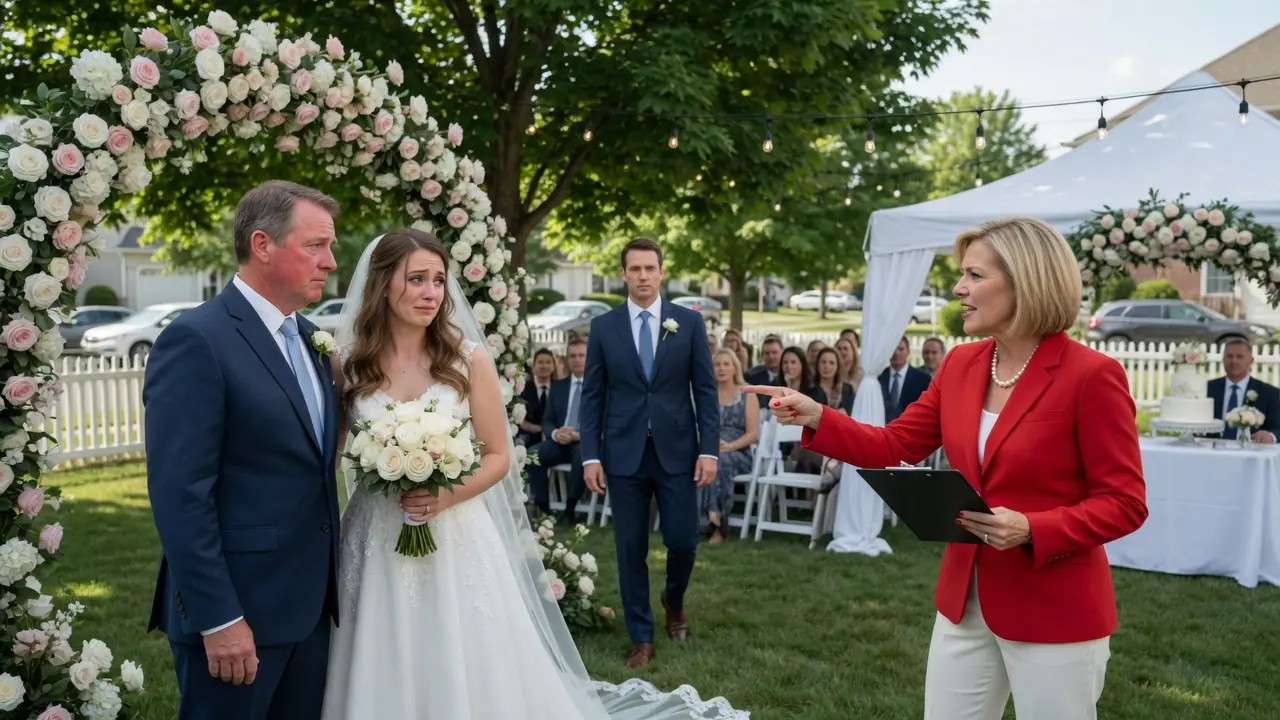
For a while, it was exactly that.
The backyard was filled with white roses.
Rows of chairs stretched across the lawn in perfect lines. A white arch stood beneath the maple tree where my daughter had once tied ribbons to the branches and called it her castle. The long reception tables were covered with cream linens and little glass jars of candles. The tent shimmered in the sunlight, and the smell of barbecue, roses, fresh grass, and buttercream drifted together like some kind of blessing.
My wife, Linda, moved through the yard with a clipboard of her own, though hers contained flower counts and seating notes, not threats.
My daughter, Emily, floated in and out of the house in her wedding dress, glowing so brightly I kept having to look away.
She was twenty-six, but when I saw her standing near the kitchen window with her veil over one shoulder, I saw her at five years old again, wearing a pillowcase on her head and asking me to walk her down the hallway because she was “practicing being a bride.”
Back then, I had laughed.
That morning, I nearly cried before the ceremony even started.
“You okay, Dad?” she asked, catching me staring.
I cleared my throat.
“Fine.”
She smiled.
“You’re doing the jaw thing.”
“What jaw thing?”
“The thing where you pretend you’re not emotional but your face forgets how to behave.”
Linda walked past carrying a box of programs and said, “He has been doing that since seven this morning.”
“I have allergies,” I said.
“To your daughter growing up?” Emily asked.
“Very common condition.”
She laughed, and that laugh almost broke me.
That was how the day began.
With joy.
With family.
With a father trying not to fall apart.
And then Patricia Morgan arrived.
She came strutting across the lawn like a storm dressed in a red blazer, carrying a clipboard like she was the sheriff, judge, jury, and executioner of Maple Glen Estates. Her blonde bob was sprayed into a shape so sharp it looked like it could slice bread. Her oversized sunglasses rested on top of her head like a crown. Her lips were pressed into that thin, sour line I had come to know too well.
Patricia was our HOA president.
Technically, she called herself the “community standards chair,” but everyone in the neighborhood called her the HOA queen behind her back.
Never to her face.
Not because we respected her.
Because no one wanted a six-page violation notice taped to their front door.
She had been terrorizing our neighborhood for years.
Trash cans left out ten minutes too long.
Holiday decorations she personally found “excessive.”
Grass half an inch above regulation height.
Children’s bikes on lawns.
Door wreaths that were “seasonally confusing.”
Patricia had cited a family once because their inflatable snowman was “too whimsical for the architectural tone of the street.”
She had fined Mrs. Alvarez for planting yellow flowers because, according to Patricia, “the approved palette leans cooler.”
She had once measured my mailbox with a tape measure because she claimed it looked “emotionally crooked.”
That was Patricia.
The woman could turn a birdbath into a legal dispute.
So when Emily told us she wanted a backyard wedding, I knew there would be a problem.
Not because the wedding violated any real city law.
It did not.
Not because we had failed to prepare.
We had checked noise ordinances, parking rules, tent safety, vendor permits, and everything else responsible adults check when hosting more than eight people and a cake worth more than some used cars.
No, I knew there would be a problem because Patricia Morgan hated happiness when she had not personally approved it.
Her first warning came three months before the wedding.
I was in the driveway unloading boxes of white folding chairs from my truck when she appeared at the property line, arms crossed, red nails tapping against her clipboard.
“Planning an event?” she asked.
I already hated the way she said event.
Like it meant crime.
“My daughter’s wedding,” I said.
“In the backyard?”
“That’s where the backyard wedding usually goes.”
Her eyes narrowed behind her sunglasses.
“Large gatherings require HOA review.”
“We are not blocking the street, charging admission, or sacrificing goats, Patricia. It’s a wedding.”
“Mockery will not help your case, Robert.”
My name is Robert Miller.
I have lived at 14 Willowbend Court for fifteen years. I pay my HOA dues on time, shovel my sidewalk, keep my lawn tidy, wave at neighbors, and have never once started a feud over flower color, mailbox angle, or the emotional tone of seasonal decor.
Before Patricia came to power, that used to be enough.
Now, existing peacefully seemed to require legal counsel.
“She’s my only daughter,” I told her. “She wants to get married under the maple tree where she played as a kid. We’re keeping it respectful.”
“Respectful is subjective.”
“So is annoying.”
Patricia’s mouth tightened.
“I suggest you submit a formal request.”
“I suggest you enjoy your afternoon.”
She left with the look of someone mentally drafting revenge.
That was the first warning shot.
After that, Patricia became a fixture.
While we set up the tent, she paced the sidewalk with her clipboard.
While the florist measured the arch, Patricia took photographs from across the street.
While my brother helped me carry tables into the yard, she stood near the curb with binoculars.
Binoculars.
In a subdivision.
I caught her one afternoon kneeling at the corner of our lawn, holding a tape measure from the tent leg to the property line.
“Patricia,” I called, “if you want to help, I have three hundred napkins that need folding.”
She stood so quickly she almost dropped the tape measure.
“I am documenting proximity issues.”
“To what?”
“Common sight lines.”
I stared at her.
“Those are not words.”
“They are in the spirit of the guidelines.”
That was how Patricia operated.
When actual rules did not serve her, she invented spiritual cousins of the rules and pretended they had authority.
The week before the wedding, she taped a notice to our front door.
Potential Event Violation Warning.
Potential.
Not actual.
Potential.
That meant even she could not find a real rule we had broken.
Linda found me in the kitchen reading it.
“Do not engage,” she warned.
“I am not engaging.”
“You are making your angry eyebrow.”
“I only have the two.”
“You know which one I mean.”
I folded the notice carefully and placed it in a drawer with the others.
“We are not letting her ruin this,” I said.
Linda touched my arm.
“She has ruined smaller things.”
“She is not ruining Emily’s wedding.”
Linda looked out the kitchen window at the yard, where Emily stood beneath the arch with Daniel, practicing where they would stand during the vows.
Daniel Clark.
My future son-in-law.
He was calm in a way that made people trust him before they knew why. Thirty-two years old, tall, clean-cut, always polite, always listening more than he talked. He dressed simply but well. He shook hands firmly. He remembered names. He treated waiters, children, and elderly people with the same respect he gave lawyers and business owners.
I liked him from the first time Emily brought him home.
But he was also a little mysterious.
Whenever I asked what he did, he smiled and gave vague answers.
“Public service,” he said once.
“Administration,” he said another time.
“Civic work keeps me busy,” he told my brother at Thanksgiving.
My brother thought he worked for the city.
I thought maybe he was a policy analyst or department manager.
Emily knew more, of course, but she always gave me that same teasing smile.
“You’ll see, Dad.”
I told her she was being dramatic.
She said, “I learned from Mom.”
Linda denied responsibility.
Looking back, I cannot believe how blind I was.
But that secret would become the one thing Patricia Morgan could not measure, fine, or control.
The morning of the wedding arrived warm and clear.
By eight o’clock, our house was alive.
The bridesmaids filled the upstairs rooms with hairspray, makeup bags, curling irons, laughter, and the sort of emotional chaos only a wedding morning can produce. My sister cried while pinning flowers to a chair. My brother almost dropped the cake stand and aged ten years in two seconds. The caterers set up behind the tent. The string quartet arrived early and tuned beneath the shade.
Linda moved through it all with fierce efficiency.
“Robert, where are the extra extension cords?”
“Garage.”
“Robert, why is your tie on the toaster?”
“I was distracted.”
“Robert, do not touch the cake.”
“I was looking at it.”
“With a fork?”
“It was a structural inspection.”
She took the fork.
Through all the madness, Emily remained strangely peaceful.
I found her in the downstairs guest room, sitting near the window while her maid of honor adjusted the tiny buttons at the back of her dress. Sunlight touched her face. Her veil fell over one shoulder. Her bouquet sat on the table, white roses and pale blue forget-me-nots, because her grandmother had loved those.
I stood in the doorway.
She looked up.
For a second, neither of us spoke.
Then she smiled.
“Dad?”
I swallowed.
“I’m fine.”
“You haven’t said anything.”
“Because if I talk, your mother will have to redo my tie due to emotional flooding.”
Her eyes softened.
“You like him, right?”
“Daniel?”
“No, the florist.”
I gave her a look.
She laughed.
“Yes, Daniel.”
I stepped into the room.
“I more than like him,” I said. “He respects you. He listens to you. He looks at you like he knows he’s lucky. That matters.”
Her eyes filled.
“He makes me feel safe.”
That sentence hit me harder than I expected.
A father spends years trying to make sure his daughter does not mistake attention for love, charm for character, or control for devotion. Then one day, she tells you she feels safe with someone else, and you realize the job was never to keep her forever.
It was to help her recognize where peace lives.
I kissed her forehead.
“Then I’m ready.”
“No, you’re not.”
“No,” I admitted. “But I’ll walk anyway.”
By noon, guests began arriving.
Cars lined the street, though not illegally. We had arranged overflow parking with the church two blocks over and hired two college kids to direct traffic. The music stayed within city noise limits. The tent was properly secured. The catering company had its license displayed near the service table because Patricia had trained us to expect absurdity.
Neighbors came by smiling.
The Johnsons brought extra ice.
The Millers lent folding fans for older guests.
Mr. Ray from three houses down, who rarely left his porch, came wearing a navy suit and handed Emily a card with shaking hands.
“Your father told me you used to sell lemonade under that maple tree,” he said.
Emily smiled.
“I charged too much.”
“You were a good businesswoman.”
The backyard filled with people we loved.
For a little while, I forgot Patricia existed.
Then, just before the ceremony, I saw her.
Across the street.
She stood at the edge of her driveway in a bright red blazer and white slacks, clutching her clipboard against her chest. Her sunglasses rested on top of her head. Her face was twisted with disgust.
Her eyes darted from the parked cars to the tent, from the tent to the arch, from the arch to the speakers tucked discreetly near the flower arrangements.
She was not watching a wedding.
She was hunting violations.
I muttered under my breath, “Not today.”
Linda appeared beside me.
“Is she looking?”
“Like a hawk with a law degree.”
Linda’s face tightened.
“Robert.”
“I know.”
“Do not start anything.”
“I am not starting anything.”
“She might.”
“I am aware.”
Linda looked at me with the tired expression of a woman who had been married to me long enough to know when I was mentally preparing speeches.
“Please,” she said softly. “For Emily.”
That was enough.
I took a breath and let my shoulders drop.
“For Emily.”
The ceremony was supposed to begin at two.
At 1:55, guests took their seats.
The string quartet began playing something soft and sweet.
Daniel stood at the altar beneath the rose-covered arch, wearing a dark navy suit, white shirt, pale blue tie, and the calm expression of a man who had already decided nothing would stop him from marrying my daughter.
The officiant checked his notes.
The bridesmaids lined up.
Emily took my arm.
Her hand trembled.
“You okay?” I whispered.
“I’m happy.”
“That’s allowed.”
“And nervous.”
“That’s also allowed.”
“And if you cry, I will cry.”
“Then we are both in danger.”
She squeezed my arm.
The music changed.
Everyone stood.
For one perfect second, the world held still.
Then Patricia Morgan stepped onto our lawn.
Her heels sank slightly into the grass, but she marched forward anyway, clipboard raised like Moses coming down with the Ten Commandments.
“This entire setup is illegal!”
The violinist startled so badly his bow screeched across the strings.
Guests turned.
Emily froze beside me.
Her veil trembled in the breeze.
My heart dropped through my shoes.
Patricia stood at the edge of the aisle, chest rising, lips pursed, eyes burning with the righteous fury of a woman who believed the universe owed her a supervisor role.
“Patricia,” I said quietly, stepping forward while keeping Emily behind me, “do not do this.”
She lifted one red-nailed finger.
“Oh, I absolutely will do this. You have ignored repeated warnings, violated multiple community standards, and turned a residential backyard into a public spectacle.”
“It is my daughter’s wedding.”
“It is a noncompliant event.”
That word.
Noncompliant.
As if love required inspection.
As if my daughter’s tears could be filed under Section 12.4.
I walked closer, lowering my voice.
“This is private property. Invited guests. City rules followed. We are not doing this today.”
Patricia’s smile widened.
“Yes, we are.”
She turned toward the seated guests and raised her voice.
“You are all currently participating in an unauthorized gathering in violation of Maple Glen Estates HOA bylaws. Section 12.4 states that tents larger than ten feet require board approval. Section 14.2 prohibits amplified sound without written notice. Section 8.6 regulates street parking. This property is out of compliance.”
My brother muttered from the front row, “She memorized it like wedding vows.”
A few people chuckled nervously.
Patricia heard.
Her face flushed.
“This is not funny. These rules exist to preserve neighborhood dignity.”
I looked around.
At the white roses.
At the seated grandparents.
At the children in dress shoes.
At the bride trying not to cry.
“At the moment,” I said, “you are the only thing damaging dignity.”
A murmur moved through the guests.
Patricia’s eyes snapped back to me.
“Do not speak to me that way.”
“Then stop behaving this way.”
She marched farther down the aisle.
Every step felt like an insult.
“Champagne,” she snapped, pointing at one of Daniel’s cousins holding a flute. “Open container violation.”
“It’s sparkling cider,” he said.
She pointed at another guest filming with her phone.
“Unauthorized recording of a neighborhood disturbance.”
The woman lowered her phone.
Patricia turned toward the caterers.
“Food service on residential property without HOA clearance.”
The caterer, a broad man named Marcus who had been nothing but patient all morning, looked at me and whispered, “Sir, I have permits in the truck.”
“I know,” I whispered back.
Patricia continued down the aisle like she owned every blade of grass.
My daughter’s face had gone pale.
Daniel watched from the altar, hands folded in front of him, expression unreadable.
That calm annoyed me for half a second.
Then I noticed something.
He was not passive.
He was waiting.
There is a difference.
I stepped in front of Patricia before she could reach Emily.
“Enough.”
She stopped inches from me.
“Either shut this event down immediately, or there will be consequences.”
“Consequences?” I repeated. “This is not a hostage negotiation. It’s a wedding.”
“It is a violation.”
“It is a ceremony.”
“It is unlawful.”
“It is inconvenient to your ego.”
A few guests laughed.
Patricia’s lips thinned.
“You think this is amusing?”
“No, Patricia. I think it is pathetic.”
Her eyes flashed.
Behind me, Emily whispered, “Dad, please.”
That broke my heart.
Not because she was afraid of Patricia.
Because her wedding day now had this ugly stain across it, and she was trying to hold herself together in front of everyone she loved.
I turned slightly.
“I won’t let her ruin this,” I said.
Patricia seized the moment.
“You hear that?” she shouted. “Threatening language. Hostile tone. This is exactly why HOA oversight is necessary.”
Linda stood now.
“Patricia, you should be ashamed of yourself.”
Patricia barely glanced at her.
“I am ashamed of this community’s decline.”
That did it.
Several neighbors spoke at once.
“She fined me for pumpkins.”
“She threatened my kids over sidewalk chalk.”
“She called my bird feeder nonconforming.”
“She made us repaint our shutters.”
Patricia whipped around, shocked by the rebellion.
“Silence,” she snapped. “This is not a public forum.”
“No,” my brother said. “It’s a wedding you crashed.”
The crowd laughed louder this time.
Patricia’s face turned crimson.
Then she pulled out her phone.
“Fine,” she announced. “If you refuse to respect the rules, the law will handle it.”
My stomach tightened.
“Patricia, do not call the police.”
She smiled like she had been waiting for me to say that.
“Oh, I absolutely will.”
She dialed.
Then she put the call on speaker.
“Yes, hello,” she said loudly. “I need officers sent to Willowbend Court immediately. There is an illegal gathering taking place in Maple Glen Estates. Dozens of people, unauthorized structure, traffic obstruction, amplified sound, open containers, and a hostile homeowner refusing to comply.”
Several guests gasped.
My wife closed her eyes.
Emily’s hand tightened around my arm.
Daniel took one step forward.
Patricia continued.
“Yes, I feel unsafe. The homeowner has become aggressive.”
I stared at her.
That lie hit differently.
False aggression claims are not harmless. A person like Patricia can turn someone else’s calm frustration into a police report with just the right tone of voice.
I knew that.
Daniel knew it too.
His expression changed for the first time.
Only slightly.
But I saw it.
The call ended.
Patricia lowered her phone triumphantly.
“The police are on their way.”
The backyard fell silent.
The music had stopped.
The guests were frozen.
My daughter stared at the grass, blinking hard.
I wanted to scream.
I wanted to grab Patricia’s clipboard and snap it over my knee.
Instead, I turned to Emily.
“Look at me.”
She did.
“This is still your day.”
Her eyes filled.
“It doesn’t feel like it.”
“I know,” I said. “But it is.”
Daniel walked down the aisle toward us.
He took Emily’s free hand and kissed her knuckles.
“I promise you,” he said softly, “we are getting married today.”
Emily let out a shaky breath.
“You seem very sure.”
He smiled.
“I am.”
Patricia snorted.
“Confidence will not help you when the officers arrive.”
Daniel looked at her.
Not angrily.
Not even loudly.
Just looked.
“Mrs. Morgan,” he said, “you may want to be very careful with what you say next.”
She laughed.
“And who are you to warn me?”
Daniel did not answer yet.
The sirens arrived five minutes later.
Two squad cars pulled up along the street. Red and blue light washed across white roses, cream tablecloths, and Emily’s wedding dress. It was one of the strangest sights I have ever seen, beauty and official tension colliding in a backyard that had smelled like roses ten minutes earlier.
Patricia hurried toward the officers before they were halfway out of their cars.
“Over here,” she called, waving her clipboard. “I am the reporting party.”
The lead officer was a woman in her forties with sharp eyes and a calm face. Her badge read Daniels. The second officer, younger and taller, followed with a notebook.
Officer Daniels looked around the yard.
Bride.
Groom.
Guests.
Flowers.
Quartet.
Cake.
She lifted one eyebrow.
“Ma’am, what exactly is the emergency?”
Patricia pointed toward the tent.
“Unauthorized event. Illegal structure. Parking congestion. Open containers. Noise violation. Potential public safety hazard.”
Officer Daniels looked toward the lemonade table where my nephew was carefully filling cups.
“This appears to be a wedding.”
“Weddings can be illegal.”
My brother muttered, “That would make divorce lawyers very happy.”
Linda elbowed him.
Officer Daniels turned to me.
“Sir, is this your property?”
“Yes, ma’am,” I said. “Robert Miller. I live here. This is my daughter Emily’s wedding. We checked city ordinances, noise rules, parking restrictions, and vendor permits. Everything is compliant. The HOA president is angry because we did not ask her permission to be happy.”
Patricia gasped.
“That is a gross mischaracterization.”
Officer Daniels looked back at her.
“HOA bylaws are not criminal law.”
Patricia blinked.
“They are binding community rules.”
“Civil agreement,” Officer Daniels said. “Not police enforcement unless there is a crime.”
“There is a crime,” Patricia insisted. “A disturbance.”
The officer glanced at the seated guests.
A toddler waved at her.
Someone’s grandmother smiled nervously.
The string quartet sat with instruments in their laps, looking like they would prefer to become invisible.
Officer Daniels said, “I do not see a disturbance.”
Patricia’s voice rose.
“Because they stopped when they saw you. That is what violators do.”
The younger officer coughed into his hand.
It sounded suspiciously like a laugh.
Patricia heard it and turned on him.
“Do not mock me. I represent the HOA.”
Officer Daniels’ eyes cooled.
“Ma’am, I represent the law. Let’s keep those separate.”
A few guests clapped before catching themselves.
Patricia’s face darkened.
“You do not understand. This community has standards. If people are allowed to do whatever they want, we will have chaos. Cars everywhere. Music everywhere. Tents. Parties. Common people treating private neighborhoods like public parks.”
Common people.
The words hung there.
Ugly.
Revealing.
Even Patricia seemed to realize she had said too much, because her mouth closed abruptly.
Officer Daniels looked at her for a long second.
Then Daniel stepped forward.
“Officer Daniels,” he said, voice calm, “thank you for responding. I apologize that your time was wasted.”
Patricia wheeled on him.
“You do not get to speak for the officers.”
Daniel reached into his jacket pocket.
“Actually,” he said, “I can help clarify the situation.”
He pulled out a slim black wallet and opened it.
The sun caught the gold seal.
Officer Daniels straightened immediately.
Her eyes widened.
Then recognition crossed her face.
“Mr. Mayor,” she said. “I didn’t realize this was your wedding.”
The yard went utterly still.
Patricia stared at Daniel.
“What?”
Daniel closed the wallet calmly.
“My name is Daniel Clark,” he said. “I am the elected mayor of this city.”
A gasp passed through the guests like wind through tall grass.
My mouth opened.
Then closed.
I turned toward Emily.
She gave me a tiny, apologetic smile.
“You knew?” I whispered.
She whispered back, “Obviously.”
“You let me think he worked in administration.”
“He does.”
Linda covered her mouth, half crying and half laughing.
Patricia looked from Daniel to Officer Daniels to the guests, her face draining of color.
“No,” she said. “No, that is ridiculous. He is too young.”
Officer Daniels said, “Ma’am, Mayor Clark was sworn in two years ago.”
The younger officer nodded.
“Yes, ma’am. That is definitely the mayor.”
Patricia’s mouth opened wider.
For the first time in all the years I had known her, no words came out.
The crowd began to murmur.
Then phones came up.
Not nervously this time.
Joyfully.
Everyone understood what was happening.
The HOA queen had called the police on the mayor at his own wedding.
Daniel turned fully toward Patricia.
His voice stayed even, but something in it made every whisper stop.
“Mrs. Morgan, I respect community associations when they serve residents. I respect neighbors working together to maintain safe, beautiful places to live. But what you have done today is not service.”
Patricia clutched her clipboard.
“I am enforcing bylaws.”
“No,” Daniel said. “You are harassing a family during a lawful private ceremony. You are misusing emergency services. You made false claims of aggression. You attempted to convert HOA preferences into law. And you publicly humiliated a bride on her wedding day.”
Patricia’s lips trembled with anger.
“You think being mayor makes you above the rules?”
“No,” Daniel said. “It makes me very familiar with them.”
A few people laughed.
Then Daniel continued.
“HOA bylaws do not override property rights. They do not supersede city ordinances. They do not authorize trespass onto private property. They do not grant police powers. And they certainly do not allow you to interrupt a wedding because you dislike tents and parked cars.”
Officer Daniels nodded.
“That is correct.”
Patricia turned on the officer.
“You are siding with him because he is your mayor.”
Officer Daniels’ face hardened.
“I am siding with the law.”
Daniel took a step closer.
“Mrs. Morgan, I am not interested in punishing you for disliking this event. You are entitled to your opinions. But you crossed a legal line when you called 911 with exaggerated claims and inserted yourself onto private property after being asked to leave.”
Patricia’s hand shook around the clipboard.
“You would not dare cite me.”
Daniel’s expression softened.
That almost made it worse.
“I am not the officer here. But if Officer Daniels determines that you misused emergency services, that is her decision.”
Officer Daniels looked at Patricia.
“Ma’am, I need you to step aside with me.”
Patricia looked like she had been slapped.
“Me?”
“Yes.”
“I am the complainant.”
“You are also the person who entered private property after being told not to and made claims that do not match what we observed.”
The backyard erupted.
Not into chaos.
Into applause.
At first, it was only a few claps.
Then more.
Then the whole crowd stood and cheered.
Neighbors across the street joined in.
Someone shouted, “Rules are rules, Patricia!”
Another voice called, “Sit down and eat cake!”
Patricia spun around, horrified.
She had built her power on the idea that everyone feared her.
Now everyone was laughing.
Not cruelly, exactly.
Not at first.
But with relief.
The sound of people realizing the monster under the bed was only a woman with a clipboard.
Patricia’s face went red.
“Stop clapping,” she snapped. “All of you stop.”
No one did.
Daniel raised one hand gently, and somehow the crowd quieted.
That was authority.
Not force.
Not volume.
Presence.
“Mrs. Morgan,” he said, “this wedding will continue. If you have a civil HOA complaint, you may submit it through the proper channels. But if you interrupt this ceremony again, the officers have full authority to remove you from this property.”
Patricia looked at me.
Then at Emily.
Then at Daniel.
Then at the officers.
Her mouth twisted.
“This is corruption,” she whispered loudly enough for everyone to hear. “This is abuse of power.”
Daniel shook his head.
“No, Patricia. This is what happens when fake authority meets real accountability.”
The crowd exploded again.
Officer Daniels escorted Patricia toward the sidewalk. Not in handcuffs. Not roughly. Just firmly enough to make it clear that the center of the yard no longer belonged to her.
At the edge of the lawn, Patricia turned back.
“You will regret this. All of you.”
Bob Carter, who had arrived late and was standing near the rose arch, called out, “We regretted you first.”
That almost broke the entire ceremony.
Even Officer Daniels pressed her lips together to keep from smiling.
Patricia stormed off toward her house, her heels stabbing the sidewalk, clipboard clutched to her chest, dignity leaking behind her with every step.
The officers spoke with Daniel briefly, then with me. Officer Daniels confirmed there was no violation requiring police action. She did, however, issue Patricia a formal warning for misuse of emergency services and trespassing after being asked to leave.
“She calls us too often,” the younger officer said quietly. “This is not the first neighborhood dispute she has tried to dress up as an emergency.”
Daniel nodded.
“Then please document today thoroughly.”
“We will, Mr. Mayor.”
Daniel turned back toward us.
For a second, he looked nervous for the first time all day.
Not because of Patricia.
Because he was about to face his bride.
Emily stood in her gown, hands on her hips, tears dried on her cheeks.
“Mayor?” I said.
Daniel winced slightly.
“Surprise.”
I stared at him.
“You married my daughter under false occupational pretenses.”
Emily laughed.
“Dad.”
He looked genuinely apologetic.
“I wanted your family to know me before the title.”
Linda walked over and hugged him.
“You saved her wedding.”
Daniel looked at Emily.
“No,” he said softly. “She was already brave. I just brought paperwork.”
That was when Emily cried for real.
Not from fear this time.
From relief.
The officiant cleared his throat.
“I hesitate to ask, but shall we continue?”
Emily laughed through tears.
“Please, before Patricia comes back with a megaphone.”
The yard erupted in laughter.
The quartet began again.
This time, the music sounded stronger.
Not sweeter.
Stronger.
I took Emily’s arm.
We returned to the start of the aisle.
“You ready?” I asked.
She looked at Daniel under the arch.
Then at the yard full of people who had just watched a tyrant collapse under the weight of her own behavior.
“Yes,” she said. “Now I am.”
We walked.
Slowly.
Past the guests.
Past the roses.
Past the spot where Patricia had stood and tried to turn joy into a violation.
I looked at Daniel waiting beneath the arch.
My daughter’s hand trembled on my arm, but her steps were steady.
When we reached the front, Daniel looked at me.
I placed Emily’s hand in his.
“Take care of her,” I said.
He met my eyes.
“With everything I am.”
For the first time all day, I believed the world might be exactly where it needed to be.
The ceremony continued.
The vows were beautiful.
Emily promised to love Daniel not only in bright moments, but in ordinary ones. Daniel promised to build a life where she would never have to shrink herself to keep peace with someone else’s fear.
When they kissed, the cheer was so loud I worried Patricia might file an aftershock complaint.
The officers, still near their cars, clapped too.
Then one of them accepted a plate of food from Marcus, the caterer.
So did the other.
By the time the reception began, the mood had changed completely.
What Patricia intended as humiliation had turned into legend.
People danced harder.
Laughed louder.
Ate more cake.
The interruption became the story everyone repeated with increasing dramatic flair.
“She actually said unlawful assembly.”
“She called the mayor too young.”
“She waved the clipboard at the police.”
“She said HOA rules beat the law.”
“She said common people.”
“She got escorted off like a malfunctioning parade float.”
My brother raised a glass during the first toast.
“To Emily and Daniel,” he said, “and to the first wedding in history where the bride got vows, cake, and an HOA overthrow.”
Everyone cheered.
Emily buried her face in Daniel’s shoulder, laughing.
But as the evening went on, something deeper happened too.
Neighbors began talking.
Really talking.
Mrs. Alvarez told Linda about the fines over her flowers.
The Johnsons told me Patricia had threatened them over their solar panels.
The Millers confessed they had almost moved after Patricia harassed them about their daughter’s graduation party.
A young couple from the next street said Patricia had fined them for leaving baby strollers visible on their porch.
Mr. Ray, who almost never spoke at gatherings, leaned on his cane near the lemonade table and said, “She once told me my ramp was an architectural eyesore. I built that ramp after my stroke.”
That one silenced the table.
I looked across the street at Patricia’s house.
Her curtains twitched.
She was watching.
Of course she was.
But this time, nobody cared.
For years, each family had thought Patricia’s cruelty was personal. Isolated. Maybe deserved. Maybe too small to fight.
That night, we learned it was a pattern.
Bullies thrive when victims think they are alone.
Weddings, apparently, are excellent places for people to compare notes.
By the time the last dance began, a group of neighbors had gathered near the dessert table, planning an emergency HOA meeting. Tom Harris, who was not at the wedding but arrived after someone texted him the video, looked both horrified and relieved.
“I should have stopped this earlier,” he told me.
“Yes,” I said.
He nodded.
No excuse.
No defense.
Just acceptance.
That mattered.
“We’ll call a board meeting Monday,” he said. “No more delays.”
Daniel, standing nearby with his jacket off and his sleeves rolled up, said, “You should review the entire enforcement structure. Concentrated power without oversight invites abuse.”
Tom blinked, then remembered who he was talking to.
“Yes, Mr. Mayor.”
Daniel smiled.
“Tonight, Daniel is fine.”
Tom nodded.
“Yes. Daniel.”
Then, after a pause, he added, “But I may still ask you for policy advice.”
“Send an email after the honeymoon,” Emily said sharply.
Everyone laughed.
The next morning, the videos were everywhere.
HOA Queen Calls Police On Mayor’s Wedding.
Clipboard Karen Versus City Law.
When Fake Authority Meets The Mayor.
The clip of Daniel saying, “HOA bylaws do not override property rights,” spread the fastest.
But the clip that people loved most was Bob shouting, “We regretted you first.”
Bob became briefly famous in a way he found deeply annoying.
“I went viral,” he told me two days later, standing by his mailbox. “I do not enjoy it.”
“You’re a meme.”
“I was happier as a veteran.”
The internet was not kind to Patricia.
For years, she had relied on private intimidation. Private letters. Private warnings. Private threats. But public exposure changed everything. Suddenly, neighbors who had been afraid of her found courage. Screenshots of past violation letters appeared online. Stories surfaced. Former residents commented.
She fined us for a birdhouse.
She threatened my mother over a wheelchair ramp.
She called police on my son’s birthday party.
She said my Spanish music made the street feel “less residential.”
The pattern became impossible to ignore.
On Monday evening, the HOA clubhouse was packed.
People stood along the walls. Others watched through the open doors. Patricia arrived in a gray suit instead of her usual bright blazer, but she still carried the clipboard.
That told me everything.
She had learned nothing.
Tom opened the meeting.
“We are here to address Saturday’s incident and broader concerns about abuse of HOA authority.”
Patricia immediately stood.
“I object to this entire proceeding. It is a politically motivated attack encouraged by Robert Miller and his mayor son-in-law.”
Daniel was not there.
He and Emily had left for their honeymoon Sunday morning.
The rest of us were perfectly capable of handling Patricia without him.
Tom looked at her.
“Sit down, Patricia.”
The room went quiet.
Patricia blinked.
“What did you say?”
“I said sit down. You will have time to speak. You will not control this meeting.”
A murmur of approval moved through the room.
Patricia sat, stunned.
For the next hour, residents spoke.
One by one.
Calmly.
Clearly.
Some with printed evidence.
Some with trembling voices.
Some with anger that had been stored for years.
Mrs. Alvarez held up twenty-six violation letters.
Mr. Ray described the ramp incident.
The Johnsons documented harassment over legal solar panels.
The Millers described being threatened with fines over a family funeral gathering.
A young mother named Tasha explained how Patricia had photographed her children playing in their own driveway and sent a warning about “unsupervised outdoor clutter.”
At first, Patricia tried to interrupt.
Then people shouted her down.
Not rudely.
Collectively.
There is a difference.
By the end, Tom called for a vote to remove Patricia Morgan as HOA president and suspend all enforcement powers pending investigation.
The result was nearly unanimous.
Only Patricia voted no.
When Tom announced it, she stood slowly.
Her face was white.
“You will regret this,” she said.
Mrs. Alvarez smiled.
“Submit it through the proper channels.”
The room erupted.
Patricia left without another word.
No applause followed her this time.
No jeering.
No laughter.
Just silence.
That was worse, I think.
Laughter meant she still had power as spectacle.
Silence meant she had become irrelevant.
The HOA changed after that.
Not overnight.
Communities do not heal just because one bully loses her chair.
But the structure changed.
No single board member could issue fines alone.
All violations required photographs, specific bylaw references, and board approval.
Homeowners gained the right to appeal before fines became active.
Emergency calls for HOA disputes were prohibited unless there was an actual safety threat.
A community relations committee replaced the “standards enforcement subcommittee,” which had been Patricia’s kingdom.
The ramp rule was rewritten.
Holiday decoration guidelines became recommendations instead of punishments.
Children’s bicycles were declared not only allowed, but signs of a healthy neighborhood.
Bob suggested that language.
We kept it.
Patricia tried to fight back.
Letters.
Threats.
A demand for reinstatement.
Claims of political retaliation.
A long email accusing the entire neighborhood of “mob behavior.”
Nobody took the bait.
When she tried to file a complaint with the city, the clerk politely informed her that the mayor had no involvement in the HOA vote and that private association governance was not a city matter unless laws were broken.
That must have hurt.
By fall, Patricia stopped attending meetings.
By winter, she listed her house for sale.
I saw her once before she moved.
She was loading boxes into her car, no clipboard in sight. For a second, I considered walking over and saying something graceful.
Then she looked at me with the same sour hatred she had worn at the wedding.
So I stayed on my porch.
Not every ending requires a handshake.
Some people leave the same way they lived, certain the world wronged them by refusing to obey.
A young family bought her house in spring.
They painted the front door blue.
Patricia would have hated it.
The HOA approved it unanimously.
A year after the wedding, Emily and Daniel came back to our house for their anniversary.
We set up a small dinner under the maple tree, much simpler than the wedding. No tent. No rows of chairs. No police. No clipboard. Just family, food, fairy lights, and a homemade cake Linda made because she insisted the first anniversary deserved sugar.
Daniel stood near the arch, which I had kept stored in the garage and set up again as a surprise.
Emily cried when she saw it.
“You saved it?”
“Of course,” I said. “It survived Patricia. That makes it historic.”
Daniel laughed.
Linda shook her head.
“You are never letting that go.”
“No,” I said. “I am not.”
After dinner, as the sky deepened and fireflies blinked over the lawn, Emily leaned against Daniel beneath the tree.
“Do you ever regret not telling Dad sooner that you were mayor?” she asked him.
Daniel looked at me.
“Sometimes.”
“You should,” I said.
He smiled.
“But if I had told him,” Daniel continued, “Robert would have introduced me to every neighbor as ‘the mayor’ before he introduced me as Daniel.”
“That is completely unfair,” I said.
Linda looked at me.
I sighed.
“It is also completely true.”
Daniel grew thoughtful.
“I wanted to be chosen as a man before I was recognized as a title.”
That quieted us.
I looked at him and understood him better than I had before.
Titles complicate people.
They make some bow, some resent, some perform, and some test boundaries. Daniel had wanted my daughter’s family to know his character before they knew his office.
And when the moment came, the title mattered because the character behind it was steady.
That was the difference between him and Patricia.
Patricia had chased authority because she wanted control.
Daniel carried authority because people had trusted him with responsibility.
Those are not the same thing.
Later that night, after Emily and Daniel left, I stood in the backyard beneath the maple tree.
The lawn was quiet.
The roses were gone, but I could almost smell them again. I could see Emily in her dress. Hear Patricia’s shrill voice. See Daniel opening that black wallet. Hear the applause when everyone finally stopped being afraid.
Linda came out and stood beside me.
“What are you thinking?” she asked.
“That Patricia tried to ruin the day.”
“She failed.”
“Yes.”
I looked at the tree.
“But she also revealed something.”
Linda slipped her hand into mine.
“What?”
“That we had all been letting her take little pieces of peace because each piece seemed too small to fight for.”
Linda nodded slowly.
A fine here.
A warning there.
A rude comment.
A threat.
A letter.
A complaint.
A look.
Small tyrants rarely begin by destroying whole lives. They begin by training people to tolerate discomfort. Then more discomfort. Then humiliation. Then fear. By the time they overreach, everyone wonders why they did not stop it sooner.
Patricia overreached at my daughter’s wedding.
And in doing so, she gave us back our neighborhood.
Years later, people still talk about that wedding.
Some details have gotten bigger with each retelling.
In one version, Patricia arrived with three binders and a megaphone.
In another, the police saluted Daniel in perfect formation.
In another, Bob tackled Patricia’s clipboard out of her hands, which did not happen, although he claims he considered it.
But the heart of the story remains true.
A woman drunk on fake power tried to shut down a wedding.
The groom turned out to be the mayor.
The neighbors finally stopped bowing to a bully.
And my daughter got married under the maple tree after all.
When people ask me what I remember most from that day, they expect me to say the reveal.
The mayor badge.
Patricia’s face.
The police realizing who Daniel was.
Those parts were satisfying, no question.
But they are not what I remember most.
I remember Emily taking my arm after everything settled and saying, “Now I’m ready.”
I remember Daniel looking at her like the entire world had narrowed to one woman in a white dress.
I remember the guests standing not because a ceremony demanded it, but because love had survived an interruption.
I remember the music starting again.
That is the part that stays with me.
The music starting again.
Because life is full of people like Patricia.
People who step into your joy with a clipboard, a rule book, a threat, a false emergency, a petty complaint, or a voice loud enough to make fragile moments shake.
They will tell you your happiness is unauthorized.
Your celebration is excessive.
Your family is inconvenient.
Your peace violates some rule they invented to make themselves feel important.
Do not hand them the day.
Do not let small tyrants become the authors of your memories.
Stand firm.
Speak truth.
Know your rights.
Protect the moments that matter.
Because false authority only works when real people stay silent.
That day, silence ended on our lawn.
My daughter still got her vows.
My wife still cried during the first dance.
The cake was still cut.
The guests still laughed.
The fairy lights still glowed until midnight.
And Patricia Morgan, queen of the HOA, learned the hardest lesson of her life.
A clipboard is not a crown.
A bylaw is not a badge.
And when fake power crashes into real character, real character does not have to shout.
It only has to stand there, calm and steady, until everyone sees the truth.