“Keys. Or the hood’s next.”
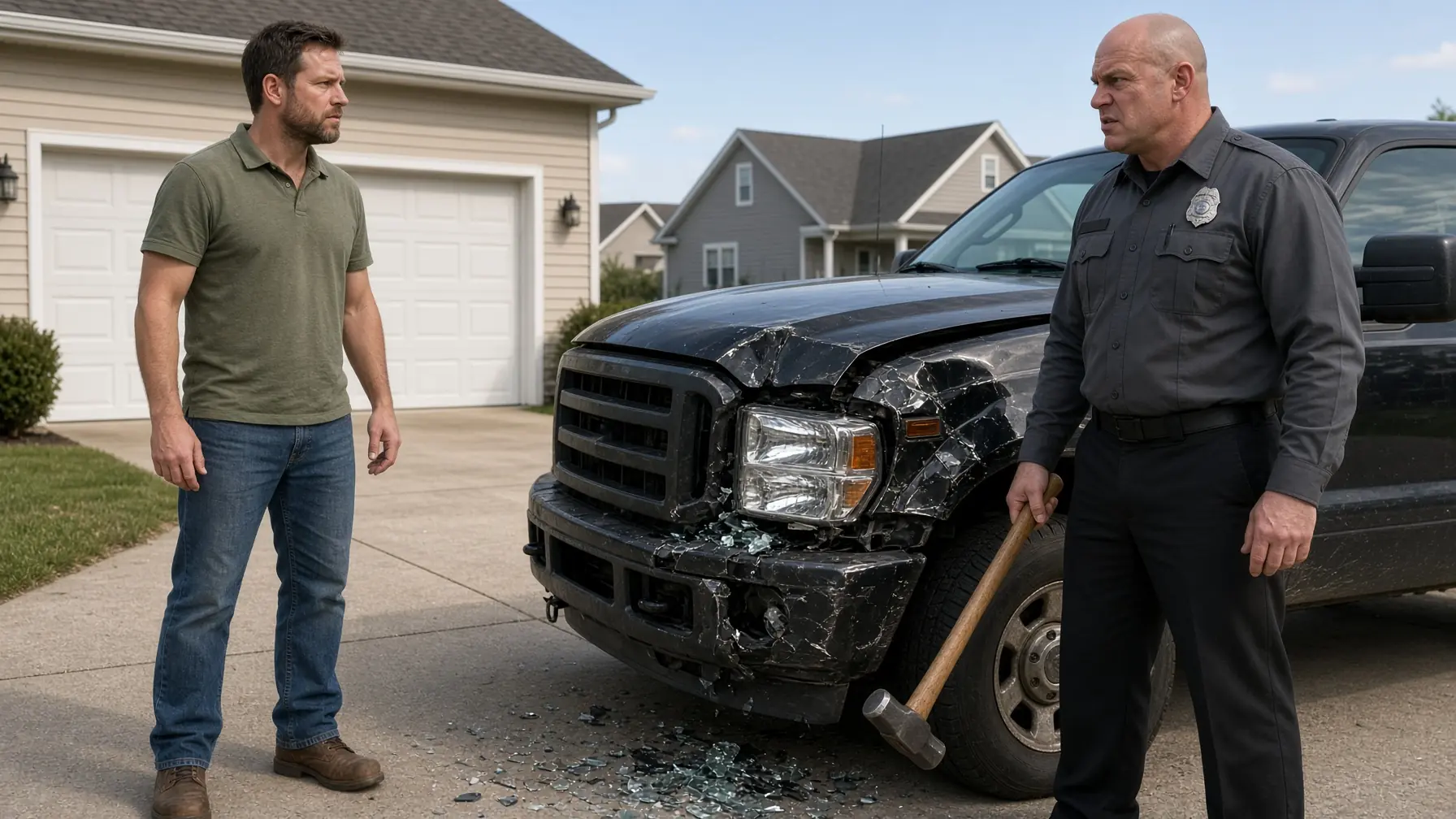
Ethan kept his hands visible. “Put the hammer down.”
The man swung again. This time the head struck the edge of the hood, folding metal inward with a heavy crack. He dragged the tool away, turned toward Ethan, and grinned.
“HOA authorized this. Scared yet?”
Ethan could see the dent from where he stood. He could also see the man’s breathing quicken, the way his grip changed after the second strike, and the distance between the hammer and the garage entrance. None of those details stopped his pulse climbing. His expression stayed steady because moving his face would not help him decide where to move his body.
“Last chance. Set it down.”
The man stepped away from the truck. He turned fully toward Ethan and began lifting the hammer again. Ethan shifted one foot back and squared his stance, leaving room behind himself without turning his attention away.
The grin faded.
For the first time, the man appeared to understand that the homeowner’s stillness was not the reaction he had expected.
Beyond the driveway, Briar Glen looked exactly as it had ten minutes earlier: trimmed lawns, quiet houses, a delivery van farther down the street. Clear morning light fell across the truck’s standard tires and factory suspension.
The vehicle was ordinary. The man had needed a story to make it otherwise.
Ethan heard a door open across the road. He did not look toward it. The hammer was still rising, and the man’s mouth tightened when someone called, “Put that thing down!”
The voice belonged to a neighbor, but Ethan was not certain which one. He was concentrating too hard on the next few feet.
“Back off,” the man shouted over his shoulder. “Official business.”
Ethan spoke without raising his voice.
“You’re standing on my driveway threatening me with a hammer. Set it on the ground.”
“You don’t give instructions.”
“You can still stop.”
The man hesitated. That hesitation mattered. Ethan did not fill it with a taunt or a demand to prove courage. He moved slightly away from the truck, keeping the vehicle between the man and the side door where his daughter had been told to stay inside.
The man followed the movement with his eyes.
“Think you’re tough?” he asked.
Ethan’s mouth was dry.
“I think this can end without anybody getting hurt.”
“Should’ve thought of that before you refused enforcement.”
The hammer came higher. Ethan saw the decision arrive before the movement finished. He moved out of its path, and the tool struck the brick edge beside the garage entrance instead of his shoulder.
The impact jarred the man off balance. Ethan did not charge him. He continued away from the arc, putting more space between them while the man struggled to recover the hammer.
Across the street, the neighbor shouted into a phone. A car horn sounded, then stopped. Ethan felt his old shoulder catch sharply when he turned, pain bright enough to remind him that he was forty-three and not made of anything stronger than the man who had nearly hit him.
“Stay back,” Ethan said.
The man pulled the hammer clear. His arrogance had become anger. He stepped forward, then stopped at the sound of a siren turning into the street.
Ethan kept moving toward the open part of the driveway, away from the house and away from the tool. The man looked toward the curb, and that was when he finally lowered it.
The first responding officer got out behind his vehicle and gave a clear command to put the hammer down.
The man tried to point at Ethan with his free hand.
The command came again.
This time he placed the tool on the pavement, slowly, as though cooperation had been his idea all along.
“He resisted,” the man said. “I’m the association’s enforcement officer.”
Ethan remained where he was until the officer directed him to move farther aside. A second officer arrived moments later. One secured the hammer while the other separated the men.
Only then did Ethan look toward his front window.
His daughter stood behind the glass, phone pressed to her ear.
He lifted one hand. Not a wave. A small signal that she should remain inside.
The morning had begun with a broken kitchen drawer.
Ethan had spent fifteen minutes trying to find the correct screwdriver while his sixteen-year-old daughter explained that he had organized the garage too carefully for anyone else to locate anything.
He told her the labels were readable.
She told him labels did not help when he used words nobody else used.
They argued pleasantly, fixed the drawer, and ate toast while discussing her plans for the day. His wife was at work. The house was quiet except for the dishwasher and his daughter playing music softly from her phone.
Ethan intended to pick up supplies, then repair a loose gate hinge before lunch.
He had bought the F-250 two years earlier because it suited that kind of life. Tools, lumber, towing a small equipment trailer when needed, helping relatives move things that did not fit in their cars.
He had not lifted it, altered the tires, or added the modifications the HOA’s recent notices accused him of having.
The truck had become a dispute anyway.
Briar Glen’s vehicle provision restricted certain commercial storage and prohibited oversized equipment being left outside for extended periods. Ethan read the provision before buying.
His personal truck did not fall into the categories described. It fit on his driveway and cleared the garage when he moved his workbench.
The first complaint arrived after he parked outside for three nights while sealing the garage floor.
It described an oversized modified vehicle.
Ethan replied with photographs, the registration, and the manufacturer’s specifications. He asked which alteration the inspector believed had been made.
No one answered that question.
Instead, he received a second notice. It said the vehicle’s appearance created concern and requested immediate correction.
Ethan asked whether concern was an enforceable category.
The management office admitted the wording was imprecise and forwarded his response to the board. The proposed fine was paused while the matter was reviewed.
He thought the pause meant everyone would examine the facts.
A board representative called and suggested that parking the truck elsewhere would be simpler.
Ethan asked why he should pay to store a compliant vehicle away from his own home.
The representative said there was no need to become combative.
Ethan had been speaking in the same tone he used to order lumber.
He filed a written appeal. He attached the original provision, the truck specifications, and the notices. He photographed the driveway with the truck parked entirely within it.
The board acknowledged receipt and confirmed that further action concerning the alleged vehicle violation would wait until the appeal had been decided.
His daughter knew about the dispute because she collected the mail.
She asked whether he would have to sell the truck.
He said no.
She asked why adults kept sending letters if they could look through the window and see the tires.
He said people sometimes relied on what they had been told instead of checking.
She replied that seemed expensive.
It became more expensive on the morning the imitation officer arrived.
Ethan heard the knock while putting dishes away. Through the porch camera, he saw a broad white man around forty with a shaved head, charcoal uniform, and a silver badge too shiny against the cheap fabric.
A sledgehammer rested beside his leg.
Ethan did not open the door immediately. He asked through the speaker what the man wanted.
The answer was vehicle enforcement.
Ethan said the appeal was pending and asked for the man’s name and written authorization.
The man held up a laminated card too briefly to read and said cooperation would prevent additional costs.
That phrase made Ethan look again at the hammer.
He told his daughter to stay inside, lock the side door, and call for help if the man threatened damage.
She looked at the screen, then at him.
“Don’t go out,” she said.
He told her he would remain near the steps and speak from a distance.
Later, he would replay that decision more often than anything else. Not because stepping outside made the attack his fault, but because being responsible for other people did not prevent him making an imperfect choice.
He had believed a clear statement and witnesses would stop a man whose confidence depended on borrowed authority.
The man had already moved toward the truck when Ethan came onto the porch.
Ethan asked him again to identify himself.
The man said he was a contracted officer.
Ethan asked which agency.
“HOA enforcement,” he replied, as though the words explained everything.
Then he demanded the keys for impoundment.
Ethan told him there was no authorization to take the vehicle and that the appeal was on hold.
The man smiled.
“You had your warning.”
Ethan took one step down, keeping distance, and said the man needed to leave.
That was when the first hammer blow hit the headlight.
His daughter called emergency services before the second blow. The neighbor across the street called too.
Their accounts described a man damaging a truck and holding a large hammer, not a routine parking disagreement.
Those calls brought officers toward the address while the man still believed he controlled the morning.
After the hammer was secured, the man gave the officers a different sequence.
Ethan had refused a lawful surrender order, advanced aggressively, and caused the tool to strike the truck during a struggle.
He spoke fluently, using phrases that sounded practiced.
There had been no struggle before the damage.
There had been no struggle afterward either.
Ethan gave his account separately. He described the two blows, the demand for keys, the raised hammer, and the strike near the garage entrance.
He did not say he had felt no fear.
He said he had tried to create distance and keep the man away from the door.
His voice stayed level until the officer asked whether anybody inside had witnessed it.
“My daughter,” he said.
The words came out differently.
The officer noticed and allowed a moment before continuing.
Ethan looked toward the house again. The girl had lowered her phone, but she remained at the window, watching him as though he might disappear if she stopped.
The officer asked whether Ethan was injured.
He described the shoulder pain and agreed to medical assessment. He did not want to be the person who insisted he was fine simply because he remained standing.
The movement had aggravated an old injury, and his hands were shaking now that he no longer needed them steady.
The imitation officer saw the shaking and smirked.
“Not so calm now.”
The officer beside him told him to stop addressing Ethan.
The man began complaining about how he was being treated.
Ethan heard him and turned away. He had no interest in winning the final sentence while the hammer lay beside an officer’s boot and broken plastic covered his driveway.
The laminated card named a small private service.
It did not confer police authority.
The cheap badge did not identify any public agency.
When asked for the alleged impound order, the man produced a page bearing the association name, Ethan’s address, and a description of a modified commercial truck.
The details repeated the original complaint almost word for word.
The responding officer read it, then looked at the F-250.
Standard tires. Factory suspension. Personal registration.
He asked whether the man had checked the vehicle before arriving.
The answer was that he followed instructions.
He asked whether the instructions authorized striking the headlight.
The man said damage was a compliance measure.
“Who told you that?”
The man named a board representative.
Ethan recognized the person who had suggested parking elsewhere to keep things simple.
That recognition made the morning feel larger.
The hammer had been held by one man, but someone else had sent him toward a house with a false description and a demand.
The officers preserved the document and contacted a supervisor.
The man was detained while the evidence and immediate circumstances were assessed.
He demanded that someone call the association.
One officer replied that the association was not responsible for deciding how a threatening incident would be handled.
Ethan’s daughter came outside only after an officer said the area was safe.
She walked past the damaged truck without looking at it and went straight to him.
He put his good arm around her.
For a moment, neither spoke.
Then she said, “I told you not to go out.”
“You did.”
“You said you’d stay by the steps.”
“I should have stayed farther away.”
She pressed her face against his shirt.
He did not defend the choice.
He did not explain that the man was responsible and therefore every decision Ethan made had been perfect.
Both things could be true: the attack was not his fault, and his daughter had a reason to be frightened by how close he came to it.
A paramedic assessed his shoulder and asked about previous injury.
Ethan answered briefly.
Years of physical work, an old service injury, limitations he managed.
The word service drew a glance from the officer writing the report.
He waited until the medical questions were finished before asking where Ethan had served.
“Navy,” Ethan said.
“How long?”
“Twenty years.”
The officer looked toward the garage, where an old framed photograph hung beside the workbench, visible through the open side entrance.
He recognized the uniform before reading anything.
Then he looked back at Ethan.
“That explains how you kept checking distance,” he said.
Ethan shook his head.
“It explains some habits. It doesn’t make a hammer safe.”
He had retired as a chief petty officer.
His work had demanded calm around danger, attention to small changes, and an ability to give clear instructions without becoming louder than the situation.
Those habits remained.
So did an unreliable shoulder and memories he had no desire to bring into a neighborhood dispute.
The imitation officer heard enough of the conversation to lose the smirk.
“You should have said that,” he muttered.
Ethan looked at him.
“You should have stopped.”
The officer moved the man farther away before the exchange continued.
Ethan was glad.
He did not want his background becoming the story’s answer. A person who had never worn a uniform should have been able to park a compliant truck beside a garage without facing a man swinging a hammer.
His wife arrived after receiving their daughter’s call.
She parked badly, left the door open, and crossed the lawn.
Her face changed when she saw the broken headlight, then changed again when she saw the scrape in the brick beside the garage entrance.
Ethan met her halfway.
She touched his face as though checking something the paramedic might have missed.
“He swung at you?”
“Yes.”
She closed her eyes.
Then she asked what was happening next.
Ethan told her what he knew and did not guess at the rest.
Their daughter stood beside them.
The three remained together while officers photographed the damage and collected the accounts of people who had seen or recorded the incident.
The driveway camera captured the approach, the demands, and both strikes.
Its view also showed Ethan moving away as the hammer rose toward him.
The neighbor’s recording covered the angle the fixed camera could not.
The emergency calls preserved his daughter describing the first blow before the man’s later account of a struggle existed.
The sequence mattered.
Ethan provided copies through the requested process and retained the originals.
He did not trim the moments when he stepped outside or raised his voice. He wanted the whole account, including his choices, available to anyone responsible for reviewing it.
Confidence did not require editing away everything imperfect.
After the man was taken away, the association called.
The representative sounded shocked. He said the contractor had been hired only to issue a final warning and coordinate possible removal through appropriate channels.
He said the violence was unauthorized.
Ethan listened with one hand resting on the kitchen table.
“The appeal was pending,” Ethan said.
“There was some confusion about that.”
“You received the acknowledgment. So did management.”
The representative paused.
Then he said the priority was ensuring everyone was safe.
Ethan agreed.
He asked the association to preserve the contract, invoices, instructions, complaints, and communications concerning his truck.
He sent the request in writing after the call, copying the management office and the other board members.
His wife watched him type.
“You’re doing it already?”
“Before they call this a misunderstanding enough times that nobody remembers the documents.”
She sat beside him.
He could see she wanted him to rest, but she also understood the urgency.
Their daughter brought his laptop charger and placed it on the table without speaking.
Then she went upstairs.
The quiet after her footsteps made him stop typing for the first time.
He went to her room.
She sat on the bed with her knees drawn up, looking at the phone she had used to call emergency services.
“I thought he was going to hit you,” she said.
Ethan sat near the doorway, careful not to crowd her.
“So did I.”
She looked up.
“You didn’t look scared.”
“I was concentrating.”
“Is that different?”
“Sometimes it looks different.”
He told her she had done exactly what she needed to do: stayed inside, called, described the address and the weapon, and remained available to the dispatcher.
He did not tell her her fear should disappear because the call had worked.
She asked whether the man could return.
Ethan explained the immediate steps being taken and promised to tell her if anything changed.
The truck went to a repair shop the next day.
It needed more than a new lamp.
The hood damage required assessment, and the front corner had to be checked for effects hidden by the obvious destruction.
Ethan asked for a complete written report before authorizing work. The shop photographed everything and explained what could be repaired and what needed replacement.
He rented a smaller vehicle for essential errands.
The empty space beside the garage looked harmless.
His daughter kept checking it anyway.
A passing engine made her look toward the front window, and his wife began locking the screen door even while they were home.
The incident had lasted minutes.
Its habits arrived to stay longer.
The man’s claim of authorization did not disappear when the association denied it.
Investigators obtained the contract and related records.
The private service had little relevant experience and no public enforcement authority. Its advertising used badges, uniforms, and words that made its role sound broader than it was.
The association had relied on that appearance without asking enough questions.
The instructions sent for Ethan’s property described refusal, defiance, and a modified commercial vehicle.
Attached were photographs taken from a distance and Ethan’s request for the actual governing rule.
Missing was the message confirming his appeal and the pause on further action.
The omission did not turn the truck into a violation.
It did help explain what the contractor believed he was arriving to confront.
Ethan was shown the relevant material as the inquiry progressed.
One phrase stopped him: visible compliance should be achieved that morning.
He asked who wrote it.
The answer was the board representative.
The representative later said he meant a clear response to the warning.
Ethan looked at the phrase beside the demand for keys and wondered how many people had trusted force to remain someone else’s interpretation.
The contractor’s own messages were more explicit.
He had described homeowners as backing down once they saw a uniform.
He offered a cheaper visit if the association did not require formal paperwork.
He said he could make the vehicle problem go away quickly.
The board representative replied that a quick result would be appreciated.
None of that proved the association ordered a hammer attack.
Ethan refused to say it did.
It did show a willingness to buy intimidation without asking what it involved.
He wanted that distinction preserved because a careless accusation would give everyone an excuse to avoid the narrower facts they could not dispute.
He hired an attorney after discussing it with his wife.
The attorney separated the threatening conduct, property damage, association procedures, and possible civil responsibility.
He requested records, tracked expenses, and made clear that Ethan’s Navy history was not the legal foundation of the complaint.
Ethan liked him better after hearing that.
The public attention began when a short clip from across the street appeared online.
Someone described the attacker as a fake cop who had chosen the wrong homeowner.
People repeated Ethan’s background with increasing invention.
A retired chief became a special operator, then an instructor, then a man who had supposedly taken down three people at once.
Ethan had done none of that.
He had moved away from a hammer, aggravated his shoulder, and waited for officers while his daughter watched from behind glass.
The truth sounded less exciting.
It also described what mattered: the man had no right to do this to anyone, and avoiding contact had been more useful than proving strength.
He declined most interview requests.
Through his attorney, he corrected the account and asked that his daughter’s image remain private.
His service background could explain his habits. It could not be allowed to turn an attack into a contest the aggressor lost because he picked a superior opponent.
At the emergency association meeting, several residents spoke as though the entire problem began when the contractor brought a hammer.
Ethan listened until someone said the board could not have predicted an unstable individual.
Then he opened the folder containing the vehicle notices.
“You could have checked the truck,” he said. “You could have read the appeal hold. You could have asked what authority the uniform represented. Those things came before the hammer.”
The room quieted.
His wife sat beside him.
Their daughter stayed home with a relative; she did not want to hear adults debating the driveway.
Ethan respected that.
He had come to address records, not make his family perform the harm so neighbors would take it seriously.
The representative said Ethan’s unwillingness to compromise had made the matter difficult.
Ethan asked what compromise was appropriate for a violation that had never been established.
The representative said moving the truck temporarily would have calmed concerns.
Ethan placed the manufacturer’s specifications on the table.
“Then your concern needed correcting. My truck did not.”
Other residents began asking about the contractor.
Who approved the expense?
Who checked insurance and authority?
Why did a pending appeal result in a visit described as impoundment?
The board could answer some questions.
Others required records it had not maintained properly.
The silence that followed those gaps was more useful than the assurances that preceded them.
One older resident stood with a notice of her own.
She had moved a small utility trailer off her driveway because someone told her the same service might come.
Another had paid to store a work van elsewhere despite having no formal determination.
The uniform had been useful before it ever reached Ethan’s house.
The association suspended the contract and appointed other members to oversee the review.
It confirmed that no contractor had authority to threaten people, damage property, or invent an impound power.
Ethan asked for a written correction of the alleged modification and commercial status.
He wanted the false description removed, not merely marked resolved.
The correction arrived two days later.
It stated that the truck had factory suspension, standard tires, and personal registration, and that the cited violation had not been established.
Ethan read it at the kitchen table.
His daughter looked over his shoulder.
“They finally checked,” she said.
He nodded.
“They finally wrote down what checking showed.”
The criminal investigation moved independently.
The recordings contradicted the contractor’s claim of a struggle causing accidental damage.
The separate hammer strikes, the demands for keys, and the movement toward Ethan were visible.
Witnesses described the same sequence from different positions.
The uniform and badge were documented as part of how the man presented himself.
Ethan gave another statement, then waited.
Waiting was harder than he expected.
He had spent much of his adult life managing immediate risks and defined tasks.
Here, the task was not to rush, not to fill unknown spaces with assumptions, and not to let impatience make him careless with what he knew.
His shoulder improved with appropriate care, though not as quickly as he wanted.
His wife caught him lifting a heavy box and took it from him.
He began to object, then stopped.
She looked at him.
“You don’t have to demonstrate that morning didn’t hurt you.”
He let her carry the box.
His daughter asked about his Navy years more often.
He told her stories about bad coffee, long watches, difficult repairs, and people who became friends because they had to trust one another.
She asked whether he had always stayed calm.
He said no.
Training helped, but so did mistakes, and sometimes calm was simply a voice used while everything inside felt loud.
“Did you want to hit him?” she asked one evening.
“Yes.”
She watched his face.
“Then why didn’t you?”
“Because wanting to do something doesn’t tell me whether it will help.”
She considered that.
He did not turn it into a lesson about always walking away or never defending oneself.
The situation could have ended differently.
He had chosen the safest options he could see, and he was grateful they worked well enough.
Gratitude was more honest than claiming he had controlled the result.
The contractor eventually acknowledged that there had been no struggle before he damaged the truck.
His defense shifted toward the instructions, the pressure to obtain compliance, and his claimed belief that the association could authorize his actions.
Those issues were examined.
They did not make the two blows or the threat to Ethan disappear.
One document complicated the contractor’s attempt to claim he had misunderstood.
Management located the original service agreement after comparing its archive with the shortened copy supplied by the representative.
The final page defined the visit as a courtesy contact. It explicitly required referral of disputed matters back to management and prohibited entering private property or moving a vehicle without the owner’s consent and the appropriate separate authorization.
The contractor had signed that page.
The signature had the same heavy slant as the one on the document he carried into Ethan’s driveway.
Ethan studied the two copies at his attorney’s office.
The man’s claim that the association had given him broad enforcement powers could no longer rest solely on an alleged misunderstanding of what his role was.
“Why wasn’t this page in the first packet?” Ethan asked.
The attorney explained that the record would establish how the shortened copy had been circulated.
He did not speculate before the communications were examined.
Ethan appreciated the restraint and found it frustrating at the same time.
The missing page contained exactly the limits that would have made the visit look different to anyone reading only the summary.
Later records showed the representative had sent a shortened version internally while describing the contractor as authorized enforcement.
He had not written permission to use a hammer.
He had removed the language that made the man’s lack of impound authority unmistakable.
That distinction did not excuse the attack, and it did not excuse the association’s handling of the appeal.
At a follow-up meeting, the representative said the final page was routine language and irrelevant to the particular assignment.
Another member read the restriction aloud.
Then she placed Ethan’s pending appeal acknowledgment beside it.
“These are the two records you needed to follow,” she said. “Neither allowed this visit to become a seizure.”
Ethan watched the representative look away.
The moment brought no pleasure.
It brought a clearer understanding of how the morning had become possible: not one grand permission to commit violence, but a series of decisions that made limits disappear whenever they obstructed the result someone wanted.
His attorney also received a message the contractor had sent after being hired.
It asked what should happen if Ethan refused to surrender the truck.
Management’s documented response instructed him to leave and refer the matter back.
The contractor had received it before arriving.
Whatever the representative had encouraged, the man holding the hammer had known there was another course.
Ethan read that message at home.
His wife asked whether it changed anything.
“It changes how much room they have to call it confusion,” he said.
He placed it with the other records and went upstairs to check whether his daughter wanted help with homework.
She had a different problem.
Someone at school had shared the short clip, and a classmate told her her father was a legend because he had nearly fought an armed man.
She had tried explaining that he had moved away.
The classmate insisted that was only because the police arrived too soon for the exciting part.
“They wanted him to hit you,” she said. “Or wanted you to hit him. They made it sound like either one would have been better.”
Ethan sat beside the desk.
He understood the attraction of a story with a clean reversal: aggressor threatens stranger, stranger reveals hidden skill, aggressor suffers immediately.
The actual morning contained a frightened girl, a painful shoulder, and several chances for an ordinary person to be badly hurt.
He did not blame children for preferring the version adults kept sharing.
“What did you tell them?” he asked.
“That I was there. That I don’t want a better fight.”
He looked at her for a moment.
“That’s a very good answer.”
She shrugged, embarrassed.
Then she asked if it was all right to tell the school she did not want people showing the clip near her.
He said yes and helped her write the request.
The staff responded, and the attention gradually faded.
She did not need to be grateful for being known because something frightening had happened at home.
The following weekend, she asked to practice using the emergency information sheet they kept near the refrigerator.
They checked the address, phone numbers, and where to find information if a family member could not speak.
Ethan let her decide when they had done enough.
He wanted her to feel prepared without making danger the organizing principle of every day.
Afterward, they baked a tray of badly shaped biscuits.
Her mother arrived to find flour on the counter and a handwritten note beside the old kitchen drawer: screwdriver, not whatever Dad calls it.
Ethan protested that the proper name was useful.
His daughter said useful names could have translations.
They argued until the timer rang, and the argument sounded wonderfully ordinary.
On another morning, Ethan walked down the driveway alone.
He stopped near the place where he had shifted his stance and looked toward the front window.
From there, he could finally see exactly what his daughter had watched.
The angle made the hammer appear closer to him than he remembered.
He stayed for a minute, not rehearsing what he might have done differently, but accepting that her account of the fear belonged beside his own.
He returned inside and asked whether she wanted to come with him on a supply run.
She did.
They talked about music and a school project in the rented car, and neither mentioned the driveway.
Recovery did not announce itself that afternoon.
It sounded like his daughter disagreeing with the radio station.
The proceedings produced consequences for the property damage and threatening conduct.
The cheap badge did not protect him.
The association contract did not turn him into an officer.
Ethan’s military service did not determine the outcome.
The recordings, documents, and witness accounts did.
The association’s separate review found that the visit had been arranged despite the appeal hold and that the contractor’s claimed authority had not been verified.
The responsible representative lost the duties involved and later left the board through its established process.
The association addressed the resulting claim and expenses without describing Ethan’s acceptance of compensation as permission to forget the failures.
The truck returned home with a repaired hood, a new headlight, and a report detailing the completed work.
Ethan inspected it carefully.
The mechanic waited while he checked the front corner.
“Take your time,” he said.
Ethan did.
He was not looking for perfection to punish someone. He wanted confidence that the visible repairs had not concealed an unresolved problem.
At home, his daughter came outside and walked around the truck.
She touched the new lamp, then the hood.
“Looks normal,” she said.
Ethan nodded.
She looked at the garage entrance, where the damaged brick had not yet been repaired.
“That doesn’t.”
He followed her gaze.
He had postponed the brick because it was minor beside everything else.
Now he understood what she saw: a mark left where a hammer had nearly reached him.
He arranged the repair that afternoon.
The mason matched the surrounding work well enough that a visitor would not notice.
The family still knew the location.
For weeks, Ethan approached strangers at the door differently.
He used the speaker, requested names, and checked before opening.
His daughter initially disliked the caution, then admitted she felt better when he stayed inside.
Over time, those steps became ordinary precautions rather than reminders delivered by fear.
One afternoon, the neighbor who had called from across the street brought over a pie.
He said his wife insisted witnesses should bring food after everyone had finished discussing the incident.
Ethan laughed and invited them inside.
They ate at the kitchen table, talking about roofs, school, and weather until the neighbor finally said what he had come to say.
“I thought you weren’t scared.”
Ethan put down his fork.
“I was.”
“You looked like you knew exactly what would happen.”
“I knew what I was trying to prevent. That’s different.”
The neighbor nodded slowly.
He admitted he had almost stayed inside because he assumed the uniform meant there was some authority he did not understand.
Then he saw the first strike.
Ethan thanked him for looking again instead of letting the first assumption decide everything.
At the next regular HOA meeting, the agenda was dull.
Landscaping, drainage, maintenance bids.
Ethan found that comforting.
The new procedures required written authorization, verification of contractor roles, and respect for pending appeals.
Residents received instructions in plain language explaining how to ask for records and challenge a claim.
Nobody promised disagreement would vanish.
The board did promise that a complaint would not become enforcement merely because someone repeated it forcefully.
Ethan asked one question about the wording and received an answer instead of a remark about cooperation.
The change was small enough that most people would not have called it a victory.
He did.
Months later, he found the first manufacturer’s sheet in his garage folder.
It showed the exact truck configuration, printed before he bought it.
He remembered comparing it with the association rules, trying to make a reasonable choice for his home.
The paper had been correct the whole time.
What changed was not the truck but other people’s willingness to check.
He kept the sheet.
He kept the recordings in secure storage.
He did not keep the broken headlight fragments or turn the dented hood into a trophy.
Those belonged to the damage, not to who he wanted to become.
The truck was for work, family errands, and carrying things too large for the car.
On a clear morning, he parked beside the garage and unloaded lumber for the gate repair he had postponed on the day of the attack.
His daughter came outside with the drill.
She had found it immediately.
“Your labels are still weird,” she said.
He told her the system worked.
She said it worked because she had learned to translate him.
They carried the boards into the yard.
A delivery driver stopped at the curb and called out a question about the address.
Ethan answered from where he stood.
The driver thanked him, left the package, and went on.
His daughter watched the ordinary exchange, then returned to measuring the gate.
“Dad?”
“Yeah?”
“I’m glad you didn’t try to prove anything.”
He looked at her.
She kept her eyes on the tape measure, giving him room to hear the sentence without making her repeat it.
He nodded.
“Me too.”
Then he held the board while she marked the cut.
The black truck waited in the driveway, exactly the vehicle it had always been.
Factory suspension. Standard tires. A new headlight reflecting the quiet street.
This time, the only tool raised beside it was one Ethan and his daughter had chosen for a job they actually had permission to do.