“Back away from that tractor, you filthy redneck. The HOA owns it now.”
Patricia Hargrave marched across the clubhouse parking lot in a fitted crimson pantsuit, waving a document stamped with the Silver Pines HOA seal. Beside her stood her twenty-seven-year-old son, Logan, dressed in a black luxury-brand hoodie covered in a subtle designer pattern, fitted jeans, spotless white sneakers, and a thick gold chain. One hand rested on the key of the green utility tractor he had stolen from Ethan Cole’s private ranch less than an hour earlier.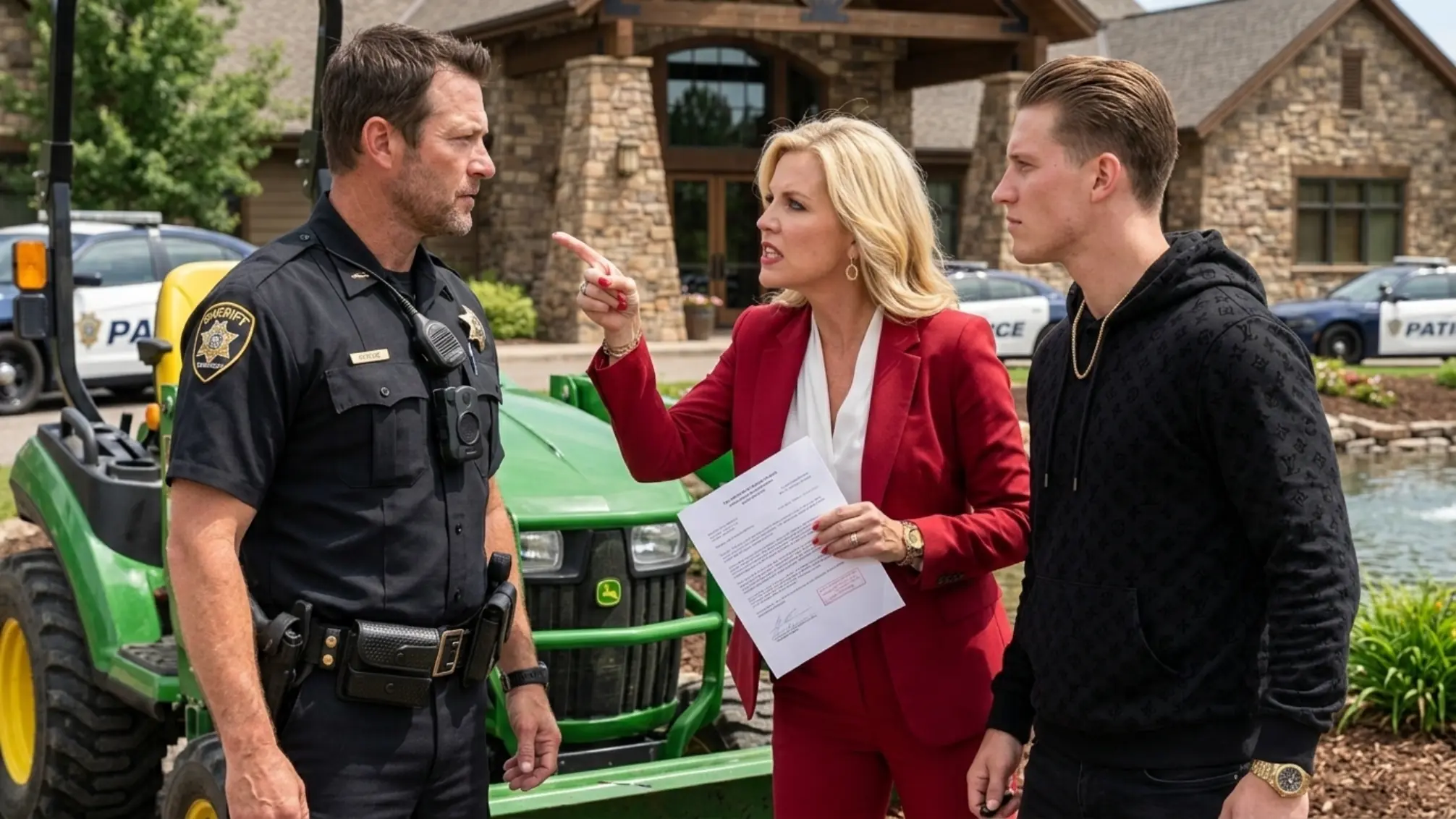
Ethan stopped ten feet away from them, wearing the dark uniform of the county sheriff’s department.
“You took it from my barn while I was asleep,” he said.
Logan laughed and stepped down from the tractor. “Touch me, cop, and I’ll drop you beside your own machine.”
Ethan looked past him toward the two patrol cruisers entering the parking lot. “Try it. Your grand-theft arrest is already here.”
The confidence on Logan’s face broke first.
Patricia turned toward the approaching cruisers, then back toward Ethan’s badge. For fourteen months she had treated him like an uneducated rancher who could be threatened with enough paperwork. Until that moment, she had never understood that the quiet man living beyond the subdivision fence had spent eleven years enforcing the laws she had just broken.
Ethan had purchased the five-acre property two years earlier. It included a weathered double-wide on a permanent foundation, a narrow creek along the eastern pasture, and an aging pole barn that leaned slightly whenever mountain winds came down from the north. The previous owner had stopped maintaining the place, and the bank had accepted a low offer simply to remove it from its books.
Ethan saw potential where other buyers saw work.
He repaired the roof, replaced the damaged fence, cleared brush from the creek, and built a gravel driveway wide enough for emergency vehicles. The land sat outside Silver Pines Estates, an expensive HOA development filled with stone-front houses, decorative ponds, and residents who paid high monthly fees for identical lawns. County maps, the recorded deed, and every property survey showed the same thing: Ethan’s ranch had never belonged to the HOA.
Patricia Hargrave believed visibility created authority.
She crossed Ethan’s field three weeks after he moved in, wearing heels that sank into the damp soil. Without introducing herself properly, she informed him that his tractor violated Silver Pines’ equipment-storage rules. The green machine was parked beneath the pole-barn overhang, almost two hundred feet from the nearest HOA home.
“I’m not a member of Silver Pines,” Ethan told her.
Patricia raised her chin. “Your property affects our community.”
“That doesn’t make it part of your community.”
“It is visible from our southern cul-de-sac.”
Ethan stared at her for a moment. “That still isn’t how property law works.”
She promised to contact him again.
The first violation notice arrived five days later. It demanded that Ethan construct a decorative screening wall around the tractor because agricultural equipment allegedly reduced neighborhood property values. A second notice accused his gravel driveway of creating dust. A third claimed that the pole barn’s faded metal siding violated Silver Pines’ approved color palette.
Ethan placed every letter inside a folder marked HOA—NOT MY HOA.
He did not pay the fines.
Patricia increased them anyway.
By the fourth month, the HOA claimed Ethan owed nearly $3,000 for violations of covenants that did not apply to him. He sent copies of his deed and county map to the association’s management company, along with a written request that Patricia stop contacting him. The company responded with a vague promise to investigate.
Nothing changed.
Patricia’s son soon joined the harassment.
Logan Hargrave operated a landscaping business that held the Silver Pines contract for mowing common areas, maintaining the clubhouse grounds, and cleaning the ornamental pond. The agreement had been awarded during Patricia’s first year as HOA president without competitive bidding. Logan charged the association nearly twice the rate of comparable local companies.
Residents rarely questioned it.
Patricia controlled the board agenda, while two loyal members supported nearly every motion she made. She spoke about her son’s company as though hiring him had been a public service rather than a conflict of interest. Whenever homeowners complained about the cost, Patricia warned that cheaper contractors would damage Silver Pines’ image.
Logan behaved as though his mother’s title extended to him.
He drove through the subdivision in an oversized black pickup, photographed yards, and left warning notices beneath windshield wipers. He had no official board position, but he carried a laminated badge identifying him as an “HOA Property Compliance Director.” The title appeared nowhere in the bylaws.
Ethan first met him on a narrow county road.
A group of children waited near the school-bus stop while Logan’s truck approached far too quickly. Ethan raised one hand and motioned for him to slow down. Logan responded by extending his middle finger through the window.
Their second encounter happened across the fence.
“You’re dragging this whole neighborhood down,” Logan shouted. “Sell that trash heap and move somewhere people like you belong.”
Ethan continued mowing.
He had learned long ago that some men became reckless when they believed there would be no consequences. Confronting Logan in anger would only give Patricia another accusation to use. Ethan documented the time, date, and exact words instead.
Most Silver Pines residents believed Ethan worked an ordinary county maintenance job.
He encouraged that assumption.
As a sheriff’s deputy, he had seen too many disputes escalate after strangers discovered his occupation. At home, he wanted to repair fences, drink coffee beside the creek, and sleep after night shifts without being treated as either a threat or a free source of legal advice.
Patricia interpreted his privacy as weakness.
Fourteen months after the first violation notice, Ethan worked an overnight patrol shift. He responded to a domestic disturbance, helped clear a rollover crash, and spent another hour completing reports before leaving the sheriff’s office shortly after seven in the morning. By the time he reached home, exhaustion had settled behind his eyes.
He parked his tractor beneath the pole-barn roof before going inside.
The machine had cost him $22,000 used. It carried gravel, cleared fallen branches, moved hay, and kept the creek banks from becoming completely overgrown. Ethan had saved for years before purchasing it.
After showering and eating cereal, he closed the blackout curtains and fell asleep.
At approximately eleven thirty, Logan drove onto the ranch.
A security camera recorded his black pickup stopping near the barn. Logan climbed out wearing the expensive hoodie, looked toward the house, and walked directly to the tractor. He used a copied universal equipment key, started the engine, and drove away along Ethan’s gravel driveway.
The theft occurred in broad daylight.
Logan did not rush.
He believed the HOA had given him authority.
Ethan woke at two thirty and immediately noticed the silence around the barn. The tractor normally sat where he could see it from the back door, but only flattened grass remained beneath the overhang. Fresh tire marks crossed the driveway and turned toward Silver Pines.
He called the neighboring rancher first.
“Did you borrow my tractor?”
“No. Is it missing?”
“I’ll call you back.”
Ethan entered the kitchen and opened the tracking application on his phone. Months earlier, he had hidden a small location tag beneath the tractor’s hood after lending the machine to a friend. He had almost forgotten it existed.
The signal came from the Silver Pines clubhouse.
Ethan stared at the map while his coffee brewed behind him.
He could have driven there immediately and confronted Logan alone. He could have worn ordinary clothes, taken the tractor back, and allowed Patricia to describe the incident however she pleased. Instead, he called dispatch through the non-emergency line.
“I need a unit at the Silver Pines clubhouse,” he said. “Stolen heavy equipment.”
The dispatcher recognized his voice. “Are you responding?”
“As the victim only. Send another deputy to handle it.”
“Understood.”
Ethan put on his uniform because he did not want witnesses seeing an exhausted man shouting about a tractor and misunderstanding the situation. He clipped on his body camera, secured his duty belt, and drove the short distance in his personal truck.
Two patrol cars were already approaching from the opposite direction.
The Silver Pines clubhouse resembled a small luxury resort. White columns supported a wide entrance roof, flower beds bordered the circular drive, and an ornamental pond shimmered beside a fountain. Residents were preparing for a summer event, and several tables had been arranged on the lawn.
Ethan’s tractor sat beside the pond.
Its front loader was filled with dark landscaping mulch.
Logan was using the stolen machine to complete a paid job for his own company.
Ethan parked and stepped out. The responding deputies, Mark Reynolds and Tyler Brooks, both worked his shift rotation. They acknowledged him with professional nods but did not treat him as the investigating officer.
Mark moved toward the tractor while Ethan remained several steps behind.
Logan killed the engine after noticing the patrol cruisers. He climbed down wearing an easy smile and raised his hands theatrically.
“Officers, what can I do for you?” he asked. “This is private community property.”
Then he saw Ethan.
His eyes moved across the uniform, badge, radio, and body camera. Confusion became recognition, and recognition became fear. He attempted to hide it beneath a laugh.
“Hey, man. What is all this?”
Ethan pointed toward the tractor. “That belongs to me.”
“I know it’s yours.”
“You drove it off my property while I was sleeping.”
Logan shrugged. “I was going to bring it back.”
“You did not ask permission.”
“It’s helping the community. Assets have to earn their keep.”
Mark stepped closer. “Sir, move away from the equipment.”
Logan looked at him. “It isn’t stolen if it was seized.”
“Seized by whom?”
“The HOA.”
Mark’s expression remained neutral. “Show me the court order.”
Logan folded his arms. “My mother has the paperwork.”
As though summoned by the sentence, Patricia emerged from the clubhouse carrying a bright red folder. Her crimson suit matched the anger already spreading across her face. She began speaking before reaching the group.
“This tractor was lawfully secured under the HOA’s enforcement authority,” she announced. “He has ignored fourteen months of fines.”
Ethan looked at her. “I am not in your HOA.”
“You are effectively part of this community.”
“That phrase has no legal meaning.”
Patricia opened the folder and removed a document titled NOTICE OF LIEN AND ASSET SECUREMENT. It claimed the HOA had placed a maintenance lien against Ethan’s tractor because of unpaid covenant violations. The document carried Patricia’s signature and a notary seal.
Her own notary seal.
Mark took the paper and read it carefully.
“Who issued this lien?”
“The association.”
“Was it filed with the county?”
“It became effective when I signed it.”
“That isn’t how liens work.”
Patricia’s jaw tightened. “I have been advised by counsel.”
“Name the attorney.”
She did not answer.
Logan stepped between Ethan and the tractor. “None of this changes anything. The machine stays here until he pays.”
Ethan looked at the key still in Logan’s hand. “Give it back.”
“Make me.”
The two men stood only a few feet apart. Logan squared his shoulders and leaned forward as if preparing to shove Ethan. His designer hoodie, gold chain, and expensive watch seemed selected to announce that he was untouchable.
Patricia pointed toward Ethan. “Back off, you filthy redneck. This tractor belongs to my HOA now.”
Ethan stepped closer. “You stole it from my ranch while I slept.”
Logan raised the key. “Touch me, cop, and I’ll drop you beside your own machine.”
Ethan glanced toward the deputies. “Try it. Your grand-theft arrest is already here.”
Mark moved between them.
“Place the key on the ground.”
Logan stared at him. “Are you serious?”
“Very.”
Patricia shoved the lien document toward Mark. “You are interfering with lawful HOA enforcement.”
A gray-haired man hurried from the clubhouse. He introduced himself as Paul Dennison, another Silver Pines board member. His expression changed when he saw the document.
“What lien is that?” he asked.
“The one the board approved,” Patricia replied.
Paul shook his head. “We never voted on a tractor lien.”
“We approved it through emergency authority.”
“There is no emergency-authority clause in the bylaws.”
Patricia’s face reddened. “The email vote was sufficient.”
“The board does not vote by email.”
Residents gathering near the clubhouse began whispering.
Patricia tried talking over Paul, but he refused to stop. He explained that no lawyer had reviewed the document and no board member had authorized Logan to enter Ethan’s ranch. Patricia finally admitted that she had acted independently because Ethan’s continued defiance threatened community standards.
Mark examined the notary seal.
“Did you notarize your own signature?”
“I am the HOA president and a commissioned notary.”
“That wasn’t my question.”
“Yes, I notarized it.”
“You cannot serve as an impartial notary for a document you created and signed.”
Patricia lifted her chin. “I can notarize whatever I deem necessary for association business.”
Logan turned toward her.
Until then, he had believed the red folder protected him. Now he looked at his mother as though seeing the edge of a cliff she had encouraged him to walk over.
Mark folded the document. “Even a valid lien would not authorize you to physically take someone’s personal property. You would need to file through the proper court process.”
Patricia pointed at the tractor. “He owes the HOA money.”
“He does not belong to the HOA,” Paul repeated.
“The community is harmed by his property.”
“That still does not make his tractor yours.”
Logan began backing away.
Tyler moved into his path. “Stay where you are.”
“I didn’t steal anything.”
“You entered his property and removed a $22,000 vehicle without permission.”
“My mother told me to.”
Patricia snapped her head toward him. “Logan, stop talking.”
The order arrived too late.
His admission had been captured by three body cameras, two patrol-car systems, and several residents’ phones. Ethan’s security footage also showed the original entry and theft from beginning to end.
Mark instructed Logan to turn around.
Patricia stepped forward. “You are not arresting my son.”
“Ma’am, move back.”
“He acted under HOA authority.”
“There was no authority.”
Logan pulled away when Mark reached for his wrist. It was a brief movement, more panic than genuine resistance, but it ended with both deputies controlling his arms against the patrol car.
His gold chain shifted across the black hoodie as the handcuffs closed.
Patricia began screaming.
She threatened the deputies’ jobs, the sheriff’s department, the county, Ethan’s property, and everyone filming the arrest. Logan continued insisting the tractor had merely been borrowed for community use.
Mark placed him inside the cruiser.
The rear door shut.
For the first time that afternoon, Logan stopped speaking.
Patricia looked at Ethan’s uniform again. “You work for the sheriff?”
“Yes.”
“Since when?”
“Since before you bought your house.”
Several residents laughed quietly.
Patricia’s anger turned toward them. “None of you understand what he has done to this community.”
Paul took the red folder from her hand. “What you did is the problem.”
She was not arrested at the clubhouse, but investigators immediately seized copies of the false lien, the security footage, and the HOA records connected to the tractor. Ethan recovered the machine after deputies photographed it and documented the location.
The front loader still contained mulch purchased with HOA money.
He drove the tractor home himself.
The following week, Patricia was charged with forgery-related offenses, notary misconduct, filing a false instrument, and participating in the unauthorized taking of heavy equipment. Logan faced charges connected to grand theft, trespassing, and operating the tractor without permission.
Their defense depended heavily on the claim that they genuinely believed the HOA possessed enforcement authority.
The records destroyed that argument.
Emails showed Patricia had received repeated warnings from the association’s management company that Ethan’s property stood outside Silver Pines. The HOA attorney had advised her in writing that the board could not enforce covenants beyond its recorded boundary.
She continued sending fines anyway.
One email to Logan was particularly damaging.
He works nights. Take the tractor after eight in the morning when he is asleep. We need the mulch finished before the event.
The theft had not been a misunderstanding.
It had been planned.
With Patricia temporarily removed from authority, the remaining board commissioned an independent audit. Investigators reviewed four years of contracts, invoices, meeting minutes, and bank statements. The landscaping agreement awarded to Logan’s company had never received competing bids.
Silver Pines paid nearly twice the local market rate.
Quarterly statements also included a “community strategy consulting fee” sent directly to a private account belonging to Patricia. The payments continued for years without a clear contract or board approval.
Residents were furious.
The HOA had fined retired homeowners over flowerpots while paying thousands of dollars to its own president. It had threatened families over driveway cracks while enriching the president’s son through an overpriced landscaping contract.
An emergency meeting filled the clubhouse.
Patricia arrived in another red suit and attempted to control the agenda, but Paul moved to suspend her before she could begin her prepared statement. Homeowners demanded access to financial records, contract files, and correspondence involving Ethan.
The vote to remove her was nearly unanimous.
Logan’s landscaping contract was terminated that evening.
Without Silver Pines as its primary customer, his company collapsed within two months. Equipment was repossessed, employees left, and the black pickup he used to enter Ethan’s ranch disappeared from Patricia’s driveway.
The criminal cases moved more slowly.
Logan eventually accepted responsibility for taking the tractor and entered a plea agreement that included restitution, probation, and community service. Patricia’s consequences were broader because the fake lien connected the theft to years of false enforcement.
The notary commission she had treated as a personal weapon was revoked.
Silver Pines filed a civil action seeking repayment of misappropriated funds. Legal fees and the judgment forced Patricia to list her house for sale. Six months after Logan drove the tractor away, a real-estate sign appeared in her perfectly maintained yard.
She moved before the beginning of the next school year.
Ethan never spoke to her again.
The HOA sent him a formal letter acknowledging that his ranch had never fallen under its authority. Every violation notice and claimed fine was withdrawn. The new board also installed a permanent marker along the county easement separating Silver Pines from Ethan’s property.
The wording was simple:
PRIVATE PROPERTY BEYOND THIS POINT. HOA AUTHORITY ENDS HERE.
Ethan kept the original red folder.
The fraudulent lien remained inside an evidence box until the case concluded, after which prosecutors returned a certified copy. He stored it beside Patricia’s first equipment-violation notice and the photograph of his tractor beside the clubhouse pond.
Not as trophies.
As reminders.
The tractor returned to its place beneath the pole-barn roof. Ethan installed a heavier chain, upgraded the cameras, and added a second tracker beneath the seat. He also began removing the universal key whenever the machine was parked.
The flattened tire marks eventually vanished from the grass.
One afternoon, the rancher across the road asked whether Ethan regretted keeping his occupation private.
“No,” Ethan replied. “People should respect property because it belongs to someone, not because that someone carries a badge.”
That was the part Patricia never understood.
Stealing from a sheriff’s deputy had made the reversal more dramatic, but it had not made the theft more wrong. The tractor would still have belonged to Ethan if he had been a mechanic, teacher, ranch hand, or unemployed widower.
His uniform did not create his rights.
It only made it harder for Patricia to bury the truth beneath fake legal language.
A year later, Ethan used the tractor to repair the washed-out section of his driveway after several days of hard rain. The engine ran steadily as he spread fresh gravel and shaped the drainage ditch.
Children from Silver Pines waited at the nearby bus stop.
When Ethan passed them, he slowed and raised one hand.
They waved back.
The neighborhood had changed since Patricia’s removal. Residents elected a new board, canceled unnecessary contracts, and reduced monthly assessments after the audit revealed how much money had been wasted. Meetings became shorter, and violation notices required evidence, a recorded vote, and review by the management company.
Nobody crossed Ethan’s fence in heels.
Nobody claimed his equipment.
Nobody told him that being visible from an HOA made him part of it.
Late that evening, Ethan parked the tractor beneath the overhang and switched off the engine. The sudden quiet settled across the pasture, broken only by the creek and the distant sound of cattle.
He looked at the machine Patricia believed she could seize with a homemade document.
She had treated the HOA seal like a badge, her signature like a court order, and her son like an untouchable enforcement officer. She believed authority existed wherever she announced it loudly enough.
Then Logan drove a stolen tractor into a public clubhouse parking lot.
He used it for a paid landscaping job.
Patricia handed deputies the forged document connecting herself to the crime.
They had supplied the location, witnesses, motive, confession, and paperwork themselves.
Ethan had needed only to track the machine and let the law examine what they had done.
Patricia Hargrave thought she could take a rancher’s property because he lived outside her manicured gates and refused to fear her title.
She discovered too late that boundaries meant something.
So did deeds.
So did evidence.
And when her son threatened to knock Ethan down beside the tractor he had stolen, the deputies did not arrest the quiet ranch owner.
They opened the patrol-car door for the man wearing the luxury hoodie—and dismantled the false empire his mother had built around him.