The first bag appeared on a Monday morning.
I found it beside the narrow concrete walkway that ran from my driveway to the backyard gate, a tied black kitchen bag resting against the cedar fence as if somebody had carefully placed it there.
My name is Derrick Cole. I was forty-one years old, lived in a quiet suburban neighborhood outside Phoenix, Arizona, and until that morning I had never spent more than ten seconds thinking about a garbage bag that wasn’t mine.
I assumed a neighbor had accidentally dropped it.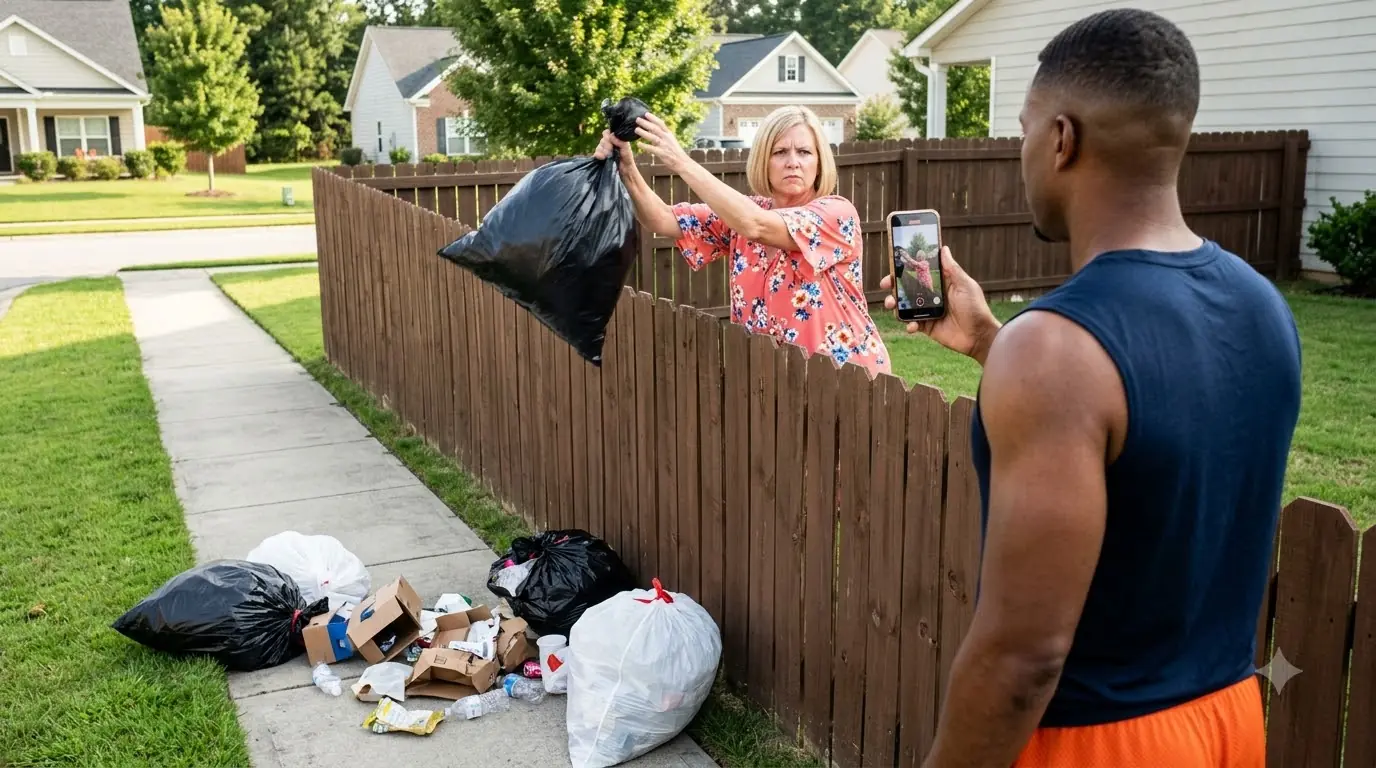
Cedar Ridge Estates was the kind of community where identical beige mailboxes stood at the same distance from every curb, lawns were trimmed to nearly identical heights, and people could identify an unfamiliar delivery truck before it reached the second intersection.
A loose trash bag was unusual.
It wasn’t alarming.
I carried it to my bin without opening it.
By the next morning, there were two more.
One sat beside my side gate.
The other had landed several feet inside my backyard.
That second bag bothered me.
My backyard was surrounded by a six-foot wooden privacy fence.
There was only one gate.
The gate was locked.
I stood on the patio staring at the bag and trying to imagine how it had gotten there.
Maybe an animal had dragged it.
Maybe the wind had somehow carried it over.
Neither explanation made much sense.
The bag was tied tightly and looked too heavy to have traveled far.
I put on work gloves, carried it outside, and forgot about it.
At least I tried to.
Three days later, the first HOA letter arrived.
The envelope had the green Cedar Ridge logo in the upper left corner and PROPERTY COMPLIANCE NOTICE printed beneath my name.
I opened it at the kitchen counter.
The letter stated that household waste had been observed near the side portion of my property and that residents were required to prevent “unsightly accumulation of refuse visible from neighboring lots or common pathways.”
I read it twice.
There wasn’t any garbage there anymore.
I had removed it.
At the bottom was the signature of HOA president Karen Whitmore.
Karen had taken over the board eight months earlier.
She was fifty-three, white American, thin, with a straight chin-length blonde bob and narrow features that always seemed slightly tense even when she smiled.
Karen dressed more colorfully than most people in Cedar Ridge.
Her favorite outfit that summer was a loose coral-pink floral dress covered in blue, white, and orange flowers.
You could spot her from half a block away.
She also treated the HOA handbook like a combination of constitution, religious text, and personal autobiography.
Before Karen became president, Cedar Ridge meetings were mostly about landscaping budgets and whether the clubhouse needed new patio furniture.
After Karen became president, residents started receiving notices for things nobody remembered being violations.
Garden hoses visible from the street.
Temporary basketball hoops.
Holiday decorations left up three days too long.
Cars parked with one tire touching decorative gravel.
Karen called it “restoring standards.”
Most of us called it exhausting.
I emailed her that afternoon.
The trash referenced in your notice did not belong to me. It appeared beside my property and was removed immediately. Please let me know if there is a specific issue still requiring correction.
Her response arrived twenty minutes later.
Residents are responsible for conditions present on their property regardless of origin. Please maintain the area going forward.
That annoyed me.
I wrote back.
If someone dumps trash on my property, I’m responsible for removing it, but I’m not responsible for creating it. Those are different things.
Karen did not respond.
The following Tuesday, I woke up to four garbage bags inside the backyard.
That was when I stopped believing in coincidence.
One bag had split after hitting the concrete.
Empty cereal boxes, paper towels, plastic food containers, and several crushed soda cans were scattered across the walkway.
Another bag was hanging from the top of the fence.
I stood there in gym shorts at six fifteen in the morning, staring at the mess.
Someone was throwing trash over my fence.
There was no other reasonable explanation.
My next-door neighbor, Rosa Martinez, noticed me cleaning it.
Rosa was sixty-seven, Latina American, retired from elementary-school teaching, and had lived in Cedar Ridge since the first houses were completed.
She leaned over the low decorative wall separating our front driveways.
“Party?”
I held up a torn bag.
“Not mine.”
Her expression changed.
“That’s the third time.”
I stopped.
“You’ve seen this before?”
“Monday morning. Then Thursday.”
“Why didn’t you say anything?”
“I thought you were cleaning out your garage.”
“My garage is on the other side.”
Rosa looked toward the privacy fence.
“Then somebody likes giving you presents.”
“Apparently.”
She walked closer.
“You should get a camera.”
“I already have a doorbell camera.”
“Not facing the backyard.”
“No.”
“Get one.”
I smiled.
“You sound like a security salesman.”
“I’m retired. I need hobbies.”
I ordered two cameras that afternoon.
Before they arrived, the second HOA notice did.
This one included photographs.
There was my fence.
My side walkway.
Three bags of trash.
The timestamp showed 7:42 a.m., less than two hours before I had removed them.
The notice declared the condition a “repeat sanitation issue.”
There was now a $100 administrative fine.
I called Karen.
She answered with the tone of someone who already knew why I was calling.
“Derrick.”
“You fined me for garbage somebody keeps throwing into my yard.”
“The board documented a repeat condition.”
“You documented somebody else dumping trash.”
“We documented trash on your property.”
“That is not the same thing.”
“The governing documents do not require us to determine the origin of refuse before issuing a sanitation notice.”
“Then maybe they should.”
Karen sighed.
“If people could avoid enforcement simply by claiming someone else created the condition, the rules would become meaningless.”
“I’m not making a random claim.”
“What evidence do you have?”
“At the moment? The fact that I don’t store kitchen garbage beside my fence.”
“That’s not evidence.”
She was right about one thing.
It wasn’t.
I hated that.
“The fine is staying?”
“You can appeal.”
“To the board you run.”
“The board consists of five members.”
“And you’re president.”
“If you believe the process is unfair, submit your concerns in writing.”
I looked out my kitchen window.
“You already have them in writing.”
Karen’s voice cooled.
“Then we’re done.”
She hung up.
The cameras arrived the next day.
I mounted one beneath the rear patio roof facing the entire backyard.
The second went beneath the eave near the side of the house, aimed toward the top of the fence and gate.
I adjusted both until there were no obvious blind spots.
Rosa watched from her driveway.
“You need one on the other side.”
“That would be pointing at somebody else’s property.”
“Fine. Be ethical.”
“I’m trying.”
“You’ll regret it.”
I laughed.
For four nights, nothing happened.
No bags.
No wrappers.
No notices.
I started wondering whether whoever had been doing it had seen me installing the cameras.
Then Saturday morning arrived.
My phone buzzed at 5:38.
BACKYARD MOTION DETECTED.
I opened the live feed.
A black garbage bag was tumbling through the air.
It disappeared behind the fence and struck the concrete.
I sat upright.
Another bag appeared.
Then another.
The camera had captured the bags.
But it couldn’t see who was throwing them.
Whoever was outside the fence remained below the camera angle.
I ran downstairs.
By the time I reached the yard, the person was gone.
Five bags lay near the gate.
One had broken open across the grass.
I checked the second camera.
Same problem.
The fence blocked the thrower.
All I had was garbage appearing from nowhere.
Rosa came over after breakfast.
I showed her the footage.
“Somebody knows exactly where your cameras can see.”
“I just installed them.”
“You didn’t exactly do it secretly.”
“Are you suggesting somebody watched me?”
“I’m suggesting we have bored people.”
I replayed the clip.
The bags cleared the fence at roughly the same point.
“Could be someone from the walking path.”