Marcus Reed first noticed the problem on a Tuesday night while sitting at his kitchen table with three months of utility statements spread in front of him.
The numbers were not catastrophic, but they were wrong. His electricity usage had risen by almost thirty percent despite the fact that he had spent nearly two weeks of the previous month traveling for work, the weather had been mild, and his air-conditioning system had barely run. Marcus had managed commercial facilities long enough to know that unexplained consumption usually meant one of three things: faulty equipment, bad metering, or somebody using power that did not belong to them.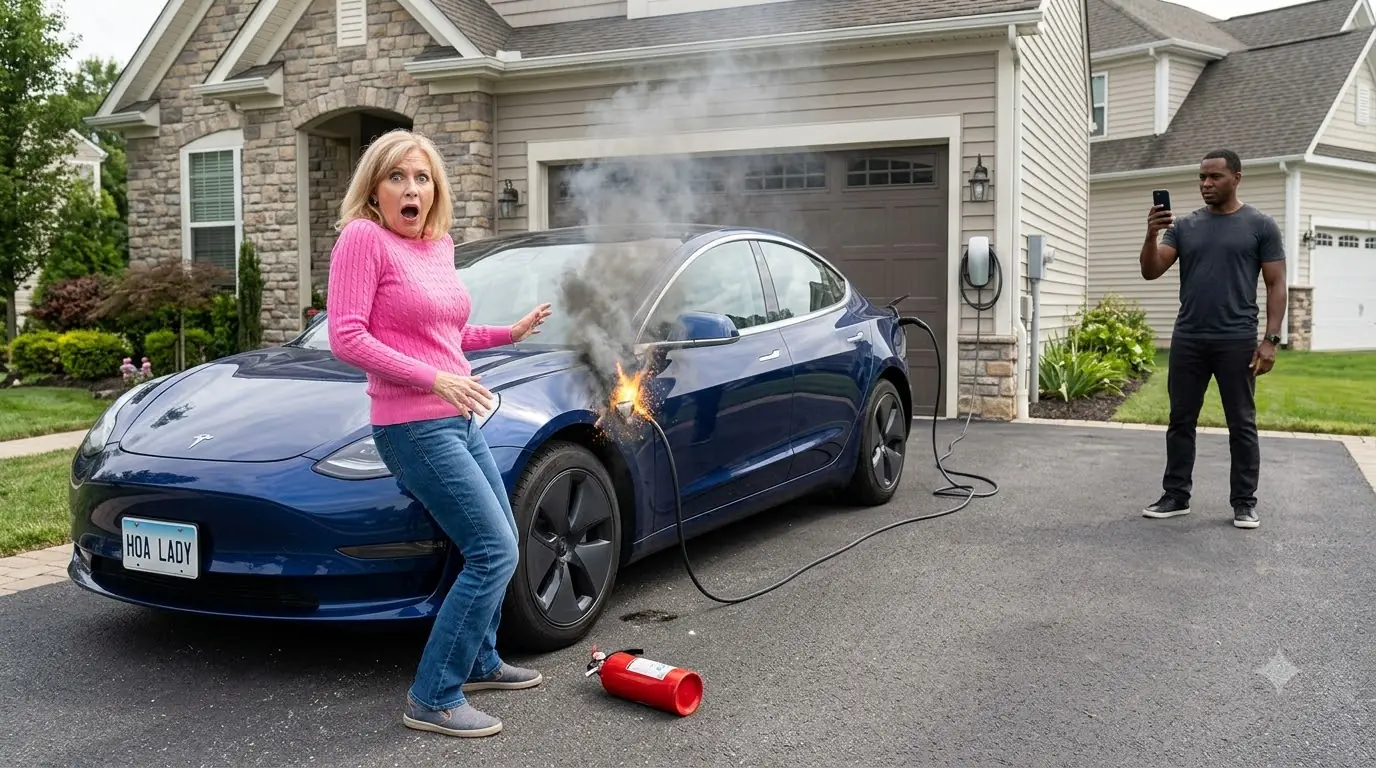
He began with the obvious possibilities.
The HVAC system was working normally. The water heater showed no unusual cycling. His garage refrigerator, pool pump, kitchen appliances, outdoor lighting, and workshop equipment all tested within their expected ranges.
Nothing explained the overnight spikes.
The unusual usage appeared between approximately 11:00 p.m. and 5:00 a.m., three or four nights each week.
Marcus lived in Brookstone Heights, an affluent planned community outside Charlotte, North Carolina, where rows of carefully landscaped homes curved around wide sidewalks, ornamental trees, and an HOA clubhouse that looked more like a small country club than a neighborhood meeting room. His two-story house sat near the end of a quiet cul-de-sac, with a two-car garage, a fenced backyard, and an exterior electrical outlet beside the driveway that contractors occasionally used while working on the property.
Marcus was forty-two years old, Black American, broad-shouldered, disciplined, and patient by temperament.
People sometimes interpreted that patience as passivity.
Linda Carver had made that mistake almost immediately.
Linda was fifty-eight, white American, blonde, always carefully dressed, and had served as president of the Brookstone Heights Homeowners Association for nearly five years. She wore pastel blazers to board meetings, carried a leather binder under one arm, and spoke about neighborhood rules with a certainty that suggested she believed covenants were not documents created by residents but commandments delivered personally to her.
Her disputes with Marcus began six weeks after he bought the house.
First came a letter claiming his garbage bins were visible fifteen minutes beyond the permitted collection window.
Then another said his contractor had parked a van in the driveway too long.
A third complained that the charcoal-gray planters near his garage were not on the approved decorative list, even though identical planters stood outside the HOA clubhouse.
Marcus responded to each notice calmly.
He requested the relevant covenant section.
He attached photographs.
He saved emails.
He appealed when necessary.
Most violations disappeared.
Linda never apologized.
Instead, new ones appeared.
Marcus eventually developed a simple rule regarding Linda Carver: never argue about what could be documented.
That rule was the reason he did not immediately accuse anyone when the electricity bills increased.
He wanted proof.
The first useful clue arrived the following Friday.
Marcus had gone to bed just after midnight when his phone alerted him that motion had been detected near the side of the garage. His existing doorbell camera did not cover the entire driveway, but one of the small security cameras above the garage captured part of the area.
Marcus opened the feed.
A blue Tesla sat near the edge of his driveway.
He recognized it immediately.
Linda Carver’s car.
Marcus sat upright.
The vehicle was usually parked three houses away at Linda’s property.
Now it was backed toward Marcus’s garage.
He enlarged the image.
A cable ran from the Tesla toward the side wall of his house.
Marcus got dressed and walked downstairs.
By the time he opened the front door, the Tesla was gone.
So was the cable.
He walked to the exterior outlet.
The protective cover was open.
Marcus stared at it.
Then he returned inside without touching anything.
At 7:12 the next morning, he checked his utility-monitoring application.
There it was.
A clear overnight spike.
He compared the time against the camera event.
Almost exact.
Marcus did not confront Linda.
Instead, he installed another camera.
The following week, it happened again.
At 12:47 a.m., Linda’s Tesla rolled quietly toward Marcus’s house.
This time, the camera captured everything.
Linda stepped from the vehicle wearing a pale pink tracksuit and white sneakers. She opened her trunk, removed a heavy charging cable, crossed several feet of Marcus’s driveway, and connected it to the exterior outlet.
She looked toward his windows.
Then toward the street.
Then returned to the Tesla.
Marcus watched the recording the following morning.
He played it twice.
The video was unambiguous.
Linda had crossed onto his property.
Connected her vehicle to his power.
Left it there for nearly four hours.
Then returned before sunrise and disconnected everything.
Marcus exported the footage.
He saved it locally.
Then to cloud storage.
Then sent a copy to his attorney, Dana Whitaker.
Dana called twenty minutes later.
“Please tell me this is not your HOA president.”
“It is.”
“She is charging her car from your house?”
“Yes.”
“Why?”
“That is the question.”
“Have you confronted her?”
“No.”
“Good.”
Marcus smiled.
“You always like when I don’t confront people.”
“I like evidence more than arguments.”
“So do I.”
Dana asked how long the utility spikes had been happening.
Marcus estimated at least three months.
She asked whether Linda had ever received permission to use the outlet.
No.
Had Marcus ever shared electricity with her?
No.
Was the outlet inside his property boundary?
Yes.
Had Linda crossed onto the property to access it?
The video showed exactly that.
Dana asked him not to disable the outlet immediately.
Marcus frowned.
“Why?”
“Because if this has happened repeatedly, we should document the pattern before it becomes a story about one accidental night.”
Marcus understood.
Over the next twelve days, Linda returned three times.
Each event was recorded.
The pattern was almost identical.
Late arrival.
Quick glance toward the windows.
Cable connected.
Tesla charged for several hours.
Cable removed before morning.
Marcus calculated the approximate energy consumed over the previous months.
It was not enough to ruin him financially.
That was never the point.
The point was the certainty required to walk onto another person’s property in the middle of the night and repeatedly take something while assuming the homeowner would never know.
Marcus finally contacted a licensed electrician named Andre Lawson.
Andre had worked on several projects for Marcus’s company and knew him well.
Marcus showed him the videos.
Andre watched Linda connect the cable.
Then watched the next one.
Then the third.
He lowered the phone.
“That woman is charging her Tesla from your house.”
“Yes.”
“For free.”
“Yes.”
“Does she know you have cameras?”
“Apparently not.”
Andre shook his head.
“What do you want me to do?”
“Secure the circuit.”
Andre nodded.
There was no elaborate trap.
No concealed high-voltage device.
No dangerous modification.
No attempt to damage Linda’s vehicle.
Andre installed a code-compliant locking outlet enclosure and added smart monitoring so Marcus could control exterior access remotely. He inspected the circuit, confirmed it was properly protected, documented the work, and left the system configured so unauthorized users could not simply connect equipment while Marcus was away.
The entire job was boring.
That was exactly how Marcus wanted it.
Afterward, he placed a small weatherproof notice beside the enclosure.
PRIVATE ELECTRICAL SERVICE.
OWNER AUTHORIZATION REQUIRED.
Marcus photographed everything.
Dana approved.
Then they waited.
Linda discovered the change two nights later.
The camera showed her arriving at 1:06 a.m.
She backed the Tesla into the usual position.
Opened the trunk.
Removed the charging cable.
Walked toward the outlet.
Then stopped.
The enclosure was locked.
Linda stared at it.
She tried the cover.
Then again.
She crouched.
Examined the notice.
Looked toward Marcus’s house.
Then returned to her car.
Marcus expected that to be the end of it.
It was not.
At 8:14 the following morning, an HOA email arrived.
SUBJECT: UNAUTHORIZED EXTERIOR ELECTRICAL MODIFICATION.
Marcus laughed before opening it.
Linda claimed the locking enclosure represented an “unapproved alteration visible from a shared community approach.”
Marcus forwarded the message to Dana.
Her response arrived thirty seconds later.
Of course she did.
Marcus replied:
Do I answer?
Dana:
No.
Thirty minutes later, another email arrived.
This one claimed the exterior electrical enclosure presented a potential safety hazard.
Marcus forwarded that too.
Dana responded:
Still no.
At noon, Linda appeared at Marcus’s front door.
He did not open it.
Instead, he spoke through the doorbell camera.
“Good afternoon, Linda.”
She looked directly into the lens.
“We need to discuss the electrical installation.”
Marcus remained inside.
“Send it through the management office.”
“I already did.”
“Then there’s nothing to discuss at my door.”
“You cannot install locking electrical equipment without architectural approval.”
“It’s a code-compliant protective enclosure.”
“That is not the point.”
“What is?”
Linda paused.
Marcus waited.
Finally she said, “This neighborhood has standards.”
Marcus almost smiled.