The first time I noticed Karen Whitmore standing beside my backyard fence, I told myself she was probably looking for somebody’s missing dog.
That explanation lasted about thirty seconds.
Karen wasn’t looking down the street or calling an animal’s name. She was standing perfectly still beside the cedar privacy fence that separated my property from the walking path behind Cedar Ridge Estates, leaning slightly toward one of the narrow gaps between the boards and staring directly at my swimming pool.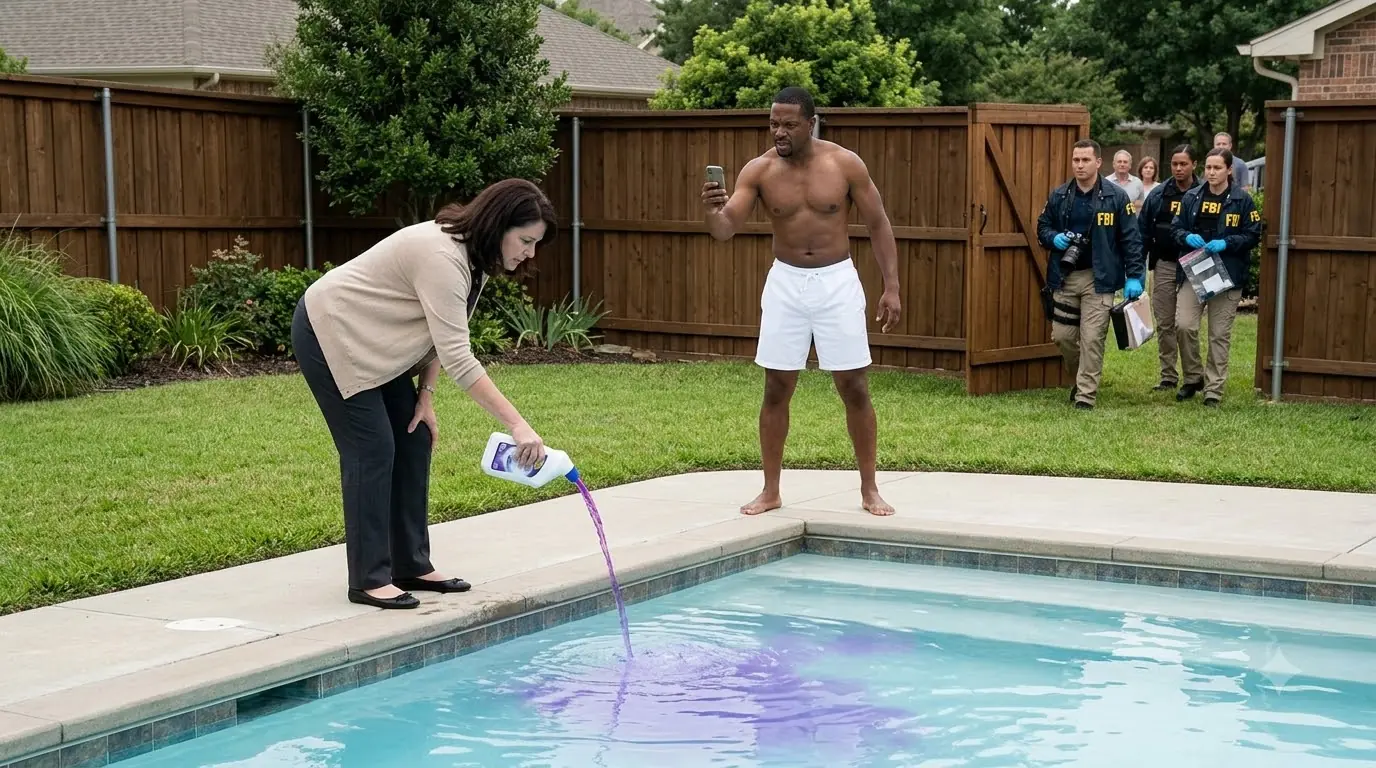
I was inside my kitchen when I saw her.
My name is Derrick Cole. I was forty-two years old, had lived in Chandler, Arizona, for nearly six years, and until that summer I considered myself unusually good at avoiding neighborhood drama.
I paid my assessments on time. I kept the front yard trimmed. I didn’t leave my trash bins on the curb overnight, and I had never once attended an HOA meeting simply because I enjoyed arguing with strangers under fluorescent lights.
My house was a single-story stucco home near the western edge of the development. The backyard wasn’t enormous, but I had spent years turning it into the one place where I could stop thinking about work.
There was a rectangular blue pool, a small covered patio, two citrus trees, a row of red flowering shrubs, and the six-foot wooden fence surrounding the entire yard.
The pool mattered to me more than I normally admitted.
My father, Calvin Cole, had taught me to swim when I was seven. He had worked long weeks as an electrician, and Saturday mornings at the municipal pool were one of the few times I had him completely to myself.
He died five years before I bought the house.
When I finally saved enough for a place with a pool, I remembered standing in shallow water with his hand under my back while he told me not to fight the water.
“Trust what’s holding you up,” he used to say.
I thought about that sentence almost every time I floated there alone.
So when I saw Karen Whitmore pressing her face toward my fence, looking into that backyard like she was inspecting something that belonged to her, I felt irritated before I felt suspicious.
Karen was fifty-three, thin, always carefully dressed, and had the kind of posture that made every sidewalk look like a board meeting.
She had shoulder-length dark brown hair that she curled inward near her jaw, narrow glasses she wore only when reading documents, and a habit of speaking to adults as if she were explaining consequences to children.
She had become president of the Cedar Ridge Estates Homeowners Association nine months earlier.
I opened the sliding door and walked onto the patio.
“Karen?”
She straightened immediately.
For half a second, she looked surprised.
Then the expression disappeared.
“Derrick.”
“What are you doing?”
She glanced toward the walking path.
“Community inspection.”
“Through my fence?”
Her mouth tightened.
“I’m checking for visible compliance issues.”
“My backyard isn’t common property.”
“I’m aware of the property map.”
“Good.”
Karen looked through the fence again.
“Your pool water appears darker than it did last month.”
I actually laughed.
“You can tell that through a quarter-inch crack in a fence?”
“I can tell enough.”
She pulled a small tablet from beneath her arm.
“The board has received concerns about improper pool maintenance.”
“From who?”
“I’m not required to identify residents who make complaints.”
“Then tell the resident my pool is professionally serviced every week.”
Karen tapped her screen.
“Professional servicing does not automatically establish HOA compliance.”
That was the first time I heard that phrase.
HOA pool compliance.
I had lived in Cedar Ridge for years, and there had never been anything in our rules requiring the association to test or approve private pool chemistry.
There were regulations concerning fencing, visible equipment, noise from pumps, drainage onto neighboring property, and obviously basic safety requirements.
But there was no rule giving Karen permission to judge the color of my water through my fence.
“I think we’re done here,” I said.
Karen gave me a smile that contained no warmth at all.
“We’ll see.”
Then she walked away.
I should have forgotten about it.
Instead, two days later, a white envelope appeared beneath my front door.
NOTICE OF OBSERVED POOL MAINTENANCE DEFICIENCY.
The letter claimed that my water had shown “potential visual indicators of sanitation imbalance” and gave me ten days to provide proof of professional testing.
There was no fine.
Not yet.
But there was something at the bottom that bothered me more.
The notice recommended one particular company.
AquaSure Community Services.
I had never heard of them.
My pool technician had.
His name was Marcus Bell, a thirty-nine-year-old Black American contractor who had maintained pools throughout the Phoenix area for more than a decade.
Marcus arrived every Thursday morning in an old silver pickup with enough equipment in the back to make it look like he was opening a laboratory beside my patio.
He read Karen’s letter twice.
Then he looked at me.
“This makes no sense.”
“That’s reassuring.”
“I’m serious. Your water is fine.”
“You tested it last week.”
“I tested it this morning.”
He gestured toward his equipment.
“Nothing here justifies a warning.”
I pointed to AquaSure’s name.
“You know them?”
Marcus hesitated.
“I’ve heard of them.”
“That sounded promising.”
“Not exactly.”
He sat on the edge of one of my patio chairs.
“They started showing up around HOA communities maybe a year ago. They don’t really operate like a normal residential pool company.”
“What does that mean?”
“They pitch boards instead of homeowners.”
Marcus explained that AquaSure offered something called “community aquatic compliance monitoring.”
The phrase sounded official enough to impress people who didn’t ask questions.
AquaSure would inspect private pools, supposedly from public or HOA-controlled areas, then recommend additional testing when they believed something looked wrong.
“I know three independent pool guys who lost clients after associations started pushing AquaSure,” Marcus said.
“Were the clients unhappy with their service?”
“That’s the strange part. A lot of them weren’t.”
Marcus handed the letter back.
“I’d keep this.”
I did.
Three days later, Karen came back.
This time, my neighbor Rosa Martinez saw her first.
Rosa lived two houses down and had been in Cedar Ridge since the development was built. She was sixty-seven, retired from teaching fifth grade, and possessed the neighborhood’s most reliable combination of curiosity and moral outrage.
She knocked on my front door shortly after noon.
“Your friend is back.”
I looked past her.
“What friend?”
“Madam President.”
Karen was on the sidewalk beside my house.
She was taking photographs.
I stepped outside.
“Karen.”
She lowered her phone.
“You have a habit of appearing suddenly.”
“I live here.”
“That would explain it.”
“What are you photographing?”
“The exterior condition of the property.”
“Which exterior condition?”
She pointed toward the narrow side yard.
“Pool equipment may be audible beyond reasonable limits.”
I stared at her.
“My pump isn’t running.”
Karen looked toward the wall.
Neither of us heard anything.
Rosa folded her arms.
“That is one quiet violation.”
Karen ignored her.
“We have received multiple concerns.”
“Again,” I said, “from who?”
“That information is confidential.”
“You keep saying that.”
“And you keep asking.”
She turned to leave.
Rosa called after her.
“My pool better not start offending anybody.”
Karen stopped.
For one wonderful second, I thought she might actually answer.
Instead, she continued walking.
Rosa looked at me.
“You need cameras.”
“I have a doorbell camera.”
“Backyard cameras.”
“That seems dramatic.”
Rosa pointed after Karen.
“So does inspecting silent pool equipment.”
That afternoon, I ordered two cameras.
I mounted one beneath the patio roof facing the pool and another above the side gate facing the fence line.
The gate already had a keyed latch.
I added a second interior lock.
I wasn’t expecting somebody to break in.
I simply wanted proof that Karen’s inspections were happening as often as they seemed to be happening.
The cameras gave me more than that.
Four nights later, at 8:47 p.m., my phone sent a movement notification.
I was upstairs in my home office.
The live feed showed nobody inside the yard.
But the second camera had recorded Karen walking slowly along the outside of my fence.
She stopped twice.
The first time she photographed the pool through a gap.
The second time she raised her phone above the top of the fence.
I saved the recording.
The next morning, another HOA notice arrived.
This one claimed there was “visible evidence of possible surface contamination.”
Marcus came over again.
He tested the water.
“Still normal.”
I showed him the footage.
Marcus watched Karen lift her phone over the fence.
“That woman really wants something to be wrong with your pool.”
“That’s what I’m starting to think.”
He stared at the water for a few seconds.