My $80,000 private driveway was gone overnight.
Fresh asphalt covered it from end to end. Yellow speed bumps had appeared across the surface, crisp white center lines ran down the middle, and brand-new signs declared, “Private Property — HOA Members Only.” 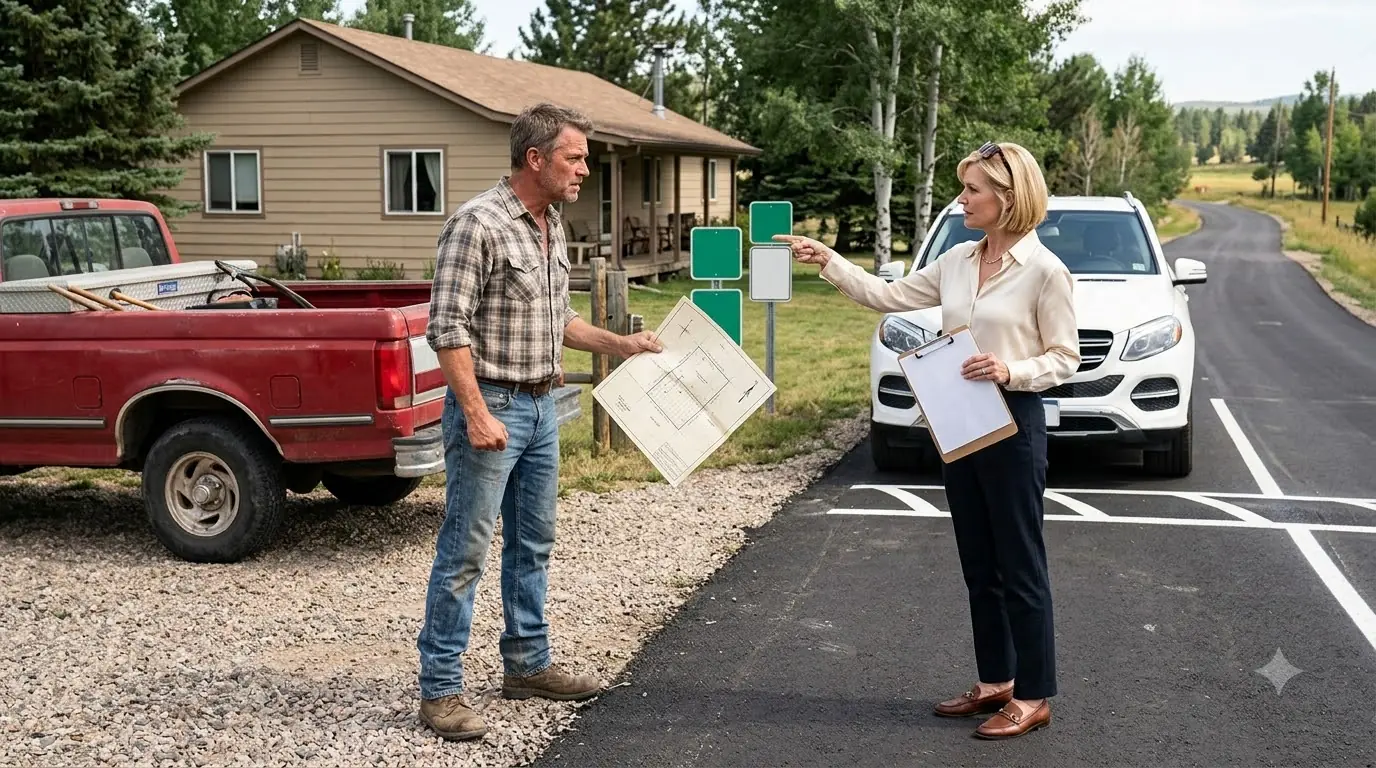
My grandfather’s road, built in 1987 to handle vehicles far heavier than anything that had ever entered Willowbrook Estates, had somehow become an HOA “community improvement.”
And they had billed me $12,400 for it.
Vivian Ashworth, the HOA president, stood beside her white Escalade with a clipboard tucked against one arm and that familiar smug smile on her face. Her manicured nails tapped against the invoice as though she were waiting for me to thank her.
“You should be grateful,” she said. “We fixed your ugly dirt path. Property values just skyrocketed.”
The smell of hot tar hit me like betrayal.
Thirty-seven years of clear ownership had apparently been erased during the seven days I had been away working.
Vivian had picked the wrong guy to bully.
My name is Garrett Sullivan. I was fifty-two years old, a retired Army combat engineer, and according to certain clipboard-wielding busybodies, the neighborhood’s problem resident. I lived alone on three acres in Willowbrook Estates, Colorado, although my property had been there long before anyone came up with that pretentious name.
I inherited the property from my grandfather in 2010, along with the piece of land that would eventually start this entire war: a four-hundred-foot private access road connecting my property to County Highway 34.
Grandpa built that road in 1987 with the kind of precision that defined everything he did. He hired a professional surveyor, obtained county permits, installed proper drainage, laid a reinforced base, and engineered the road to support vehicles weighing as much as sixty tons. He had spent years hauling heavy equipment across Europe and did not believe in half measures.
The project cost nearly $80,000.
Every document was filed properly.
Every boundary was recorded.
Every ownership detail was written into county records in language strong enough to survive decades of development, tax transfers, title reviews, and bureaucratic reshuffling.
Back then, my property was surrounded by cattle pasture and pine forest.
The only sounds were wind through the trees, birds in the morning, and the occasional diesel rumble of farm equipment in the distance.
It was perfect for somebody like me.
I fixed things for a living and generally preferred machines to people.
Then 2019 brought what developers liked to call progress.
A developer bought most of the ranch land around me, divided it into sixty nearly identical residential lots, and created Willowbrook Estates.
The subdivision came with stone entrance pillars, matching mailboxes, landscaping rules, architectural restrictions, and a covenant document thick enough to serve as a small-town phone book.
The smell of fresh paint and new money attracted exactly the kind of residents you would expect.
Retired middle managers.
Former corporate supervisors.
People with too much free time and very strong opinions about how everybody else should live.
Fortunately, my property predated the subdivision by more than three decades.
The recorded documents excluded my land from the development covenants and from mandatory HOA membership.
That suited me perfectly.
I had zero interest in paying more than $3,000 every year for the privilege of asking permission to repaint my own mailbox.
Then fate introduced me to Vivian Ashworth.
Picture your worst middle-school principal crossed with a bank foreclosure officer.
Vivian was fifty-eight years old and had relocated from Phoenix to enjoy what she called “mountain tranquility,” while apparently making everyone else’s life miserable.
Within six months, she had successfully campaigned herself into the HOA presidency on promises of stronger property standards, enhanced community values, and better neighborhood accountability.
Her first diplomatic visit to my property arrived with a clipboard.
Designer sunglasses reflected my diesel pickup as she pointed a manicured finger toward my work trailer like it carried a contagious disease.
“This is a family neighborhood,” she announced, her voice dripping with practiced authority. “Not some truck stop. Those commercial vehicles are completely inappropriate for our aesthetic standards.”
The crunch of gravel beneath her expensive shoes mixed with the distant buzz of Bob Patterson’s riding mower.
Even the birds seemed to go quiet.
I explained that I was a licensed contractor running a legitimate business.
Those trucks paid my mortgage.
They bought my groceries.
They supported my family of one.
More importantly, Vivian had absolutely no legal authority over my private property.
She huffed and clicked a gold pen against her clipboard like a tiny gavel.
“You really should reconsider joining our community association,” she said. “We’re accomplishing wonderful improvements. Membership is only $3,200 per year. Quite reasonable considering the benefits.”
I went inside and returned with my property documents.
The original 1987 survey clearly showed my land sitting outside the future subdivision boundaries.
Vivian studied the papers as though they were written in ancient symbols.
Then she handed them back.
“Times change, Mr. Sullivan.”
Her smile could have frozen antifreeze.
“We’ll see about that.”
That was red flag number one.
Over the next eighteen months, Vivian transformed petty harassment into an art form.
Monthly violation notices began appearing for rules that did not legally apply to me.
My grass was allegedly excessive.
It wasn’t.
My workshop supposedly generated industrial noise.
Most days I used hand tools.
My truck was supposedly leaking fluids.
It wasn’t.
She filed complaints with the county claiming I was running an illegal commercial operation.
The operation consisted mostly of building kitchen cabinets, repairing decks, and doing legitimate contracting work for neighbors who actually liked me.
County inspectors visited.
They checked my permits.
They found nothing.
Vivian kept filing complaints anyway.
I watched other people suffer under the same pressure.
Three elderly residents eventually sold their homes rather than continue dealing with constant arguments about lawn height, mailbox placement, exterior decorations, and minor landscaping.
But I stayed patient.
I kept my head down.
I did honest work.
I minded my own business on my own property.
I figured Vivian would eventually find somebody else to torment.
Then I accepted a week-long installation job in Wyoming.
Good money.
Honest work.
Seven full days without hearing Vivian’s voice.
I pulled into my driveway Tuesday evening.
My diesel engine should have been rumbling across familiar gravel.
Instead, the tires rolled smoothly over fresh black asphalt gleaming under the setting sun like spilled oil.
Yellow speed bumps stretched across the roadway.
Crisp white center lines ran down the middle.
Three new signs made my blood pressure spike.
PRIVATE PROPERTY.
HOA MEMBERS ONLY.
My road.
My grandfather’s road.
Paved without permission while I was out of state working.
Vivian’s white Escalade blocked the entrance like a territorial marker.
She stood beside it with her clipboard, waiting for my reaction with the patience of a spider that had just felt movement in its web.
“Congratulations,” she called.
Her voice was sweet as antifreeze.
“We’ve improved your little dirt path. Your contribution comes to $12,400.”
The smell of fresh tar mixed with pure audacity.
I could taste the petroleum fumes in the evening air.
Thirty-seven years of clear ownership, and this woman had the nerve to bill me for paving over my own property.
“This is my private road, Vivian. You had no right to touch it.”
Her smile widened.
“Actually, we have every right. HOA bylaws grant us improvement authority over shared community infrastructure.”
She held up a thick folder filled with official-looking documents.
“Plus, we’re claiming ownership through adverse possession. Your private road has been used by community members for years.”
I had dealt with property disputes before.
I knew enough to understand that merely driving across someone else’s road did not magically transfer ownership.
Adverse-possession disputes required far more than casual use.
Vivian had either not done her homework or assumed I had not done mine.
I opened the truck’s center console and retrieved the original 1987 survey, county-recorded easement documents, maintenance receipts, tax records, and property paperwork stretching back years.
The papers rustled in the evening breeze as I spread them across my tailgate like evidence at a trial.
“See this line?”
I pointed at the survey.
“Private access. Lot 47. That’s my lot. This road is explicitly recorded as private property. It’s filed with Adams County and has been maintained at my expense since 2010.”
For the first time, Vivian’s expression flickered.
Only briefly.
Then she recovered.
“Your paperwork is outdated. We have an attorney reviewing everything. Modern community standards supersede individual property claims.”
The woman was making up law as she went.
“Community standards don’t override recorded property deeds. That isn’t how this works.”
Vivian pulled out her phone and began typing furiously.
“I’m calling an emergency board meeting tomorrow night. Seven o’clock sharp. You’re expected to attend and explain your refusal to contribute to community improvements.”
Her nails tapped against the screen.
Across the road, neighbors began gathering on porches.
Mrs. Henderson’s porch light came on.
Within an hour, the neighborhood Facebook group had exploded.
Vivian posted a long explanation about a “difficult resident” refusing to pay his fair share for infrastructure improvements.
She portrayed me as a freeloader taking advantage of community generosity.
The comments section split immediately.
Some people supported her.
“Rules are rules.”
“Everyone should contribute equally.”
“Some people just want something for nothing.”
Others checked public records.
“It’s literally his road.”
“Look at the county parcel map.”
“How can the HOA pave private property?”
I spent the entire evening researching every document I could find relating to the creation of Willowbrook Estates.
Three hours of paperwork archaeology revealed something that made my coffee taste bitter.
An early neighborhood planning survey had included my road inside the HOA’s proposed boundaries.
But my actual property documents explicitly excluded my land from the development.
The county records had never been properly corrected to reflect the conflict between that preliminary planning map and the final property ownership.
Someone had used that inaccurate map to claim control over my road.
Whether the original error was accidental or deliberate, Vivian had clearly chosen to exploit it.
This was no longer simple neighbor drama.
Somebody had attempted to claim my road on paper before covering it with asphalt.
Around midnight, my phone buzzed.
A private message from Janet Mills, a property appraiser who lived three houses away.
The blue light of my phone hurt my tired eyes as I read her words.
“Garrett, you need to know something. Vivian came to me last month asking how road improvements would affect neighborhood property values. She specifically asked how much paving your road would increase sale prices for HOA properties.”
I read it again.
This had been planned.
Vivian had not simply woken up one morning and decided my driveway needed improvement.
She had researched the financial benefit.
She had asked questions about property values.
She had prepared before commissioning the work.
The next morning brought another insult.
I stepped outside and found a bright yellow vehicle boot clamped to the front tire of my truck like some mechanical parasite.
A laminated notice had been zip-tied to the windshield.
ILLEGALLY PARKED ON HOA PROPERTY.
Removal fee: $200.
Daily storage: $40.
The metallic taste of anger filled my mouth.
I called the Adams County Sheriff’s Office.
Deputy Martinez arrived within twenty minutes.
He examined the property documents, checked the recorded boundaries, spoke with me for several minutes, and had the boot removed.
Vivian appeared with her clipboard almost the moment the patrol vehicle pulled up.
“Ma’am,” Martinez told her, “the documents I’ve reviewed show that Mr. Sullivan owns this road. You cannot immobilize vehicles on private property that does not belong to your association.”
Vivian’s smile never moved.
“We’ll see about that, Deputy. Our attorney will have something to say.”
The metallic click of the boot being removed echoed across the quiet neighborhood.
That sound marked the beginning of the real fight.
The emergency HOA meeting took place in Vivian’s living room.
Apparently democracy worked better when surrounded by porcelain cats and motivational wall art about manifesting abundance.
I arrived with Patricia Finley, a property-rights attorney I had hired that afternoon.
Patricia specialized in HOA disputes.
She was in her forties, sharp, calm, and carried herself like somebody who collected legal victories the way other people collected stamps.
Five board members sat around Vivian’s dining table looking as though they would rather have been almost anywhere else.
The room smelled overwhelmingly of vanilla candles.
“Ladies and gentlemen,” Vivian began, shuffling papers with theatrical importance, “we’re here to address Mr. Sullivan’s selfish refusal to pay his fair share for community improvements.”
Patricia set her briefcase on the coffee table with a satisfying thud.
“Actually,” she said, “we’re here because your association paved privately owned property without permission and then demanded more than twelve thousand dollars from the owner. Depending on the evidence, that may expose the people responsible to significant civil and criminal liability.”
You could have heard a pin drop in that vanilla-scented room.
Tom Bradley, a retired insurance investigator who clearly recognized trouble when he saw it, shifted in his chair.
“Wait. Nobody mentioned private property when we voted on this project.”
That confirmed one of my suspicions.
The entire board might not have known what Vivian was doing.
“The board approved community infrastructure improvements,” Vivian said quickly, her voice rising. “Sullivan’s driveway connects to county roads. It’s shared access.”
Patricia opened her briefcase.
Documents spread across Vivian’s immaculate coffee table.
Original surveys.
Deed transfers.
Maintenance receipts.
Tax records.
Recorded boundaries.
“This road has been separately owned and maintained for decades,” Patricia said. “The board cannot transform private property into community property simply by voting to improve it.”
Sarah Kim, a librarian who looked like she had never deliberately broken a rule in her life, raised one trembling hand.
“Vivian, you told us this was shared community property. You also said Mr. Sullivan had already agreed.”
Vivian’s face flushed above her pearl necklace.
“I said some residents might initially resist contributing to obvious improvements.”
Patricia looked at me.
I looked back at her.
There it was.
Vivian had misrepresented my consent to her own board.
The meeting exploded.
Three board members demanded to see the legal documentation Vivian claimed gave the HOA control over the road.
She finally produced a neighborhood map with hand-drawn boundary markings on it.
Patricia examined the amateur revisions.
Then she actually laughed.
“Ma’am, you cannot redraw county property lines with a marker and call it legally binding.”
Tom Bradley stood so quickly his chair scraped across the hardwood floor.
“I resign.”
Vivian stared at him.
“Tom, sit down.”
“No. Effective immediately. I will not be part of this.”
The front door slammed behind him.
Two more board members followed within minutes.
Vivian remained behind with Sarah Kim, one other nervous board member, and an entire collection of porcelain cats silently witnessing her empire begin to collapse.
By Saturday morning, Vivian had escalated from paperwork to vandalism.
I found my mailbox post cut cleanly through.
The metal box lay in the ditch.
The cut was too precise to be accidental.
Someone had used power equipment.
That afternoon, I installed security cameras.
Sunday morning, I found rock salt scattered across portions of the newly paved road.
The cameras answered the obvious question.
At approximately two in the morning, Vivian’s nephew, Marcus Ashworth, had walked onto my property carrying a bag of salt.
He spread it across sections of the asphalt, apparently believing he could damage the surface.
It was not particularly clever.
But the footage made excellent evidence.
Monday morning almost felt like Christmas.
Three separate county inspectors showed up.
Anonymous complaints accused me of operating an illegal business, storing hazardous material, and generating excessive noise.
Each inspector conducted an independent review.
Each found nothing.
By the time the third inspector closed his clipboard, he looked genuinely irritated about having his time wasted.
Tuesday brought the call that changed the nature of the fight.
My insurance agent, Dave Morrison, had been a friend since high school.
“Garrett, somebody filed a claim connected to the road.”
“What kind of claim?”
“They’re asserting ownership and seeking reimbursement for the paving. But here’s the interesting part. The insurance company ran a routine background review.”
I gripped the phone.
“And?”
“Vivian Ashworth has three prior insurance-fraud allegations in her history. Phoenix authorities investigated her twice in connection with disputed claims. She’s flagged in the system.”
My quiet neighborhood tyrant was beginning to look like something more than a woman addicted to HOA authority.
“What happens now?”
“The state insurance-fraud unit gets notified. If they find a pattern and evidence that false ownership information was knowingly submitted, this could become serious.”
Wednesday evening, I discovered bright orange paint sprayed across the road.
Fake property lines.
Arrows pointed toward Vivian’s side of the subdivision as though she had personally redrawn territorial boundaries.
The sharp smell of fresh paint mixed with a growing sense of satisfaction.
Every desperate move produced more evidence.
That night, I called an old friend from my Army days who now worked with the state transportation department.
Jackson Torres arrived Thursday morning.
Six feet two inches of engineering expertise wearing a state DOT uniform and carrying the kind of briefcase that usually meant somebody’s day was about to become complicated.
“Garrett, you magnificent bastard.”
He grinned and crushed my hand with a grip that could probably bend rebar.
“When you called about property violations, I figured you had some neighbor complaining about a fence line.”
He gestured toward the paved road.
“This is something else.”
The smell of his black coffee mixed with mountain pine as we spread county maps across my tailgate.
We had known each other for twenty-three years.
Jackson had never failed me when I needed help.
“Your grandfather’s easement documentation is as solid as I’ve seen,” he said, tracing the boundaries with a calloused finger. “But the really interesting part is the HOA formation paperwork. There are conflicting boundary documents. Somebody relied on a proposed map that clearly contradicts the final deed.”
“That’s what Patricia found.”
Jackson nodded.
“So somebody tried to establish control on paper before the paving ever happened.”
The words landed hard.
Premeditation.
Paper trail.
Intent.
“What’s my strongest option?”
Jackson smiled.
“Talk to Patricia before you do anything, but private-road owners have significant control over permissive access. If these people are using your road only because you tolerated it, you may be able to revoke that permission with notice.”
That afternoon, Patricia arrived carrying financial discovery documents.
Her briefcase clicked open over my kitchen table.
“Vivian funded the road project through what she called emergency assessment authority.”
She spread bank statements and invoices in front of me.
“Each household was charged approximately $1,379. The money was collected without the level of board authorization residents believed existed.”
I examined the receipts.
Professional paving.
Speed bumps.
Signs.
Materials.
Administrative expenses.
Approximately $80,000 had been extracted from residents who believed they were contributing toward legitimate community infrastructure.
They had funded the alteration of my private road without knowing it.
“Potential fraud issues?” I asked.
“Possibly. The insurance investigation is already active. The state will decide whether the evidence supports charges.”
Patricia tapped another sheet.
“And the Arizona history makes intent much harder for Vivian to explain away.”
Friday brought Vivian’s most desperate move yet.
I returned from purchasing additional security equipment and found a professional guard stationed near the entrance to my property.
He could not have been much older than twenty-five.
His discount uniform looked uncomfortable beneath the afternoon sun.
“Sir, you need to stop right there.”
One hand hovered near the pepper spray on his belt.
“This is restricted HOA property.”
I showed him my deed.
Then the survey.
Then the county parcel map.
His confidence evaporated quickly.
Vivian watched from her porch.
“Ma’am,” the guard finally called toward her, “this gentleman has documentation showing legal ownership. I cannot prevent him from accessing his own property.”
He called his supervisor.
Not long afterward, he left.
Vivian had hired security to blockade property she did not own.
Even the security company wanted no part of it once the documents appeared.
Saturday evening brought the conversation that expanded the conflict beyond my road.
Bob Patterson knocked carrying two cold beers.
He looked like a man who had finally reached his limit.
“Garrett, this needs to stop.”
He handed me one.
“Vivian has been terrorizing everybody.”
Bob’s weathered hands trembled slightly.
“Mrs. Henderson got hit with three hundred dollars in fines over bird feeders. The Johnsons were cited for parking in their own driveway because Vivian claimed the vehicles interfered with community sight lines.”
He took a drink.
“She’s driving out anyone who doesn’t submit. Seven families have sold since she took over. My granddaughter doesn’t even want to visit because Vivian yelled at the kids for making too much noise outside.”
The beer tasted bitter.
This was no longer only about my road.
Vivian had turned the whole neighborhood into her private dictatorship.
“What are you asking me, Bob?”
His eyes hardened.
“Whatever you’re planning, I’m in. That woman has destroyed everything decent about this neighborhood.”
Sunday brought more intelligence.
Janet Mills had analyzed local property sales.
“Garrett, I’ve compared Willowbrook values since Vivian became president. Her so-called improvements have not increased prices. Relative to comparable properties nearby, values are about fourteen percent lower than they should be. The legal disputes and constant enforcement problems are hurting sales.”
The irony was almost perfect.
Vivian claimed everything she did protected property values.
Her leadership was doing the opposite.
Monday morning, I called Rodriguez Brothers Towing.
“This is Garrett Sullivan. I need to discuss vehicle removal from private property.”
Carlos Rodriguez laughed when I explained the situation.
“How many vehicles are we talking about?”
“Potentially dozens.”
That conversation was only preliminary.
Nothing could happen until Patricia confirmed exactly what the law allowed.
Tuesday morning, she arrived looking like a lawyer who had discovered buried treasure.
She kicked off her heels at my door and spread statutory material, easement documents, plats, and access records across the kitchen table.
“We found the leverage.”
She pointed to the applicable transportation and property provisions.
“Your road is privately owned. The HOA does not own it. For residents whose use is merely permissive rather than protected by a recorded easement, you can revoke permission after proper notice.”
“Meaning?”
“Meaning your road, your access rules, subject to emergency access and any valid recorded rights. We issue notice. Anyone without a legal easement has to stop using it unless you allow them.”
My coffee sat untouched.
Three years of harassment had given me a lawful pressure point.
Jackson entered through the kitchen a few minutes later carrying survey equipment.
He spread neighborhood maps across the counter.
“Forty-three households use your road as their primary convenient access route. Without it, many of them face roughly a six-mile detour through Pine Valley Township.”
The geographic reality settled over the room.
Vivian’s subdivision relied heavily on the road she had attempted to claim.
“Emergency services?” I asked.
“Fire, ambulance, police remain protected. Nobody interferes with emergencies.”
“Obviously.”
“For ordinary trips, shopping, work, recreation? That depends on the documented rights and whatever permission you choose to grant.”
Patricia pulled another financial sheet toward me.
“Forensic accounting gives us a clearer picture of the paving project. Total recorded project cost is approximately eighty-seven thousand dollars. Around eighty thousand came from assessments against residents, and several thousand more appear categorized as administrative fees.”
Every neighbor had helped pay for a project most of them did not understand.
“It gets worse,” Jackson said.
He looked down at his clipboard.
“County planning cannot locate several documents Vivian claims prove the HOA’s authority. The association has serious formation and filing deficiencies.”
“Serious enough that it doesn’t exist?”
Patricia raised a hand.
“Careful. We’re not making that conclusion yet. But its legal standing and the scope of its authority absolutely need formal review.”
Fair enough.
The evidence was strong enough without exaggeration.
We developed a battle plan.
Formal access-termination notices would be delivered to affected households.
Every notice would explain that the road was privately owned.
Emergency access would remain open.
Any person holding a legitimate recorded easement would keep those rights.
Everyone else would need permission or an alternate route.
After the notice period expired, unauthorized vehicles physically located on my private road could be removed according to applicable procedures.
“What about innocent neighbors?” I asked.
“They’re victims, too,” Patricia said.
Her voice softened.
“Vivian used their money to alter your property. Make sure they understand you’re not trying to punish medical patients, elderly residents, or families who had nothing to do with the decision.”
Jackson rolled up one of his maps.
“Your grandfather engineered this thing for sixty-ton vehicles. There’s some irony in the fact that the best infrastructure in the subdivision is the road Vivian never owned.”
I walked them to the door.
We had seventy-two hours of notice and preparation ahead of us.
Then Patricia paused at the threshold.
“One more thing. Investigators confirmed more of Vivian’s Phoenix history. Similar allegations involving unauthorized improvement projects and disputed assessments. The state has plenty to examine.”
Somewhere in Willowbrook, Vivian was probably planning her next move.
She had no idea how much evidence now existed.
Wednesday morning felt electric.
The crisp mountain air carried the scent of pine while I spread plans across my workshop table.
Carlos Rodriguez arrived at exactly eight.
His diesel engine rumbled down the road like controlled thunder.
Several Rodriguez Brothers tow vehicles followed him.
Flatbeds.
Wheel-lift trucks.
Support vehicles.
Enough equipment to handle whatever number of illegally parked vehicles remained after the deadline.
“Señor Sullivan.”
Carlos grinned and shook my hand.
“This is certainly not an ordinary job.”
We reviewed potential locations.
No vehicle would be touched unless Patricia confirmed it was legally eligible.
Every plate would be photographed.
Every position would be documented.
Every property boundary would be verified.
Vivian’s Escalade was the obvious first potential problem because she repeatedly parked it partly across the road entrance as a territorial statement.
“If it’s still there after the deadline,” I said, “I want everything documented.”
Carlos laughed.
“My nephew Miguel handles difficult vehicles. He’ll treat it like any other job.”
Patricia arrived with the notices.
Every household received the same language.
No secret rules.
No selective treatment.
No emotional threats.
Just ownership records, access status, effective time, emergency exceptions, and contact information for legal questions.
Jackson unloaded cameras and digital survey equipment.
“Timestamp verification, license plate documentation, fixed boundary markers. If this ends up in court, we’ll know exactly where every vehicle was.”
That was when my doorbell rang.
Bob Patterson stood outside with Janet Mills and two other neighbors.
They looked worried.
“Garrett, we need to talk.”
“What happened?”
“Vivian knows something is coming.”
Janet stepped forward holding printed screenshots.
“She called an emergency neighborhood meeting for tonight. Mandatory attendance. She’s telling everybody you’re planning to illegally blockade community access.”
Tom Bradley, now firmly on our side, pointed toward another page.
“She hired a private security company. Says she needs to protect residents from your ‘unstable behavior.’”
The room went quiet.
Sarah Kim had also found an anonymous Facebook post warning residents to move their cars and prepare for illegal vehicle seizures.
Someone had leaked part of the plan.
Patricia immediately reconsidered the timing.
“If everybody starts hiding vehicles, that’s fine legally, but we need the notices served clearly so nobody later claims they didn’t understand what was happening.”
Jackson studied the maps.
“Private guards have no authority to interfere, but they could create confusion.”
Carlos shrugged.
“If they interfere, we stop and call law enforcement. Nobody on my crew is getting into a confrontation.”
That was the right answer.
The strategy changed.
Process servers would deliver the notices immediately after Vivian’s neighborhood meeting.
That way, everyone heard her version and then received the actual legal documentation.
Thursday evening brought storm clouds over the mountains.
Vivian packed the community center.
While residents argued inside, four certified process servers moved through Willowbrook.
By nine, every affected household had received written notice.
My phone started ringing almost immediately.
Terrified neighbors.
Angry neighbors.
Confused former board members.
Vivian left voicemail after voicemail.
The first demanded explanations.
The second threatened lawsuits.
The third accused me of trying to destroy the neighborhood.
I sat on my porch listening to the distant sound of arguments carrying between houses.
Friday morning, Vivian’s desperation became visible.
Her white Escalade flew down the road shortly after sunrise.
Security cameras captured her visiting Marcus Ashworth’s apartment complex.
Thirty minutes later, they returned together.
Marcus carried a briefcase like it contained something far more impressive than whatever documents he actually had.
By noon, a rented moving truck appeared in Vivian’s driveway.
She started loading boxes.
Then she came to my house.
A thick manila envelope rested under one arm.
“Mr. Sullivan,” she said, her voice trembling somewhere between anger and fear, “I’m prepared to offer a reasonable settlement so we can avoid unnecessary legal complications.”
Inside was a cashier’s check for $15,000.
“Consider this a goodwill gesture.”
I looked at the check.
Then handed it back.
“Vivian, this does not cover the damage, the paving, my legal fees, the vandalism, the assessments taken from your own neighbors, or the false ownership claim.”
“We can resolve this like civilized people.”
“We could have done that before you paved someone else’s property.”
Her expression cracked.
“You can’t shut us out. Fifty-eight families depend on that road.”
“You should have considered that before claiming ownership of it.”
She stormed off.
Friday afternoon brought three vehicles from Elite Community Protection Services.
Uniformed guards positioned themselves near public streets and neighborhood intersections.
Their radios crackled with the kind of confidence usually reserved for people with much more authority than they actually possessed.
Carlos called.
“County says private security cannot obstruct lawful activity on your property. If they stay on public streets and observe, we leave them alone.”
Perfect.
Vivian was paying people to watch her strategy collapse.
Friday evening, the community center parking lot filled again.
Bob called from inside.
The background sounded like a political convention falling apart.
“Vivian says you’re an unstable veteran planning some kind of dangerous blockade.”
I heard shouting.
“Three more families are demanding her resignation. Tom Bradley just called her a fraud to her face.”
Janet presented the financial records.
Sarah Kim read publicly available details from Vivian’s Arizona history.
Residents demanded bank statements.
People wanted receipts.
They wanted to know why their money had paid for paving property the HOA did not own.
By nine o’clock, additional households had withdrawn support from Vivian’s leadership and demanded formal legal review of the association.
Saturday arrived clear and cold.
At six in the morning, Rodriguez Brothers began warming up its tow trucks at the staging area.
My phone rang.
Vivian.
“Sullivan!”
Her voice cracked through the speaker.
“I’ll have you arrested for extortion. Marcus found legal precedent proving you cannot—”
“Vivian, if Marcus has a valid court order, have him serve it through proper channels.”
“You think this is funny?”
“No. I think this should have been avoided months ago.”
I ended the call.
At six forty-five, Jackson called with another issue.
County records showed unresolved tax and assessment questions connected to the road project.
Patricia added them to her growing list.
At seven sharp, Carlos positioned his lead truck at the top of the road.
Game time.
The morning air carried the smell of diesel and wet pine.
The first vehicle eligible for removal was Vivian’s white Escalade.
She had left it partly within the restricted road area despite receiving notice.
Carlos documented the location.
Miguel photographed the plate.
Patricia confirmed the position.
The wheel lift engaged.
Hydraulics began raising the Escalade.
Vivian burst through her front door wearing a pink bathrobe and flip-flops.
“You can’t do this! That’s my car! I’m calling the police!”
Miguel leaned out of the cab.
“Ma’am, law enforcement has already been notified. Please speak with the property owner or your attorney.”
The Escalade rolled away toward County Highway 34.
Vivian stood in the driveway watching it disappear.
Then the rest of the removal operation began.
Vehicles that had remained illegally positioned on my private road after the notice period were documented and removed one by one.
Trucks backed into place.
Hydraulic systems whined.
Chains clinked.
Engines rumbled.
Residents stumbled out of houses wearing robes and carrying coffee cups.
Phones appeared everywhere.
Some neighbors had already moved their cars and avoided the problem completely.
Others had ignored the notices.
The three private security guards stood at intersections looking increasingly uncomfortable.
One radioed his supervisor.
“Base, this is Unit Two. Vehicles are being removed. Request instructions.”
The reply came quickly.
“Stay clear of private property. Do not interfere with lawful operations.”
Even the security company understood that whatever Vivian wanted, they were not going to risk liability for her.
At seven fifteen, Tom Bradley approached my workshop wearing pajama pants and holding his keys.
“Garrett, please. I never supported the road project. My wife has dialysis.”
I had expected something like this.
“Her transportation is already handled.”
Tom stared at me.
“What?”
“Jackson coordinated with county services. She’ll get to the appointment.”
His shoulders dropped.
“Thank you.”
“I’m angry with Vivian. I’m not putting your wife’s health at risk.”
That distinction mattered.
At seven thirty, Vivian appeared at my property line carrying a bullhorn and a sheet of paper printed on official-looking letterhead.
“Attention, everyone! I have a court order stopping these illegal seizures!”
Patricia stepped beside me.
“May I see it?”
Vivian reluctantly handed her the paper.
Patricia read it.
Then looked up.
“This is a civil complaint form downloaded from the county website.”
“It’s been filed.”
“It has not been signed by a judge.”
“It’s still legal paperwork.”
“It is paperwork. It is not an injunction.”
Neighbors began laughing.
Patricia handed it back.
“If you obtain an actual signed order, we will comply immediately.”
Marcus chose that moment to arrive in a rental car.
He carried several legal books.
“I demand immediate cessation of these illegal activities under Colorado Revised Statute—”
Carlos stepped away from his truck.
“Do you have a court order?”
Marcus started explaining.
Deputy Martinez arrived before he could finish.
He examined Marcus’s papers.
“Do you have a signed order from a judge?”
“No, but—”
“Then step back and let the attorneys handle this.”
Another vehicle was lifted behind him.
The contrast between Marcus’s confidence and reality could not have been clearer.
At eight, the media arrived.
Channel 9’s van came first.
Three more stations followed.
Soon the road was full of camera crews, reporters, neighbors, security guards, tow trucks, and people trying to understand how a private driveway dispute had turned into the biggest event Willowbrook had seen in years.
A Channel 9 reporter approached.
“Mr. Sullivan, can you explain what’s happening?”
I looked directly at the camera.
“My family built this road in 1987. It is private property. While I was working out of state, the HOA paved it without permission, installed signs claiming ownership, and demanded that I pay more than twelve thousand dollars toward the project.”
I held up the original construction photographs.
Then the county-recorded deed.
“Vivian Ashworth decided decades of documented ownership could be erased by an HOA vote. The records say otherwise.”
The crowd listened.
Vivian forced her way toward the cameras.
“This is harassment! This is illegal! This man is unstable!”
She pointed toward the tow trucks.
“Families are being held hostage!”
The entire crowd quieted.
Deputy Martinez stepped forward.
“Ma’am, I have personally reviewed the ownership documents. Mr. Sullivan owns this road. Vehicles left on his private property after proper notice may be subject to lawful removal. Emergency access remains open.”
“But people need their cars!”
Mrs. Henderson shouted from behind the reporters.
“Then maybe you shouldn’t have stolen his road!”
The crowd reacted immediately.
Then neighbors began speaking up.
“She fined me three hundred dollars over bird feeders.”
Janet Mills raised her voice.
“My family got hit with fines over garden modifications.”
Tom Bradley added, “We planted tomatoes.”
Another parent called out, “My kids were told they couldn’t ride bicycles because of excessive recreational noise.”
The reporters suddenly understood that the road was only the surface story.
Underneath it sat years of resentment.
Years of citations.
Years of intimidation.
Years of people feeling as though Vivian had transformed a neighborhood association into a private government.
Marcus tried once more.
“I’m representing the HOA, and we demand an immediate halt under Colorado law.”
Deputy Martinez examined the papers again.
Patricia spoke before the situation could turn into more theater.
“The association’s legal standing and formation documents are under formal review. Mr. Ashworth does not have a signed court order stopping this activity.”
Marcus went quiet.
At eight thirty, a Channel 9 news helicopter appeared overhead.
The aerial footage transformed Willowbrook into a statewide story.
From above, the subdivision looked almost surreal.
Tow trucks moving through the road.
Residents clustered on lawns.
Vivian in a pink bathrobe arguing with reporters.
Security guards standing helplessly on public corners.
Empty spaces where vehicles had been removed.
Carlos consulted his clipboard.
“Most vehicles are clear. A few remaining.”
The exact number became a source of exaggerated rumors online.
Some posts claimed fifty-eight vehicles had been removed.
Others claimed fewer.
The television images made it look as though the entire neighborhood had been emptied.
What mattered was that every removal had been documented.
No guessing.
No random retaliation.
No touching vehicles that were legally parked outside my road.
The final vehicles belonged to some of Vivian’s strongest supporters who had ignored every notice.
Watching them disappear was less satisfying than I expected.
By then, the real victory had already happened.
The neighborhood knew the truth.
The reporters knew.
The sheriff’s office knew.
The board knew.
Vivian could no longer control the narrative.
The Channel 9 reporter held the microphone toward me.
“Any final words for people watching this property-rights dispute?”
I looked toward the road.
“Property rights are not suggestions. If someone alters your land or claims ownership they do not have, document everything and use the legal process. Don’t let anger make you careless.”
I gestured toward the recorded deed in my hand.
“My grandfather built this road with honest work. Vivian tried to turn it into HOA property because she assumed nobody would stop her. She was wrong.”
A final tow truck rolled away.
Nine o’clock.
The main operation was over.
The aftermath began almost immediately.
By noon Saturday, dozens of residents had retrieved their vehicles from Rodriguez Brothers.
The average towing and short-term storage bill was around a few hundred dollars.
Vivian’s Escalade remained at the facility longer while she argued over responsibility and spent money on lawyers and security services.
Sunday brought the meeting that truly changed the neighborhood.
Bob Patterson organized it at the old fire station because residents no longer trusted Vivian to control meetings at the community center.
Fifty-three households attended.
The largest neighborhood gathering in three years.
The room smelled like coffee.
For once, it also smelled like hope.
Tom Bradley stood first.
His experience in insurance gave him enough background to understand financial irregularities.
He held up several records.
“Over roughly three years, this association collected more than two hundred thousand dollars in assessments and fees that now require independent review.”
People stared.
Janet Mills followed with property data.
“Since Vivian became president, Willowbrook home values have underperformed comparable nearby neighborhoods by approximately fourteen percent.”
The room erupted.
Vivian’s entire public identity had been built around protecting property values.
Yet legal disputes, unauthorized projects, fines, and constant conflict appeared to have damaged the very thing she claimed to defend.
Monday brought criminal consequences closer.
Patricia called me.
“The state insurance-fraud unit has referred portions of its investigation for possible felony review.”
She sounded almost satisfied.
“With Vivian’s Arizona history, prosecutors are taking the pattern seriously.”
“What does that mean?”
“It means nobody should predict sentencing yet, but she is facing a very real possibility of criminal charges, restitution claims, and substantial financial exposure.”
Tuesday brought Vivian’s resignation letter.
Three sentences.
No apology.
No admission of wrongdoing.
Only an announcement that she was stepping down immediately from every HOA position.
Marcus quietly stopped claiming to be association counsel.
By Wednesday, a FOR SALE sign stood in Vivian’s front yard.
By Friday, she had left Colorado, citing family health issues.
Leaving did not make the investigation disappear.
Bank records followed her.
Invoices followed her.
Emails followed her.
Security footage followed her.
The documented claims followed her.
The neighborhood changed almost immediately.
Without Vivian’s constant enforcement campaigns, people started spending time outside again.
Children rode bicycles without worrying about being cited for recreational noise.
Mrs. Henderson hung her bird feeders back outside.
Cardinals and finches returned.
Morning air filled with birds instead of arguments.
Several months later, the investigations and settlement processes resulted in restitution for residents affected by unauthorized assessments.
My legal costs were recovered through negotiated resolutions.
The ownership of the road was formally reaffirmed.
The HOA’s organizational documents underwent an independent legal review, and new leadership rebuilt the association under proper procedures.
Six months later, I helped establish the Willowbrook Property Rights Defense Fund.
It provided a $5,000 annual scholarship for law students interested in property-rights advocacy.
The money came partly from surplus community donations that had poured in after the Willowbrook dispute reached wider audiences.
The first recipient was Maria Santos.
Her family had lost ranch property during a long eminent-domain dispute in Texas.
Her thank-you letter hangs framed inside my workshop.
It reminds me that standing up to one bully can produce consequences far beyond your own property line.
Jackson Torres and I eventually launched Veterans Property Solutions.
We advised military families dealing with difficult HOA disputes, property records, easement questions, and aggressive enforcement.
Whenever possible, we provided pro bono assistance to elderly and disabled property owners who could not afford specialized counsel.
Our reputation grew quickly.
Local television documentaries covered the Willowbrook dispute.
Property-law professors referenced it in discussions about association powers, private roads, documentation, and the importance of verifying recorded ownership before acting.
Speaking invitations arrived from places I never expected.
Sarah Kim from Channel 9 received a regional journalism award for her investigation into HOA abuse and property disputes.
Her documentary, The Road to Justice, became the piece most people associated with Willowbrook.
The practical lessons were less dramatic than television made them look.
Maintain documentation.
Photograph everything.
Keep your surveys.
Save maintenance records.
Understand your deed.
Know what rights an HOA actually possesses and which ones it merely claims to possess.
Most importantly, use qualified legal counsel before turning anger into action.
Today, Willowbrook Estates operates under new leadership.
Meetings are open.
Financial statements are published.
Major projects require transparent approval.
Residents can question decisions without immediately receiving a violation notice.
Block parties occasionally happen on my road.
With my permission.
That last part matters.
I allow neighbors to use the road because I choose to.
Not because Vivian seized it.
Not because somebody painted a line on a map.
Not because an HOA title somehow transformed into ownership.
Consent is different from coercion.
Property values eventually recovered.
Families started staying instead of leaving.
People spent time outside again.
Turns out communities function better when residents feel secure rather than constantly threatened by somebody with a clipboard.
Every morning, I still walk down the road my grandfather built.
The asphalt Vivian ordered is still there.
I could have demanded that it be removed.
I didn’t.
Once ownership had been settled, tearing up a perfectly usable surface would have served no purpose.
The HOA signs came down.
The fake property lines disappeared.
The unnecessary speed bumps were removed.
At the entrance now stands one simple sign.
PRIVATE ROAD — ACCESS BY PERMISSION.
That is enough.
Sometimes I stop there and think about how close Vivian came to turning a paperwork discrepancy into permanent control.
She believed being president gave her authority over anything she pointed at.
She believed official-looking papers would scare people into surrender.
She believed the neighborhood would stay divided long enough that nobody would compare records.
Her biggest mistake was confusing loud authority with legal authority.
While Vivian issued notices, I kept documents.
While she made accusations, Patricia read deeds.
While she invented boundaries, Jackson examined surveys.
While she told residents that I was the problem, her own financial records quietly revealed what had actually happened.
The tow trucks became the image everybody remembered.
People remembered Vivian standing outside in that pink bathrobe.
They remembered the Escalade being lifted.
They remembered reporters everywhere and the sound of hydraulic equipment echoing between the houses.
But that was never the real victory.
The real victory came afterward.
The quiet.
Not fearful quiet.
Peaceful quiet.
The kind of silence a neighborhood gets when people finally stop waiting for the next violation letter.
For three years, everyone had been holding their breath.
Then suddenly they could breathe again.
My grandfather built that road to last.
He never could have imagined what it would become.
A driveway.
A disputed boundary.
A paper trail.
A confrontation.
A symbol.
And eventually a lesson.
Vivian Ashworth confused being loud with being right.
She confused a title with ownership.
She confused a clipboard with law.
For years, those mistakes worked because decent people were too exhausted to keep fighting her.
Then she touched something backed by thirty-seven years of records.
Surveys.
Maintenance receipts.
County documents.
Photographs.
Witnesses.
Security footage.
Bank records.
And a property owner who had finally decided that enough was enough.
The road survived Vivian.
So did Willowbrook.
And every time my truck rolls over that asphalt toward County Highway 34, I remember the simplest lesson that came out of everything.
A title does not give somebody ownership.
Official-looking paperwork does not make a false claim true.
And when someone tries to take what belongs to you, the strongest response is not rage.
It is evidence.