“Your garage is sealed, and if you touch one board, I’ll bury you in fines!”
Sandra Whitmore slammed her thick HOA folder against the fresh plywood covering Daniel Carter’s garage while her eight-year-old son stood behind her in a black hoodie, hands buried in the pockets, wearing a smug little grin that looked painfully familiar.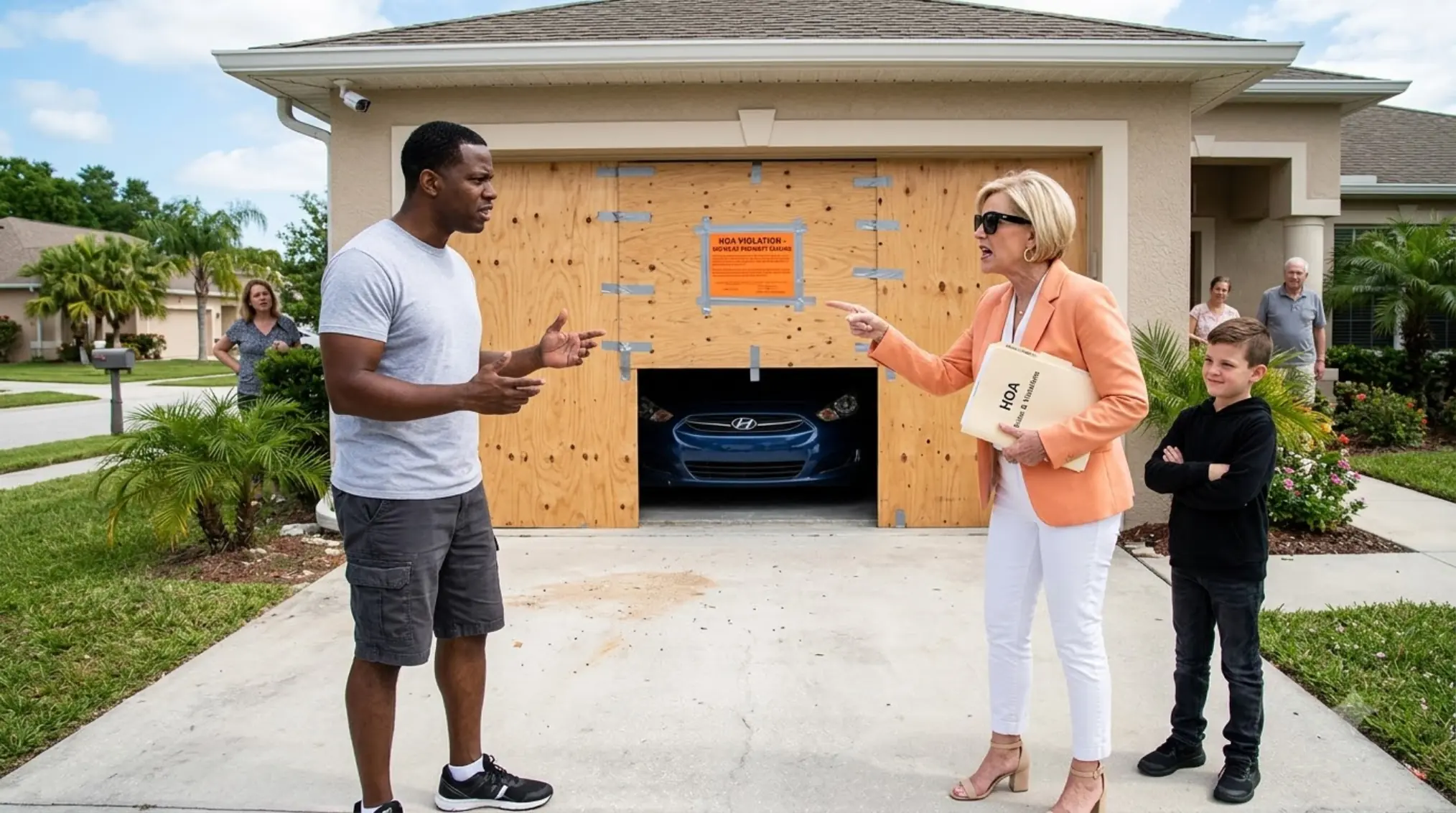
Daniel stared at the wall of plywood where his garage door had been visible that morning.
He was thirty-nine, a Black software consultant who had lived in Palm Crest, Florida, for four quiet years. He wore a plain gray T-shirt, dark shorts, and sneakers because twenty minutes earlier he had been sitting inside answering emails.
Then the hammering started.
Now his SUV, tools, work equipment, and nearly fifteen thousand dollars of electronics were trapped behind boards someone had attached to his house without permission.
Daniel stepped closer.
“You boarded up my property like a thief. Now you’re going to answer for it.”
Sandra ripped off her oversized sunglasses.
“I am the HOA president. I have authority to secure a property that is in violation.”
Her son smirked wider.
Daniel noticed.
Sandra struck her palm against the warning notice nailed to the plywood.
“I run this street, and I can make your life miserable by sundown.”
Daniel pulled out his phone.
“Good.”
He pointed toward the small camera mounted above the front door.
“Tell that to the police, because the camera caught your whole little stunt.”
The boy’s smirk disappeared first.
Then Sandra looked up.
For the first time that afternoon, she saw the camera.
And suddenly, the shouting stopped.
Eight months earlier, Daniel had barely known Sandra Whitmore existed.
Palm Crest was the kind of Florida subdivision people moved into because they wanted quiet streets, clean lawns, palms near the sidewalks, and neighbors who waved without demanding involvement in one another’s lives.
Daniel liked exactly that.
He worked remotely for several corporate technology clients, which meant strange hours and occasional business travel. When he finished working, he wanted his home to feel private.
His garage mattered more than most people would have guessed.
One side held his SUV.
The other contained a clean workbench, networking equipment, several computers, backup servers for temporary client projects, and tools inherited from his father.
Nobody entered that space without Daniel’s permission.
Sandra apparently believed HOA office changed the meaning of the word private.
She was sixty-one, always perfectly dressed and nearly always carrying a folder.
Her favorite outfit seemed to be expensive blazers over bright white pants, large sunglasses, and heels unsuitable for inspecting lawns.
The first time she knocked on Daniel’s door, she complained that his mailbox leaned.
“Approximately three degrees.”
Daniel had thought she was joking.
She produced a measuring tool.
He straightened the mailbox.
Then came a notice about his trash bin being visible twenty minutes too long.
Another about an oil mark in the driveway.
Another because a contractor replacing an outdoor light had parked partially across a painted boundary.
Daniel complied whenever the rules actually supported her claim.
When they did not, he sent the relevant section back to her.
That seemed to irritate Sandra more than outright refusal.
She wanted obedience, not accuracy.
Then Daniel made his first serious mistake in her eyes.
He questioned the HOA budget.
At a quarterly meeting, Sandra presented a proposed increase in annual dues.
Daniel raised his hand.
“What changed?”
Sandra smiled.
“Operating costs.”
“Which ones?”
“Landscaping, compliance, property management.”
Daniel looked at the printed sheet.
“Compliance costs increased forty-two percent.”
Sandra’s smile tightened.
“Neighborhood standards require enforcement.”
“What are we paying for that we weren't paying for last year?”
Several homeowners looked toward him.
Sandra closed her folder.
“All expenditures have been reviewed by the board.”
“That wasn't my question.”
A few people nodded.
Daniel continued.
“Can residents see the invoices?”
Sandra stared at him for a moment.
“They can submit a formal records request.”
Daniel did.
Two days later.
After that, the notices multiplied.
Three in one month.
His hedge was supposedly too high.
His patio umbrella could allegedly be seen from the street.
His cousin’s pickup remained in the driveway overnight.
Daniel appealed all three.
Two were withdrawn.
The third disappeared without explanation.
Then Sandra began appearing personally.
Sometimes her son came with her.
Eight-year-old Evan Whitmore was an ordinary boy in most circumstances, but Daniel noticed something uncomfortable.
Whenever Sandra confronted someone, Evan watched like it was entertainment.
If Sandra pointed at a homeowner, Evan smiled.
If somebody argued back, he rolled his eyes exactly like his mother.
Once Daniel saw him tell another child near the mailbox cluster:
“My mom can fine your parents.”
That bothered Daniel more than Sandra’s behavior.
A child was learning what power looked like by watching an adult abuse a tiny amount of it.
The conflict changed completely when Daniel traveled to Miami for three days.
His security system sent him an alert while he was in a client meeting.
GARAGE ACCESS — 2:17 P.M.
Daniel checked the app.
The garage door had opened.
He immediately pulled up the camera.
Sandra’s white SUV entered his driveway.
Then Sandra walked toward the keypad.
She entered a code.
The garage opened.
Daniel stared at the screen.
His neighbor Tom Avery appeared from across the street.
Camera audio captured their conversation.
Tom asked, “Daniel know you’re using his garage?”
Sandra answered without hesitation.
“Yes. He gave me permission before leaving.”
Daniel felt his jaw tighten.
He had done no such thing.
Sandra moved her SUV into his garage.
Then her son climbed out of the passenger side.
Evan looked directly toward the camera for half a second.
He knew it was there.
Sandra closed the garage door.
Daniel immediately called Tom.
“You just talked to Sandra?”
Tom sounded confused.
“Yeah. She said you told her she could park inside while her driveway gets resurfaced.”
“I did not.”
Silence.
“Oh.”
“How did she get my garage code?”
“I thought you gave it to her.”
“I didn’t.”
Tom lowered his voice.
“Daniel, I’m sorry.”
“You didn't do anything.”
Daniel ended the call.
He watched the footage again.
Sandra knew the code.
That meant she had either observed him using it, obtained it from an HOA or property-management record she was never supposed to use personally, or gotten it from someone with administrative access.
All three possibilities were unacceptable.
He called Sandra.
She did not answer.
He sent a message.
Remove your vehicle from my garage immediately. You do not have permission to enter or use my property.
No reply.
Two hours later, he sent another.
Nothing.
When Daniel returned the following evening, the SUV was gone.
Sandra behaved as though nothing happened.
Daniel did not.
He changed the code.
Installed two additional cameras.
And called an attorney named Patricia Monroe.
Patricia listened carefully.
“Keep every recording.”
“I already backed them up.”
“Good.”
“Can the HOA president access private garage codes?”
“Not for personal use.”
“I assumed.”
“What do you want to do?”
Daniel thought about it.
“For now? Nothing.”
Patricia was surprised.
“Nothing?”
“I want to see whether she stops.”
She did not.
Three weeks later Daniel received a garage violation.
The notice claimed his garage was being used for prohibited commercial storage.
He read it twice.
There was no visible evidence from outside the property.
Which created one obvious question.
How did Sandra know what was inside?
Daniel wrote back:
Please provide the date, time, and lawful inspection basis supporting this allegation.
Sandra answered the next morning.
The HOA has received credible evidence of noncompliant garage usage.
Daniel requested the evidence.
She refused.
He requested board review.
Sandra scheduled it six weeks away.
Then she added a daily fine.
Daniel contacted Patricia again.
This time Patricia sent the response.
The fines stopped.
Two days later, Sandra appeared outside Daniel’s house with Evan.
Daniel opened the door.
“What?”
She held her folder against her chest.
“You've created an unnecessarily hostile situation.”
“I asked how you know what's inside my garage.”
“I do not discuss confidential complaint sources.”
“It wasn't a complaint.”
“What?”
Daniel leaned against the doorway.
“You went inside.”
Sandra’s face remained perfectly controlled.
“You should be careful making accusations.”
Daniel smiled.
“You should be careful around cameras.”
Evan looked toward the doorbell camera.
Sandra took her son by the shoulder.
“Come on.”
As they walked away, Daniel heard Evan ask:
“Mom, can he get in trouble?”
Sandra answered:
“Everyone gets in trouble when they think rules don't apply to them.”
Daniel almost laughed.
The irony was too clean.
The plywood appeared two months later.
Daniel was home.
That was Sandra’s biggest mistake.
At 1:42 on a Tuesday afternoon, his camera alerted him to movement near the garage.
A contractor’s pickup stopped in front of the house.
Two workers unloaded plywood.
Sandra arrived moments later with Evan.
Daniel watched from his office monitor.
He expected them to knock.
They did not.
Sandra pointed toward the garage.
One worker looked uncertain.
The camera microphone captured him asking:
“You sure the owner approved this?”
Sandra opened her folder.
“The association authorized emergency securing of the structure.”
“What's wrong with it?”
“Compliance matter.”
The worker looked at the closed garage.
“Looks fine.”
Sandra’s voice sharpened.
“Are you the contractor or the attorney?”
He shrugged.
Then the drilling began.
Daniel did not immediately go outside.
Instead, he recorded.
Every board.
Every screw.
Every instruction.
Sandra directing placement.
Sandra handing them the warning sign.
Sandra’s son standing near the driveway, watching.
At one point Evan pointed toward Daniel’s camera.
“Mom, his camera’s on.”
Sandra looked up.
Then laughed.
“Let him record.”
That sentence became important later.
Daniel downloaded the footage before stepping outside.
By then, most of the garage had disappeared behind plywood.
That was when the confrontation happened.
Sandra shouted.
Daniel answered.
Neighbors appeared.
Evan stood behind her smirking.
Then Daniel mentioned the police.
The atmosphere changed.
Sandra lowered her voice.
“This doesn't need to become dramatic.”
Daniel looked at the massive plywood wall attached to his house.
“You boarded my garage shut.”
“It’s temporary.”
“My car is inside.”
“You should have considered that before ignoring the violation.”
Daniel stopped.
There.
Admission.
The camera above them captured it.
“What violation allows you to physically seal private property?”
Sandra flipped open her folder.
“Article twelve gives the association authority to secure unsafe structures.”
“Unsafe?”
“Yes.”
“My garage is unsafe?”
“You were given notice.”
“Show me.”
Sandra turned pages.
Could not find one.
Daniel folded his arms.
“Because it doesn't exist.”
Her face reddened.
“Don't tell me how to run my association.”
“It isn't your association.”
“It absolutely—”
Sirens interrupted her.
Evan moved closer to his mother.
The smugness was gone.
Two police cruisers stopped near the driveway.
Officer Lena Ruiz watched the security footage on Daniel’s phone.
Then she watched the contractor footage.
She asked Sandra a simple question.
“Did the homeowner authorize this work?”
Sandra answered, “The HOA did.”
“That wasn't what I asked.”
Sandra pointed at the plywood.
“The association has enforcement rights.”
Ruiz looked at Daniel.
“Any court order?”
“No.”
“Municipal unsafe-structure order?”
“No.”
“Building department notice?”
“No.”
Ruiz looked back at Sandra.
“Then what emergency justified physically blocking access to his garage?”
Sandra became quieter.
“He violated storage rules.”
Officer Ruiz stared at her.
“Storage rules?”
“Yes.”
Ruiz looked at the plywood again.
“You boarded a man's car inside his garage over storage rules?”
The second officer turned away briefly, perhaps hiding his reaction.
Daniel provided his earlier correspondence.
Then the old video showing Sandra entering his garage without permission.
Ruiz watched.
Her expression changed.
“This happened before?”
“Yes.”
Sandra immediately said, “That situation was resolved.”
Daniel responded, “No. You removed your car after I discovered it.”
Ruiz looked toward Sandra.
“You parked inside his garage?”
“It was temporary.”
“With permission?”
Sandra hesitated.
Daniel handed Ruiz the message he had sent demanding removal.
Ruiz read it.
Then looked at Sandra.
“This is going into the report.”
Sandra’s face tightened.
Daniel pointed toward the contractors.
“I want the boards removed.”
Ruiz asked the foreman whether removal could be performed safely.
“Yes.”
Sandra interrupted.
“No. The HOA ordered—”
Ruiz cut her off.
“The property owner is ordering you to remove material attached to his home. Unless she can produce legal authority showing otherwise, I suggest you listen to him.”
The contractor needed less than an hour.
The garage reappeared.
Daniel’s SUV remained inside untouched.
He opened the door.
Checked his equipment.
Nothing appeared missing.
But the story did not end there.
Not even close.
Patricia received the police report that evening.
Her response was immediate.
“Now we act.”
The first letter went to the HOA board.
Not Sandra.
Every board member individually.
Attached:
Video of Sandra using Daniel’s private garage without permission.
Video of her claiming authorization.
Video of workers asking whether Daniel had approved the boarding.
Video of Sandra personally ordering the work.
Police incident report.
Photographs.
Prior violation correspondence.
Patricia requested preservation of all emails, messages, access records, vendor invoices, and property-management logs related to Daniel’s home.
Within forty-eight hours, the board called an emergency meeting.
Sandra arrived confident.
She left without access to the HOA’s electronic systems.
The board discovered she had authorized the contractor without a vote.
Worse, she had classified the work as an “emergency property stabilization,” allowing immediate payment from HOA funds.
The garage had never been unstable.
There was no engineering report.
No municipal inspection.
No emergency.
Only Sandra’s signature.
Then came the garage-code question.
The property management company investigated.
Sandra had once been given temporary administrative access to emergency homeowner contact data during hurricane preparation.
That file included certain garage and gate access information homeowners had voluntarily provided for genuine emergencies.
Sandra had retained a copy after her access should have expired.
Daniel’s old garage code was inside.
The board attorney stopped the meeting.
“This creates significant exposure.”
Sandra became furious.
“I was protecting neighborhood standards.”
A board member named Michael Chen answered:
“You entered a man’s garage because you had a code intended for emergencies.”
“I needed to confirm a violation.”
“You had no authority.”
“I’m president.”
“Not anymore.”
The room went quiet.
The motion came five minutes later.
Suspend Sandra Whitmore as HOA president pending formal investigation.
Four votes yes.
One no.
Sandra’s.
Then other homeowners started speaking.
Tom told Daniel first.
“You opened a floodgate.”
“What happened?”
“Three people filed complaints.”
By the following week, it was seven.
One woman said Sandra entered her fenced backyard to photograph patio furniture.
A retired couple claimed she opened their side gate while they were away.
Another homeowner alleged Sandra threatened to use emergency-access records to inspect an attached garage.
One family had video of Sandra attempting to look through a garage window while discussing storage violations with Evan beside her.
Daniel watched that footage.
The boy looked bored.
Not malicious.
Just familiar with the behavior.
That changed how Daniel felt about him.
Evan was eight.
The smirk in Daniel’s driveway had not begun with him.
He had simply been learning.
Weeks later Daniel saw the boy walking with his father near the community park.
Evan looked away when he noticed Daniel.
Daniel did not confront him.
Children should not carry the consequences of adults’ choices.
The HOA investigation lasted five weeks.
Sandra had not stolen money.
There was no giant financial conspiracy.
The truth was simpler.
She had become convinced that being elected HOA president transformed private property into territory she could inspect whenever rules interested her.
Years without meaningful oversight reinforced that belief.
The board removed her permanently.
Her contractor authorization was declared improper.
Daniel’s violation record was reviewed.
Nine notices were voided because procedural requirements had not been followed.
The ridiculous mailbox issue disappeared too.
The HOA reimbursed Daniel for cosmetic repairs where screws had damaged exterior trim.
The board also prohibited officers from retaining private access codes.
Emergency information moved to a professional property management service under controlled access logs.
Any physical intervention involving private property now required legal review except during immediate threats such as fire, flooding, or structural collapse.
Sandra resigned from the board entirely.
Two months later, she placed her house on the market.
Daniel saw the sign while driving home.
He felt less satisfaction than he expected.
Tom found him outside checking the mailbox.
“You hear?”
“Yeah.”
“She’s leaving.”
Daniel nodded.
Tom grinned.
“Your garage finally beat the HOA president.”
Daniel laughed.
“No.”
“What?”
“Her own decisions beat her.”
Tom considered that.
“Less fun version.”
“More accurate.”
Daniel looked toward his garage.
No plywood.
No warnings.
Just the ordinary gray door.
“That’s all I wanted.”
A new HOA president was elected in January.
His name was Gerald Price.
Retired landscape architect.
Sixty-seven.
His first email to the neighborhood contained three paragraphs.
The second announced a volunteer tree-planting Saturday.
The third asked residents whether meetings could be shortened from ninety minutes to sixty.
Daniel immediately liked him.
Three months passed without a violation letter.
One Saturday, Daniel noticed Gerald walking down the street.
Gerald stopped at the mailbox.
Looked at it.
Daniel froze.
The post was still slightly crooked.
Gerald said, “Morning.”
“Morning.”
He continued walking.
Daniel laughed for nearly a minute.
One afternoon Daniel opened his garage while Evan and his father were passing on bicycles.
The boy slowed.
He looked at the garage.
Then at Daniel.
“Your car still in there?”
Daniel smiled slightly.
“Yep.”
Evan hesitated.
“My mom said you got her fired.”
Daniel could have answered sharply.
He did not.
“No.”
Evan frowned.
“She said you complained.”
“I did.”
“So you got her fired.”
Daniel walked toward the driveway.
“Your mom made decisions. The board decided what those decisions meant.”
The boy looked down.
“Was she wrong?”
Daniel considered the question carefully.
“She entered places that weren't hers without asking.”
Evan nodded.
“She said HOA people are allowed.”
“Sometimes adults believe things because nobody has challenged them yet.”
The boy looked toward the garage.
“What happens now?”
“Nothing.”
“Nothing?”
Daniel smiled.
“It stays my garage.”
Evan seemed confused by how ordinary the answer was.
Then his father called him.
The boy pedaled away.
Daniel watched him go.
He hoped the lesson stayed with him.
Not that his mother lost.
That ownership mattered.
Permission mattered.
Authority had limits.
Sandra moved away two weeks later.
Her white SUV passed Daniel’s house for the final time on a clear Florida morning.
No confrontation.
No folder.
No sunglasses lowered toward him.
Just a car leaving the neighborhood.
Daniel stood inside the garage organizing tools.
He heard it pass.
Then continued working.
The story eventually became neighborhood legend.
People exaggerated it.
Some claimed Sandra had ordered concrete poured across the garage.
Others insisted Daniel’s vehicle remained trapped for weeks.
One version had police arriving while contractors were still holding hammers.
The truth was less spectacular.
And more useful.
An HOA president became so certain nobody could challenge her that she ordered workers to board a homeowner’s garage.
She brought her young son along.
She shouted in the driveway.
She threatened fines.
She believed a title made her authority unlimited.
Then the cameras showed exactly what she had done.
That was enough.
Daniel never needed revenge.
He needed records.
Video.
Emails.
Police reports.
Bylaws.
Access logs.
Sandra had relied on people becoming too exhausted to fight small abuses.
Daniel did something different.
He documented them.
That changed everything.
Months later, while closing the garage one evening, Daniel watched the door descend slowly.
The security camera above it blinked.
He smiled.
Not because he expected Sandra to return.
She wouldn't.
He smiled because something that should never have become complicated had finally become simple again.
His house.
His driveway.
His garage.
His permission.
Nobody else’s.
And somewhere inside the story was a lesson Daniel hoped even eight-year-old Evan eventually understood:
Power does not mean you can enter any door you want.
Sometimes the most important rule is knowing which doors were never yours to open.