The concrete struck Marcus Cole’s Chevrolet before he could make Valerie Hale stop smiling.
It poured from the mixer’s steel chute in a thick gray rope, hammering the roof hard enough to buckle the metal before spreading across the windshield and hood. Wet gravel snapped beneath Marcus’s work boots as he ran down the narrow driveway, still wearing the pale-blue shirt from his overnight shift at the assisted-living center.
“What the hell are you doing to my car?”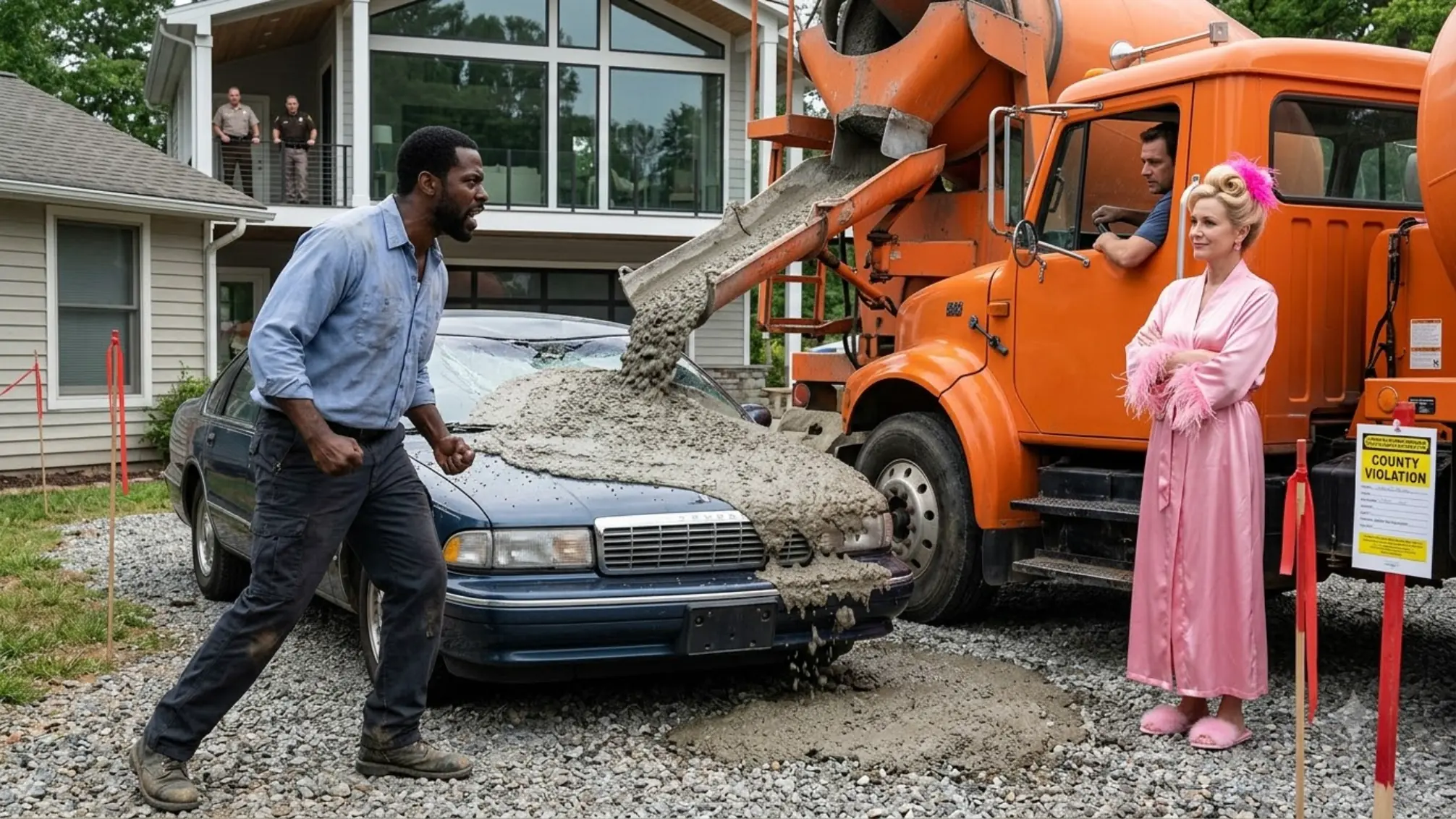
Valerie stood safely beyond the splatter with her arms folded across a glossy pink satin robe. Bright feathers covered the cuffs, another curved from her high blonde bun, and matching heels rested absurdly clean upon the dusty gravel.
“Fixing the ugly view your family forced us to tolerate.”
Marcus stepped close enough to see his reflection in her sunglasses.
“Stop that truck now, or your husband won’t be the only one answering for this.”
Valerie pointed toward the road. “Take one more step, and I’ll have you dragged out of your own neighborhood.”
Inside the concrete mixer’s cab, Valerie’s husband, Grant, kept one hand on the chute controls.
He looked through the side mirror at Marcus.
Then he increased the flow.
Concrete struck the Chevrolet harder, swallowed the wipers, and rolled over the front doors in heavy waves. The car’s alarm began screaming beneath the weight, its broken electronic cries competing with the mixer’s engine.
Marcus pulled out his phone, but his fingers trembled so violently that he entered the wrong passcode twice.
“That car is how I get to work,” he shouted. “It’s how I take my daughter to school.”
Valerie’s smile widened.
“Not anymore.”
The front door of Marcus’s modest lakeside house opened behind him.
Eight-year-old Olivia stepped onto the leaning wooden porch wearing a yellow cardigan over her school dress. Her dark curls had been tied into two neat braids, and she held Marcus’s old tablet against her chest.
She stared at the concrete consuming the car.
Then she looked past Valerie toward the large modern house towering over the neighboring lot.
“Dad,” Olivia called.
Marcus turned immediately. “Go inside, baby.”
She did not move.
Instead, she raised the tablet and aimed it toward the cement truck.
A small red recording light blinked in the corner of the screen.
Valerie noticed.
“Put that down,” she ordered.
Olivia’s expression remained calm.
“My teacher says we shouldn’t stop recording when someone tells us to.”
Valerie took one step toward the porch.
Marcus moved between them.
“Don’t go near my daughter.”
Grant finally released the chute control.
The concrete slowed, then stopped. The mixer drum continued rotating behind him, filling the sudden quiet with a low mechanical growl.
The Chevrolet was nearly unrecognizable.
Concrete covered most of the roof and windshield. The weight had collapsed the front suspension, pressing the bumper toward the gravel. Gray sludge dripped from the side mirrors and hardened around the door seams.
Marcus stared at the car.
It had belonged to his late wife, Camille.
She had driven it to every medical appointment during the final year of her life. After she died, Marcus could have sold it, but Olivia remembered her mother singing in the passenger seat. Marcus remembered Camille’s hand resting on his arm during long drives home from treatment.
The Chevrolet had little market value.
To Marcus and Olivia, it carried a life that could not be replaced.
Valerie had not merely destroyed transportation.
She had buried a piece of their family.
“Why?” Marcus asked.
The rage left his voice for one brief second, replaced by something wounded.
Valerie looked toward the ruined car.
“Because I warned you.”
“About what?”
“Your property is an embarrassment.”
Marcus looked around his yard.
The grass was cut. The porch needed paint, but its boards were secure. Olivia’s bicycle stood beside the steps, and two flower boxes hung beneath the front windows.
His small house looked modest beside Valerie’s glass-walled lake residence, but it was clean and cared for.
“You mean my house blocks your view,” Marcus said.
Valerie did not deny it.
Her property stood uphill from his, separated by a boundary line running beneath part of her extended lake-facing balcony. When she and Grant purchased the neighboring house two years earlier, they immediately began renovations.
They replaced the siding, expanded the kitchen, and built an enormous steel-supported balcony facing the water.
The project gave them a clear view over the lake—except for Marcus’s house.
Valerie began making offers within weeks.
The first was politely worded.
She offered to purchase Marcus’s property for twenty percent below its assessed value, claiming she wanted to create a landscaped guest cottage.
Marcus declined.
The second offer was slightly higher but required him to leave within thirty days.
He declined again.
Then the HOA notices began.
His porch railing was supposedly the wrong shade of brown.
His recycling container remained visible from the street for forty-two minutes after collection.
Olivia’s bicycle was classified as “unsightly outdoor storage.”
A bird feeder violated an architectural consistency rule that did not exist in the bylaws.
Marcus appealed each fine and requested the enforcement records.
The HOA, led by Valerie, refused to provide them.
When Marcus hired a surveyor to verify the boundary, Valerie’s hostility became open.
The surveyor placed red stakes beneath two of the steel columns supporting her new balcony. According to the preliminary measurements, the structure extended nearly twelve feet across Marcus’s property line.
Valerie tore the stakes out that same night.
Marcus replaced them and installed security cameras.
Three days later, someone filed an anonymous complaint with the county claiming Marcus had placed fraudulent markers to interfere with a legally approved structure.
That complaint brought Inspector Daniel Reyes to the property.
Valerie did not know he was scheduled to arrive that morning.
Olivia did.
She had heard Marcus discussing the appointment the previous night. When the mixer entered the driveway while her father was changing after work, she called the number on the inspector’s card.
“Before you celebrate,” Olivia said now, “look at your porch.”
Valerie turned.
Inspector Reyes stood beneath her balcony with rolled plans tucked under one arm. A county deputy stood beside him, his body camera showing a steady green light.
Fresh red survey stakes rose beneath the steel supports.
A bright-red notice had been attached to one of the columns.
Valerie’s smile disappeared.
Grant climbed down from the mixer’s cab.
“What is that?” he asked.
Reyes raised his voice. “Mrs. Hale, your balcony crosses the recorded property boundary and was constructed without final county approval.”
Valerie walked rapidly toward him.
“That is impossible.”
Reyes unrolled the plans against the railing.
“The approved design ends here.”
He pointed toward a line nearly twelve feet behind the actual balcony edge.
“The completed structure extends beyond that point, and two supports stand inside Mr. Cole’s parcel.”
“My contractor handled the permits.”
Grant’s face tightened.
Reyes looked toward him. “Your contractor is Hale Shore Construction.”
Grant said nothing.
Valerie turned on her husband.
“You said it was approved.”
“I submitted the plans.”
“That wasn’t his question,” Marcus said.
Valerie spun toward him.
Her pale face had hardened with panic.
“You stay out of this.”
“It’s standing on my land.”
Deputy Paulson walked toward the mixer.
“Mr. Hale, step away from the controls.”
Grant raised both hands. “The discharge was accidental.”
Olivia held up the tablet.
“No, it wasn’t.”
Paulson looked toward her. “You recorded it?”
“Yes, sir.”
Marcus crossed the driveway and gently lowered the device.
“You did good, baby. Now go inside.”
“But—”
“Please.”
She looked toward the concrete-covered car.
“Mom’s car is gone.”
Marcus swallowed.
“We’ll deal with it.”
Olivia went inside slowly, closing the door behind her.
Valerie watched the child leave without showing regret.
“The vehicle was parked in violation of community appearance standards,” she said. “We had authority to remove a nuisance.”
Deputy Paulson stared at her.
“You poured concrete onto a privately owned car.”
“It was obstructing work.”
“What work?”
Valerie gestured toward the mixer. “Repairs.”
“There are no forms, barricades, or construction materials besides the truck.”
Grant shifted his weight.
The deputy looked at him. “Who ordered the delivery?”
Grant glanced toward Valerie.
She answered first.
“The association.”
Marcus laughed once.
It contained no humor.
“You are the association president. Your husband owns the concrete company. And you expect us to believe the HOA ordered a truck to destroy my car?”
Valerie’s voice sharpened. “You have been given repeated opportunities to cooperate.”
“With selling my home?”
“With improving this neighborhood.”
“My house was here before yours.”
“And it should have been removed years ago.”
The statement silenced everyone.
Even Grant stared at her.
Marcus stepped forward.
Paulson immediately moved between them.
“Mr. Cole, stay back.”
Marcus’s fists tightened.
“She buried my wife’s car because she wants my land.”
“I understand,” the deputy said. “But do not give her anything she can use against you.”
Valerie lifted her chin again.
“He already threatened us.”
“The body camera heard the entire exchange,” Paulson replied.
Her confidence faltered.
A second patrol vehicle entered the driveway. Two officers began photographing the Chevrolet, the mixer, the chute position, and the concrete trail leading from the truck.
Inspector Reyes examined the balcony while an engineer from his office measured each support.
The findings were worse than expected.
Not only had the Hales crossed the boundary, but Grant’s company had changed the approved foundation design. Two columns rested on shallow footings rather than the deeper reinforced bases required for a structure extending over the slope.
A long crack had already formed around one support.
Reyes placed another red notice beside the first.
Valerie marched toward him.
“What does that one say?”
“Unsafe structure. Restricted access pending engineering review.”
“You cannot close my balcony.”
“I just did.”
“We have a dinner party tomorrow.”
“No one steps onto it.”
Valerie pointed at Marcus’s car. “Take the car, not my balcony.”
Everyone heard her.
Paulson slowly turned.
Marcus looked at her in disbelief.
“You’d trade my livelihood for twelve feet of illegal concrete?”
Valerie realized too late what she had said.
“I meant—”
“I know exactly what you meant.”
Grant lowered his head.
The officers separated the parties and collected statements. Grant initially claimed that a mechanical failure caused the chute to open, but the mixer’s electronic control log told another story.
The discharge began when he pressed the manual release.
It stopped only after Olivia mentioned the inspector.
The truck’s internal camera also recorded Valerie standing beside the Chevrolet and directing Grant to move the chute toward the windshield.
By noon, both Valerie and Grant were taken to the county station for questioning.
The cement truck was impounded.
Marcus stood alone beside the ruined car after the police left.
The concrete had begun hardening.
A towing company explained that moving the vehicle might tear off the roof and suspension. They would need specialized lifting equipment and a flatbed rated for the added weight.
Marcus sat on the porch steps.
He had worked eleven hours overnight repairing heating equipment at the assisted-living center. He had returned home expecting coffee, two hours of sleep, and then a meeting with the building inspector.
Instead, he had watched Valerie destroy the only car he owned.
The front door opened.
Olivia sat beside him.
“Are you mad at me?”
Marcus looked at her. “Why would I be mad at you?”
“I called the inspector before I asked.”
“You made the smartest call anyone made today.”
“I saw the truck from my window.”
She leaned against him.
“Mrs. Hale said Dad would finally learn.”
Marcus’s body became still.
“When?”
“Before the concrete started. She was talking to her husband outside.”
“You heard her?”
Olivia nodded.
“She said after the car was gone, you wouldn’t be able to get to work, and then the bank would take the house.”
Marcus closed his eyes.
This was not impulsive vandalism.
It was a plan.
Valerie knew Marcus relied on the Chevrolet for his night shift. She also knew he had recently refinanced the property to pay Camille’s final medical bills.
If he lost his job and fell behind on payments, the house could become vulnerable.
Marcus called attorney Rebecca Sloan, who had helped him challenge the HOA fines.
She arrived that afternoon.
Rebecca listened to Olivia’s recording, reviewed the survey documents, and examined the complaint history.
“This was pressure from the beginning,” she said.
“To make me sell.”
“Yes. But we need to know who else benefited.”
The answer appeared in HOA emails obtained through an emergency records demand.
Valerie had been negotiating with Lake Mercer Developments, a company planning luxury vacation rentals along the shoreline. Marcus’s parcel was the only remaining property between Valerie’s house and the proposed private access road.
If Marcus sold, Valerie’s property value would rise dramatically. Grant’s construction company was also positioned to receive contracts for retaining walls, foundations, and concrete work.
One email from Valerie to the developer read:
Cole won’t move voluntarily. Once transportation and employment become problems, his position will soften.
Another message, sent to Grant the night before the attack, said:
Tomorrow ends this. Make the car unusable, and make it look like a construction mistake.
Grant replied:
Too risky.
Valerie answered:
Then decide whether you want the lake contracts.
Rebecca printed the emails and placed them across Marcus’s kitchen table.
“She threatened her own husband into participating,” Marcus said.
“She offered him profit and applied pressure. He still chose to operate the chute.”
“What happens now?”
Rebecca looked toward Olivia, who was doing homework in the next room.
“Now we make sure she cannot reduce this to an HOA disagreement.”
Criminal charges followed within forty-eight hours.
Grant was charged in connection with property destruction, reckless endangerment, and conspiracy. Valerie faced additional allegations involving coercion, false HOA filings, trespass, and attempted property fraud.
The court issued protective orders preventing either Hale from approaching Marcus, Olivia, or the Cole property.
The county ordered the balcony closed immediately.
Engineers later concluded that the illegal extension could not be corrected by moving only the columns. The added section had been integrated into the entire structure, and the unstable footings threatened the house-facing connection.
Nearly half the balcony had to be demolished.
Valerie attempted to blame the original architect.
The architect produced emails showing that she had demanded a larger design after the permit was approved. When he refused to stamp the changes, Grant’s company built them without revision.
The HOA board held an emergency meeting in the community clubhouse.
Valerie arrived through video from her attorney’s office, insisting she remained president until a formal vote removed her.
More than two hundred residents attended.
Marcus sat in the second row beside Rebecca. Olivia remained with Marcus’s sister because he refused to let the meeting become another spectacle for her.
Vice President Thomas Bell opened the session.
“We are here to address the conduct of President Valerie Hale and the use of association authority against the Cole family.”
Valerie interrupted through the screen.
“This meeting is invalid.”
Thomas ignored her.
Rebecca presented the enforcement history.
Over eighteen months, Valerie had issued Marcus thirty-one violation notices. Twenty-seven were dismissed on appeal. Comparable violations involving other homes had received either informal reminders or no action.
HOA money had also been used to pay Grant’s company for “emergency inspections” that no board vote authorized.
The most recent invoice described the concrete delivery to Marcus’s house as:
Corrective access preparation.
A resident stood.
“You billed us for destroying his car?”
Grant’s attorney objected from beside Valerie.
Thomas replied, “The invoice came from Mr. Hale’s company and was approved by Mrs. Hale.”
Another homeowner raised her hand.
“Did the board approve any work on Mr. Cole’s property?”
“No,” Thomas said.
The room erupted.
Valerie leaned toward her camera.
“Marcus Cole refused every reasonable solution.”
Marcus stood.
“What solution?”
“You know what I mean.”
“Say it.”
Her attorney touched her arm, but she pulled away.
“You should have taken the offer and left.”
Silence filled the clubhouse.
Marcus looked around at the same neighbors who had watched Valerie fine his daughter’s bicycle, criticize his porch, and call his family’s home an obstruction.
“My wife died in that house,” he said. “My daughter took her first steps on that porch. You decided our memories were worth less than your view.”
Valerie’s face remained hard.
“You are emotional.”
Marcus nodded.
“You buried my wife’s car in concrete. I’d be worried if I wasn’t.”
The board removed Valerie unanimously.
It then voted to suspend every contract involving Hale Shore Construction and commission an independent audit.
That audit exposed years of misconduct.
Grant’s company had overbilled the association for drainage work, sidewalk repairs, and retaining-wall inspections. Valerie approved most invoices without competitive bids.
She also used complaint records to pressure four other homeowners into making repairs through her husband’s company.
Two elderly residents had paid thousands for unnecessary concrete work after Valerie threatened escalating fines.
The association’s insurer refused to cover intentional misconduct.
Valerie and Grant were forced to finance their defense personally.
The criminal case ended before trial.
Grant accepted a plea agreement requiring restitution, community service, probation, and testimony about Valerie’s planning. His construction license was suspended pending professional review.
Valerie continued denying responsibility until prosecutors introduced Olivia’s recording and the truck’s control data.
Her own voice could be heard moments before the discharge:
“Cover the windshield first. If he can’t drive, he can’t keep fighting.”
She eventually entered a plea.
The sentence included jail time, extended probation, restitution, and a permanent prohibition against serving on an HOA or managing residential property.
The developer terminated every agreement with the Hales and withdrew from the lake project after the county opened a broader inquiry.
Demolition of Valerie’s balcony began six months after the attack.
Marcus and Olivia watched from their porch as workers removed the glass railing, cut through the illegal extension, and lifted the steel supports from their land.
Valerie’s house remained large and expensive.
But its commanding lake view disappeared behind the legal boundary she had tried to erase.
The civil settlement paid for a reliable replacement vehicle, Marcus’s lost wages, legal costs, and emotional damages. It also covered restoration of the driveway and landscaping damaged by the mixer.
Marcus did not replace the Chevrolet immediately.
First, he hired a company to remove the concrete in sections.
Most of the car could not be saved. The roof was crushed, the glass shattered, and the frame twisted beneath the weight.
But the emblem on the front grille remained intact.
So did the small silver keychain Camille had given him during their first year of marriage.
Marcus cleaned both and placed them inside a wooden shadow box.
Beneath them, he added a photograph of Camille leaning against the Chevrolet while Olivia, still a toddler, sat on the hood.
Olivia helped choose the inscription:
SOME THINGS CANNOT BE BURIED.
A year after the attack, Marcus became an elected member of the restructured HOA board. He refused the presidency but chaired a committee responsible for enforcement transparency.
Every complaint now required evidence.
No board officer could approve a case they personally filed.
Private-property access required written consent or a lawful emergency order.
Association contracts had to be competitively reviewed.
The rules were not created to punish future boards.
They were designed to prevent authority from becoming personal power again.
One warm evening, Marcus parked his replacement car in the repaired driveway. It was used, practical, and blue like Camille’s Chevrolet.
Olivia came running from the house.
“Can we drive to the lake?”
“We live at the lake.”
“The ice-cream place on the other side.”
Marcus pretended to consider it.
“You finish your homework?”
“Yes.”
“Clean your room?”
“Mostly.”
“That means no.”
She climbed into the passenger seat anyway.
Marcus looked toward the neighboring property.
Valerie’s illegal balcony was gone. The red county notices had been removed, and new owners were repairing the house after purchasing it through a court-supervised sale.
They had already introduced themselves.
Their first question was not whether Marcus would sell.
It was whether Olivia preferred chocolate or vanilla cupcakes for their housewarming party.
Marcus started the engine.
As he reversed from the driveway, Olivia touched the shadow-box photograph visible through the living-room window.
“Mom would like this car,” she said.
“I think so.”
“She’d say it needs cleaning.”
“She would definitely say that.”
Olivia smiled.
Marcus drove toward the road, passing the spot where Valerie had stood in her pink robe and watched concrete destroy something she believed was merely inconvenient.
She thought taking his car would take his job.
She thought taking his income would take his home.
She thought a title, a luxury house, and a powerful husband made her untouchable.
Instead, the same concrete meant to bury Marcus’s future exposed the permits, property lines, emails, and corruption holding up her own life.
Valerie wanted an unobstructed view.
In the end, she lost the balcony built to enjoy it.
Marcus kept his home.
His daughter kept her memories.
And the concrete that crushed Camille’s Chevrolet became the evidence that finally brought Valerie Hale’s entire empire down.