“Step away from that Rolls-Royce before I call the police.”
Patricia Davenport’s voice cut across the valet circle of the Grand Lakeshore Country Club, silencing the conversations beneath the terrace awnings. She stood beside the midnight-blue car in an ivory pantsuit, one hand gripping her phone and the other pointing directly at the tall Black man holding the key fob. Byron Fletcher did not step away, lower his eyes, or rush to convince her that he belonged there.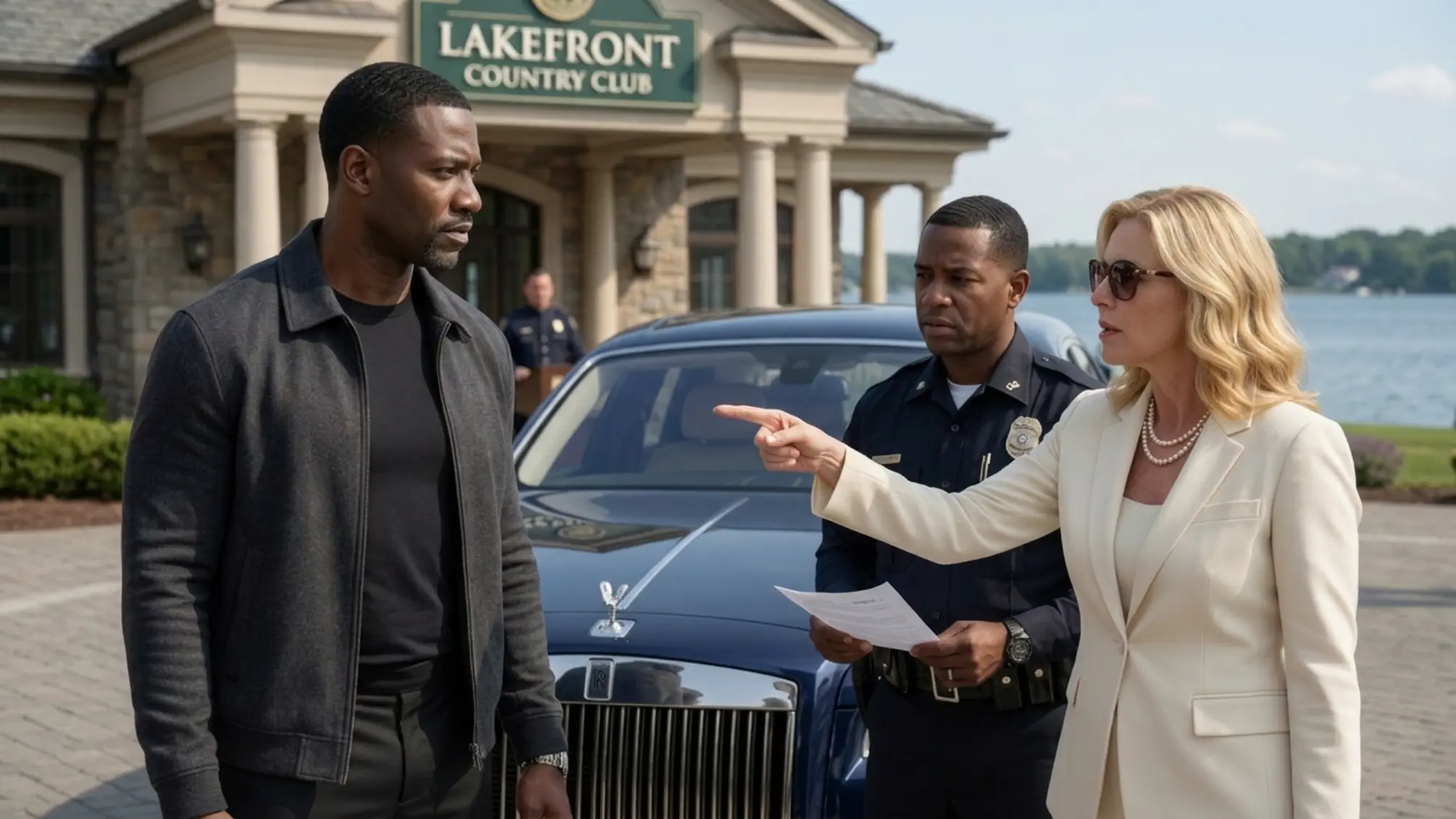
“This is my car,” he said.
Patricia stared at his charcoal jacket, fitted black shirt, polished shoes, and deep-brown skin before laughing loudly enough for the surrounding guests to hear. “Yours? You could not afford the hubcaps.”
Several people shifted uncomfortably, but nobody challenged her. The club manager stood beneath the entrance canopy with sweat forming around his collar, while a young valet named Evan watched with growing alarm. He had personally seen Byron press the key fob and watched the Rolls-Royce headlights flash twice.
“Ma’am,” Evan began, “he did unlock—”
Patricia turned sharply. “Nobody asked you.”
The young man immediately fell silent. Patricia served as vice president of operations for Lakeshore Hospitality Group, the corporation managing the club, and every employee knew she could destroy a career with one complaint. She had spent nine years turning authority into fear while presenting it as high standards.
“Security!” she called. “This man is attempting to steal a vehicle.”
Byron glanced toward the club entrance. The stone building overlooked Lake Michigan from twelve acres of manicured grounds, with black luxury cars lining the circular drive and expensive boats crossing the water beyond the trees. Everything about the property announced that ordinary people were permitted only when serving someone richer.
Nobody from security approached.
Patricia’s cheeks flushed. “Did none of you hear me?”
“I heard you,” Byron replied. “I’m waiting to see how far you’re willing to take this.”
His calmness offended her more than anger would have. She expected panic, defensive explanations, or the desperate presentation of documents. Instead, Byron stood beside the car as though she were the one being examined.
Patricia removed her phone from her designer handbag. “I am calling the police.”
“Go ahead.”
“You think this is funny?”
“No,” Byron said. “I think it’s revealing.”
Patricia dialed 911 and raised her voice so everyone nearby could hear the report. She claimed an aggressive man was attempting to steal a Rolls-Royce and refusing to leave private property. Byron had not raised his voice or moved toward her, but she repeated that she felt threatened.
The word changed the atmosphere.
Several guests stepped farther away from Byron. A man near the terrace lifted his phone and began recording, not to help but to capture whatever spectacle might follow. The club manager avoided Byron’s eyes and quietly instructed Evan to return to the valet stand.
Byron noticed every decision.
He had built his career by paying attention to what people did when they believed the consequences belonged to someone else. Financial reports showed profits, losses, debt, and growth, but character appeared in smaller transactions: whether a manager protected a worker, whether an executive admitted a mistake, and whether witnesses spoke when silence was safer.
Patricia ended the call with a satisfied smile. “They’re coming.”
“I’ll wait.”
“You should leave before this becomes more humiliating.”
“For whom?”
She tilted her head. “Men like you always think confidence can substitute for proof.”
Byron raised the key fob. “The proof is in my hand.”
“That could belong to anyone.”
He pressed the unlock button.
The Rolls-Royce lights flashed, its mirrors unfolded, and the doors released with a soft mechanical click. A few guests exchanged looks, but Patricia refused to acknowledge what had happened.
“Modern thieves use electronic devices,” she said. “You could have cloned the signal.”
Evan’s mouth fell open.
Byron looked at her with something close to disbelief. “You would rather invent technology than admit you judged the wrong man.”
“I judged the situation.”
“No. You judged my skin before checking the car.”
Patricia’s expression hardened. “Do not accuse me of racism because you were questioned near an expensive vehicle.”
“Was anyone else questioned?”
“You were the only suspicious person here.”
“What did I do?”
“You were standing beside a Rolls-Royce.”
“So were you.”
The guests listening from the terrace suddenly found the lake more interesting. Patricia’s confidence depended on an audience willing to accept her conclusions without examining them. Byron’s questions were forcing everyone to see how little evidence existed beneath her certainty.
A police cruiser entered through the iron gates.
Patricia straightened, satisfaction returning to her face. Two officers stepped out near the entrance, one older white man and one younger Black woman. Their eyes moved from Patricia to Byron, then to the vehicle between them.
“Officers,” Patricia called, walking forward. “Thank goodness. That man is attempting to steal this Rolls-Royce.”
The older officer raised one hand. “Everyone remain where you are.”
Byron kept the key fob visible.
Patricia continued speaking before either officer could ask a question. She described herself as a club executive and respected member, repeated that Byron did not belong on the property, and claimed he had become aggressive when confronted. The officer looked toward Byron.
“Sir, place your hands where I can see them.”
Byron slowly raised both hands. “The key is in my right hand, and my identification is in my jacket.”
Patricia pointed toward him. “Be careful. He may be dangerous.”
The younger officer looked at her. “Has he threatened you?”
“Not in those exact words.”
“Has he displayed a weapon?”
“No, but men like him—”
She stopped too late.
The officer’s expression changed. “Men like him what?”
Patricia recovered quickly. “Men who target luxury properties.”
Byron remained silent.
The older officer stepped toward him. “What is your connection to the vehicle?”
“I own it.”
“Can you show registration?”
“It is inside the glove compartment. My identification and the digital title are also on my phone.”
The officer nodded. “Retrieve your phone slowly.”
Byron reached inside his jacket.
Patricia moved backward as though he were drawing a weapon, although the officers had clearly authorized the action. Byron removed a black phone, unlocked it, and opened the vehicle registration application. The younger officer examined the screen.
The name matched his identification.
BYRON FLETCHER.
The vehicle identification number matched the Rolls-Royce.
“This car is registered to him,” she said.
Patricia folded her arms. “Then the registration may be fraudulent.”
The older officer looked at her. “On what basis?”
“He does not appear to be the kind of person who owns a vehicle like this.”
A heavy silence spread across the valet circle.
Byron watched the older officer’s jaw tighten. “Ma’am, appearance is not evidence.”
“I am vice president of operations here. I know our members.”
Byron placed his phone against the car’s hood. “Do you?”
“I certainly know you are not one of them.”
“I have held a membership for two years.”
Patricia laughed again, but nobody joined her. “I review the membership list.”
“You review the public list.”
“There is no private list.”
“There is for ownership.”
She stared at him.
Byron’s phone began vibrating. The caller’s name appeared brightly across the screen:
MARTIN HALE — BOARD CHAIRMAN, LAKESHORE HOSPITALITY GROUP.
The club manager saw it from several feet away.
His face lost all color.
Byron answered and activated the speaker. “Martin.”
“Mr. Fletcher, I was informed police were called during your property visit. Are you safe?”
Every executive near the entrance froze.
Patricia looked toward the phone.
Byron kept his eyes on her. “I’m safe. Activate the emergency ownership file and place corporate counsel on the line.”
“Immediately.”
Patricia’s voice became smaller. “Who are you?”
Byron did not answer her directly. He waited while another voice joined the call, followed by the company’s general counsel and chief human-resources officer. The officers remained near him, their posture no longer suggesting that he was the suspected criminal.
“Mr. Fletcher,” the board chairman said, “the ownership file is active.”
“Confirm the corporate structure for everyone listening.”
Martin hesitated only briefly. “Titan Crest Holdings owns sixty-one percent of Lakeshore Hospitality Group. Lakeshore Hospitality owns and operates Grand Lakeshore Country Club.”
“And who owns Titan Crest?”
“You do.”
The terrace went completely silent.
Even the lake seemed to disappear beneath the weight of the revelation.
Patricia stared at Byron as though his face had changed. “You own Lakeshore Hospitality?”
“I own the controlling company.”
“That is impossible.”
The board chairman continued through the speaker. “Mr. Fletcher is the founder, chief executive officer, and majority owner of Titan Crest Holdings.”
Byron turned slightly toward the officers. “The woman who called you is employed by a company I control.”
The younger officer looked at Patricia. “You called police on your employer because he stood beside his own car.”
Patricia swallowed. “I had no way of knowing who he was.”
Byron’s voice remained quiet. “You had a key fob, registration, a valid membership, and a valet who witnessed me unlock the vehicle.”
“I was protecting the club.”
“From its owner?”
“From suspicious activity.”
“What activity?”
She opened her mouth but could not produce an answer that did not expose her.
Byron picked up his phone. “Corporate counsel, preserve every security recording from the valet circle and entrance. Include audio if available. Human resources, freeze Patricia Davenport’s system access and preserve her internal communications for the previous twenty-four months.”
Patricia stepped forward. “You cannot do this publicly.”
“You accused me publicly.”
“This is retaliation.”
“No,” Byron said. “Retaliation is punishing someone for reporting misconduct. This is an investigation into misconduct I personally witnessed.”
The club manager backed toward the doors.
Byron noticed.
“Stay where you are, Mr. Langford.”
The manager froze.
Byron had learned his name from monthly performance reports, though they had never met in person. Thomas Langford had submitted repeated assurances that member complaints were reviewed fairly and employees felt safe reporting discrimination. Yet only minutes earlier, he had silenced the valet who tried to tell the truth.
“Why did you stop Evan from speaking?” Byron asked.
Thomas adjusted his tie. “I was trying to prevent the situation from escalating.”
“By preventing evidence from being heard?”
“Ms. Davenport outranks him.”
“Truth is not ranked by job title.”
Thomas looked toward Patricia, but she no longer possessed enough authority to rescue anyone.
Byron called Evan forward.
The young valet approached hesitantly, twisting his hands together. “Yes, sir?”
“What did you see?”
Evan looked toward Patricia.
Byron followed his gaze. “Your job is protected while you answer honestly.”
“I saw you press the key before Ms. Davenport confronted you. The headlights flashed, and the doors unlocked.”
“Did you tell her?”
“I tried.”
“What happened?”
“She told me nobody asked me. Mr. Langford later told me to return to the stand.”
The club manager interrupted. “I was managing staff.”
Byron turned toward him. “You were managing silence.”
Patricia’s face flushed with anger. “This is becoming a performance.”
Byron gestured toward the guests holding phones. “You created the audience.”
One of the officers stepped toward Patricia. “You reported an attempted theft. The registered owner is standing here, and no evidence of theft exists. Did you knowingly provide false information?”
“I believed the report was accurate.”
“After seeing him unlock the car?”
“I did not personally see that.”
“The valet told you.”
“He is inexperienced.”
The younger officer removed a small notebook. “Did Mr. Fletcher threaten you?”
Patricia hesitated. “His posture was intimidating.”
“He stood beside his car.”
“He refused to leave.”
“Was he legally required to leave?”
Patricia looked toward Thomas, but he avoided her eyes.
Byron’s phone speaker came alive again. The head of human resources had entered the call and confirmed Patricia’s access was suspended. She also reported finding several unresolved complaints connected to Patricia’s name.
Byron’s attention sharpened. “How many?”
“Fourteen formal complaints over three years. Nine were closed by property management without independent review.”
“What were the allegations?”
The executive paused. “Racial profiling, discriminatory membership enforcement, employee retaliation, and selective security referrals.”
Patricia stepped toward the phone. “Those complaints were investigated.”
“By whom?” Byron asked.
“The club’s management team.”
He looked at Thomas.
The manager’s shoulders dropped.
“How many involved unfamiliar Black visitors?” Byron asked.
The executive scrolled through the records. “At least six.”
“How many involved white visitors under comparable circumstances?”
“I would need additional review.”
“Conduct it.”
Patricia shook her head. “You are taking unproven accusations and turning them into facts because you are angry.”
Byron looked at her steadily. “I am ordering an investigation because your behavior gave those accusations context.”
She lowered her voice. “We can discuss this privately.”
“No.”
“Mr. Fletcher—”
“You believed public humiliation was appropriate when you thought I had no power. You do not get privacy only because the balance changed.”
A woman near the terrace began lowering her phone. She was one of the guests who had smiled when Patricia mocked Byron’s ability to afford the car. Byron saw embarrassment cross her face.
He did not address her.
The police officers completed their report. The younger officer confirmed no crime had been committed by Byron and warned Patricia that knowingly exaggerating danger during an emergency call could result in further investigation. Patricia insisted she had acted in good faith.
Byron spoke before the officers left.
“Officer, I want the record to reflect that she described me as aggressive before I said anything beyond identifying the car as mine.”
The officer nodded. “It will.”
Patricia’s expression hardened. “You are trying to destroy me.”
“No,” Byron replied. “I am examining what you built when you believed nobody above you was watching.”
Corporate counsel arranged for an independent security team to preserve the property’s electronic systems. Within twenty minutes, two Lakeshore executives arrived from the regional office. They collected Patricia’s badge, company phone, and access cards.
She looked around the entrance for support.
The guests who had encouraged her confidence now avoided eye contact. Thomas stood near the doorway, knowing his own decisions would soon be reviewed. Evan remained beside the valet podium, still frightened but no longer silent.
Patricia removed her gold identification badge.
“You will regret humiliating a senior executive in front of members,” she told Byron.
He accepted the badge without touching her hand. “You believed seniority made your prejudice valuable. It only made it more expensive.”
She was escorted inside to await formal suspension paperwork.
The country club did not return to normal after she disappeared.
Byron had not come merely to expose one executive. His unannounced visit was part of a broader review of Lakeshore Hospitality, which had reported strong profits alongside unusual employee turnover and repeated guest complaints. Patricia’s confrontation revealed that the problem extended from the valet circle into the organization’s leadership.
He asked the police officers to remain available while he addressed the employees.
Thomas attempted to guide him toward a private conference room, but Byron refused. He stood beside the Rolls-Royce where the confrontation had occurred.
“Any employee who has been threatened, punished, or silenced for reporting discrimination may speak directly with the independent investigators arriving today,” he announced. “No local manager may participate in those interviews.”
Several employees exchanged cautious looks.
A server stepped forward first.
She explained that Patricia had ordered staff to delay service for guests she considered “temporary members,” a term often applied to Black professionals invited through corporate programs. A groundskeeper said he had been instructed to report unfamiliar Black men near the golf course, even when they wore guest identification.
Another valet described a wealthy white teenager taking the wrong Mercedes from the line as a joke. Patricia had laughed and called it youthful stupidity. Weeks later, she had summoned security when a Black surgeon reached into his own vehicle for a forgotten wallet.
The pattern became impossible to dismiss.
Thomas tried to defend the club by claiming Patricia made independent decisions. Byron requested copies of his signed incident reports. Several showed he had personally approved her actions or closed the complaints without reviewing available video.
“You said you prevented escalation,” Byron told him. “What you prevented was accountability.”
Thomas was suspended before sunset.
The independent investigation lasted six weeks.
It uncovered a culture in which employees were rewarded for protecting wealthy members from discomfort, even when those members acted abusively. Black guests were questioned about membership at nearly four times the rate of white guests. Latino workers received disproportionate disciplinary warnings for speaking Spanish in service corridors, while complaints against influential members vanished after private meetings.
Patricia had overseen most of the policy enforcement.
Internal messages revealed how openly she viewed exclusion as part of luxury. In one email, she wrote that the club should maintain “the right visual standard at arrival points.” In another, she complained that diversity initiatives were making the property resemble a public resort.
The most damaging message concerned Byron himself.
After seeing him dine alone at the club months earlier, Patricia had sent Thomas a photograph taken from the security system. Beneath it, she wrote:
Find out who keeps letting this man inside. He does not fit our membership profile.
Thomas replied:
I’ll have staff watch him.
Neither had checked his identity.
If they had, they would have discovered he owned the company issuing their paychecks.
Patricia was terminated for discriminatory conduct, retaliation, falsifying reports, and misuse of emergency services. Thomas was dismissed for suppressing complaints and enabling the misconduct. Three additional managers received disciplinary action, while the club’s entire security and membership-verification policy was rewritten.
Byron refused to present the terminations as proof the organization had been repaired.
“A company cannot blame two people for a culture hundreds learned to survive,” he told the board. “We have to remove the incentives that made silence profitable.”
Grand Lakeshore established independent complaint reporting, mandatory evidence review, and strict limits on security intervention. Employees could no longer be ordered to approach someone because they “looked unfamiliar.” A specific behavior had to justify every action.
Evan became assistant valet supervisor.
When Byron offered the promotion, the young man hesitated.
“I stayed quiet at first,” he admitted.
“You tried to speak.”
“Then I stopped when she told me to.”
Byron nodded. “Courage is not something you either have or don’t. It is a decision you will face again.”
“What should I do next time?”
“Speak before you know who the person is.”
Months later, Byron returned to Grand Lakeshore in an ordinary sedan borrowed from one of his employees. He wore jeans, a navy sweater, and no visible indication of status. A new valet greeted him, scanned his membership card, and welcomed him inside without hesitation.
Near the entrance, an unfamiliar Black family stood studying a map of the grounds. A staff member approached them, not to demand proof, but to ask whether they needed directions.
Nothing dramatic happened.
Nobody summoned police.
No executive was exposed.
That ordinary moment mattered more to Byron than Patricia’s termination.
He later drove the Rolls-Royce to the lakeshore and parked beneath an old oak near the western boundary. The car still reminded him of Lorraine, the mother who had taught in overcrowded classrooms and never once allowed bitterness to control her.
Byron touched the steering wheel and looked toward the water.
“You would have hated all that attention,” he said quietly.
He could almost hear her answer.
Then build something better from it.
The story spreading through the club focused on Patricia’s mistake. Members repeated that she had called police on the man who owned the building and paid her salary. They enjoyed the reversal because power arriving unexpectedly made satisfying entertainment.
Byron understood the deeper failure.
Patricia had not been wrong because he was wealthy.
She had been wrong because she believed a Black man’s right to stand beside a luxury car depended upon her approval. The registration, membership, key, and ownership call merely exposed how far she was willing to go once prejudice replaced evidence.
Her greatest mistake was not failing to recognize the owner.
It was believing she could mistreat anyone safely as long as she thought they had no authority over her.
The Rolls-Royce belonged to Byron Fletcher.
The country club belonged to his company.
But dignity had belonged to him before either fact was revealed—and it would have belonged just as fully to any man standing in the same place without a fortune, a board chairman, or one quiet phone call capable of making the entire club answer.