Thomas Bennett had imagined his daughter’s wedding a thousand times.
He had pictured the white roses winding around the wooden arbor, the quiet music drifting across the backyard, and Emily walking toward him in the same garden where she had learned to ride a bicycle. He had imagined crying when she reached the aisle, although he had promised himself he would remain composed. Most of all, he had imagined a peaceful afternoon filled with family, laughter, and the memory of the wife who should have been standing beside him.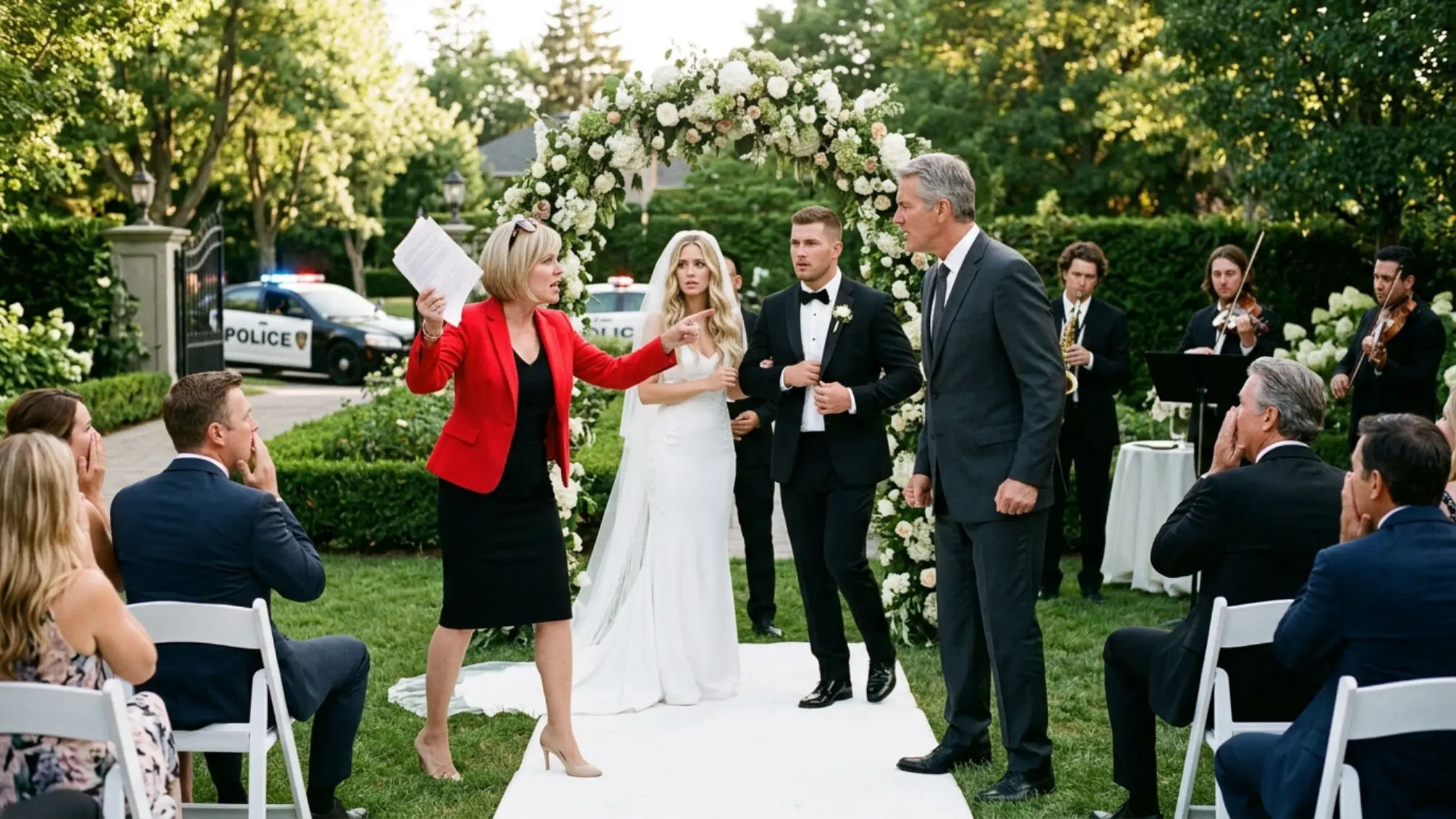
He had never imagined police cruisers arriving before the vows.
The wedding began beneath a wide white canopy behind Thomas’s home in Charlotte, North Carolina. Rows of white chairs faced a circular arch covered in roses, eucalyptus, and soft ivory fabric. A string quartet played near the oak trees, while warm lights stretched from the canopy to the garden fence.
Thomas had spent six months preparing the property.
He repaired the porch himself, planted fresh grass, and restored the garden his late wife, Caroline, had designed before cancer took her nine years earlier. Emily had asked whether marrying at home would be too painful for him.
Thomas told her the opposite was true.
“This is where your mother would want you,” he had said.
By three in the afternoon, nearly eighty guests filled the yard. Neighbors had moved their cars to create space. A licensed valet company directed traffic, and every required county permit was stored inside a folder near the kitchen.
Thomas had checked those papers four times.
He knew why.
Victoria Lang had been president of the Briarwood Heights Homeowners Association for seven years, and she treated every neighborhood event as a personal challenge to her authority. She had fined families for basketball hoops, holiday lights, flowerpots, and children’s bicycles left near garages. The rules themselves were rarely the real problem.
The problem was that Victoria changed them whenever obedience became too easy.
When Thomas submitted notice of Emily’s wedding, Victoria demanded a private-event fee of five thousand dollars. The HOA bylaws contained no such fee, so Thomas refused. She then claimed that outdoor music required board approval, despite approving three larger parties for her friends the previous summer.
Thomas responded with a copy of the county noise permit.
Victoria sent another notice regarding temporary tents.
He provided the fire inspection certificate.
She objected to parking.
He hired a licensed valet service and rented spaces from a nearby church.
Every time she created a new obstacle, Thomas answered with another lawful document. By the week of the wedding, Victoria had stopped sending notices.
Thomas hoped that meant she had surrendered.
He should have known better.
Inside the house, Emily stood before the hallway mirror while her bridesmaid adjusted the delicate veil attached beneath her blonde curls. At twenty-eight, she had the same blue eyes as Caroline and the same habit of pressing her lips together whenever emotion threatened her composure.
Thomas entered wearing a charcoal suit and a white rose pinned to his lapel.
Emily turned.
For a moment, neither spoke.
Then her eyes filled with tears.
“Dad.”
Thomas swallowed hard. “Your mother would have complained that I tied this tie badly.”
Emily laughed softly. “She would have fixed it herself.”
“She always did.”
Thomas stepped closer and held out a small velvet box. Inside rested Caroline’s pearl bracelet.
Emily touched it with trembling fingers.
“I thought this was lost.”
“I kept it for today.”
He fastened it around her wrist.
Emily looked at their reflection. “I wish she could see this.”
Thomas rested one hand on her shoulder. “She saw the beginning. That matters.”
Music changed outside.
The coordinator appeared at the doorway. “We’re ready.”
Thomas offered his arm.
Emily took it.
They had almost reached the back door when the string quartet stopped.
Not gradually.
All four musicians lowered their instruments at once.
A sharp voice carried across the yard.
“This ceremony is unauthorized!”
Thomas closed his eyes.
Emily whispered, “No.”
Through the glass door, he saw Victoria Lang marching down the white aisle.
She wore a bright red designer blazer over a black pencil skirt, beige heels, and pearl earrings. Her sharp blonde bob barely moved as she walked, but the stack of papers in her hand snapped angrily with each step.
Guests turned in their chairs.
At the altar, Emily’s fiancé, Nathan Cole, stood beneath the flower arch in a tailored black tuxedo. His expression remained controlled, though Thomas noticed his jaw tighten when Victoria pointed toward the canopy.
Behind her, two black-and-white police cruisers had stopped near the open garden gate.
Two officers were approaching.
Emily gripped her father’s arm. “She called the police.”
Thomas looked at his daughter.
“You stay here.”
“No. This is my wedding.”
“And I’m going to make sure it remains that way.”
He walked outside before she could stop him.
Victoria reached the center of the aisle and turned toward the officers as though they had arrived under her personal command.
“This event is in direct violation of the association’s emergency compliance order,” she announced. “The homeowner was formally instructed to cancel.”
Thomas stepped onto the aisle.
“No, I wasn’t.”
Victoria pointed at him. “You were served yesterday.”
“I was home all day yesterday.”
“The notice was posted electronically.”
“Where?”
“To your association portal.”
Thomas removed his phone and opened the account.
“No notice.”
“That does not invalidate the order.”
“What order?”
Victoria shoved the top page toward his chest.
“This one.”
The document carried the Briarwood Heights logo, several red warnings, and what appeared to be the signature of County Fire Marshal Daniel Kersey. Across the top, bold letters read:
IMMEDIATE CESSATION OF OUTDOOR ASSEMBLY
Thomas read the first paragraph.
It claimed the canopy lacked emergency exits, the electrical system posed a fire risk, and the number of guests exceeded the permitted occupancy of the property.
None of that was true.
The canopy had been inspected two days earlier. Electrical equipment was powered by a professional generator placed beyond the guest area. The county permit allowed up to one hundred twenty attendees.
Thomas held up the page.
“This is fake.”
Victoria’s eyes narrowed. “Careful.”
“The fire marshal never issued this.”
“You are not qualified to make that determination.”
“I spoke to him this morning.”
For the first time, uncertainty crossed her face.
Only briefly.
Then she turned toward the officers.
“He’s refusing a lawful evacuation order. Arrest him and clear the property.”
The guests began whispering.
Thomas heard Emily step outside behind him, but he did not turn. He refused to let his daughter see fear in his face on her wedding day.
Officer Melissa Warren, a dark-haired woman in her late thirties, approached first.
“Mr. Bennett?”
“Yes.”
“We received a report of an unsafe assembly and refusal to comply with a county closure order.”
Thomas handed her the paper.
“I have every valid permit inside. This document was never delivered to me, and I believe the signature is forged.”
Victoria laughed sharply. “Of course he says that now.”
The second officer, Daniel Price, examined the supposed order.
“Who issued this to you, ma’am?”
“The county sent it to the HOA because Mr. Bennett has repeatedly ignored safety regulations.”
“Which county department?”
“It’s clearly written on the page.”
Price looked at the signature.
“Fire Marshal Daniel Kersey?”
“Yes.”
Thomas folded his arms. “Call him.”
Victoria stepped closer until her face was inches from his.
“You think you can turn this into another argument about paperwork?”
“You brought paperwork.”
“I brought authority.”
“No. You brought two officers to frighten my daughter during her wedding.”
Victoria shoved the order against his chest.
“This illegal wedding ends now.”
Thomas knocked the paper away.
“Touch my daughter’s ceremony again, and you’ll leave this property before she does.”
Several guests stood.
Victoria’s face flushed.
“You don’t speak to me that way.”
“I just did.”
“I run this neighborhood.”
“You manage landscaping complaints and dues.”
“I can place enough fines on this house to destroy you.”
Thomas stepped closer.
“Try it.”
The officers moved between them before the confrontation became physical.
“Both of you step back,” Warren ordered.
Victoria pointed over Warren’s shoulder. “This man is threatening an elected association officer.”
Thomas laughed bitterly. “Elected association officer?”
“Mr. Bennett,” Warren said, “please give us space to verify the document.”
At the altar, Nathan stepped away from the flower arch.
Emily caught his arm.
“Please don’t make this worse.”
“I’m not going to.”
Nathan kissed her forehead and began walking down the aisle.
He moved with the calm confidence Thomas had noticed from the first day they met. Nathan had always described his work vaguely, saying he handled county security operations and rarely discussing specific cases. Thomas assumed he worked in administration.
Victoria saw him approaching and lifted one hand.
“You need to return to the altar or leave the property.”
Nathan stopped beside Thomas.
“This is my wedding.”
“Then you should have made certain your future father-in-law followed the rules.”
“He did.”
“You haven’t reviewed the association file.”
“I reviewed the permits this morning.”
Victoria looked him over dismissively. “Being the groom does not give you legal authority.”
Nathan reached inside his tuxedo jacket.
Both officers watched his hand.
He removed a leather credential wallet and opened it.
A gold sheriff’s badge caught the afternoon light.
Victoria’s expression froze.
Nathan spoke quietly.
“Nathan Cole, Mecklenburg County Sheriff.”
Officer Warren straightened immediately. “Sheriff.”
Guests gasped.
Even Thomas stared at him.
Nathan had said he worked with the sheriff’s office.
He had never mentioned that he ran it.
Victoria recovered enough to sneer. “You expect me to believe the county sheriff is getting married in an ordinary backyard?”
Nathan’s eyes hardened.
“That sentence tells me more than you realize.”
She looked toward the officers. “Verify it.”
Price nodded awkwardly. “Ma’am, that is Sheriff Cole.”
Nathan closed the credential wallet.
“Now threaten this family again.”
Victoria tightened her grip on the clipboard. “I don’t care what title you hold. This property is governed by the HOA.”
“Not above county law.”
“The ceremony violates an emergency safety order.”
Nathan held out his hand.
“Give it to me.”
She did not move.
Nathan repeated himself.
“The order.”
Victoria handed it over reluctantly.
He studied the county seal, tracking number, and signature.
Then he looked at Officer Warren.
“Call Marshal Kersey directly. Not through the number printed here.”
Victoria’s eyes darted toward the garden gate.
Thomas saw it.
“So you know the number is wrong.”
“I know nothing of the kind.”
Nathan compared the page to a genuine permit stored on his phone.
“The county seal was copied from an old document. The spacing is wrong, the file number is incomplete, and Daniel Kersey’s title changed last year.”
Victoria lifted her chin.
“Administrative errors happen.”
“Forged orders happen too.”
A phone began ringing inside Victoria’s handbag.
She ignored it.
Officer Warren contacted the fire marshal. The conversation lasted less than a minute.
When she lowered the radio, her face had changed.
“Sheriff, Marshal Kersey confirms he issued no cessation order. The permit for this property remains valid.”
The guests reacted immediately.
Some cursed beneath their breath. Others began recording.
Victoria stepped backward.
“This must be a misunderstanding.”
Nathan held up the paper.
“You walked onto private property with a forged county order and instructed police officers to arrest the homeowner.”
“I relied on information provided by the association’s compliance contractor.”
“Name the contractor.”
“I don’t have to answer questions without counsel.”
“You’re not under arrest.”
“Then I’m leaving.”
Nathan moved into her path.
“You’re free to leave after you surrender every copy of this document and provide identification.”
Victoria glared at him.
“You cannot detain me at your own wedding.”
“I’m not detaining you. These officers are investigating a suspected forged government document.”
Thomas looked toward Emily.
She stood near the back door in her white gown, trying not to cry. The musicians remained silent. Guests clustered around the aisle, and the wedding arch that had looked perfect fifteen minutes earlier now framed a confrontation.
Thomas turned back to Victoria.
“You planned this.”
She laughed coldly.
“You think I care enough about your daughter’s little ceremony to plan anything?”
Nathan’s expression became dangerous.
Thomas moved before he could.
He stepped so close to Victoria that she had to tilt her head upward.
“Say one more word about my daughter.”
Victoria pointed toward him again.
“You and your family have treated this neighborhood like your private estate. Music, cars, tents, strangers—”
“This is one afternoon.”
“It begins with one exception.”
“You held a three-day birthday celebration for your son last year.”
“That was a board-approved community event.”
“You hired a band until midnight.”
“I had permission.”
“From yourself.”
Several neighbors laughed.
Victoria turned toward them.
“Anyone who participates in this unauthorized gathering will receive violation notices.”
The laughter stopped.
Nathan looked at the residents.
“How many of you have received similar county orders through the HOA?”
Hands slowly rose.
One.
Then five.
Then more than a dozen.
A woman named Patricia Moore stepped into the aisle.
“Victoria sent us a mold inspection order last winter. We paid eighteen thousand dollars to one of her contractors.”
A man behind her spoke next.
“She threatened to condemn our deck unless we used Briarwood Compliance Services.”
Another resident raised his voice.
“The county said they never inspected it.”
Nathan looked toward Thomas.
The wedding interruption was no longer an isolated act.
It was part of something larger.
Officer Price took the clipboard from Victoria.
Inside were copies of inspection orders, violation lists, and prewritten emergency fines. Several documents carried county seals.
Nathan examined them.
“Every one of these may be forged.”
“They came from contractors.”
“Which contractors?”
Victoria remained silent.
Thomas noticed a name at the bottom of one invoice.
Lang Community Solutions.
He looked up.
“Is that your company?”
Victoria’s face tightened.
“My husband owns several businesses.”
Nathan read further.
“Briarwood Compliance Services sends inspection fees to Lang Community Solutions. Emergency repairs are assigned to Lang Residential Group. All three companies use the same address.”
Thomas understood.
Victoria had created violations, used fake government orders to frighten homeowners, and directed the resulting work toward companies connected to her family.
The wedding was merely the day she finally became too arrogant to hide the scheme.
Nathan handed the clipboard to Warren.
“Preserve this as evidence.”
Victoria reached for it.
Officer Price caught her wrist.
“Do not touch it.”
“You cannot seize HOA property.”
“We can secure documents connected to suspected forgery.”
“This is political retaliation.”
Nathan’s voice remained quiet.
“You called police on my wedding and brought a forged county order. Do not pretend you were dragged into this.”
Victoria pulled free.
“I want my attorney.”
“You should call one.”
She removed her phone.
Instead of dialing, she turned and ran toward the gate.
Her beige heel caught the edge of the aisle runner.
She stumbled, recovered, and shoved past a guest.
Officer Warren intercepted her before she reached the cruisers.
“Stop.”
Victoria swung her handbag at the officer.
Warren blocked it and controlled her arm.
The wedding guests watched as Victoria Lang was turned toward the hood of a police cruiser and secured in handcuffs.
“This is assault!” she screamed.
“You struck an officer,” Warren replied.
“I was defending myself!”
Nathan approached without hurry.
Victoria glared at him.
“You think this badge makes you untouchable?”
“No,” he said. “That’s what you thought your HOA title did.”
The officers placed her in the rear of the cruiser.
For several seconds, nobody moved.
Then Emily began crying.
Thomas hurried toward her.
“I’m sorry.”
She shook her head and threw her arms around him.
“You didn’t do this.”
Nathan joined them.
“I should have warned you there might be trouble.”
Thomas looked at him. “You knew?”
“I knew Victoria had used questionable orders before. My office was reviewing complaints, but we didn’t have direct evidence connecting her to the documents.”
“And now?”
Nathan glanced toward the cruiser.
“Now she delivered it personally.”
Emily wiped her eyes.
“Can we still get married?”
Nathan took both her hands.
“I’ll marry you in a parking lot if that’s what remains.”
Thomas looked toward the guests.
The string quartet waited near their instruments. The officiant remained beneath the flower arch. Neighbors began fixing the aisle runner Victoria had damaged.
Officer Warren approached.
“Sheriff, we’ll handle the scene. There’s no reason the ceremony cannot continue.”
Nathan looked at Emily.
“Your decision.”
She drew a slow breath.
Then she nodded.
“Play the music.”
The quartet lifted their instruments.
Guests returned to their seats.
Thomas walked Emily to the beginning of the aisle while Nathan resumed his place beneath the roses. Police lights flashed beyond the garden gate, but the cruisers remained far enough away not to distract from the ceremony.
Thomas offered his arm again.
Emily smiled through tears.
“You ready?”
“I’ve been ready since you were born.”
They walked forward.
Every guest stood.
When Thomas placed Emily’s hand into Nathan’s, he leaned close to the groom.
“You could have mentioned the sheriff part.”
Nathan smiled. “She asked me not to make today about work.”
Emily laughed.
The sound restored something the interruption had tried to steal.
They exchanged vows beneath the same arch, surrounded by family, neighbors, and two officers who quietly watched from the gate. When Nathan kissed Emily, the applause shook the canopy.
The investigation began the following morning.
Search warrants uncovered more than seventy forged municipal inspection orders inside Victoria’s home office. Her family companies had received $3.1 million from Briarwood Heights residents over five years.
Some homeowners had paid for repairs that were unnecessary.
Others had paid for work that was never performed.
Victoria used fake fire, structural, mold, and electrical notices to create urgency. Residents who questioned the documents were threatened with escalating HOA fines or police involvement.
The county seals had been copied from legitimate records.
Signatures belonged to retired inspectors, deceased officials, or employees who had never reviewed the properties.
Victoria’s son handled contractor payments.
Her husband controlled the shell companies.
The HOA treasurer altered meeting minutes and approved invoices without board votes.
Police recovered lists ranking homeowners by resistance level, income, age, and likelihood of hiring attorneys. Widows and elderly residents were labeled “easy compliance.”
Thomas Bennett was marked:
HOSTILE—DOCUMENTS EVERYTHING. APPLY PUBLIC PRESSURE.
The wedding had been selected deliberately.
Victoria believed Thomas would surrender rather than risk embarrassing Emily in front of guests. She assumed the presence of police would make her forged order appear unquestionable.
She did not know the groom was the county sheriff.
Within six weeks, Victoria, her husband, her son, and the HOA treasurer were indicted on charges including forgery, fraud, extortion, money laundering, conspiracy, and impersonating public officials.
The association removed its entire board.
An independent audit restored hundreds of thousands of dollars in improper fines, while seized property funded restitution for victims.
At Victoria’s trial, her attorneys argued that she believed the inspection orders were legitimate.
Prosecutors played security footage from Thomas’s wedding.
The video showed her pointing at the homeowner, demanding his arrest, and threatening to destroy the family with fines. It also captured her attempt to flee after officers confirmed the order was false.
Nathan testified in uniform.
Victoria refused to look at him.
Her attorney asked whether his personal involvement in the wedding compromised the investigation.
Nathan answered calmly.
“I did not arrest her. The responding officers made their own decisions based on the forged order, witness statements, and her conduct.”
“But you used your title to challenge her.”
“I used a telephone to verify a county document.”
“Would any ordinary citizen have received that response so quickly?”
Nathan looked toward the jury.
“That question is exactly why this case matters. A forged government order should not become real merely because the victim lacks a badge.”
Thomas testified next.
He described the months of notices, the lawful permits, and Victoria’s threat to bury his family in fines.
The prosecutor asked why he resisted.
Thomas looked toward Emily and Nathan seated behind the rail.
“Because my daughter had already lost her mother. I refused to let another person steal part of her wedding simply because cruelty had become easier than accountability.”
The jury convicted Victoria on every major count.
She received fourteen years in prison. Her husband received eleven. Their son accepted a plea agreement and testified against them, while the treasurer received seven years.
Briarwood Heights rewrote its bylaws.
No single president could issue emergency violations. Every inspection required direct verification from the relevant public department. Financial records became available online, and contractors had to disclose ownership relationships.
Thomas kept one framed photograph from the wedding in his study.
It showed him walking Emily down the aisle after the police confrontation. The white roses remained perfect, the music had resumed, and Nathan stood beneath the arch waiting for her.
Police lights were faintly visible beyond the garden gate.
Emily once asked why he chose that picture rather than one without the cruisers.
Thomas smiled.
“Because happiness doesn’t always mean nothing went wrong.”
“What does it mean?”
“It means the wrong thing didn’t get the final word.”
Victoria Lang had arrived believing she could end the wedding with a clipboard, two cruisers, and a forged signature.
Instead, she exposed the criminal scheme that had terrorized her neighbors for years.
The officers did remove someone from the property that afternoon.
But the bride still reached the altar.
The vows were still spoken.
And when the groom opened his badge, Victoria finally learned that real authority did not need forged paper to be feared.