Marcus Kellerman never expected a fuel pump to become the center of a neighborhood war.
To him, it was just another tool.
Like his truck.
Like his workshop.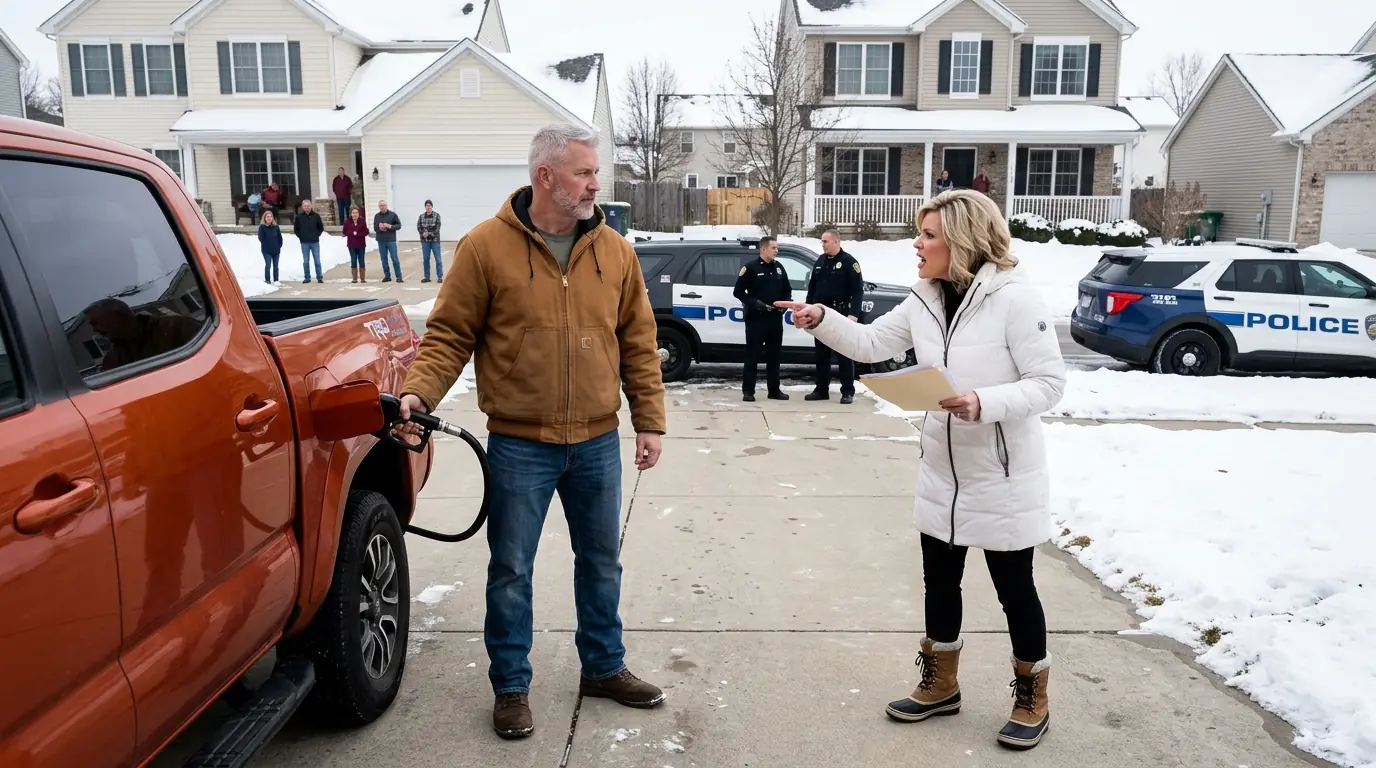
Like the equipment he had collected over decades of working with his hands.
But to Brenda Ashworth, the HOA president of Willowbrook Estates, it represented something much bigger.
Control.
And Marcus had learned something during his life.
People who want control often become most aggressive when they realize they cannot get it.
Marcus was fifty-two years old.
He had lived through enough changes to understand what mattered and what did not.
He had spent years working in logistics, where preparation was everything.
Plans.
Safety procedures.
Documentation.
Every decision had consequences.
After leaving that career, he moved to Willowbrook Estates hoping for a quieter life.
The neighborhood looked perfect.
Clean streets.
Well-maintained homes.
Families walking in the evenings.
Neighbors helping each other.
It reminded him of the kind of community people always talked about.
The kind where people looked after one another.
And for a while, it was exactly that.
Until Brenda arrived.
Brenda Ashworth moved into Willowbrook with a completely different idea of what a neighborhood should be.
She believed everything should look perfect.
Every lawn.
Every mailbox.
Every vehicle.
Every decision.
Within months, she became the HOA president.
At first, many residents welcomed her.
She was organized.
Confident.
She spoke like someone who always had a plan.
But slowly, people noticed a pattern.
The rules seemed to apply differently depending on who you were.
A longtime resident’s garden became a violation.
A family’s decorations became a problem.
A truck parked in a driveway became an “aesthetic concern.”
Brenda called it maintaining standards.
Others called it controlling people.
Marcus watched quietly.
He had seen this before.
People who believed authority came from a title instead of trust.
The problem started with his fuel pump.
Marcus owned a large workshop behind his home.
He restored old vehicles in his spare time.
The previous property owner had installed a private fuel system for agricultural use.
It was not a random setup.
It was professionally installed.
Inspected.
Documented.
The equipment had safety features that exceeded local requirements.
Marcus maintained it carefully.
He never sold fuel.
He never operated a business from it.
It was simply part of his property.
But during a major winter storm, something happened that changed how the neighborhood viewed it.
Power went out.
Several families lost electricity.
Some elderly residents depended on medical equipment.
Marcus had fuel available.
He helped keep generators running.
He helped neighbors stay warm.
Nobody complained then.
Nobody called it dangerous.
They called it helpful.
Everyone except Brenda.
The first letter arrived on a Monday morning.
Marcus found it attached to his front door.
A formal HOA violation notice.
He read it twice.
Then a third time.
The complaint claimed his private fuel pump created an unsafe condition.
Marcus almost laughed.
Not because the issue was funny.
Because the accusation was so disconnected from reality.
He had permits.
He had inspections.
He had records.
He knew exactly what he owned.
That was something Brenda did not expect.
She expected him to panic.
Instead, Marcus calmly responded with documentation.
A copy of the installation approval.
Safety inspection reports.
Insurance information.
He delivered everything directly.
He believed the issue was finished.
It was not.
Three days later, Brenda called an emergency HOA meeting.
The community center was packed.
People sat in folding chairs while Brenda stood at the front with a presentation.
The first image appeared on the screen.
A picture of Marcus’s fuel pump.
Large red arrows pointed toward it.
Warnings filled the slide.
Danger.
Risk.
Community concern.
Brenda spoke confidently.
“This equipment threatens neighborhood safety.”
Marcus sat quietly.
He listened.
She described explosions.
Environmental problems.
Insurance disasters.
She painted a picture of a dangerous installation waiting to harm everyone.
Many residents looked concerned.
Not because they knew she was right.
Because fear was powerful.
Marcus understood that.
Fear could make people ignore facts.
Finally, he stood.
“Before anyone votes, I think we should review the actual documents.”
Brenda smiled.
A small, confident smile.
“You’ve already had your opportunity.”
“No.”
Marcus placed a folder on the table.
“I don’t think everyone has.”
He opened the folder.
The first document was the fire inspection report.
Approved.
The second was the county permit.
Approved.
The third was insurance documentation.
Approved.
The room became quieter with every page.
Then Marcus did something unexpected.
He invited the fire inspector who had reviewed the system.
The man was sitting in the back.
He stood.
“I inspected this installation myself.”
Everyone looked at him.
“It is completely legal.”
Brenda’s expression changed.
The confidence disappeared slightly.
The inspector continued.
“In fact, this setup has better safety features than many commercial systems I have reviewed.”
The room shifted.
People who had been worried started asking different questions.
Not about Marcus.
About Brenda.
Why had she ignored the documents?
Why had she presented only one side?
Brenda refused to admit defeat.
Instead, she changed tactics.
If she could not win with facts, she would win with pressure.
She filed complaints.
She contacted county officials.
She claimed Marcus was operating an illegal fuel business.
She suggested the equipment was dangerous.
Every complaint required investigation.
Every investigation required time.
But every investigation ended the same way.
No violation.
No problem.
No evidence.
Each failed complaint created a larger record.
And Marcus knew something Brenda did not.
Records mattered.
Then came the day everything escalated.
Marcus was outside filling his truck when Brenda arrived.
She was not alone.
Two police officers followed behind her.
Several neighbors watched from their driveways.
Brenda walked toward him holding a folder.
Her white coat stood out against the snowy background.
“Marcus.”
He looked up.
“Brenda.”
She pointed toward the pump.
“You need to stop using that immediately.”
Marcus calmly removed the fuel nozzle.
“Why?”
“Because this violates community rules.”
“You know the permits exist.”
She ignored the statement.
“I am giving you one final warning.”
The officers stood nearby.
Marcus looked at them.
Then back at Brenda.
“You called the police because I’m using equipment on my own property?”
Brenda crossed her arms.
“I called them because you refuse to cooperate.”
The officer stepped forward.
“Sir, can we see your documentation?”
Marcus nodded.
“Of course.”
That was the moment Brenda did not expect.
She expected confusion.
Arguments.
A homeowner who could not defend himself.
Instead, Marcus handed over a complete file.
The officer reviewed the paperwork carefully.
A minute passed.
Then another.
Finally, he looked at Brenda.
“Ma’am.”
“Yes?”
“Everything here appears to be properly approved.”
Her face changed.
“What?”
“The permits are valid.”
“That cannot be right.”
The officer looked at the documents again.
“It is.”
The neighbors watching began whispering.
Because the story they had been told was falling apart.
Marcus was not hiding anything.
He was not breaking rules.
He was not endangering anyone.
He was simply refusing to surrender his rights.
Brenda stepped backward.
“This isn’t finished.”
Marcus looked at her calmly.
“No.”
A pause.
“It isn’t.”
The confrontation changed the neighborhood.
People started asking questions.
Not only about Marcus’s fuel pump.
About the HOA.
About decisions.
About transparency.
Residents requested financial records.
Meeting notes.
Contract information.
They wanted to know if the same confidence Brenda showed publicly existed behind closed doors.
And what they discovered surprised them.
Several decisions had been made without proper communication.
Rules had been enforced inconsistently.
Residents had been pressured instead of heard.
The problem was never one fuel pump.
It was the belief that one person had unlimited authority.
Eventually, Brenda resigned.
Not because she suddenly changed.
Because the community changed.
People stopped being afraid.
The neighborhood created new rules.
More transparency.
More accountability.
More resident involvement.
The HOA became what it was supposed to be.
A way for neighbors to work together.
Not a weapon.
Months later, Marcus was still using his fuel pump.
But now people saw it differently.
During another winter storm, several neighbors came by.
Not to complain.